Tomorrow, 9/9, is International Sudoku Day. And while I have a special Sudoku puzzle planned for tomorrow, I wanted to take some time today to talk about this puzzle.
Because, honestly, Sudoku is kind of amazing.
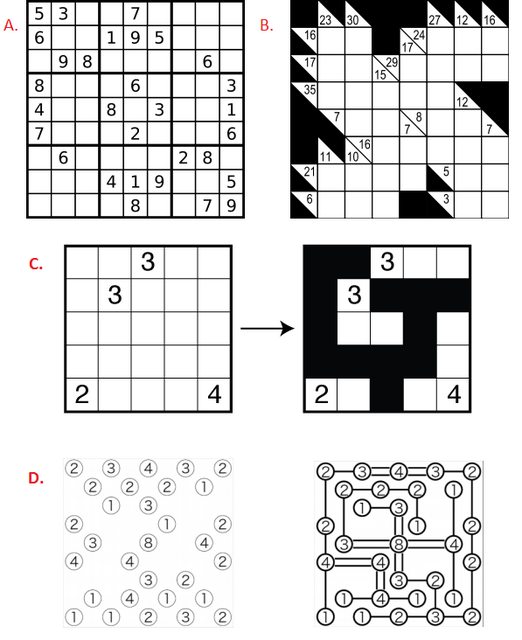
It’s a logic puzzle — a deduction puzzle — that looks like a math puzzle. (And, in fact, its genuinely mathier cousins Kenken and Cross Sums/Kakuro don’t have a tenth of the audience that Sudoku does.)
It’s one of the very few puzzles I can think of that requires no introduction, no words, no guidance. If you just look at that grid, you inherently know what you need to do.
That’s a very rare thing. I mean, sure, if you look at a logic puzzle — the premise, the grid, the hints to help eliminate things — you can pick it up quickly. A crossword is fairly universal, but still requires the outside knowledge of vocabulary, facts, and wordplay each solver brings.
Sudoku is clean, simple, and irrefutable. It crosses linguistic and cultural barriers with ease.
And yet, it took decades to become an overnight sensation.
Similar puzzles can be traced back to France in the 1890s, but Sudoku as we know it was featured in Dell Pencil Puzzles and Word Games in 1979 under the name Number Place (though it has also been called To The Nines), thanks to constructor Howard Garns.
Links to a solvable online version of each of those two puzzles are here and here. Try out these half-century-old puzzles!
Wayne Gould kickstarted a UK Sudoku craze after creating a generation program for the puzzles and selling it to The Times in London.
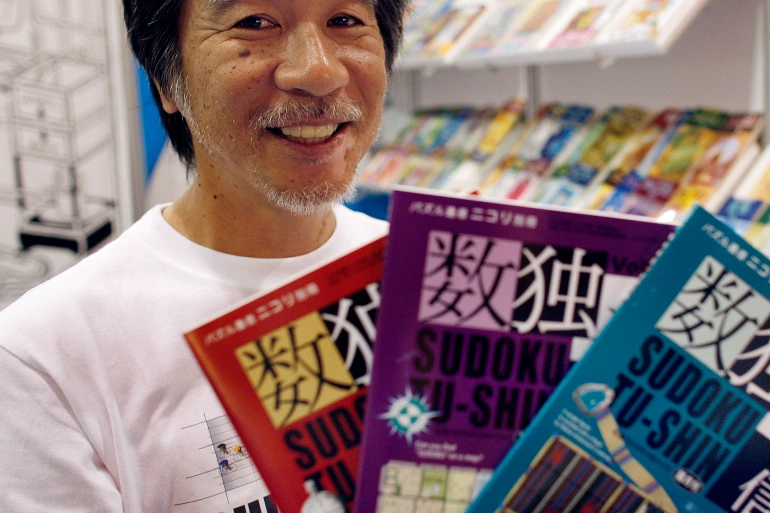
Maki Kaji began championing Sudoku in the 1980s in Japan with his puzzle magazine Nikoli, and he’s why most people know the puzzle as Sudoku now. (Originally the puzzle was called Suuji wa dokushin ni kagiru, or “numbers should be single.” Maki later took the suggestion to shorten it to Sudoku.)
We can literally track the puzzle’s expansion across the years, and its rebirth as Sudoku in the 2000s, because many puzzle solvers have lived through Sudoku’s entire modern lifespan.
And it’s baffling, isn’t it? That Sudoku feels so timeless and universal, but is relatively young, as puzzles go.
We’ve been playing with words for far longer than we’ve been playing with numbers. Anagrams and riddles go back centuries upon centuries. They’ve been playing Go in China for more than 2,500 years, and the Royal Game of Ur dates back to the third millennium BC.
Sudoku is just a pup compared to them, but it’s among the most widely solved and recognizable puzzles.
I’ve spent a lot of timing thinking about (and writing about) Sudoku over the years. A decade ago, I tried to calculate how many of the 5-and-a-half billion possible unique Sudoku puzzles had been published up to that point.
And yet, I’m still fascinated by every new twist. I try every variant I see clever constructors come up with. I inevitably watch every video where someone solves the hot new “impossible” Sudoku.
In less than half the time crosswords have been around, Sudoku has swept across the world and become a household name.
True, there haven’t been any Sudoku musical revues or pop songs — at least, not that I’m aware of! — but it remains one of the most ubiquitous pen-and-paper puzzles in the world today.
“Numbers should be single.” Maybe. But I like the message of Number Place better: every number in its place. An unsolved Sudoku grid shan’t remain empty for long.
When you get right down to it, the puzzle world isn’t all that big. There are a few names that everyone knows, and plenty of names that people should, but generally don’t. And sadly, too many of those names aren’t celebrated until after they’re gone.
Maki Kaji is one of those names you should know.
He passed away recently, and different articles and obituaries called him everything from “puzzle enthusiast” to “Sudoku creator,” but the title he most deserves is the one he put on his business cards: Godfather of Sudoku.
Honestly, he’s one of the three most important people in the history of Sudoku.
Howard Garns is credited with creating Number Place for Dell Pencil Puzzles and Word Games in May 1979 (though a French variant of the puzzle appeared in the newspaper La France in the 1890s). Wayne Gould stumbled upon Sudoku puzzles in a magazine, then designed a generation program and sold it to the Times in London, kickstarting the craze in the UK that spread elsewhere.
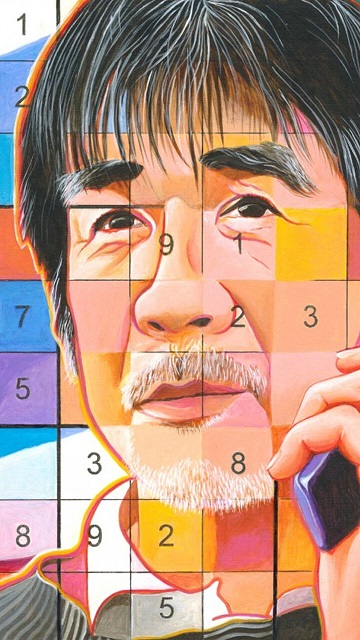
[Maki Kaji at Brazil’s first national Sudoku competition in São Paulo in 2012.]
But it was Maki Kaji who championed the puzzle all over, using it in his puzzle magazine Nikoli starting in the early 80s, then taking advantage of the UK boom and selling it in dozens of countries. (Gould didn’t have the resources, so many newspapers and publishers came to Maki Kaji for them.)
The name Sudoku came from him. (In American puzzle magazines, it was Number Place or To the Nines.) Originally the puzzle was called Suuji wa dokushin ni kagiru, or “numbers should be single,” before taking the suggestion to shorten it to Sudoku.
Of course, despite his close association with Sudoku, Maki championed puzzles in all forms. He founded Nikoli (also known as Puzzle Communication Nikoli) with two school friends in 1980, four years before adding Sudoku to its roster of puzzles. It was Japan’s first puzzle magazine!
One of the goals of Nikoli was to feature what they called “culture independent” puzzles, meaning puzzles that didn’t rely on a specific language or alphabet. (Talk about accessibility!)
“When we create our puzzles, we want people to enjoy them and not feel stressed by them,” he said.
Because of this culture-independent style, Nikoli was famed for its many logic puzzles, because they relied less on words and more on numbers, symbols, and elegant grid positioning. Popular puzzles included familiar ones like Sudoku and Kakuro, as well as less familiar puzzles like Nurikabe and Hashiwokakero.
“I don’t want to just be the godfather of Sudoku,” Maki said. “I’d like to spread the fun of puzzles until I’m known as the person who established the puzzle genre in Japan.”
One of his key tools was a section in Nikoli that invited readers to submit their own ideas for puzzles. It quickly became the most popular part of the magazine. Readers submitted new puzzles, which other readers then refined and expanded on. Nikoli is credited with introducing hundreds of new logic and number puzzles to the world through this puzzle-loving fan-fueled pipeline.
Of course, even the Godfather of Sudoku ventured into crosswords from time to time. In fact, in 2017, it was reported that he published the world’s largest ever crossword, with 59,365 across clues and 59,381 down clues on a printed grid 30m long, kept in a scroll.
Go big or go home, I guess.
[Constructor Peter Gordon (and his Sudoku license plate) with Maki.
Maki stepped down as president of Nikoli just last month, and the company released this statement in response to his passing:
Kaji-san came up with the name Sudoku and was loved by puzzle fans from all over the world. We are grateful from the bottom of our hearts for the patronage you have shown throughout his life.
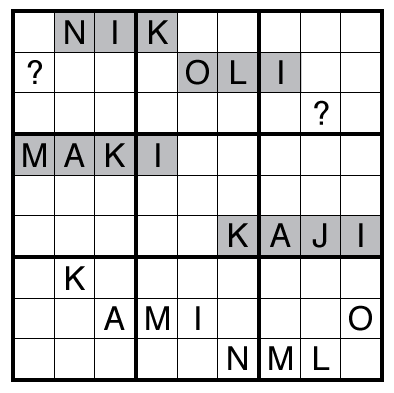
But, naturally, it takes a puzzler to truly honor a puzzler, and I think Thomas Snyder (aka Dr. Sudoku, no slouch himself when it comes to the famed number puzzle) offered the perfect tribute on his Art of Puzzles website:
A wordoku puzzle dedicated to Maki Kaji.
The puzzle world is a far richer and more varied place thanks to the creativity, hard work, and passion of Maki Kaji. You probably didn’t know his name before. But hopefully, you’ll remember it now.
Farewell, Maki. Thank you for bringing so many new eyes to the world of puzzles.
Back in 2013, we created a timeline of events from crossword history as part of our celebration of the hundredth anniversary of the crossword.
Although 105 isn’t as prestigious as 100, and the anniversary is technically tomorrow, we thought we’d honor the day this year by updating our comprehensive look at the long (yet surprisingly short) road it took to get to that marvelous centennial!
So, without further ado or folderol, we proudly present:
A Brief History of the Crossword (Updated)
16th – 11th century BC
Inscriptions from New Kingdom-era Egypt (Eighteenth to Twentieth Dynasties) of horizontal and vertical lines of text divided into equal squares, that can be read both across the rows and down the columns, are made. These inscriptions are later referred to by Egyptologists as “Egyptian crossword puzzles.”
19th century AD
Rudimentary crosswords, similar to word squares, begin appearing in England, and later elsewhere in Europe.
June 22, 1871
Future inventor of the crossword, Arthur Wynne, is born.
March 23, 1897
Future New York Times crossword editor Margaret Farrar is born.
February 25, 1907
Future New York Times crossword editor Will Weng is born.
December 21, 1913
The New York World publishes the first crossword, invented by Liverpool journalist Arthur Wynne. (The puzzle is originally known as a word-cross.)
January 6, 1916
Future New York Times crossword editor Eugene T. Maleska is born.
1920
Margaret Farrar is hired by The New York World as a secretary, but soon finds herself assisting Arthur Wynne with proofreading puzzles. Her puzzles soon exceed Wynne’s in popularity.
Colonel H.W. Hill publishes the first Crossword Dictionary.
1923
Margaret Farrar revises the cluing system for crosswords, sorting them into “Horizontal” and “Vertical” clues by number. (It wouldn’t be until the 1940s that the more familiar “Across” and “Down” terminology became the norm.)
1924
Margaret Farrar publishes the first book of crossword puzzles under contract for Richard L. Simon and Max Schuster, “The Cross-Word Puzzle Book.” It was an instant bestseller, launching Simon & Schuster as a major publisher. (Additional information available below the timeline.)
The Daily Express, founded in 1900, becomes the first newspaper in the United Kingdom to carry crosswords.
Crossword-themed novelty songs hit the airwaves as the puzzle craze intensifies, most notably “Crossword Mama, You Puzzle Me (But Papa’s Gonna Figure You Out).”
The Amateur Crossword Puzzle League of America, a self-appointed group of puzzle enthusiasts, lobbies for rotational symmetry in crosswords, which becomes the standard.
Solver Ruth Franc von Phul becomes a minor celebrity after winning The New York Herald-Tribune’s National All Comers Cross Word Puzzle Tournament at the age of 20. (She would win again 2 years later.)
January 15, 1925
“Felix All Puzzled,” the first animated short to feature a crossword, is released.
Disney releases a crossword-themed animated short, “Alice Solves the Puzzle.”
1926
The cryptic crossword is invented by Edward Powys Mathers, who publishes under the pseudonym Torquemada. He devises them for The Observer newspaper.
First reported instances of Braille crosswords.
1931
Dell Puzzle Magazines begins publishing.
(Dell Publishing itself was founded in 1921.)
1941
Dell Pocket Crossword Puzzles first published.
(The magazine continues to this day.)
February 15, 1942
The New York Times runs its first Sunday edition crossword. (Additional information available below the timeline.)
June 2, 1944
Physics teacher and crossword constructor Leonard Dawe is questioned by authorities after several words coinciding with D-Day invasion plans appear in London’s Daily Telegraph. (Additional information available below the timeline.)
1950
The crossword becomes a daily feature in The New York Times.
August 26, 1952
Future New York Times crossword editor Will Shortz is born.
1968
Lyricist Stephen Sondheim begins creating cryptic crosswords for New York Magazine, helping introduce Americans to British-style crosswords.
1969
Will Weng succeeds Margaret Farrar as the second crossword editor for The New York Times.
1973
Penny Press is founded.
1977
Eugene T. Maleska succeeds Will Weng as the third crossword editor for The New York Times.
1978
First year of the American Crossword Puzzle Tournament, later featured in the documentary Wordplay. 149 contestants compete for the title in the first national crossword tournament since the 1930s.
1979
Howard Garns creates the modern Sudoku puzzle for Dell Magazines (under the name Number Place), the first pen-and-paper puzzle to rival the crossword in popularity (though this spike in popularity would occur decades later under the name Sudoku).
June 11, 1984
Margaret Farrar, while working on the 134th volume in Simon & Schuster’s crossword puzzle book series, passes away.
1993
Will Shortz succeeds Eugene T. Maleska as the fourth crossword editor for The New York Times.
November 5, 1996
One of the most clever and famous crosswords of all time is published, the election-preceding crossword where either BOB DOLE ELECTED or CLINTON ELECTED could read out, depending on the solver’s answers.
1998
The Wall Street Journal adds a crossword to its newspaper, and Mike Shenk is appointed editor.
June 23, 2006
Wordplay documentary hits theaters, featuring celebrity solvers of crosswords as well as the participants and organizers of the 2005 edition of the American Crossword Puzzle Tournament.
February 29 – March 2, 2008
Thanks in part to the Wordplay documentary, the American Crossword Puzzle Tournament outgrows its previous setting and moves to Brooklyn.
The city of Lvov, Ukraine, creates a crossword that spans an entire side of a 100-foot-tall residential building, with clues scattered around the city’s major landmarks and attractions. It’s awesome.
David Steinberg launches the Pre-Shortzian Puzzle Project, designed to compile a complete database of every New York Times crossword.
August 13, 2012
PuzzleNation Blog is launched.
June 14, 2013
Matt Gaffney celebrates five years of MGWCC,
stating that MGWCC will run for 1000 weeks
(which puts the final edition around August 6th, 2027).
December 21, 2013
The Crossword officially turns one hundred years old.
Additional information:
1924: The publishing house Simon & Schuster, agreed to a small (3,600-copy) run of a crossword puzzle book, prompted by founder Richard L. Simon’s aunt, who wanted to give such a book to a friend. It became “a runaway bestseller.”
In no time the publisher had to put the book back on press; through repeated printings, it sold more than 100,000 copies. Soon a second collection followed, and then a third and a fourth. In 1924 and 1925 the crossword books were among the top 10 nonfiction bestsellers for the year, besting, among others, The Autobiography of Mark Twain and George Bernard Shaw’s Saint Joan.
February 15, 1942: The New York Times initially regarded crosswords as frivolous, calling them “a primitive form of mental exercise”; the motivating impulse for the Times to finally run the puzzle (which took over 20 years even though its publisher, Arthur Hays Sulzberger, was a longtime crossword fan) appears to have been the bombing of Pearl Harbor.
In a memo dated December 18, 1941, an editor conceded that the puzzle deserved space in the paper, considering what was happening elsewhere in the world and that readers might need something to occupy themselves during blackouts. The puzzle proved popular, and Sulzberger himself would author a Times puzzle before the year was out.
June 2, 1944: The words Omaha (codename for one of Normandy’s beaches), Utah (another Normandy beach codename), Overlord (the name for the plan to land at Normandy on June 6th), mulberry (nickname for a portable harbor built for D-Day), and Neptune (name for the naval portion of the invasion) all appeared in Daily Telegraph crosswords during the month preceding the D-Day landing.
This has been attributed to either an incredible coincidence or Dawe somehow overhearing these words (possibly slipped by soldiers involved) and incorporating them into puzzles unwittingly.
Do you have any suggestions for additions for our Crossword Timeline? Let us know in the comments section below! We’d love to hear from you!
Thanks for visiting PuzzleNation Blog today! Be sure to sign up for our newsletter to stay up-to-date on everything PuzzleNation!
Sudoku is one of the most popular paper puzzles in the history of puzzling, perhaps the only puzzle to rival crosswords in the hearts of solvers worldwide.
That being said, I frequently encounter people who have either never tried to solve Sudoku puzzles or had a dismal first showing that dissuaded them from trying again. And today, I’d like to reach out to the Sudoku disenfranchised out there with a PuzzleNation How-To.
How to solve Sudoku, to be specific!
[Brief historical tidbit: The Sudoku puzzle as we know it was created in 1979 for Dell Magazines by puzzler Howard Garns (though it was introduced under the name Number Place). Before its rebranding in the modern era, it was also known as To the Nines.]
The rules of Sudoku seem simple enough. It’s the solver’s job to place the numbers 1 through 9 in every row, column, and 3×3 square in a 9×9 grid.
[Additional brief historical tidbit: Each row and column add up to 45, making every Sudoku puzzle a variation on the classic Magic Square puzzle concept. Only Extreme Sudoku puzzles — puzzles where the numbers 1 through 9 also appear along the diagonals — qualify as true Magic Squares, grids where the sum of every row, column, and diagonal all add up to the same number. Magic Squares have been around for more than 2000 years, giving Sudoku an impressive puzzly pedigree.]
Sudoku puzzles come in all sorts of sizes and difficulty rankings — most of which are dependent on where numbers are set, how many are set, and what numbers are set — and the placement of set numbers often adheres to the same diagonal symmetry as black squares in crosswords.
Let’s look at a sample puzzle, shall we?
The best way to start a Sudoku puzzle is to scan for numbers that appear most frequently, since they’ll offer more hints pointing toward where to place other numbers.
For instance, we’ve got a 7 in the top left-hand 3×3 grid (on the top row) and a 7 in the top center grid (in the middle row), so let’s try placing a 7 in the top right-hand grid.
Since a number can only appear once in each row, column, and 3×3 grid, we can draw imaginary lines crossing out the open spaces in the top row, the middle row, and the rightmost column, leaving only one space remaining where the 7 could possibly go.
Let’s continue with 7s and see if we can place a 7 in the middle left-hand grid.
Between the 7s in the top row, the middle row, and the second column from the left, there’s only one open space for that 7.
With this new 7 in place, we can also determine the 7 in the bottom left-hand grid.
Our new 7 eliminates any spots in the leftmost column, and the given 7s in the second column and the middle row eliminate all possibilities but one.
With this new information, we can place the last 7 in the bottom right-hand grid.
Focusing on one number can deliver a lot of new information early on.
Now, after filling in a few more numbers, we can move into more of the deduction aspects of Sudoku solving.
Look at the middle grid on the left-hand side. There are only two numbers missing from this 3×3 square, the 5 and the 8. While we don’t have enough information to place them, this box can help us place numbers in the top and bottom left-hand squares.
The second column has four numbers missing — the 1, the 2, the 5, and the 8 — and we know the 5 and the 8 will be in that middle grid.
This means that there are only two options for the 1 and the 2, the top left-hand space and the bottom left-hand space.
And since there’s already a 1 in the top left-hand square and a 2 in the bottom left-hand square, it’s easy to place our numbers.
That sort of deduction can be extremely helpful when it comes to harder Sudoku puzzles. Here’s another example, a little farther into our solve.
In this case, we’re going to try to place a 3 in the center 3×3 square. We know from the placement of other 3s in the grid that the 3 cannot be in the bottom row or the middle row.
Unfortunately, we don’t know which of the open boxes in the top row will hold our 3.
But, thanks to this information, we can place the 3 in the middle grid on the right-hand side. Here’s the grid with the 3s we know for certain.
Since we know the center square’s 3 will occupy one of two places in that top row, we can also eliminate that row from the possibilities for the middle grid on the right-hand side.
We can now place the 3 in the remaining square, and move forward with our solve.
From this point onward, you’ll be able to fill the entire grid with ease, adding the first of many vanquished Sudoku puzzles to your solving experience.
I hope you found this PuzzleNation How-to helpful. All of the graphics came from our Classic Sudoku app, now available for the iPad!
(Although the black lines were for illustrative purposes only, you can place possible numbers in blue just as I did with our Candidates feature.)
The hundredth anniversary of the crossword is nearly upon us, and we at PuzzleNation Blog thought we’d take a look at the long (yet surprisingly short) road it took to get to this marvelous centennial!
And so, without further ado or folderol, we proudly present:
A Brief History of the Crossword (by Glenn Dallas and the PuzzleNation Team)
16th – 11th century BC
Inscriptions from New Kingdom-era Egypt (Eighteenth to Twentieth Dynasties) of horizontal and vertical lines of text divided into equal squares, that can be read both across the rows and down the columns, are made. These inscriptions are later referred to by Egyptologists as “Egyptian crossword puzzles.”
19th century
Rudimentary crosswords, similar to word squares, begin appearing in England, and later elsewhere in Europe.
June 22, 1871
Future inventor of the crossword, Arthur Wynne, is born.
March 23, 1897
Future New York Times crossword editor Margaret Farrar is born.
February 25, 1907
Future New York Times crossword editor Will Weng is born.
December 21, 1913
The New York World publishes the first crossword, invented by Liverpool journalist Arthur Wynne.
(The puzzle is originally known as a word-cross.)
January 6, 1916
Future New York Times crossword editor Eugene T. Maleska is born.
1920
Margaret Farrar is hired by The New York World as a secretary, but soon finds herself assisting Arthur Wynne with proofreading puzzles. Her puzzles soon exceed Wynne’s in popularity.
Colonel H.W. Hill publishes the first Crossword Dictionary.
1924
Margaret Farrar publishes the first book of crossword puzzles under contract for Richard L. Simon and Max Schuster, “The Cross-Word Puzzle Book.” It was an instant bestseller, launching Simon & Schuster as a major publisher.
The Sunday Express becomes the first newspaper in the United Kingdom to carry crosswords.
1926
The cryptic crossword is invented by Edward Powys Mathers, who uses the pseudonym of Torquemada. He devises them for The Observer newspaper.
1931
Dell Puzzle Magazines begins publishing.
(Dell Publishing itself was founded in 1921.)
1941
Dell Pocket Crossword Puzzles first published.
(The magazine continues to this day.)
February 15, 1942
The New York Times runs its first Sunday edition crossword. (Click here to read more about this.)
June 2, 1944
Physics teacher and crossword constructor Leonard Dawe is questioned by authorities after several words coinciding with D-Day invasion plans appear in London’s Daily Telegraph. (Click here to read more about this.)
1950
The crossword becomes a daily feature in the New York Times.
August 26, 1952
Future New York Times crossword editor Will Shortz is born.
1968
Lyricist Stephen Sondheim begins creating cryptic crosswords for New York Magazine, helping introduce Americans to British-style crosswords.
1969
Will Weng succeeds Margaret Farrar as the second crossword editor for the New York Times.
1973
Penny Press is founded.
1977
Eugene T. Maleska succeeds Will Weng as the third crossword editor for the New York Times.
1978
First year of the American Crossword Puzzle Tournament,
later featured in the documentary Wordplay.
1979
Howard Garns creates the modern Sudoku puzzle for Dell Magazines (under the name Number Place), the first pen-and-paper puzzle to rival the crossword in popularity (though this spike in popularity would occur decades later under the name Sudoku).
June 11, 1984
Margaret Farrar, while working on the 134th volume in Simon & Schuster’s crossword puzzle book series, passes away.
1993
Will Shortz succeeds Eugene T. Maleska as the fourth crossword editor for the New York Times.
November 5, 1996
One of the most clever and famous crosswords of all time is published, the election-preceding crossword where either BOB DOLE ELECTED or CLINTON ELECTED could read out, depending on the solver’s answers.
June 23, 2006
Wordplay documentary hits theaters, featuring both celebrity solvers of crosswords and the participants and organizers of the 2005 American Crossword Puzzle Tournament.
February 29 – March 2, 2008
Thanks in part to the Wordplay documentary, the American Crossword Puzzle Tournament outgrows its previous setting and moves to Brooklyn.
The city of Lvov, Ukraine, creates a crossword that spans an entire side of a 100-foot-tall residential building, with clues scattered around the city’s major landmarks and attractions. It’s awesome.
David Steinberg launches the Pre-Shortzian Puzzle Project, intending to create a complete database of every New York Times crossword.
August 13th, 2012
PuzzleNation Blog is launched.
June 14th, 2013
Matt Gaffney celebrates five years of MGWCC,
stating that MGWCC will run for 1000 weeks
(which puts the final edition around August 6th, 2027).
December 21st, 2013
The Crossword officially turns one hundred years old.
Additional information:
February 15th, 1942: The New York Times initially regarded crosswords as frivolous, calling them “a primitive form of mental exercise”; the motivating impulse for the Times to finally run the puzzle (which took over 20 years even though its publisher, Arthur Hays Sulzberger, was a longtime crossword fan) appears to have been the bombing of Pearl Harbor.
In a memo dated December 18, 1941, an editor conceded that the puzzle deserved space in the paper, considering what was happening elsewhere in the world and that readers might need something to occupy themselves during blackouts. The puzzle proved popular, and Sulzberger himself would author a Times puzzle before the year was out.
June 2nd, 1944: The words Omaha (codename for one of Normandy’s beaches), Utah (another Normandy beach codename), Overlord (the name for the plan to land at Normandy on June 6th), mulberry (nickname for a portable harbor built for D-Day), and Neptune (name for the naval portion of the invasion) all appeared in Daily Telegraph crosswords during the month preceding the D-Day landing.
This has been attributed to either an incredible coincidence or Dawe somehow overhearing these words (possibly slipped by soldiers involved) and incorporating them into puzzles unwittingly.










 PuzzCulture