International Sudoku Day is tomorrow!

Tomorrow, 9/9, is International Sudoku Day. And while I have a special Sudoku puzzle planned for tomorrow, I wanted to take some time today to talk about this puzzle.

Because, honestly, Sudoku is kind of amazing.

It’s a logic puzzle — a deduction puzzle — that looks like a math puzzle. (And, in fact, its genuinely mathier cousins Kenken and Cross Sums/Kakuro don’t have a tenth of the audience that Sudoku does.)

It’s one of the very few puzzles I can think of that requires no introduction, no words, no guidance. If you just look at that grid, you inherently know what you need to do.

That’s a very rare thing. I mean, sure, if you look at a logic puzzle — the premise, the grid, the hints to help eliminate things — you can pick it up quickly. A crossword is fairly universal, but still requires the outside knowledge of vocabulary, facts, and wordplay each solver brings.

Sudoku is clean, simple, and irrefutable. It crosses linguistic and cultural barriers with ease.

And yet, it took decades to become an overnight sensation.

Similar puzzles can be traced back to France in the 1890s, but Sudoku as we know it was featured in Dell Pencil Puzzles and Word Games in 1979 under the name Number Place (though it has also been called To The Nines), thanks to constructor Howard Garns.

Links to a solvable online version of each of those two puzzles are here and here.
Try out these half-century-old puzzles!

Wayne Gould kickstarted a UK Sudoku craze after creating a generation program for the puzzles and selling it to The Times in London.

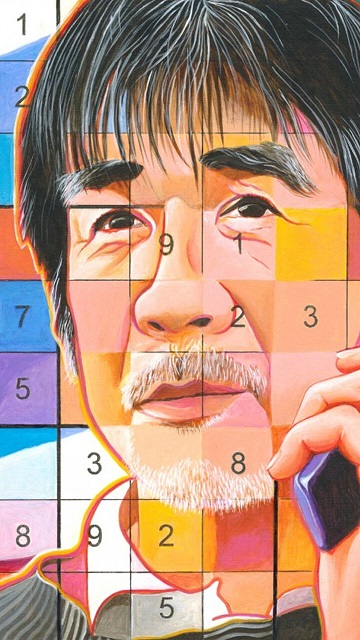
Maki Kaji began championing Sudoku in the 1980s in Japan with his puzzle magazine Nikoli, and he’s why most people know the puzzle as Sudoku now. (Originally the puzzle was called Suuji wa dokushin ni kagiru, or “numbers should be single.” Maki later took the suggestion to shorten it to Sudoku.)

maki kaji 1

We can literally track the puzzle’s expansion across the years, and its rebirth as Sudoku in the 2000s, because many puzzle solvers have lived through Sudoku’s entire modern lifespan.

And it’s baffling, isn’t it? That Sudoku feels so timeless and universal, but is relatively young, as puzzles go.

We’ve been playing with words for far longer than we’ve been playing with numbers. Anagrams and riddles go back centuries upon centuries. They’ve been playing Go in China for more than 2,500 years, and the Royal Game of Ur dates back to the third millennium BC.

Sudoku is just a pup compared to them, but it’s among the most widely solved and recognizable puzzles.

I’ve spent a lot of timing thinking about (and writing about) Sudoku over the years. A decade ago, I tried to calculate how many of the 5-and-a-half billion possible unique Sudoku puzzles had been published up to that point.

I’ve chronicled as many variants of Sudoku as I could, both in English and abroad. One year I tried solving the puzzles from the UK Sudoku Championship and was thoroughly humbled.

And yet, I’m still fascinated by every new twist. I try every variant I see clever constructors come up with. I inevitably watch every video where someone solves the hot new “impossible” Sudoku.

In less than half the time crosswords have been around, Sudoku has swept across the world and become a household name.

True, there haven’t been any Sudoku musical revues or pop songs — at least, not that I’m aware of! — but it remains one of the most ubiquitous pen-and-paper puzzles in the world today.

“Numbers should be single.” Maybe. But I like the message of Number Place better: every number in its place. An unsolved Sudoku grid shan’t remain empty for long.

Happy solving, friends!

Getting Started with Crosswords

We spend a lot of time talking about crosswords here on PuzzleNation Blog, and rightfully so.

For more than a century now, crosswords have been the standard-bearer for paper-and-pencil puzzles. From your local paper to The New York Times crossword, from online solving to puzzle apps like our very own Penny Dell Crosswords App, crosswords sit comfortably at the apex of the proverbial puzzle mountain, atop worthy also-rans like word searches, cryptograms, and Sudoku.

[Apparently Puzzle Mountain is actually a place. Who knew?]

But in talking about crosswords, it’s easy to forget that not everyone solves them. In fact, plenty of people find them intimidating, given the mix of trivia, wordplay, and tricky cluing that typify many crosswords these days, particularly in outlets like The New York Times, The LA Times, The Guardian, and more.

So today, I thought I’d offer some helpful resources to solvers just getting started with crosswords.

First off, if you need help filling in troublesome letter patterns, Onelook is an excellent resource. Not only can you search for words that fit various patterns, but you can narrow your searches according to cluing, look up definitions and synonyms, and even hunt down phrases and partial phrases.

Along the same lines, there are websites like Crossword Tracker that offer informal cluing help culled from online databases. For something more formal, there’s XWordInfo, an online database of entries and cluing that also serves as an archive of NYT puzzles you can search for a small fee.

The NYT Wordplay Blog chronicles each day’s puzzle, including insights into the theme, key entries, and more, plus they’ve begun amassing helpful articles about crossword solving. Not only are there sample puzzles to download and solve to get you started, but there are lists of opera terms, rivers, and sports names to know to make you a stronger solver.

And if British-style or cryptic crosswords are your puzzle of choice, look no further than The Guardian‘s Crossword Blog, which frequently posts about various cluing tricks employed by crafting cryptic puzzle setters. Their “Cryptic Crosswords for Beginners” series of posts has discussed all sorts of linguistic trickery, covering everything from the NATO alphabet to elementary chemistry.

For other variety puzzles, our friends at Penny Dell Puzzles offer sample puzzles and helpful solving tips for many of the puzzles in their magazines. For example, you can find a sample Kakuro or Cross Sums puzzle on the page for their Dell Collector’s Series Cross Sums puzzle book, as well as a How to Solve PDF.

Is there a particular puzzle that troubles you, or one you find too intimidating to tackle, fellow puzzlers? If so, let us know! We can either point you toward a solving resource or tackle the puzzle ourselves in a future post to provide helpful solving tips!


Thanks for visiting PuzzleNation Blog today! Be sure to sign up for our newsletter to stay up-to-date on everything PuzzleNation!

You can also share your pictures with us on Instagram, friend us on Facebook, check us out on TwitterPinterest, and Tumblr, and explore the always-expanding library of PuzzleNation apps and games on our website!

Other puzzles you might not know! (Volume 3)

In previous editions of this series, we’ve presented some new puzzles for crossword devotees and Fill-In fans to try out. Today, let’s turn our attention to Sudoku enthusiasts.

Now, before we talk about other types of puzzles, there are numerous Sudoku variants to choose from, if you’d like just a little twist on the familiar Sudoku formula. In fact, I did an entire blog post about them, as well as posts about new variants like Will Sudoku and Pentdoku Puzzles!

There are a few lesser-known number-placement puzzles out there that might scratch your puzzly itch if you’re a Sudoku fan: Futoshiki and Beehive Hidato.

[Futoshiki image courtesy of PuzzleMagazine.com.]

Futoshiki will seem fairly familiar, since the row and column rules of Sudoku are in effect. But you have an additional placement rule to consider: the less than/greater than signs in the grid, which indicate where to place lower or higher numbers in the grid. (Futoshiki translates to “not equal” in Japanese.)

[Hidato image courtesy of TheGuardian.com.]

Beehive Hidato eschews the traditional Sudoku row/column system of the deduction in favor of chain-placement of numbers in its hexagonal grid. Your goal is to fill every cell in the grid by filling in the missing numbers between 1 and the highest number. So, instead of placing the same numbers in every row and column, you’re placing a different number in each cell, forming a single chain from 1 to the last number.

The cell containing the number 1 must neighbor the cell containing the number 2, and the cell containing the number 2 must neighbor the cell containing the number 3, and so on, all the way around the grid.

If you’re looking to go a little farther afield and leave numbers behind, I’ve got you covered.

After all, some people tend to think of Sudoku as a math puzzle, but it’s really not; it’s more of a deduction and placement puzzle. You could check out not only Fill-Ins, but also all the puzzles I’ve previously recommended for Fill-In fans. That’s a great place to start.

You could also try your hand at Brick by Brick.

[Click here or on the grid for a larger version.]

Brick by Brick puzzles are a terrific bridge between placement puzzles and crosswords, using aspects of both. You’re given the complete first row of a crossword, and all of your clues, both across and down.

But, instead of the black squares you’d normally rely on to help guide you through answering those clues and placing your words, you’ve got 3×2 bricks filled with letters and black squares, a scrambled jigsaw puzzle to reassemble.

Here you can use your deductive Sudoku skills to place black squares and entire bricks into the grid as you apply crossword-solving skills toward answering the across and down clues, working back and forth between the two to complete your grid, assembling chunks of answer words as bricks fit neatly together.

And if you prefer quote puzzles to crossword puzzles, there’s always Quotefalls.

[Click here or on the grid for a full page of Quotefalls.]

Quotefalls gives you all of the letters in a given quote, plus the black squares that separate each word from the next. But it’s up to you to figure out where in each column to place the letters above so that the quotation reads out correctly.

Sometimes that’s easy, like in the fourth column of puzzle 2 above. Since there’s three black squares and only one open square, you know exactly where that E will go. Seedling letters like that can go a long way toward helping you fill each word, and eventually, the entire quote.

It’s a different form of deduction, but one not too terribly far from the number-placement solving of Sudoku.

Any one of these puzzles could add some welcome variety to your puzzle solving, while still honoring the style and play inherent in your favorite puzzle. Give them a shot, and let us know how you like them.


Next time, we’ll be tackling recommendations for Cryptogram fans, but if you’ve got puzzle recs for your fellow puzzlers in the meantime, please let us know in the comments!

Thanks for visiting PuzzleNation Blog today! Be sure to sign up for our newsletter to stay up-to-date on everything PuzzleNation!

You can also share your pictures with us on Instagram, friend us on Facebook, check us out on TwitterPinterest, and Tumblr, and explore the always-expanding library of PuzzleNation apps and games on our website!

A ten-digit brain teaser to melt your mind!

I’ve started to develop a reputation as something of a brain-teaser pro, given some of the beastly brain teasers we’ve featured on the blog over the last few months.

And, as such, I’ve started to receive brain teasers from friends and fellow puzzlers, challenging me to unravel them AND explain my methods to the PuzzleNation audience.

I’ve never been one to shirk a challenge, so here we go! This puzzle is entitled Mystery Number, and a little googling after solving it reveals it most likely came from this Business Insider link. (Although their solution is slightly flawed.)

Enjoy!


There is a ten-digit mystery number (not starting with zero) represented by ABCDEFGHIJ, where each numeral, 0 through 9, is used once. Given the following clues, what is the number?

1. A + B + C + D + E = a multiple of 6.
2. F + G + H + I + J = a multiple of 5.
3. A + C + E + G + I = a multiple of 9.
4. B + D + F + H + J = a multiple of 2.
5. AB = a multiple of 3.
6. CD = a multiple of 4.
7. EF = a multiple of 7.
8. GH = a multiple of 8.
9. IJ = a multiple of 10.
10. FE, HC, and JA are all prime numbers.

(And to clarify here for clues 5 through 9, AB is a two-digit number reading out, NOT A times B.)


[Image courtesy of Wikipedia.]

Now, anyone who has solved Kakuro or Cross Sums puzzles will have a leg up on other solvers, because they’re accustomed to dealing with multiple digits adding up to certain sums without repeating numbers. If they see three boxes (which would essentially be A + B + C) and a total of 24, they know that A, B, and C will be 7, 8, and 9 in some order.

[For those unfamiliar with Cross Sums or Kakuro solving, feel free to refer to this solving aid from our friends at Penny/Dell Puzzles, which includes a terrific listing of possible number-combinations that will definitely prove useful with this brain teaser.]

And since the digits 0 through 9 add up to 45, that provides a valuable starting hint for clues 1 and 2 (in which all 10 digits appear exactly once). A multiple of 6 (6, 12, 18, 24, 30, 36, 42) plus a multiple of 5 (5, 10, 15, 20, 25, 30, 35, 40, 45) will equal 45. And there’s only one combination that works.

So A + B + C + D + E must equal 30, and F + G + H + I + J must equal 15.

The same logic applies to clues 3 and 4 (in which all 10 digits appear exactly once). A multiple of 9 (9, 18, 27, 36, 45) plus a multiple of 2 (2, 4, 6, 8, 10, etc.) will equal 45. And there’s only one combination that works.

So A + C + E + G + I must equal 27, and B + D + F + H + J must equal 18.

And now, we jump to clue 9. Since IJ is a multiple of 10, and all multiples of 10 end in 0, we know J = 0.

This tells us something about JA in clue 10. J is 0, which means A can only be 2, 3, 5, or 7.

There may a quicker, more deductive manner of solving this puzzle, but I couldn’t come up with it. I went for a brute force, attrition-style solve.

So I wrote out all of the possibilities for clues 5 through 9, and began crossing them off according to what I already knew. Here’s what we start with:

AB = 12, 15, 18, 21, 24, 27, 30, 33, 36, 39, 42, 45, 48, 51, 54, 57, 60, 63, 66, 69, 72, 75, 78, 81, 84, 87, 90, 93, 96, 99
CD = 12, 16, 20, 24, 28, 32, 36, 40, 44, 48, 52, 56, 60, 64, 68, 72, 76, 80, 84, 88, 92, 96
EF = 14, 21, 28, 35, 42, 49, 56, 63, 70, 77, 84, 91, 98
GH = 16, 24, 32, 40, 48, 56, 64, 72, 80, 88, 96
IJ = 10, 20, 30, 40, 50, 60, 70, 80, 90

Now, we can remove any double numbers like 33 because we know each letter represents a different number.

AB = 12, 15, 18, 21, 24, 27, 30, 36, 39, 42, 45, 48, 51, 54, 57, 60, 63, 69, 72, 75, 78, 81, 84, 87, 90, 93, 96
CD = 12, 16, 20, 24, 28, 32, 36, 40, 48, 52, 56, 60, 64, 68, 72, 76, 80, 84, 92, 96
EF = 14, 21, 28, 35, 42, 49, 56, 63, 70, 84, 91, 98
GH = 16, 24, 32, 40, 48, 56, 64, 72, 80, 96
IJ = 10, 20, 30, 40, 50, 60, 70, 80, 90

[Sorry guys, you’re out.]

And we know that J = 0, so we can remove any numbers that end in zero for AB, CD, EF, and GH.

AB = 12, 15, 18, 21, 24, 27, 36, 39, 42, 45, 48, 51, 54, 57, 63, 69, 72, 75, 78, 81, 84, 87, 93, 96
CD = 12, 16, 24, 28, 32, 36, 48, 52, 56, 64, 68, 72, 76, 84, 92, 96
EF = 14, 21, 28, 35, 42, 49, 56, 63, 84, 91, 98
GH = 16, 24, 32, 48, 56, 64, 72, 96
IJ = 10, 20, 30, 40, 50, 60, 70, 80, 90

And for AB, we know that A can only be 2, 3, 5, or 7, so we can delete any numbers that don’t start with one of those four digits.

AB = 21, 24, 27, 36, 39, 51, 54, 57, 72, 75, 78
CD = 12, 16, 24, 28, 32, 36, 48, 52, 56, 64, 68, 72, 76, 84, 92, 96
EF = 14, 21, 28, 35, 42, 49, 56, 63, 84, 91, 98
GH = 16, 24, 32, 48, 56, 64, 72, 96
IJ = 10, 20, 30, 40, 50, 60, 70, 80, 90

Hmmm, that’s still a LOT of options. What else do we know?

Well, we know from clue 10 that FE and HC are prime numbers. So they can’t be even numbers OR end in a 5. So we can eliminate any options from CD and EF that begin with an even number or a 5.

AB = 21, 24, 27, 36, 39, 51, 54, 57, 72, 75, 78
CD = 12, 16, 32, 36, 72, 76, 92, 96
EF = 14, 35, 91, 98
GH = 16, 24, 32, 48, 56, 64, 72, 96
IJ = 10, 20, 30, 40, 50, 60, 70, 80, 90

Alright, now we need to look at those big addition formulas again. Specifically, we need to look at B + D + F + H + J = 18.

We know J = 0, so the formula becomes B + D + F + H = 18. Now, take a look at our lists of multiples for AB, CD, EF, and GH. Look at the second digit for each. There’s a little nugget of information hiding inside there.

Every D and H digit is an even number. Which means that B and F must either both also be even, or both be odd in order to make an even number and add up to 18.

But, wait, if they were both even, then they would use all of our even numbers, and some combination of B, D, F and H would be 2 + 4 + 6 + 8, which equals 20. That can’t be right!

So let’s delete any even numbered options from AB and EF.

AB = 21, 27, 39, 51, 57, 75
CD = 12, 16, 32, 36, 72, 76, 92, 96
EF = 35, 91
GH = 16, 24, 32, 48, 56, 64, 72, 96
IJ = 10, 20, 30, 40, 50, 60, 70, 80, 90

Okay, we’ve whittled down EF to 2 possibilities: 35 and 91. [Here is where the Business Insider solution goes awry, because they never eliminate one of these two options.]

Clue 10 tells us that FE is a prime number, but that doesn’t help, because both 53 and 19 are prime. So now what?

Let’s return to those starting formulas.

We know that A + B + C + D + E = 30, and our handy-dandy number-combination listing tells us there are six possible ways that five digits can add up to 30: 1-5-7-8-9; 2-4-7-8-9; 2-5-6-8-9; 3-4-6-8-9; 3-5-6-7-9; and 4-5-6-7-8.

Look at the possibilities for A, B, C, D, and E according to our work thus far:

AB = 21, 27, 39, 51, 57, 75
CD = 12, 16, 32, 36, 72, 76, 92, 96
EF = 35, 91

There’s not a single 8 in any of those pairings! And five of our six possible answers for A + B + C + D + E = 30 include an 8 as one of the five digits.

Therefore, 3-5-6-7-9 and A-B-C-D-E match up in some order.

EF is either 35 or 91, but with both 3 and 5 counted among the letters in A-B-C-D-E, EF cannot be 35, so EF is 91. Let’s eliminate any option for AB, CD, GH, or IJ that include 9 or 1.

AB = 27, 57, 75
CD = 32, 36, 72, 76
EF = 91
GH = 24, 32, 48, 56, 64, 72
IJ = 20, 30, 40, 50, 60, 70, 80

Because E = 9, that leaves 3, 5, 6, and 7 as the only possible digits available for A, B, C, and D. So let’s eliminate any combinations that use numbers other than those four.

AB = 57, 75
CD = 36, 76
EF = 91
GH = 24, 32, 48, 56, 64, 72
IJ = 20, 30, 40, 50, 60, 70, 80

We can also eliminate any combinations for GH and IJ that include those four numbers.

AB = 57, 75
CD = 36, 76
EF = 91
GH = 24, 48
IJ = 20, 40, 80

Since our only possibilities for AB use 5 and 7 in some order, CD cannot be 76, so it must be 36.

AB = 57, 75
CD = 36
EF = 91
GH = 24, 48
IJ = 20, 40, 80

So, here are our options at this point:

AB = 57, 75
CD = 36
EF = 91
GH = 24, 48
IJ = 20, 40, 80

All possible solutions for GH include the number 4, so we can delete 40 as a possibility for IJ.

AB = 57, 75
CD = 36
EF = 91
GH = 24, 48
IJ = 20, 80

Let’s look at those formulas one more time. We know A + C + E + G + I = 27.

We also know C = 3 and E = 9, so A + G + I = 15. And the only combination of available digits that allows for that is 5, 2, and 8, meaning AB = 57, GH = 24, and IJ = 80.

So ABCDEFGHIJ = 5736912480.


I don’t think I’ve tackled a puzzle this tough since the seesaw brain teaser!

Thanks for visiting PuzzleNation Blog today! You can share your pictures with us on Instagram, friend us on Facebook, check us out on TwitterPinterest, and Tumblr, and be sure to check out the growing library of PuzzleNation apps and games!

Sudoku Around the World!

sudokuworld18

Sudoku is the most popular pen-and-paper puzzle since the crossword. No other puzzles come close. Whether it’s in your local paper, our iPad app, or one of the magazines offered by our friends at Penny/Dell Puzzles, chances are you’ve solved a Sudoku puzzle at one time or another.

And the solving experience is an integral part of its success. When you look at a Sudoku grid, you instinctively know what sort of puzzle you’re dealing with and what the goal is. You don’t need the instructions or any elaborate explanations. You can simply dive right in.

That sort of simplicity and accessibility gives Sudoku major appeal, and has contributed to its success as an iconic puzzle worldwide.

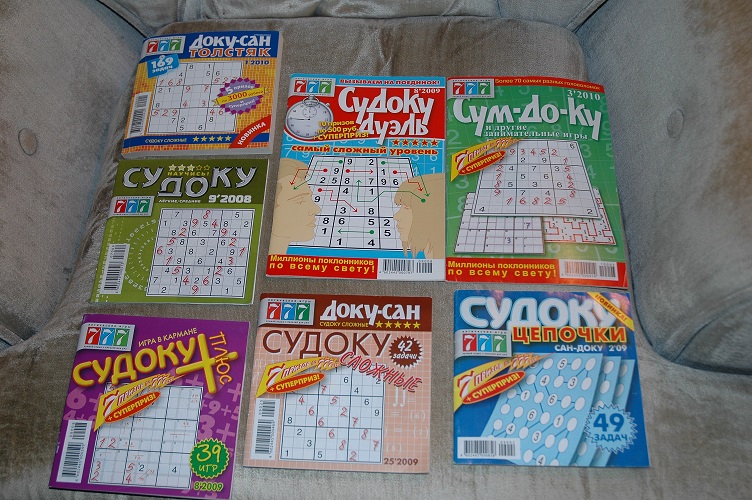
sudokuworld2

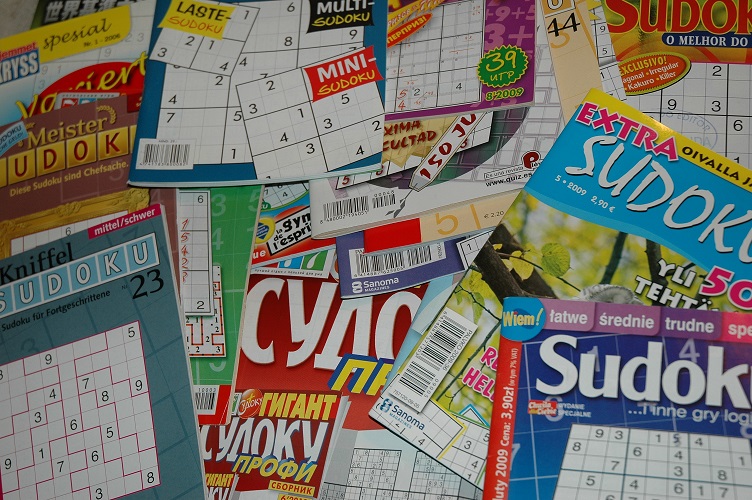
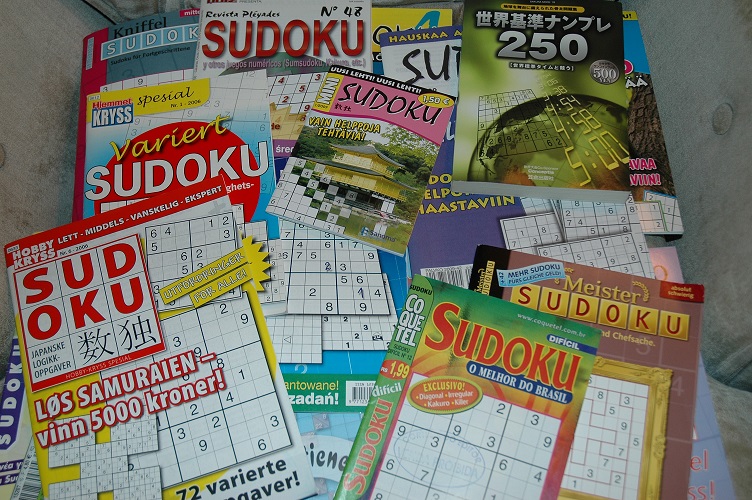
Look at this stack of puzzle books from around the world, loaned to me by a friend of the blog!

There are Sudoku books in Russian, French, Japanese, and other languages! And yet, you could pick up any one of these magazines and start solving immediately.

sudokuworld7

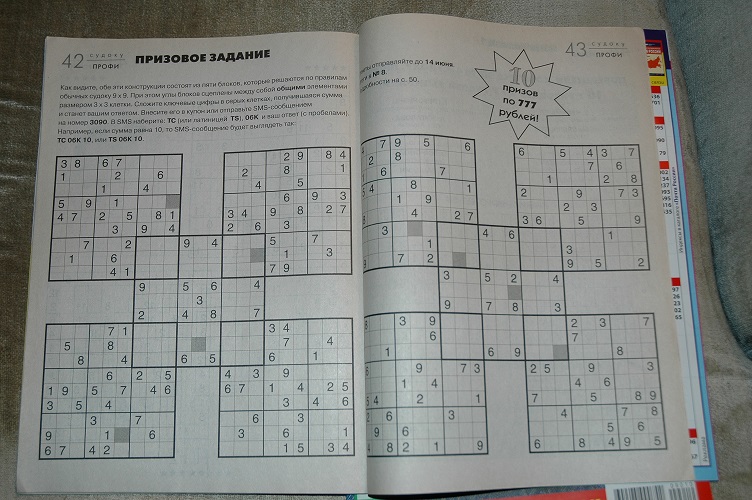
Here are two Samurai Sudoku from a Russian puzzle magazine. Again, these are identical to the overlapping grids you find in the States.

sudokuworld12

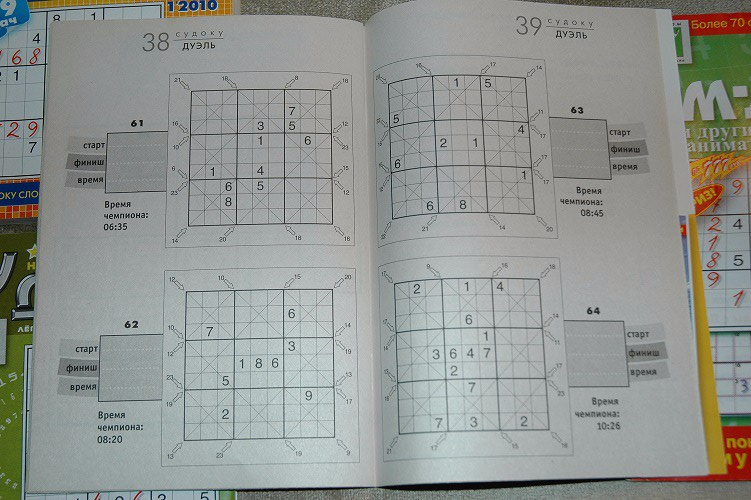
I did, however, encounter a few intriguing variations I was unfamiliar with as I perused these magazines published by 777.

sudokuworld14

Instead of providing sums in smaller boxes within the grid like Sum-Doku puzzles, or along the edges like Kakuro, these puzzles offer totals that correspond to the three diagonal boxes in a line a given arrow points to.

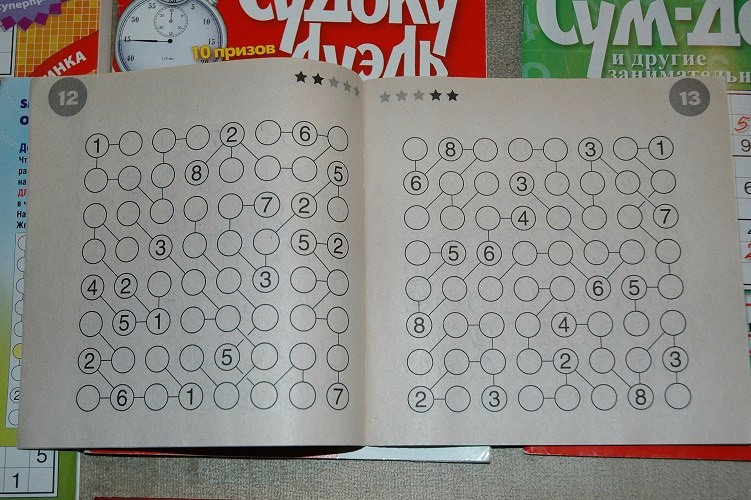
sudokuworld16

In this Sudoku variant, there are no repeats of the numbers 1 through 8 in a given row or column, but there are also no repeats within each group of connected circles.

Again, although I couldn’t read the instructions for these new puzzles, I was easily able to figure out the mechanics of each and start solving within a few minutes. Very few puzzles have that sort of universal accessibility.

sudokuworld9

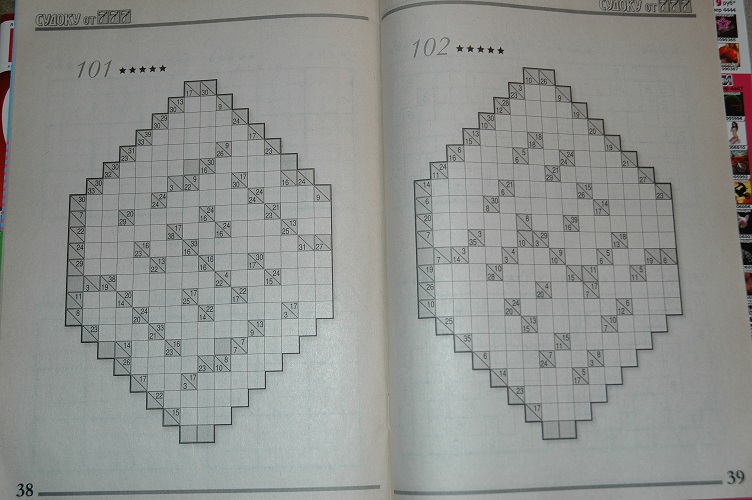
While I’m very familiar with Kakuro (or Cross Sums) puzzles, I’ve never encountered cut-style grids like these. I just love the simple elegance of these diamond-shaped grids. Very eye-catching.

Believe it or not, this is just a sampling of the hundreds and hundreds of Sudoku magazines and puzzle books released over the last decade.

Although the puzzle as we know it has been around since the ’70s under other names (To the Nines and Number Place, among them), it was only relatively recently that it exploded in popularity, becoming a true cultural touchstone and undeniable puzzle phenomenon.

[For another blog post exploring puzzle books from around the world, click here!]

Thanks for visiting PuzzleNation Blog today! You can share your pictures with us on Instagram, friend us on Facebook, check us out on TwitterPinterest, and Tumblr, and be sure to check out the growing library of PuzzleNation apps and games!
Deck the Halls with Loads of Puzzles!

Merry Christmas, puzzlers and PuzzleNationers! I hope you’re having a marvelous holiday!

One of the integral parts of the holiday season is decorating, decking your halls in all manner of festive holiday fun. Whether it’s Santas or garland, mistletoe or sleigh bells, a Christmas village or little dancing reindeer, everyone expresses their holiday spirit differently.

Naturally, around here, we couldn’t resist adding some puzzly flavor to our holiday decorating. I put my origami skills to the test to come up with some puzzle ornaments for the tree my friends at Penny/Dell Puzzles were putting together, and I think the end result was something pretty terrific.

Here’s the tree in progress. You can already see some puzzly touches like a Mega Sudoku front and center there, as well as a wreath on the wall behind the tree!

Let’s take a closer look at that wreath! Darcy did an outstanding job on it, and you can see a lot of flagship Penny/Dell puzzles represented here, like Cross Sums (Kakuro), Codewords, Cryptograms, and Word Games Puzzles!

Here’s a close-up on some of those puzzlier ornaments, including a Crossword star and a Cryptogram crane (one of my contributions) soaring above the Mega Sudoku. (The tree was also liberally garnished with coupon offers!)

A few more ornaments, including a Flower Power grid in the lower left corner!

Here’s the tree in its finished state, all lit up and decked out with gifts. It looks great! The mix of traditional ornaments and puzzly ones really makes for a unique display.

And check out this word search-wrapped gift just waiting for someone! I wonder if the recipient’s name is hidden in the grid! (Maybe they can’t open it until they find themselves!)

Are there any puzzly decorations on your tree this year, fellow puzzlers? Let us know! Send us a picture! We’d love to see it!

Have a terrific holiday!