In a recent Gameplay newsletter, Sam Corbin wrote about three-word instructions / mottos (like “Eat, Drink and Be Merry” or “Live, Laugh, Love”), and pondered a slogan like that for puzzle solving.
It’s a definite challenge for sure, like trying to come up with a poignant six-word memoir. But I’ve never been one to turn down a challenge simply because I’ll probably fail. I WELCOME IT.
So, today, I thought I would pitch in and come up with some slogans (not all fitting the three-word formula) for various puzzle outlets.
Penny Press / Dell Magazines
I’ve always thought a great slogan for them would be “We’re As Puzzled As You Are.” It’s light, a little self-deprecating, and fosters a feeling of camaraderie between publisher and solver.
But a three-word instruction for them?
How about Sample, Savor, Solve? Sample a variety puzzle you’ve never tried. Savor the ones you know you like. And, as always, solve.
The New York Times
I mean, a good motto would obviously be “All the Clues That Are Fit to Print,” playing off the classic NYT slogan.
But for a later-week crossword, how about Determine, Decipher, Discover?
Determine what you know, decipher tricky clues, discover the gimmick.
The Los Angeles Times
Now, The LA Times has several mottos (like “Read the Paper,” which could easily be converted into “Read the Down Clues”), but my favorite is their historical slogan, “Stand Fast, Stand Firm, Stand Sure, Stand True.”
And when it comes to puzzles, that could be Stand Watch, Stand Pat, Stand Back.
Let your eyes go to the clues you know immediately, trust your instincts on ones you’ve filled in, and then stand back and survey your work to unravel the theme.
Doesn’t really work with the three-word motto, though.
Maybe Stop, Drop, and Roll!
Stop what you’re doing and solve a puzzle. Look at those down clues. And keep trying ’til you’ve solved it.
Fireball Crosswords (and other meta outlets)
For me, it was actually easy to come up with a three-word motto for solving these, because it’s what I do when I try to unravel a meta while completing the grid:
Pattern, Exception, Association.
Look for a pattern or rhythm outside the regular solve. Look for exceptions that feel intentional. Look for associations on a second read.
But what about for a general three-word instruction for crossword solving?
For solvers still getting used to crosswords, I would recommend Blanks, Bios, Back-and-forth or Fill, Famous, Flip, which both fit some of my solving advice for newbies.
Fill in the blank, scan clues for famous names, flip to the crossings once a word is filled in and work on that section.
Oh, and if you suspect a puzzle will be difficult, always remember:
Write Light, Alright!?
Hopefully one of these mottos works for you, fellow solver. Do you have any suggestions, leave them in the comment section below! We’d love to hear from you.
Puzzles bring joy to so many of us. They’re an escape, a challenge, a satisfying little test of our wits, our dedication, our creativity, and our flexibility of thought.
In uncertain times, in times of trouble, people often turn to puzzles. Puzzles were a refuge for many during lockdown when COVID hung over our heads. And now, when so much seems uncertain, if not downright unstable, people will no doubt turn to puzzles again.
That’s not to say that puzzle solving is a mere flight of fancy, a desperate bit of escapism, a Hail Mary avoidance of difficult circumstances, hard questions, and treacherous times to come. Quite the opposite, in fact.
If you turn to puzzles now, you’ll see a road map that proves things can get better.
Because, like it or not, misogyny once dominated the world of puzzles. It was baked into crosswords from the very beginning.
Yes, Arthur Wynne created the template for crosswords. Simon & Schuster are credited with publishing the first crossword puzzle book, as well as all the bestselling puzzle books that followed, serving as the foundation that helped build their brand.
But it was women who made crosswords into something more.
Women like Richard Simon’s aunt Wixie. She insisted Simon look into publishing a limited release crossword book. (UPDATE: I originally wrote that none of the stories mentioned her name, but I later found some that included her nickname, Wixie. I later discovered her actual name is Hedwig Simon.)
Women like Margaret Farrar. While serving as “an unofficial editor of the crossword-puzzle section,” she prevented errors and helped establish some of the baselines that still stand in crosswords today.
Women like Ruth Hale. Ruth was the founding president of the Amateur Cross Word Puzzle League of America, an organization that set crossword standards like limiting black squares and symmetrical grids, building off of Farrar’s work.
Women like Nancy Schuster. Schuster (no relation to the aforementioned publisher) not only ran Dell Crosswords but was the first winner of the American Crossword Puzzle Tournament.
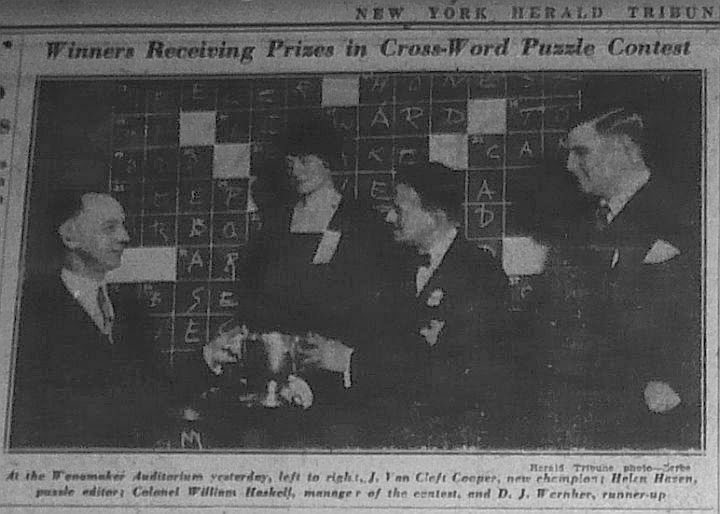
Women like Helen Haven. In the 1920s, Haven was the organizer of the first competitive crossword-solving contest and served as the puzzle editor for The New York Herald-Tribune.
As pointed out by Anna Shechtman in her book The Riddles of the Sphinx: Inheriting the Feminist History of the Crossword Puzzle, between 1913 and the 1960s, most crosswords were created by women.
Puzzles were literally women’s work! With all the connotations that phrase invites.
The New York Times called the crossword “a primitive form of mental exercise” and female solvers were blamed for neglecting their families and wifely duties because of their “utterly futile finding of words the letters of which will fit into a prearranged pattern, more or less complex.”
Funny how their opinions changed just in time to profit on crosswords in the 1940s.
Much like the Beatles — who were dismissed as nothing more than a glorified boy band when thousands of women cheered at their shows, only for them to be recognized as a once-in-a-generation group of talents when men started paying attention — crosswords became “respectable” only when men took interest and took over.
The percentage of female constructors published in The New York Times went down during the Will Shortz era, as compared to the Will Weng and Eugene Maleska eras.
And like it or not, but “the average solver” concept — a problem I discussed years ago — is still using a white male yardstick for comparisons, to the detrimental of solving and constructing.
And I realized how lucky I was to NOT have that association. In fact, I don’t think I would be a puzzly guy without the women in my life.
My mother (the first female store manager in A&P history) still solves crosswords and jigsaw puzzles to this day, and encouraged my interest in puzzles in the first place. My oldest sister (a teacher) introduced me to wordplay. My older sister spent hours playing puzzle video games like Dr. Mario with me. My younger sister is not just a master jigsaw puzzle solver, but a fiend at trivia nights and escape rooms, forever challenging me to match her flow.
I was trained in crossword puzzle editing and construction by Penny Press’s crossword guru Eileen Saunders, and still lean on her creativity and wisdom every day (and marvel at her blistering speed and efficiency).
I was shepherded through the world of variety puzzles by Los Angeles Times crossword editor and puzzle badass Patti Varol. (Though it was probably more like dragging my deadweight body through molasses than “shepherding” if I’m being honest.)
And that’s not counting the undeniable and indispensable influence of Amy Roth (a shining light at Penny Press), Chris Begley, and so many other female voices that make Penny Press one of the best outlets for puzzles in the world.
I love puzzles because of those women. I have made a career in puzzles because of those women. I am better at puzzles because of those women.
The puzzle world is better because of women. It will continue to advance and innovate and thrive because of women.
How do I know this? Because women are doing incredible things in puzzles RIGHT NOW.
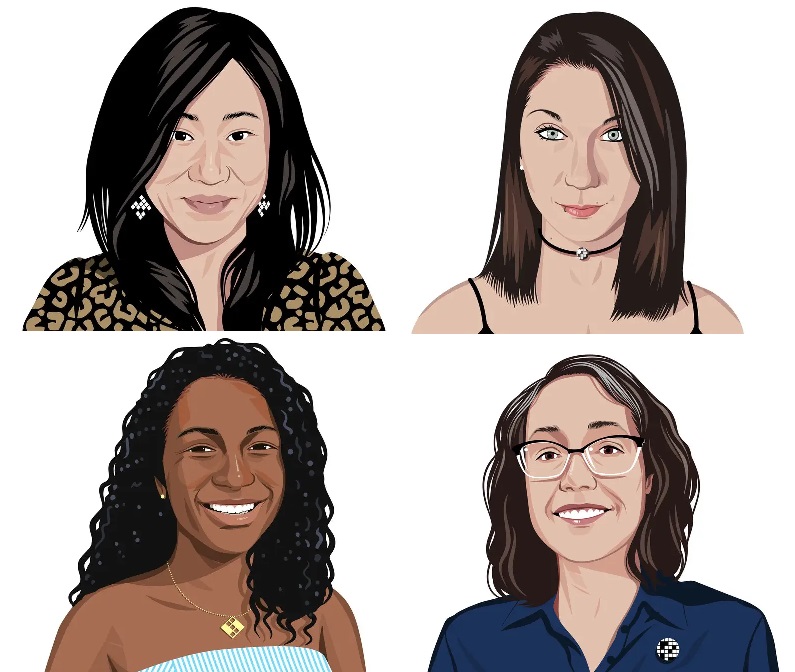
A small sampling of the women making puzzles better. Wyna Liu, Amanda Rafkin, Soleil Saint-Cyr, Tracy Bennett. Illustrations by Ben Kirchner.
Look at The New York Times. Tracy Bennett, Wyna Liu, and Christina Iverson are delivering great daily puzzles like Connections, Strands, and Mini Crosswords not just consistently, but brilliantly.
The aforementioned Patti Varol is absolutely crushing it at The Los Angeles Times crossword. With Katie Hale and Angela Kinsella Olsen on Patti’s team, every month since mid-April 2022 has had a minimum of 50% women constructors and often exceeds that, all while delivering topnotch puzzles.
The New Yorker, USA Today, The Slate Crossword? Liz Maynes-Aminzade, Amanda Rafkin, Quiara Vasquez. Brooke Husic runs PuzzMo (where Rachel Fabi constructed my favorite puzzle of the year!) and Amy Reynaldo co-edits Crosswords With Friends.
Rebecca Goldstein just won the Orca for constructor of the year. Smarter people than me have called Stella Zawistowski a crossword boss in every sense of the word. Ada Nicolle won the 2024 Lollapuzzoola crossword tournament.
The impact of projects like Women of Letters and The Inkubator weren’t just the tip of the iceberg, they were the tip of the spear. A spear aimed directly at the heart of outdated notions of who makes crosswords and who solves them, dismantling the idea of some mythical “average solver” that has never truly represented the crossword audience.
As constructors, editors, and solvers, women in the past shaped puzzles as we know them. And women in the present are redefining puzzles. Not just in terms of representation (both as grid answers and creators behind the scenes), but in terms of acknowledgment, respect, and appreciation.
As for women of the future? I, for one, can’t wait to see what they have in store for us.
(And thank you to several of the women mentioned above for making this post far, far better than it started.)
Occasionally, we’ll get a message from a PuzzleNationer who wonders why we don’t review the daily New York Times crossword or some of the other prominent daily newspaper crosswords.
It makes sense to ask. After all, we try to cover all things puzzles and games here — great clues, trivia, brain teasers, puzzles in pop culture, interviews, game reviews, how to’s, puzzle history, the Crossword Mysteries — so why not the top crossword outlets?
Well, to be honest, there are already several crossword blogs doing a dynamite job of covering those. So today, I want to discuss some top-notch blogs that discuss and review the daily crosswords!
For the New York Times crossword alone, there’s Wordplay, XWord Info, and Rex Parker.
Wordplay is the official New York Times crossword blog, and not only do you get great analysis from knowledgeable minds, but you get live solve-alongs, insight from constructors, and more.
Rex Parker’s blog can be more critical of Times puzzles — as we’ve said before, he borders on the curmudgeonly — but he has terrific advice about grid construction, theme entries, and more that several constructors have told me proved to be invaluable in their early days learning to construct.
His blog is probably not for everybody, but he remains one of the most influential voices in crossword reviewing today.
Of course, the NYT crossword isn’t the only game in town.
If you’re a fan of the Los Angeles Times Crossword, there’s the terrific L.A. Times Crossword Corner blog to keep you up to date on that puzzle, breaking every puzzle down clue by clue. (There’s also LAX Crossword, which offers answers and clue explanations.)
If you enjoy the USA Today crossword, Sally Hoelscher offers Sally’s Take on the USA Today Crossword daily, offering up theme explanations, things she learned from the puzzle, and sharing terrific opinions and thoughts that would absolutely be beneficial to newer solvers.
And although it’s not a blog per se, the XWord Muggles Forum offers an interactive space to discuss and break down the Wall Street Journal weekly crossword contest, as well as other meta crossword puzzles.
But, if you’re looking for more of a one-stop-shop experience, then you should check out Diary of a Crossword Fiend.
Crossword Fiend covers NYT, LA Times, WSJ, Universal, USA Today, The New Yorker, TheWashingtonPost, Newsday, The Inkubator, AVCX, and more! Not only that, but you’ll get reviews of puzzles from independent constructors like Elizabeth Gorski’s Crossword Nation, Brendan Emmett Quigley, Peter Gordon’s Fireball Crosswords, and others.
They post their solving times, analyze the puzzles, and spread the word about other puzzly projects and crossword news. It’s a fantastic site.
And before I wrap up this recommendation post, I do want to shout out the community on Reddit’s r/crossword subreddit. It’s a forum for discussing puzzle opinions, sharing works from aspiring and developing constructors, and yes, reviewing and sharing thoughts on the major outlets (mostly the NYT).
Most of the posters and commenters are genuinely good folks who love crosswords and enjoy discussing them, and it’s a pretty pleasant place to visit if you’re a crossword fan.
Do you have any favorite Crossword Review Blogs that we missed? Let us know in the comments section below. We’d love to hear from you!
Welcome to 5 Questions, our recurring interview series where we reach out to puzzle constructors, game designers, writers, filmmakers, musicians, artists, and puzzle enthusiasts from all walks of life!
It’s all about exploring the vast and intriguing puzzle community by talking to those who make puzzles and those who enjoy them! (Click here to check out previous editions of 5 Questions!)
And we’re excited to welcome Amanda Rafkin as our latest 5 Questions interviewee!
When she’s not contributing to musical theater with her deft piano performances (or entertaining herself with various showtunes), Amanda constructs crosswords for various outlets including her own puzzle website, Brain Candy, where she posts a new puzzle every day. She also features other constructors, providing a valuable platform for her fellow cruciverbalists!
She has been published in The New York Times, The Los Angeles Times, Universal, The Inkubator, and many other outlets, and recently contributed a puzzle to the 2020 Boswords crosswords tournament (which just so happened to be your lead blogger’s favorite puzzle from this year’s tournament).
Amanda was gracious enough to take some time out to talk to us, so without further ado, let’s get to the interview!
5 Questions for Amanda Rafkin
1. How did you get started with puzzles?
I really started loving puzzles at some point in my pre-teen years when I would confiscate my mom’s half-finished puzzles when she would step out of the room. I think she eventually got so fed up with me stealing her puzzles that she bought me my own book of variety puzzles, and since then I’ve been off to the races.
I became interested in constructing a couple of years ago when I got more serious with my crossword solving and felt that crossword construction could fall in that blissful middle-of-the-Venn-diagram area between something I might be good at and something I might love. I guess who’s good at anything is a matter of opinion, but I’m happy to report that I was wildly correct about the love part.
2. In addition to your crossword constructing, you’re also a musician, which seems to be a recurring theme among some constructors (Patrick Blindauer, Brian Cimmet) and tournament solvers (Dan Feyer, John Delfin). Do your musical skills ever influence your puzzling, or do you ever find yourself relying on your puzzly skills while performing or composing?
This is something I’ve heard many times (the relationship between crossword constructing and musicianship) to the point that I, myself, wonder if there’s something to it! If there is, it’s not something I’m aware of at all. For me, the two things are pretty separate experiences in my life.
The one exception to this I guess would be my theater-themed puzzles that I’ve grown so fond of. Every Thursday on my website is “Theatre Thursday”, where I post a midi-sized Broadway-themed puzzle, often accompanied by a bunch of relevant musical theater information that no one asked for. I also have a couple of Broadway-themed midi packs on the horizon. One is completed and will be released sometime in the (probably) not-too-distant future, and the other is a midi pack centering around each of Sondheim’s 19 major works, which I’m working on right now.
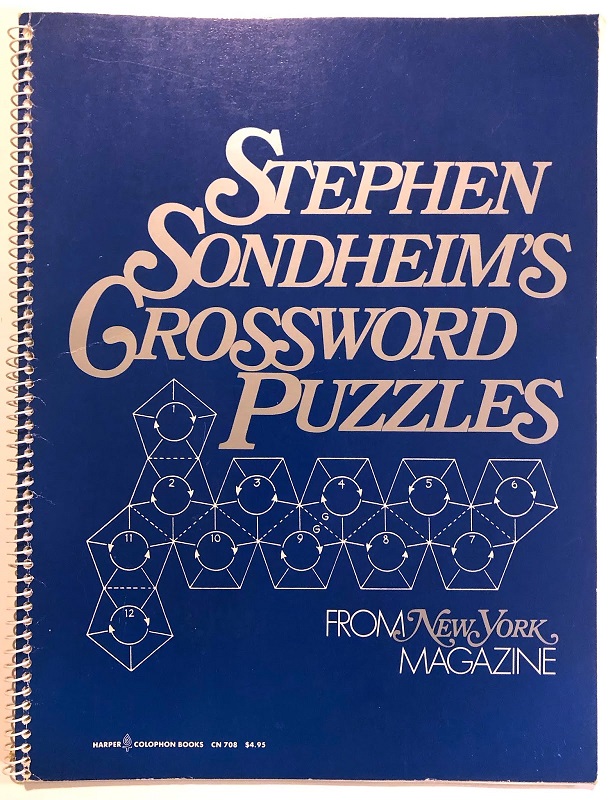
[Sondheim constructed cryptic crosswords for New York Magazine,
so Amanda certainly finds herself in good company!]
3. To call the last few months tumultuous is an understatement, considering public unrest and pushback against infringements on civil rights. In a similar vein, there has been a more strenuous push in crosswords recently (Women’s March, for instance) for greater representation for women, people of color, and the LGBTQIA+ community. In your estimation, how are the major outlets faring regarding inclusion?
Well there’s a loaded question! The numbers will tell you that, by and large, they are faring rather poorly. There are of course some exceptions (notably, the USA Today, which publishes far more puzzles by women than men). If you’re looking at the major outlet (The New York Times), this can feel challenging to assess in some ways.
If we’re acknowledging a recent push for inclusion, then we also have to take into consideration the often 18-month delay between the time of construction and the time of publication. As a result, the things that are happening now may not reveal themselves to us until over a year from now. None of this is an excuse for not having implemented a more inclusive system long ago, but I do think that even the major outlets with a shorter queue than The New York Times may not reveal to us any of aforementioned representational shifts until months from now.
I hope this is something that we as constructors and solvers continue to keep our eyes on, so that we can continue to work on opening doors that may have previously felt closed, and offering equal opportunities to anyone and everyone interested in the endeavor of crossword construction.
I think, as a whole, the general industry is still struggling to understand the difference between “I personally don’t know this because of my own life experiences” and “This isn’t gettable/knowable/likeable for solvers”. Inclusion begets inclusion, as exclusion begets exclusion. By leaving certain things/people/customs etc. out of puzzles, we continue this cycle in perpetuity. The more different kinds of people we have making puzzles, the more likely it is that any given solver will be able to do a puzzle and see themselves within it. And, at least for me, that is a goal that I always try to keep in mind when constructing.
[Solving runs in the family.]
4. What’s next for Amanda Rafkin?
I wish Amanda Rafkin knew the answer to that question as well. Given how things are going, it seems it will be a while before I’ll be doing much in the way of music again. So, for now, I’m going to continue to do what I’ve been doing for most of quarantine: making puzzles, putting them into the world, and hoping that they bring some kind of joy to folks during a time when joy can be a tricky thing to come by. Would it be awesome to be able to make a living solely from making crossword puzzles? HECK YES! So maybe that’s a goal for sometime in the future as well.
5. If you could give the readers, writers, aspiring constructors, and puzzle fans in the audience one piece of advice, what would it be?
No matter who you are, no matter how much you know, no matter where you went to school, no matter who your friends are, no matter the experiences you’ve had in your life, no matter how woke you think you are, you have blind spots. We all have blind spots. And sometimes, in the wake of these blind spots can come decisions that hurt other people. We are imperfect but lifelong students on this collective journey to betterment.
Be open to feedback, specifically from people who have had different life experiences than you. Feedback is not criticism; it’s the space from which we all grow. So get feedback on your work and actually listen. Resist the urge to be defensive. Collaborate with other people. If they differ from you in some way, even better.
Oh, and if you’ve been tossing around the idea of constructing for a while but haven’t actually taken the leap…jump. The kindest and most supportive people are on the other side waiting to catch you.
A huge thank you to Amanda for her time. You can follow her on Twitter for updates on her puzzly and musical endeavors, and be sure to visit her puzzle website Brain Candy for all sorts of puzzle goodness. We can’t wait to see what she cooks up next.
Thanks for visiting PuzzleNation Blog today! Be sure to sign up for our newsletter to stay up-to-date on everything PuzzleNation!
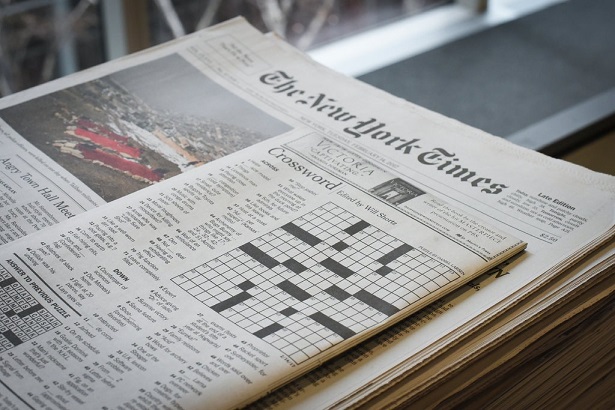
There’s good news for aspiring and established crossword constructors out there, as The New York Times crossword is now accepting online submissions.
I could be cynical and say it’s about time for a change like this, given that The Los Angeles Times has been accepting online submissions for at least a decade now, and many of the other major outlets made the transition well before 2020.
But I won’t. This is a moment worth celebrating.
True, it was inevitable that the Times would move in this direction. I don’t know if the tipping point was the pandemic, given how many other companies and businesses have been forced to adapt to a paperless/lower-contact way of doing business, or if the department was simply following a directional shift the industry had already taken.
But I’m glad they have. This may seem like a relatively small change, but it’s significant for several reasons.
1.) It’s simply easier
People send emails, attach documents, and share files every day. How often do you hit the post office?
2.) Electronic submission encourages younger solvers to get involved
New blood is a necessity for any industry, crosswords included, and when the standard-bearer makes a shift toward inclusivity (even if it’s just a matter of technological familiarity), it’s a step in the right direction.
3.) Electronic submission helps level the playing field
Having to mail submissions has a price attached, through envelopes, paper, and postage, whereas electronic submissions don’t. Yes, the price of crossword construction programs is still a hindrance, limiting access to some, but again, this is a step in the right direction.
The submission page is loaded with information, including specs on puzzles, file formats for submission, and the submission form itself.
Plus NYT-savvy constructors and staff like Joel Fagliano have already posted answers online to Frequently Asked Questions in forums like the Crossword Puzzle Collaboration Directory, and have offered to answer any other questions constructors have.
Hopefully this change means not only an influx of new talent, but greater accessibility for underrepresented groups in crosswords.
Thanks for visiting PuzzleNation Blog today! Be sure to sign up for our newsletter to stay up-to-date on everything PuzzleNation!
In the wake of puzzly public events like the American Crossword Puzzle Tournament being cancelled, as well as the shutdown of various school districts, workplaces, and businesses in order to limit exposure to the Coronavirus, it’s completely understandable that some puzzle fans may be feeling disappointed or even isolated from their fellow puzzlers.
But fear not! There are all sorts of options available to solvers looking to enjoy a puzzly experience from home, either on their own or with friends.
If you’re looking for crosswords, all you need is your computer. The New York Times, The LA Times, The Washington Post, and many other outlets offer online puzzle-solving, either by subscription or through watching ads before solving.
If you have access to a printer, you can print those puzzles out for the true pencil-and-paper solving experience.
And it’s not just newspapers. Many constructors — Brendan Emmett Quigley comes to mind — offer their own free puzzles semi-regularly (though you’re welcome to tip as a thank you). There is a world of puzzles out there on the Internet awaiting solvers.
But you don’t even have to go to a computer anymore. There are loads of terrific puzzles available right on your phone. Forgive us for tooting our own horn, but Daily POP Crosswords is a great puzzle app with a free puzzle every day and additional puzzle packets available for purchase or through our in-app coin system. (We also offer Word Seeks, Sudoku, and a marvelous story-driven puzzle mystery, Wordventures, if you’re looking for something different.)
Oh, and speaking of something different, if you’re looking to delve into more elaborate puzzles, there are some fantastic puzzle services by mail that offer all sorts of challenges.
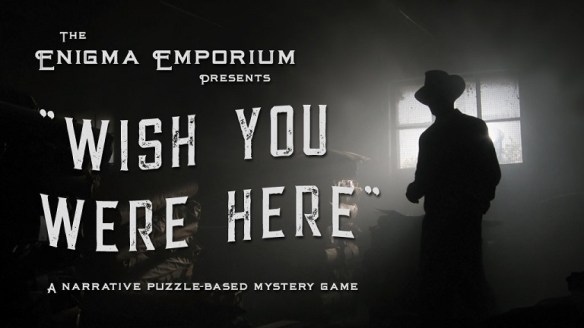
Wish You Were Here by the Enigma Emporium conceals an entire mystery within a handful of postcards, challenging you to mine them for every scrap of information as you uncover a series of coded messages. It’s spycraft in an envelope, very clever stuff.
The Cryptogram Puzzle Post out of the UK offers something unique, mixing puzzles and encryption with bits of mystery and supernatural narratives to create standalone chapters in an ongoing story. So you can pick one season or an entire year, depending on how deep you want to go!
And for multi-month affairs, there are outlets like Hunt a Killer and The Mysterious Package Company, which create vast, immersive puzzle experiences by mail. (Though according to friends’ recommendations, Hunt a Killer works better without the month wait between installments.)
As you can see, there’s a wide variety of ways you can puzzle from home, whether you prefer to solve online, by email, on the phone, or by mail!
That’s all well and good, you might be saying, but what about the social aspect? Well, there are options there as well, even from the comforts of your home.
Some puzzlers actually livestream their puzzle-solving online through avenues like Twitch, Facebook, and YouTube. The New York Timesperiodically does this as well, often with celebrity guest solvers!
You can keep your eyes peeled on Facebook and Twitter for constructors and solvers who do so. It often adds a fun, communal element to puzzle-solving (especially if they struggle with the same tricky clues that you do). Some pubtrivia outlets are also moving online to allow for participating from home!
But if you don’t want to wait for someone to livestream their solving, you can do it yourself! Between Facetime and similar apps on smartphones and all the online avenues for audio and video-chatting (Skype, Google Hangouts, Discord, etc.), you could pair up with a friend and tag-team a crossword puzzle or other puzzly challenge!
It’s like co-working, except with puzzles. Co-solving!
In times like this, where uncertainty abounds and our comfortable routines have been upended, puzzles can offer a wonderful refuge from all the stresses of the world. And with technology on our side, we can even keep the communal joys of puzzling in our lives.
Happy puzzling, friends.
Thanks for visiting PuzzleNation Blog today! Be sure to sign up for our newsletter to stay up-to-date on everything PuzzleNation!










 PuzzCulture