The Peculiar, Particular Art of Palindromic Puzzling!

Palindrome, written as an ambigram.

I’m a sucker for wordplay. I’m sure that comes as no surprise to you, gentle reader. You’re probably a fan of wordplay as well.

Two of my favorite forms of wordplay are the palindrome and the semordnilap.

For the uninitiated, palindromes are words, phrases, or sentences that can be read the same both backwards and forwards. KAYAK, RACECAR, etc.

A semordnilap (literally “palindromes” backwards) is a word or phrase that reads as one thing forwards and another thing backwards. STRESSED and DESSERTS, for instance.

It will come as no surprise to anyone who solved my Thisaway or Thataway crossword I shared a few weeks ago that I’ve had palindromes and semordnilaps on the brain.

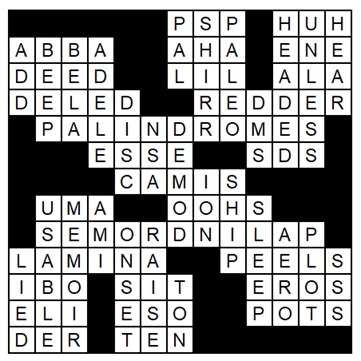
My goal was to make every across entry above the center a palindrome (except for the entry PALINDROMES) and every across entry below the center a semordnilap (except for the entry SEMORDNILAP).

After trying several different layout and ideas, I finally got the puzzle to a place where I was happy with it. And now that it’s been shared with solvers, I’ve been wondering if anyone else had tackled the combination of palindromes / semordnilaps, and crosswords.

Thankfully, Xwordinfo made the searching for them easy.

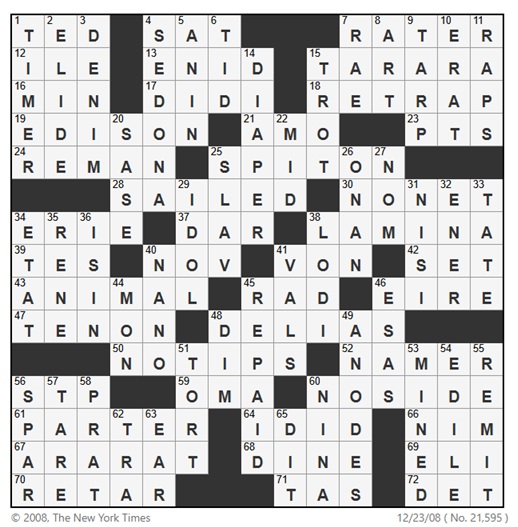
I found this Joe Krozel puzzle from December 23rd, 2008, where the entire puzzle can be rotated 180 degrees and read out the same.

It’s an entire puzzle of semordnilaps!

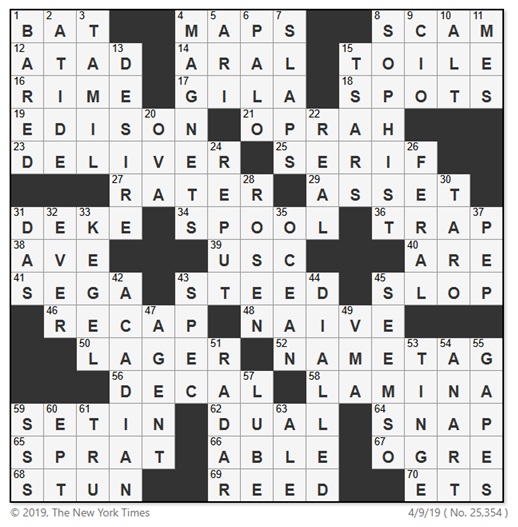
Alex Eaton-Salners executed a similar idea on April 9th, 2019, creating a puzzle where every across entry is a semordnilap, cluing both the word reading forwards and the word reading backwards.

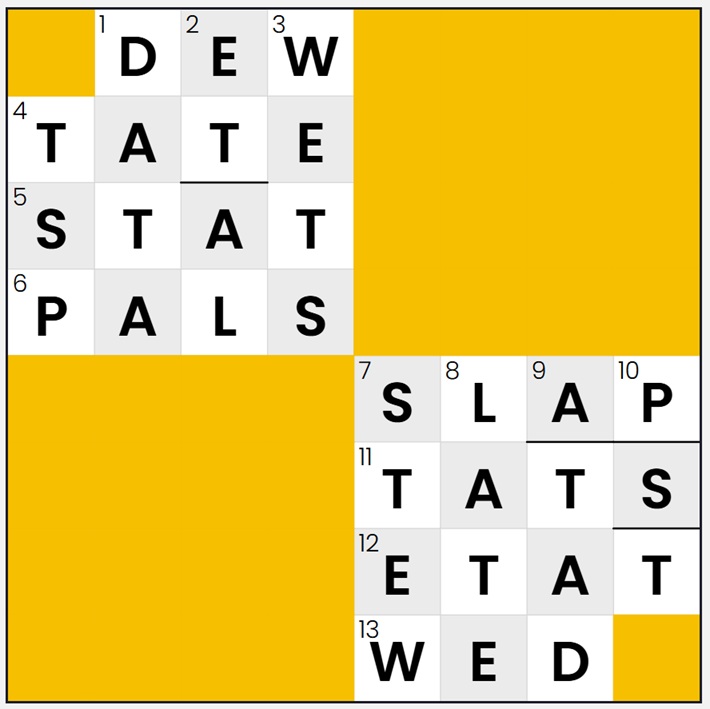
Leo Tsai managed the same trick as Krozel in a Puzzmo mini on May 20th of this year, offering two mini grids that reflect each other. (Solving this puzzle while constructing one in a similar vane was encouraging!)

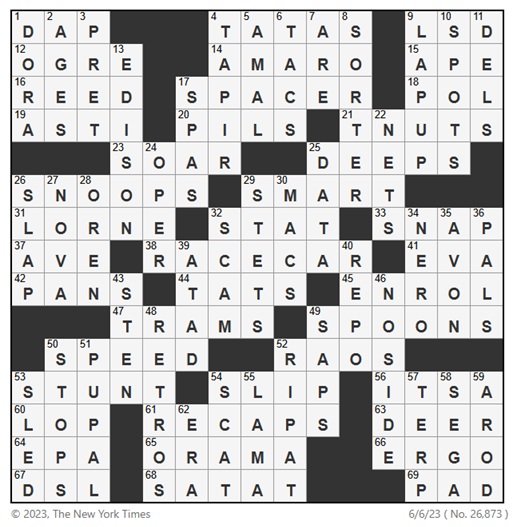
On June 6th, 2023, Daniel Jaret’s crossword appeared in the New York Times, and executed the same trick managed by Joe Krozel 15 years earlier! Once again, the entire puzzle could be rotated 180 degrees.

He also managed to place two palindromes at the very center of the puzzle, RACECAR crossing STETS, which is a terrific extra touch.

That’s more puzzles than I expected when I started hunting for palindromic crosswords!


Of course, crosswords aren’t the only puzzles where you can see palindromes and semordnilaps.

Our friends at Penny/Dell Puzzles have several puzzles where words overlap and read backwards and forwards. Right of Way and Crozzle both come to mind.

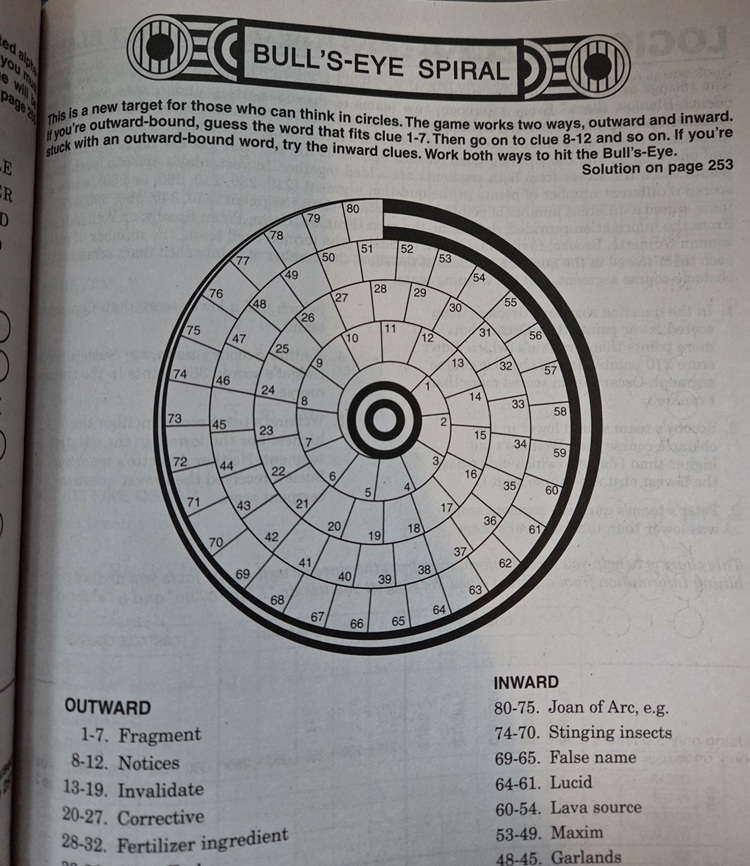
But the best example in their puzzly library is undoubtedly Bull’s-Eye Spiral.

Bull’s-Eye Spiral challenges solvers to use the clues provided to create a chain of answer words that can be read both forwards and backwards.

Unlike a single semordnilap like STOP and POTS where one word can be reversed into a different word, the answers in Bull’s-Eye Spiral overlap, allowing the backwards words to bleed into the forwards words, creating a massive spiraling chain of words that’s actually two chains of words where the only common breaks are at the beginning and the end.

I’ve never tried to construct a Bull’s-Eye Spiral, though it does seem like a fun challenge to put on my ever-growing to-do / wish list.

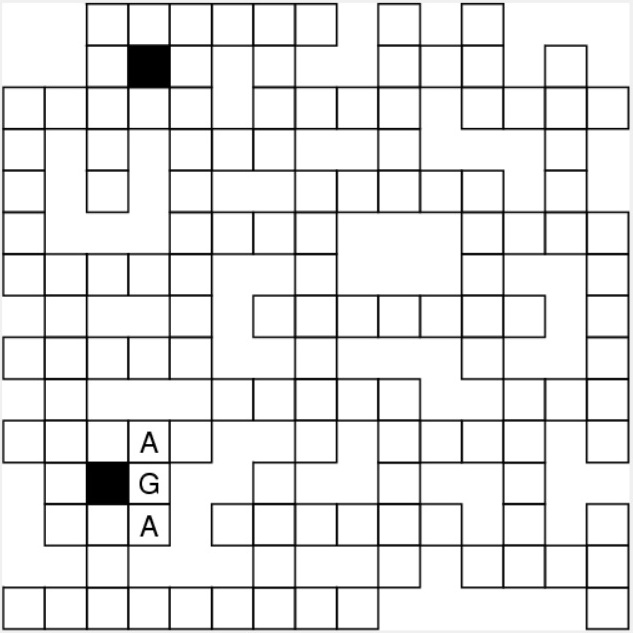
I did, however, manage to construct a Framework puzzle years ago with only palindromes as answer words.

[Click here to download a PDF of this puzzle!]

It was challenging to construct, not because of the limited wordlist, but because all the common letter crossings made it difficult to ensure there was only one way to complete the grid. (No alternate solutions here!)

Happy solving!


Musician, parodist, and wordsmith “Weird Al” Yankovic once said that “the writing of a brilliant palindrome is a small miracle, and that, I think, deserves to be honored more than a lot of the stupid and inconsequential things we often celebrate in our culture.”

Do you agree with him? Are you a fan of palindromes and semordnilaps, in puzzles or otherwise? Let us know in the comments section below! We’d love to hear from you.

An Amazing Opportunity for New Voices in the New York Times Crossword!

Yes, I know this is the New Yorker’s iconography, but sadly this is also the default in some people’s minds for who constructs and who solves the NYT crossword, and it’s awesome we’re taking steps to change that…

It’s only a few days before submissions open for the fifth New York Times Diverse Crossword Constructor Fellowship!

At noon on June 15th, the Times will begin accepting applications for a fellowship. But what does that entail?

According to the Times from the announcement page:

The New York Times Diverse Crossword Constructor Fellowship provides mentorship and support for constructors whose backgrounds and perspectives could be better reflected in our puzzles. We want our puzzles to reflect the experiences of as many people as possible, which means publishing work that displays a wide range of cultural reference points, language usage and communities.

This mentorship gives aspiring constructors (ones who haven’t yet been published by NYT) the opportunity for three months of instruction, advice, and insight from one of the NYT puzzle editors. It’s an incredibly talented list of people to learn from: Sam Ezersky, Wyna Liu, Tracy Bennett, Christina Iverson, Joel Fagliano, and Ian Livengood.

It’s open to constructors seeking guidance on either themed or unthemed crosswords, with specific guidelines when you apply:

If you’d like to work on a themed puzzle during the fellowship, you will need a theme set with theme clues provided. A tentative grid with theme answers placed is helpful.

If you’d like to work on a themeless puzzle, you will need to provide one of the following: a 7×7 grid with clues, a 15×15 grid with clues or a partly filled 15×15 grid with clues.

You can check out the full announcement here, and you can click here for submission guidelines and some resources available to constructors already.

Good luck to everyone submitting! The world of crosswords is a more interesting, more immersive place when everyone is represented, and opportunities like this make both constructors AND outlets better.

Deb Amlen, the Whimsical Wordnik of “Wordplay,” Announces Retirement

damlen2

This morning, loyal readers of the Wordplay column in The New York Times were greeted by the news that Deb Amlen is retiring on January 2nd, 2026.

In case you somehow didn’t know, Deb is a talented crossword constructor, but these days, she’s better known for her role as the head writer and senior editor of Wordplay, the crossword blog and educational/humor column associated with The New York Times crossword puzzle.

You can read her thoughts in today’s Wordplay column, but please allow me to share a snippet of her thoughts from an accompanying Facebook post:

After more than 4,400 bylines and millions of words, mostly in the right order, I can honestly say that this has been the best job I’ve ever had. I’ve had the honor of working with some of the greatest journalists and editors in the business. It has been a wild ride, and as the great David Carr once advised, I have enjoyed every caper I’ve ever pulled at the company: the Trans-Atlantic cruise, the curling adventure, the rogue Crosswords Live. All of it.

Hopefully, after an extended period of drooling on myself to get over the deadlines, I can also continue to be part of the puzzle community in some way, because you all are the kindest, most generous, most funny people I know. Also extremely attractive.

damlen1

As an ambassador into the world of puzzles, Deb’s warmth and playfulness have been the perfect counterbalance for new and inexperienced solvers to the sometimes daunting prospect of tackling a New York Times crossword. Her columns are always funny, more than a little self-deprecating, and very complimentary to each day’s constructor.

I’ve interacted with Deb a few times over the years. I interviewed her for the blog back in 2020, and we had several friendly conversations at the American Crossword Puzzle Tournament. Her enthusiasm for not just puzzles, but for meeting other puzzle fans, is unmatched, and even during a quick “gotta run!” visit, you come away with a smile.

I’m sad to see her go, but I’m glad to know that she’ll be working on new passion projects, traveling, and leaving the Wordplay column in the very capable hands of Sam Corbin and Caitlin Lovinger.

As one of the public faces of The New York Times Crossword, Deb often found herself the recipient of public feeling toward the crossword. Over the years, she has become rather infamous for reminding people that SHE just writes about the puzzles. “I didn’t do it” has become a catchphrase.

Well, Deb, it was true the vast majority of the time, but allow me to say, when it comes to making puzzles more welcoming and accessible to solvers, you absolutely DID do it.

Thank you for everything, Deb.

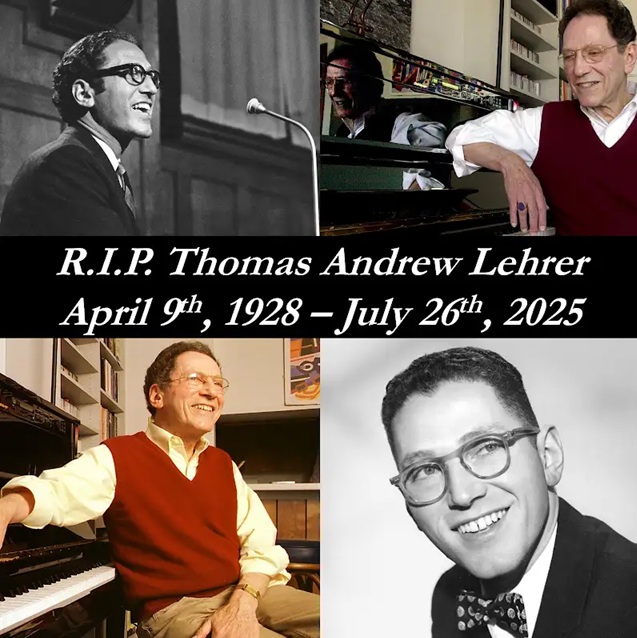
Farewell, Tom Lehrer.

The world of puzzles and games is larger than constructors and game designers. There are artists, writers, editors, wordsmiths, hosts, musicians, and influences that help shape puzzles and games in so many different ways. Their efforts enrich and popularize these beloved pastimes, contributing to the world by celebrating wordplay, creativity, and nerdy pursuits.

And sadly, the world grew a little less witty, a little less clever, and a lot less bold and outspoken about so many important topics when Tom Lehrer passed away a few days ago.

It’s hard to know where to begin.

How do you describe the cultural influence of a man whose songs still delight, inform, and push boundaries today, even though he wrote most of them over sixty years ago?

How do you describe a successful musician who walked away from public performance after three brilliant albums — thirty-seven songs, each an intricately-crafted dissection of some aspect of culture, science, or current events, often as poignant and sharp-tongued as they were hilarious — and spent the bulk of his life as a teacher and college professor instead?

How do you describe the genius of a man for whom wordplay flowed as easily as scientific lingo or political commentary, a man who could make you laugh (and think, really think) about nuclear annihilation, questionable post-war government programs, or even the Catholic Church itself?

His influence on pop culture can’t be overestimated. Across generations, his songs educated and inspired, and his legacy is bulletproof. He created songs for The Electric Company, Square One TV, and That Was The Week That Was. (Those shows were decades apart!)

He inspired performers like “Weird Al” Yankovic, and I think his fingerprints are unmistakable on other hilarious and educational projects, like the songs of Randy Rogel for Animaniacs. (Trust me, you can’t listen to “the Multiplication song” from Animaniacs and NOT think of Lehrer’s “New Math”.)

Tom retired from live performance in the late 1960s, having felt like he’d said everything he wanted to say with his music. (Plus, as he famously pointed out, “political satire became obsolete when Henry Kissinger was awarded the Nobel peace prize.”)

But his songs wouldn’t be denied.

Dr. Demento’s radio show brought Lehrer’s work to new ears in the 1970s, 80s, and 90s, and Honest2Betsy has brought him to yet another generation’s attention with her videos over the last few years.

His songs are timeless. “The Elements” alone has appeared in Better Call Saul, NCIS, Gilmore Girls, and The Big Bang Theory. (Not to mention Daniel Radcliffe’s famous rendition of the song on The Graham Norton Show, where he called Lehrer his hero. This actually led to Radcliffe starring in the film Weird: The Al Yankovic Story.)

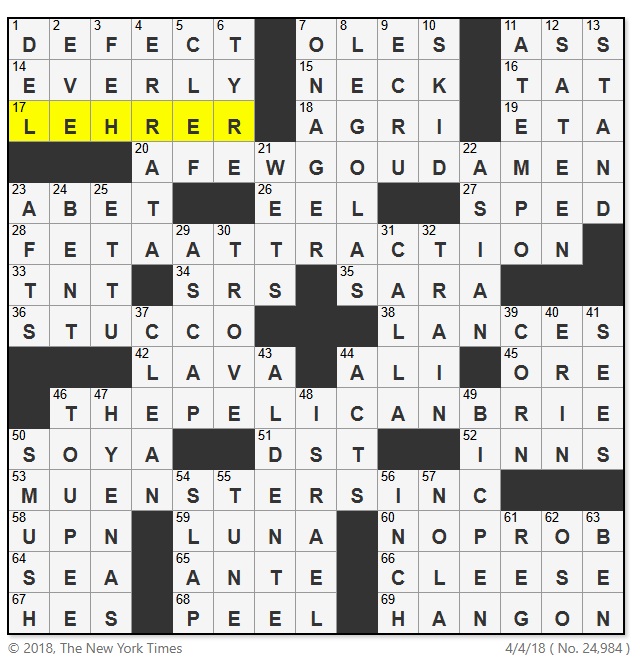
Speaking of “Weird Al,” his New York Times crossword puzzle with constructor Eric Berlin namedropped Tom as part of the grid fill in this pun-heavy collaboration:

And it is a love of wordplay that sparked this tribute today.

Lehrer’s work is absolutely riddled with clever puns, comedic craftsmanship, and playing with the listener’s expectations: all things that great crossword cluing employs.

You can’t listen to songs like “Silent E” or “Without an S” and NOT imagine clues or themes that Lehrer’s linguistic legerdemain could inspire.

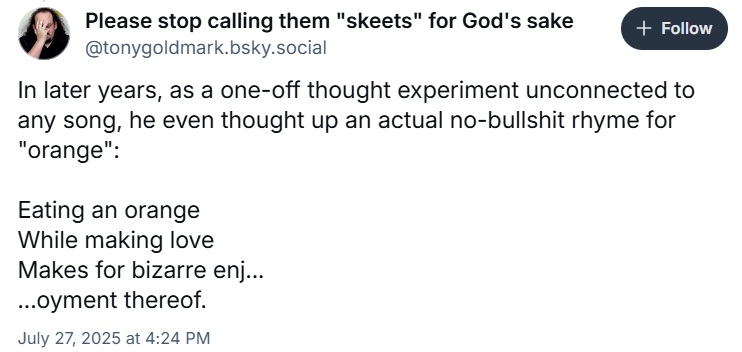
Not to mention this gem:

There’s a playfulness there, paired with technique, creativity, and an absolute willingness to bend conventions to their breaking point in order to make something new. How can you not love it?

But wordplay, commentary, and scientific and mathematical literacy weren’t Lehrer’s only gifts to the world.

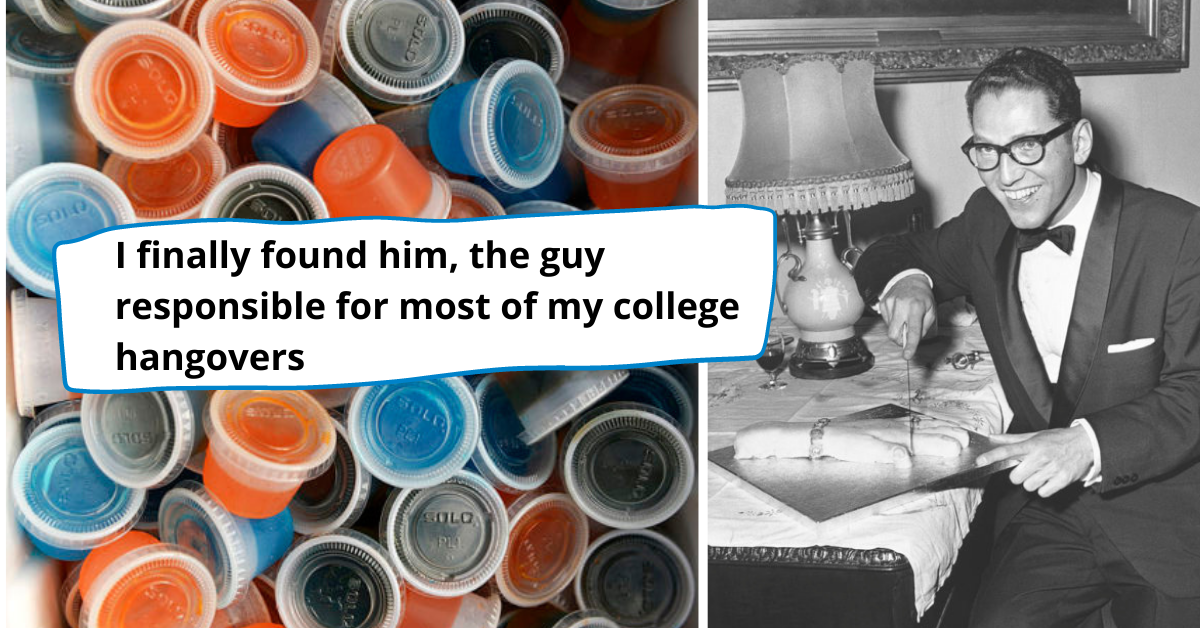
He claimed to have invented the jello shot while in the military (to skirt rules about alcohol consumption). He wrote the song “Don’t Major in Physics,” which would have been good advice to me in freshman year of college, had I cared to listen.

Image courtesy of warhistoryonline.

And he also made the incredible gesture in 2022 of transferring the music and lyrics for all the songs he had ever written into the public domain. He relinquished the copyright and performing/recording rights for his songs as well, making his music and lyrics free for anyone to use. Downloadable lyric and music files are available on his website.

His statement releasing all his works into the public domain concluded with this note: “This website will be shut down at some date in the not too distant future, so if you want to download anything, don’t wait too long.”

For now, at least, the website remains online.

And it seems so apropos that the man who walked away from music decades ago to share his love of mathematics, science, and teaching with others is also the man who would happily sign away the rights to his music to enrich the lives of others once again.

The humanities and the STEM fields both owe Tom Lehrer a debt that can never be repaid.

The world was blessed with his presence for 97 years, and I have no doubt that his words, his music, and the forceful spirit that infused both will be around for many many years to come.

Farewell, Tom. Thanks for warning us about Shakespeare.

Oh, and for this lovely little ditty:

Crossword News Roundup!

In today’s blog post, we’ve got a trio of crossword-related news items for you!


shortzoffice

Welcome back, Will!

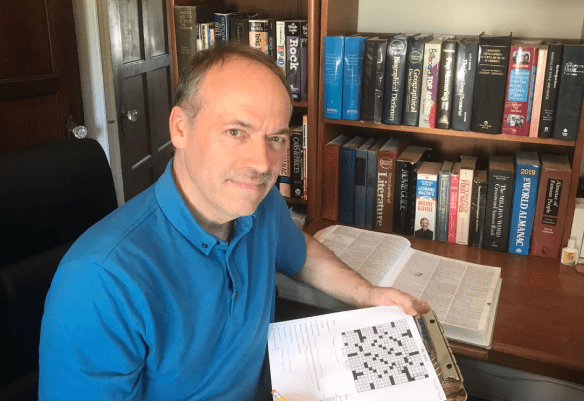
Earlier this week, The New York Times announced that Will Shortz was back at work editing the Times crossword (beginning with the December 30th puzzle).

This is wonderful news, as Will had to step back from his editing work in February to attend to his recovery.

For those who were unaware, Will suffered a stroke that affected his mobility — he offered details on both the stroke and his recovery to Brain & Life magazine — but he is back to editing and playing table tennis.

From the NYT article:

In addition to completing hours of physical therapy and rehab, Will slowly returned to puzzle making and editing throughout the year. He directed the American Crossword Puzzle Tournament, returned as the creator of NPR’s Weekend Edition Sunday Puzzle in April and resumed choosing puzzles for The Times in May.

We wish Will all the best in his continued recovery and return to puzzling. I’ve had the pleasure of interacting with Will a number of times — mostly at the ACPT, though I did interview him for the blog years ago — and I’m very glad to hear that he’s well enough to enjoy both of his favorite pastimes again.


acptlogo

And speaking of Will Shortz news, registration is open for the 47th edition of the American Crossword Puzzle Tournament!

Once again being hosted in Stamford, CT, the ACPT is a weekend-long puzzle extravaganza of solving, puzzle-themed events, fun, and community.

This year’s tournament runs from April 4th through the 6th, and you can click here for more details (and to register for this year’s event, should the spirit move you).

Are you planning on competing this year? Let us know in the comments below! We’d love to hear from you.


Our last bit of crossword news was brought to our attention by friend-of-the-blog DGhandcrafted.

The jewelry crafting supply website Lima Beads has a puzzly promotion going on that might interest the craftier members of the readership.

There is a crisscross grid featured on the site for the entire month of January, and the numbered answers correspond to what’s on sale that particular day!

There’s even a chance to win a bonus prize if you solve the entire puzzle early!

It’s a pretty clever way to bring solvers and crafters back to the site throughout the month, and hopefully it’s a success for both the customers and Lima Beads.

Happy puzzling (and crafting) everyone!

Women of Letters (and Squares and Boxes and Clues and…)

Puzzles bring joy to so many of us. They’re an escape, a challenge, a satisfying little test of our wits, our dedication, our creativity, and our flexibility of thought.

In uncertain times, in times of trouble, people often turn to puzzles. Puzzles were a refuge for many during lockdown when COVID hung over our heads. And now, when so much seems uncertain, if not downright unstable, people will no doubt turn to puzzles again.

That’s not to say that puzzle solving is a mere flight of fancy, a desperate bit of escapism, a Hail Mary avoidance of difficult circumstances, hard questions, and treacherous times to come. Quite the opposite, in fact.

If you turn to puzzles now, you’ll see a road map that proves things can get better.

Because, like it or not, misogyny once dominated the world of puzzles. It was baked into crosswords from the very beginning.

Yes, Arthur Wynne created the template for crosswords. Simon & Schuster are credited with publishing the first crossword puzzle book, as well as all the bestselling puzzle books that followed, serving as the foundation that helped build their brand.

But it was women who made crosswords into something more.

Women like Richard Simon’s aunt Wixie. She insisted Simon look into publishing a limited release crossword book. (UPDATE: I originally wrote that none of the stories mentioned her name, but I later found some that included her nickname, Wixie. I later discovered her actual name is Hedwig Simon.)

Women like Margaret Farrar. While serving as “an unofficial editor of the crossword-puzzle section,” she prevented errors and helped establish some of the baselines that still stand in crosswords today.

Women like Ruth Hale. Ruth was the founding president of the Amateur Cross Word Puzzle League of America, an organization that set crossword standards like limiting black squares and symmetrical grids, building off of Farrar’s work.

Women like Nancy Schuster. Schuster (no relation to the aforementioned publisher) not only ran Dell Crosswords but was the first winner of the American Crossword Puzzle Tournament.

Women like Helen Haven. In the 1920s, Haven was the organizer of the first competitive crossword-solving contest and served as the puzzle editor for The New York Herald-Tribune.

As pointed out by Anna Shechtman in her book The Riddles of the Sphinx: Inheriting the Feminist History of the Crossword Puzzle, between 1913 and the 1960s, most crosswords were created by women.

Puzzles were literally women’s work! With all the connotations that phrase invites.

And crosswords were derided as a frivolous pastime because of it. Not only because women made crosswords, but because crosswords were predominantly solved by women.

The New York Times called the crossword “a primitive form of mental exercise” and female solvers were blamed for neglecting their families and wifely duties because of their “utterly futile finding of words the letters of which will fit into a prearranged pattern, more or less complex.”

Funny how their opinions changed just in time to profit on crosswords in the 1940s.

Much like the Beatles — who were dismissed as nothing more than a glorified boy band when thousands of women cheered at their shows, only for them to be recognized as a once-in-a-generation group of talents when men started paying attention — crosswords became “respectable” only when men took interest and took over.

The percentage of female constructors published in The New York Times went down during the Will Shortz era, as compared to the Will Weng and Eugene Maleska eras.

And like it or not, but “the average solver” concept — a problem I discussed years ago — is still using a white male yardstick for comparisons, to the detrimental of solving and constructing.

In a wonderful blog post on the subject of women in puzzles, the author of the piece opens with the line “I’ve always associated crossword puzzles with men.”

And I realized how lucky I was to NOT have that association. In fact, I don’t think I would be a puzzly guy without the women in my life.

My mother (the first female store manager in A&P history) still solves crosswords and jigsaw puzzles to this day, and encouraged my interest in puzzles in the first place. My oldest sister (a teacher) introduced me to wordplay. My older sister spent hours playing puzzle video games like Dr. Mario with me. My younger sister is not just a master jigsaw puzzle solver, but a fiend at trivia nights and escape rooms, forever challenging me to match her flow.

I was trained in crossword puzzle editing and construction by Penny Press’s crossword guru Eileen Saunders, and still lean on her creativity and wisdom every day (and marvel at her blistering speed and efficiency).

I was shepherded through the world of variety puzzles by Los Angeles Times crossword editor and puzzle badass Patti Varol. (Though it was probably more like dragging my deadweight body through molasses than “shepherding” if I’m being honest.)

And that’s not counting the undeniable and indispensable influence of Amy Roth (a shining light at Penny Press), Chris Begley, and so many other female voices that make Penny Press one of the best outlets for puzzles in the world.

I love puzzles because of those women. I have made a career in puzzles because of those women. I am better at puzzles because of those women.

The puzzle world is better because of women. It will continue to advance and innovate and thrive because of women.

How do I know this? Because women are doing incredible things in puzzles RIGHT NOW.

A small sampling of the women making puzzles better. Wyna Liu, Amanda Rafkin, Soleil Saint-Cyr, Tracy Bennett. Illustrations by Ben Kirchner.

Look at The New York Times. Tracy Bennett, Wyna Liu, and Christina Iverson are delivering great daily puzzles like Connections, Strands, and Mini Crosswords not just consistently, but brilliantly.

The aforementioned Patti Varol is absolutely crushing it at The Los Angeles Times crossword. With Katie Hale and Angela Kinsella Olsen on Patti’s team, every month since mid-April 2022 has had a minimum of 50% women constructors and often exceeds that, all while delivering topnotch puzzles.

The New Yorker, USA Today, The Slate Crossword? Liz Maynes-Aminzade, Amanda Rafkin, Quiara Vasquez. Brooke Husic runs PuzzMo (where Rachel Fabi constructed my favorite puzzle of the year!) and Amy Reynaldo co-edits Crosswords With Friends.

Rebecca Goldstein just won the Orca for constructor of the year. Smarter people than me have called Stella Zawistowski a crossword boss in every sense of the word. Ada Nicolle won the 2024 Lollapuzzoola crossword tournament.

The impact of projects like Women of Letters and The Inkubator weren’t just the tip of the iceberg, they were the tip of the spear. A spear aimed directly at the heart of outdated notions of who makes crosswords and who solves them, dismantling the idea of some mythical “average solver” that has never truly represented the crossword audience.

As constructors, editors, and solvers, women in the past shaped puzzles as we know them. And women in the present are redefining puzzles. Not just in terms of representation (both as grid answers and creators behind the scenes), but in terms of acknowledgment, respect, and appreciation.

As for women of the future? I, for one, can’t wait to see what they have in store for us.

(And thank you to several of the women mentioned above for making this post far, far better than it started.)