Puzzly Mantras in Just Three Words!

In a recent Gameplay newsletter, Sam Corbin wrote about three-word instructions / mottos (like “Eat, Drink and Be Merry” or “Live, Laugh, Love”), and pondered a slogan like that for puzzle solving.

It’s a definite challenge for sure, like trying to come up with a poignant six-word memoir. But I’ve never been one to turn down a challenge simply because I’ll probably fail. I WELCOME IT.

So, today, I thought I would pitch in and come up with some slogans (not all fitting the three-word formula) for various puzzle outlets.


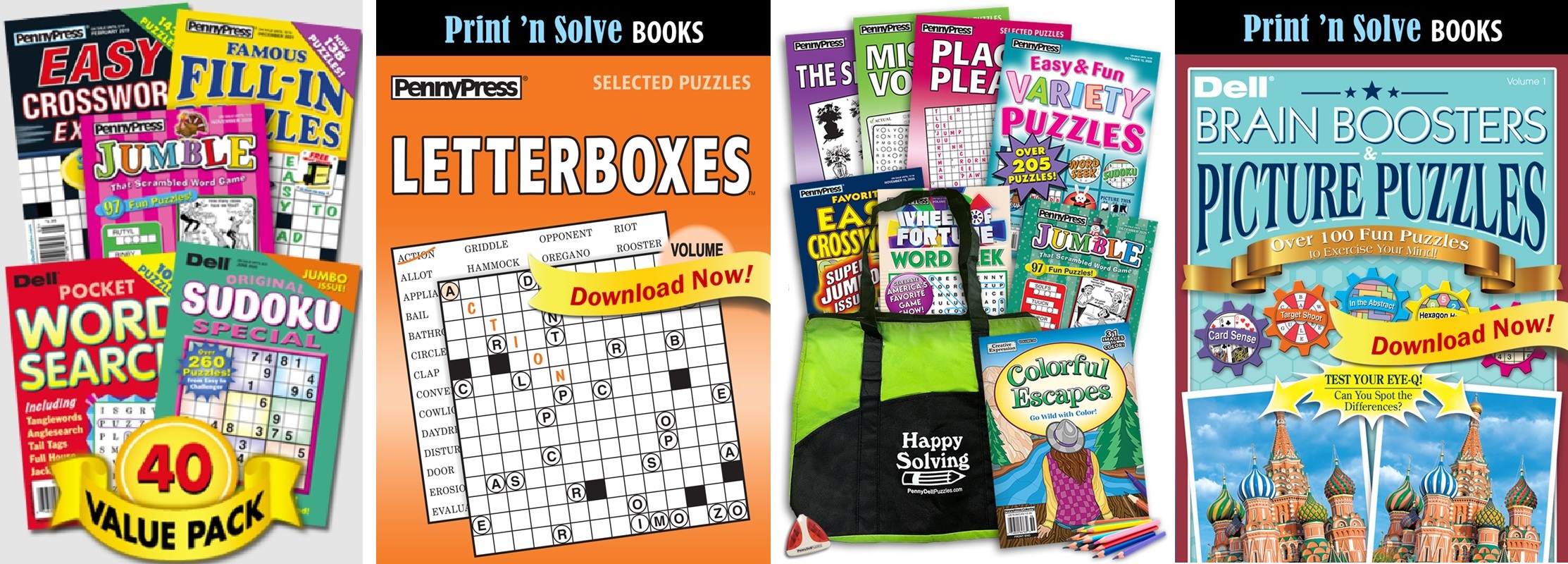
Penny Press / Dell Magazines

I’ve always thought a great slogan for them would be “We’re As Puzzled As You Are.” It’s light, a little self-deprecating, and fosters a feeling of camaraderie between publisher and solver.

But a three-word instruction for them?

How about Sample, Savor, Solve? Sample a variety puzzle you’ve never tried. Savor the ones you know you like. And, as always, solve.


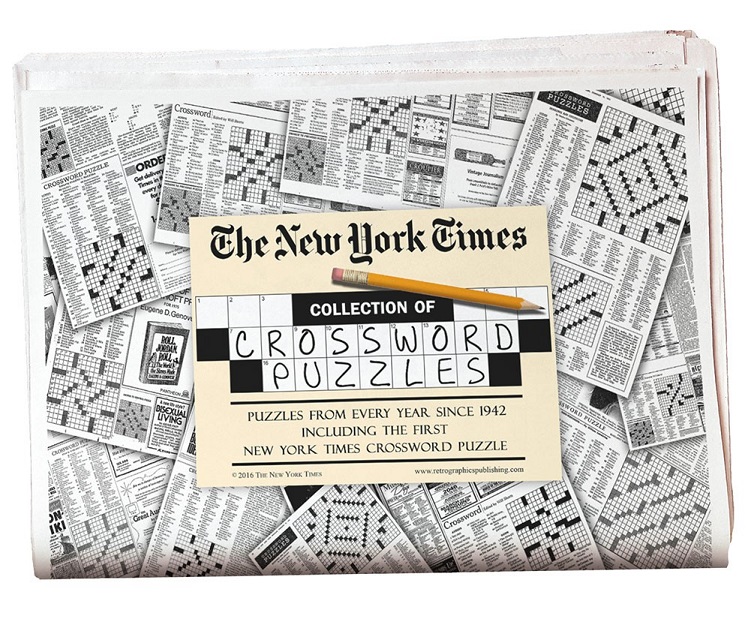
The New York Times

I mean, a good motto would obviously be “All the Clues That Are Fit to Print,” playing off the classic NYT slogan.

But for a later-week crossword, how about Determine, Decipher, Discover?

Determine what you know, decipher tricky clues, discover the gimmick.


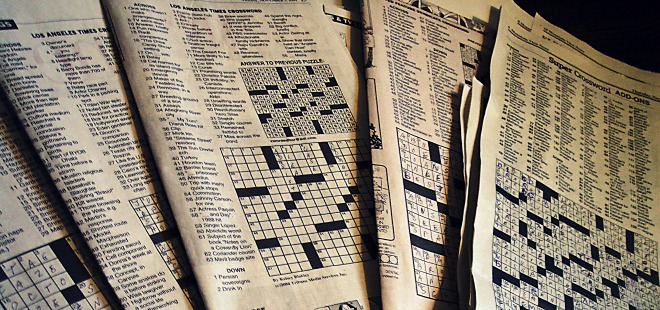
The Los Angeles Times

Now, The LA Times has several mottos (like “Read the Paper,” which could easily be converted into “Read the Down Clues”), but my favorite is their historical slogan, “Stand Fast, Stand Firm, Stand Sure, Stand True.”

And when it comes to puzzles, that could be Stand Watch, Stand Pat, Stand Back.

Let your eyes go to the clues you know immediately, trust your instincts on ones you’ve filled in, and then stand back and survey your work to unravel the theme.

Doesn’t really work with the three-word motto, though.

Maybe Stop, Drop, and Roll!

Stop what you’re doing and solve a puzzle. Look at those down clues. And keep trying ’til you’ve solved it.


Fireball Crosswords (and other meta outlets)

For me, it was actually easy to come up with a three-word motto for solving these, because it’s what I do when I try to unravel a meta while completing the grid:

Pattern, Exception, Association.

Look for a pattern or rhythm outside the regular solve. Look for exceptions that feel intentional. Look for associations on a second read.


But what about for a general three-word instruction for crossword solving?

For solvers still getting used to crosswords, I would recommend Blanks, Bios, Back-and-forth or Fill, Famous, Flip, which both fit some of my solving advice for newbies.

Fill in the blank, scan clues for famous names, flip to the crossings once a word is filled in and work on that section.

Oh, and if you suspect a puzzle will be difficult, always remember:

Write Light, Alright!?


Hopefully one of these mottos works for you, fellow solver. Do you have any suggestions, leave them in the comment section below! We’d love to hear from you.

And now for my traditional three-word sendoff:

Happy puzzling, everyone!

A-Ha Moments Stick in the Brain!

It’s one of the best moments in puzzle solving.

When all the pieces click into place brilliantly. When the wordplay is unraveled. When the cryptic crossword clue is deciphered. When the trickery behind the riddle is revealed.

That rush, that satisfaction that coincides with overcoming the clever, devious creation of another keen mind.

The a-ha moment.

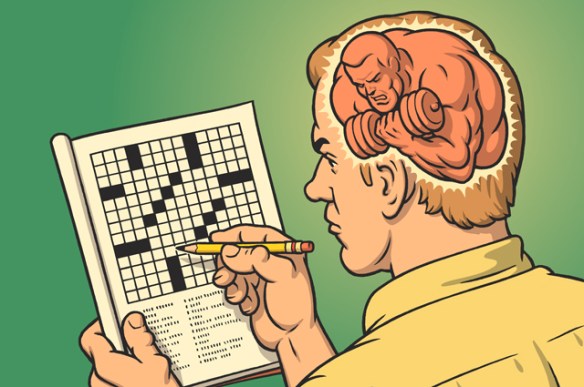
And it turns out that the a-ha moment isn’t just significant for puzzly spirits, it’s biochemically significant as well.

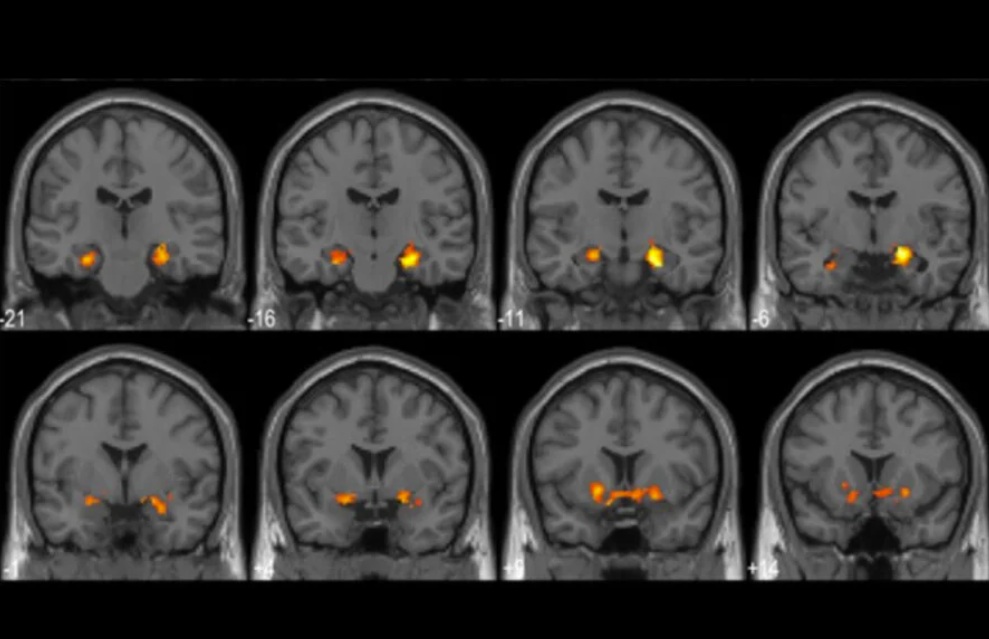
According to a study by Maxi Becker, Tobias Summer, and Roberto Cabeza, the brain remembers a-ha moments better than solutions reached through traditional methodologies.

From a report by Gizmodo:

As study participants solved brain teasers, he [Cabeza] and his colleagues recorded their brain activity with functional magnetic resonance imaging, a technique that measures changes in blood flow associated with brain activity. The brain teasers were visual fill-in-the-blank puzzles that revealed a previously hidden picture once participants completed the image.

And the brain activity resulting from an a-ha moment was comparable to the brain characteristics of important insight events. This means that the solutions derived from a-ha moments were remembered more clearly and with greater detail than those derived from traditional solving or process of elimination-style solving. Some of the solvers still recalled their a-ha moment solution a full five days later!

Researchers are already looking to revamp the ways we teach by utilizing techniques that inspire more a-ha moments, hoping that students will benefit more in the long term from inspiration-focused learning, rather than rote memorization.

Here’s hoping for more a-ha moments for all us! They’re good for the soul and good for the memory banks.

Happy puzzling, everyone!

A Gateway Puzzle for Crossword Solving?

Where do you get started with crossword solving?

I see that question a lot. And the advice offered to new solvers varies. Sometimes they’re pointed particular crossword outlets promising a more newbie-friendly solve. You certainly don’t want someone tackling a crossword too difficult for their skill level and getting discouraged.

Often, they’re told to just plug away at it, since the only way to get better at crosswords… is by solving crosswords.

None of this advice is wrong. I’m sure people follow these suggestions and slowly start to enjoy this puzzly world that many of us have embraced for decades.

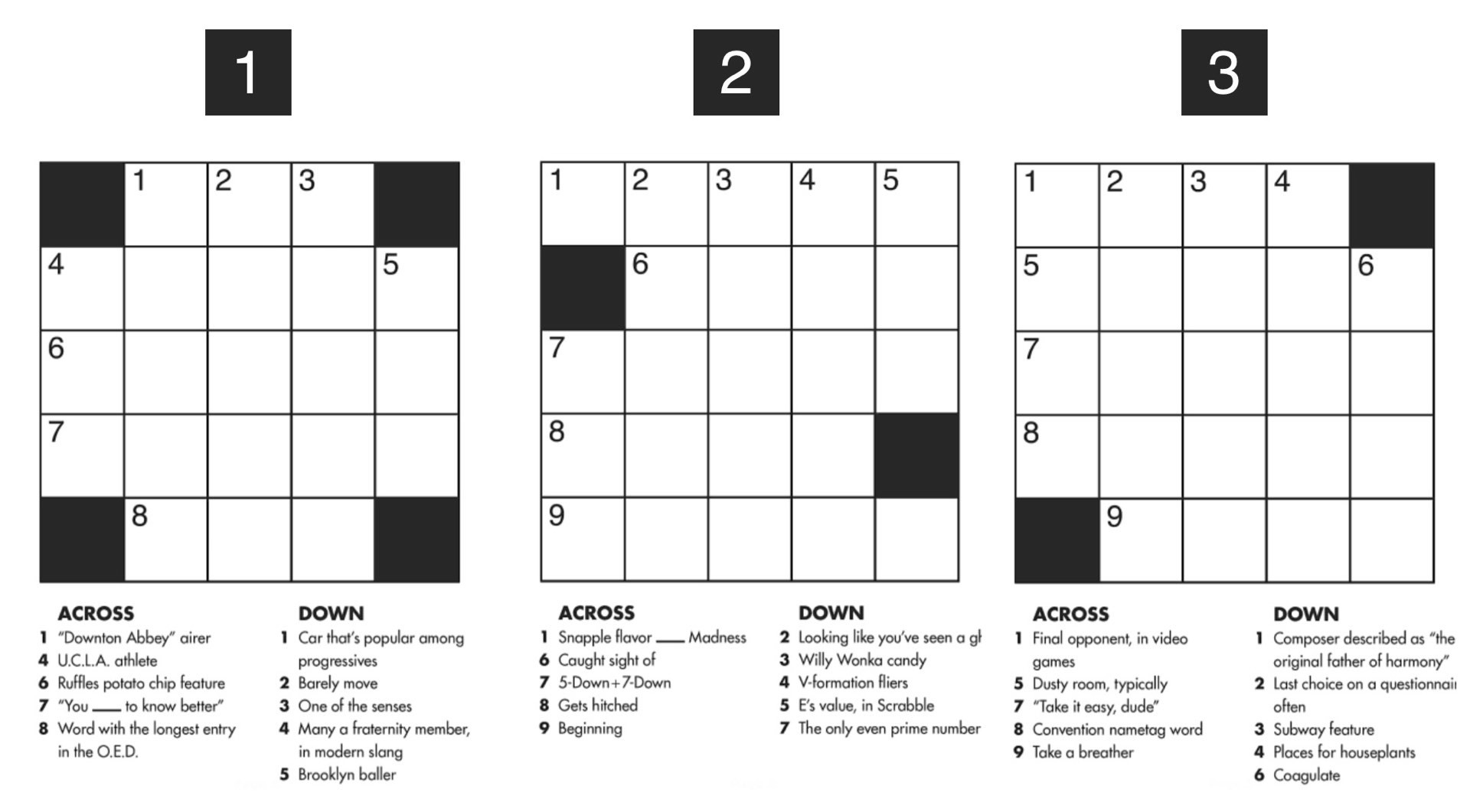
You might think that Mini Crosswords, like those featured in the New York Times puzzle app, are the way to go. But while the grid is smaller, that also means new solvers have fewer chances to find crossings and work on their solving.

Imagine a regular crossword. A Mini is essentially one corner of the grid. If you started a crossword in one corner, and didn’t get any entries, you can move to another spot. But if you’re stumped on a Mini, where do you go?

I also think the running timer feature — although obviously not a necessity for solvers — can add to a new solver’s anxiety. If you’re stumped, and you’re just sitting there, watching the timer tick away, that’s going to eat at your confidence a bit.

crisscross

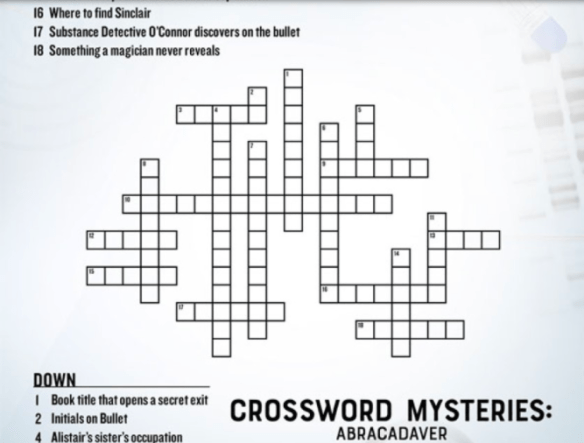
You might think that crisscross-style puzzles (like the one above) would be less intimidating, since they don’t have the same dense grid surrounded by clues that crosswords have, but I’ve found that folks don’t warm to those quickly. No matter how well-constructed the crisscross, it tends to remind people of activity books for kids, and no one wants to feel patronized when trying out a new hobby or giving it another go.

Not only that, but they are missing one of the most helpful components to crossword solving: all the overlapping letters! In a crossword, you have two chances at every single box because of the across and down clues. But in a crisscross, you usually only have one or two points of overlap, so if the clue isn’t helpful or intuitive, you’re just stuck. That doesn’t build solver confidence.

I do have a suggestion, though.

I’ve tried this with several friends and acquaintances who had sworn off crosswords entirely, and not only introduced them to a new puzzle they didn’t know, but opened their eyes to the possibility of more puzzle solving in the future.

My solution was: Fill-Ins.

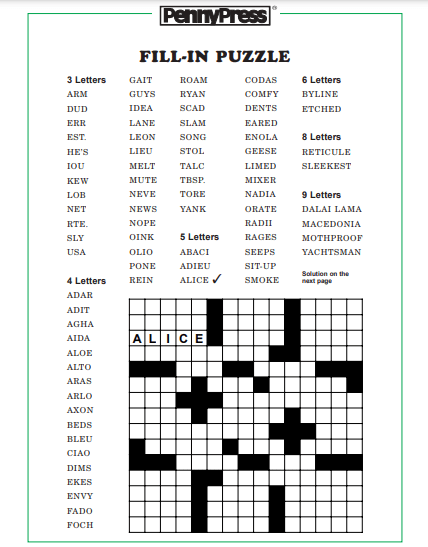
fillin sample
A sample puzzle from our friends at Penny Dell Puzzles.
Check out their fill-in library here!

For the uninitiated, fill-ins utilize the same general grid style as a crossword. But instead of answering numbered clues to place the words in the grid, you’re already given the answer words, organized by word length. Your task is to place them all into the grid, using other words and letters in the grid to guide you.

It’s closer to Sudoku-style solving than crosswords, because you’re eliminating options in a logical manner, rather than figuring out clues to place the words.

I believe solving fill-ins helps remove the intimidation factor of crosswords in three ways:

1. No trivia or outside knowledge is required, which removes a huge burden from a solver who has probably felt overwhelmed by crossword cluing in the past.

2. It makes empty crossword grids less intimidating. Do you ever have those moments where you read three or four crossword clues in a row and you don’t immediately conjure up answers? And then you look at all those empty spaces in the grid and feel dumb? It happens. But fill-ins often have a set word to get you started, and once you start placing letters, recognizing useful crossings, and filling the grid, all that goes away.

3. Fill-ins help strengthen another skill valuable in crossword solving: letter-blank recognition. If you see B _ U _ , a regular solver instantly starts listing off possibilities: BOUT, BLUE, BLUR, BAUD, etc. But a new solver — who might not have that reflexive knowledge of possible words — can read through the list of four-letter words and see what fits, helping to build that mental lexicon for future solving.

120718_crossword_L

After solving a handful of fill-ins, word placement goes quicker, confidence in filling in those letter blanks increases, and empty grids become fields of potential puzzle fun, not stark empty spaces.

I’ve suggested fill-ins to several crossword-shy or puzzle-shy friends, and usually, a few weeks later or so, they start asking what other puzzles are out there, or where a good place to start with crosswords might be. And that’s a win.

Happy puzzling, everyone!

Fairness and Accessibility in Puzzles?

We love crosswords here at PuzzleNation. Crosswords are our bread and butter, as well as our pizza, our salad, and our desserts.

We strive to keep our puzzles as accessible as possible for solvers of all ages. And that’s tougher than non-puzzlers might think.

Recently we discussed a never-ending debate in crosswords as we delved into the many, sometimes contradictory, goals of creating a great crossword. You want entries to appeal to older solvers without alienating younger solvers, and vice versa. Some people despise pop culture references and proper nouns, while others embrace them.

Abbreviations, partial phrases, fill-in-the-blank clues, wordplay clues, clues that reference other clues… there’s a vast swathe of crossword qualities that must be balanced, and no matter how good a job you do, you’re probably still going to have a few dissenting voices who believe you should do better.

As a hobby still very much viewed as the purview of older white men — despite the many worthwhile voices of women, people of color, and members of the LGBTQIA+ community that contribute to the world of crosswords in increasing numbers — the language featured in crosswords MATTERS.

It reflects our society, serving as a microcosm of the current day and our culture as a whole. Older solvers might not know new slang or black artists or trans performers or any number of references that are growing more commonplace AND gaining greater visibility. But updating the vocabulary of crosswords is a constant effort, and a worthwhile one.

But I said a lot of this in that previous post, so why am I returning to the topic now?

Well, because I find this continuing democratization of crosswords interesting, because it’s something required of crosswords, but not of many other types of puzzles.

Word seeks (except for some variations) give you the starting list, and then you go hunting for answers. Fill-Ins do the same thing, leaving you the empty grid to fill but requiring no specialized knowledge. Everyone gets the same running start.

(I snagged this helpful image from www.logic-puzzles.org.)

Traditional logic puzzles are also presented on an even playing field. You’re presented with information (say, hints about various names, places, times, and activities), as well as an end goal to figure out (the correct schedule of who did what, where, and when).

You don’t have to bring any foreknowledge or previous experience to the table. Given the opportunity, everyone should have an equal chance of solving the puzzle.

Naturally, this equality depends on the assumption that you, the solver, can read the language the puzzle is presented in.

Which brings me to, perhaps, the most democratically fair paper puzzle of all: Sudoku.

The rules are simple, even if the puzzles can be very challenging: place the numbers 1 through 9 in every row, column, and cell.

Even at a glance, without knowing the puzzle, pretty much anyone would have an idea of what’s going on and what needs to be done. Language doesn’t matter, so long as you can identify the nine different symbols to be placed. (This is why word and color variations of Sudoku exist, because the numbers themselves are irrelevent. You just need nine different things.)

Anyone can pick up a pen, a pencil, or a stylus and solve a Sudoku.

And we should strive for the same thing with crosswords.

Sure, all of those other puzzles require practice to get GOOD at them. But at a baseline, everyone who approaches them has a fair shot. Crosswords demand that solvers bring their own knowledge and info and trivia and vocabulary to the table.

But crosswords as a whole should seek that same democratization: Accessibility. Representation. That inviting X factor.

There’s already a touch of that in the medium. Anytime I see someone solving a puzzle on a train, or in an airport, or in some public place, there’s always someone else sneaking a peek or stealing a glance.

Have you ever seen someone complete a crossword for the very first time? I have, and it’s awesome. It’s a magnified version of the delicious a-ha moment when you unravel a tricky clue.

Do you remember the joy in your heart the first time you conquered a New York Times puzzle on a difficult day? The first time you solved a puzzle type you’d never bested before? The first time you cracked the meta lurking in the background of an already devilish design?

Everyone should get that feeling.

No crossword will ever be everything every solver wants it to be. And that’s fine. But I do look forward to the day when everyone looks at a puzzle and at least one of the clues speaks to them, makes them feel seen and heard and represented.

Puzzles should be for everyone.

[Thank you to ThinkFun and Michelle Parrinello-Cason for inspiring this post.]


dailypopwsicon

Have you checked out our special summer deals yet? You can find them on the Home Screen for Daily POP Crosswords and Daily POP Word Search! Check them out!

Thanks for visiting PuzzleNation Blog today! Be sure to sign up for our newsletter to stay up-to-date on everything PuzzleNation!

Let’s Talk About Cheating in Crosswords!

cheating

[Image courtesy of Getty Images.]

I think most people who solve crosswords already know this, but for anyone who doesn’t, I’ll make this very simple for you.

Unless you’re in a tournament or competition setting, there’s no such thing as cheating at solving crosswords.

Are we cool? Sweet. *checks watch* Outstanding! Shortest blog post ever.

Okay, I’ll elaborate.

Recently, a high school friend of mine “confessed” on Facebook that she had never completed a crossword puzzle where she “didn’t cheat.”

I replied, “It’s not cheating. It’s learning new words so you can get better later.”

And her mother replied, “Don’t encourage her!”

I was a little baffled.

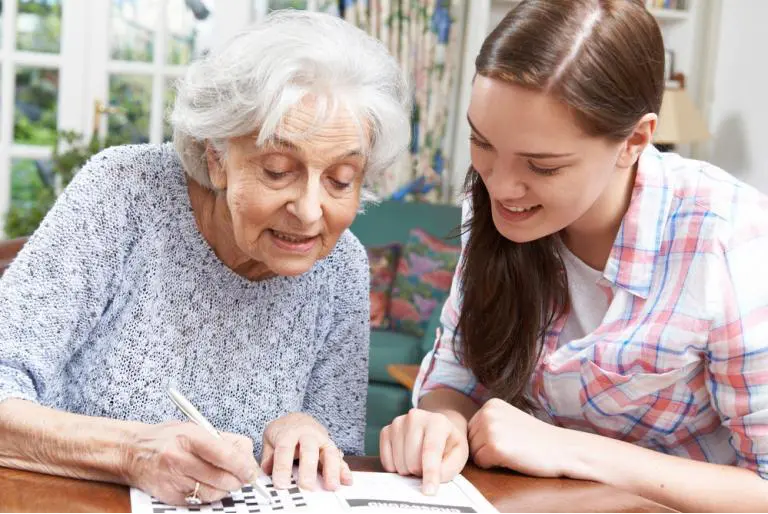
Crossword.

I mean, obviously you get better the more you solve crosswords, but if you keep coming across the same clues (or various clues for the same word) and you don’t know the word, how are you ever going to learn it if you don’t look it up?

You’re not going to suddenly KNOW a word or a person or a phrase if you don’t know it. As much as crosswords are about building skills like wordplay and figuring out what words fit different letter patterns, it’s also about building a personal lexicon and adding to your arsenal as a solver.

The average person does not know ETUI. If they see the clue “needle case,” they’re not going to suddenly know it. Even having one or two correct answers crossing it is not going to magically impart knowledge of the word ETUI.

It’s not cheating if you look up answers. You’re cheating yourself by NOT doing so.

Sure, in a tournament setting or a timed setting, it’s cheating. But in general solving, it’s just prep work that sets you up for greater success down the line.

120718_crossword_L

So, once more for those in the back or those who really want explicit permission:

Once you’ve tried your best, once you’ve filled in as many entries that cross it as possible, once you’ve wracked your brain, taken time away from it, and returned to try again but not succeeded, I hereby give you permission to “cheat.”

Okay? Okay. Happy solving, everyone!

[Oh, and just for clarification, this applies to solvers. There is absolutely cheating in crossword constructing. It’s called plagiarism, and it will not be tolerated.]


Thanks for visiting PuzzleNation Blog today! Be sure to sign up for our newsletter to stay up-to-date on everything PuzzleNation!

You can also share your pictures with us on Instagram, friend us on Facebook, check us out on TwitterPinterest, and Tumblr, and explore the always-expanding library of PuzzleNation apps and games on our website!

Crossword Tournament From Your Couch Recap!

ctfccouch

This past weekend was supposed to be the 43rd year of the American Crossword Puzzle Tournament, but that event was postponed due to the ongoing public health crisis.

But something amazing arose from the ashes of those plans. A small, intrepid group of puzzlers worked night and day for more than a week, bringing an at-home crossword tournament to life: Crossword Tournament From Your Couch. (AKA #CouchWord on Twitter.)

And in doing so, they hosted the biggest crossword tournament in history. According to the Google scoresheet, more than 1,800 solvers took part in the event (with at least 1,300 tackling ALL of the puzzles).

Over the course of a few hours, and thanks to the Herculean efforts of a hard-working few, the puzzle community came together for an afternoon of fun, frivolity, and frantic puzzle-solving.

Oh, and in this recap, I will be discussing the tournament puzzles somewhat, so if you want to remain completely unspoiled, stop reading here. (Or better yet, click here to solve the puzzles for yourselves!)


Before I get into the event itself, I want to highlight the folks who made it all possible.

The initial idea belongs to Kevin Der, who put out the rallying cry to fellow puzzlers. He ran the tech side of the event alongside Finn Vigeland, coordinating each puzzle’s release, the overlapping livestreams, and the live-solving finals.

livestreampic2

Hosting duties were ably carried out by Ryan Hecht and Brian Cimmet, who kept the energy light, made sure the participants were well-informed, and even interviewed fellow constructors and event organizers in the downtime between tournament puzzles.

The tournament puzzles — 4 tournament puzzles, 1 championship playoff puzzle, and 2 warm-up puzzles — were constructed by Byron Walden, Rachel Fabi, Joel Fagliano, Robyn Weintraub, Patrick Blindauer, Finn Vigeland, Laura Braunstein, and Jesse Lansner.

Jeremy Horwitz, Natan Last, and Ellen Ripstein were credited as test-solvers, and Jeff Davidson, Stephanie Yeung, and Vincent Siao were credited as tech support/magic gurus.

The Inkubator was credited as tournament sponsor.

Assembling and running this event was a monumental, complex undertaking, and my sincerest appreciation and utmost respect (and AWE) goes out to everyone involved in making CTFYC possible.
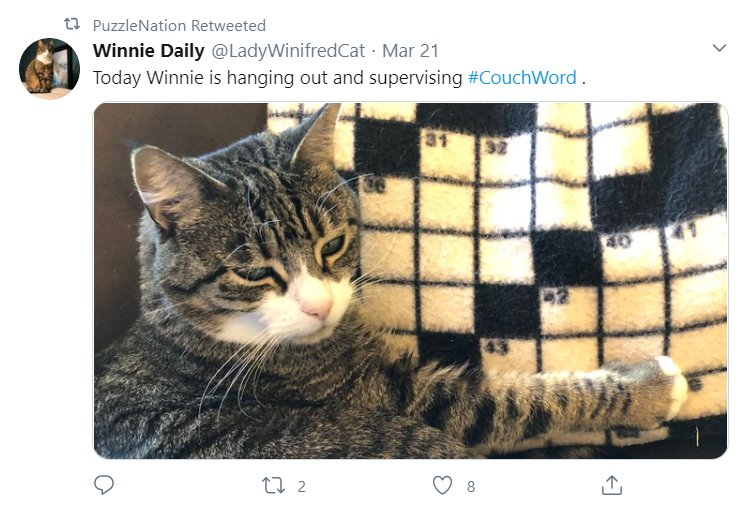

catpuzzle

[Image courtesy of @ladywinifredcat.]

So, how did the tournament itself go?

Well, participants logged into the website and selected one of three divisions in which to compete:

  • The Chesterfield Division (for individuals who in the past few years have finished in the top 20% of a major crossword tournament)
  • The Futon Division (for all other individual participants)
  • The Love Seat Division (for two participants who want to solve together)

Upon logging in, a warm-up puzzle created by Robyn Weintraub awaited solvers. “Get the Pillows Ready” allowed solvers to get familiar with the online solving interface and start getting in a tournament mindset.

tournamentpuzzlepage

The tournament itself was set to begin at approximately 1 PM with the livestream of Ryan and Brian, our amiable emcees who covered the rules, other tournament info, and so on.

The livestream was warm and welcoming, and the accompanying chat area was packed with new faces as well as familiar puzzlers. The usual suspects from ACPT were all there, alongside constructors, puzzle enthusiasts, and top-notch solvers. It was genuinely heartwarming to see so many names I recognized from the puzzle world participating.
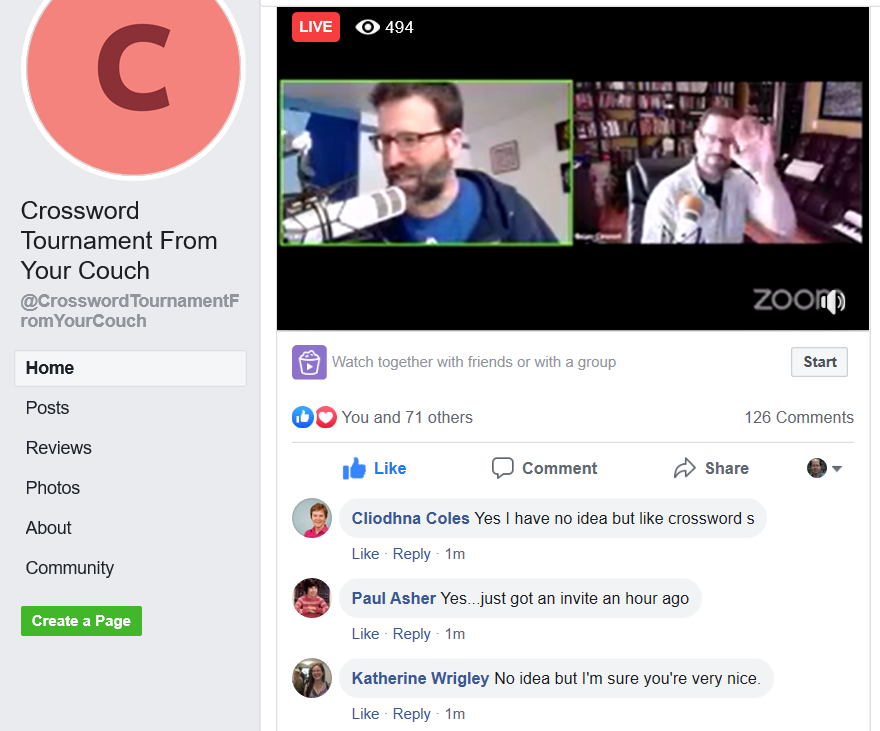
livestreampic

Soon, a second warm-up puzzle became available — Rachel Fabi’s “Put Your Feet Up” — a small, Saturday mini-sized puzzle that still managed to be tricky. (And I personally loved the Fleabag reference.) It was a great way for solvers to get their pre-tournament juices flowing AND served to ensure that all of the tech was working for the organizers.


From the livechat:

“Changed my system font to Papyrus so that I could win Worst Handwriting.” — Neville Fogarty
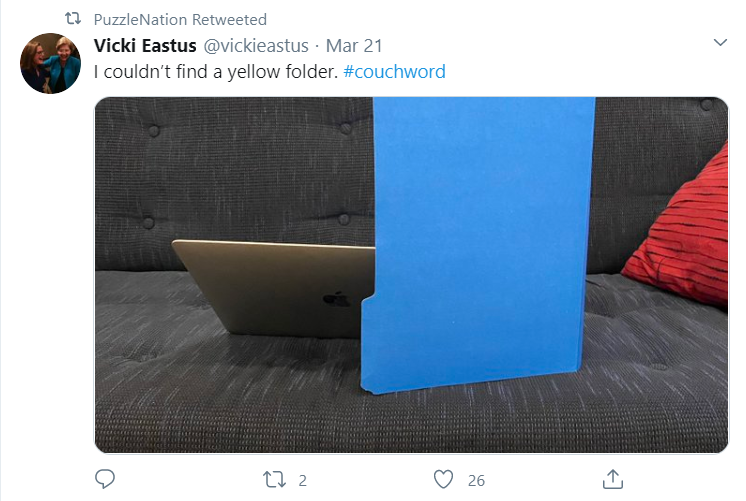

yellowfolder

[Image courtesy of @vickieastus.]

The first tournament puzzle was scheduled for 1:30ish, and to the credit of the organizers, we only started a few minutes late.

Puzzle #1, “Hollywood Ending” by Joel Fagliano, was a 15x puzzle with a 15-minute time limit.

In all, it was a really fun starter with a good hook — entries that end with items found on a Hollywood set, a la JAVASCRIPT. I got stuck in the upper right corner for about two minutes, because I didn’t want to make a mistake, but doing so slowed me down considerably.

With the online solving, results were tabulated much faster than you’d expect from past tournaments, so you could view the leaderboard and see who was on top quite quickly.

At the end of puzzle 1, many of the usual suspects were on top, along with rookie (and bewilderingly constructor) Will Nediger:
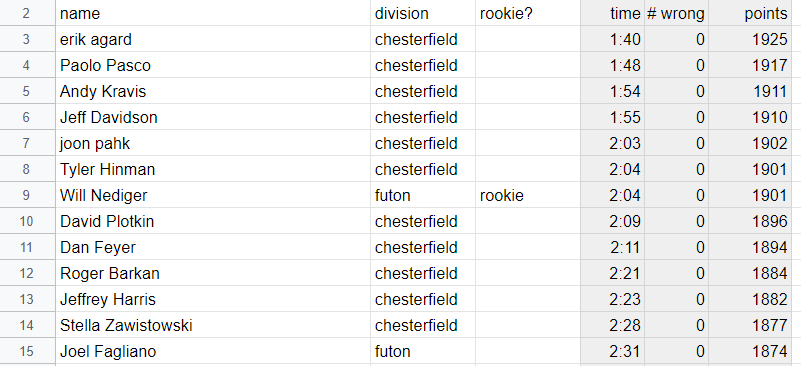
leaderboardafterpuzzle1

After solving, competitors were welcome to return to the livestream chat and treat the chatroom like the lobby at the ACPT, sharing thoughts and commiserating on their solves.

Puzzle #2, “Raise the Roof” by Laura Braunstein and Jesse Lansner, was a 17x puzzle with a 25-minute time limit.

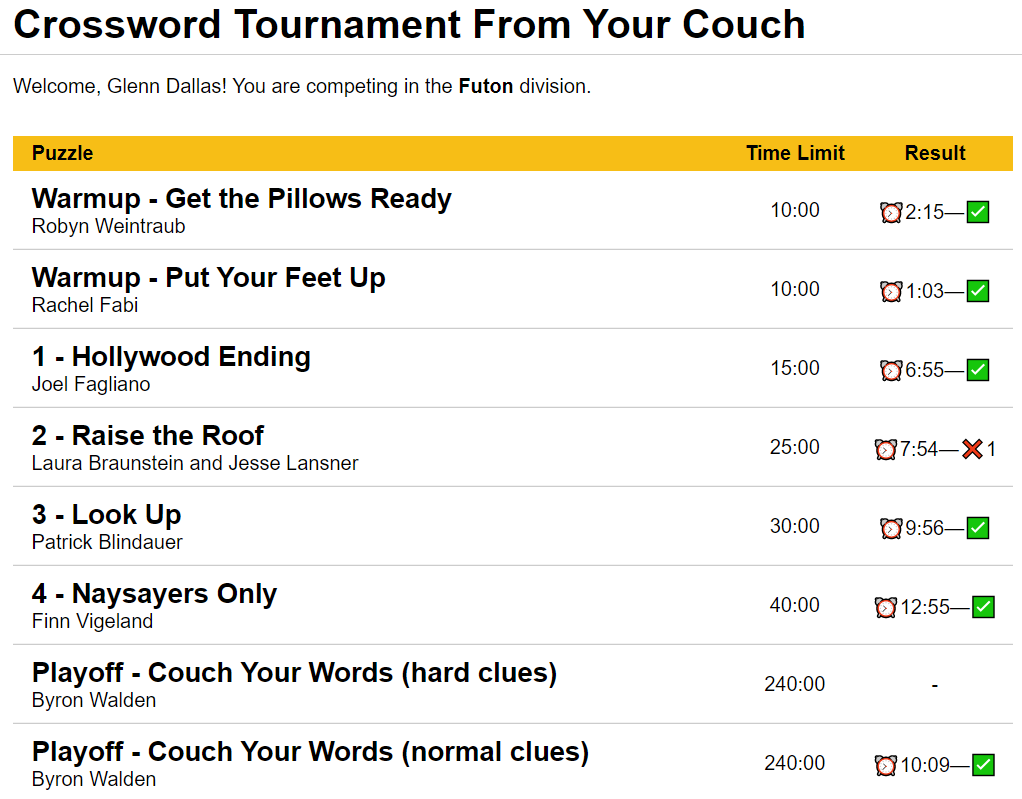
This puzzle had a solid punny hook, phrases where the letter T became P, so you had PICKLE ME ELMO instead of TICKLE ME ELMO. This was accompanied by great fill, although some were tougher entries (like SEZ WHO and NEOPET). I made one dumb mistake, leading to my only error of the tournament, but otherwise, I enjoyed the puzzle.

(I also enjoyed the conversation about The Westing Game in the livestream chat kicked off by the entry RASKIN.)
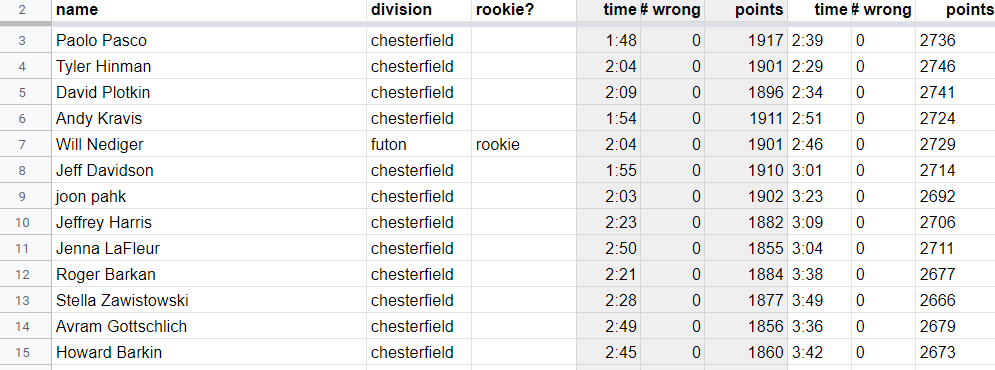
leaderboardafterpuzzle2

Errors by Dan Feyer and Erik Agard opened up a few spots in the top 15, so at least I was in good company with my own error.

At this point, players were invited to take a break before the next two puzzles. The tentative time for that was around 3 PM.

As I surfed the livechat during the break, the feedback for the tournament was overwhelmingly positive. Everyone was enjoying the communal puzzling, and compliments for both the constructors and organizers were plentiful.


From the livechat:

“Yeah, the bad news for the organizers is that this is working so well we’re all going to come to expect it now. :)” — Steve Thurman


Before Puzzle #3, Brian and Ryan had video interviews with Joel, Laura, and Jesse about their puzzles. It was a very cool touch to hear the constructors talk about the origins of each puzzle and how they ended up in the tournament. More of this in the future, please!
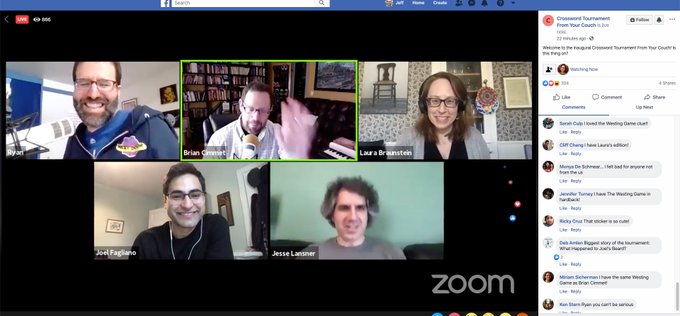
joellaurajesse

[Image courtesy of @tinmanic.]

Soon, we were back, and it was time for the second half of the tournament.

Puzzle #3, “Look Up” by Patrick Blindauer, was a 15x puzzle with a 30-minute time limit. So everyone was expecting some trickery afoot.

Blindauer didn’t disappoint, naturally, offering up a clever hook that took entries in a different direction, mixed with lots of long crossings which made getting into the puzzle difficult. All in all, it was a worthy tournament puzzle.
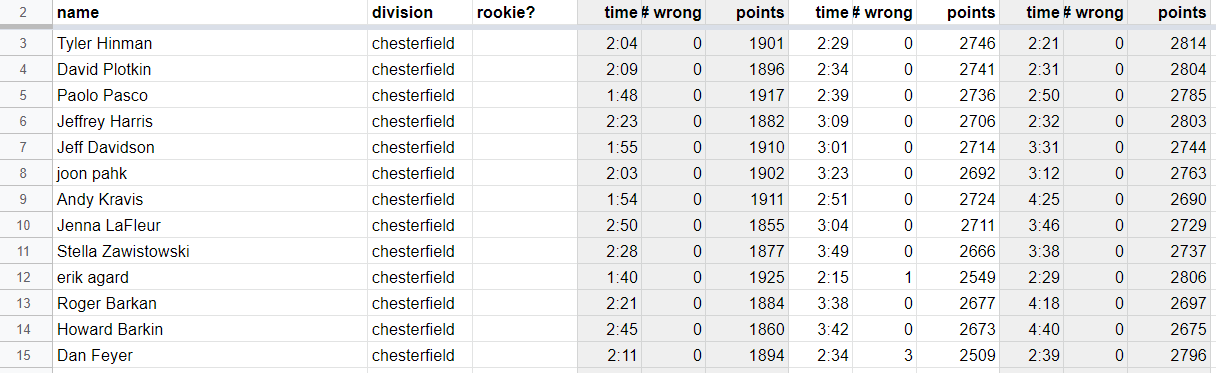
leaderboardafterpuzzle3

I managed to capture this screengrab of the top 15 after Puzzle 3 before the leaderboard went down. As you can see, the blistering speed of Erik Agard and Dan Feyer had them back in the top 15.

Yes, we managed to break the leaderboard on Google Sheets at this point. (This just made the design for the solving interface even MORE impressive, because it never broke down, even with more than a thousand solvers using it at the same time.)

I was ranked 292 after Puzzle 3, which I felt pretty good about.


From the livechat:

“Hmm, I can play the ‘where would I be if not for the silly error’ game.” — GP Ryan


After a short break, the final puzzle of regular tournament play was upon us.

Puzzle #4, “Naysayers Only” by Finn Vigeland, was a 19x puzzle with a 40-minute time limit.

This was a strong finisher for the tournament, combining clever cluing with a tough theme where the clues referred not to the answers you filled in, but to what the answers became if you followed the rule in the revealer GET OUT THE VOTE. (For instance, you filled in the answer VAMPIRE SLAYER, but the clue “Camera for a photo shoot with Dracula, in brief?” referred to VAMPIRE SLR, since you would remove “AYE” when you get out the vote.)

Yeah, I completed the grid first and had to go back and reread the grid and clues to actually understand the theme.
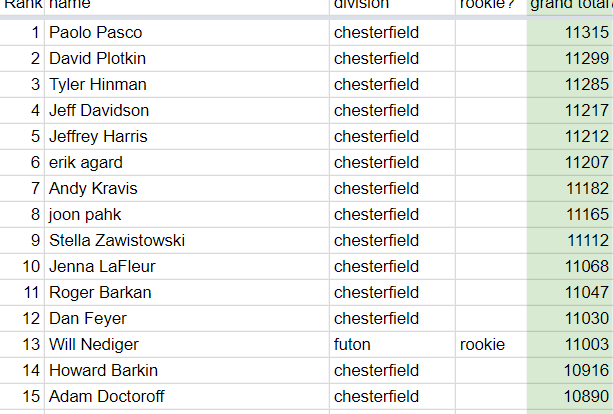
leaderboard2bafter2bpuzzle2b4fixed

Going into the live playoff final, the top 15 reshuffled a bit. (The board was constantly updating. At one point, I was ranked 283, then 312, then 314. I stopped checking there, because I’m a nerd for Pi.)


From the livechat:

“Shout out to the 11 Davids who are ahead of me in the rankings. Watch your backs.” — David Whyte


After Puzzle #4, Brian and Ryan attempted to interview Patrick, but that didn’t go so well, because the audience couldn’t hear Patrick. The interview with Finn went much better.

Then they announced the finalists for each division who would be participating in the live playoffs.

In the Chesterfield Division, it would be Paolo Pasco, David Plotkin, and Tyler Hinman.

In the Futon Division, it would be Will Nediger, Jason Juang, and Ricky Liu, the top three rookies.

As the top 3 competitors in each division were “sequestered” during the prep for the live playoffs, the playoff puzzle was released for non-finalists to enjoy.

The playoff puzzle, “Couch Your Words” by Byron Walden, was a themeless 15x puzzle with a 15-minute time limit. It also had two sets of clues: the difficult Chesterfield set, aka the A level clues, and the somewhat easier Futon set.

I looked at the Chesterfield clues, but I quickly bailed to try the Futon set. And honestly, even with the Futon Division clues, I found the puzzle pretty tough with ALL the long crossings. As you’d expect from Byron, it was a terrific, well-constructed grid, a very worthy choice to close out the day’s events.


From the livechat:

“Puzzle 5 in this tournament is so hard it doesn’t exist.” — Natan Last


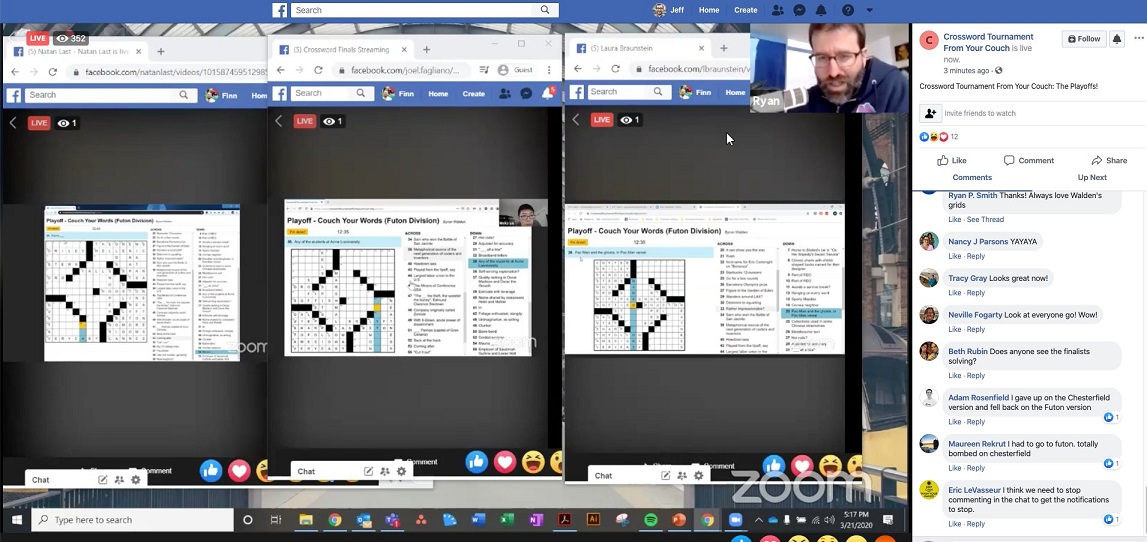
The Futon Division solvers went first, and the three rookie solvers acquitted themselves well.
futonlivescreamfinalsbetter

[Image courtesy of @tinmanic.]

Each solver’s time was linked to when they clicked “Start” and when they clicked “I’m done”, so you couldn’t immediately tell who won based on who finished first, because with the livestream lag, it was hard to tell who started first.

In the end, Will completed the puzzle in 4 minutes flat, Jason wasn’t far behind with 4:48, and Ricky closed out the trio with 6:20. Impressive efforts all around!

There were a few more technical issues before the Chesterfield Division playoffs could begin but eventually the tech team got things sorted and the main event started.

During both the prep and the solving, Brian and Ryan interviewed Byron about the finale puzzle and about constructing and cluing in general. It was a terrific bonus mini-seminar on puzzling!

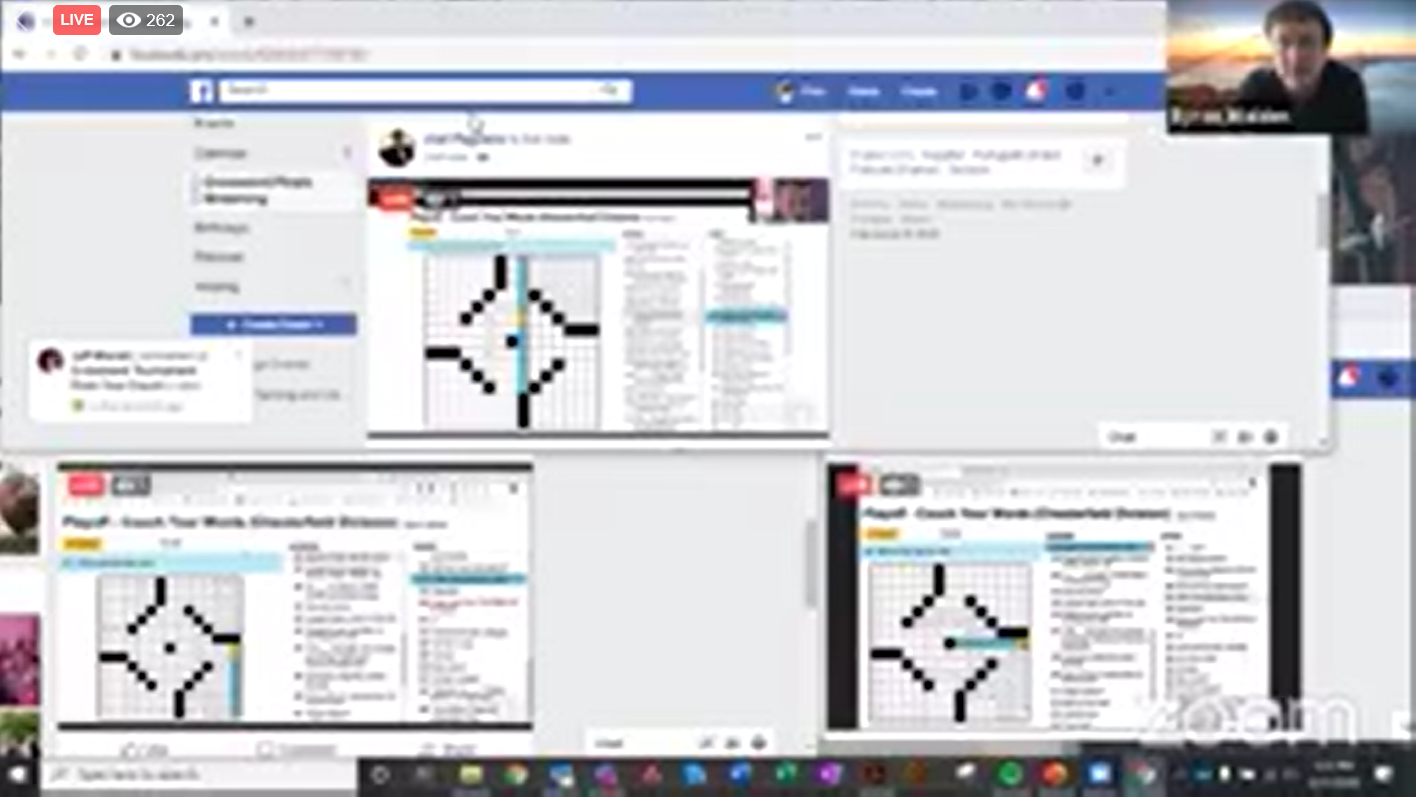
Finally, all was ready and the top three solvers took center stage.
chesterfieldlivestreamfinals

The final was over in less than six minutes.

Tyler, as you might expect from the five-time champ, blasted through the grid, completing it in 4:07. Paolo wasn’t far behind with 4:41, and David, a perennial top finisher, closed out the trio with 5:57.

Again, we had to wait for the official times due to lag, but it was worth the wait.


Here are your Crossword Tournament From Your Couch results:

  • Chesterfield Division: Tyler Hinman, Paolo Pasco, David Plotkin
  • Futon Division: Will Nediger, Jason Juang, Ricky Liu
  • Love Seat Division: Sam Ezersky and Madison Clague, Justin Werfel and Marta Herschkopf, Mike Berman and unnamed partner

After announcing the winners and finalists — and giving another well-deserved shout-out to all of the organizers and folks who made the marvelous event possible — the livestream chat was left running so that participants could talk and enjoy a virtual happy-hour mixer.


From the livechat:

“Anyone else never been to ACPT or Lollapuzzoola, but getting an itch to go after today??” — Josh Beu Forsythe


Even if it hadn’t been the biggest crossword tournament in history, Crossword Tournament From Your Couch would still have been a fantastic success.

More than just a tremendous stand-in for ACPT, CTFYC brought together established puzzlers and newbies for an afternoon of much-needed distraction. (According to the organizers, it was the first tournament for more than 1200 of the participants!)

Thank you once again to everyone involved in this brilliant endeavor. What a treat it was.
myresults


Thanks for visiting PuzzleNation Blog today! Be sure to sign up for our newsletter to stay up-to-date on everything PuzzleNation!

You can also share your pictures with us on Instagram, friend us on Facebook, check us out on TwitterPinterest, and Tumblr, and explore the always-expanding library of PuzzleNation apps and games on our website!