The Week in Puzzles and Games

There’s so much going on in the intertwined worlds of puzzles and games, so let’s skip the intro and get to the good stuff!

Bryant Park Crossword Tournament This Weekend!

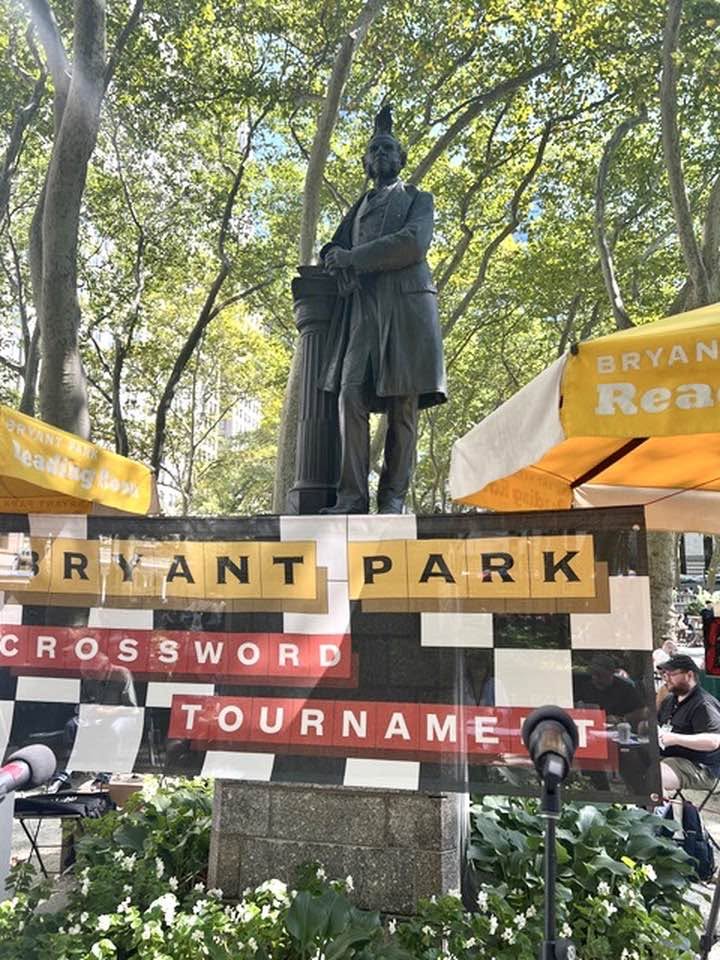
The summer crossword bonanza might have come to an end for another year, but tournament solving fans still have plenty to look forward to! Not only is Chicago’s Midwest Crossword Tournament looming in early October, but the 8th Bryant Park Crossword Tournament is this Saturday, September 19th!

Although you’re welcome to walk in and participate, things go much smoother if you register ahead of time. Click here to get started!
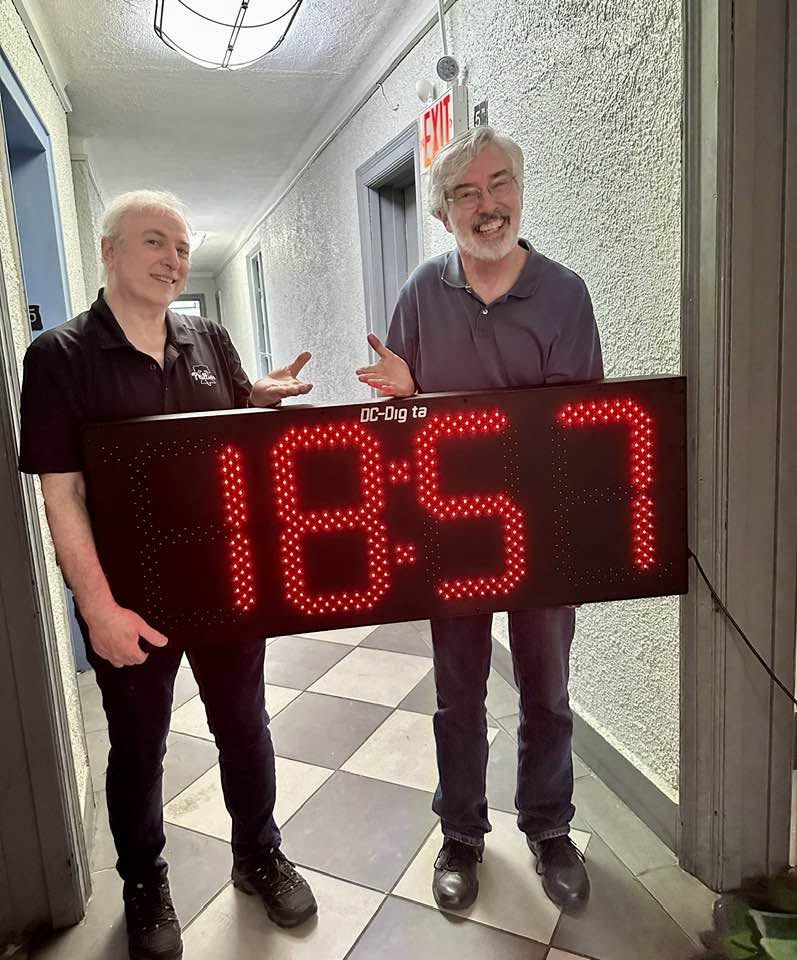
They’ve even borrowed Will Shortz’s clock for the tournament!

With three Mike Shenk puzzles waiting for competitors, you should absolutely make an effort to participate in this year’s event.


boswords new

The Boswords Fall Themeless League Returns Soon!

And speaking of crosswords, there’s still time to register for this year’s Fall Themeless League, which starts up on Monday, October 5 (though they have a preseason puzzle launching the week before on September 28th).

If you’re unfamiliar, the Boswords Fall Themeless League is a clever weekly spin on traditional crossword tournament-style solving. Instead of cracking through a number of puzzles in a single day (or two), the Fall Themeless League consists of one themeless / freestyle crossword each week, scored based on your accuracy and how fast you complete the grid.
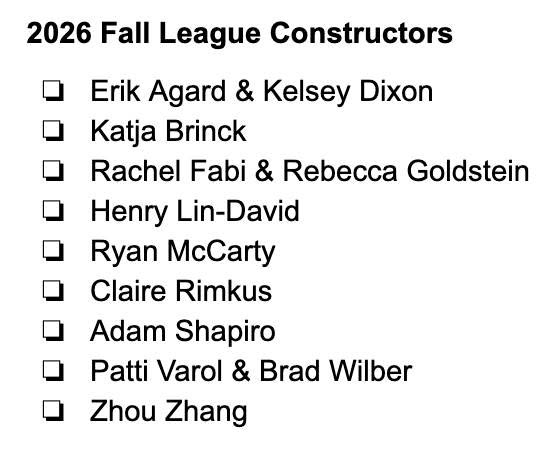
Look at that lineup of talent!

Each week’s puzzle only has one grid, but there are three sets of clues, each representing a different difficulty level for solvers. Smooth is the least challenging, Choppy is the middle ground, and Stormy is the most challenging. (When you register to participate, you choose the difficulty level that suits you best.)

Each week’s puzzle is accompanied by a one-hour broadcast on Twitch, starting with a preseason puzzle and broadcast.

The Fall Themeless League then runs the next nine Monday nights starting at 9 PM.
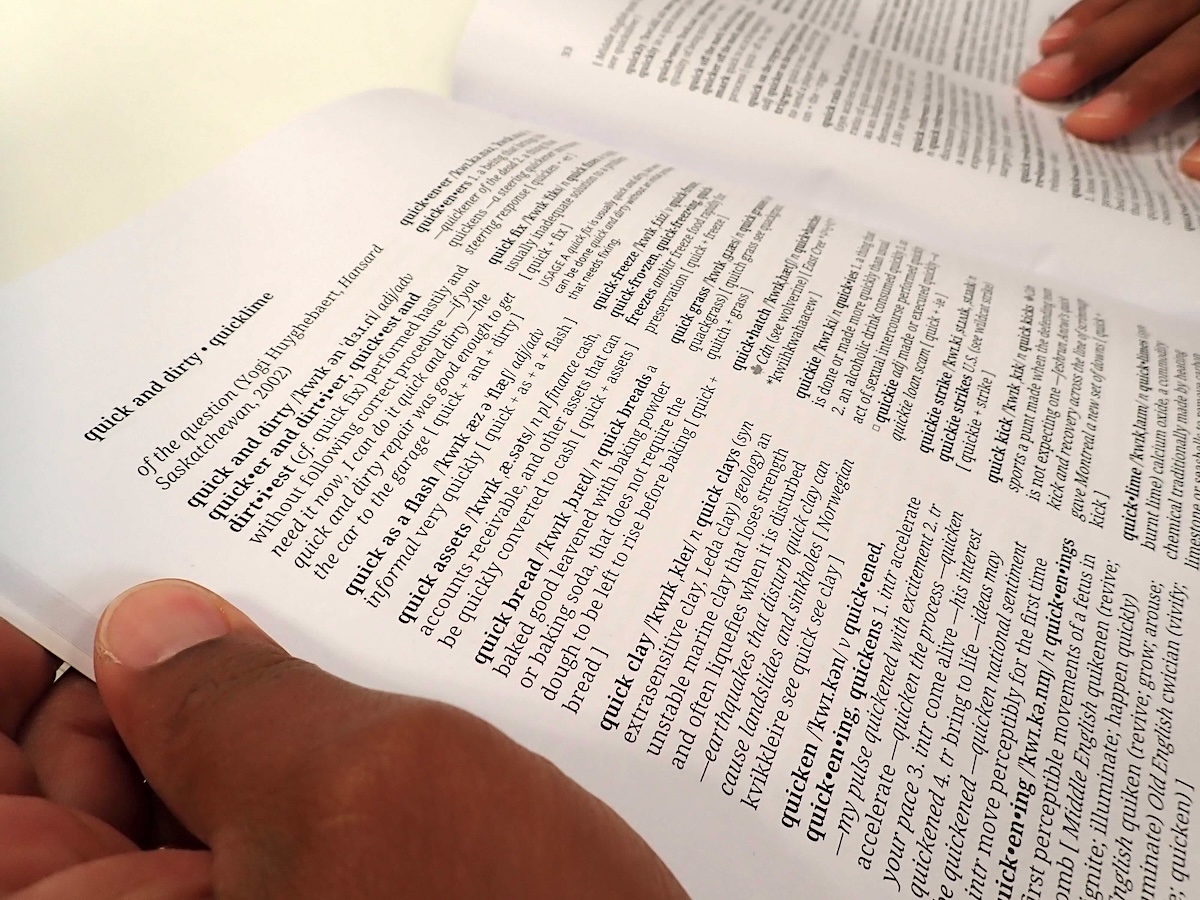

Image courtesy of The Tyee / Michelle Gamage

Scrabble and the Canadian English Dictionary

The Tyee dropped an article recently about a group of Canadian linguists, the Society for Canadian English, that are working on a new Canadian English Dictionary.

And they’ve started with the letter Q.

“Q is a short fascicle, but not as trivially so as X, and it’s a favourite among Scrabble players,” its quintet of authors explained, in an article published in Dictionaries: The Journal of the Dictionary Society of North America.

“Q has plenty of quite quintessentially quirky and quotable words that are useful in attracting attention to our project.”

They wish to raise awareness of their undertaking, not just for public support, but to find a publisher and secure funding for the project.

Check out the full article here. It’s an in-depth and fascinating exploration of the intersection of language, culture, play, and politics.


Two Puzzle Games to Try Out!

One of the coolest things about running PuzzCulture is getting to learn about new puzzles and creators in the puzzle space. Several enterprising constructors have reached out to me recently, and I’m pleased to help spread the word about their puzzly endeavors.

The first is Esteban Martin’s daily decathlon of click-and-drag puzzles, Roughly.Is.
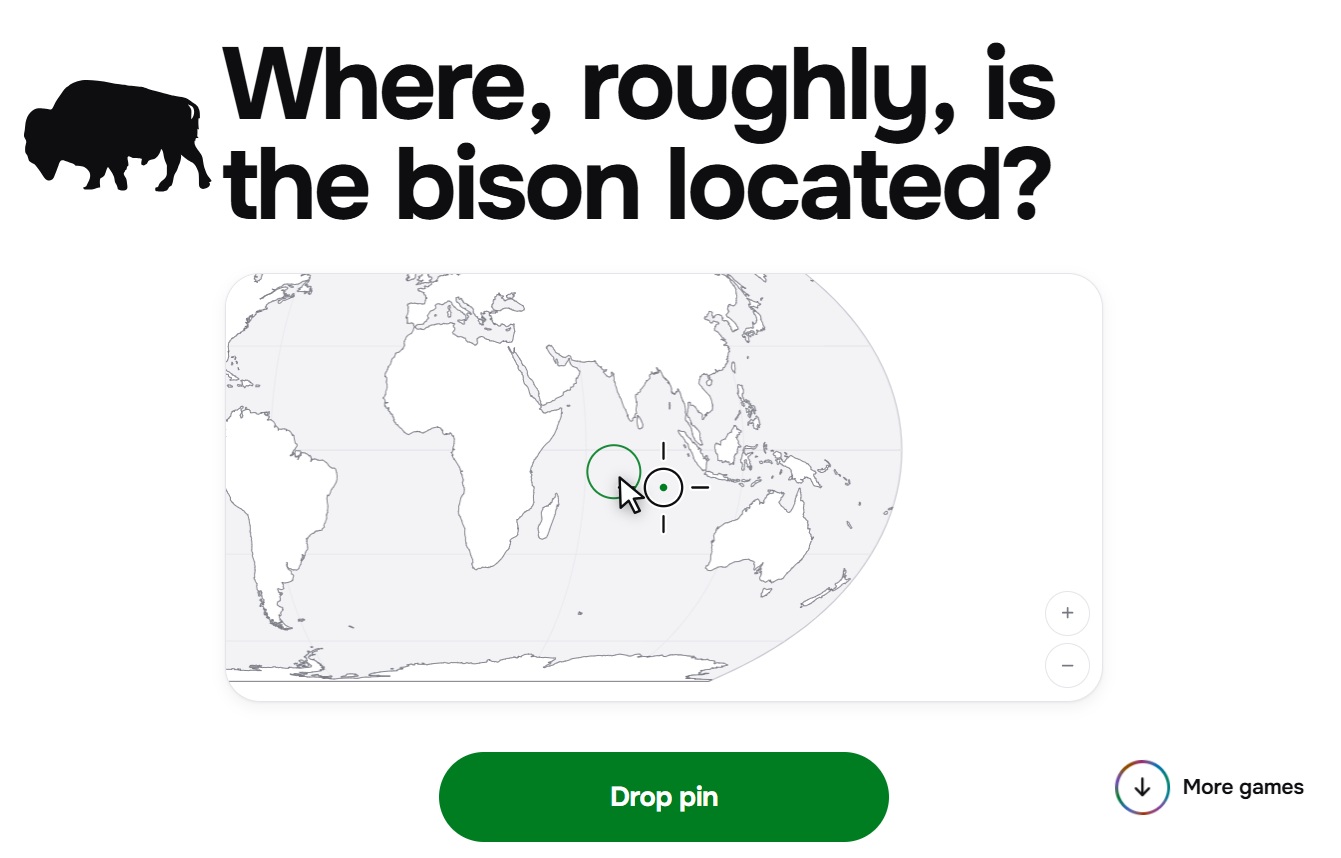
Each day, solvers are presented with ten minigames that pose a question for the reader. Some are simply trivia, others are guessing games or games of skill.

I’m a sucker for puzzles that teach me things, so the games of Roughly.Is are a delight. How big is a blue whale, compared to a Saturn V rocket? What did a steak cost in Zurich in 1970? Where do bison live?

The variety of topics means you’re sure to learn something new or find something to entertain you for a minute. What more can you ask for?

Check out Roughly.Is for all ten minigames, no ads and no login required.
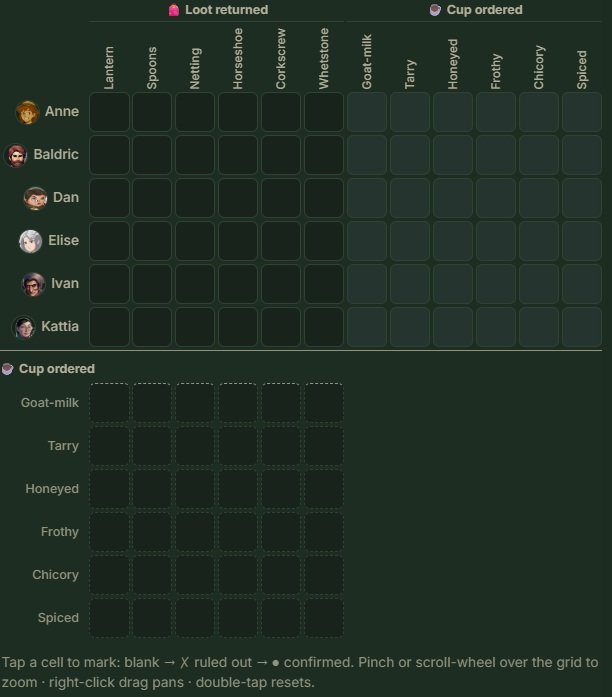
But if you’re looking for a meatier daily challenge, consider Jeff Doka’s Morning Mystery.

Part of the BossFeed puzzle lineup, Morning Mystery is a logic puzzle that invites solvers to use the facts at hand to determine the puzzly truth.

The twist? You can’t trust all of the facts you’re presented with. Some are guaranteed to be genuine, but others could be the characters in the mystery misleading you.

Can you solve the puzzle and determine who is being truthful and who is lying? Give Morning Mystery a shot by clicking here.
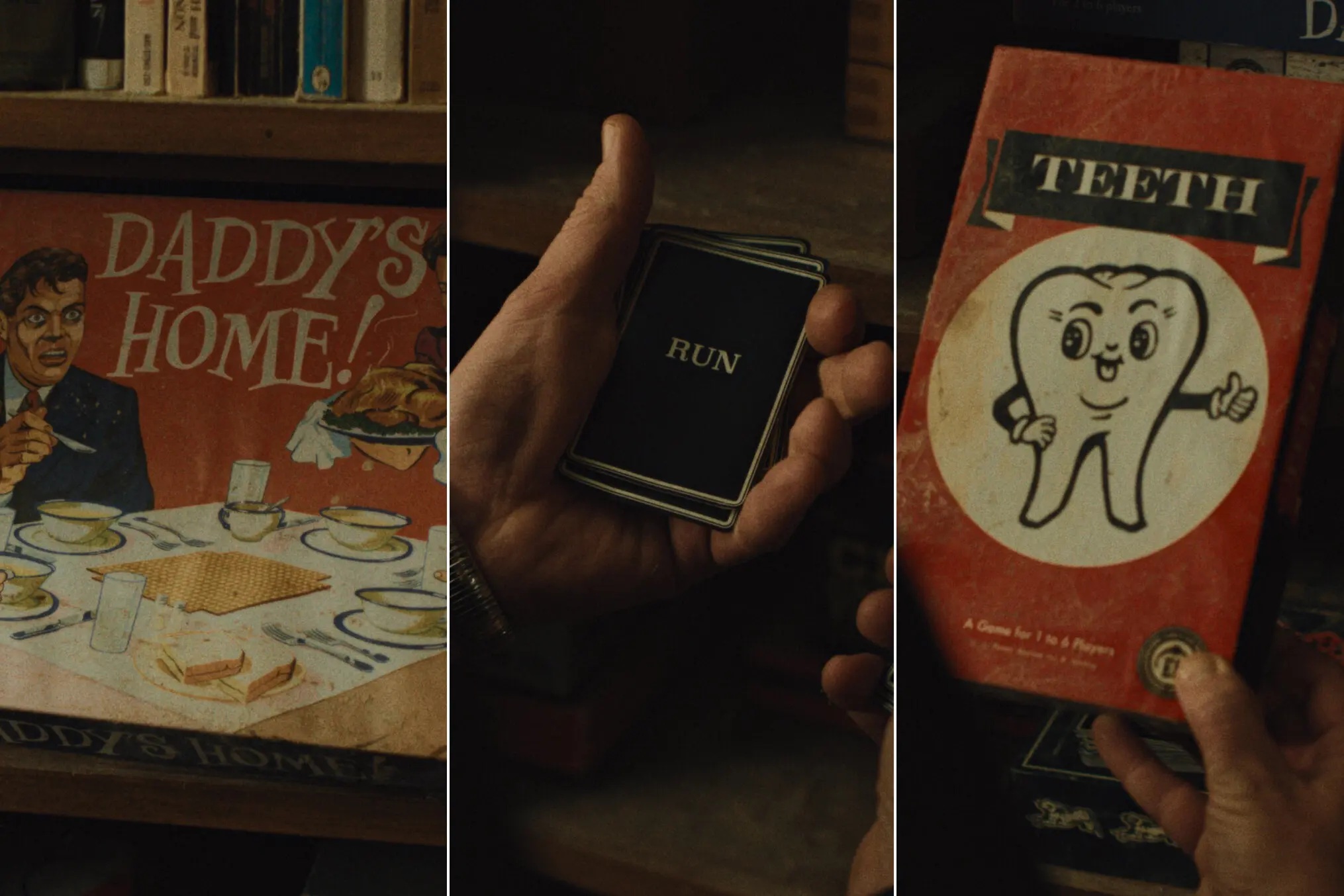

Images courtesy of Apple TV / The New York Times

Widow’s Bay and Its Sinister Board Games

Let’s wrap up today’s post with some insight into Widow’s Bay, fresh off a record-setting bevy of wins at the Emmy Awards.

Widow’s Bay is a horror comedy that’s drawing all sorts of eyes, and for good reason. It’s brilliantly cast, well-paced, and razor-sharp.

And, if you’re a board game fan, there was a creepy treat for you in episode two, as the mayor visited a local inn and discovered a number of board games with unnerving art and unpleasant implications

The New York Times did a fantastic piece with the show’s creative team and the episode’s writer about the board games and fans’ fascination with them.

Check it out, it’s a great read about how visuals and prop production can enhance both humor and horror. (Who’s up for a round of RUN?)


Did I miss any puzzly news or fun board game stories from the last few weeks? Let me know in the comments section below! I’d love to hear from you.
What Makes a Good Brain Teaser?

I was going through a collection of brain teasers a fellow puzzler gave me, and it occurs to me that “brain teaser” is one of the least specific puzzle terms around.

Riddles, logic and deduction, math puzzles, and wordplay games all fall under the brain teaser umbrella. So you never know what you’re gonna get. Are your math skills required? Your outside-the-box thinking? Your ability to pay attention to the specifics of the question itself?

In this collection alone, I found examples of each of these types of puzzles:

Riddle: Sometimes I’m green, sometimes I’m black. When I’m yellow, I’m a very nice fellow. That’s when I’m feeling mighty a-peeling. What am I?

Logic / deduction: 3 guys go into a hardware store, all looking for the same thing. William buys 1 for $1. Billy buys 99 for $2. Finally, Willie buys 757 for $3. What were they buying?

Math puzzle: The sum is 12 and the same digit is used 3 times to create the sum. Since the digit is not 4, what is the digit?

Wordplay: Which state capitals would you visit to find a ram, cord, bus, and dove?

So, if someone challenged you to a brain teaser, these would all be fair game. Would you be able to solve all four of them?


It’s possible you wouldn’t, because good and bad brain teasers alike employ tricks to keep you on your toes.

Some hide the answer in plain sight:

Homer’s mother has 4 children. 3 of them are named Spring, Summer, and Autumn. What is the 4th named?

Some use misdirection, purposely phrasing the question to get you thinking one way and steering you away from the real solution:

The big man in the butcher shop is exactly 6’4″ tall. What does he weigh?

In fact, both of these examples use plain sight (Homer, butcher shop) and misdirection (implying a pattern with seasons, specifying his height) to distract you.

I suspect you weren’t fooled by either of them, though.

Others try to overwhelm you with information so you bog yourself down in the details instead of clearly analyzing the problem at hand:

Nina and Lydia start from their home and each runs 2 miles. Nina can run a mile in 8 minutes 30 seconds and Lydia can run a mile in 9 minutes 10 seconds. When they finish running, what is the furthest apart they can be?

A lot of numbers get thrown at you, but they’re irrelevant, since the question only asks about the distance, not the time. So if they each run 2 miles, the furthest apart they can be is 4 miles. The rest is just smoke.

These are all effective techniques for teasing a solver’s brain. You’re given all the information you need to solve the puzzle, plus a little extra to distract, mislead, or overwhelm you.


Unfortunately, some brain teasers use unfair techniques to try to stump you:

Jacob and Seth were camping in June. Before going to sleep they decided to read a book. They both agreed to stop reading when it got dark. They were not fast readers, but they finished the entire encyclopedia. How?

Ignoring the fact that these two boys somehow brought an entire encyclopedia with them on a camping trip, we’re not actually given a lot of information here.

So that makes the intended answer seem like more of an insane leap than a logical jump to the conclusion: They were in Lapland, land of the midnight sun, and the sun didn’t set until September.

WHAT?

There’s no reasonable way for someone to reach this conclusion based on the information given. In fact, it makes less sense the more you read it. Presumably Jacob and Seth know where they are camping, and that it wouldn’t get dark for months. So why would Jacob and Seth agree to stop reading when it got dark IF THAT MEANT THEY’D BE READING UNTIL SEPTEMBER!?

This is gibberish, and you’d be surprised how often something like this gets passed off as acceptable in a collection of brain teasers. (I discussed a similar issue with detective riddles in a previous blog post.)


Let’s close out today’s discussion of the ins and outs of brain teasers with a few fun, fair examples, shall we?

  • In what northern hemisphere city can you find indigenous tigers and lions?
  • Scientists have found that cats are furrier on one side than the other. The side with the most fur is the side that cats most often lie on. Which side of a cat has more fur?
  • A woman married over 50 men without ever getting divorced. None of the men died and no one thought she acted improperly. Why?

Did you solve them all? Let us know! Also, please share your favorite brain teasers (or your tales of treacherous and unfair brain teasers) in the comments below!

Happy puzzling, everyone!

A Festive Brain Teaser Submitted For Your Puzzly Pleasure!

[Image courtesy of SharpBrains.com.]

When’s the last time you had your brain properly tied in knots by a riddle?

That’s a pretty common occurrence around here, honestly. In our puzzly explorations of the world, we stumble across all manner of brain teasers, riddles, logic puzzles, math problems, mind ticklers, deduction games, and wordplay-fueled bits of linguistic legerdemain.

Sometimes, we even receive them directly from our fellow PuzzleNationers!

And on those occasions, we happily share them with you, dear reader, so that you can also enjoy the challenge of unraveling whatever fiendish puzzly conundrum has been placed before us.

This time around, a solver named Darrin submitted this festive holiday puzzle he found in his aunt’s collection of puzzle books. (He credits Marilynn Rapp Buxton as the constructor of this puzzle.)

Let’s see how we do.


Four friends — two girls named Holly and Joy, two boys named Kris and Noel — all celebrate their birthdays during December. Though none was born on Christmas Day — each was born on a different day — they all have festive names. Can you figure out each person’s last name and order of birth?

1. Nobody’s first name goes with the traditional last name (Berry, Fully, Kringle, or Singer) that you might expect.
2. Someone’s birthday is three days after their friend Joy’s birthdate.
3. Holly’s birthday is three days before Noel’s and three days after Kris’.
4. Miss Fully’s birthdate is six days after Joy’s.
5. Noel’s birthdate is six days after the one whose last name is Berry.

Will you be accepting this puzzly challenge from a fellow PuzzleNationer? Let us know in the comments section below. We’d love to hear from you!


   dailypopwsicon

Treat yourself to some delightful deals on puzzles. You can find them on the Home Screen for Daily POP Crosswords and Daily POP Word Search! Check them out!

Thanks for visiting PuzzleNation Blog today! Be sure to sign up for our newsletter to stay up-to-date on everything PuzzleNation!

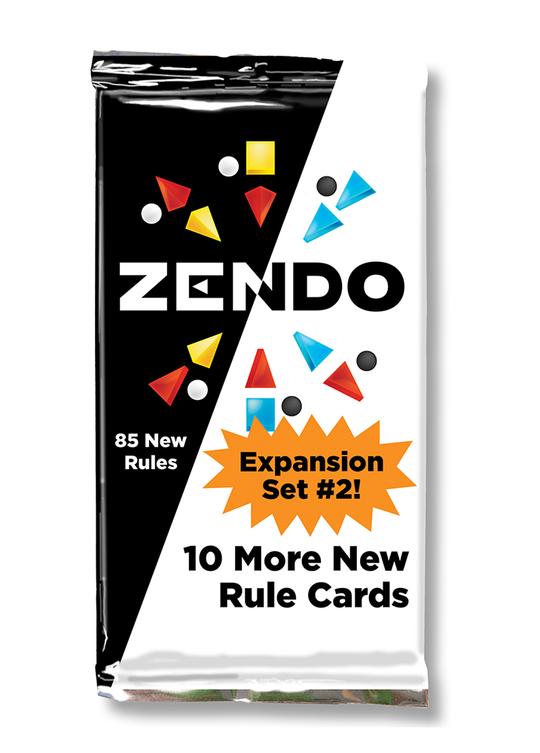
PN Product Review: Zendo Expansion #2

[Note: I received a free copy of this game in exchange for a fair, unbiased review. Due diligence, full disclosure, and all that.]

Even the best designed games need a little sprucing up from time to time. This is especially true of logic/deduction games, where after a while, it can feel like you’ve seen every trick either the game or the other players can offer.

And there are very few game companies that consistently deliver great expansions. It’s a brutal tightrope to walk; you have to add to the established game in an interesting or fresh way, but without breaking the rules, introducing problems that players won’t know how to handle mechanically, or betraying in some manner the spirit of the original game.

For the team at Looney Labs, though, creating an expansion pack seems like another day at the office. We’ve reviewed expansion packs in the past for Fluxx (Fluxx Dice), Just Desserts (Just Coffee/Better with Bacon), and Star Trek Fluxx (the Bridge Expansion), and each one revitalizes the game and adds delightful new wrinkles without hampering any of the qualities that made the original game such a treat.

Today, we’re looking at a new expansion pack for one of the company’s most immersive and challenging puzzle games: Zendo.

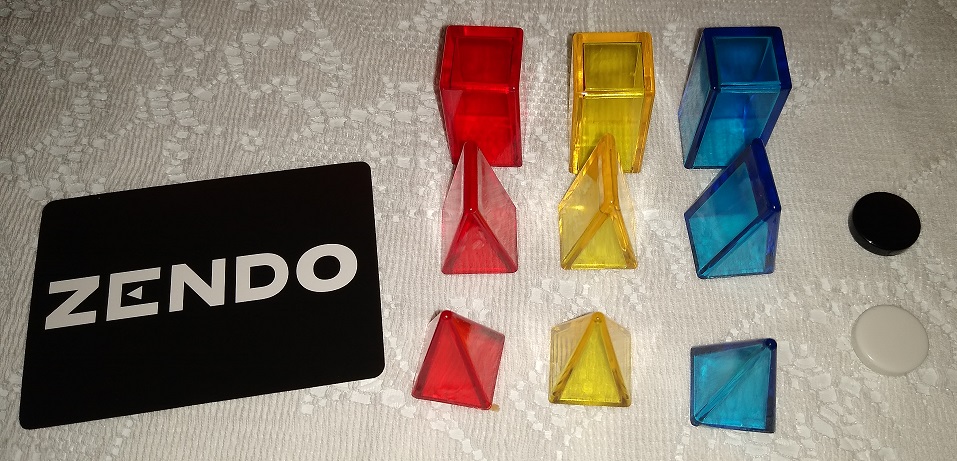
In Zendo, the players pull pieces from a communal pile in order to build different structures, using pyramids, wedges, and blocks. One player, the moderator, chooses a secret rule for the players to uncover, and builds two structures. One of these structures follows the secret rule, and one does not, and both are marked as such.

Secret rules can be as simple as “must contain all three shapes” or “must contain exactly four pieces.” They can be as complex as “must contain more blue pieces than blocks” or “must contain at least one yellow piece pointing at a blue piece.” Some rules involve how pieces touch, or how they’re stacked, while others demand no touching or stacking whatsoever. The field is wide open at the start of the game.

Players then try to deduce the secret rule by building structures themselves, arranging pieces from the communal pile into various patterns and asking the moderator for more information.

So, how does Zendo Expansion #2 affect the original?

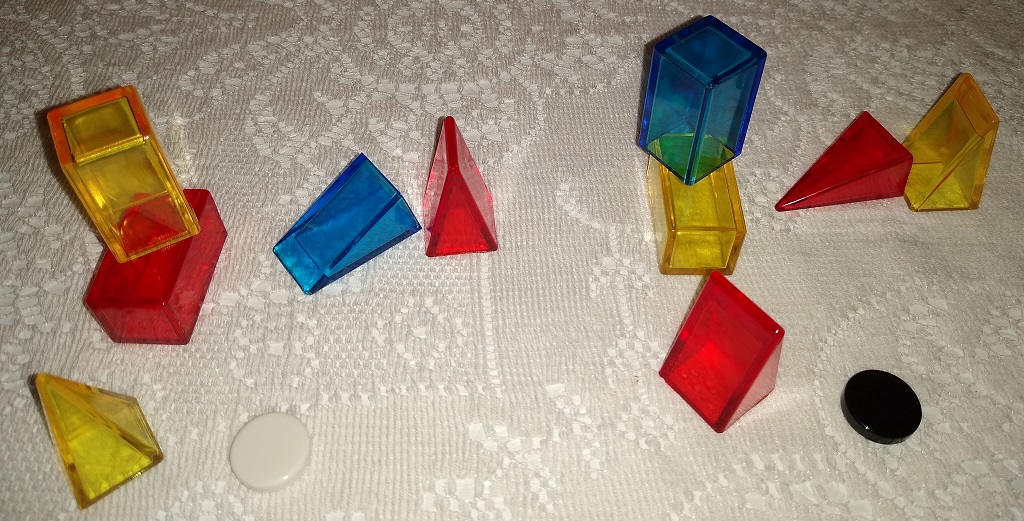
[Here are two sculptures: one that follows the secret rule and one that doesn’t. Can you figure out the secret rule? Is it about shapes? Colors? Placement? More?]

Zendo Expansion #2 is a ten-card deck of new secret rule cards that allow the moderator to create fresh challenges for the other players to unravel. The structures and arrangements may look the same, but players must reexamine what they think they know and observe to figure out the new secret rules.

Because, you see, the cards offer more than just the new rules. They demand greater cleverness from the moderator, in order to create designs that are fair for the players — not immediately obvious, but not impossible to discern either. It’s a difficult task for moderators.

And the challenge is even greater for players. After all, it’s not just about the shapes and how they interact, but all aspects of what the players see. Zendo Expansion #1 had cards where the rule involved the shape of the structure’s shadow. You could look at the pieces, the colors, how they’re placed, where they’re placed, how close, how far away, how many of each, and the shape of the shadow could NEVER occur to you.

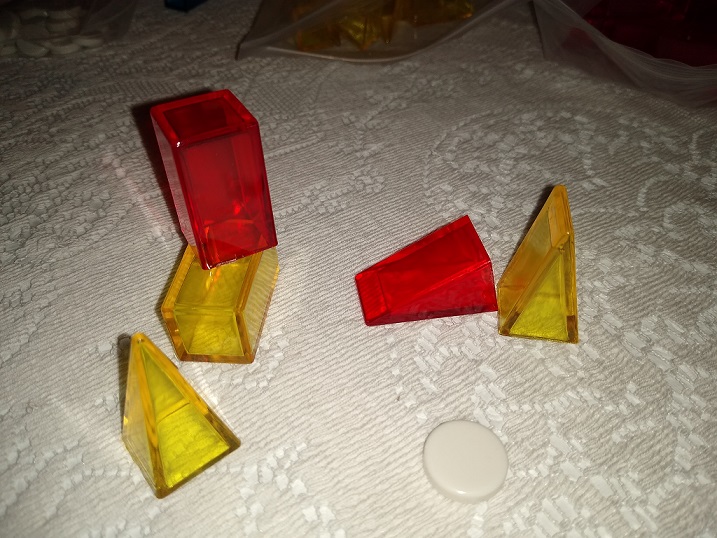
[Here’s another sculpture that removes blue pieces as a possible
element in the secret rule. Have you figured it out yet?]

With one medium rule card and nine difficult rule cards (as opposed to the easy-to-difficult range of the first expansion pack), the game will only become more surprising and thoughtful from here.

These cards include rules about relationships between pieces, conditional rules (example: something that’s true of the sculpture if something else happens theoretically), and even rules regarding something that ISN’T happening in a particular sculpture. Players will have to wrack their brains and truly example both sculptures from every angle to puzzle out these new rules.

There are even decoy tags on certain cards, to make players think the card has more variables than there actually are! Diabolical!

Although I’m a moderator far more frequently than a player, I’m excited to try out both sides of these new rule cards. After all, with the base set and two expansions’ worth of cards, there’s no way I can remember ALL of the possible combinations available. I’m as likely to be outwitted and outpuzzled as the next player.

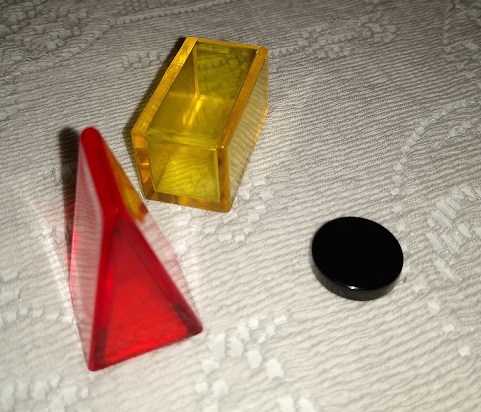
[One more chance. Here’s a much simplified version that DOESN’T
adhere to the secret rule. What can we learn from this one?]

And that’s the charm of Zendo. From a small gathering of pieces and rules, you can make practically any scenario you wish. Will the players figure it out first try, or will the moderator’s ability to reinvent their sculptures as needed be put to the ultimate test?

Zendo is at once the most collaborative and one of the most curiously devious puzzle-games in the Looney Labs catalog, and with this expansion pack, only the truly inventive and observant will thrive. What a treat.

[Zendo and the new Zendo Expansion #2 are available from Looney Labs, and the expansion pack is only $5!]


Oh, and if you figure out our secret rule for the post, we’ll send you a Zendo-themed prize!


dailypopwsicon

Have you checked out our special summer deals yet? You can find them on the Home Screen for Daily POP Crosswords and Daily POP Word Search! Check them out!

Thanks for visiting PuzzleNation Blog today! Be sure to sign up for our newsletter to stay up-to-date on everything PuzzleNation!

Fairness and Accessibility in Puzzles?

We love crosswords here at PuzzleNation. Crosswords are our bread and butter, as well as our pizza, our salad, and our desserts.

We strive to keep our puzzles as accessible as possible for solvers of all ages. And that’s tougher than non-puzzlers might think.

Recently we discussed a never-ending debate in crosswords as we delved into the many, sometimes contradictory, goals of creating a great crossword. You want entries to appeal to older solvers without alienating younger solvers, and vice versa. Some people despise pop culture references and proper nouns, while others embrace them.

Abbreviations, partial phrases, fill-in-the-blank clues, wordplay clues, clues that reference other clues… there’s a vast swathe of crossword qualities that must be balanced, and no matter how good a job you do, you’re probably still going to have a few dissenting voices who believe you should do better.

As a hobby still very much viewed as the purview of older white men — despite the many worthwhile voices of women, people of color, and members of the LGBTQIA+ community that contribute to the world of crosswords in increasing numbers — the language featured in crosswords MATTERS.

It reflects our society, serving as a microcosm of the current day and our culture as a whole. Older solvers might not know new slang or black artists or trans performers or any number of references that are growing more commonplace AND gaining greater visibility. But updating the vocabulary of crosswords is a constant effort, and a worthwhile one.

But I said a lot of this in that previous post, so why am I returning to the topic now?

Well, because I find this continuing democratization of crosswords interesting, because it’s something required of crosswords, but not of many other types of puzzles.

Word seeks (except for some variations) give you the starting list, and then you go hunting for answers. Fill-Ins do the same thing, leaving you the empty grid to fill but requiring no specialized knowledge. Everyone gets the same running start.

(I snagged this helpful image from www.logic-puzzles.org.)

Traditional logic puzzles are also presented on an even playing field. You’re presented with information (say, hints about various names, places, times, and activities), as well as an end goal to figure out (the correct schedule of who did what, where, and when).

You don’t have to bring any foreknowledge or previous experience to the table. Given the opportunity, everyone should have an equal chance of solving the puzzle.

Naturally, this equality depends on the assumption that you, the solver, can read the language the puzzle is presented in.

Which brings me to, perhaps, the most democratically fair paper puzzle of all: Sudoku.

The rules are simple, even if the puzzles can be very challenging: place the numbers 1 through 9 in every row, column, and cell.

Even at a glance, without knowing the puzzle, pretty much anyone would have an idea of what’s going on and what needs to be done. Language doesn’t matter, so long as you can identify the nine different symbols to be placed. (This is why word and color variations of Sudoku exist, because the numbers themselves are irrelevent. You just need nine different things.)

Anyone can pick up a pen, a pencil, or a stylus and solve a Sudoku.

And we should strive for the same thing with crosswords.

Sure, all of those other puzzles require practice to get GOOD at them. But at a baseline, everyone who approaches them has a fair shot. Crosswords demand that solvers bring their own knowledge and info and trivia and vocabulary to the table.

But crosswords as a whole should seek that same democratization: Accessibility. Representation. That inviting X factor.

There’s already a touch of that in the medium. Anytime I see someone solving a puzzle on a train, or in an airport, or in some public place, there’s always someone else sneaking a peek or stealing a glance.

Have you ever seen someone complete a crossword for the very first time? I have, and it’s awesome. It’s a magnified version of the delicious a-ha moment when you unravel a tricky clue.

Do you remember the joy in your heart the first time you conquered a New York Times puzzle on a difficult day? The first time you solved a puzzle type you’d never bested before? The first time you cracked the meta lurking in the background of an already devilish design?

Everyone should get that feeling.

No crossword will ever be everything every solver wants it to be. And that’s fine. But I do look forward to the day when everyone looks at a puzzle and at least one of the clues speaks to them, makes them feel seen and heard and represented.

Puzzles should be for everyone.

[Thank you to ThinkFun and Michelle Parrinello-Cason for inspiring this post.]


dailypopwsicon

Have you checked out our special summer deals yet? You can find them on the Home Screen for Daily POP Crosswords and Daily POP Word Search! Check them out!

Thanks for visiting PuzzleNation Blog today! Be sure to sign up for our newsletter to stay up-to-date on everything PuzzleNation!

Say It Ain’t Sudoku: A Puzzly Hashtag Game!

201654408_4210866405626741_6616576075734839633_n

You may be familiar with the board game Schmovie or hashtag games on Twitter.

For years now, we’ve been collaborating on puzzle-themed hashtag games with our pals at Penny Dell Puzzles, and this month’s hook was #PennyDellPuzzleQuote. Today’s entries all mash up Penny Dell puzzles with famous quotations!

Examples include: “Be the Changaword you wish to see in the world,” “Loose Blips sink ships,” or “Cogito, ergo Sum Triangles.”

So, without further ado, check out what the puzzlers at PuzzleNation and Penny Dell Puzzles came up with!


One cannot Step by Step in the same river twice.

We’ll Anacross that bridge when we get to it.

One and Only if by land, Two at a Time if by sea.

You miss 100% of the shots you don’t Give and Take.

Piece by piece comes from within. Do not Word Seek it without.

It ain’t over ’til it’s Overlaps.

A Penny Press saved is a Penny Press earned.

It takes two to Tanglewords.

The buck Stoplines here.

It’s all right there in Block and White.

Leave no Stepping Stones unturned.

Don’t judge a Bookworm by its cover.

Chain Words are only as strong as their weakest Linkwords.

Picture This…worth a thousand Word Seeks.

A stitch in time saves Three from Nine.

When the going gets Mind Boggler, the Mind Boggler gets going.

When life gives you Share-A-Letter, make Alphabet Soup.

All Four One and one Four-Most.

That’s one small Stepping Stones for man…

You are the Masterwords of your unspoken Word Seeks, but a slave to the Wordfinders you have spoken.

The only thing we have to fear is test-solving forty Codewords in a row.

. . . and go round and round and round in the Circle Sums game.

The pre-type reviewer’s red pen is mightier than the sword.


Members of the PuzzleNation readership also got in on the fun when we spread the word about this hashtag game online!

On Facebook, fellow puzzler Ralph Angelo B. Sinson contributed this quote that he didn’t even have to alter!

“If you come to a Logic show, you get all creeds, colors, religions, and sexual orientations.”


dailypopwsicon

Have you checked out our special summer deals yet? You can find them on the Home Screen for Daily POP Crosswords and Daily POP Word Search! Check them out!

Thanks for visiting PuzzleNation Blog today! Be sure to sign up for our newsletter to stay up-to-date on everything PuzzleNation!