The River Crossing Puzzle

Hey there, fellow puzzler. Stop me if you’ve heard this one before:

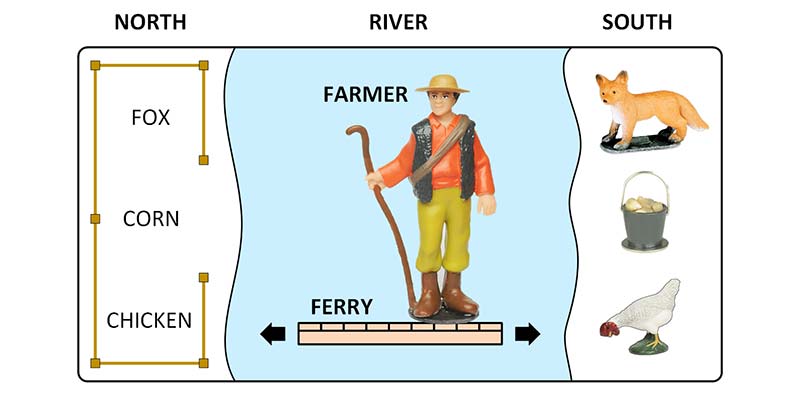
Image courtesy of Nuts & Volts.

A farmer with a wolf, a goat, and a cabbage must cross a river by boat. The boat can carry only the farmer and a single item. If left unattended together, the wolf would eat the goat, or the goat would eat the cabbage. The farmer must help them all cross the river without anything being eaten.

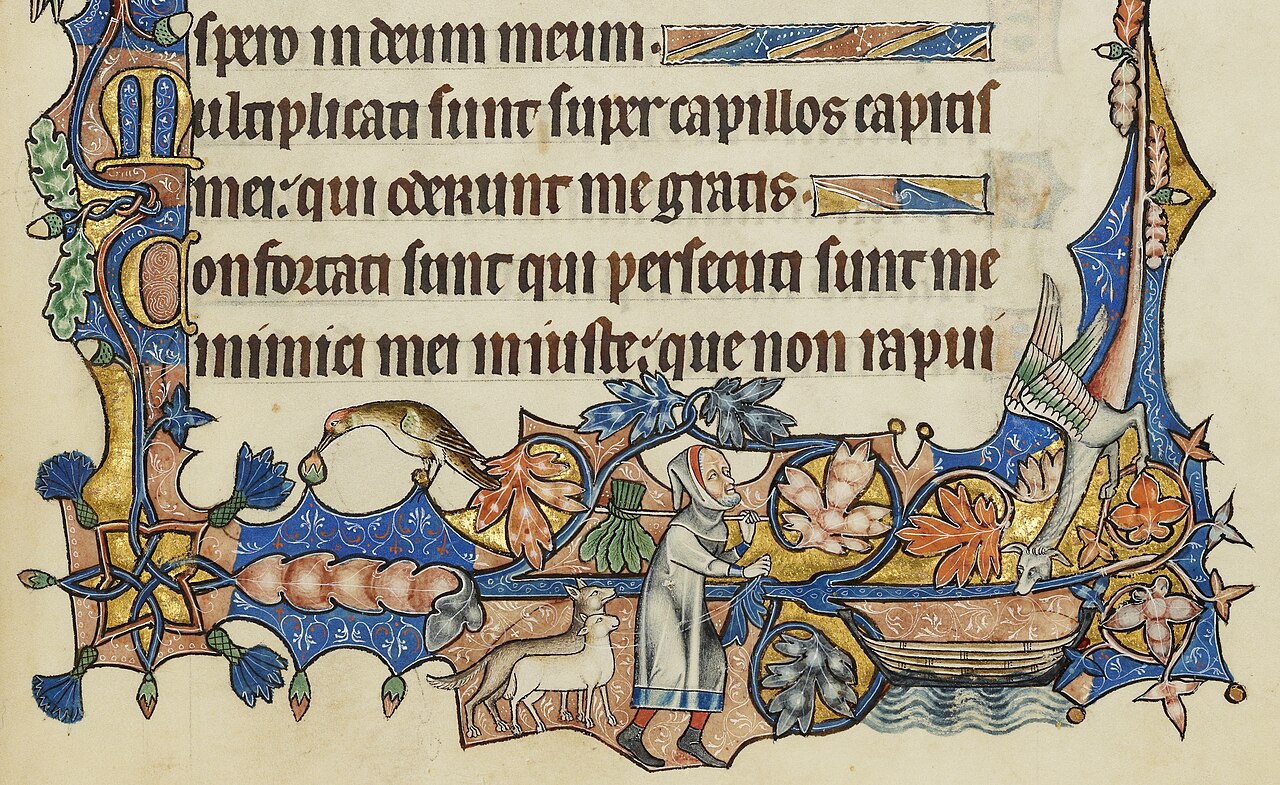
This is known as a river crossing puzzle, and there have been many versions over the years. In fact, the earliest known variation, printed in Propositiones ad Acuendos Juvenes (Problems to Sharpen the Young), dates back to the 9th century!

Depiction of the riddle from the Ormesby Psalter, dating back to 1250-1330

Sometimes the puzzle features missionaries and cannibals crossing a river, and you cannot allow the missionaries to be outnumbered at any point on either shore, lest they be eaten. Sometimes it features jealous husbands crossing a river with their wives, where none of the men will allow his wife to be alone with either of the other men. Sometimes it is knights and squires, and the squires are afraid to stay with the other knights.

I’m going to ignore the racial and misogynistic energy of those examples and focus on the wolf, goat, and cabbage version, which is the one people are most familiar with. (Although the animals do change from riddle to riddle. Sometimes it’s wolves, sheep, and cabbages, other times it’s foxes, chickens, and grain, or foxes, geese, and seeds.)

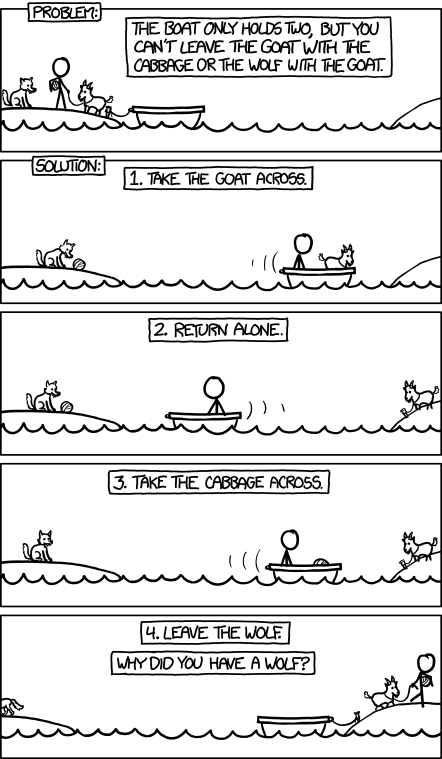
The traditional answer works for any variation:

  • you take the prey (goat, sheep, chicken) across
  • you come back with the boat otherwise empty
  • you take either the predator (wolf, fox) OR the prey’s food (grain, cabbage, seeds) across
  • you come back with the prey in the boat
  • if you took the predator first, you bring the prey’s food this time. If you took the prey’s food first, you take the predator this time. Either way, you leave the prey behind on this trip
  • you come back with the boat otherwise empty
  • you take the prey across

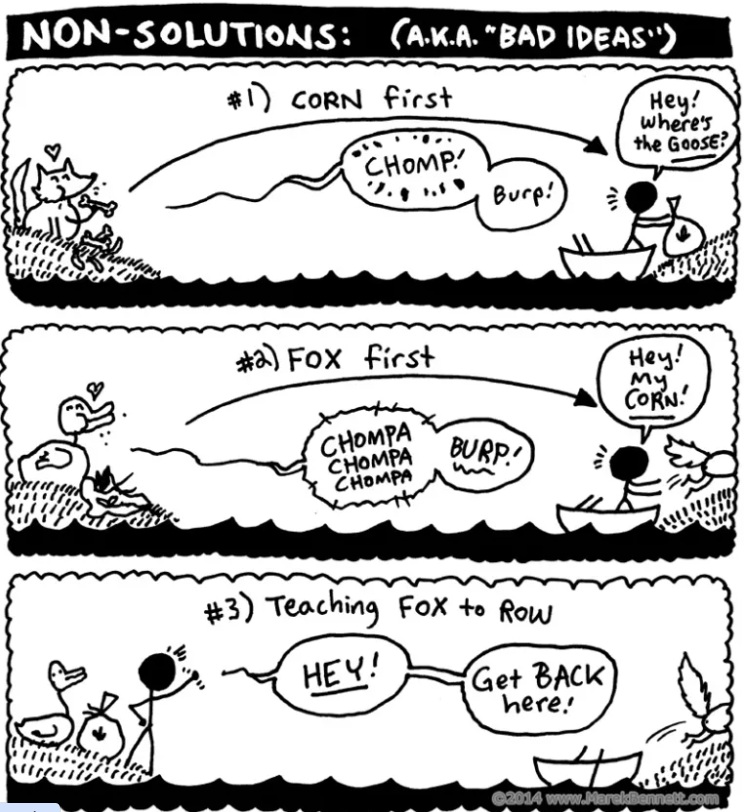
It’s fairly simple as brain teasers go, but the main trick is realizing that you can bring things back with you.

Image courtesy of Marek Bennett

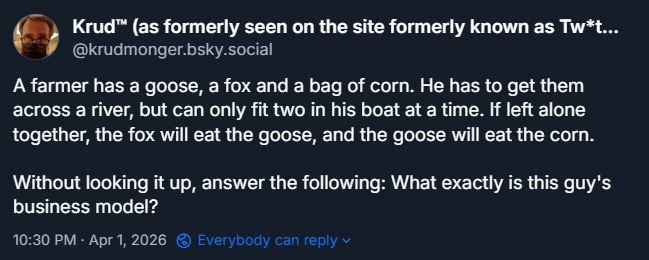
Now, logistically speaking, I have to ask something. Whether it’s a goat or a chicken or a sheep, whether it’s a wolf or a fox, they can all swim, so why not tie a rope to one on one side of the boat, a rope to the other on the other side, and tow them along as you row the grain/seeds/cabbage across?

Yeah, I am one of those all-the-groceries-in-one-trip guys. How did you know?!

The impracticality of this has crossed the minds of others as well. My friend Krud wrote on Twitter:

The folks at XKCD also found a simpler way while asking a very reasonable question:

In an episode of the TV show Fargo, the riddle was posed involving a fox, a rabbit, and a cabbage, and one of the characters immediately gets stuck on the details before offering the following solution:

Pepper: A Turducken.
Budge: A what’s that now?
Pepper: He stuffs the cabbage in the rabbit and the rabbit in the fox, and he eats all of them.
Budge: That’s not the answer.
Pepper: It’s an answer.

Someone online noticed that Martin Freeman’s characters have encountered this riddle twice between The Office and Fargo:

I also found a post online where someone suggested this delightfully impractical solution: “He puts the fox and the seed in the boat and pushes it to the other side. Then he finds the nearest ledge and glides across with the chicken.”

You know what? It’s innovative. I’ll give ’em that.


This riddle has naturally made its way into pop culture. (Apparently it even appears in a Peppa Pig cartoon!)

In The Simpsons episode “Gone Maggie Gone,” Homer must solve the river crossing riddle. Santa’s Little Helper can’t be left with Maggie, or he’ll chew on her favorite stuffed animal. Maggie can’t be left with the jar of poison because it looks like candy.

Naturally, they manage to create their own variation on the riddle and lampoon the original all in one fell swoop:

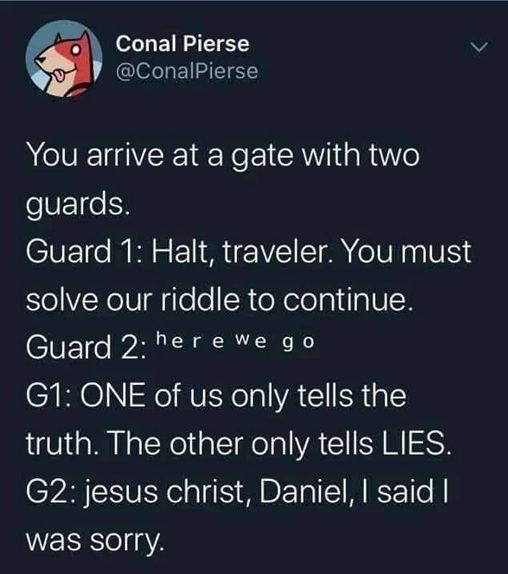
In an episode of Dropout’s Make Some Noise, they actually reference the river crossing puzzle WHILE making fun of the Riddle of the Two Guards:

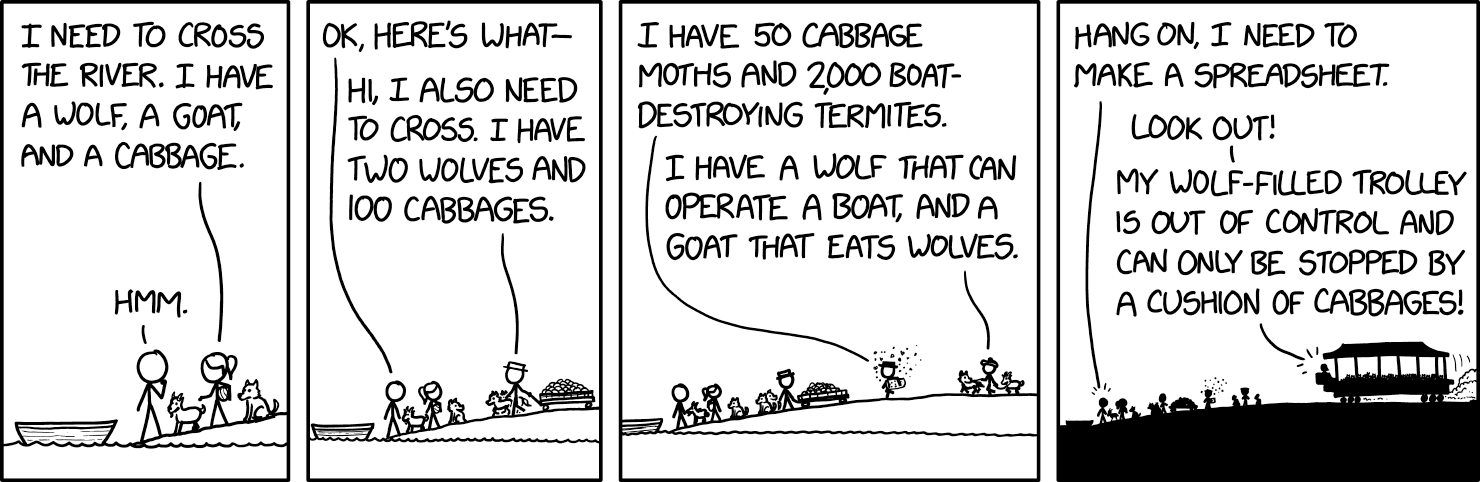
And of course, sometimes the wolf-sheep-cabbage problem escalates with the introduction of more factors to be considered.

XKCD shared how complicated the river crossing becomes with a few more unexpected additions:

An episode from the 2010s Powerpuff Girls TV show also dealt with a more elaborate version of the river crossing riddle. In the episode “Splitsville,” Bubbles tries to solve the riddle while dealing with further complications like tourists, a robber baron, and the Raptor King:


At this point the river crossing riddle has essentially become pop culture shorthand for any problem that is getting out of hand through overworked analysis.

Writer Cleolinda Jones referenced the problem while discussing the abject ridiculousness of The Twilight Saga:

Yeah, it’s like, Bella wants to be a vampire but she doesn’t want to be a vampire before she’s had sex as a human, and Edward doesn’t want her to be a vampire but he wants to get married, but Bella doesn’t want to get married unless she can be a vampire, but Edward won’t have sex with her until they get married, and then you put the fox and the grain in the boat and you leave the goose back on the riverbank.

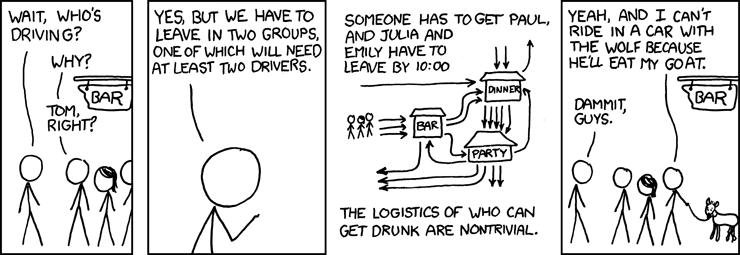
XKCD has similarly used the problem as a punchline to a comic strip about overthinking things:


As you can see, while most of us will never encounter a real-life use for the river crossing puzzle in our lifetimes, at least we’re prepared for the possibility.

Now, if you’ll excuse me, I need to get this beaver, this kite-eating willow tree, and my favorite kite across the street to the park in time for the picnic. See ya!

Riddles of the Heart!

puzzlelove

I’ve always been a sucker for a story where puzzlers help make someone’s life better, their world a little bit more magical. I’ve had the privilege of constructing and facilitating several puzzly marriage proposals, for instance.

But there’s something even more heartwarming when it’s anonymous puzzlers helping a stranger with a puzzly dilemma. Like the time online puzzlers saved Christmas by decoding a kid’s encrypted wish list to Santa for his baffled mother.

This time around, it’s not Christmas magic, it’s a potential romance.

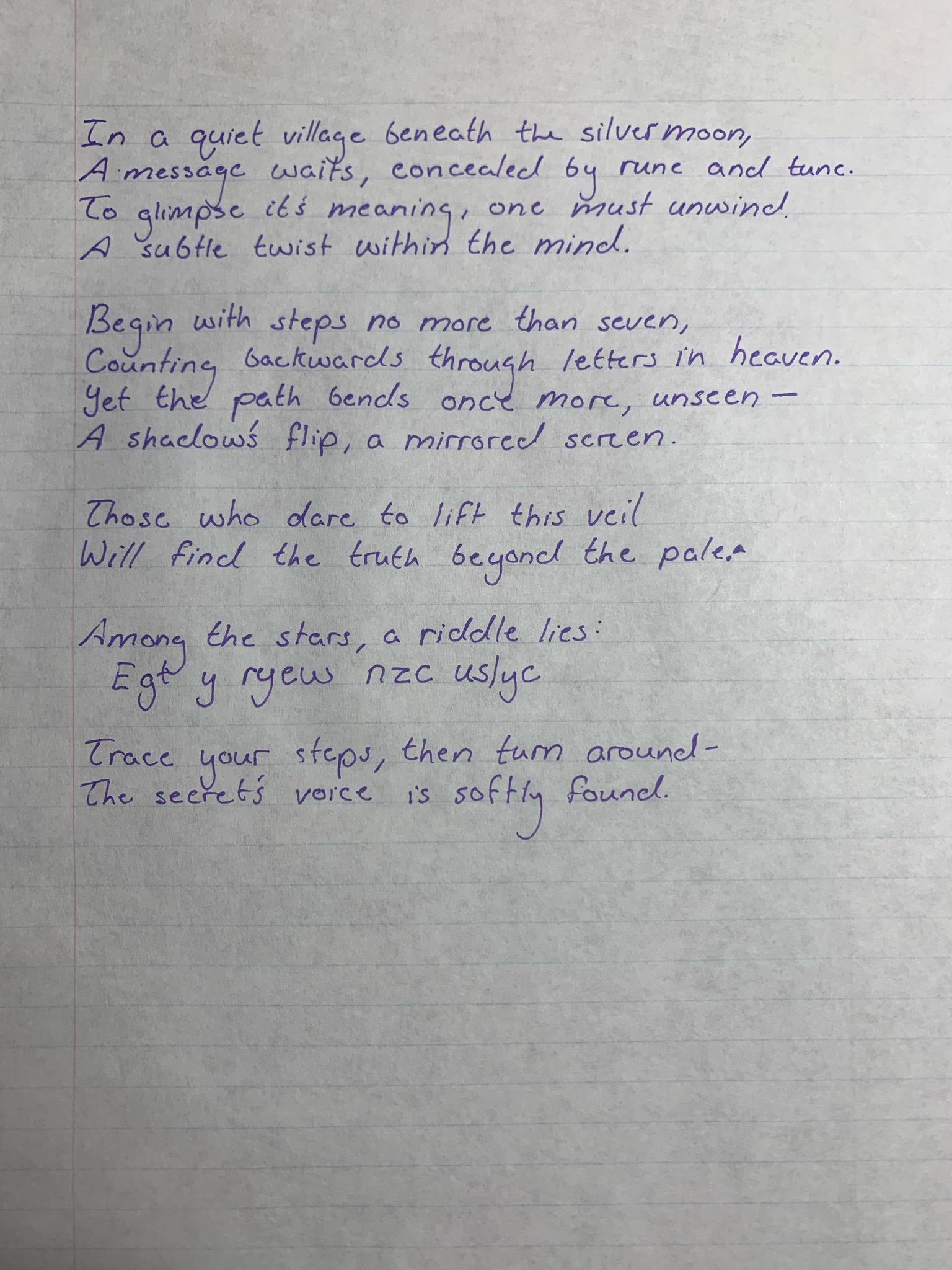
In a recent Reddit post, a request for help went out the puzzliest of D&D players:

I asked someone out using a riddle, and they responded with another one, but now I can’t solve it. We both dm at our local game store, and we’re running games tomorrow, I need a quick solution. I don’t need someone to give me the answer, but can someone please help walk me through how to solve this?

First off, that’s very cute.

Secondly, my dude, they responded to a riddle with your riddle. That’s a yes, my friend! Congrats.

As you might expect, his fellow riddle fans and puzzle fiends quickly explained how to find the solution, hoping that this marvelous exchange of riddles leads to more! Everyone loves a meet-cute, especially a puzzly one!

But what about you, fellow solver? Could you crack it?

I’ll give you a bit of space before I reveal how to solve it.

.

..

….

…..

……

…….

……

…..

….

..

.

Ready? Okay, let’s get to the riddle itself.

Egt y ryew nzc uslyc

This is clearly a single substitution cipher, also known as a simple substitution cipher, where each letter represented by another.

You could tackle this in a brute force way, treating it like a cryptogram. We know that “y” is going to be A or I. The most common three-letter word is “the”, which is a good place to start. At the very least, we can probably assume that “c” is the letter E, since it’s at the end of several words.

But the poem tells us how to solve it.

Start with the “letters in heaven,” your alphabet.

ABCDEFGHIJKLMNOPQRSTUVWXYZ

We get references to a mirrored screen or a shadow’s flip, so let’s try the alphabet backwards and placed underneath.

ABCDEFGHIJKLMNOPQRSTUVWXYZ
ZYXWVUTSRQPONMLKJIHGFEDCBA

We’re told to count backwards with steps no more than seven.

So let’s take the first letter in our secret message, E. Counting backwards (and wrapping around the alphabet again), that brings us to X. And in the mirror of X, we have C.

Continuing, seven letters back from G is Z, and in the mirror, A. Seven letters back from T is M, and in the mirror, N.

Egt Y ryew nzc uslyc
CAN

Continue for all the letters, and you get your answer written in the stars (presumably replying to his riddle):

Can I pick the movie?

Here’s hoping we get some updates in the future (or more riddles) from this pair of dice-rolling riddle-crafting delights.

And let’s offer one more huzzah for the anonymous puzzlers who helped crack the code!

Puzzlers… is there anything they can’t do?

The Riddle of the Two Guards

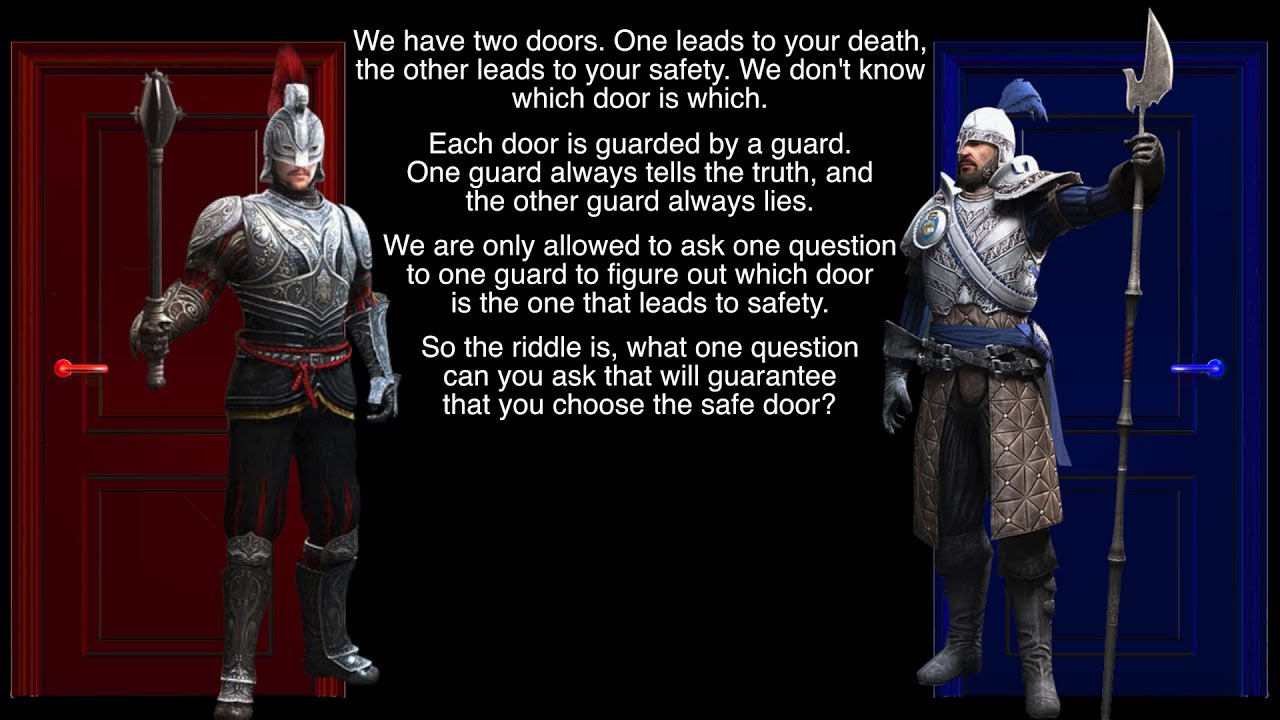
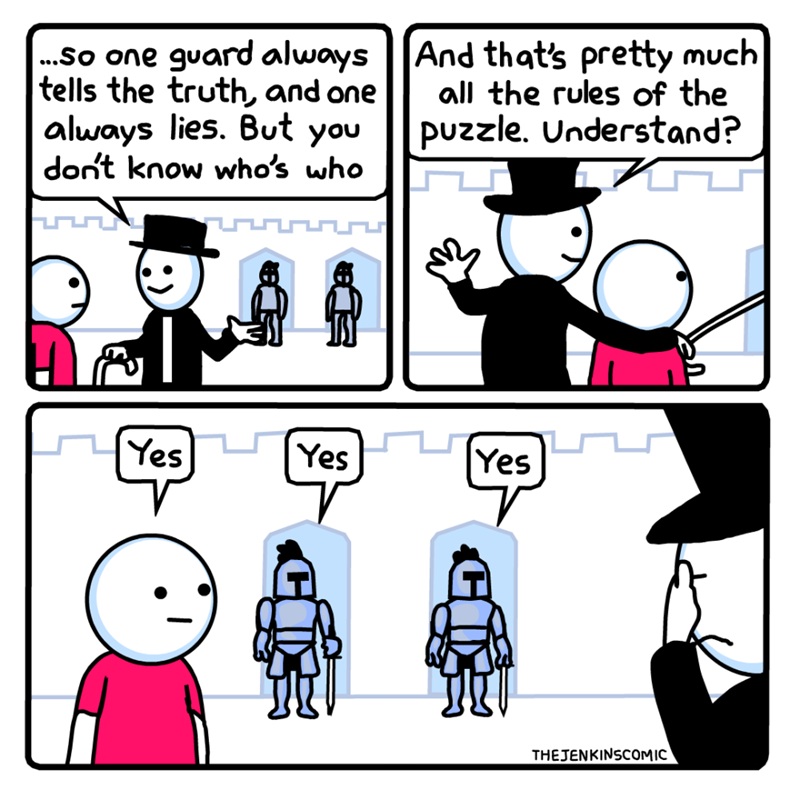
Hey there, fellow puzzler. Stop me if you’ve heard this one before:

Ah yes, the riddle of the two guards. Also known as the two doors puzzle, the two guards/two doors puzzle, and, my personal favorite, that awful crap riddle.

It’s easily the most famous example of a Knights and Knaves logic puzzle, which all work off the idea of individuals who always lie or always tell the truth, and a solver who needs to deduce how to proceed.

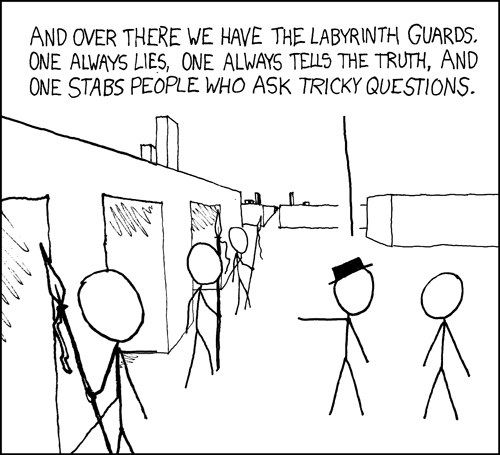
I think the best and most colorful presentation of the riddle was in the film Labyrinth, thanks to Jennifer Connolly and some very lovely puppetry:

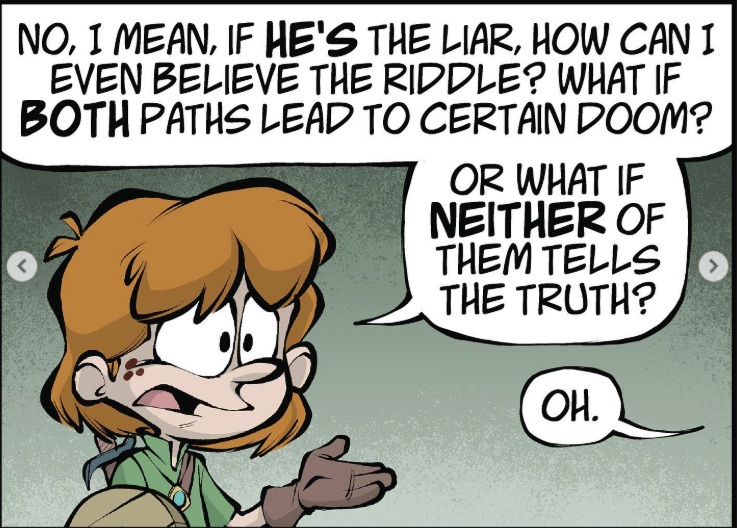
I’ve always wondered about this riddle. Is there a sign posted that explains the rules? Because otherwise, you’d assume the guard who tells the truth would have to explain the rules…

Unless the one who lies tells you the rules, which are a lie, and it’s a trap and you’re totally screwed!

Geez, this is getting complicated already.

Oh good, I’m not the only one who agonizes over this sort of thing. Image courtesy of Crabgrass Comic.

Let’s assume the rules are fair. There’s a guard who always lies and a guard who always tells the truth, and you need a single question to root out which door is the safe one to enter.

The traditional answer is to ask one guard which door the OTHER guard would say leads out.

But what if one of the guards is INVISIBLE?!

If the guard you asked is the one who lies, then he will lead you astray by telling you (falsely) that the other guard—the truthful guard—will point you towards door B. This makes door A the safe bet.

If the guard you ask is the one who tells the truth, he will tell you (honestly) that the other guard—the lying guard—will point you towards door B. This makes door A the safe bet.

In both cases, the outcome is the same: walk through the opposite door.

Naturally, people have tried to find ways around this.

Some suggest that you ask the guards to walk through their respective doors and report back what they see. I don’t know that this would work, because it’s not clear if the guards would have to follow your orders. Also, we don’t know if certain doom for US would be certain doom for the guards. If they both walk out totally fine, it probably won’t work.

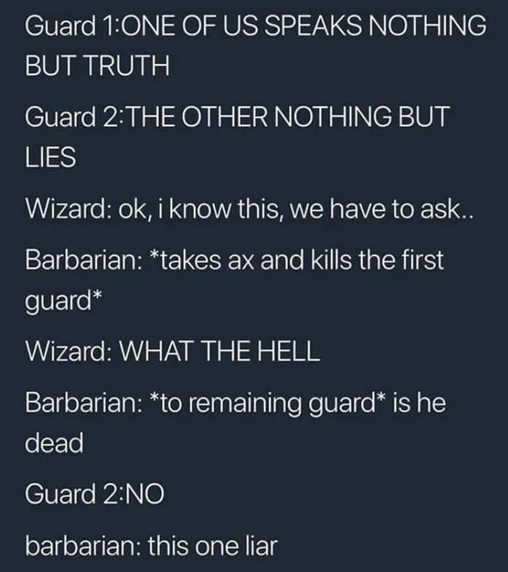
For another option, you can act in typical Dungeons and Dragons-fueled fashion and use what I call the direct approach:

But unfortunately, it misses the meat of the riddle. It’s not just knowing which guard lies and which guard tells the truth, it’s about knowing which door to take as well.

Of course, if you believe the folks at XKCD, there are consequences for cleverness as well:

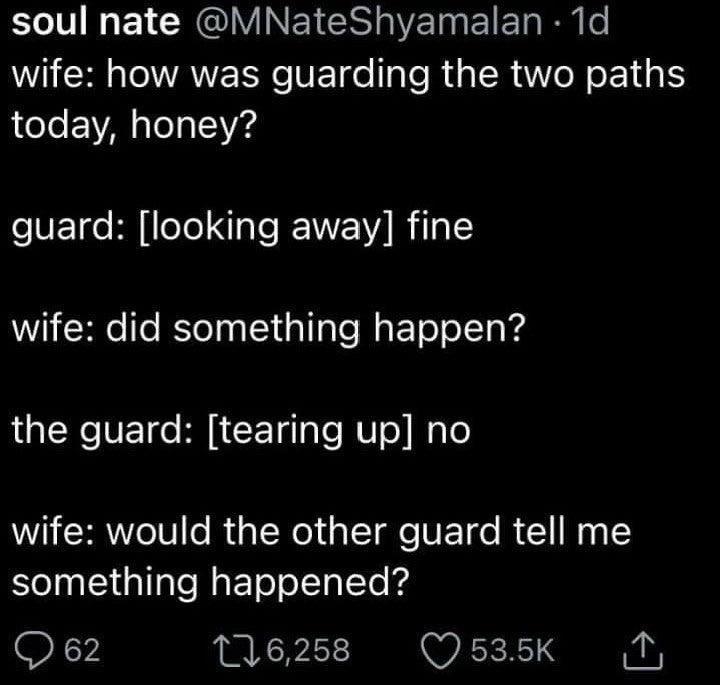
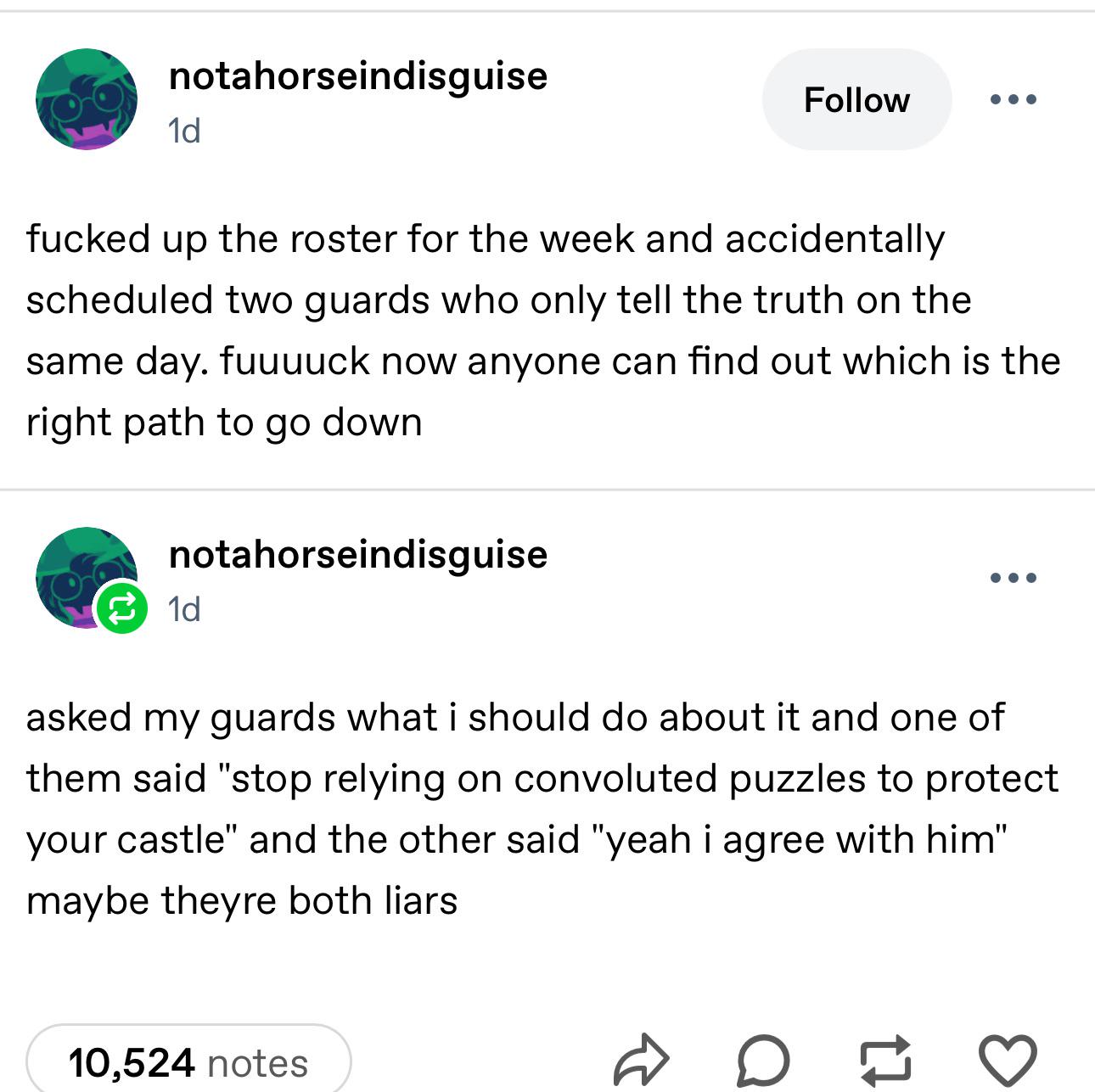
Although it is a riddle easily given to weasel words and pedantry, it has led to some wonderful comedy.

This joke, for instance, gives us some much-needed backstory to the guards and their current circumstances:

In a similar vein, this one lets us see one guard’s life after clocking out for the day:

I also enjoy this one, which ponders what sort of person would employ a riddle like this as a security measure in the first place:


So I put it to you, fellow puzzler: how would you tackle the riddle of the two guards? Labyrinth style? Barbarian style? Or have you conjured up a different question to ask the guards?

Let us know in the comment section below. We’d love to hear from you!

What Makes a Good Brain Teaser?

I was going through a collection of brain teasers a fellow puzzler gave me, and it occurs to me that “brain teaser” is one of the least specific puzzle terms around.

Riddles, logic and deduction, math puzzles, and wordplay games all fall under the brain teaser umbrella. So you never know what you’re gonna get. Are your math skills required? Your outside-the-box thinking? Your ability to pay attention to the specifics of the question itself?

In this collection alone, I found examples of each of these types of puzzles:

Riddle: Sometimes I’m green, sometimes I’m black. When I’m yellow, I’m a very nice fellow. That’s when I’m feeling mighty a-peeling. What am I?

Logic / deduction: 3 guys go into a hardware store, all looking for the same thing. William buys 1 for $1. Billy buys 99 for $2. Finally, Willie buys 757 for $3. What were they buying?

Math puzzle: The sum is 12 and the same digit is used 3 times to create the sum. Since the digit is not 4, what is the digit?

Wordplay: Which state capitals would you visit to find a ram, cord, bus, and dove?

So, if someone challenged you to a brain teaser, these would all be fair game. Would you be able to solve all four of them?


It’s possible you wouldn’t, because good and bad brain teasers alike employ tricks to keep you on your toes.

Some hide the answer in plain sight:

Homer’s mother has 4 children. 3 of them are named Spring, Summer, and Autumn. What is the 4th named?

Some use misdirection, purposely phrasing the question to get you thinking one way and steering you away from the real solution:

The big man in the butcher shop is exactly 6’4″ tall. What does he weigh?

In fact, both of these examples use plain sight (Homer, butcher shop) and misdirection (implying a pattern with seasons, specifying his height) to distract you.

I suspect you weren’t fooled by either of them, though.

Others try to overwhelm you with information so you bog yourself down in the details instead of clearly analyzing the problem at hand:

Nina and Lydia start from their home and each runs 2 miles. Nina can run a mile in 8 minutes 30 seconds and Lydia can run a mile in 9 minutes 10 seconds. When they finish running, what is the furthest apart they can be?

A lot of numbers get thrown at you, but they’re irrelevant, since the question only asks about the distance, not the time. So if they each run 2 miles, the furthest apart they can be is 4 miles. The rest is just smoke.

These are all effective techniques for teasing a solver’s brain. You’re given all the information you need to solve the puzzle, plus a little extra to distract, mislead, or overwhelm you.


Unfortunately, some brain teasers use unfair techniques to try to stump you:

Jacob and Seth were camping in June. Before going to sleep they decided to read a book. They both agreed to stop reading when it got dark. They were not fast readers, but they finished the entire encyclopedia. How?

Ignoring the fact that these two boys somehow brought an entire encyclopedia with them on a camping trip, we’re not actually given a lot of information here.

So that makes the intended answer seem like more of an insane leap than a logical jump to the conclusion: They were in Lapland, land of the midnight sun, and the sun didn’t set until September.

WHAT?

There’s no reasonable way for someone to reach this conclusion based on the information given. In fact, it makes less sense the more you read it. Presumably Jacob and Seth know where they are camping, and that it wouldn’t get dark for months. So why would Jacob and Seth agree to stop reading when it got dark IF THAT MEANT THEY’D BE READING UNTIL SEPTEMBER!?

This is gibberish, and you’d be surprised how often something like this gets passed off as acceptable in a collection of brain teasers. (I discussed a similar issue with detective riddles in a previous blog post.)


Let’s close out today’s discussion of the ins and outs of brain teasers with a few fun, fair examples, shall we?

  • In what northern hemisphere city can you find indigenous tigers and lions?
  • Scientists have found that cats are furrier on one side than the other. The side with the most fur is the side that cats most often lie on. Which side of a cat has more fur?
  • A woman married over 50 men without ever getting divorced. None of the men died and no one thought she acted improperly. Why?

Did you solve them all? Let us know! Also, please share your favorite brain teasers (or your tales of treacherous and unfair brain teasers) in the comments below!

Happy puzzling, everyone!

Puzzly Tombstones for October 1st!

[Image courtesy of How To With Kristin.]

It’s October 1st, and for many folks, it’s the official start of the spookiest of seasons, aka the lead-up to Halloween.

One of the things I really enjoy about the weeks before Halloween is seeing the decorations go up, and wondering just how elaborate they’re going to get. One house near me does a big fake spider web every year that’s made out of rope and dominates half of their yard!

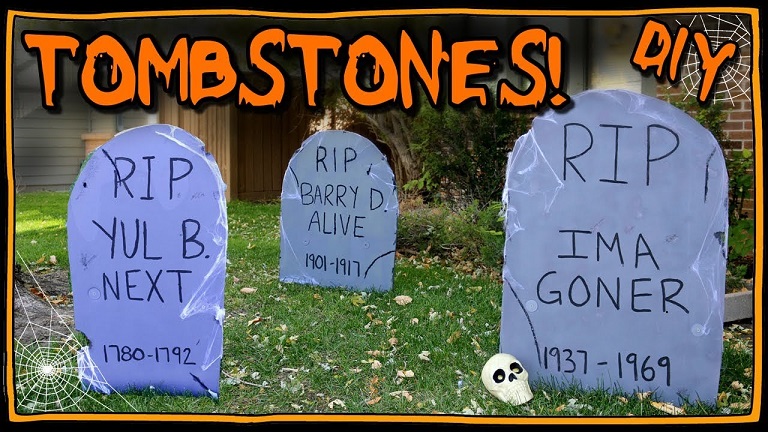
But it’s the little fake tombstones that get me. It’s a simple thing, but I quite enjoy how people always put something interesting on them. Sometimes it’s funny inside jokes, or silly punny names like Bart Simpson would use to prank Moe the bartender on The Simpsons.

And it occurs to me that we as puzzlers could get in on this. Puzzly tombstone decorations! Why not?

Here are a few real-world examples to spark some ideas for you.

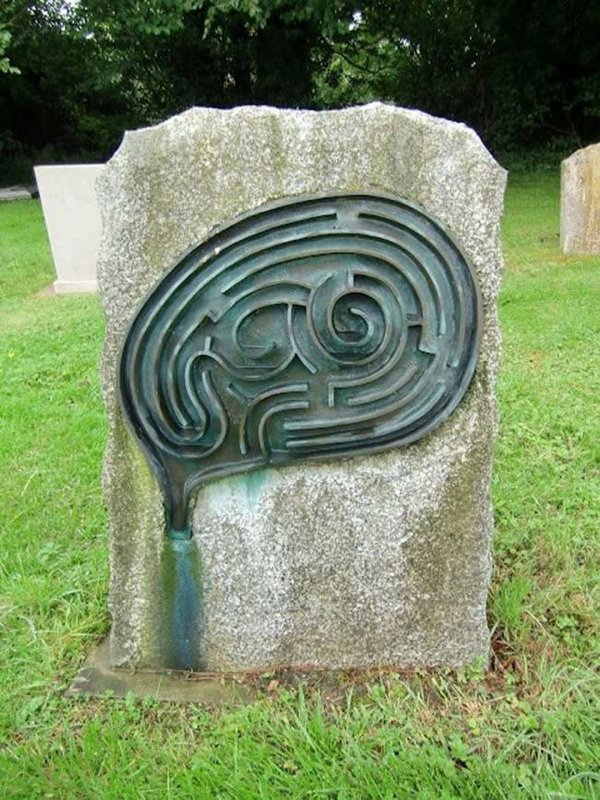
This gorgeous design adorns the gravestone of Michael and Elisabeth Ayrton. He was a painter and sculptor, and she was a writer.

It’s simple, but quite lovely.

headstone0

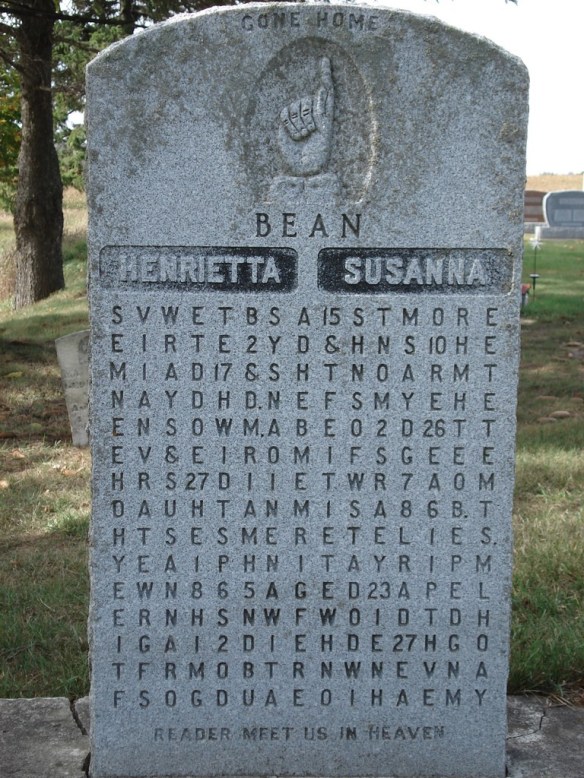
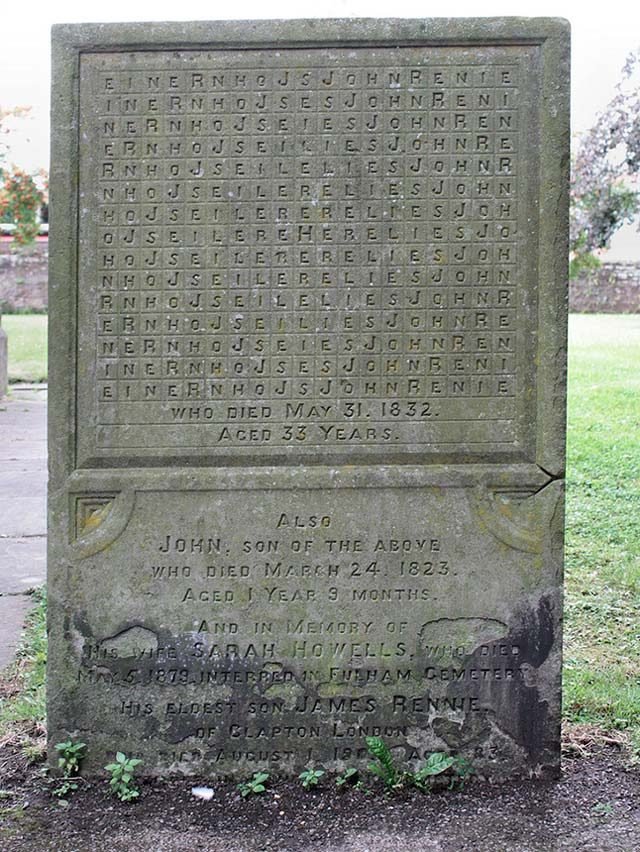
If you wanted, you could recreate this puzzly tribute that took passersby a century to finally unravel.

In a similar vein, this tombstone hides a simple message in thousands of different ways, if you know where to get started.

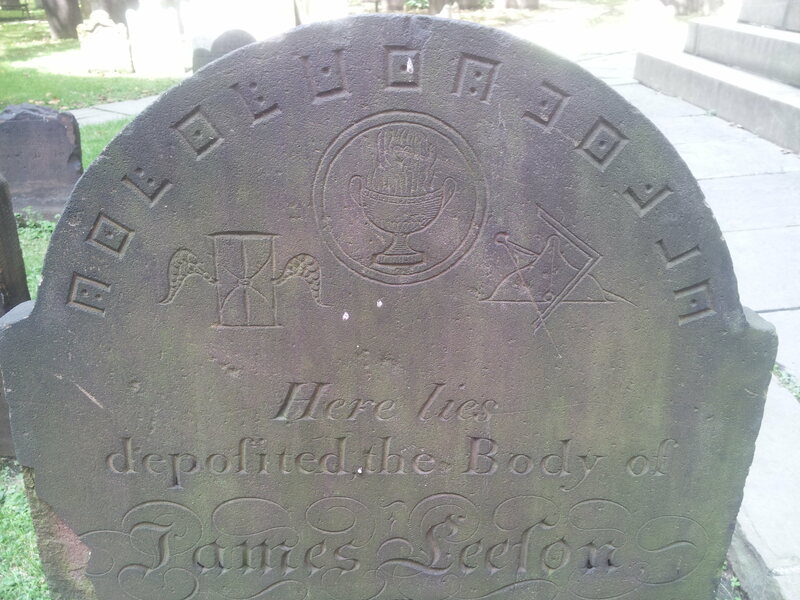
You could hide a coded message on them, like James Leeson did with his own tombstone in the Trinity Churchyard in Manhattan.

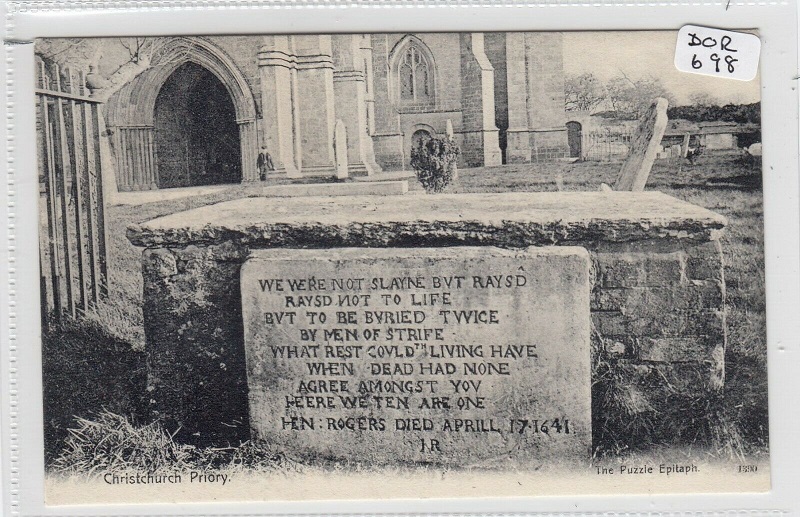
You could even offer a riddle or puzzly epitaph for people to solve, like this one found on the gravestone of Henry Rogers in Christchurch Priory in Dorset.

So what do you think, fellow PuzzleNationers? Will you be decorating with any puzzle-inspired tombstones? Or maybe you have something else that’s puzzle-inspired in store for Halloween.

Let us know in the comments section below! We’d love to hear from you.

dailypopwsicon

Well, summer’s over, but we still have deals galore for you to check out. You can find them on the Home Screen for Daily POP Crosswords and Daily POP Word Search! Check them out!

Thanks for visiting PuzzleNation Blog today! Be sure to sign up for our newsletter to stay up-to-date on everything PuzzleNation!

Solutions to Our June Brain Teasers!

Two weeks ago, we shared a pair of brain teasers sent in by a PuzzleNationer who discovered these particular deduction and math thinkers in a book of riddles and puzzles.

Today, we’re going to share not only the solutions, but how we got there! Please enjoy this brief solve and tutorial, courtesy of brain teasers from your fellow PuzzleNationers!


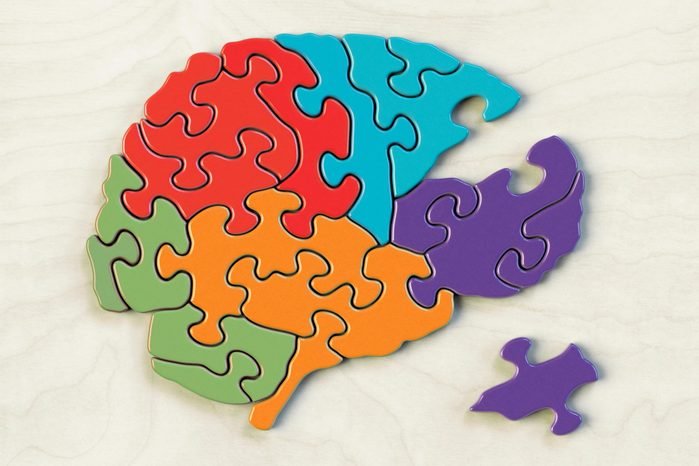
[Image courtesy of SharpBrains.com.]

Brain Teaser #1: There is a three-digit number. All three digits are different. The second digit is four times as big as the third digit, while the first digit is three less than the second digit. What is the number?

Solution: 582

This is a fairly simple one, but if you’re unfamiliar with brain teasers, or uncomfortable in general with number puzzles, it can be off-putting. No worries, though! We’ve got you covered.

We know the second digit is four times as big as the third. That leaves only two options for those digits: 4 and 1 or 8 and 2.

If the first digit is three less than the second digit, it can’t be 4 and 1, because that would be 4 minus 1, or 1 for the first digit, and the first and third digits can’t be the same.

That means it’s 8 and 2 for the second and third digits. So if the first digit is three less than the second, the first digit is 5, and the three-digit number is 582.


calendar pages

Brain Teaser #2: When asked about his birthday, a man said, “The day before yesterday, I was only 25, and next year I will turn 28.” This is true only one day in a year – what day was he born?

Solution: He was born on December 31st and spoke about it on January 1st.

The wording in this one is especially important, because at first glance, this sounds impossible.

“Next year, I will turn 28.”

But if you look at the key word in what the man says — “turn” — the puzzle starts to unravel.

If next year, he will turn 28, this means that, at some point this year, he will turn 27. Which means he is currently 26.

Let’s look at what we know:

  • Day before yesterday: 25
  • Currently: 26
  • This year (at some point): 27
  • Next year: 28

Since he’ll be both 26 and 27 this year, the day before yesterday had to be last year.

Which means that yesterday was his birthday.

But at some point this year, he turns 27. That means both yesterday and the day before yesterday had to be last year.

Which leaves us with this timetable:

  • December 30 (day before yesterday, last year): 25
  • December 31 (yesterday, last year, his birthday): 26
  • January 1 (today, this year): 26
  • December 31 (later this year): 27
  • December 31 (next year): 28

He was born on December 31st and spoke about it on January 1st.


Did you unravel one or both of these brain teasers? Let us know in the comments section below! We’d love to hear from you.
dailypopwsicon

Hey, have you checked out our special summer deals yet? You can find them on the Home Screen for Daily POP Crosswords and Daily POP Word Search! Check them out!

Thanks for visiting PuzzleNation Blog today! Be sure to sign up for our newsletter to stay up-to-date on everything PuzzleNation!