The River Crossing Puzzle

Hey there, fellow puzzler. Stop me if you’ve heard this one before:
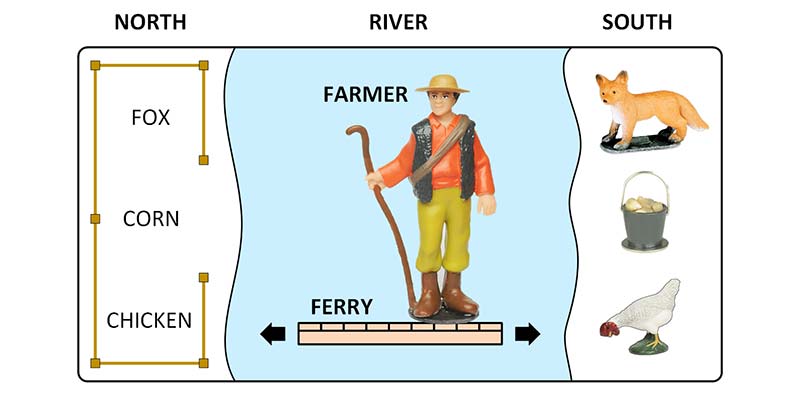
Image courtesy of Nuts & Volts.

A farmer with a wolf, a goat, and a cabbage must cross a river by boat. The boat can carry only the farmer and a single item. If left unattended together, the wolf would eat the goat, or the goat would eat the cabbage. The farmer must help them all cross the river without anything being eaten.

This is known as a river crossing puzzle, and there have been many versions over the years. In fact, the earliest known variation, printed in Propositiones ad Acuendos Juvenes (Problems to Sharpen the Young), dates back to the 9th century!
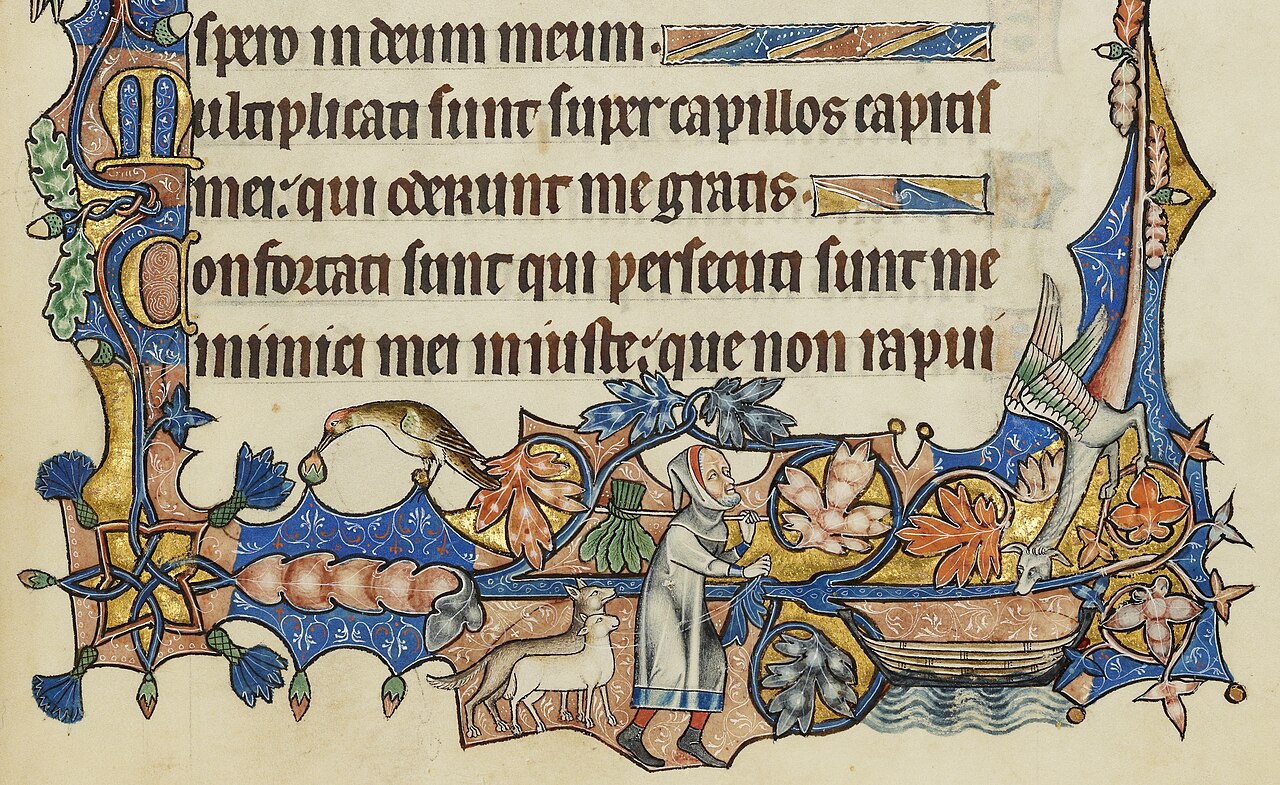
Depiction of the riddle from the Ormesby Psalter, dating back to 1250-1330

Sometimes the puzzle features missionaries and cannibals crossing a river, and you cannot allow the missionaries to be outnumbered at any point on either shore, lest they be eaten. Sometimes it features jealous husbands crossing a river with their wives, where none of the men will allow his wife to be alone with either of the other men. Sometimes it is knights and squires, and the squires are afraid to stay with the other knights.

I’m going to ignore the racial and misogynistic energy of those examples and focus on the wolf, goat, and cabbage version, which is the one people are most familiar with. (Although the animals do change from riddle to riddle. Sometimes it’s wolves, sheep, and cabbages, other times it’s foxes, chickens, and grain, or foxes, geese, and seeds.)

The traditional answer works for any variation:

  • you take the prey (goat, sheep, chicken) across
  • you come back with the boat otherwise empty
  • you take either the predator (wolf, fox) OR the prey’s food (grain, cabbage, seeds) across
  • you come back with the prey in the boat
  • if you took the predator first, you bring the prey’s food this time. If you took the prey’s food first, you take the predator this time. Either way, you leave the prey behind on this trip
  • you come back with the boat otherwise empty
  • you take the prey across

It’s fairly simple as brain teasers go, but the main trick is realizing that you can bring things back with you.
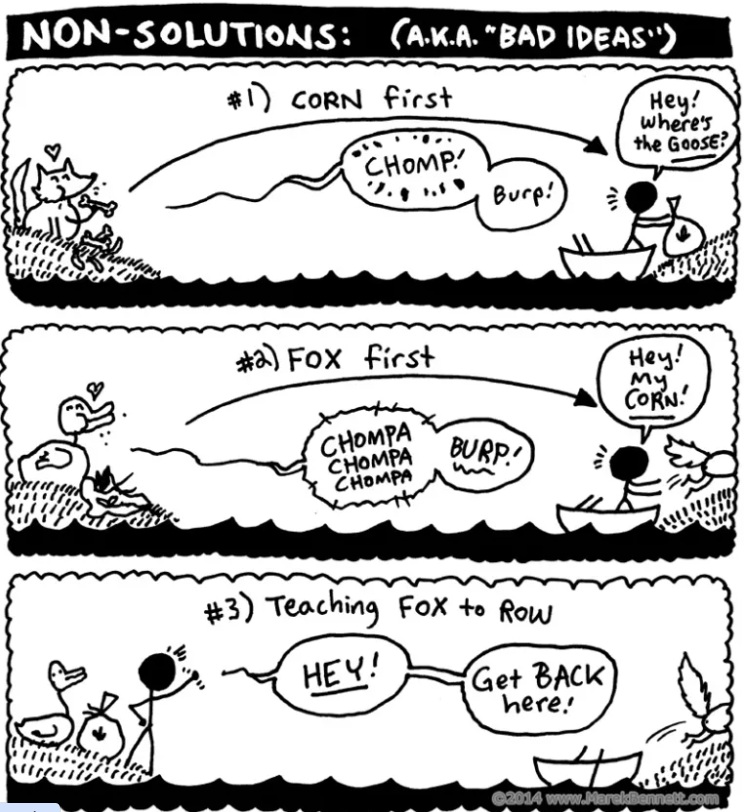
Image courtesy of Marek Bennett

Now, logistically speaking, I have to ask something. Whether it’s a goat or a chicken or a sheep, whether it’s a wolf or a fox, they can all swim, so why not tie a rope to one on one side of the boat, a rope to the other on the other side, and tow them along as you row the grain/seeds/cabbage across?

Yeah, I am one of those all-the-groceries-in-one-trip guys. How did you know?!

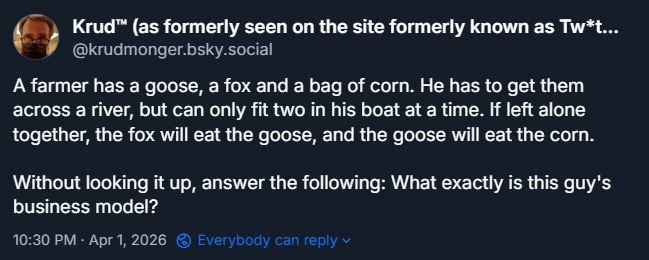
The impracticality of this has crossed the minds of others as well. My friend Krud wrote on Twitter:
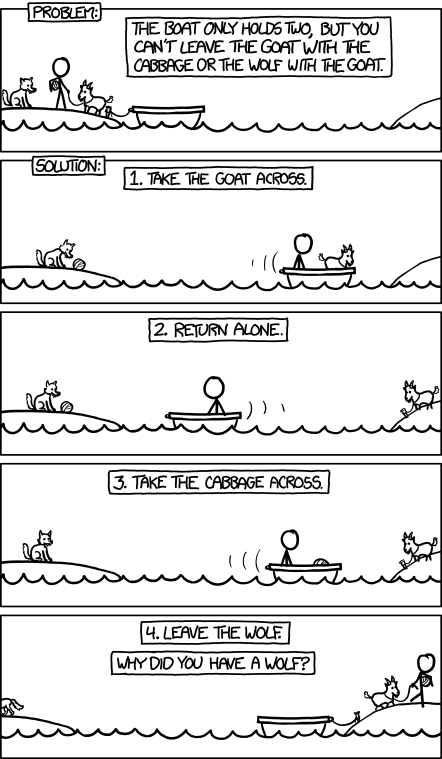
The folks at XKCD also found a simpler way while asking a very reasonable question:
In an episode of the TV show Fargo, the riddle was posed involving a fox, a rabbit, and a cabbage, and one of the characters immediately gets stuck on the details before offering the following solution:

Pepper: A Turducken.
Budge: A what’s that now?
Pepper: He stuffs the cabbage in the rabbit and the rabbit in the fox, and he eats all of them.
Budge: That’s not the answer.
Pepper: It’s an answer.

Someone online noticed that Martin Freeman’s characters have encountered this riddle twice between The Office and Fargo:

I also found a post online where someone suggested this delightfully impractical solution: “He puts the fox and the seed in the boat and pushes it to the other side. Then he finds the nearest ledge and glides across with the chicken.”

You know what? It’s innovative. I’ll give ’em that.


This riddle has naturally made its way into pop culture. (Apparently it even appears in a Peppa Pig cartoon!)

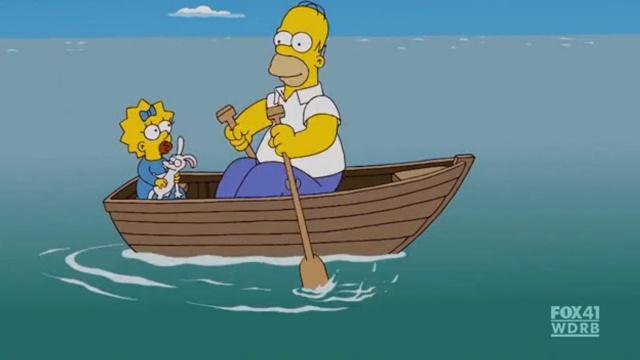
In The Simpsons episode “Gone Maggie Gone,” Homer must solve the river crossing riddle. Santa’s Little Helper can’t be left with Maggie, or he’ll chew on her favorite stuffed animal. Maggie can’t be left with the jar of poison because it looks like candy.

Naturally, they manage to create their own variation on the riddle and lampoon the original all in one fell swoop:

In an episode of Dropout’s Make Some Noise, they actually reference the river crossing puzzle WHILE making fun of the Riddle of the Two Guards:

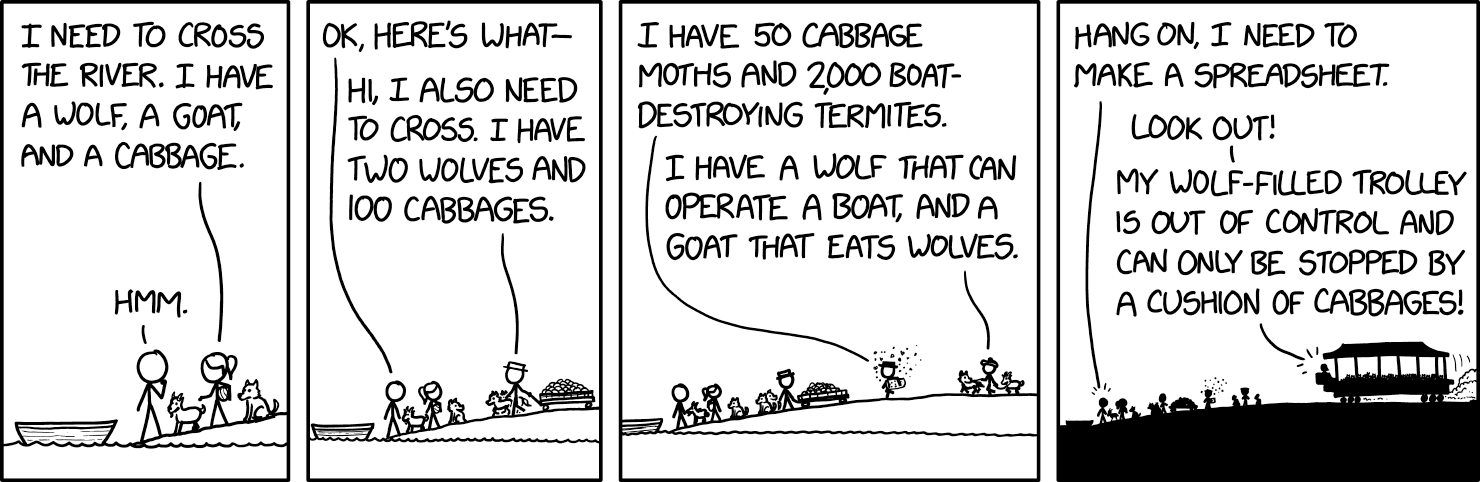
And of course, sometimes the wolf-sheep-cabbage problem escalates with the introduction of more factors to be considered.

XKCD shared how complicated the river crossing becomes with a few more unexpected additions:
An episode from the 2010s Powerpuff Girls TV show also dealt with a more elaborate version of the river crossing riddle. In the episode “Splitsville,” Bubbles tries to solve the riddle while dealing with further complications like tourists, a robber baron, and the Raptor King:


At this point the river crossing riddle has essentially become pop culture shorthand for any problem that is getting out of hand through overworked analysis.

Writer Cleolinda Jones referenced the problem while discussing the abject ridiculousness of The Twilight Saga:

Yeah, it’s like, Bella wants to be a vampire but she doesn’t want to be a vampire before she’s had sex as a human, and Edward doesn’t want her to be a vampire but he wants to get married, but Bella doesn’t want to get married unless she can be a vampire, but Edward won’t have sex with her until they get married, and then you put the fox and the grain in the boat and you leave the goose back on the riverbank.

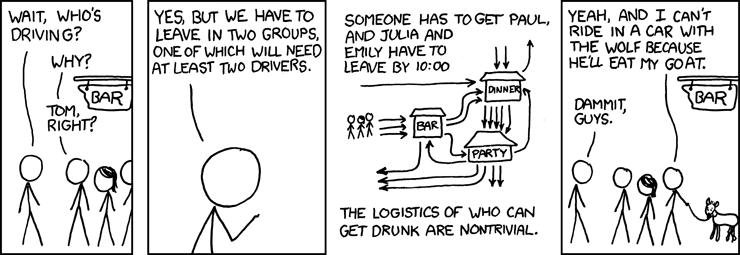
XKCD has similarly used the problem as a punchline to a comic strip about overthinking things:

As you can see, while most of us will never encounter a real-life use for the river crossing puzzle in our lifetimes, at least we’re prepared for the possibility.

Now, if you’ll excuse me, I need to get this beaver, this kite-eating willow tree, and my favorite kite across the street to the park in time for the picnic. See ya!
Puzzles in Pop Culture: The Simpsons (re-revisited!)

The TV show The Simpsons is part of the fabric of American culture at this point. It has been on for decades, and although the show doesn’t put out banger after banger like they did in their heyday, they can still be counted on to put out fun shows and the occasional home run.

As part of their cultural influence, naturally puzzles have featured prominently from time to time.

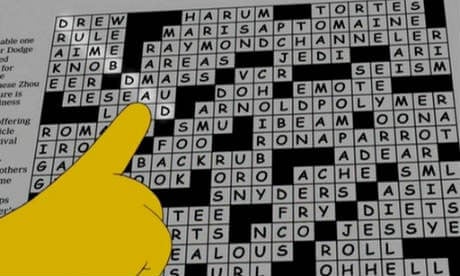
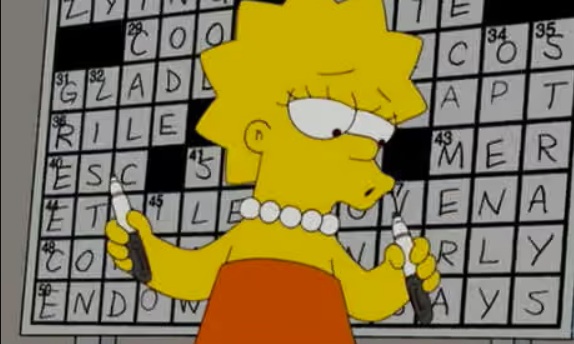
Probably the most famous puzzly moment was when Lisa became a competitive crossword solver and Homer’s apology puzzle to her appeared in The New York Times. But they’ve also featured brain teasers, anagrams, and a Da Vinci Code-esque series of riddles.

And that legacy of puzzle-fueled storytelling hasn’t stopped since I wrote that post over a decade ago.


But it wasn’t through crosswords or brain teasers that puzzles have appeared on the Simpsons more recently. It was through Wordle.

Wordle has been mentioned enough times on The Simpsons that it actually has its own entry on the Simpsons Wiki.

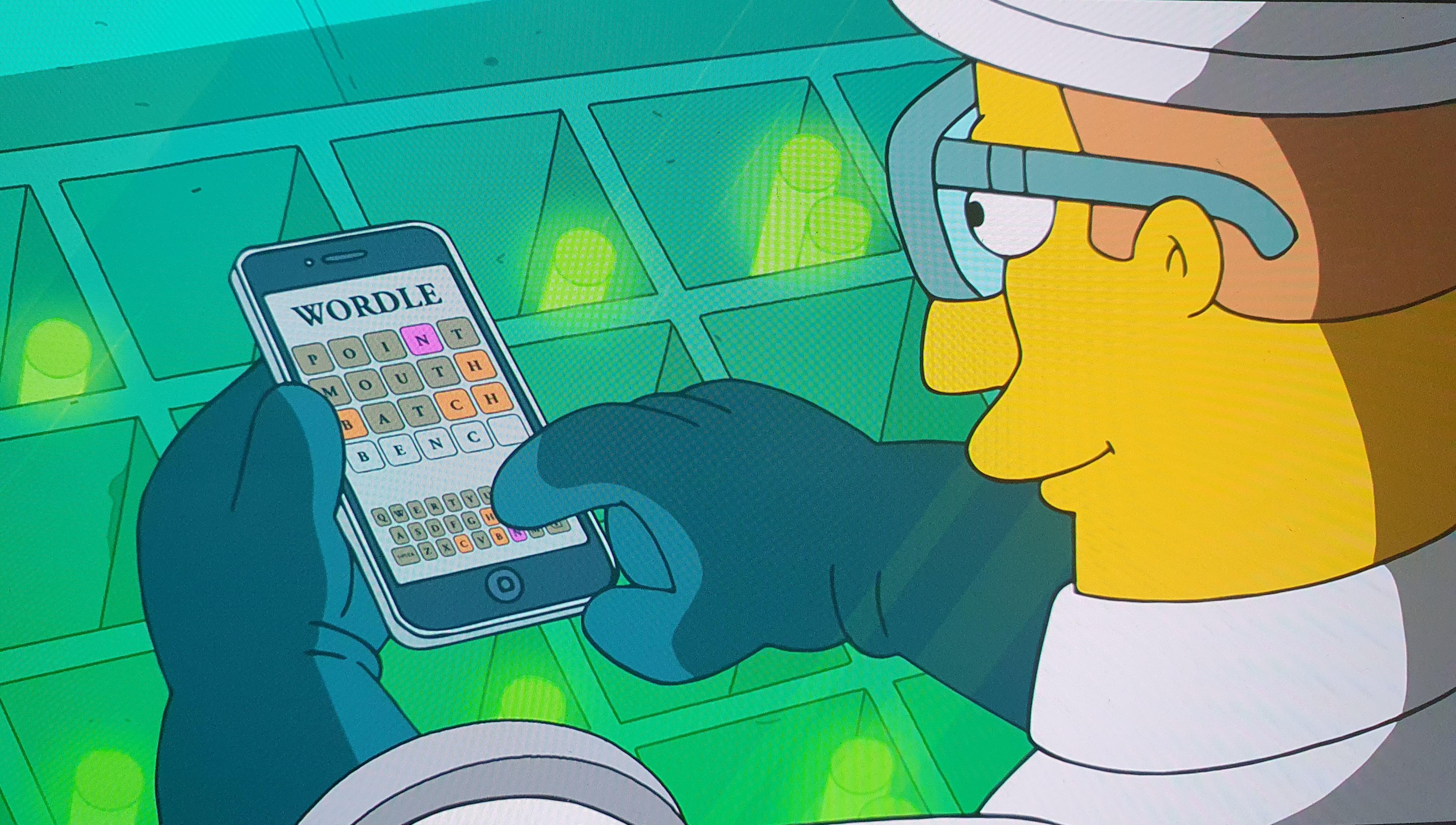
We get a glimpse of a Wordle game in episode 2 of season 37, entitled “Keep Chalm and Gary On.”

Supernintendo Chalmers is fired from his job, and ends up working at the Nuclear Power Plant with Homer. After seeing how hard Chalmers was working, Homer teaches him how to APPEAR like he’s working hard.

During this montage, we get a glimpse of Chalmers playing Wordle.

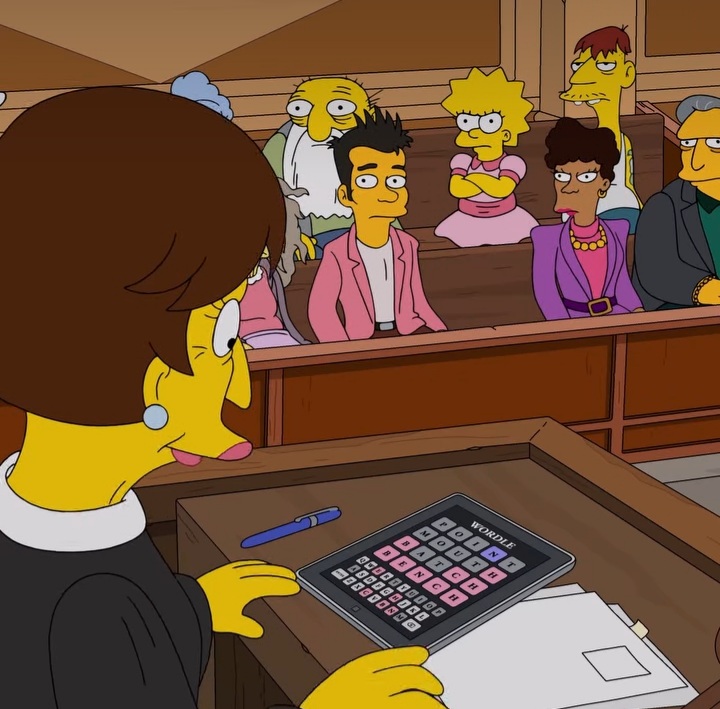
But this was actually the second instance of this exact same Wordle game appearing on The Simpsons.

A few seasons earlier — episode 2 of season 34, entitled “One Angry Lisa” — Lisa finds herself on a jury, and is annoyed when she spots Judge Constance Harm playing Wordle during court.

Lisa points out that she’s playing games on the bench, and the judge realizes the answer word is, in fact, BENCH.

Wordle is also mentioned in episode 8 from season 36, entitled “Convenience Airways.” The pilot is making announcements:

Just a reminder, folks, the call button is only for real emergencies, like if you’re down to your last guess on Wordle.

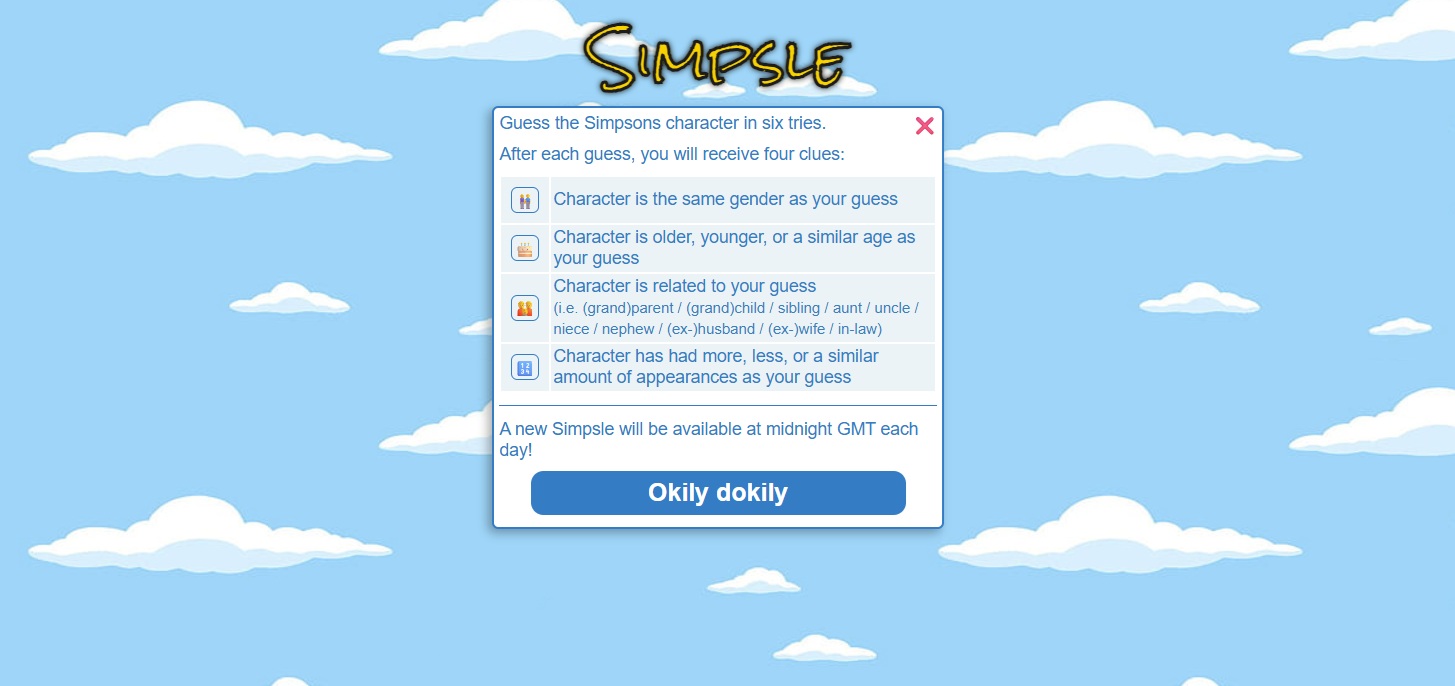
The Simpsons also inspired their own variation on Wordle, Simpsle, where you try to figure out which Simpsons character the game has chosen.

You get hints — are they the same gender as your guess, older or younger, related to your guess, or had more or fewer appearances than your guess — in order to deduce the character’s identity in six tries or fewer.

It’s a good time, depending on your familiarity with the show. I’m a huge fan, so I managed to guess Kearney (one of the older bullies/miscreant kids in town) on my sixth guess.

(There was actually another Simpsons-inspired Wordle game at one point, Doh-dle, but it no longer appears to be active.)

And I would be remiss if I didn’t mention a personal anecdote involving puzzling and The Simpsons.

I was removing a repeat from a Penny Press crossword grid, and as I was working on the puzzle, I thought I’d found the perfect quick fix to fill the space.

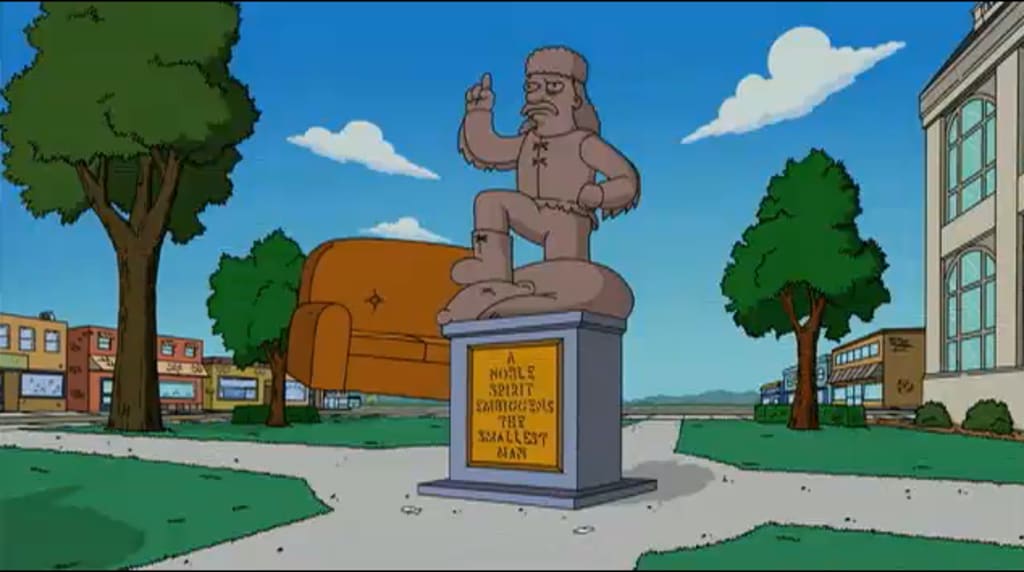
I showed Patti Varol, future editor of The LA Times Crossword, my correction, and she pointed out that my fix, EMBIGGENS, despite being a perfectly cromulent word, wouldn’t be accepted.

It had not even occurred to me that EMBIGGENS wasn’t standard jargon. We both lamented that fact, and I got back to work on the grid.

Still, it shows the cultural impact of the show in general. From “Yoink!” and “meh” to “saying the quiet part out loud” and “old man yells at cloud,” it has literally changed how we speak.

And that goes for how we puzzle as well.


Do you have any favorite puzzly Simpsons moments? Or puzzly moments from other TV shows? Let us know in the comments section below! We’d love to hear from you.

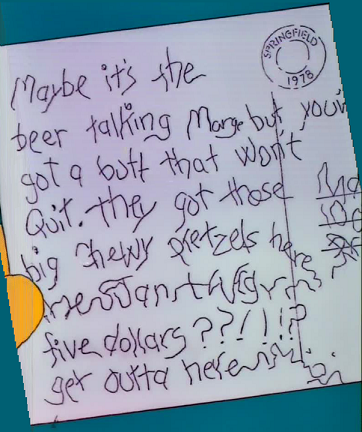
I mean, a little more legibly than this, if you don’t mind…

Puzzles in Pop Culture: Futurama

Not so long ago, I wrote a post about cryptography in the real world, highlighting moments where codebreaking made a difference in crime solving and espionage, and sometimes changed the course of history.

And while the encryptions featured in today’s entry aren’t quite as world-changing, they just as interesting.

I’m talking about the alien languages that were featured in the background of the animated television show Futurama.

At least two ciphers have been employed by the writers and animators of the show — a third is rumored to have appeared in the fourth season of the show, but there hasn’t been confirmation of that — and they’ve proven to be an engaging Easter egg for puzzle fans.

The first is called Alien Language One, or Alienese, and it appeared in the background of the show from the pilot episode onward. It’s a simple one-to-one code, with symbols for all 26 letters and 10 digits in standard English. (Supposedly it was solved by some enterprising puzzlers within a half-hour of the show’s premiere.)

A second, far more complex encryption started appearing during the show’s second season, and it’s called Alien Language Two, or Alienese II, and it’s based on an autokey cipher.

Autokey ciphers are more involved than a standard encryption, because there’s no one-to-one organizational structure. Instead, the symbol for a given letter or number can change based on the symbol that precedes it.

I’ll let the folks at the Futurama Wiki explain:

Each symbol has a numerical value. To decode a message, the first symbol’s value is translated directly into a character (0=’A’, 1=’B’, and so on). For the remaining letters, you subtract the previous symbol’s numerical value. If the result is less than zero, you add 26. Then that number is converted into a character as before.

This is some high-level puzzling, considering it’s a background joke-delivery system on an animated show. (But, considering the show does jokes about Schrodinger and throwaway gags based on mathematical principles like taxicab numbers, I’m not at all surprised.)

Of course, those puzzle-lovers at The Simpsons couldn’t help but get in on the fun, using Alienese as a background gag in a reference to the show Lost.

The masterminds at Futurama are definitely puzzlers at heart, and more than worthy of recognition in the Puzzles in Pop Culture library.

Puzzles in Pop Culture: The Simpsons (revisited!)

In previous editions of Puzzles in Pop Culture, I’ve recapped a classic episode of M*A*S*H and delved into the rich puzzling history of MacGyver.

Today, however, I’m returning to the ever-giving well of puzzly goodness provided by that unstoppable animated juggernaut, The Simpsons.

In an earlier blog post, I discussed the show’s hilarious ventures in the worlds of brain-teasers and crosswords, but I neglected one shining example of puzzleriffic fun in Season 20 episode “Gone Maggie Gone.” (Oddly enough, the same season that featured “Homer and Lisa Exchange Cross Words.”)

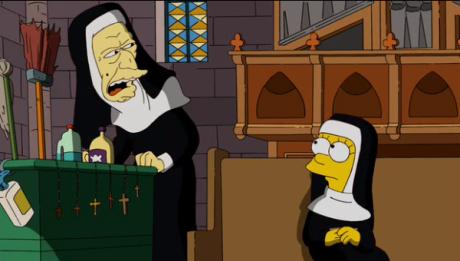
In an episode that playfully melds elements of Gone Baby Gone, Ratatouille, and The Goonies, while delightfully skewering National Treasure and The Da Vinci Code, Homer accidentally leaves Maggie on the doorstep of a convent. When the nuns take her in and Homer can’t retrieve her, Lisa infiltrates the convent, discovering a series of elaborate puzzles that may lead to both Maggie and a jewel hidden in Springfield.

The puzzles take center stage early in this episode, as Homer encounters his own version of the cabbage, wolf, and goat river-crossing puzzle — in this case, featuring Maggie, Santa’s Little Helper, and a colorful bottle of rat poison. (His attempt to solve this puzzle is how Maggie ends up in the convent in the first place.)

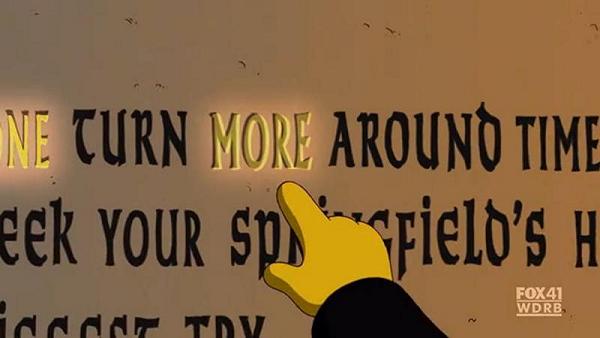
Lisa’s first clue is to “seek God with heart and soul,” which leads her to play “Heart and Soul” on the church organ. After a ridiculously overelaborate Rube Goldberg device opens up, the next clue tells her to seek the biggest man-made ring in Springfield.

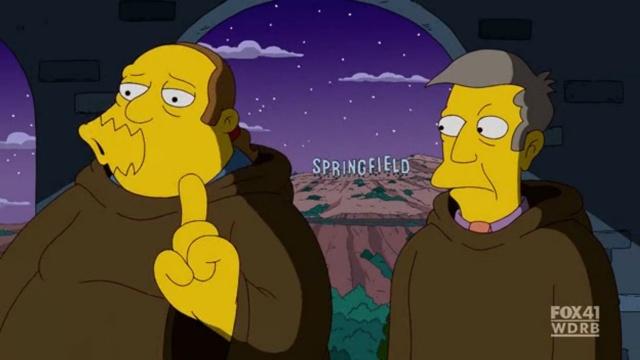
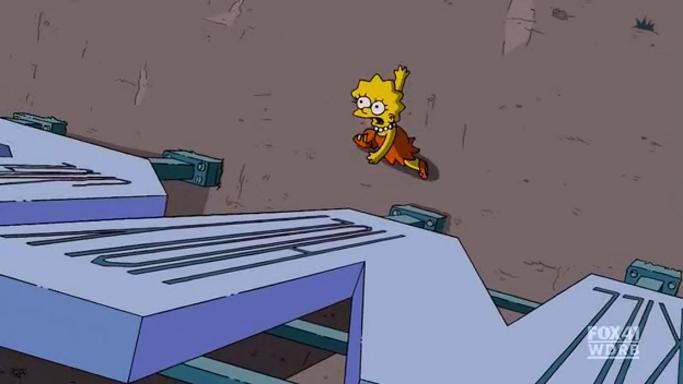
After a red herring and a stop for some goofy exposition from amateur puzzle-solvers Comic Book Guy and Principal Skinner, Lisa deduces that the biggest ring in Springfield is, in fact, the word RING in the Hollywood-esque Springfield Sign in the hills, and the adventurous trio sets off.

Hidden on the giant letters of the Springfield Sign is the message “Great crimes kill holy sage,” which Lisa dutifully anagrams into the message “Regally, the rock gem is Lisa.” Naturally, she does so just in time for Mr. Burns (the requisite shadowy Freemason figure) to emerge and take everyone back to the convent.

When she arrives, the nuns tell her Maggie is in fact the gem they’ve been seeking, and they re-anagram the message to read, “It’s really Maggie, Sherlock.” A pretty impressive feat of wordplay, I’d say.

(Naturally, Marge enters the scene here and sets everyone to rights by taking Maggie home. Bart sits on the throne of the gem child just vacated by Maggie, and ends up transforming the world into a nightmarish hellscape, as you’d expect.)

With elements of logic puzzles, brain-teasers, and anagram goodness, this episode is a treat for puzzlers of all ages, plus it’s hysterical to boot. The Simpsons excels at not simply including puzzles in their stories, but making the puzzles the linchpin of the story, something to drive the characters to learn and grow and challenge themselves.

While this episode was a little goofier and a little less heartfelt than “Homer and Lisa Exchange Cross Words,” it remains a worthwhile entry in the Puzzles in Pop Culture library.

Puzzles in Pop Culture: The Simpsons

From Stanley’s love of crosswords on The Office to the clever conundrums constantly conjured by the Riddler in various iterations of Batman, puzzles have played roles both big and small in numerous TV shows and films.

But for my money, few shows have made puzzles the centerpiece of storyline development and family interaction quite like The Simpsons.

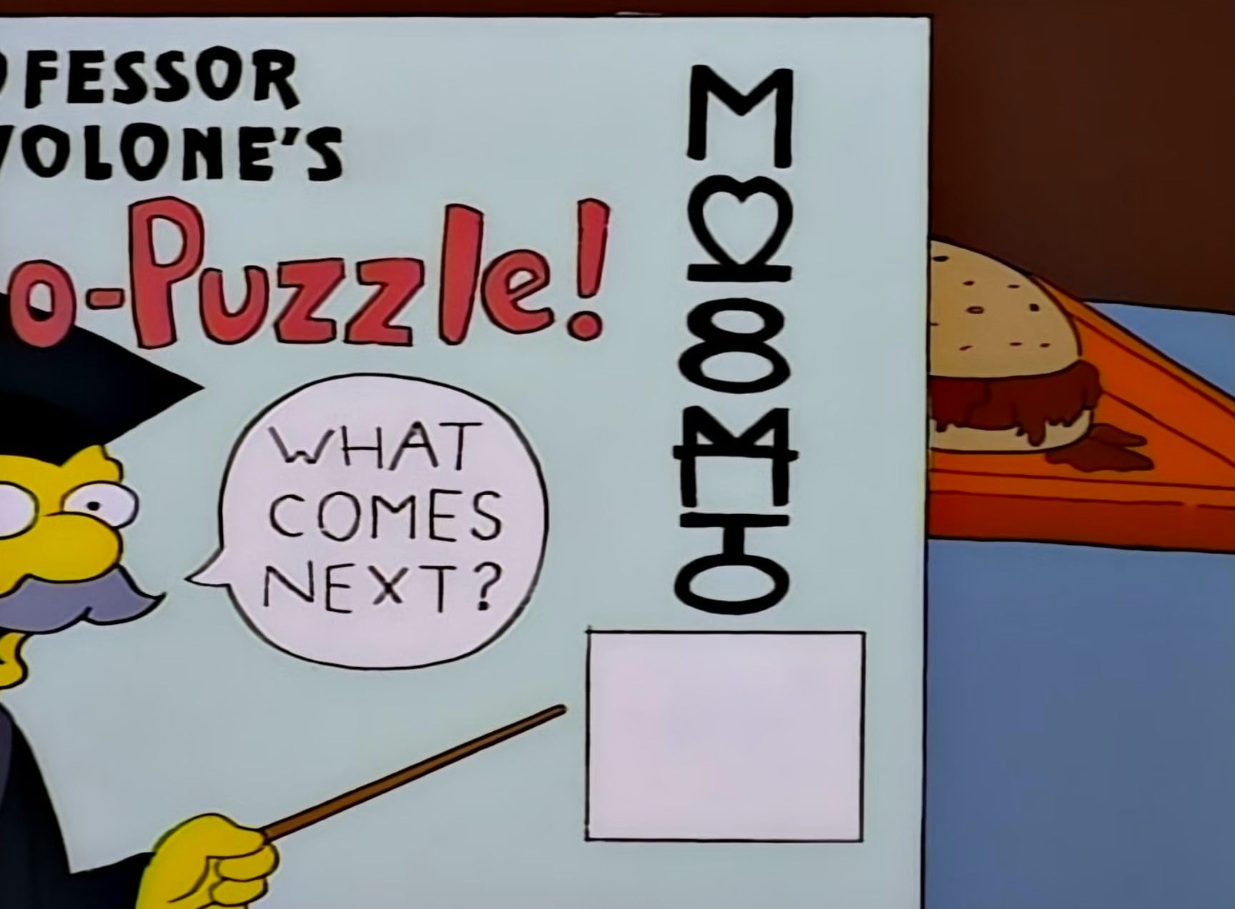
The first episode that comes to mind — and my personal favorite — is season 9’s Lisa the Simpson.

In the episode, Lisa is stumped by a brain teaser and begins to worry about her intelligence, a concern that is only exacerbated by Grandpa’s revelation of the Simpson Gene, a genetic quirk that caused Homer and Bart’s descent from academic achievement to hilarious idiocy.

In the end, of course, Lisa discovers she’ll be just fine — the defective gene is on the Y chromosome, so only male Simpsons are afflicted — and she conquers the brain teaser.

Puzzly themes would continue to crop up in the show from time to time.

For instance, Homer discovers a secret acrostic message from his mother in the newspaper in season 15’s My Mother the Carjacker. But most of the puzzle-centric goodness centered around Lisa.

She indulged in palindromic fun with fellow Mensa members in season 10’s They Saved Lisa’s Brain, as well as an anagramming game in the season 6 classic Lisa’s Rival.

(That’s when I first learned that Alec Guinness anagrams into Genuine Class.)

But puzzles wouldn’t again take center stage until season 20’s episode Homer and Lisa Exchange Cross Words.

In the episode, Lisa quickly becomes a crossword fiend, solving all the puzzles she can and eventually entering the Crossword City Tournament.

Trouble brews when Homer bets against her in the championship round, and their relationship fractures.

This was a real watershed moment in synergy for the show, since they somehow managed to convince The New York Times to publish the same puzzle in the paper that Homer uses to apologize to Lisa.

(You can click here to see the full puzzle.)

Homer’s hidden message runs along the diagonal, and it’s a brilliantly unobtrusive trick. I’m sure some solvers never even noticed the tie-in. (The puzzle didn’t reference The Simpsons or the episode in any other way.)

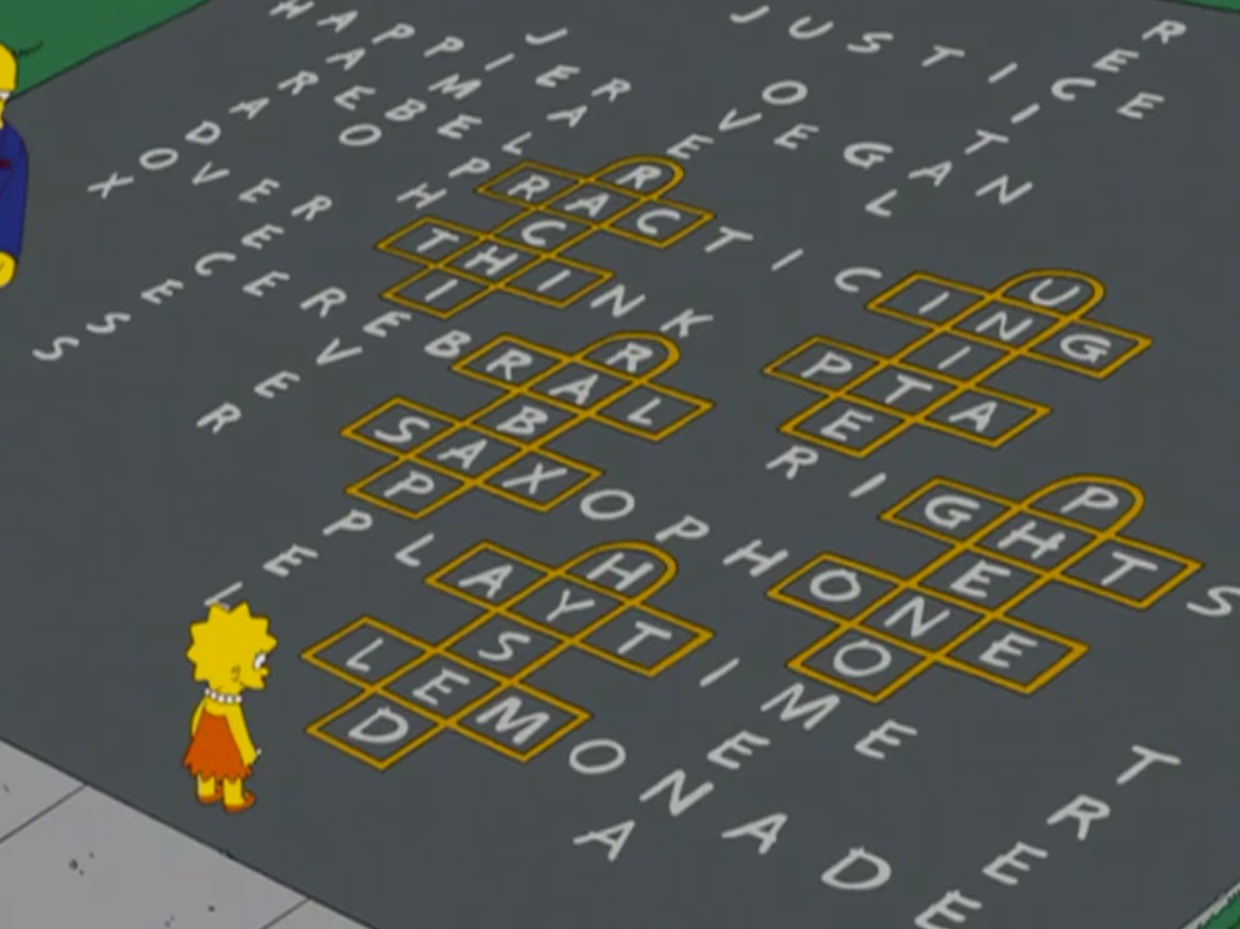
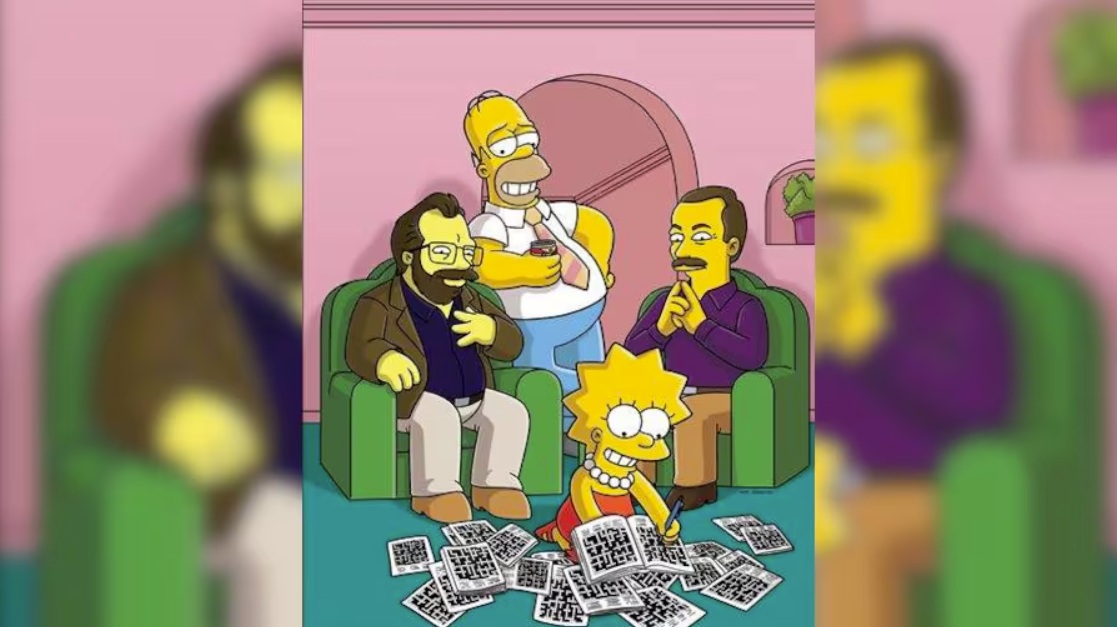
Puzzlemaster Merl Reagle created the puzzle, and Will Shortz oversaw the project. Both also appeared in the episode. (Reagle also created the word crossings for the hopscotch puzzle pictured above.)

It’s a real treat to see puzzles incorporated into a narrative like this. Instead of a time-killer or a mere passing interest, they become linchpins of each story. The puzzles create conflict, drive epiphanies, and bring people together.

It’s a testament to the power of puzzles in pop culture. Plus, they’re just a buttload of fun.

Hope you enjoyed this little (animated) trip down memory lane. Until next time, keep calm, puzzle on, and I’ll catch you again soon.