

I wanted to do one more Sudoku-centric post for Sudoku Month, so I figured I’d take a look at different solving techniques!
Sudoku is all about deduction, but you’d be surprised what you can learn from different number patterns and arrangements. There is plenty of information lurking in those grids beyond the given digits.
Let’s take a look!
Many how-to-solve guides suggest utilizing candidates to assist with your solving. Candidates are all of the possible numbers that could be in a given cell, and most Sudoku apps have a feature allowing you to list them onscreen for ease of solving.
It can absolutely be an advantage, especially if you have a hard time keeping track of possible numbers in different locations of the grid while you’re solving.
But keep in mind, especially for solvers newer to Sudoku, the amount of information can also be a bit overwhelming, obscuring paths forward.
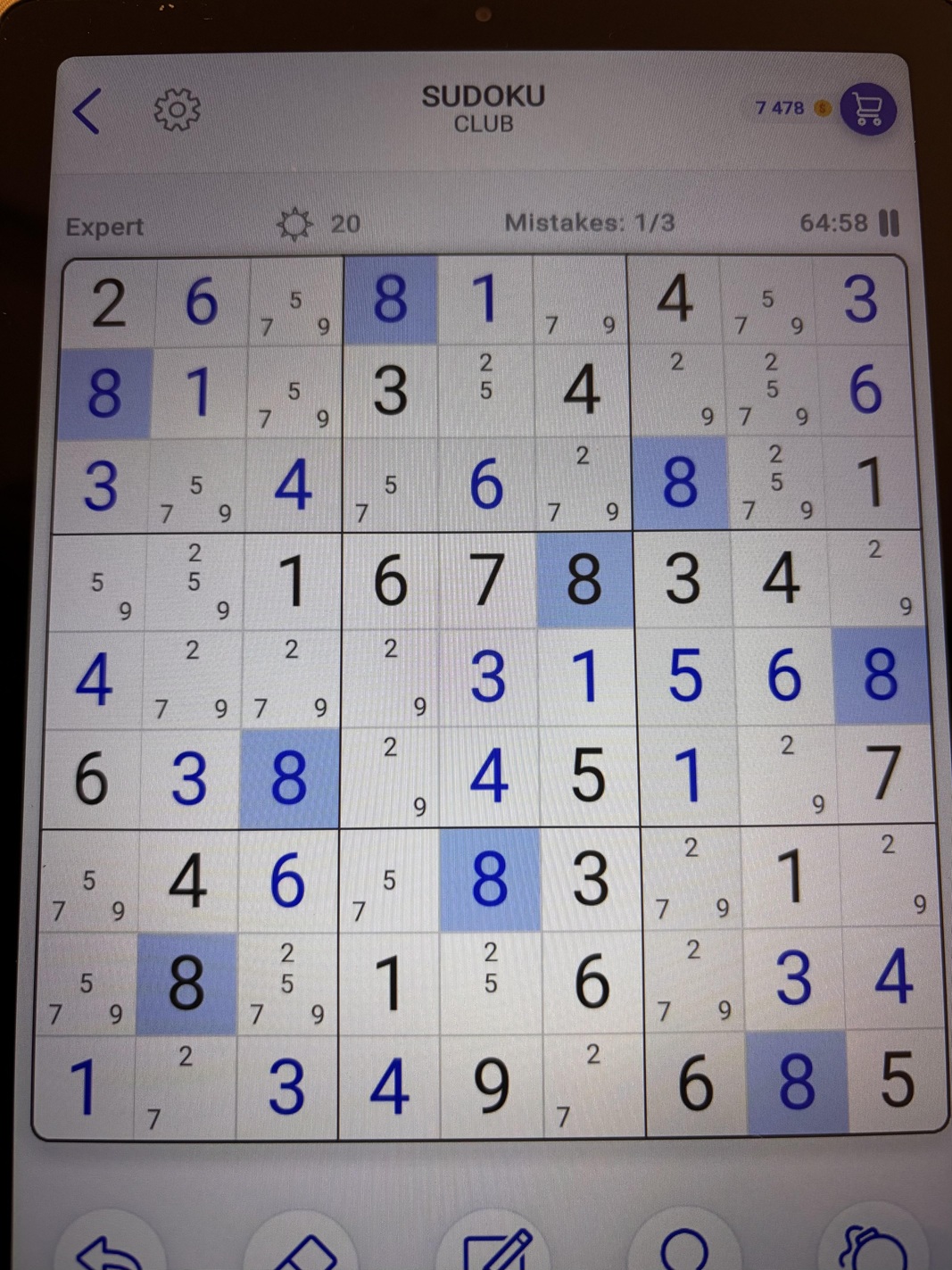
In this grid (which I nabbed from r/Sudoku), you can see all the candidates placed. But I suspect a less experienced solver might not spot my next step because of ALL the noise onscreen. Viewing all the candidates can take some getting used to.
But if you look in Box 7 (the lower-left 3×3 section of the grid), you’ll find your next move.
There, if you look at the first column, you can see that the 7 can only be in one of those two boxes. (Otherwise, there’s no 7 at all in that column.) Which means the seven isn’t a candidate for the bottom cell or the cell to the right of the 8. In fact, that means we can place that 2 in the bottom cell immediately.
And from that point, we can place the 7 in Box 8, as well as the 9 and the 2 in Box 2 (column 6). One quick deduction, and we’ve placed four digits!
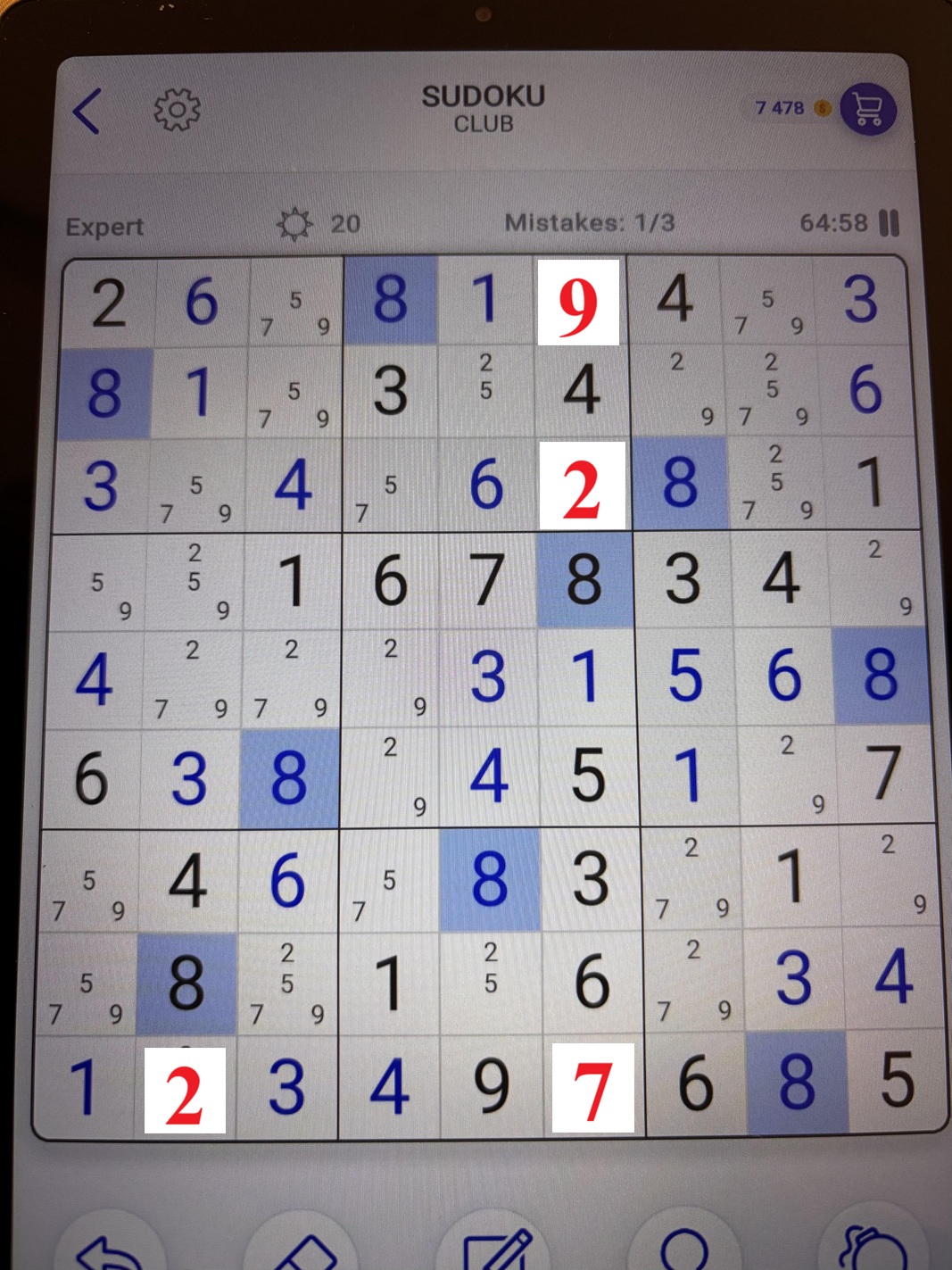
From that point, we can fill in the rest of Box 8 and we’re off to the races.
Now that was pretty simple, so let’s look at something a little more complex. This technique is called X-Wings, and it’s all about pattern recognition.
Start looking for columns or rows with only two instances of a particular candidate (for example, the number 4). If you can find two rows, each with only two places that a 4 can be, and they’re the same in both rows, you might have an X-Wing. Now check the crossing columns. If two columns also have only two instances of that candidate 4 in the same position (making a square or rectangle), you’ve got an X-Wing.
Okay, I know that was A LOT, so let’s look at it in grid form to help you visualize. (This grid comes from the book Sudoku Rocks! by David Klein.)
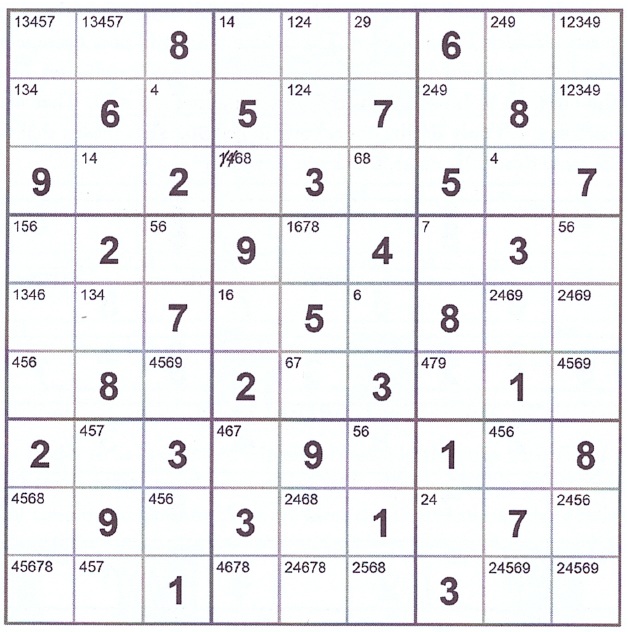
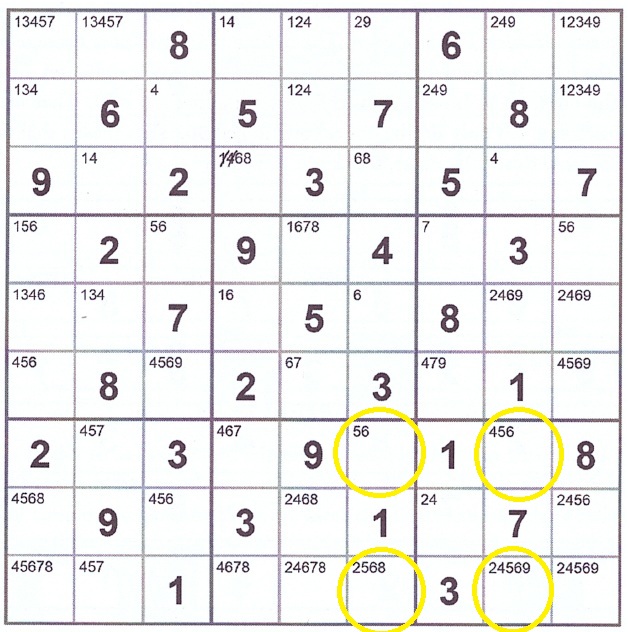
In this example, look at columns 6 and 8. Each column only has two candidate 5s (in Box 8 and Box 9, respectively). And those candidate 5s are in the same positions in the crossing rows (row 7 and 9).
Those four candidate 5s form a square, so we’ve got an X-Wing here.
How does that help us?
Well, we know that there are no other 5s in those two columns. But what we also know is that, no matter which 5 is correct, both of those intersecting rows (rows 7 and 9) are also covered. That X-Wing will contain two 5s diagonally one way or the other.
So that means any of the other 5s listed as candidates in those two rows can be crossed out.
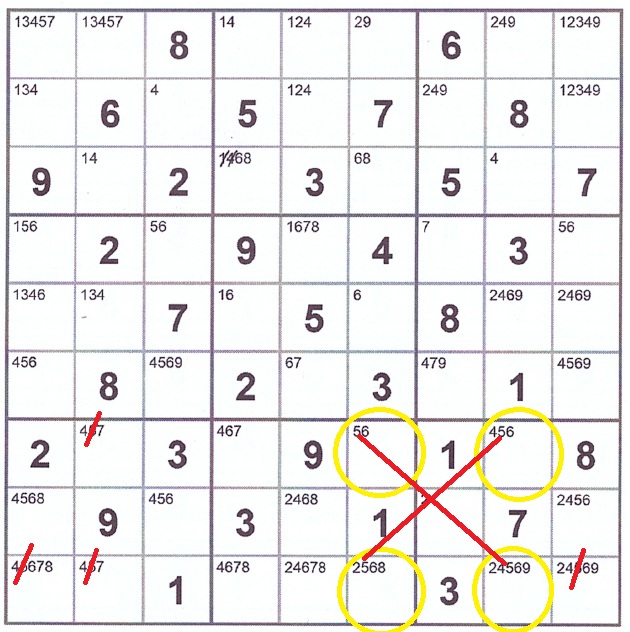
This may seem trivial, but we can already place a number because of it. By crossing out the 5s in Box 7, there is only one place in column 2 that a 5 can go. Right at the top, in Box 1.
This pattern in the lower right-hand corner just gave us a confirmed number in the upper left-hand corner. Pretty cool!
Now, after learning X-Wings, we can explore another pattern variation: Y-Wings (also known as XY-Wings).
In an XY-Wing, you’re identifying a square or rectangular pattern of candidates in the grid that influence each other, similar to an X-Wing layout.
One of the corners of the square will be the target, where you hope to eliminate one of the candidates. The neighboring corners of the square will be the pincers, closing in on your answer. And the final corner is called the pivot. By testing the candidates in this square (pivoting between the choices), we will learn something about our target cell.
It takes some practice to learn to spot XY-Wings, but when you manage it, you’ve added a valuable tool to your Sudoku solving kit.
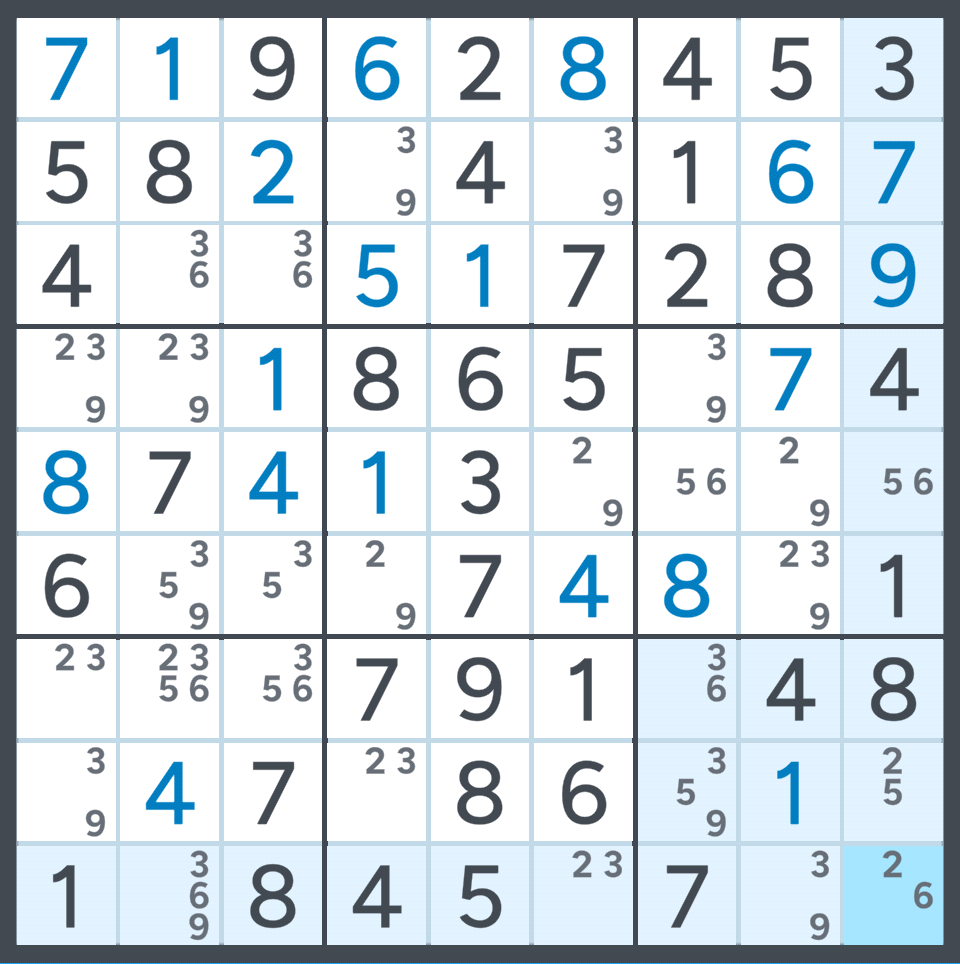
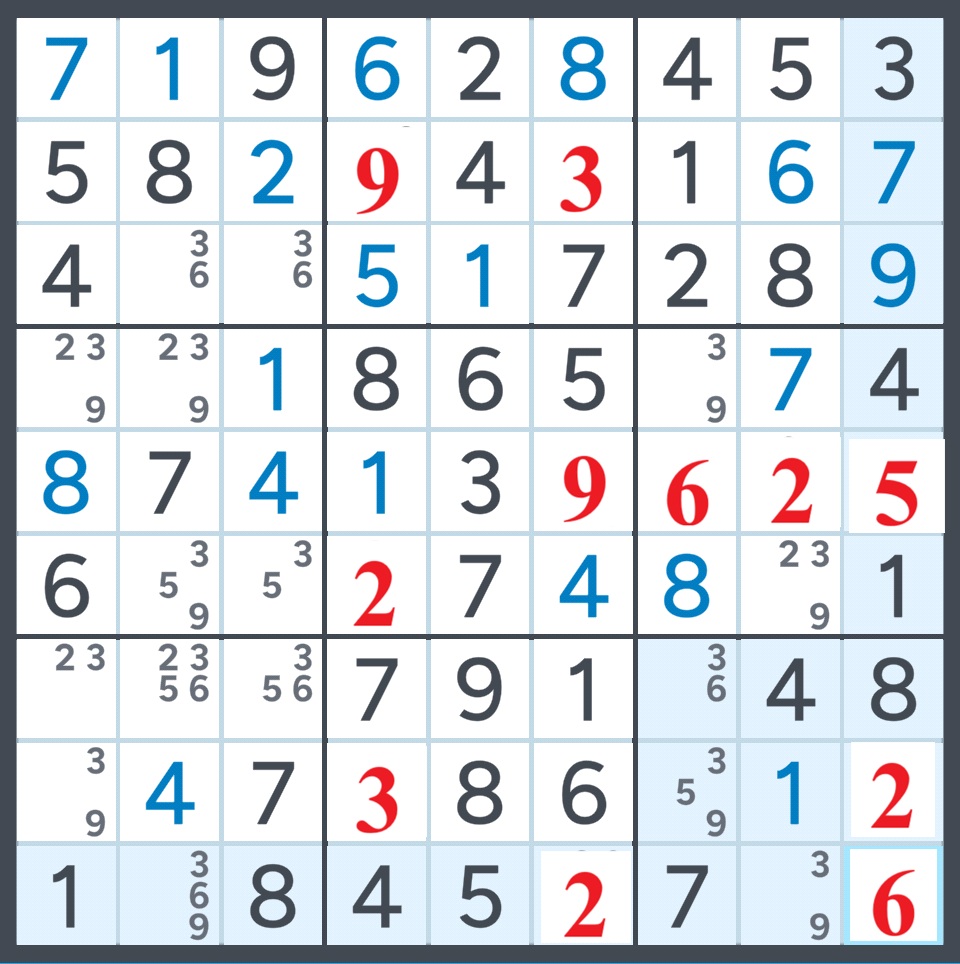
Here is another grid I grabbed off r/Sudoku. Can you spot the XY-Wing in the lower right-hand corner of the grid?
It’s okay if you can’t! It definitely took me a minute to spot it.
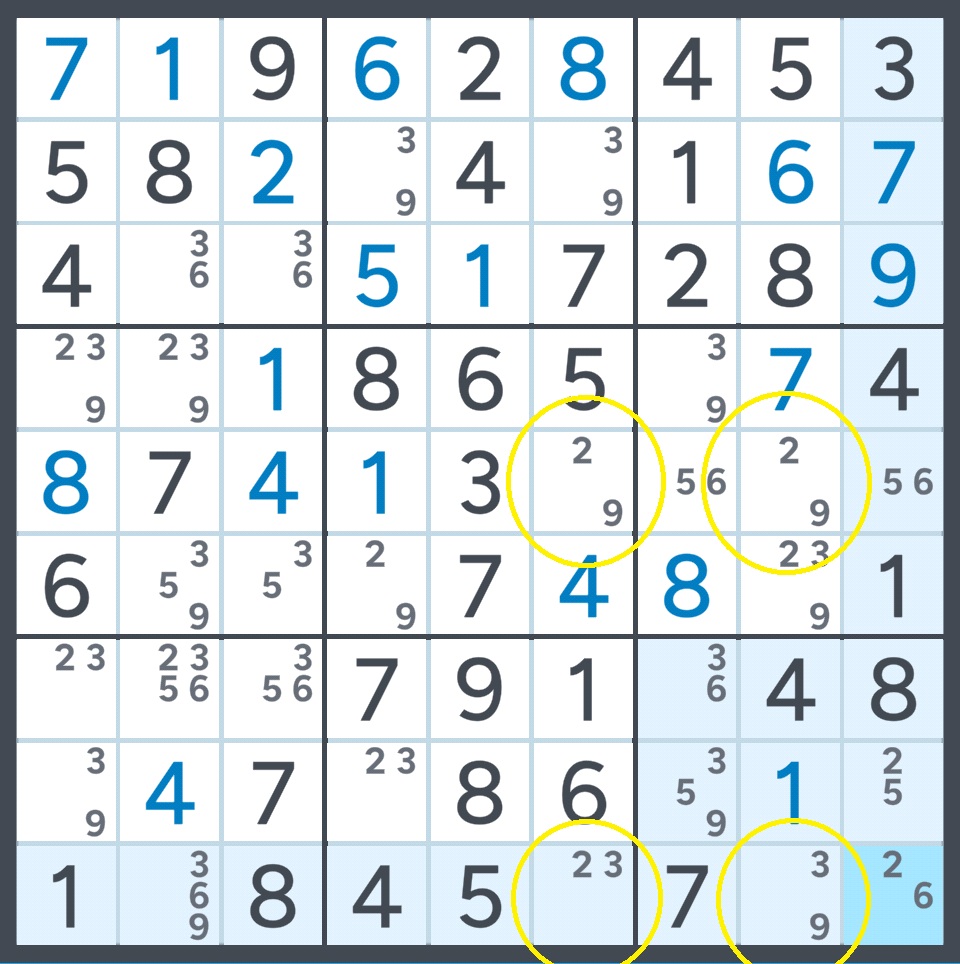
In this case, the cell in Box 6 will be our target, the cell in Box 8 is our pivot, and the other two are our pincers.
In Box 8, our circled cell has two options, 2 and 3. If the answer is 2, the pincer above in Box 5 is a 9. If the answer is 3, the pincer to the right in Box 9 is a 9. So, no matter what’s in Box 8, one of those two pincers will be a 9.
And since both of those pincers are in a row or column with the circled cell in Box 6, we know that cell CANNOT be a 9. So it must be a 2.
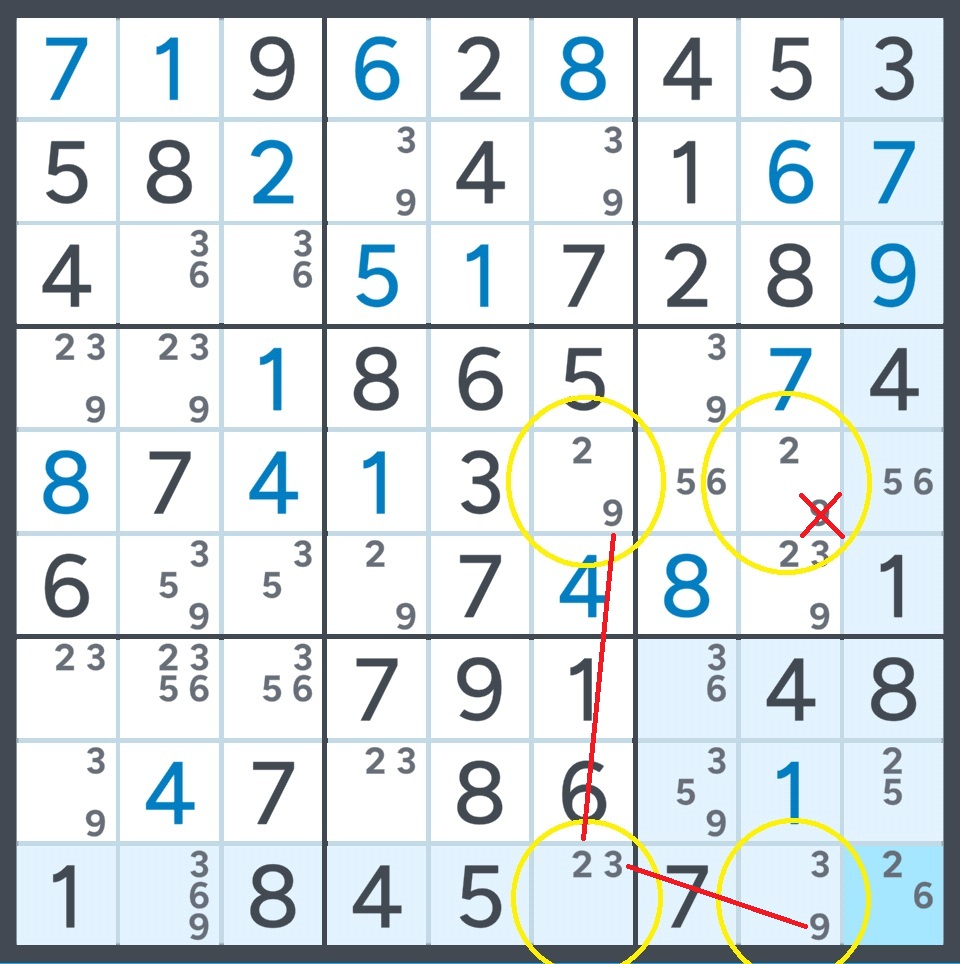
And once we’ve placed that 2, we can place the 9 in Box 5, the 2 in Box 5, the 3 in Box 2, the 9 in Box 2, and more! All from one deduction.
Hopefully these tools and techniques will help you with your Sudoku solving in the future, fellow puzzler!
Would you like me to return to this subject in the future? There are plenty of advanced techniques out there to explore, like Two-String Kite, Skyscraper, or Finned X-Wings. If you’d like to see more posts like this (for Sudoku or other puzzles), please let me know in the comment section below! I’d love to hear from you.

