2026 continues to be a year of big anniversaries in the world of puzzles. Yesterday marked the 155th birthday of Arthur Wynne, the creator of the first modern crossword puzzle in 1913.
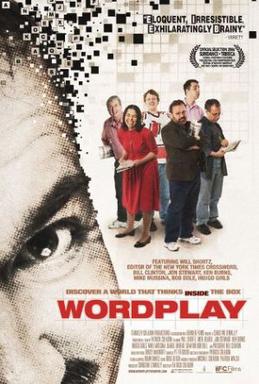
And today marks twenty years since the Wordplay documentary first hit theaters.
The documentary chronicled the 2005 edition of the American Crossword Puzzle Tournament, bringing national attention to the tournament (and inspiring a Simpsons episode about crosswords).
Wordplay introduced a wider audience to several famous names in crossword tournament circles, like Ellen Ripstein, Trip Payne, Tyler Hinman, Jon Delfin, and Al Sanders, as well as highlighting many celebrity crossword solvers like Jon Stewart, Ken Burns, Bill Clinton, and more.
And the impact Wordplay had on the tournament itself, and interest in crosswords in general, cannot be overstated.
Wordplay sparked a 40% increase in attendance the year after it aired, and the growing interest in the yearly event caused the tournament to actually change locations from the Stamford Marriott to a larger venue in New York City for 7 years.
And it’s delightfully apropos that this year marked the tournament’s last year in Stamford, once again moving to a larger venue (in Philadelphia this time!) in order to accommodate increased attendance. Synchronicity!
There was even a song for the documentary…
I think my favorite part of the documentary was Will Shortz reading some critical responses (aka hate mail) in good spirits, though getting a glimpse into the creative process of Merl Reagle was also a treat.
Over the last twenty years, Wordplay has gone from introducing many people to crosswords and tournament solving to a time capsule of a particular era in puzzles.
A time when the hundredth anniversary of the crossword hadn’t arrived. A time before crosswords on The Simpsons, before online tournaments and apps like Daily Pop Crosswords or Puzzmo. A time when crosswords were still weirdly considered a niche interest, despite the tens of millions of people solving them every day.
And we can thank Wordplay for helping welcome a new generation of solvers to our puzzly world.
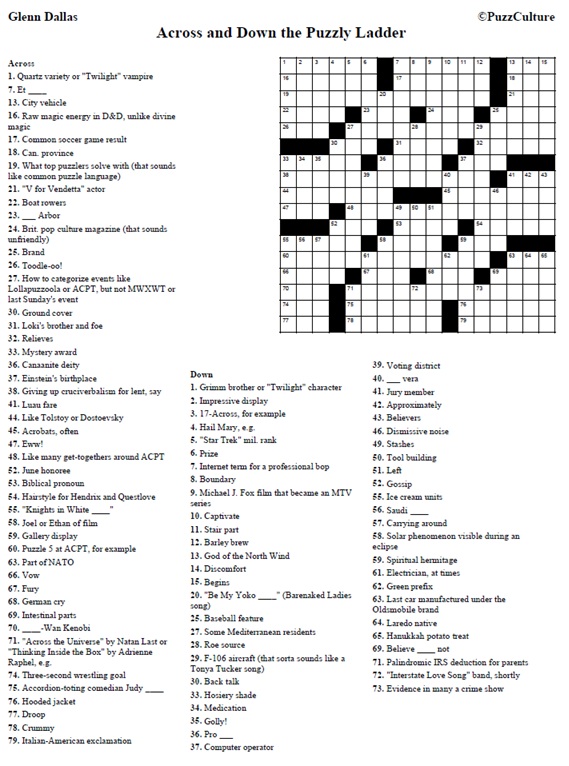
In honor of the anniversary, I’ve got a puzzle for you!
I had the idea for the theme while writing this post and thinking about puzzle history, and I hope you enjoy.
How did you find your way to crossword solving, fellow puzzlers? Was Wordplay your gateway, or was it a friend or a family member? Or did you simply accept the challenge of a grid in your local paper on a whim one day?
Let me know in the comments section below! I’d love to hear from you.
In 1913, Arthur Wynne created the first modern crossword puzzle — which he called a Word-Cross puzzle — and over a hundred years later, we are still enjoying the ever-increasing variety of puzzles and clues spawned by that “fun”-filled grid.
Wynne was born on June 22, 1871 in Liverpool, England, but moved to the states in the early 1890s, spending time in Pittsburgh and New York City before creating his Word-Cross puzzle for the New York Sunday World.
But, speaking of figures who helped elevate crosswords to greater prominence, that brings us to our second anniversary.
Tomorrow marks the 15th anniversary of the release of the influential crossword documentary Wordplay.
Wordplay introduced several famous names in crossword tournament circles, like Ellen Ripstein, Trip Payne, Tyler Hinman, Jon Delfin, and Al Sanders, as well as highlighting many celebrity crossword solvers like Jon Stewart, Ken Burns, Bill Clinton, and more. The documentary also chronicled the 2005 edition of the American Crossword Puzzle Tournament, bringing national attention to the tournament (and inspiring a Simpsons episode about crosswords).
Wordplay sparked a 40% increase in attendance the year after it aired, and the growing interest in the yearly event caused the tournament to actually change locations to a larger venue in New York City for 7 years!
(It has since returned to the Stamford Marriott, its traditional setting, despite actually topping the biggest NYC attendance in 2019, and again virtually in 2021.)
But the impact Wordplay had on the tournament itself, and interest in crosswords in general, cannot be overstated.
And this week, we celebrate both crossword anniversaries, one marking the genesis of crosswords, and the other marking how far crosswords had come, and how much farther they could go in the future.
It’s a pretty cool confluence of dates, to be sure.
Back in 2013, we created a timeline of events from crossword history as part of our celebration of the hundredth anniversary of the crossword.
Although 105 isn’t as prestigious as 100, and the anniversary is technically tomorrow, we thought we’d honor the day this year by updating our comprehensive look at the long (yet surprisingly short) road it took to get to that marvelous centennial!
So, without further ado or folderol, we proudly present:
A Brief History of the Crossword (Updated)
16th – 11th century BC
Inscriptions from New Kingdom-era Egypt (Eighteenth to Twentieth Dynasties) of horizontal and vertical lines of text divided into equal squares, that can be read both across the rows and down the columns, are made. These inscriptions are later referred to by Egyptologists as “Egyptian crossword puzzles.”
19th century AD
Rudimentary crosswords, similar to word squares, begin appearing in England, and later elsewhere in Europe.
June 22, 1871
Future inventor of the crossword, Arthur Wynne, is born.
March 23, 1897
Future New York Times crossword editor Margaret Farrar is born.
February 25, 1907
Future New York Times crossword editor Will Weng is born.
December 21, 1913
The New York World publishes the first crossword, invented by Liverpool journalist Arthur Wynne. (The puzzle is originally known as a word-cross.)
January 6, 1916
Future New York Times crossword editor Eugene T. Maleska is born.
1920
Margaret Farrar is hired by The New York World as a secretary, but soon finds herself assisting Arthur Wynne with proofreading puzzles. Her puzzles soon exceed Wynne’s in popularity.
Colonel H.W. Hill publishes the first Crossword Dictionary.
1923
Margaret Farrar revises the cluing system for crosswords, sorting them into “Horizontal” and “Vertical” clues by number. (It wouldn’t be until the 1940s that the more familiar “Across” and “Down” terminology became the norm.)
1924
Margaret Farrar publishes the first book of crossword puzzles under contract for Richard L. Simon and Max Schuster, “The Cross-Word Puzzle Book.” It was an instant bestseller, launching Simon & Schuster as a major publisher. (Additional information available below the timeline.)
The Daily Express, founded in 1900, becomes the first newspaper in the United Kingdom to carry crosswords.
Crossword-themed novelty songs hit the airwaves as the puzzle craze intensifies, most notably “Crossword Mama, You Puzzle Me (But Papa’s Gonna Figure You Out).”
The Amateur Crossword Puzzle League of America, a self-appointed group of puzzle enthusiasts, lobbies for rotational symmetry in crosswords, which becomes the standard.
Solver Ruth Franc von Phul becomes a minor celebrity after winning The New York Herald-Tribune’s National All Comers Cross Word Puzzle Tournament at the age of 20. (She would win again 2 years later.)
January 15, 1925
“Felix All Puzzled,” the first animated short to feature a crossword, is released.
Disney releases a crossword-themed animated short, “Alice Solves the Puzzle.”
1926
The cryptic crossword is invented by Edward Powys Mathers, who publishes under the pseudonym Torquemada. He devises them for The Observer newspaper.
First reported instances of Braille crosswords.
1931
Dell Puzzle Magazines begins publishing.
(Dell Publishing itself was founded in 1921.)
1941
Dell Pocket Crossword Puzzles first published.
(The magazine continues to this day.)
February 15, 1942
The New York Times runs its first Sunday edition crossword. (Additional information available below the timeline.)
June 2, 1944
Physics teacher and crossword constructor Leonard Dawe is questioned by authorities after several words coinciding with D-Day invasion plans appear in London’s Daily Telegraph. (Additional information available below the timeline.)
1950
The crossword becomes a daily feature in The New York Times.
August 26, 1952
Future New York Times crossword editor Will Shortz is born.
1968
Lyricist Stephen Sondheim begins creating cryptic crosswords for New York Magazine, helping introduce Americans to British-style crosswords.
1969
Will Weng succeeds Margaret Farrar as the second crossword editor for The New York Times.
1973
Penny Press is founded.
1977
Eugene T. Maleska succeeds Will Weng as the third crossword editor for The New York Times.
1978
First year of the American Crossword Puzzle Tournament, later featured in the documentary Wordplay. 149 contestants compete for the title in the first national crossword tournament since the 1930s.
1979
Howard Garns creates the modern Sudoku puzzle for Dell Magazines (under the name Number Place), the first pen-and-paper puzzle to rival the crossword in popularity (though this spike in popularity would occur decades later under the name Sudoku).
June 11, 1984
Margaret Farrar, while working on the 134th volume in Simon & Schuster’s crossword puzzle book series, passes away.
1993
Will Shortz succeeds Eugene T. Maleska as the fourth crossword editor for The New York Times.
November 5, 1996
One of the most clever and famous crosswords of all time is published, the election-preceding crossword where either BOB DOLE ELECTED or CLINTON ELECTED could read out, depending on the solver’s answers.
1998
The Wall Street Journal adds a crossword to its newspaper, and Mike Shenk is appointed editor.
June 23, 2006
Wordplay documentary hits theaters, featuring celebrity solvers of crosswords as well as the participants and organizers of the 2005 edition of the American Crossword Puzzle Tournament.
February 29 – March 2, 2008
Thanks in part to the Wordplay documentary, the American Crossword Puzzle Tournament outgrows its previous setting and moves to Brooklyn.
The city of Lvov, Ukraine, creates a crossword that spans an entire side of a 100-foot-tall residential building, with clues scattered around the city’s major landmarks and attractions. It’s awesome.
David Steinberg launches the Pre-Shortzian Puzzle Project, designed to compile a complete database of every New York Times crossword.
August 13, 2012
PuzzleNation Blog is launched.
June 14, 2013
Matt Gaffney celebrates five years of MGWCC,
stating that MGWCC will run for 1000 weeks
(which puts the final edition around August 6th, 2027).
December 21, 2013
The Crossword officially turns one hundred years old.
Additional information:
1924: The publishing house Simon & Schuster, agreed to a small (3,600-copy) run of a crossword puzzle book, prompted by founder Richard L. Simon’s aunt, who wanted to give such a book to a friend. It became “a runaway bestseller.”
In no time the publisher had to put the book back on press; through repeated printings, it sold more than 100,000 copies. Soon a second collection followed, and then a third and a fourth. In 1924 and 1925 the crossword books were among the top 10 nonfiction bestsellers for the year, besting, among others, The Autobiography of Mark Twain and George Bernard Shaw’s Saint Joan.
February 15, 1942: The New York Times initially regarded crosswords as frivolous, calling them “a primitive form of mental exercise”; the motivating impulse for the Times to finally run the puzzle (which took over 20 years even though its publisher, Arthur Hays Sulzberger, was a longtime crossword fan) appears to have been the bombing of Pearl Harbor.
In a memo dated December 18, 1941, an editor conceded that the puzzle deserved space in the paper, considering what was happening elsewhere in the world and that readers might need something to occupy themselves during blackouts. The puzzle proved popular, and Sulzberger himself would author a Times puzzle before the year was out.
June 2, 1944: The words Omaha (codename for one of Normandy’s beaches), Utah (another Normandy beach codename), Overlord (the name for the plan to land at Normandy on June 6th), mulberry (nickname for a portable harbor built for D-Day), and Neptune (name for the naval portion of the invasion) all appeared in Daily Telegraph crosswords during the month preceding the D-Day landing.
This has been attributed to either an incredible coincidence or Dawe somehow overhearing these words (possibly slipped by soldiers involved) and incorporating them into puzzles unwittingly.
Do you have any suggestions for additions for our Crossword Timeline? Let us know in the comments section below! We’d love to hear from you!
Thanks for visiting PuzzleNation Blog today! Be sure to sign up for our newsletter to stay up-to-date on everything PuzzleNation!
A few years ago, I wrote a post discussing the curious intersection of music and puzzles. It centered around several studies about the effects both listening to music and performing music can have on individuals taking tests or solving puzzles.
There were two intriguing takeaways from these studies:
Both adults and children perform better on tests, puzzles, and problem-solving exercises when music is involved (ex.: if they listen to music before or during the test).
Children who are given music lessons often achieve greater heights in other subjects, including math and sports.
But it didn’t occur to me until much later that the connection between music and crosswords in particular has been in evidence for quite some time.
There are two 7-time champions in the history of the American Crossword Puzzle Tournament: Dan Feyer and Jon Delfin. Think about that. Fourteen out of forty-one ACPT tournaments have been won by one of these men. Practically one out of every three!
And both of them have a musical background as pianists and music directors.
Their ability to assimilate a lot of coded information instantly. In other words, a piano player like John Delfin, the greatest crossword player of our time, he sits down and he sees three staffs of music and he can instantly play it. He’s taken all those notes and absorbs what they mean, instantaneously. If you have that kind of mind, and you add it to it a wide range of information, and you can spell, you’d be a really great crossword puzzler.
Crossword constructor and psychology professor Arthur Schulman — known for a series of seminars entitled “The Mind of the Puzzler” at the University of Virginia — would agree with that statement. He posited a correlation between word puzzles, math, and music, in that they all involve a quick and intuitive understanding of symbols. It’s about “finding meaning in structure.”
In an interview with the New York Times, Dan Feyer built on this idea, stating that music, math, and puzzles all have pattern recognition in common, quickly recognizing combinations of blanks and spaces and mentally filling in possible answer words, even before reading the clues.
Now, clearly, musical skill and proficiency isn’t required to be a good crossword solver — I’d classify myself as a pretty good solver and I have an almost magical lack of musical talent — but it’s intriguing to ponder how puzzling could easily be wrapped up with a musical bow.
Do you know any other puzzlers with a musical background, or are you a lyrical solver yourself? Let us know in the comments section below! We’d love to hear from you!
Thanks for visiting PuzzleNation Blog today! Be sure to sign up for our newsletter to stay up-to-date on everything PuzzleNation!
The puzzle world was stunned this weekend by the sudden passing of a true crossword legend: Merl Reagle.
Merl has been one of the biggest names in puzzles for a long time now, one of the few crossword constructors who was successful and prolific enough to work on puzzles full-time.
Between his appearance in the Wordplay documentary and a cameo on The Simpsons alongside New York Times crossword editor Will Shortz, he proudly represented both the love of puzzles so many solvers share AND stood as a standard-bearer for crossword construction and quality puzzling.
Merl sold his first crossword to the New York Times at age 16 — ten years after he started constructing puzzles, amazingly enough! In a career spanning five decades, his contributions to the world of puzzles were myriad. Nearly every year, one of his puzzles appears at the American Crossword Puzzle Tournament. The crossword he constructed for the 100th Anniversary of the Crossword was turned into a Google Doodle, and, based on my research, is the most solved crossword puzzle in history.
A craftsman with humor and heart (and no small amount of anagram skill), Merl was truly one of a kind.
I had the privilege of meeting him at the American Crossword Puzzle Tournament this year. It was only for a few minutes while the tournament participants were tackling one of the early puzzles and the vendor’s floor was pretty empty. (Otherwise, there were always puzzlers crowded around Merl’s table between tournament puzzles. He was the center of gravity around which many fellow puzzle fans orbited, a master of ceremonies wherever he went.)
He was friendly and gracious, one of those people who can strike an instant rapport with virtually anyone. He put me at ease immediately as I checked out his latest puzzly offerings and we briefly chatted about the tournament itself. (I didn’t get the chance to challenge his legendary anagramming talents, sadly.)
Fellow puzzler and friend of the blog Keith Yarbrough was kind enough to share one of this experiences with Merl:
Merl gave me his philosophy of puzzle construction at the ACPT one year. His goal, he said, was to make the solver smile. Coming up with a funny theme was the main thing. His test when he came up with an idea was to run it past his wife, who is not a puzzler. If it made her smile, it was a keeper.
He wasn’t out to frustrate the solver with obscurities or unnecessary crosswordese, so he used common entries as much as possible. His mantra was that the fill should not be overly difficult.
The dozens of tributes I’ve seen online are a testament to how many friends and admirers Merl earned over the years. There are too many to link to here, but I want to highlight a few from fellow puzzlers Brendan Emmett Quigley, Deb Amlen, and David Steinberg.
Merl, you will be missed. Thank you, for the laughs, for the tough crossings, the trickiest-of-tricky clues, and the many unexpected delights you managed to spring on so many solvers.
One of the privileges of writing two or three posts a week for this blog is that it pushes me to expand my own horizons when it comes to puzzles. I reach out to puzzlers, game designers, and pop culture personalities of all sorts; I try out new games and puzzles; I obsessively scour the Internet for new projects, new products, and new stories that involve puzzles.
Oftentimes, that continuous search takes me beyond the borders of the United States, allowing me to explore what puzzles mean to other countries and cultures. And I am forever intrigued by the differences in crossword puzzles between America and the UK.
The world of cryptic crosswords (or British-style crosswords, as some call them) is a bit different from the world of American crosswords. Instead of constructors, they have compilers or setters, and while constructor bylines and attributions were a long time coming on this side of the Atlantic, setters in the UK have been drawing loyal followings for decades, thanks to their unique and evocative pseudonyms.
In fact, beloved setter Araucaria will soon be the subject of a documentary. For more than 50 years, he challenged and delighted cryptic crossword fans, amassing a loyal following. In January of 2013, he even shared his cancer diagnosis with the audience through a puzzle in The Guardian.
While the Wordplay documentary, as well as interviews on PuzzleNation Blog and other sites, have given solvers some insight into the minds and lives of constructors and setters, it’s wonderful to know that the life of a fellow puzzler will be chronicled in so intimate a format.







 PuzzCulture