The Guardian Cryptic Crossword Treasure Hunt… Revealed!

cryptic

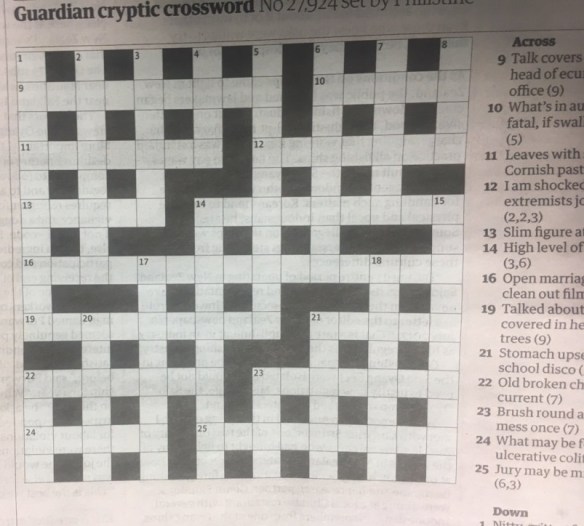
Cryptic crosswords have been getting a lot of attention this year.

Josh Wardle launched his Parseword daily puzzle, Barry Joseph has taken us on a fascinating journey into Stephen Sondheim’s love of puzzles and games (review coming soon!), and The Observer celebrated one hundred years of cryptic crossword puzzles back in March.

And just last week, The Guardian pulled back the curtain on a multi-year surprise for solvers that celebrated not only a milestone in longevity, but in creativity as well.
On May 6th, The Guardian published their 30,000th cryptic puzzle, which was set by one of the most celebrated voices in cryptic puzzles, Arachne. Crossword editor Alan Connor called the cryptic puzzle “a perfect little enigma.”

Now, that would have been milestone enough, but as it turns out, the setters of The Guardian had something much more elaborate in store for their loyal solvers: a treasure hunt spanning MANY cryptics.

They’d started two years beforehand.

Back in 2024, they began brainstorming something special for Cryptic #30,000.

A few months later, a series of entries began appearing in the bottom row of particular cryptics. Entries like WELL DONE, BRAVO, and HERE were intended to draw the eye of attentive puzzle fans. (This would prove helpful later for people searching back through the puzzle archives, once they’d learned about the treasure hunt.)

But the creative team were careful going forward, utilizing only chunks of words (ISOURF, INALCH, ALLENG) and not full entries. I can imagine the confusion for those keen-eyed solvers who were already on the trail when the pattern suddenly changed.

This continued throughout 2025 with solvers none the wiser.


The treasure hunt began in earnest when cryptic #30,000 was published.
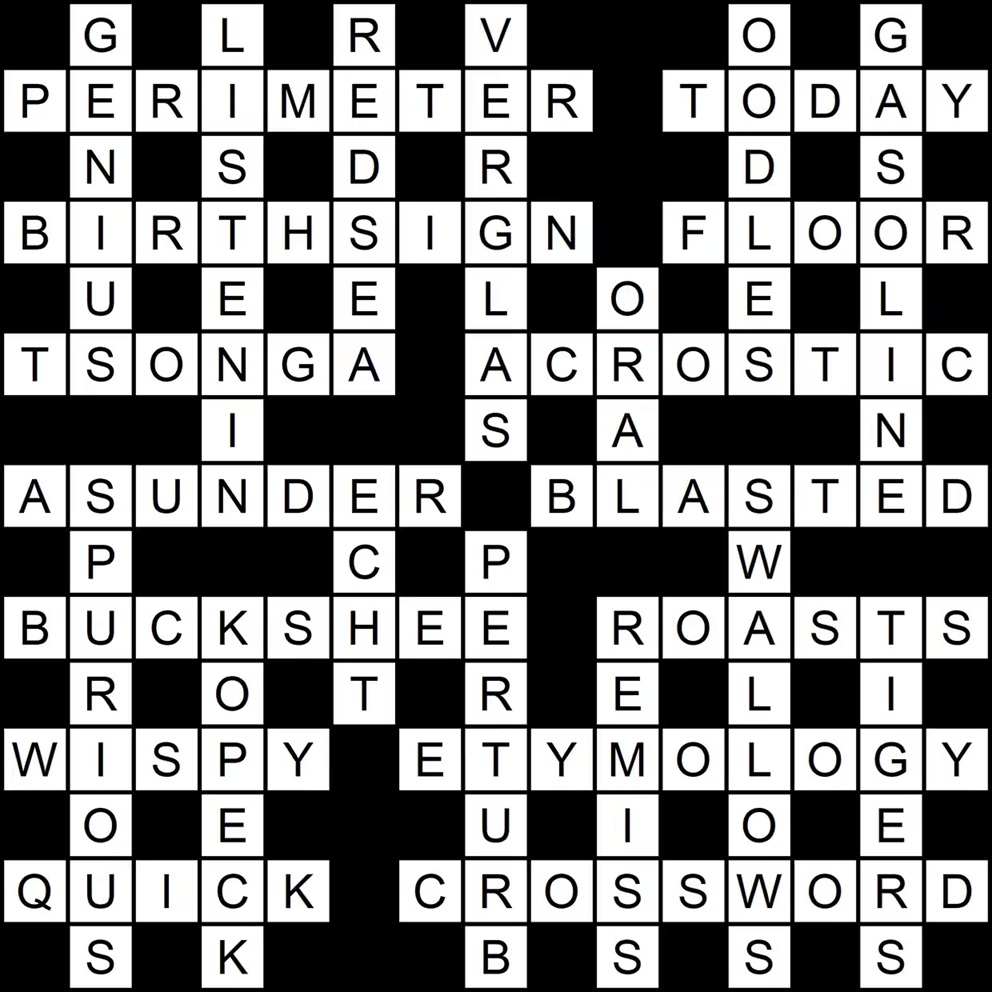
In cryptic #30,000, Arachne included the phrases PERIMETER TODAY and QUICK CROSSWORD reading out in the grid. (The Quick Crossword accompanies the daily cryptic in The Guardian.) Solvers who then completed the Quick Crossword would then find the following message reading out clockwise on the perimeter of the grid:

LEADER I TAILORED BADLY

A cryptic clue was hidden in the perimeter letters!

This cryptic clue can be parsed with “Leader” as the definition, and “badly” indicating that “I tailored” needs to be rearranged. “I tailored” anagrams into EDITORIAL, pointing to the piece Alan Connor wrote that day in celebration of the 30,000th cryptic.

Arachne had also included the word ACROSTIC in Cryptic #30,000 as a subliminal hint to solvers for where to look in the editorial that day.

And if you read the first letter of each paragraph in Connor’s editorial, you get the message LAST THIRTY-FIVE PRIMES.

No, wait, wrong Prime…

Diabolical work. That was the pattern to follow in order to uncover which puzzles were part of their long-running secret message, indicating the actual cryptic puzzle numbers to search through, starting with #29581 and ending with #29989.

So what was the message? What was the final result of a year and a half of seeding and sneaking and devious wordplay?

29581 WELLDONE
29587 BRAVO
29599 HERE
29611 INCONCLUSION
29629 ISOURF
29633 INALCH
29641 ALLENG
29663 EAREYOU
29669 KEEPINGUPGREAT
29671 THEREWI
29683 LLBEAWON
29717 DERF
29723 ULPRIZ
29741 EBUTFIR
29753 STYOUM
29759 USTENT
29761 ERARAC
29789 ENOTAN
29803 ACTUALATHLETIC
29819 RACEOFC
29833 OURSETH
29837 ATWOULD
29851 BEWEIRD
29863 NOTTHAT
29867 ITSACER
29873 EBRALRA
29879 CEINTHE
29881 FORMOFA
29917 CROSSWORDPUZZLE
29921 ITSAGEN
29927 IUSPUBL
29947 ISHEDAT
29959 NOONBST
29983 TOMORROW
29989 GODSPEED

Well done, bravo, here in conclusion is our final challenge. Are you keeping up? Great, there will be a wonderful prize but first you must enter a race. Not an actual athletic race of course, that would be weird. Not that. It’s a cerebral race in the form of a crossword puzzle. It’s a Genius published at noon BST tomorrow. Godspeed!

Naturally, when the hour arrived, a Genius crossword appeared, set by the one and only Enigmatist, another beloved name in the field of cryptics.

Duncan over at Fifteen Squared did an amazing breakdown of not just the treasure hunt but the puzzle that awaited solvers at the end, and it is a mind-bending bit of puzzling.

To start, there were no answer length at the end of each clue, which is definitely a break with tradition when it comes to cryptic crosswords. And that’s for a good reason.

Solvers had to add a letter to many of the answers in order to form the words RECKON, DEDUCE, REASON, and IDEATE beyond the boundaries of the grid.
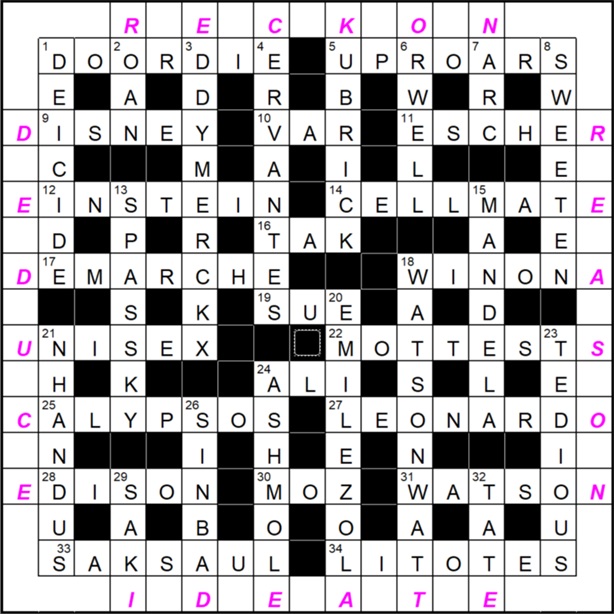
Yes, they had to think outside the box.

Many of the answers referred to luminaries in their various fields (EINSTEIN, ESCHER, LEONARDO, MANDELA, WATSON, CERVANTES, etc.), making the Genius crossword rather literal.

The first letter of every clue ALSO had something to hide. When you removed the names of two more geniuses reading out acrostic-style, BEETHOVEN and ARAUCARIA (yet another beloved cryptic setter), you get the message IT IS WHAT GENIUSES DO.

Which ties back to thinking outside the box.

Wow. What a puzzle.
So, did the puzzle live up to the hype after ALL of this amazing build-up?

I’ll give the last word to Redditor colinbeveridge, who shared this heartfelt response to the entire endeavor:

I’ve finally followed the rabbit-hole all the way to the bottom and… wow. Just blown away by the whole thing, to the point of tears at the final mic-drop.

It’s as if a dedicated team of clever people co-ordinated in secret for a year and a half to deliver something that felt like it was designed just for me (and possibly you, if you’re here). Gorgeous, beautiful work.

WELL DONE and BRAVO, Guardian editors and setters and contributors. What an amazing gift to offer your solvers.

Good luck topping this one when you get to the next 30,000 puzzle goal line!


Are you a cryptic solver, fellow puzzler? Would you have been unable to unravel The Guardian’s crafty clues and hidden hints? Let me know in the comments section below! I’d love to hear from you.

A puzzler, by any other name…

Fake names, stage names, noms de plume… they’re more common than you might think. Authors, musicians, actors, and performers of all sorts can take on new identities, either to make themselves more marketable, to build a brand, or simply to create a public persona in order to keep their private lives separate.

As I mentioned in a previous blog post, crossword constructors in the UK (known as setters) also employ pseudonyms, literally making a name for themselves as they create challenging cryptic crosswords for their solving audience.

Evocative names like Araucaria, Gordius, Crucible, Otterden, Anax, Charybdis, Tramp, Morph, Paul, Enigmatist, Hypnos, Phi, Nutmeg, Shed, Arachne, and Qaos grace the puzzles in England’s The Guardian newspaper.

That made me wonder… if American constructors were given the same opportunity, what UK-style names would they choose?

So, I reached out to some of my fellow puzzlers, and as I compiled their replies, some curious patterns emerged. I thought I’d share their responses with the PuzzleNation readership.

Whereas several UK setters have employed the names of former members of the Inquisition and other nasty sorts — like Torquemada, Ximenes, and Azed (which is Deza backwards) — to highlight the torturous challenges solvers could expect, some of their American counterparts prefer to highlight the playful, tricky aspect of constructing.

Constructor Robin Stears would publish under the name Loki or Anansi (citing two famous mythological tricksters), while meta-puzzle master Matt Gaffney would ply his craft under the name Puck. (He actually played Puck in sixth grade in a performance of A Midsummer Night’s Dream.)

[Loki, as played by Tom Hiddleston in the
Marvel cinematic universe, seems to approve…]

Other constructors embraced wordplay involving their names, like Brendan Emmett Quigley who chose Beck (his initials pronounced phonetically) or Penny Press variety editor Cathy Quinn, who chose the nom de plume Sequin (for C. Quinn).

Still others revealed their feelings about those curious words that are only found in crosswords. Variety editor Paula Curry opted for the name Ese-Averse to show her disdain for crosswordese, while puzzle historian and constructor David Steinberg selected Osier, both for its crosswordese appeal and its homophone pronunciation (OCR, representing the Orange County Register, for whom David has served as crossword editor for years).

[This crossword features several infamous crosswordese
clues as entries. Do you recognize them all?

Naturally, my fellow puzzlers at Penny Press had some of my favorite puzzly stage names. Will Shortz’s WordPlay editor Leandro Galban sets himself firmly against the heroic solver by choosing Grendel, while variety editor Andrew Haynes opted for either Bob the Settler or The Flying Penguin. (He feels that “the” adds a certain arrogance to the pseudonym, and Bob has that delightfully bland palindromic quality.)

Editor Ariane Lewis would be known simply as Dub, leaving interpretation up to the solvers, while editor Maria Peavy offered a plethora of possible pennames, including Pushkin, Excelsior, Kutuzov (in the spirit of Torquemada), Sphinx (another famous riddler) or Grail.

Or you could adopt a full false moniker like variety editor Keith Yarbrough did, and go by Rufus T. Firefly.

As for me, I haven’t decided if I want something esoteric like Syzygy (alluding to the rare alignment of both planets and quality crossword grids), something obscure and wordnerdy like Snurp or Timmynoggy or Interrobang, or something meaningless but fun to say aloud, like Skylark or Guava.

So watch out, UK setters, because one of these days, you might see names like Sequin or Osier or The Flying Penguin baffling your solvers with cryptic crossword cleverness.

Thanks for visiting PuzzleNation Blog today! You can share your pictures with us on Instagram, friend us on Facebook, check us out on TwitterPinterest, and Tumblr, and be sure to check out the growing library of PuzzleNation apps and games!

Crosswords, Cryptics, Constructors, and… Setters?

One of the privileges of writing two or three posts a week for this blog is that it pushes me to expand my own horizons when it comes to puzzles. I reach out to puzzlers, game designers, and pop culture personalities of all sorts; I try out new games and puzzles; I obsessively scour the Internet for new projects, new products, and new stories that involve puzzles.

Oftentimes, that continuous search takes me beyond the borders of the United States, allowing me to explore what puzzles mean to other countries and cultures. And I am forever intrigued by the differences in crossword puzzles between America and the UK.

The world of cryptic crosswords (or British-style crosswords, as some call them) is a bit different from the world of American crosswords. Instead of constructors, they have compilers or setters, and while constructor bylines and attributions were a long time coming on this side of the Atlantic, setters in the UK have been drawing loyal followings for decades, thanks to their unique and evocative pseudonyms.

While Will Shortz, Merl Reagle, Patrick Blindauer, Brendan Emmett QuigleyPatrick Berry, Trip Payne, Matt Gaffney, and Bernice Gordon represent some of the top puzzlers to grace the pages of the New York Times Crossword, names such as Araucaria, Qaos, Arachne, Crucible, Otterden, Tramp, Morph, Gordius, Shed, Enigmatist, and Paul are their word-twisting counterparts featured in The Guardian and other UK outlets.

In fact, beloved setter Araucaria will soon be the subject of a documentary. For more than 50 years, he challenged and delighted cryptic crossword fans, amassing a loyal following. In January of 2013, he even shared his cancer diagnosis with the audience through a puzzle in The Guardian.

While the Wordplay documentary, as well as interviews on PuzzleNation Blog and other sites, have given solvers some insight into the minds and lives of constructors and setters, it’s wonderful to know that the life of a fellow puzzler will be chronicled in so intimate a format.

Thanks for visiting PuzzleNation Blog today! You can share your pictures with us on Instagram, friend us on Facebook, check us out on TwitterPinterest, and Tumblr, and be sure to check out our library of PuzzleNation apps and games!