The Guardian Cryptic Crossword Treasure Hunt… Revealed!

cryptic

Cryptic crosswords have been getting a lot of attention this year.

Josh Wardle launched his Parseword daily puzzle, Barry Joseph has taken us on a fascinating journey into Stephen Sondheim’s love of puzzles and games (review coming soon!), and The Observer celebrated one hundred years of cryptic crossword puzzles back in March.

And just last week, The Guardian pulled back the curtain on a multi-year surprise for solvers that celebrated not only a milestone in longevity, but in creativity as well.
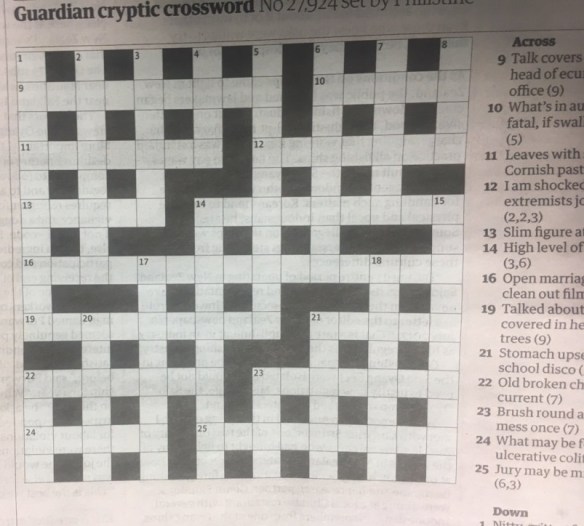
On May 6th, The Guardian published their 30,000th cryptic puzzle, which was set by one of the most celebrated voices in cryptic puzzles, Arachne. Crossword editor Alan Connor called the cryptic puzzle “a perfect little enigma.”

Now, that would have been milestone enough, but as it turns out, the setters of The Guardian had something much more elaborate in store for their loyal solvers: a treasure hunt spanning MANY cryptics.

They’d started two years beforehand.

Back in 2024, they began brainstorming something special for Cryptic #30,000.

A few months later, a series of entries began appearing in the bottom row of particular cryptics. Entries like WELL DONE, BRAVO, and HERE were intended to draw the eye of attentive puzzle fans. (This would prove helpful later for people searching back through the puzzle archives, once they’d learned about the treasure hunt.)

But the creative team were careful going forward, utilizing only chunks of words (ISOURF, INALCH, ALLENG) and not full entries. I can imagine the confusion for those keen-eyed solvers who were already on the trail when the pattern suddenly changed.

This continued throughout 2025 with solvers none the wiser.


The treasure hunt began in earnest when cryptic #30,000 was published.
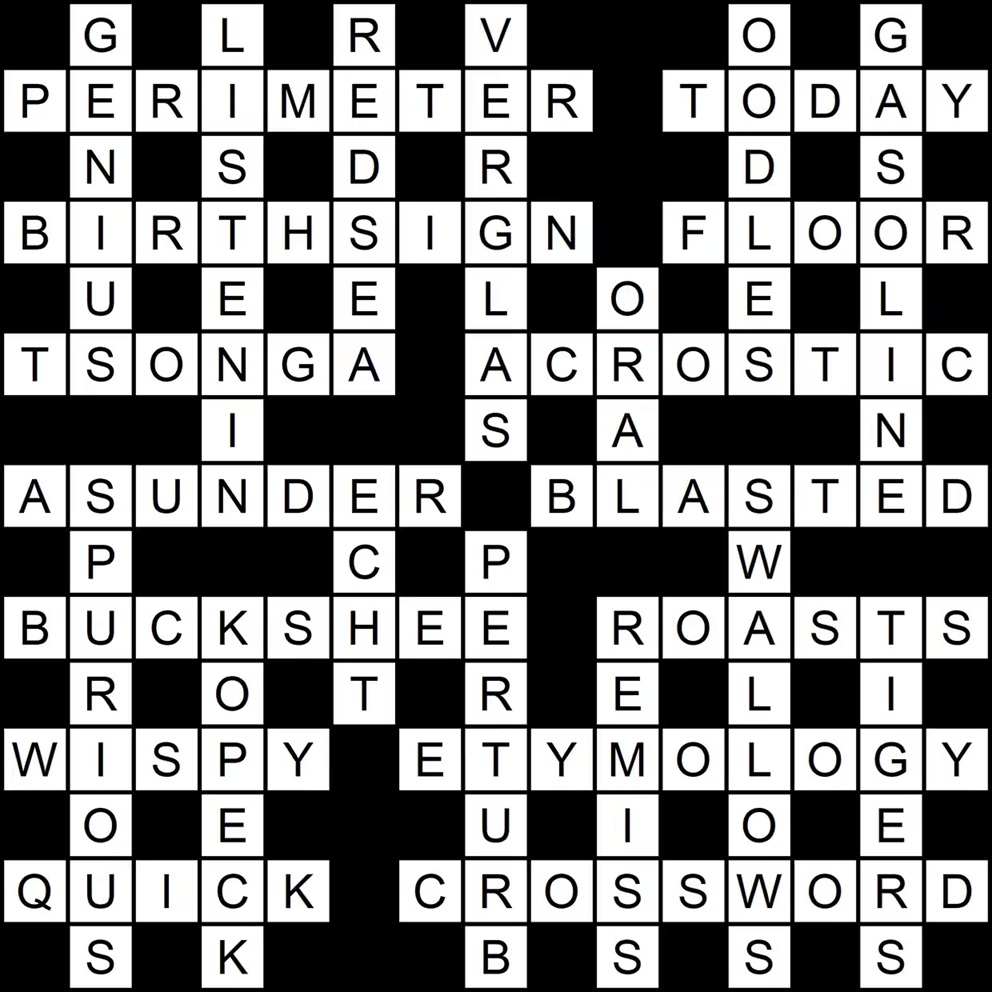
In cryptic #30,000, Arachne included the phrases PERIMETER TODAY and QUICK CROSSWORD reading out in the grid. (The Quick Crossword accompanies the daily cryptic in The Guardian.) Solvers who then completed the Quick Crossword would then find the following message reading out clockwise on the perimeter of the grid:

LEADER I TAILORED BADLY

A cryptic clue was hidden in the perimeter letters!

This cryptic clue can be parsed with “Leader” as the definition, and “badly” indicating that “I tailored” needs to be rearranged. “I tailored” anagrams into EDITORIAL, pointing to the piece Alan Connor wrote that day in celebration of the 30,000th cryptic.

Arachne had also included the word ACROSTIC in Cryptic #30,000 as a subliminal hint to solvers for where to look in the editorial that day.

And if you read the first letter of each paragraph in Connor’s editorial, you get the message LAST THIRTY-FIVE PRIMES.
No, wait, wrong Prime…

Diabolical work. That was the pattern to follow in order to uncover which puzzles were part of their long-running secret message, indicating the actual cryptic puzzle numbers to search through, starting with #29581 and ending with #29989.

So what was the message? What was the final result of a year and a half of seeding and sneaking and devious wordplay?

29581 WELLDONE
29587 BRAVO
29599 HERE
29611 INCONCLUSION
29629 ISOURF
29633 INALCH
29641 ALLENG
29663 EAREYOU
29669 KEEPINGUPGREAT
29671 THEREWI
29683 LLBEAWON
29717 DERF
29723 ULPRIZ
29741 EBUTFIR
29753 STYOUM
29759 USTENT
29761 ERARAC
29789 ENOTAN
29803 ACTUALATHLETIC
29819 RACEOFC
29833 OURSETH
29837 ATWOULD
29851 BEWEIRD
29863 NOTTHAT
29867 ITSACER
29873 EBRALRA
29879 CEINTHE
29881 FORMOFA
29917 CROSSWORDPUZZLE
29921 ITSAGEN
29927 IUSPUBL
29947 ISHEDAT
29959 NOONBST
29983 TOMORROW
29989 GODSPEED

Well done, bravo, here in conclusion is our final challenge. Are you keeping up? Great, there will be a wonderful prize but first you must enter a race. Not an actual athletic race of course, that would be weird. Not that. It’s a cerebral race in the form of a crossword puzzle. It’s a Genius published at noon BST tomorrow. Godspeed!

Naturally, when the hour arrived, a Genius crossword appeared, set by the one and only Enigmatist, another beloved name in the field of cryptics.

Duncan over at Fifteen Squared did an amazing breakdown of not just the treasure hunt but the puzzle that awaited solvers at the end, and it is a mind-bending bit of puzzling.

To start, there were no answer length at the end of each clue, which is definitely a break with tradition when it comes to cryptic crosswords. And that’s for a good reason.

Solvers had to add a letter to many of the answers in order to form the words RECKON, DEDUCE, REASON, and IDEATE beyond the boundaries of the grid.
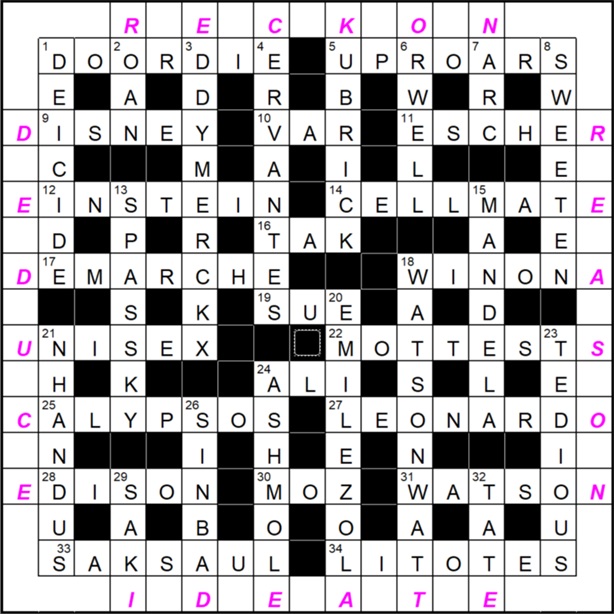
Yes, they had to think outside the box.

Many of the answers referred to luminaries in their various fields (EINSTEIN, ESCHER, LEONARDO, MANDELA, WATSON, CERVANTES, etc.), making the Genius crossword rather literal.

The first letter of every clue ALSO had something to hide. When you removed the names of two more geniuses reading out acrostic-style, BEETHOVEN and ARAUCARIA (yet another beloved cryptic setter), you get the message IT IS WHAT GENIUSES DO.

Which ties back to thinking outside the box.

Wow. What a puzzle.
So, did the puzzle live up to the hype after ALL of this amazing build-up?

I’ll give the last word to Redditor colinbeveridge, who shared this heartfelt response to the entire endeavor:

I’ve finally followed the rabbit-hole all the way to the bottom and… wow. Just blown away by the whole thing, to the point of tears at the final mic-drop.

It’s as if a dedicated team of clever people co-ordinated in secret for a year and a half to deliver something that felt like it was designed just for me (and possibly you, if you’re here). Gorgeous, beautiful work.

WELL DONE and BRAVO, Guardian editors and setters and contributors. What an amazing gift to offer your solvers.

Good luck topping this one when you get to the next 30,000 puzzle goal line!


Are you a cryptic solver, fellow puzzler? Would you have been unable to unravel The Guardian’s crafty clues and hidden hints? Let me know in the comments section below! I’d love to hear from you.
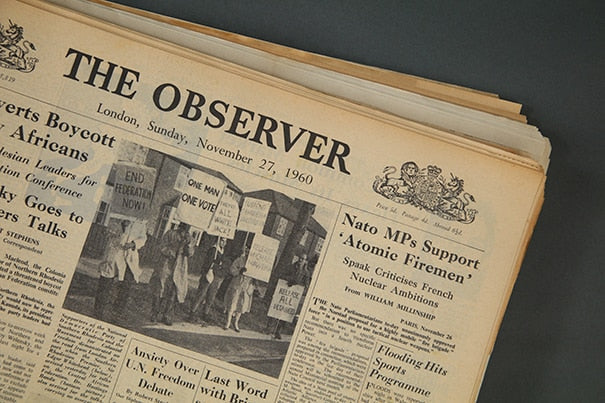
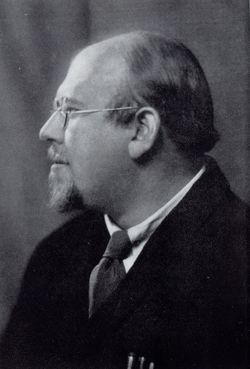
One Hundred Years of The Observer Crosswords!

1913 marked the birth of the crossword as we know it, but cryptic (or British-style) crosswords have been around nearly as long as the American version!

In fact, this past Saturday — Pi Day — marked an important anniversary in the history of cryptic crosswords.

On March 14th, 1926, Edward Powys Mathers, under the pseudonym Torquemada, published the first of 670 cryptic puzzles under the umbrella of The Observer, launching a crossword dynasty that continues to this very day.

Mathers was a poet and a translator, and quite accomplished in both fields. Two years before his Observer debut as Torquemada, he was actually working for The Observer, but as a reviewer of thriller books. Apparently, he preferred to suggest how each book might be improved, rather than criticizing the book as is.

He noticed the American crossword craze crossing the ocean, but didn’t think much of them. (At the time, crossword cluing was very straightforward, consisting mostly of dictionary definitions. There was no wordplay, no misdirection, no humor. Cluing was VERY dry.)

In 1925, his first cryptic puzzles — a series of 12 crosswords where pairs of clues were rhyming couplets — appeared in The Saturday Westminster Gazette. This was where he first introduced himself to the puzzling public as Torquemada, taking the name of the Spanish Grand Inquisitor.

Well, sort of. The first puzzle was constructed for the entertainment of friends, but one of those friends took it to The Saturday Westminster Gazette against his wishes. The editors of The Gazette then managed to convince Mathers to create more. They were boldly advertised:

I recall how thrilling the green poster looked: “Crosswords for Supermen.” Alas, your tired commuter of today would swallow that first puzzle, verse and all, and correctly disgorge it between Charing Cross and Waterloo. — Torquemada, 1935

(Later those twelve puzzles were collected as “Crosswords for Riper Years.”)

After his run with The Saturday Westminster Gazette was finished, The Observer asked him to contribute puzzles to their outlet. They were called “Feelers,” as Mathers sought to widen the scope and audience of his puzzles, slowly “feeling his way” to better and more satisfying cluing.

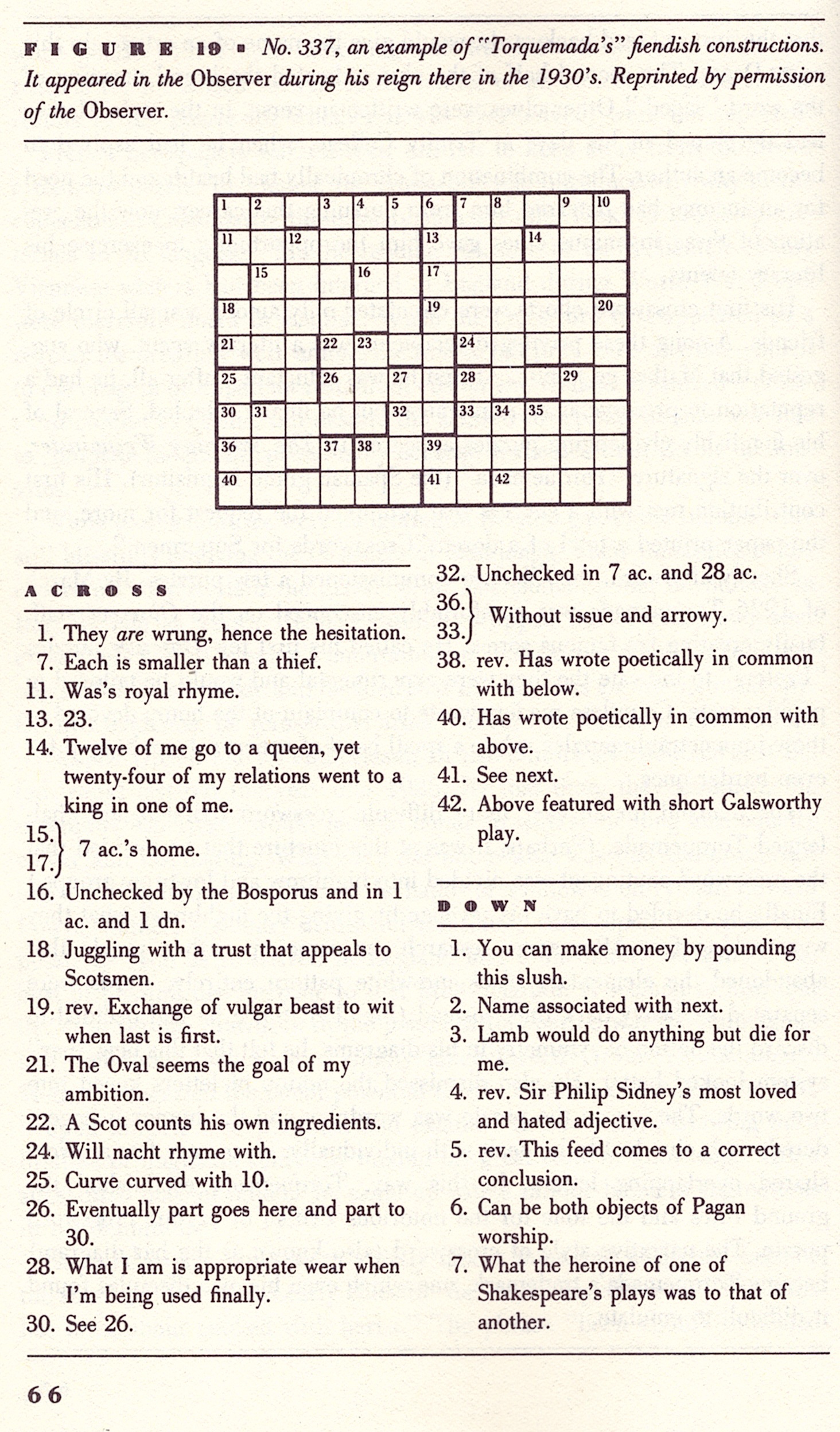
It’s unlikely that Torquemada was the first setter to use cryptic-style cluing, but he was the first to ONLY use cryptic clues in his puzzles. But that wasn’t his only cryptic crossword innovation. He abandoned American-style grids as well, including these black bar grids:

Image courtesy of What’s Gnu? by Michelle Arnot

Apparently he was successful in feeling out his audience; no matter how difficult his puzzles seemed to many, The Observer would receive as many as seven THOUSAND correct solutions from solvers all around the world, hoping to be among the lucky few selected to win a prize. (Prizes went to the first three correct solutions opened each week at The Observer offices.) It’s estimated another twenty thousand solvers out there were regularly completing his puzzles and not sending in their solutions.

Torquemada’s wife Rosamond later recalled that solvers would thank him for helping them “rediscover forgotten beauties in prose and verse to which we might never have returned but for the stimulus of the weekly chase”.

Torquemada’s prolific puzzling and creative cluing led some to suspect that there was actually a team of constructors toiling away under a shared sobriquet, but Torquemada’s only collaborator was Rosamond. He would choose the topic/theme for the grid, providing her with a list of words to include, and she would construct the grid.

Sadly, his time shepherding cryptic crosswords came to end when he passed away on February 3rd, 1939, at the age of 46.

After his passing, Rosamond read through over thirty thousand of his clues. She found the same word used fifty times in his puzzles, and every single time, the clue was different. Fifty different clues for the same word!


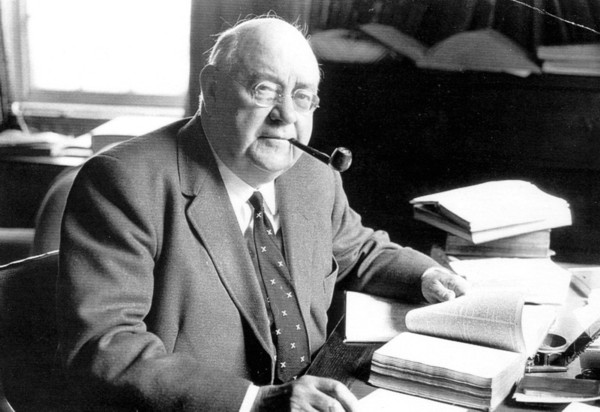
The unenviable task of taking over for Torquemada fell to Derek Somerset Macnutt, who adopted the name Ximenes for his constructing career. (Ximenes, as you might expect, was the name of a Grand Inquisitor in the Spanish Inquisition who succeeded the real Torquemada.)

Taking that particular set a very high bar, a challenge that Macnutt readily accepted. He aspired to increase the vocabulary of his audience, hoping for 30 percent of the answer words in the grid to be new to solvers.

Interestingly, his interest in puzzles was inspired by Torquemada but his singular brand of cluing was more reminiscent of Afrit, aka Alistair Ferguson Ritchie, who constructed cryptics for The Listener.

Ximenes adopted a symmetrical grid — a standard which remains to this day — as well as a maximum and minimum number of unches in the grid. (Unches, for you portmanteau lovers, means unchecked squares.) He also considered some of Torquemada’s puzzles unfair, and sought to standardize cluing, ensuring each had both wordplay and definition included, even while making them more creative and inventive.

In 1966, he published Ximenes on the Art of the Crossword, which pulled back the curtain on his constructing and inspired many constructors and setters in the years to come. (One of the most famous is the setter Eric Chalkley, aka Apex, who literally named himself after Ximenes in his endeavors to “ape X.”)

He also helped kickstart the cryptic crossword movement in America. After solving some of Frank Lewis’s puzzles for The Nation, Stephen Sondheim discovered the work of Ximenes, and started to learn the ins and outs of cryptic crosswords.

He even participated in Ximenes’s weekly clue-writing competitions:

Ximenes would then judge all the clues, conferring a first prize, a second prize, a third prize, and then two levels of honorable mentions: HC (Highly Commended) and VHC (Very Highly Commended). “And you would get in the mail a slip of paper giving the winners’ names and the winning clues.”

The slip was usually four inches wide by twelve inches long. In this way, even though Sondheim was in New York City, he became part of an international community of puzzle solvers matching minds with Ximenes. “I never got past honorable mention,” he lamented, “but I did get honorable mention.”

As it turns out, Sondheim received seventeen honorable mentions, fourteen HCs and three VHCs. One of those VHCs was for the clue “Pop art panel, derived from Dada” for PATERNAL.

Later accepting the challenge of the cryptic crosswords in The Listener (which were, and are, infamous for their difficulty), he introduced them to his collaborator on West Side Story, Leonard Bernstein.

And when Sondheim and Bernstein’s creative differences got the better of each other, they would reunite over a cryptic crossword, and then get back to work.

Sondheim would go on to create cryptic crosswords for New York Magazine, starting in the late 1960s, helping to introduce American audiences to that devious and challenging variety of crosswords. He also cultivated a library of cryptic puzzles and puzzle magazines, passing part of that collection (all of his Listener cryptic crosswords up through 1984) to Will Shortz.


Macnutt passed away in 1971, but the final Ximenes puzzle, number 1200, was published in 1972. In March of that same year, stewardship of The Observer cryptic crossword passed to Jonathan Crowther, who took up the name Azed. Not only does this sound like it covers the alphabet (A to Zed), but it reverses the name of another Grand Inquistor, Diego de Deza.

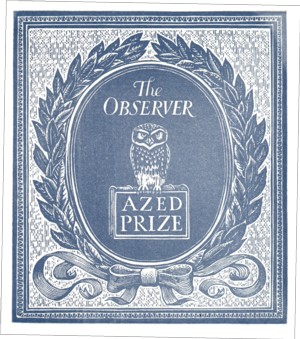
He had been a solver of Ximenes’s puzzles since 1959, as well as a setter for The Listener. He also continued Ximenes’s clue-writing contest as the Azed Prize.

At this point, Azed has been setting the Observer cryptic crossword for longer than both his predecessors combined.

Also, you can’t help but love that he also sets occasional puzzles under the pseudonym Ozymandias. On his Wikipedia page, it even quotes the poem: “Look on my works, ye Mighty, and despair!”


Cryptic crosswords are alive and well. The Observer, The Guardian, The Independent, The Daily Telegraph, The Spectator, and The Sunday Times, in England, among others. The Ottawa Citizen, Toronto Star and The Globe and Mail in Canada. Harper’s in the US. Nearly every Australian newspaper has cryptic crosswords.

With Parsewords making the scene and hoping to demystify cryptic crossword cluing for new solvers, there’s no telling how many more solvers will discover or rediscover these challenging, playful puzzles.

And the folks at The Observer are marking the puzzle centenary with a special event on Thursday, March 19th!

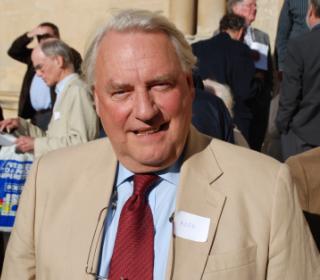
Caitlin O’Kane (their Puzzles Editor) and Azed himself will be in attendance, alongside other crossword setters and cryptic crossword enthusiasts, to enjoy an evening of live-solving and celebration:

From the invention of the cryptic to the rise of the modern brainteaser, they’ll unpack the secrets of their craft – what makes a clue sing, how setters think, and why a good puzzle keeps us hooked. Expect lively chat, unexpected revelations, and at least one enigma that demands to be cracked.

Raise a glass, meet other aficionados, and celebrate a century of wit, wordplay and ingenuity with the people keeping The Observer’s puzzling spirit alive.

So whether you’re attending The Observer‘s Puzzle Centenary, tackling a Parseword puzzle, or trying one of the numerous cryptic crossword outlets across the world, be sure to give a cryptic crossword a chance this week and be a part of one hundred years of puzzly challenge and creativity!

Happy solving, fellow puzzlers (and setters)!


Sources:

  • The Centenary of the Crossword by John Halpurn
  • What’s Gnu: A History of the Crossword Puzzle by Michelle Arnot
  • The Strange World of the Crossword by Roger Millington
  • Matching Minds with Sondheim: The Puzzles and Games of the Broadway Legend by Barry Joseph
  • The Puzzle Edit
  • Derek Harrison’s The Crossword Centre

Crossword History: An Updated Timeline

Back in 2013, we created a timeline of events from crossword history as part of our celebration of the hundredth anniversary of the crossword.

Although 105 isn’t as prestigious as 100, and the anniversary is technically tomorrow, we thought we’d honor the day this year by updating our comprehensive look at the long (yet surprisingly short) road it took to get to that marvelous centennial!

So, without further ado or folderol, we proudly present:

A Brief History of the Crossword (Updated)

16th – 11th century BC

Inscriptions from New Kingdom-era Egypt (Eighteenth to Twentieth Dynasties) of horizontal and vertical lines of text divided into equal squares, that can be read both across the rows and down the columns, are made. These inscriptions are later referred to by Egyptologists as “Egyptian crossword puzzles.”

19th century AD

Rudimentary crosswords, similar to word squares, begin appearing in England, and later elsewhere in Europe.

June 22, 1871

Future inventor of the crossword, Arthur Wynne, is born.

March 23, 1897

Future New York Times crossword editor Margaret Farrar is born.

February 25, 1907

Future New York Times crossword editor Will Weng is born.

December 21, 1913

The New York World publishes the first crossword, invented by Liverpool journalist Arthur Wynne. (The puzzle is originally known as a word-cross.)

January 6, 1916

Future New York Times crossword editor Eugene T. Maleska is born.

1920

Margaret Farrar is hired by The New York World as a secretary, but soon finds herself assisting Arthur Wynne with proofreading puzzles. Her puzzles soon exceed Wynne’s in popularity.

Colonel H.W. Hill publishes the first Crossword Dictionary.

1923

Margaret Farrar revises the cluing system for crosswords, sorting them into “Horizontal” and “Vertical” clues by number. (It wouldn’t be until the 1940s that the more familiar “Across” and “Down” terminology became the norm.)

1924

Margaret Farrar publishes the first book of crossword puzzles under contract for Richard L. Simon and Max Schuster, “The Cross-Word Puzzle Book.” It was an instant bestseller, launching Simon & Schuster as a major publisher. (Additional information available below the timeline.)

The Daily Express, founded in 1900, becomes the first newspaper in the United Kingdom to carry crosswords.

Crossword-themed novelty songs hit the airwaves as the puzzle craze intensifies, most notably “Crossword Mama, You Puzzle Me (But Papa’s Gonna Figure You Out).”

The Amateur Crossword Puzzle League of America, a self-appointed group of puzzle enthusiasts, lobbies for rotational symmetry in crosswords, which becomes the standard.

Solver Ruth Franc von Phul becomes a minor celebrity after winning The New York Herald-Tribune’s National All Comers Cross Word Puzzle Tournament at the age of 20. (She would win again 2 years later.)

January 15, 1925

“Felix All Puzzled,” the first animated short to feature a crossword, is released.

February 2, 1925

The crossword-fueled musical revue “Puzzles of 1925” opens on Broadway. It runs until May of 1925.

February 15, 1925

Disney releases a crossword-themed animated short, “Alice Solves the Puzzle.”

1926

The cryptic crossword is invented by Edward Powys Mathers, who publishes under the pseudonym Torquemada. He devises them for The Observer newspaper.

First reported instances of Braille crosswords.

1931

Dell Puzzle Magazines begins publishing.
(Dell Publishing itself was founded in 1921.)

1941

Dell Pocket Crossword Puzzles first published.
(The magazine continues to this day.)

February 15, 1942

The New York Times runs its first Sunday edition crossword. (Additional information available below the timeline.)

June 2, 1944

Physics teacher and crossword constructor Leonard Dawe is questioned by authorities after several words coinciding with D-Day invasion plans appear in London’s Daily Telegraph(Additional information available below the timeline.)

1950

The crossword becomes a daily feature in The New York Times.

August 26, 1952

Future New York Times crossword editor Will Shortz is born.

1968

Lyricist Stephen Sondheim begins creating cryptic crosswords for New York Magazine, helping introduce Americans to British-style crosswords.

1969

Will Weng succeeds Margaret Farrar as the second crossword editor for The New York Times.

1973

Penny Press is founded.

1977

Eugene T. Maleska succeeds Will Weng as the third crossword editor for The New York Times.

1978

First year of the American Crossword Puzzle Tournament, later featured in the documentary Wordplay. 149 contestants compete for the title in the first national crossword tournament since the 1930s.

1979

Howard Garns creates the modern Sudoku puzzle for Dell Magazines (under the name Number Place), the first pen-and-paper puzzle to rival the crossword in popularity (though this spike in popularity would occur decades later under the name Sudoku).

June 11, 1984

Margaret Farrar, while working on the 134th volume in Simon & Schuster’s crossword puzzle book series, passes away.

1993

Will Shortz succeeds Eugene T. Maleska as the fourth crossword editor for The New York Times.

November 5, 1996

One of the most clever and famous crosswords of all time is published, the election-preceding crossword where either BOB DOLE ELECTED or CLINTON ELECTED could read out, depending on the solver’s answers.

1998

The Wall Street Journal adds a crossword to its newspaper, and Mike Shenk is appointed editor.

June 23, 2006

Wordplay documentary hits theaters, featuring celebrity solvers of crosswords as well as the participants and organizers of the 2005 edition of the American Crossword Puzzle Tournament.

February 29 – March 2, 2008

Thanks in part to the Wordplay documentary, the American Crossword Puzzle Tournament outgrows its previous setting and moves to Brooklyn.

June 6, 2008

Matt Gaffney launches his Weekly Crossword Contest (MGWCC).

August 2008

Lollapuzzoola, a crossword-solving tournament with a more tongue-in-cheek, freeform style, launches in Jackson Heights, New York.

October 6, 2008

Patrick Blindauer’s famous dollar bill-inspired crossword puzzle is published.

2009

The city of Lvov, Ukraine, creates a crossword that spans an entire side of a 100-foot-tall residential building, with clues scattered around the city’s major landmarks and attractions. It’s awesome.

October 11, 2011

PuzzleNation.com goes live.

June 2012

David Steinberg launches the Pre-Shortzian Puzzle Project, designed to compile a complete database of every New York Times crossword.

August 13, 2012

PuzzleNation Blog is launched.

June 14, 2013

Matt Gaffney celebrates five years of MGWCC,
stating that MGWCC will run for 1000 weeks
(which puts the final edition around August 6th, 2027).

December 21, 2013

The Crossword officially turns one hundred years old.


Additional information:

1924: The publishing house Simon & Schuster, agreed to a small (3,600-copy) run of a crossword puzzle book, prompted by founder Richard L. Simon’s aunt, who wanted to give such a book to a friend. It became “a runaway bestseller.”

In no time the publisher had to put the book back on press; through repeated printings, it sold more than 100,000 copies. Soon a second collection followed, and then a third and a fourth. In 1924 and 1925 the crossword books were among the top 10 nonfiction bestsellers for the year, besting, among others, The Autobiography of Mark Twain and George Bernard Shaw’s Saint Joan.

February 15, 1942: The New York Times initially regarded crosswords as frivolous, calling them “a primitive form of mental exercise”; the motivating impulse for the Times to finally run the puzzle (which took over 20 years even though its publisher, Arthur Hays Sulzberger, was a longtime crossword fan) appears to have been the bombing of Pearl Harbor.

In a memo dated December 18, 1941, an editor conceded that the puzzle deserved space in the paper, considering what was happening elsewhere in the world and that readers might need something to occupy themselves during blackouts. The puzzle proved popular, and Sulzberger himself would author a Times puzzle before the year was out.

June 2, 1944: The words Omaha (codename for one of Normandy’s beaches), Utah (another Normandy beach codename), Overlord (the name for the plan to land at Normandy on June 6th), mulberry (nickname for a portable harbor built for D-Day), and Neptune (name for the naval portion of the invasion) all appeared in Daily Telegraph crosswords during the month preceding the D-Day landing.

This has been attributed to either an incredible coincidence or Dawe somehow overhearing these words (possibly slipped by soldiers involved) and incorporating them into puzzles unwittingly.


Do you have any suggestions for additions for our Crossword Timeline? Let us know in the comments section below! We’d love to hear from you!

Thanks for visiting PuzzleNation Blog today! Be sure to sign up for our newsletter to stay up-to-date on everything PuzzleNation!

You can also share your pictures with us on Instagram, friend us on Facebook, check us out on TwitterPinterest, and Tumblr, and explore the always-expanding library of PuzzleNation apps and games on our website!

Crossword History: A Timeline

The hundredth anniversary of the crossword is nearly upon us, and we at PuzzleNation Blog thought we’d take a look at the long (yet surprisingly short) road it took to get to this marvelous centennial!

And so, without further ado or folderol, we proudly present:

A Brief History of the Crossword
(by Glenn Dallas and the PuzzleNation Team)

16th – 11th century BC

Inscriptions from New Kingdom-era Egypt (Eighteenth to Twentieth Dynasties) of horizontal and vertical lines of text divided into equal squares, that can be read both across the rows and down the columns, are made. These inscriptions are later referred to by Egyptologists as “Egyptian crossword puzzles.”

19th century

Rudimentary crosswords, similar to word squares, begin appearing in England, and later elsewhere in Europe.

June 22, 1871

Future inventor of the crossword, Arthur Wynne, is born.

March 23, 1897

Future New York Times crossword editor Margaret Farrar is born.

February 25, 1907

Future New York Times crossword editor Will Weng is born.

December 21, 1913

The New York World publishes the first crossword, invented by Liverpool journalist Arthur Wynne.
(The puzzle is originally known as a word-cross.)

January 6, 1916

Future New York Times crossword editor Eugene T. Maleska is born.

1920

Margaret Farrar is hired by The New York World as a secretary, but soon finds herself assisting Arthur Wynne with proofreading puzzles. Her puzzles soon exceed Wynne’s in popularity.

Colonel H.W. Hill publishes the first Crossword Dictionary.

1924

Margaret Farrar publishes the first book of crossword puzzles under contract for Richard L. Simon and Max Schuster, “The Cross-Word Puzzle Book.” It was an instant bestseller, launching Simon & Schuster as a major publisher.

The Sunday Express becomes the first newspaper in the United Kingdom to carry crosswords.

1926

The cryptic crossword is invented by Edward Powys Mathers, who uses the pseudonym of Torquemada. He devises them for The Observer newspaper.

1931

Dell Puzzle Magazines begins publishing.
(Dell Publishing itself was founded in 1921.)

1941

Dell Pocket Crossword Puzzles first published.
(The magazine continues to this day.)

February 15, 1942

The New York Times runs its first Sunday edition crossword. (Click here to read more about this.)

June 2, 1944

Physics teacher and crossword constructor Leonard Dawe is questioned by authorities after several words coinciding with D-Day invasion plans appear in London’s Daily Telegraph. (Click here to read more about this.)

1950

The crossword becomes a daily feature in the New York Times.

August 26, 1952

Future New York Times crossword editor Will Shortz is born.

1968

Lyricist Stephen Sondheim begins creating cryptic crosswords for New York Magazine, helping introduce Americans to British-style crosswords.

1969

Will Weng succeeds Margaret Farrar as the second crossword editor for the New York Times.

1973

Penny Press is founded.

1977

Eugene T. Maleska succeeds Will Weng as the third crossword editor for the New York Times.

1978

First year of the American Crossword Puzzle Tournament,
later featured in the documentary Wordplay.

1979

Howard Garns creates the modern Sudoku puzzle for Dell Magazines (under the name Number Place), the first pen-and-paper puzzle to rival the crossword in popularity (though this spike in popularity would occur decades later under the name Sudoku).

June 11, 1984

Margaret Farrar, while working on the 134th volume in Simon & Schuster’s crossword puzzle book series, passes away.

1993

Will Shortz succeeds Eugene T. Maleska as the fourth crossword editor for the New York Times.

November 5, 1996

One of the most clever and famous crosswords of all time is published, the election-preceding crossword where either BOB DOLE ELECTED or CLINTON ELECTED could read out, depending on the solver’s answers.

June 23, 2006

Wordplay documentary hits theaters, featuring both celebrity solvers of crosswords and the participants and organizers of the 2005 American Crossword Puzzle Tournament.

February 29 – March 2, 2008

Thanks in part to the Wordplay documentary, the American Crossword Puzzle Tournament outgrows its previous setting and moves to Brooklyn.

June 6, 2008

Matt Gaffney launches his Weekly Crossword Contest (MGWCC).

August 2008

Lollapuzzoola, a crossword-solving tournament with a more tongue-in-cheek, freeform style, launches in Jackson Heights, New York.

October 6th, 2008

Patrick Blindauer’s famous dollar bill-inspired crossword puzzle is published.

2009

The city of Lvov, Ukraine, creates a crossword that spans an entire side of a 100-foot-tall residential building, with clues scattered around the city’s major landmarks and attractions. It’s awesome.

October 11th, 2011

PuzzleNation.com goes live.

June 2012

David Steinberg launches the Pre-Shortzian Puzzle Project, intending to create a complete database of every New York Times crossword.

August 13th, 2012

PuzzleNation Blog is launched.

June 14th, 2013

Matt Gaffney celebrates five years of MGWCC,
stating that MGWCC will run for 1000 weeks
(which puts the final edition around August 6th, 2027).

December 21st, 2013

The Crossword officially turns one hundred years old.


Additional information:

February 15th, 1942: The New York Times initially regarded crosswords as frivolous, calling them “a primitive form of mental exercise”; the motivating impulse for the Times to finally run the puzzle (which took over 20 years even though its publisher, Arthur Hays Sulzberger, was a longtime crossword fan) appears to have been the bombing of Pearl Harbor.

In a memo dated December 18, 1941, an editor conceded that the puzzle deserved space in the paper, considering what was happening elsewhere in the world and that readers might need something to occupy themselves during blackouts. The puzzle proved popular, and Sulzberger himself would author a Times puzzle before the year was out.

June 2nd, 1944: The words Omaha (codename for one of Normandy’s beaches), Utah (another Normandy beach codename), Overlord (the name for the plan to land at Normandy on June 6th), mulberry (nickname for a portable harbor built for D-Day), and Neptune (name for the naval portion of the invasion) all appeared in Daily Telegraph crosswords during the month preceding the D-Day landing.

This has been attributed to either an incredible coincidence or Dawe somehow overhearing these words (possibly slipped by soldiers involved) and incorporating them into puzzles unwittingly.


Thanks for visiting the PuzzleNation blog today! You can like us on Facebook, follow us on Twitter, cruise our boards on Pinterest, check out our Classic Word Search iBook (recently featured by Apple in the Made for iBooks category!), play our games at PuzzleNation.com, or contact us here at the blog!