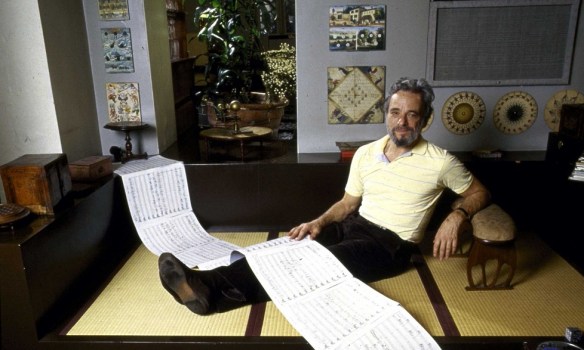
Most people know him as a titan of Broadway and the American stage, the composer and lyricist behind dozens of iconic works, spanning decades. West Side Story. Gypsy. Into the Woods. A Funny Thing Happened on the Way to the Forum. (My personal favorite? Assassins.)
Even as someone with a degree in theater, I don’t feel qualified to discuss or summarize his impact on the stage. It’s monumental. Incalculable. Iconic.
But as a puzzle enthusiast, I do feel qualified to discuss his influence in that realm. You see, Stephen Sondheim occupies a curious space in the history of puzzles.
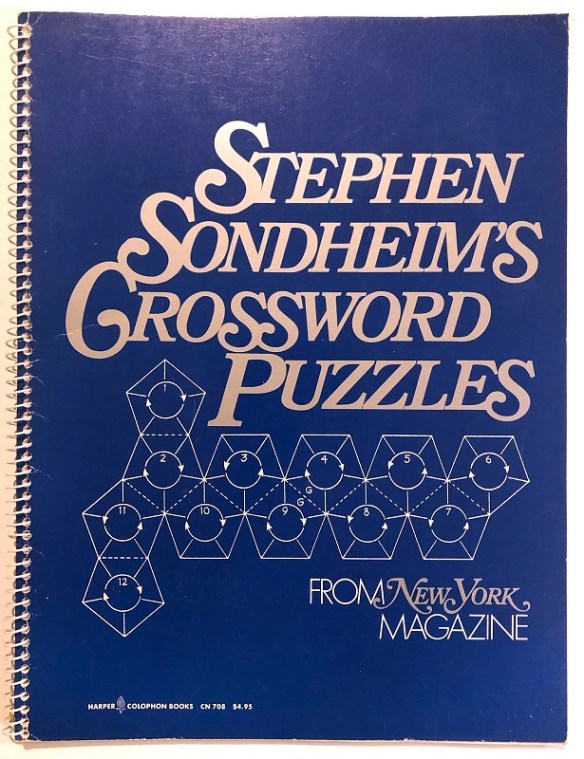
He created cryptic / British-style crosswords for New York Magazine in the late 1960s, helping to introduce American audiences to that devious and challenging variety of crosswords.
In fact, he famously wrote an article in that very same magazine decrying the state of American crosswords and extolling the virtues of cryptic crosswords. (He even explained the different cluing tricks and offering examples for readers to unravel.)
Sondheim was an absolute puzzle fiend. His home was adorned with mechanical puzzles, and he happily created elaborate puzzle games. Some of them were featured in Games Magazine! In his later years, he was also an aficionado of escape rooms. (Friend of the blog Eric Berlin shared a wonderful anecdote about Sondheim here.)
Their ability to assimilate a lot of coded information instantly. In other words, a piano player like Jon Delfin, the greatest crossword player of our time, he sits down and he sees three staffs of music and he can instantly play it. He’s taken all those notes and absorbs what they mean, instantaneously. If you have that kind of mind, and you add it to it a wide range of information, and you can spell, you’d be a really great crossword puzzler.
Sondheim certainly fits the bill.
He will forever be remembered for his musical creations, and that legacy far overshadows his work in puzzles. But as someone who opened the door to a new brand of puzzle solving for many people, Sondheim will also have the undying loyalty, respect, and admiration of many puzzlers around the world.
We wholeheartedly include ourselves in that crowd of admirers.
Welcome to 5 Questions, our recurring interview series where we reach out to puzzle constructors, game designers, writers, filmmakers, musicians, artists, and puzzle enthusiasts from all walks of life!
It’s all about exploring the vast and intriguing puzzle community by talking to those who make puzzles and those who enjoy them! (Click here to check out previous editions of 5 Questions!)
And we’re excited to welcome Deb Amlen as our latest 5 Questions interviewee!
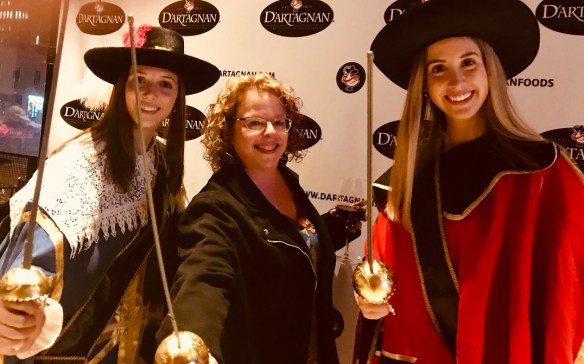
[Deb in the center, flanked by her fellow Musketeers.]
Deb is a talented crossword constructor, but these days, it’s more likely you know her for her role as the head writer and senior editor of Wordplay, the crossword blog and educational/humor column associated with The New York Times crossword puzzle.
One of the most public faces associated with the crossword, Deb entertains and informs across both the blog and its associated Twitter account, as well as hosting a live-solving show on YouTube with fellow constructor Sam Ezersky and celebrity guests!
Deb was gracious enough to take some time out to talk to us, so without further ado, let’s get to the interview!
5 Questions for Deb Amlen
1. How did you get started with puzzles?
Word games like “Ghost” were always my favorite things to play when I was a child, but I didn’t really get into puzzles until I was a young adult. I watched my father solve the New York Times crossword when I was really young, but I didn’t start solving on my own until I bought myself a subscription to New York Magazine after college and discovered Maura Jacobson’s puzzles.
I started constructing crosswords when my own kids were young because, as a stay-at-home mom, I desperately needed a creative outlet that didn’t involve Pokémon or Elmo. I read everything I could about puzzle making and learned how to make crosswords from Nancy Salomon. Nancy has mentored hundreds of constructors to publication.
2. As the flagbearer for crosswords in the public eye, The New York Times crossword is often the most scrutinized when it comes to cultural sensitivity regarding entries and clues, and more than once, that has depicted the Times puzzle in an unflattering light.
As a very public figure for the brand — not to mention the de facto social media gatekeeper — this puts you in the unenviable position of being between the audience and the editorial team. How do you handle these situations, and as an enthusiastic solver yourself, how do you think the Times is doing in this arena?
The crossword does get a lot of flack, doesn’t it? Honestly, some of it is warranted, some of it is not.
There is definitely a need to bring the flagship puzzle into the 21st century in terms of diversity and representation. Like most large companies, however, sometimes change happens slowly at The New York Times.
A lot of work is being done by the company and the puzzle editors behind the scenes, though, to increase diversity on their team and to be more aware of content that is inflammatory, and I think the recent puzzles reflect that. They have a ways to go, but the conversation is active and ongoing, and I’m very optimistic about the future of the crossword.
As far as social media goes, people tend to conflate “the Wordplay Twitter account” with “Everything The New York Times Does With Regard to Puzzles and Games.” So, since I run the Wordplay account and the puzzle editors are not really on social media, I tend to be the target of people’s complaints, which is hilarious because I’m just the columnist. Luckily, The Times has allowed me to expense a thick skin, so I’m doing OK. When I’m not, I take a break from social media, which I highly recommend and think everyone should do.
On the other hand, most people are well-wishers and are a lot of fun. They tweet their solving victories to me and I give them a gold medal emoji, which people really respond to. It’s very satisfying to be able to lift people up and encourage them, especially on social media, which can be very negative.
3. For the 75th anniversary of the New York Times crossword, constructors and celebrity guest puzzlers collaborated on numerous puzzles. Which celebrity constructors surprised you the most with their work, and who would you like to see as guest constructors in the future?
[Author’s note: When asked about her puzzle, Natasha said, “Working with Deb Amlen to create this puzzle has quite literally been a lifetime highlight for me.”]
4. What’s next for Deb Amlen?
Dinner, probably.
5. If you could give the readers, writers, aspiring constructors, and puzzle fans in the audience one piece of advice, what would it be?
Enjoy yourself. This is not like sitting down to take the SAT; it’s a game. And games should be fun. Life is too short to sweat the crossword.
Back in 2013, we created a timeline of events from crossword history as part of our celebration of the hundredth anniversary of the crossword.
Although 105 isn’t as prestigious as 100, and the anniversary is technically tomorrow, we thought we’d honor the day this year by updating our comprehensive look at the long (yet surprisingly short) road it took to get to that marvelous centennial!
So, without further ado or folderol, we proudly present:
A Brief History of the Crossword (Updated)
16th – 11th century BC
Inscriptions from New Kingdom-era Egypt (Eighteenth to Twentieth Dynasties) of horizontal and vertical lines of text divided into equal squares, that can be read both across the rows and down the columns, are made. These inscriptions are later referred to by Egyptologists as “Egyptian crossword puzzles.”
19th century AD
Rudimentary crosswords, similar to word squares, begin appearing in England, and later elsewhere in Europe.
June 22, 1871
Future inventor of the crossword, Arthur Wynne, is born.
March 23, 1897
Future New York Times crossword editor Margaret Farrar is born.
February 25, 1907
Future New York Times crossword editor Will Weng is born.
December 21, 1913
The New York World publishes the first crossword, invented by Liverpool journalist Arthur Wynne. (The puzzle is originally known as a word-cross.)
January 6, 1916
Future New York Times crossword editor Eugene T. Maleska is born.
1920
Margaret Farrar is hired by The New York World as a secretary, but soon finds herself assisting Arthur Wynne with proofreading puzzles. Her puzzles soon exceed Wynne’s in popularity.
Colonel H.W. Hill publishes the first Crossword Dictionary.
1923
Margaret Farrar revises the cluing system for crosswords, sorting them into “Horizontal” and “Vertical” clues by number. (It wouldn’t be until the 1940s that the more familiar “Across” and “Down” terminology became the norm.)
1924
Margaret Farrar publishes the first book of crossword puzzles under contract for Richard L. Simon and Max Schuster, “The Cross-Word Puzzle Book.” It was an instant bestseller, launching Simon & Schuster as a major publisher. (Additional information available below the timeline.)
The Daily Express, founded in 1900, becomes the first newspaper in the United Kingdom to carry crosswords.
Crossword-themed novelty songs hit the airwaves as the puzzle craze intensifies, most notably “Crossword Mama, You Puzzle Me (But Papa’s Gonna Figure You Out).”
The Amateur Crossword Puzzle League of America, a self-appointed group of puzzle enthusiasts, lobbies for rotational symmetry in crosswords, which becomes the standard.
Solver Ruth Franc von Phul becomes a minor celebrity after winning The New York Herald-Tribune’s National All Comers Cross Word Puzzle Tournament at the age of 20. (She would win again 2 years later.)
January 15, 1925
“Felix All Puzzled,” the first animated short to feature a crossword, is released.
Disney releases a crossword-themed animated short, “Alice Solves the Puzzle.”
1926
The cryptic crossword is invented by Edward Powys Mathers, who publishes under the pseudonym Torquemada. He devises them for The Observer newspaper.
First reported instances of Braille crosswords.
1931
Dell Puzzle Magazines begins publishing.
(Dell Publishing itself was founded in 1921.)
1941
Dell Pocket Crossword Puzzles first published.
(The magazine continues to this day.)
February 15, 1942
The New York Times runs its first Sunday edition crossword. (Additional information available below the timeline.)
June 2, 1944
Physics teacher and crossword constructor Leonard Dawe is questioned by authorities after several words coinciding with D-Day invasion plans appear in London’s Daily Telegraph. (Additional information available below the timeline.)
1950
The crossword becomes a daily feature in The New York Times.
August 26, 1952
Future New York Times crossword editor Will Shortz is born.
1968
Lyricist Stephen Sondheim begins creating cryptic crosswords for New York Magazine, helping introduce Americans to British-style crosswords.
1969
Will Weng succeeds Margaret Farrar as the second crossword editor for The New York Times.
1973
Penny Press is founded.
1977
Eugene T. Maleska succeeds Will Weng as the third crossword editor for The New York Times.
1978
First year of the American Crossword Puzzle Tournament, later featured in the documentary Wordplay. 149 contestants compete for the title in the first national crossword tournament since the 1930s.
1979
Howard Garns creates the modern Sudoku puzzle for Dell Magazines (under the name Number Place), the first pen-and-paper puzzle to rival the crossword in popularity (though this spike in popularity would occur decades later under the name Sudoku).
June 11, 1984
Margaret Farrar, while working on the 134th volume in Simon & Schuster’s crossword puzzle book series, passes away.
1993
Will Shortz succeeds Eugene T. Maleska as the fourth crossword editor for The New York Times.
November 5, 1996
One of the most clever and famous crosswords of all time is published, the election-preceding crossword where either BOB DOLE ELECTED or CLINTON ELECTED could read out, depending on the solver’s answers.
1998
The Wall Street Journal adds a crossword to its newspaper, and Mike Shenk is appointed editor.
June 23, 2006
Wordplay documentary hits theaters, featuring celebrity solvers of crosswords as well as the participants and organizers of the 2005 edition of the American Crossword Puzzle Tournament.
February 29 – March 2, 2008
Thanks in part to the Wordplay documentary, the American Crossword Puzzle Tournament outgrows its previous setting and moves to Brooklyn.
The city of Lvov, Ukraine, creates a crossword that spans an entire side of a 100-foot-tall residential building, with clues scattered around the city’s major landmarks and attractions. It’s awesome.
David Steinberg launches the Pre-Shortzian Puzzle Project, designed to compile a complete database of every New York Times crossword.
August 13, 2012
PuzzleNation Blog is launched.
June 14, 2013
Matt Gaffney celebrates five years of MGWCC,
stating that MGWCC will run for 1000 weeks
(which puts the final edition around August 6th, 2027).
December 21, 2013
The Crossword officially turns one hundred years old.
Additional information:
1924: The publishing house Simon & Schuster, agreed to a small (3,600-copy) run of a crossword puzzle book, prompted by founder Richard L. Simon’s aunt, who wanted to give such a book to a friend. It became “a runaway bestseller.”
In no time the publisher had to put the book back on press; through repeated printings, it sold more than 100,000 copies. Soon a second collection followed, and then a third and a fourth. In 1924 and 1925 the crossword books were among the top 10 nonfiction bestsellers for the year, besting, among others, The Autobiography of Mark Twain and George Bernard Shaw’s Saint Joan.
February 15, 1942: The New York Times initially regarded crosswords as frivolous, calling them “a primitive form of mental exercise”; the motivating impulse for the Times to finally run the puzzle (which took over 20 years even though its publisher, Arthur Hays Sulzberger, was a longtime crossword fan) appears to have been the bombing of Pearl Harbor.
In a memo dated December 18, 1941, an editor conceded that the puzzle deserved space in the paper, considering what was happening elsewhere in the world and that readers might need something to occupy themselves during blackouts. The puzzle proved popular, and Sulzberger himself would author a Times puzzle before the year was out.
June 2, 1944: The words Omaha (codename for one of Normandy’s beaches), Utah (another Normandy beach codename), Overlord (the name for the plan to land at Normandy on June 6th), mulberry (nickname for a portable harbor built for D-Day), and Neptune (name for the naval portion of the invasion) all appeared in Daily Telegraph crosswords during the month preceding the D-Day landing.
This has been attributed to either an incredible coincidence or Dawe somehow overhearing these words (possibly slipped by soldiers involved) and incorporating them into puzzles unwittingly.
Do you have any suggestions for additions for our Crossword Timeline? Let us know in the comments section below! We’d love to hear from you!
Thanks for visiting PuzzleNation Blog today! Be sure to sign up for our newsletter to stay up-to-date on everything PuzzleNation!
So, what sort of progress has been made over the previous 365 days? Clearly not enough, given the title of an article published last week on The Outline, entitled “The NYT Crossword is Old and Kind of Racist.”
Adrianne Jeffries makes a strong case for how out-of-touch the crossword often seems these days:
…the Times crosswords, which have been edited by the famed crossword giant Will Shortz since 1993, are vexing for how outdated some of the clues and answers are, especially since in some cases the terms have been abandoned by the paper itself. The puzzle clearly isn’t seeking new talent or a new audience, and in its stodginess, it becomes clear that it is composed for a very particular reader with a very particular view of the world.
She backs up her supposition with numerous examples of tone-deaf cluing and grid fill, like ESKIMO, Oriental, and SISSIES.
There is some overlap with Ruth Graham’s points from last year — including the reductive use of HOMIE regarding black culture and the clue “One caught by the border patrol” for ILLEGAL — and Jeffries went on to include examples of the issue I raised last year with the objectionable “This, to Juan” cluing style that abounds in crosswords.
But she takes things one step further than previous efforts by pointing out how the crossword is out-of-step with the rest of the New York Times newspaper, citing the year that various terms were marked offensive in the Times style guide. (“Oriental” as a descriptor, for instance, was banned in 1999.)
It’s disheartening that articles like this are so necessary. Women and people of color deserve better representation in the Times puzzles, both as contributors of puzzles AND as subjects of clues and entries themselves.
Jeffries offered another damning example of dubious Shortzian editing:
I also found an exchange from 2011 illuminating. Shortz asked puzzle constructor Elizabeth Gorski to change an answer on her submitted puzzle. “There was one thing about the construction I didn’t like, and that was at 35 Down,” Shortz told The Atlantic. “The answer was LORELAI, and the sirens on the Rhine are of course ‘Lorelei,’ with an ‘e-i.’ Liz’s clue was Rory’s mom on Gilmore Girls, and I didn’t think solvers should have to know that.” He had the constructor revise the answer to make it 1) more old and 2) refer to mythical women who are so distractingly beautiful that they cause men to crash their ships on the rocks, instead of, a cool mom from a television show that millions of women (and some men) love.
Even as a (relatively) younger voice in puzzles, I can’t deny many of her points. Puzzles should do a better job of acknowledging modern culture, of serving as a tiny, daily time capsule of our world.
As I said last year, crosswords are a cultural microcosm, representing the commonalities and peculiarities of our language in a given time and place. They represent our trivia, our understanding, our cleverness, our humor, and, yes, sometimes our shortcomings.
One year later, I wonder if progress will continue to feel so gradual, or if, sometime soon, we’ll begin to feel the cultural quakes and shifts that indicate real change is approaching.
Thanks for visiting PuzzleNation Blog today! Be sure to sign up for our newsletter to stay up-to-date on everything PuzzleNation!
The hundredth anniversary of the crossword is nearly upon us, and we at PuzzleNation Blog thought we’d take a look at the long (yet surprisingly short) road it took to get to this marvelous centennial!
And so, without further ado or folderol, we proudly present:
A Brief History of the Crossword (by Glenn Dallas and the PuzzleNation Team)
16th – 11th century BC
Inscriptions from New Kingdom-era Egypt (Eighteenth to Twentieth Dynasties) of horizontal and vertical lines of text divided into equal squares, that can be read both across the rows and down the columns, are made. These inscriptions are later referred to by Egyptologists as “Egyptian crossword puzzles.”
19th century
Rudimentary crosswords, similar to word squares, begin appearing in England, and later elsewhere in Europe.
June 22, 1871
Future inventor of the crossword, Arthur Wynne, is born.
March 23, 1897
Future New York Times crossword editor Margaret Farrar is born.
February 25, 1907
Future New York Times crossword editor Will Weng is born.
December 21, 1913
The New York World publishes the first crossword, invented by Liverpool journalist Arthur Wynne.
(The puzzle is originally known as a word-cross.)
January 6, 1916
Future New York Times crossword editor Eugene T. Maleska is born.
1920
Margaret Farrar is hired by The New York World as a secretary, but soon finds herself assisting Arthur Wynne with proofreading puzzles. Her puzzles soon exceed Wynne’s in popularity.
Colonel H.W. Hill publishes the first Crossword Dictionary.
1924
Margaret Farrar publishes the first book of crossword puzzles under contract for Richard L. Simon and Max Schuster, “The Cross-Word Puzzle Book.” It was an instant bestseller, launching Simon & Schuster as a major publisher.
The Sunday Express becomes the first newspaper in the United Kingdom to carry crosswords.
1926
The cryptic crossword is invented by Edward Powys Mathers, who uses the pseudonym of Torquemada. He devises them for The Observer newspaper.
1931
Dell Puzzle Magazines begins publishing.
(Dell Publishing itself was founded in 1921.)
1941
Dell Pocket Crossword Puzzles first published.
(The magazine continues to this day.)
February 15, 1942
The New York Times runs its first Sunday edition crossword. (Click here to read more about this.)
June 2, 1944
Physics teacher and crossword constructor Leonard Dawe is questioned by authorities after several words coinciding with D-Day invasion plans appear in London’s Daily Telegraph. (Click here to read more about this.)
1950
The crossword becomes a daily feature in the New York Times.
August 26, 1952
Future New York Times crossword editor Will Shortz is born.
1968
Lyricist Stephen Sondheim begins creating cryptic crosswords for New York Magazine, helping introduce Americans to British-style crosswords.
1969
Will Weng succeeds Margaret Farrar as the second crossword editor for the New York Times.
1973
Penny Press is founded.
1977
Eugene T. Maleska succeeds Will Weng as the third crossword editor for the New York Times.
1978
First year of the American Crossword Puzzle Tournament,
later featured in the documentary Wordplay.
1979
Howard Garns creates the modern Sudoku puzzle for Dell Magazines (under the name Number Place), the first pen-and-paper puzzle to rival the crossword in popularity (though this spike in popularity would occur decades later under the name Sudoku).
June 11, 1984
Margaret Farrar, while working on the 134th volume in Simon & Schuster’s crossword puzzle book series, passes away.
1993
Will Shortz succeeds Eugene T. Maleska as the fourth crossword editor for the New York Times.
November 5, 1996
One of the most clever and famous crosswords of all time is published, the election-preceding crossword where either BOB DOLE ELECTED or CLINTON ELECTED could read out, depending on the solver’s answers.
June 23, 2006
Wordplay documentary hits theaters, featuring both celebrity solvers of crosswords and the participants and organizers of the 2005 American Crossword Puzzle Tournament.
February 29 – March 2, 2008
Thanks in part to the Wordplay documentary, the American Crossword Puzzle Tournament outgrows its previous setting and moves to Brooklyn.
The city of Lvov, Ukraine, creates a crossword that spans an entire side of a 100-foot-tall residential building, with clues scattered around the city’s major landmarks and attractions. It’s awesome.
David Steinberg launches the Pre-Shortzian Puzzle Project, intending to create a complete database of every New York Times crossword.
August 13th, 2012
PuzzleNation Blog is launched.
June 14th, 2013
Matt Gaffney celebrates five years of MGWCC,
stating that MGWCC will run for 1000 weeks
(which puts the final edition around August 6th, 2027).
December 21st, 2013
The Crossword officially turns one hundred years old.
Additional information:
February 15th, 1942: The New York Times initially regarded crosswords as frivolous, calling them “a primitive form of mental exercise”; the motivating impulse for the Times to finally run the puzzle (which took over 20 years even though its publisher, Arthur Hays Sulzberger, was a longtime crossword fan) appears to have been the bombing of Pearl Harbor.
In a memo dated December 18, 1941, an editor conceded that the puzzle deserved space in the paper, considering what was happening elsewhere in the world and that readers might need something to occupy themselves during blackouts. The puzzle proved popular, and Sulzberger himself would author a Times puzzle before the year was out.
June 2nd, 1944: The words Omaha (codename for one of Normandy’s beaches), Utah (another Normandy beach codename), Overlord (the name for the plan to land at Normandy on June 6th), mulberry (nickname for a portable harbor built for D-Day), and Neptune (name for the naval portion of the invasion) all appeared in Daily Telegraph crosswords during the month preceding the D-Day landing.
This has been attributed to either an incredible coincidence or Dawe somehow overhearing these words (possibly slipped by soldiers involved) and incorporating them into puzzles unwittingly.







 PuzzCulture