2018 is quickly coming to a close, and as I look back on an eventful year in the world of puzzles and games, I’m incredibly proud of the contributions both PuzzleNation Blog and PuzzleNation made to the puzzle community as a whole.
Over the last year, we explored board games and card games, strategy games and trivia games, dice games and tile games, do-it-yourself puzzlers and pen-and-paper classics. We met game designers, constructors, artists, YouTubers, and creative types of all kinds.
We unraveled math puzzles and diabolical brain teasers. We pondered optical illusions, Internet memes, and more, even questioning our place in the world of puzzles as AI and solving robots continued to rise in capability.
We delved into puzzle history with posts about ancient board games from centuries ago, Edgar Allan Poe’s secret codes, and the legacy of influential female codebreakers and spymasters previously lost to revisionist history like Elizebeth Smith Friedman and the Countess Alexandrine. We brought to light valuable examples of puzzles in art, comic strips, animation, music, television, film, and popular culture.
We spread the word about numerous worthwhile Kickstarters and Indiegogo campaigns, watching as the puzzle/game renaissance continued to amaze and surprise us with innovative new ways to play and solve. We shared worthy causes like Queer Crosswords and Women of Letters, as well as amazing projects like new escape rooms, puzzle experiences like The Enigmatist, online puzzle quests, and long-running unsolved treasure hunts.
We celebrated International TableTop Day, offered up puzzly suggestions for Valentine’s Day, attended the American Crossword Puzzle Tournament, and dove deep into an ever-expanding litany of puzzle events like the Indie 500, BosWords, and Lollapuzzoola.
We found puzzly ways to celebrate everything from Halloween, Thanksgiving, and Christmas to Star Wars Day and the anniversary of the Crossword, and we were happy to share so many remarkable puzzly landmark moments with you.
It’s been both a pleasure and a privilege to explore the world of puzzles and games with you, my fellow puzzle lovers and PuzzleNationers. We marked six years of PuzzleNation Blog this year, I’m closing in on my 1000th blog post, and I’m more excited to write for you now than I was when I started.
And honestly, that’s just the blog. PuzzleNation’s good fortune, hard work, and accomplishments in 2018 went well beyond that.
Every month, we delivered quality content for both the Penny Dell Crosswords App and Daily POP Crosswords. Whether it was monthly deluxe sets and holiday bundles for PDCW or the world-class topical puzzles by some of the industry’s best constructors for Daily POP, hundreds of topnotch crosswords wended their way to our loyal and enthusiastic solvers.
And a little more than a week ago, we launched our newest puzzly endeavor — Wordventures: The Vampire Pirate — bringing you a unique, story-driven puzzling experience, complete with gorgeous visuals, atmospheric music, and an immersive mystery to keep you solving!
But whether we’re talking about crosswords, Sudoku, or Wordventures, I’m proud to say that every single puzzle represents our high standards of quality puzzle content crafted for solvers and PuzzleNationers.
And your response has been fantastic! Daily POP Crosswords is thriving, we’re very excited about the response to Wordventures, the blog has over 2300 followers, and with our audience on Facebook, Twitter, Instagram, and other platforms continuing to grow, the enthusiasm of the PuzzleNation readership is both humbling and very encouraging.
2018 was our most ambitious, most exciting, and most creatively fulfilling year to date, and the coming year promises to be even brighter.
Thank you for your support, your interest, and your feedback, PuzzleNationers. The new year looms large, and we look forward to seeing you in 2019!
Thanks for visiting PuzzleNation Blog today! Be sure to sign up for our newsletter to stay up-to-date on everything PuzzleNation!
Merry Christmas, fellow puzzlers and PuzzleNationers! (And if you don’t celebrate Christmas, then Happy December 25th, fellow puzzlers and PuzzleNationers!)
I’m a sucker for a festive event, so I’ve got a puzzly double feature lined up for you today.
First, allow me to present a delightful video concocted by friend of the blog Hevesh5. Lily is a domino master who has created numerous domino chains and Rube Goldberg-style machines with elements that fit a given theme. So naturally, given the season, she’s devised a marvelous domino chain with all sorts of holiday elements. Enjoy!
And since we’re on a holiday kick, there’s an anagram challenge for you too!
What are the longest common words you can make from the letters in the following phrase?
M-E-R-R-Y C-H-R-I-S-T-M-A-S
No plurals or proper nouns are allowed, and you can only use the letters in the phrase. (Meaning, for instance, you can use 3 Rs, but not 4, since there are only 3 in the phrase.)
We came up with one 10-letter word, four 9-letter words, twelve 8-letter words, and thirty 7-letter words.
Let’s see how you do!
Have a marvelous holiday (or day), and happy puzzling to you!
Thanks for visiting PuzzleNation Blog today! Be sure to sign up for our newsletter to stay up-to-date on everything PuzzleNation!
One of the best things about writing this blog is getting to talk about all of the amazing ways that people with puzzly skills have contributed to society. We’ve talked about codebreakers who saved Christmas and hunted Nazis, puzzlers who decoded ancient messages, and solvers who unraveled some of the mysteries of lost civilizations, all with the clever and insightful application of puzzle skills.
I’m surprised we haven’t talked about archaeologists more frequently, because they’re basically detectives of history who try to reassemble the past jigsaw-style.
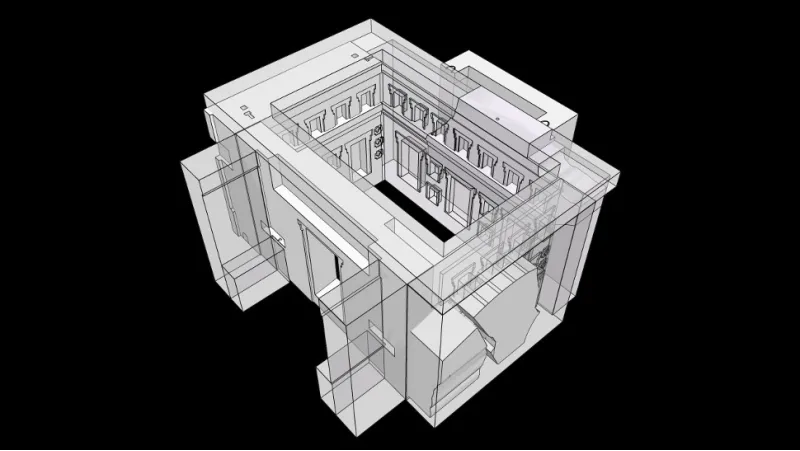
Recently, researchers from UC Berkeley put their puzzly skills to the test to solve a 1,500-year-old mystery: what the pre-Incan Tiwanaku temple known as Pumapunku actually looked like.
You see, the temple has been raided, pillaged, and ransacked over the centuries, leaving archaeologists with very little information on what the temple actually looked like, or how the many giant blocks that originally composed the temple were assembled.
But, with a combination of computer modeling, 3-D printed pieces, and their own puzzly knowhow and dedication, they have cobbled together a rudimentary idea of what the Pumapunku temple looked like.
The team created miniature 3D-printed models, at 4 percent actual size, of the temple’s 140 known pieces, which were based on measurements compiled by archaeologists over the past 150 years and Vranich’s own on-site observations of the ruins. The researchers used comparative analyses and interpolation to reconstruct broken pieces… Yes, the researchers could have performed this work exclusively in the virtual realm, but they had better luck with tangible, physical pieces they could freely move around.
Yes, not only were they using the pieces they knew about, but they were reassembling decayed or broken pieces as well in order to assemble the temple.
Vranich’s team gave a copy of the 3D-printed blocks to the Pumapunku ruins site director and taught the staff how to record the stones and model them. Vranich hopes that more blocks will be uncovered at the site, and further reconstructions of the temple complex will continue.
“The blocks will also be made available online,” said Vranich. “My hope is that other people will print them out and through the wisdom of crowds, we can find additional matches and continue to reconstruct the form of [another Tiwanaku] building known as ‘the temple of the Andes.’”
With these techniques and the lessons learned by the Pumapunku build, the team is hoping to not only recreate this ancient Andean temple, but other destroyed historical sites as well, including those in the Middle East destroyed by ISIS.
Back in 2013, we created a timeline of events from crossword history as part of our celebration of the hundredth anniversary of the crossword.
Although 105 isn’t as prestigious as 100, and the anniversary is technically tomorrow, we thought we’d honor the day this year by updating our comprehensive look at the long (yet surprisingly short) road it took to get to that marvelous centennial!
So, without further ado or folderol, we proudly present:
A Brief History of the Crossword (Updated)
16th – 11th century BC
Inscriptions from New Kingdom-era Egypt (Eighteenth to Twentieth Dynasties) of horizontal and vertical lines of text divided into equal squares, that can be read both across the rows and down the columns, are made. These inscriptions are later referred to by Egyptologists as “Egyptian crossword puzzles.”
19th century AD
Rudimentary crosswords, similar to word squares, begin appearing in England, and later elsewhere in Europe.
June 22, 1871
Future inventor of the crossword, Arthur Wynne, is born.
March 23, 1897
Future New York Times crossword editor Margaret Farrar is born.
February 25, 1907
Future New York Times crossword editor Will Weng is born.
December 21, 1913
The New York World publishes the first crossword, invented by Liverpool journalist Arthur Wynne. (The puzzle is originally known as a word-cross.)
January 6, 1916
Future New York Times crossword editor Eugene T. Maleska is born.
1920
Margaret Farrar is hired by The New York World as a secretary, but soon finds herself assisting Arthur Wynne with proofreading puzzles. Her puzzles soon exceed Wynne’s in popularity.
Colonel H.W. Hill publishes the first Crossword Dictionary.
1923
Margaret Farrar revises the cluing system for crosswords, sorting them into “Horizontal” and “Vertical” clues by number. (It wouldn’t be until the 1940s that the more familiar “Across” and “Down” terminology became the norm.)
1924
Margaret Farrar publishes the first book of crossword puzzles under contract for Richard L. Simon and Max Schuster, “The Cross-Word Puzzle Book.” It was an instant bestseller, launching Simon & Schuster as a major publisher. (Additional information available below the timeline.)
The Daily Express, founded in 1900, becomes the first newspaper in the United Kingdom to carry crosswords.
Crossword-themed novelty songs hit the airwaves as the puzzle craze intensifies, most notably “Crossword Mama, You Puzzle Me (But Papa’s Gonna Figure You Out).”
The Amateur Crossword Puzzle League of America, a self-appointed group of puzzle enthusiasts, lobbies for rotational symmetry in crosswords, which becomes the standard.
Solver Ruth Franc von Phul becomes a minor celebrity after winning The New York Herald-Tribune’s National All Comers Cross Word Puzzle Tournament at the age of 20. (She would win again 2 years later.)
January 15, 1925
“Felix All Puzzled,” the first animated short to feature a crossword, is released.
Disney releases a crossword-themed animated short, “Alice Solves the Puzzle.”
1926
The cryptic crossword is invented by Edward Powys Mathers, who publishes under the pseudonym Torquemada. He devises them for The Observer newspaper.
First reported instances of Braille crosswords.
1931
Dell Puzzle Magazines begins publishing.
(Dell Publishing itself was founded in 1921.)
1941
Dell Pocket Crossword Puzzles first published.
(The magazine continues to this day.)
February 15, 1942
The New York Times runs its first Sunday edition crossword. (Additional information available below the timeline.)
June 2, 1944
Physics teacher and crossword constructor Leonard Dawe is questioned by authorities after several words coinciding with D-Day invasion plans appear in London’s Daily Telegraph. (Additional information available below the timeline.)
1950
The crossword becomes a daily feature in The New York Times.
August 26, 1952
Future New York Times crossword editor Will Shortz is born.
1968
Lyricist Stephen Sondheim begins creating cryptic crosswords for New York Magazine, helping introduce Americans to British-style crosswords.
1969
Will Weng succeeds Margaret Farrar as the second crossword editor for The New York Times.
1973
Penny Press is founded.
1977
Eugene T. Maleska succeeds Will Weng as the third crossword editor for The New York Times.
1978
First year of the American Crossword Puzzle Tournament, later featured in the documentary Wordplay. 149 contestants compete for the title in the first national crossword tournament since the 1930s.
1979
Howard Garns creates the modern Sudoku puzzle for Dell Magazines (under the name Number Place), the first pen-and-paper puzzle to rival the crossword in popularity (though this spike in popularity would occur decades later under the name Sudoku).
June 11, 1984
Margaret Farrar, while working on the 134th volume in Simon & Schuster’s crossword puzzle book series, passes away.
1993
Will Shortz succeeds Eugene T. Maleska as the fourth crossword editor for The New York Times.
November 5, 1996
One of the most clever and famous crosswords of all time is published, the election-preceding crossword where either BOB DOLE ELECTED or CLINTON ELECTED could read out, depending on the solver’s answers.
1998
The Wall Street Journal adds a crossword to its newspaper, and Mike Shenk is appointed editor.
June 23, 2006
Wordplay documentary hits theaters, featuring celebrity solvers of crosswords as well as the participants and organizers of the 2005 edition of the American Crossword Puzzle Tournament.
February 29 – March 2, 2008
Thanks in part to the Wordplay documentary, the American Crossword Puzzle Tournament outgrows its previous setting and moves to Brooklyn.
The city of Lvov, Ukraine, creates a crossword that spans an entire side of a 100-foot-tall residential building, with clues scattered around the city’s major landmarks and attractions. It’s awesome.
David Steinberg launches the Pre-Shortzian Puzzle Project, designed to compile a complete database of every New York Times crossword.
August 13, 2012
PuzzleNation Blog is launched.
June 14, 2013
Matt Gaffney celebrates five years of MGWCC,
stating that MGWCC will run for 1000 weeks
(which puts the final edition around August 6th, 2027).
December 21, 2013
The Crossword officially turns one hundred years old.
Additional information:
1924: The publishing house Simon & Schuster, agreed to a small (3,600-copy) run of a crossword puzzle book, prompted by founder Richard L. Simon’s aunt, who wanted to give such a book to a friend. It became “a runaway bestseller.”
In no time the publisher had to put the book back on press; through repeated printings, it sold more than 100,000 copies. Soon a second collection followed, and then a third and a fourth. In 1924 and 1925 the crossword books were among the top 10 nonfiction bestsellers for the year, besting, among others, The Autobiography of Mark Twain and George Bernard Shaw’s Saint Joan.
February 15, 1942: The New York Times initially regarded crosswords as frivolous, calling them “a primitive form of mental exercise”; the motivating impulse for the Times to finally run the puzzle (which took over 20 years even though its publisher, Arthur Hays Sulzberger, was a longtime crossword fan) appears to have been the bombing of Pearl Harbor.
In a memo dated December 18, 1941, an editor conceded that the puzzle deserved space in the paper, considering what was happening elsewhere in the world and that readers might need something to occupy themselves during blackouts. The puzzle proved popular, and Sulzberger himself would author a Times puzzle before the year was out.
June 2, 1944: The words Omaha (codename for one of Normandy’s beaches), Utah (another Normandy beach codename), Overlord (the name for the plan to land at Normandy on June 6th), mulberry (nickname for a portable harbor built for D-Day), and Neptune (name for the naval portion of the invasion) all appeared in Daily Telegraph crosswords during the month preceding the D-Day landing.
This has been attributed to either an incredible coincidence or Dawe somehow overhearing these words (possibly slipped by soldiers involved) and incorporating them into puzzles unwittingly.
Do you have any suggestions for additions for our Crossword Timeline? Let us know in the comments section below! We’d love to hear from you!
Thanks for visiting PuzzleNation Blog today! Be sure to sign up for our newsletter to stay up-to-date on everything PuzzleNation!
If there’s one thing that puzzle fans of all shapes and sizes excel at, it’s pattern recognition. Whether it’s patterns of letters, patterns of numbers, patterns of logical facts, or patterns of puzzle pieces, puzzlers are outstanding at drawing order from chaos.
So it should come as no surprise that avid jigsaw puzzle solvers have noticed that some jigsaw puzzle companies use the same cutting molds over and over to create their jigsaw puzzles.
I myself realized this fact when I was younger. I was given three small Star Wars jigsaw puzzles, and all three of them were cut from the same mold. So once I’d solved one, solving the other two went much much faster. (I actually stacked them to make it even easier to complete the second and third puzzles.)
Naturally, this has led certain attentive and intrepid puzzlers to track down different puzzles with the same cutting mold to see how the two puzzles interact.
Artist Tim Klein is one of those observant individuals, and he’s had a lot of fun over the years crafting peculiar images by combining jigsaws with compatible molds:
Jigsaw puzzle companies tend to use the same cut patterns for multiple puzzles. This makes the pieces interchangeable. As a result, I sometimes find that I can combine portions from two or more puzzles to make a surreal picture that the publisher never imagined.
I take great pleasure in “discovering” such bizarre images lying latent, sometimes for decades, within the pieces of ordinary mass-produced puzzles. As I shift the pieces back and forth, trying different combinations, I feel like an archaeologist unearthing a hidden artifact.
And today, we’ve collected some of his puzzly creations for your enjoyment.
This mixture of summer and winter is marvelously balanced, particularly with the summer and winter bridges matching up so perfectly.
This fusion of a church and fairground adds a fun touch to an otherwise quiet and dignified image.
I like to call this one the Earth Mooover.
The Iron Horse comes to life in this surreal mashup.
In a natural evolution, this dinosaur train is no doubt the apex predator of the animal-train hybrid food pyramid.
This dinosaur/bunny monstrosity is a cuddly little ball of viciousness. No train parts needed.
Mixing up elements of three different puzzles brings us this Victorian ladypuppy in front of a scenic waterfall. This is dream or nightmare fuel, depending on your perspective.
This mixture of crosswords and fishing is wonderfully executed, offering the pleasantly appropriate metaphorical representation of “fishing for answers.”
And to close out this compilation of Klein’s jigsaw art, it seemed only appropriate to end on a holiday-themed note, with this kitty-in-kitty-in-present melange.
Klein’s jigsaw creations are as eye-catching as they are puzzling, and it makes you wonder what other hybrid constructions are awaiting the eagle eye of a devoted jigsaw puzzler.
There’s nothing more exciting than announcing a brand-new puzzle app we’ve been working on, and today, we’ve got something truly special for you to enjoy.
A town’s children have gone missing. A mysterious undead pirate and his ragtag crew lurk nearby. And the only person who can unravel the mystery and find the children is you!
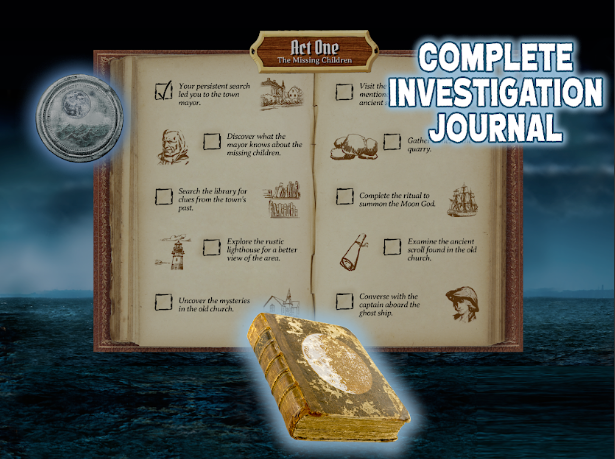
In Wordventures, you can immerse yourself in a investigation while solving word search puzzles to uncover clues, reveal secrets, and move the story forward!
Combining the world-class puzzle solving you expect from PuzzleNation with a multilayered storytelling experience offers the best of both worlds. You’ll explore the town, meet fascinating characters, and even keep notes in a journal as you play through the story!
You control the pace, you control the difficulty, and you push the narrative forward with every puzzle you solve!







 PuzzCulture