
Summer Reading: Nancy Drew #44: The Clue in the Crossword Cipher

Last week I kicked off our Summer Reading review series with Matching Minds with Sondheim.

This week, I decided to go back in time to a book I probably read during a summer break years and years ago. It felt appropriate to read the same sort of book that would’ve been ON a summer reading list for elementary or middle schoolers.

So join me as I take a trip to 1967 as we read Nancy Drew #44: The Clue in the Crossword Cipher by Carolyn Keene (aka Harriet Adams).
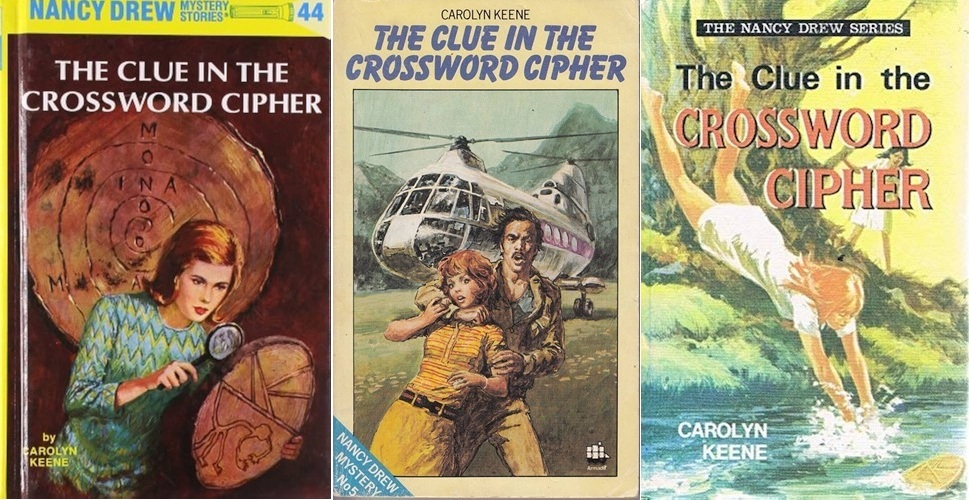
Nancy’s new acquaintance Carla Ponce shows her a family heirloom that has been in her family for generations — a wooden plaque carved into the image of a monkey — and asks for Nancy’s help unraveling the mystery of the message on the back of the carving.

While Carla is being menaced by a shadowy figure known only as El Gato, Nancy recruits her friends George and Bess to join her on a trip to Peru to unravel the centuries-old mystery of the monkey plaque.

Despite attempted (and successful) thefts, attempted kidnappings, a sabotaged plane, and a murder attempt atop Machu Picchu, Nancy and her friends unravel both the story of Carla’s missing ancestor and the secret of the monkey plaque. Their journey ends amongst the Nazca Lines as they seek a lost treasure.

I was absolutely a reader of the Hardy Boys and Nancy Drew when I was young, so I was definitely interested to revisit one of these books for our Summer Reading series.

And man, this book does not age well.

The adventure itself is fine, dealing with numerous criminal agents and cliffhangers at the end of each chapter (although some of them are just fake-outs resolved in the first sentence of the next chapter).

But the fat-shaming disguised as comedy is absolutely brutal. Every 20 pages, Bess is being called fat or chided about her eating or exercise. It sucks. They even gave this poor girl a cow-sounding NAME.

She runs all over Peru and Argentina trying to save Nancy’s life, and they still give her endless grief over eating delicious homemade local bread. LET THE GIRL BE.

There’s also the little matter of the crossword cipher on the back of the plaque.

It’s described to us in bits and pieces as they try to read the worn-away lettering, but what we have, essentially, are four words in a foreign language which seem to be crossing in pairs.

So, even being generous in our interpretation, this is neither a crossword nor a cipher. It’s not encoded, it’s just in another language. A language one of the primary characters speaks. I genuinely don’t know why they named the book after this detail. Maybe for flow? “The Case of the Worn-Off Crossed Words” doesn’t really grab your attention, does it?
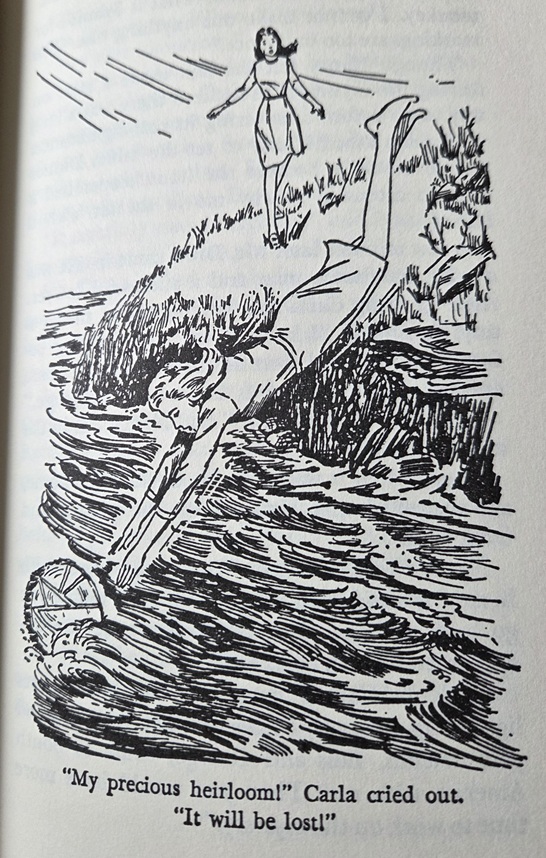
All that being said, it wasn’t a bad way to pass an hour or so. The art peppered throughout the book is fun, and the cartoonish smugglers throwing bombs and trying to toss Nancy off the top of an Incan landmark were pretty entertaining in their sinister ineptitude. (I am a sucker for incompetent lackeys.)

But I still wish there was, you know, a crossword to solve, or a cipher. That would have made the puzzle of the monkey plaque a little more engaging.


Are you doing any reading this summer, puzzly or otherwise, fellow reader? Let me know in the comments section below! I’d love to hear from you.
An Ancient Andean Jigsaw Puzzle?

[Image courtesy of Gizmodo.]

One of the best things about writing this blog is getting to talk about all of the amazing ways that people with puzzly skills have contributed to society. We’ve talked about codebreakers who saved Christmas and hunted Nazis, puzzlers who decoded ancient messages, and solvers who unraveled some of the mysteries of lost civilizations, all with the clever and insightful application of puzzle skills.

I’m surprised we haven’t talked about archaeologists more frequently, because they’re basically detectives of history who try to reassemble the past jigsaw-style.

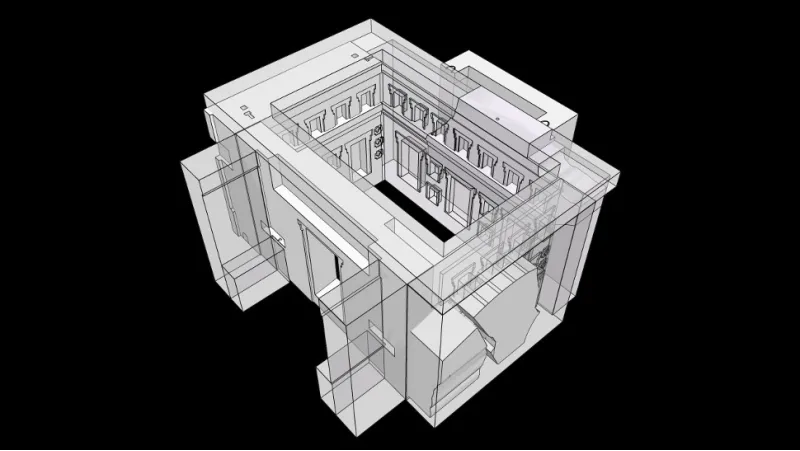
Recently, researchers from UC Berkeley put their puzzly skills to the test to solve a 1,500-year-old mystery: what the pre-Incan Tiwanaku temple known as Pumapunku actually looked like.

[Image courtesy of Gizmodo.]

You see, the temple has been raided, pillaged, and ransacked over the centuries, leaving archaeologists with very little information on what the temple actually looked like, or how the many giant blocks that originally composed the temple were assembled.

But, with a combination of computer modeling, 3-D printed pieces, and their own puzzly knowhow and dedication, they have cobbled together a rudimentary idea of what the Pumapunku temple looked like.

From an article on the project:

The team created miniature 3D-printed models, at 4 percent actual size, of the temple’s 140 known pieces, which were based on measurements compiled by archaeologists over the past 150 years and Vranich’s own on-site observations of the ruins. The researchers used comparative analyses and interpolation to reconstruct broken pieces… Yes, the researchers could have performed this work exclusively in the virtual realm, but they had better luck with tangible, physical pieces they could freely move around.

Yes, not only were they using the pieces they knew about, but they were reassembling decayed or broken pieces as well in order to assemble the temple.

[Image courtesy of Gizmodo.]

And the project continues!

Vranich’s team gave a copy of the 3D-printed blocks to the Pumapunku ruins site director and taught the staff how to record the stones and model them. Vranich hopes that more blocks will be uncovered at the site, and further reconstructions of the temple complex will continue.

“The blocks will also be made available online,” said Vranich. “My hope is that other people will print them out and through the wisdom of crowds, we can find additional matches and continue to reconstruct the form of [another Tiwanaku] building known as ‘the temple of the Andes.’”

With these techniques and the lessons learned by the Pumapunku build, the team is hoping to not only recreate this ancient Andean temple, but other destroyed historical sites as well, including those in the Middle East destroyed by ISIS.

[Image courtesy of Gizmodo.]

It’s an amazing investigative and deductive feat, made possible with puzzly skills.


Thanks for visiting PuzzleNation Blog today! Be sure to sign up for our newsletter to stay up-to-date on everything PuzzleNation!

You can also share your pictures with us on Instagram, friend us on Facebook, check us out on TwitterPinterest, and Tumblr, and explore the always-expanding library of PuzzleNation apps and games on our website!