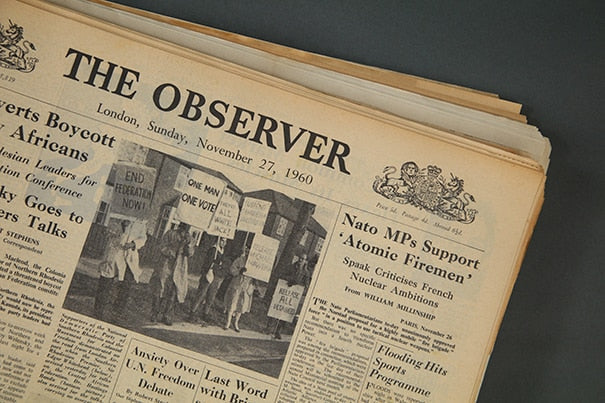
One Hundred Years of The Observer Crosswords!

1913 marked the birth of the crossword as we know it, but cryptic (or British-style) crosswords have been around nearly as long as the American version!

In fact, this past Saturday — Pi Day — marked an important anniversary in the history of cryptic crosswords.

On March 14th, 1926, Edward Powys Mathers, under the pseudonym Torquemada, published the first of 670 cryptic puzzles under the umbrella of The Observer, launching a crossword dynasty that continues to this very day.
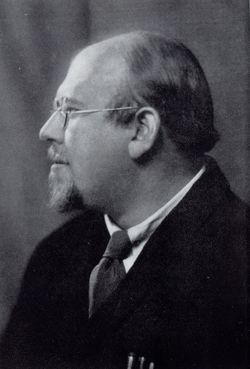
Mathers was a poet and a translator, and quite accomplished in both fields. Two years before his Observer debut as Torquemada, he was actually working for The Observer, but as a reviewer of thriller books. Apparently, he preferred to suggest how each book might be improved, rather than criticizing the book as is.

He noticed the American crossword craze crossing the ocean, but didn’t think much of them. (At the time, crossword cluing was very straightforward, consisting mostly of dictionary definitions. There was no wordplay, no misdirection, no humor. Cluing was VERY dry.)

In 1925, his first cryptic puzzles — a series of 12 crosswords where pairs of clues were rhyming couplets — appeared in The Saturday Westminster Gazette. This was where he first introduced himself to the puzzling public as Torquemada, taking the name of the Spanish Grand Inquisitor.

Well, sort of. The first puzzle was constructed for the entertainment of friends, but one of those friends took it to The Saturday Westminster Gazette against his wishes. The editors of The Gazette then managed to convince Mathers to create more. They were boldly advertised:

I recall how thrilling the green poster looked: “Crosswords for Supermen.” Alas, your tired commuter of today would swallow that first puzzle, verse and all, and correctly disgorge it between Charing Cross and Waterloo. — Torquemada, 1935

(Later those twelve puzzles were collected as “Crosswords for Riper Years.”)

After his run with The Saturday Westminster Gazette was finished, The Observer asked him to contribute puzzles to their outlet. They were called “Feelers,” as Mathers sought to widen the scope and audience of his puzzles, slowly “feeling his way” to better and more satisfying cluing.

It’s unlikely that Torquemada was the first setter to use cryptic-style cluing, but he was the first to ONLY use cryptic clues in his puzzles. But that wasn’t his only cryptic crossword innovation. He abandoned American-style grids as well, including these black bar grids:
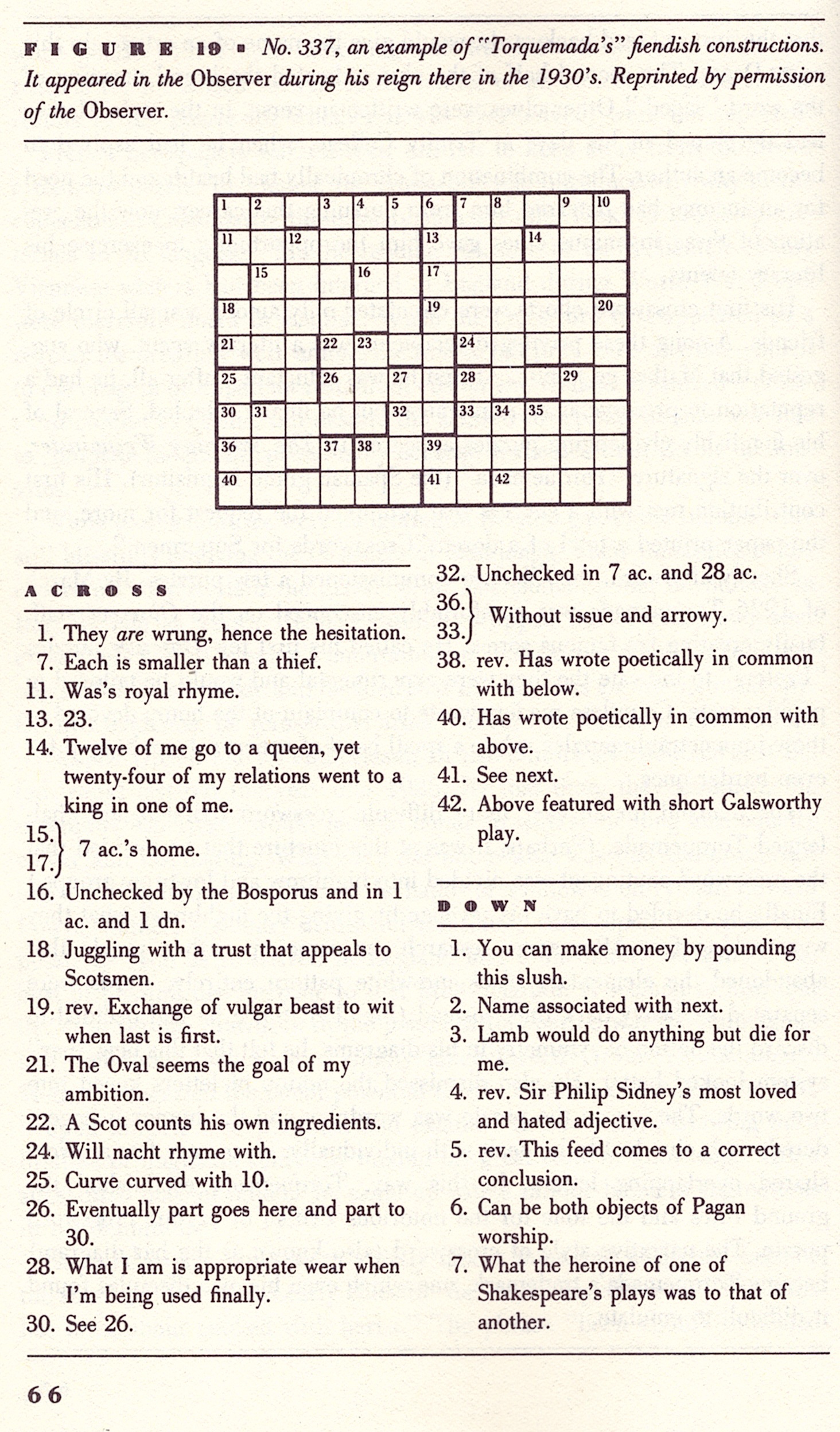
Image courtesy of What’s Gnu? by Michelle Arnot

Apparently he was successful in feeling out his audience; no matter how difficult his puzzles seemed to many, The Observer would receive as many as seven THOUSAND correct solutions from solvers all around the world, hoping to be among the lucky few selected to win a prize. (Prizes went to the first three correct solutions opened each week at The Observer offices.) It’s estimated another twenty thousand solvers out there were regularly completing his puzzles and not sending in their solutions.

Torquemada’s wife Rosamond later recalled that solvers would thank him for helping them “rediscover forgotten beauties in prose and verse to which we might never have returned but for the stimulus of the weekly chase”.

Torquemada’s prolific puzzling and creative cluing led some to suspect that there was actually a team of constructors toiling away under a shared sobriquet, but Torquemada’s only collaborator was Rosamond. He would choose the topic/theme for the grid, providing her with a list of words to include, and she would construct the grid.

Sadly, his time shepherding cryptic crosswords came to end when he passed away on February 3rd, 1939, at the age of 46.

After his passing, Rosamond read through over thirty thousand of his clues. She found the same word used fifty times in his puzzles, and every single time, the clue was different. Fifty different clues for the same word!
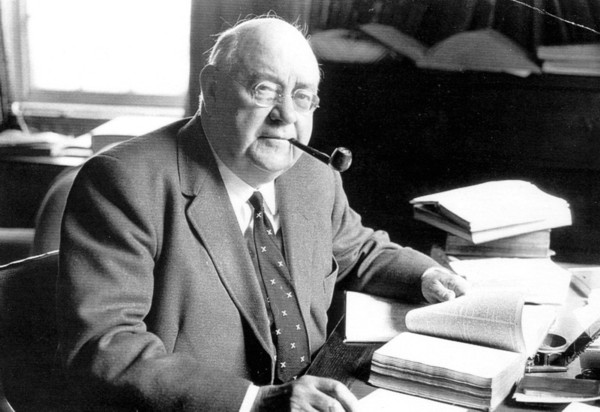

The unenviable task of taking over for Torquemada fell to Derek Somerset Macnutt, who adopted the name Ximenes for his constructing career. (Ximenes, as you might expect, was the name of a Grand Inquisitor in the Spanish Inquisition who succeeded the real Torquemada.)

Taking that particular set a very high bar, a challenge that Macnutt readily accepted. He aspired to increase the vocabulary of his audience, hoping for 30 percent of the answer words in the grid to be new to solvers.

Interestingly, his interest in puzzles was inspired by Torquemada but his singular brand of cluing was more reminiscent of Afrit, aka Alistair Ferguson Ritchie, who constructed cryptics for The Listener.

Ximenes adopted a symmetrical grid — a standard which remains to this day — as well as a maximum and minimum number of unches in the grid. (Unches, for you portmanteau lovers, means unchecked squares.) He also considered some of Torquemada’s puzzles unfair, and sought to standardize cluing, ensuring each had both wordplay and definition included, even while making them more creative and inventive.

In 1966, he published Ximenes on the Art of the Crossword, which pulled back the curtain on his constructing and inspired many constructors and setters in the years to come. (One of the most famous is the setter Eric Chalkley, aka Apex, who literally named himself after Ximenes in his endeavors to “ape X.”)

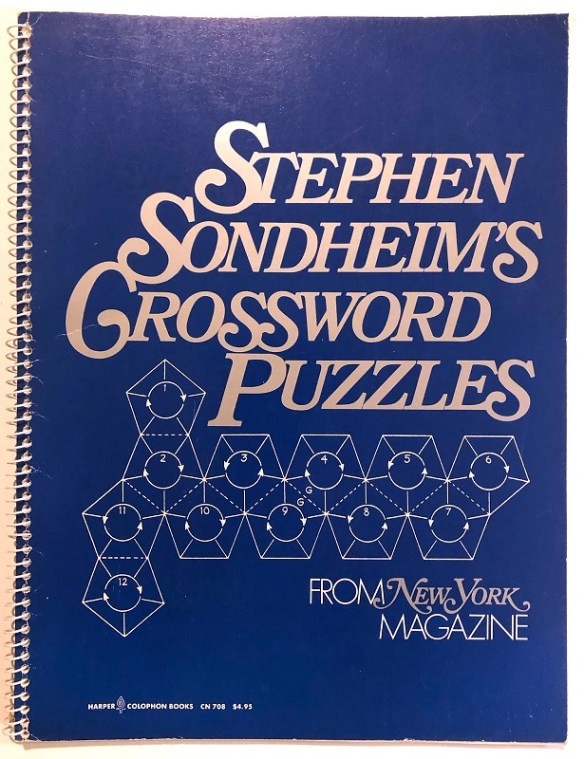
He also helped kickstart the cryptic crossword movement in America. After solving some of Frank Lewis’s puzzles for The Nation, Stephen Sondheim discovered the work of Ximenes, and started to learn the ins and outs of cryptic crosswords.
He even participated in Ximenes’s weekly clue-writing competitions:

Ximenes would then judge all the clues, conferring a first prize, a second prize, a third prize, and then two levels of honorable mentions: HC (Highly Commended) and VHC (Very Highly Commended). “And you would get in the mail a slip of paper giving the winners’ names and the winning clues.”

The slip was usually four inches wide by twelve inches long. In this way, even though Sondheim was in New York City, he became part of an international community of puzzle solvers matching minds with Ximenes. “I never got past honorable mention,” he lamented, “but I did get honorable mention.”

As it turns out, Sondheim received seventeen honorable mentions, fourteen HCs and three VHCs. One of those VHCs was for the clue “Pop art panel, derived from Dada” for PATERNAL.

Later accepting the challenge of the cryptic crosswords in The Listener (which were, and are, infamous for their difficulty), he introduced them to his collaborator on West Side Story, Leonard Bernstein.

And when Sondheim and Bernstein’s creative differences got the better of each other, they would reunite over a cryptic crossword, and then get back to work.

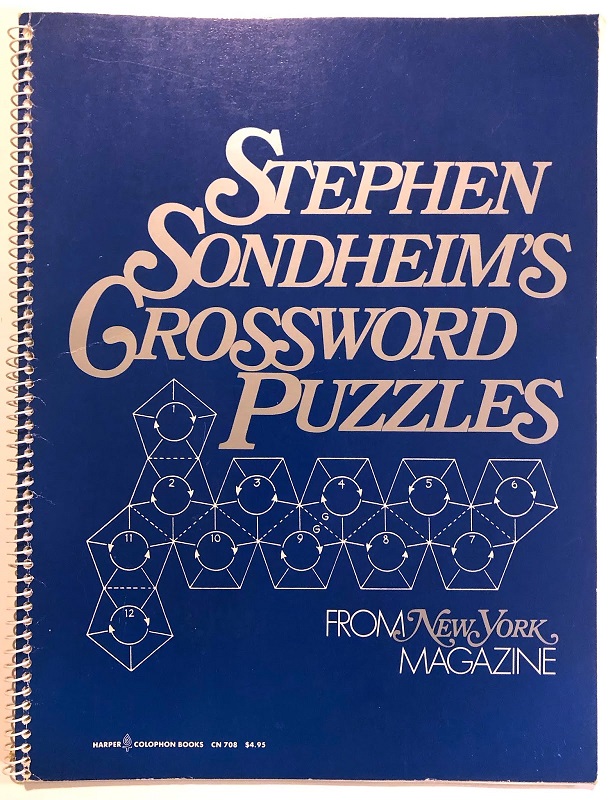
Sondheim would go on to create cryptic crosswords for New York Magazine, starting in the late 1960s, helping to introduce American audiences to that devious and challenging variety of crosswords. He also cultivated a library of cryptic puzzles and puzzle magazines, passing part of that collection (all of his Listener cryptic crosswords up through 1984) to Will Shortz.
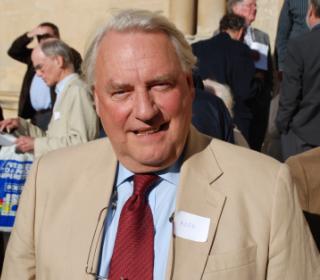

Macnutt passed away in 1971, but the final Ximenes puzzle, number 1200, was published in 1972. In March of that same year, stewardship of The Observer cryptic crossword passed to Jonathan Crowther, who took up the name Azed. Not only does this sound like it covers the alphabet (A to Zed), but it reverses the name of another Grand Inquistor, Diego de Deza.

He had been a solver of Ximenes’s puzzles since 1959, as well as a setter for The Listener. He also continued Ximenes’s clue-writing contest as the Azed Prize.
At this point, Azed has been setting the Observer cryptic crossword for longer than both his predecessors combined.

Also, you can’t help but love that he also sets occasional puzzles under the pseudonym Ozymandias. On his Wikipedia page, it even quotes the poem: “Look on my works, ye Mighty, and despair!”


Cryptic crosswords are alive and well. The Observer, The Guardian, The Independent, The Daily Telegraph, The Spectator, and The Sunday Times, in England, among others. The Ottawa Citizen, Toronto Star and The Globe and Mail in Canada. Harper’s in the US. Nearly every Australian newspaper has cryptic crosswords.

With Parsewords making the scene and hoping to demystify cryptic crossword cluing for new solvers, there’s no telling how many more solvers will discover or rediscover these challenging, playful puzzles.

And the folks at The Observer are marking the puzzle centenary with a special event on Thursday, March 19th!
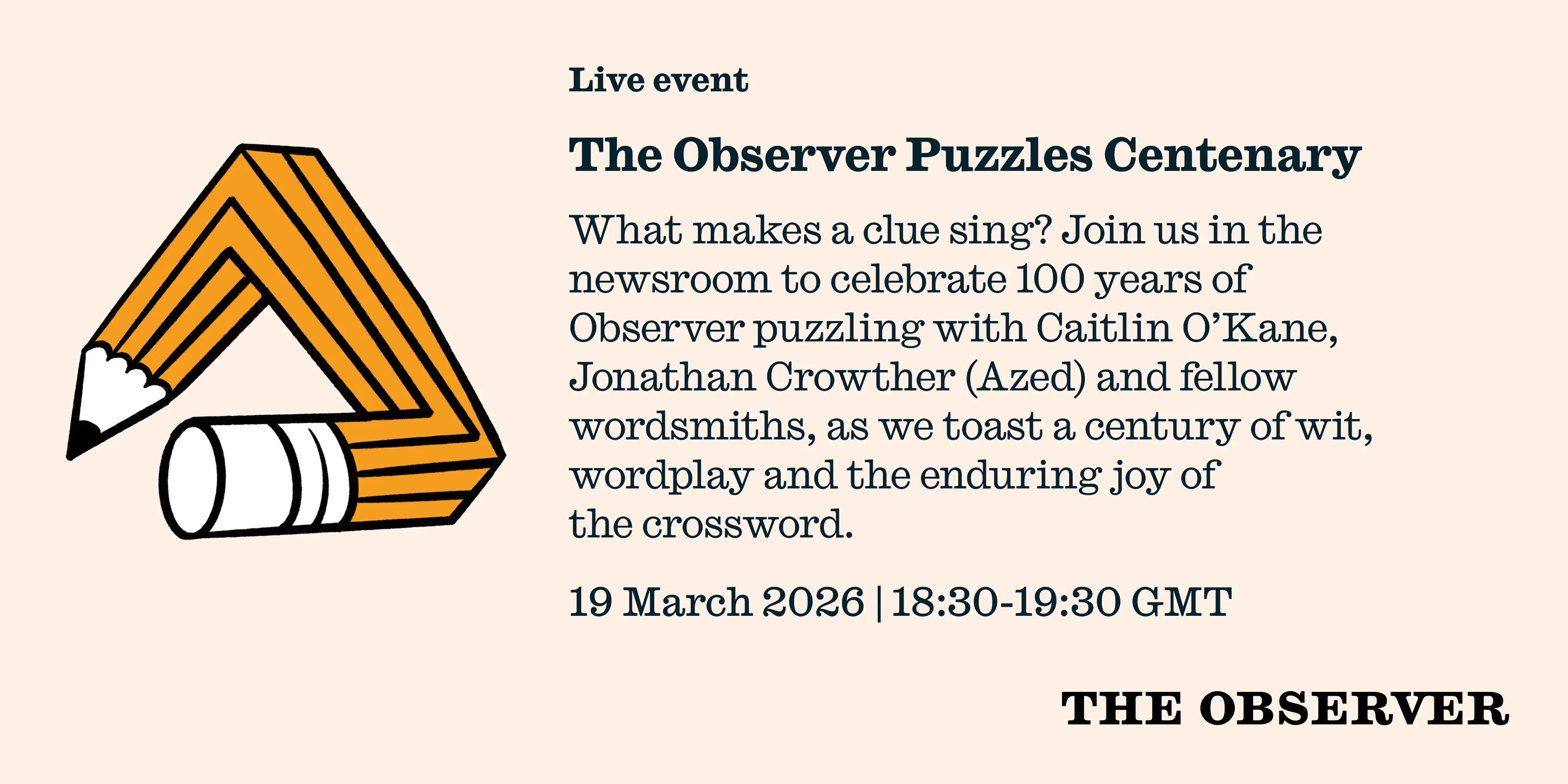
Caitlin O’Kane (their Puzzles Editor) and Azed himself will be in attendance, alongside other crossword setters and cryptic crossword enthusiasts, to enjoy an evening of live-solving and celebration:

From the invention of the cryptic to the rise of the modern brainteaser, they’ll unpack the secrets of their craft – what makes a clue sing, how setters think, and why a good puzzle keeps us hooked. Expect lively chat, unexpected revelations, and at least one enigma that demands to be cracked.

Raise a glass, meet other aficionados, and celebrate a century of wit, wordplay and ingenuity with the people keeping The Observer’s puzzling spirit alive.

So whether you’re attending The Observer‘s Puzzle Centenary, tackling a Parseword puzzle, or trying one of the numerous cryptic crossword outlets across the world, be sure to give a cryptic crossword a chance this week and be a part of one hundred years of puzzly challenge and creativity!

Happy solving, fellow puzzlers (and setters)!


Sources:

  • The Centenary of the Crossword by John Halpurn
  • What’s Gnu: A History of the Crossword Puzzle by Michelle Arnot
  • The Strange World of the Crossword by Roger Millington
  • Matching Minds with Sondheim: The Puzzles and Games of the Broadway Legend by Barry Joseph
  • The Puzzle Edit
  • Derek Harrison’s The Crossword Centre
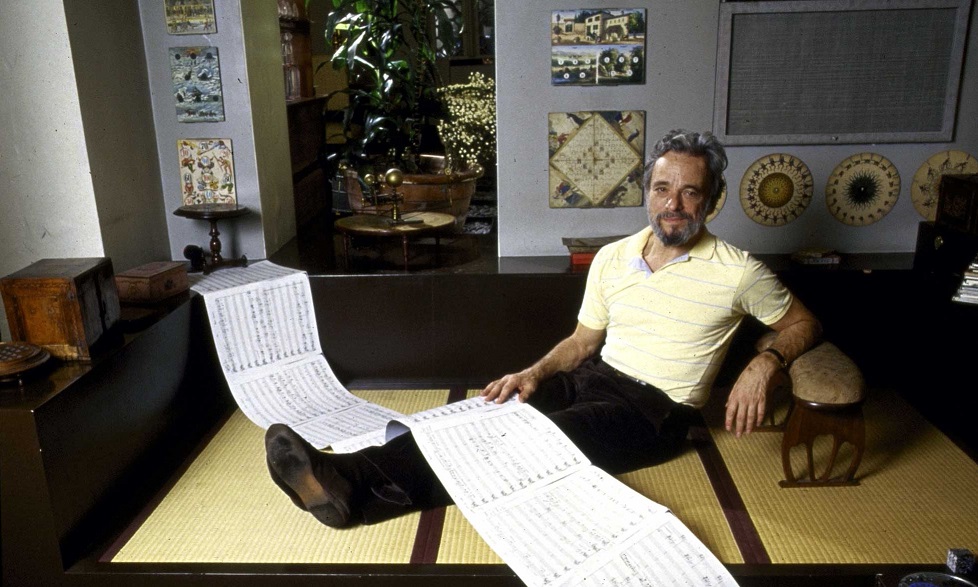
Farewell, Stephen.

StephenSondheim-2020-GettyImages-50314607

[Image courtesy of Vanity Fair.]

Most people know him as a titan of Broadway and the American stage, the composer and lyricist behind dozens of iconic works, spanning decades. West Side Story. Gypsy. Into the Woods. A Funny Thing Happened on the Way to the Forum. (My personal favorite? Assassins.)

Even as someone with a degree in theater, I don’t feel qualified to discuss or summarize his impact on the stage. It’s monumental. Incalculable. Iconic.

But as a puzzle enthusiast, I do feel qualified to discuss his influence in that realm. You see, Stephen Sondheim occupies a curious space in the history of puzzles.

sondheim

He created cryptic / British-style crosswords for New York Magazine in the late 1960s, helping to introduce American audiences to that devious and challenging variety of crosswords.

In fact, he famously wrote an article in that very same magazine decrying the state of American crosswords and extolling the virtues of cryptic crosswords. (He even explained the different cluing tricks and offering examples for readers to unravel.)

Sondheim was an absolute puzzle fiend. His home was adorned with mechanical puzzles, and he happily created elaborate puzzle games. Some of them were featured in Games Magazine! In his later years, he was also an aficionado of escape rooms. (Friend of the blog Eric Berlin shared a wonderful anecdote about Sondheim here.)

uplifting-things-crossword-the-nice-thing-about-doing-a-crossroad-puzzle-is-you-know-the-answer-1080x760

He also represents another link in the curious chain that seems to connect musicians with crosswords. Prominent constructors like Patrick Blindauer, Brian Cimmet, and Amanda Rafkin, as well as top crossword tournament competitors like Dan Feyer and Jon Delfin also have musical backgrounds.

In the crossword documentary Wordplay (and quoted from the article linked below), former New York Times Public Editor Daniel Okrent mentioned why he felt that musicians and mathematicians were good fits as crossword solvers:

Their ability to assimilate a lot of coded information instantly. In other words, a piano player like Jon Delfin, the greatest crossword player of our time, he sits down and he sees three staffs of music and he can instantly play it. He’s taken all those notes and absorbs what they mean, instantaneously. If you have that kind of mind, and you add it to it a wide range of information, and you can spell, you’d be a really great crossword puzzler.

Sondheim certainly fits the bill.

He will forever be remembered for his musical creations, and that legacy far overshadows his work in puzzles. But as someone who opened the door to a new brand of puzzle solving for many people, Sondheim will also have the undying loyalty, respect, and admiration of many puzzlers around the world.

We wholeheartedly include ourselves in that crowd of admirers.

Farewell, Stephen. Thank you.


   dailypopwsicon

Treat yourself to some delightful deals on puzzles. You can find them on the Home Screen for Daily POP Crosswords and Daily POP Word Search! Check them out!

Thanks for visiting PuzzleNation Blog today! Be sure to sign up for our newsletter to stay up-to-date on everything PuzzleNation!

5 Questions for Crossword Constructor Amanda Rafkin

Welcome to 5 Questions, our recurring interview series where we reach out to puzzle constructors, game designers, writers, filmmakers, musicians, artists, and puzzle enthusiasts from all walks of life!

It’s all about exploring the vast and intriguing puzzle community by talking to those who make puzzles and those who enjoy them! (Click here to check out previous editions of 5 Questions!)

And we’re excited to welcome Amanda Rafkin as our latest 5 Questions interviewee!

rafkin

When she’s not contributing to musical theater with her deft piano performances (or entertaining herself with various showtunes), Amanda constructs crosswords for various outlets including her own puzzle website, Brain Candy, where she posts a new puzzle every day. She also features other constructors, providing a valuable platform for her fellow cruciverbalists!

She has been published in The New York Times, The Los Angeles Times, Universal, The Inkubator, and many other outlets, and recently contributed a puzzle to the 2020 Boswords crosswords tournament (which just so happened to be your lead blogger’s favorite puzzle from this year’s tournament).

Amanda was gracious enough to take some time out to talk to us, so without further ado, let’s get to the interview!


5 Questions for Amanda Rafkin

1. How did you get started with puzzles?

I really started loving puzzles at some point in my pre-teen years when I would confiscate my mom’s half-finished puzzles when she would step out of the room. I think she eventually got so fed up with me stealing her puzzles that she bought me my own book of variety puzzles, and since then I’ve been off to the races.

I became interested in constructing a couple of years ago when I got more serious with my crossword solving and felt that crossword construction could fall in that blissful middle-of-the-Venn-diagram area between something I might be good at and something I might love. I guess who’s good at anything is a matter of opinion, but I’m happy to report that I was wildly correct about the love part.

2. In addition to your crossword constructing, you’re also a musician, which seems to be a recurring theme among some constructors (Patrick Blindauer, Brian Cimmet) and tournament solvers (Dan Feyer, John Delfin). Do your musical skills ever influence your puzzling, or do you ever find yourself relying on your puzzly skills while performing or composing?

This is something I’ve heard many times (the relationship between crossword constructing and musicianship) to the point that I, myself, wonder if there’s something to it! If there is, it’s not something I’m aware of at all. For me, the two things are pretty separate experiences in my life.

The one exception to this I guess would be my theater-themed puzzles that I’ve grown so fond of. Every Thursday on my website is “Theatre Thursday”, where I post a midi-sized Broadway-themed puzzle, often accompanied by a bunch of relevant musical theater information that no one asked for. I also have a couple of Broadway-themed midi packs on the horizon. One is completed and will be released sometime in the (probably) not-too-distant future, and the other is a midi pack centering around each of Sondheim’s 19 major works, which I’m working on right now.

sondheim

[Sondheim constructed cryptic crosswords for New York Magazine,
so Amanda certainly finds herself in good company!]

3. To call the last few months tumultuous is an understatement, considering public unrest and pushback against infringements on civil rights. In a similar vein, there has been a more strenuous push in crosswords recently (Women’s March, for instance) for greater representation for women, people of color, and the LGBTQIA+ community. In your estimation, how are the major outlets faring regarding inclusion?

Well there’s a loaded question! The numbers will tell you that, by and large, they are faring rather poorly. There are of course some exceptions (notably, the USA Today, which publishes far more puzzles by women than men). If you’re looking at the major outlet (The New York Times), this can feel challenging to assess in some ways.

If we’re acknowledging a recent push for inclusion, then we also have to take into consideration the often 18-month delay between the time of construction and the time of publication. As a result, the things that are happening now may not reveal themselves to us until over a year from now. None of this is an excuse for not having implemented a more inclusive system long ago, but I do think that even the major outlets with a shorter queue than The New York Times may not reveal to us any of aforementioned representational shifts until months from now.

I hope this is something that we as constructors and solvers continue to keep our eyes on, so that we can continue to work on opening doors that may have previously felt closed, and offering equal opportunities to anyone and everyone interested in the endeavor of crossword construction.

I think, as a whole, the general industry is still struggling to understand the difference between “I personally don’t know this because of my own life experiences” and “This isn’t gettable/knowable/likeable for solvers”. Inclusion begets inclusion, as exclusion begets exclusion. By leaving certain things/people/customs etc. out of puzzles, we continue this cycle in perpetuity. The more different kinds of people we have making puzzles, the more likely it is that any given solver will be able to do a puzzle and see themselves within it. And, at least for me, that is a goal that I always try to keep in mind when constructing.

rafkat

[Solving runs in the family.]

4. What’s next for Amanda Rafkin?

I wish Amanda Rafkin knew the answer to that question as well. Given how things are going, it seems it will be a while before I’ll be doing much in the way of music again. So, for now, I’m going to continue to do what I’ve been doing for most of quarantine: making puzzles, putting them into the world, and hoping that they bring some kind of joy to folks during a time when joy can be a tricky thing to come by. Would it be awesome to be able to make a living solely from making crossword puzzles? HECK YES! So maybe that’s a goal for sometime in the future as well.

5. If you could give the readers, writers, aspiring constructors, and puzzle fans in the audience one piece of advice, what would it be?

No matter who you are, no matter how much you know, no matter where you went to school, no matter who your friends are, no matter the experiences you’ve had in your life, no matter how woke you think you are, you have blind spots. We all have blind spots. And sometimes, in the wake of these blind spots can come decisions that hurt other people. We are imperfect but lifelong students on this collective journey to betterment.

Be open to feedback, specifically from people who have had different life experiences than you. Feedback is not criticism; it’s the space from which we all grow. So get feedback on your work and actually listen. Resist the urge to be defensive. Collaborate with other people. If they differ from you in some way, even better.

Oh, and if you’ve been tossing around the idea of constructing for a while but haven’t actually taken the leap…jump. The kindest and most supportive people are on the other side waiting to catch you.


A huge thank you to Amanda for her time. You can follow her on Twitter for updates on her puzzly and musical endeavors, and be sure to visit her puzzle website Brain Candy for all sorts of puzzle goodness. We can’t wait to see what she cooks up next.

Thanks for visiting PuzzleNation Blog today! Be sure to sign up for our newsletter to stay up-to-date on everything PuzzleNation!

You can also share your pictures with us on Instagram, friend us on Facebook, check us out on TwitterPinterest, and Tumblr, and explore the always-expanding library of PuzzleNation apps and games on our website!

Crossword History: An Updated Timeline

Back in 2013, we created a timeline of events from crossword history as part of our celebration of the hundredth anniversary of the crossword.

Although 105 isn’t as prestigious as 100, and the anniversary is technically tomorrow, we thought we’d honor the day this year by updating our comprehensive look at the long (yet surprisingly short) road it took to get to that marvelous centennial!

So, without further ado or folderol, we proudly present:

A Brief History of the Crossword (Updated)

16th – 11th century BC

Inscriptions from New Kingdom-era Egypt (Eighteenth to Twentieth Dynasties) of horizontal and vertical lines of text divided into equal squares, that can be read both across the rows and down the columns, are made. These inscriptions are later referred to by Egyptologists as “Egyptian crossword puzzles.”

19th century AD

Rudimentary crosswords, similar to word squares, begin appearing in England, and later elsewhere in Europe.

June 22, 1871

Future inventor of the crossword, Arthur Wynne, is born.

March 23, 1897

Future New York Times crossword editor Margaret Farrar is born.

February 25, 1907

Future New York Times crossword editor Will Weng is born.

December 21, 1913

The New York World publishes the first crossword, invented by Liverpool journalist Arthur Wynne. (The puzzle is originally known as a word-cross.)

January 6, 1916

Future New York Times crossword editor Eugene T. Maleska is born.

1920

Margaret Farrar is hired by The New York World as a secretary, but soon finds herself assisting Arthur Wynne with proofreading puzzles. Her puzzles soon exceed Wynne’s in popularity.

Colonel H.W. Hill publishes the first Crossword Dictionary.

1923

Margaret Farrar revises the cluing system for crosswords, sorting them into “Horizontal” and “Vertical” clues by number. (It wouldn’t be until the 1940s that the more familiar “Across” and “Down” terminology became the norm.)

1924

Margaret Farrar publishes the first book of crossword puzzles under contract for Richard L. Simon and Max Schuster, “The Cross-Word Puzzle Book.” It was an instant bestseller, launching Simon & Schuster as a major publisher. (Additional information available below the timeline.)

The Daily Express, founded in 1900, becomes the first newspaper in the United Kingdom to carry crosswords.

Crossword-themed novelty songs hit the airwaves as the puzzle craze intensifies, most notably “Crossword Mama, You Puzzle Me (But Papa’s Gonna Figure You Out).”

The Amateur Crossword Puzzle League of America, a self-appointed group of puzzle enthusiasts, lobbies for rotational symmetry in crosswords, which becomes the standard.

Solver Ruth Franc von Phul becomes a minor celebrity after winning The New York Herald-Tribune’s National All Comers Cross Word Puzzle Tournament at the age of 20. (She would win again 2 years later.)

January 15, 1925

“Felix All Puzzled,” the first animated short to feature a crossword, is released.

February 2, 1925

The crossword-fueled musical revue “Puzzles of 1925” opens on Broadway. It runs until May of 1925.

February 15, 1925

Disney releases a crossword-themed animated short, “Alice Solves the Puzzle.”

1926

The cryptic crossword is invented by Edward Powys Mathers, who publishes under the pseudonym Torquemada. He devises them for The Observer newspaper.

First reported instances of Braille crosswords, as newspapers mention Helen Keller solving Braille crosswords and recommending them to the blind.

1931

Dell Puzzle Magazines begins publishing.
(Dell Publishing itself was founded in 1921.)

1941

Dell Pocket Crossword Puzzles first published.
(The magazine continues to this day.)

February 15, 1942

The New York Times runs its first Sunday edition crossword. (Additional information available below the timeline.)

June 2, 1944

Physics teacher and crossword constructor Leonard Dawe is questioned by authorities after several words coinciding with D-Day invasion plans appear in London’s Daily Telegraph(Additional information available below the timeline.)

1950

The crossword becomes a daily feature in The New York Times.

August 26, 1952

Future New York Times crossword editor Will Shortz is born.

1968

Lyricist Stephen Sondheim begins creating cryptic crosswords for New York Magazine, helping introduce Americans to British-style crosswords.

1969

Will Weng succeeds Margaret Farrar as the second crossword editor for The New York Times.

1973

Penny Press is founded.

1977

Eugene T. Maleska succeeds Will Weng as the third crossword editor for The New York Times.

1978

First year of the American Crossword Puzzle Tournament, later featured in the documentary Wordplay. 149 contestants compete for the title in the first national crossword tournament since the 1930s.

1979

Howard Garns creates the modern Sudoku puzzle for Dell Magazines (under the name Number Place), the first pen-and-paper puzzle to rival the crossword in popularity (though this spike in popularity would occur decades later under the name Sudoku).

June 11, 1984

Margaret Farrar, while working on the 134th volume in Simon & Schuster’s crossword puzzle book series, passes away.

1993

Will Shortz succeeds Eugene T. Maleska as the fourth crossword editor for The New York Times.

November 5, 1996

One of the most clever and famous crosswords of all time is published, the election-preceding crossword where either BOB DOLE ELECTED or CLINTON ELECTED could read out, depending on the solver’s answers.

1998

The Wall Street Journal adds a crossword to its newspaper, and Mike Shenk is appointed editor.

June 23, 2006

Wordplay documentary hits theaters, featuring celebrity solvers of crosswords as well as the participants and organizers of the 2005 edition of the American Crossword Puzzle Tournament.

February 29 – March 2, 2008

Thanks in part to the Wordplay documentary, the American Crossword Puzzle Tournament outgrows its previous setting and moves to Brooklyn.

June 6, 2008

Matt Gaffney launches his Weekly Crossword Contest (MGWCC).

August 2008

Lollapuzzoola, a crossword-solving tournament with a more tongue-in-cheek, freeform style, launches in Jackson Heights, New York.

October 6, 2008

Patrick Blindauer’s famous dollar bill-inspired crossword puzzle is published.

2009

The city of Lvov, Ukraine, creates a crossword that spans an entire side of a 100-foot-tall residential building, with clues scattered around the city’s major landmarks and attractions. It’s awesome.

October 11, 2011

PuzzleNation.com goes live.

June 2012

David Steinberg launches the Pre-Shortzian Puzzle Project, designed to compile a complete database of every New York Times crossword.

August 13, 2012

PuzzleNation Blog is launched.

June 14, 2013

Matt Gaffney celebrates five years of MGWCC,
stating that MGWCC will run for 1000 weeks
(which puts the final edition around August 6th, 2027).

December 21, 2013

The Crossword officially turns one hundred years old.


Additional information:

1924: The publishing house Simon & Schuster, agreed to a small (3,600-copy) run of a crossword puzzle book, prompted by founder Richard L. Simon’s aunt, who wanted to give such a book to a friend. It became “a runaway bestseller.”

In no time the publisher had to put the book back on press; through repeated printings, it sold more than 100,000 copies. Soon a second collection followed, and then a third and a fourth. In 1924 and 1925 the crossword books were among the top 10 nonfiction bestsellers for the year, besting, among others, The Autobiography of Mark Twain and George Bernard Shaw’s Saint Joan.

February 15, 1942: The New York Times initially regarded crosswords as frivolous, calling them “a primitive form of mental exercise”; the motivating impulse for the Times to finally run the puzzle (which took over 20 years even though its publisher, Arthur Hays Sulzberger, was a longtime crossword fan) appears to have been the bombing of Pearl Harbor.

In a memo dated December 18, 1941, an editor conceded that the puzzle deserved space in the paper, considering what was happening elsewhere in the world and that readers might need something to occupy themselves during blackouts. The puzzle proved popular, and Sulzberger himself would author a Times puzzle before the year was out.

June 2, 1944: The words Omaha (codename for one of Normandy’s beaches), Utah (another Normandy beach codename), Overlord (the name for the plan to land at Normandy on June 6th), mulberry (nickname for a portable harbor built for D-Day), and Neptune (name for the naval portion of the invasion) all appeared in Daily Telegraph crosswords during the month preceding the D-Day landing.

This has been attributed to either an incredible coincidence or Dawe somehow overhearing these words (possibly slipped by soldiers involved) and incorporating them into puzzles unwittingly.


Do you have any suggestions for additions for our Crossword Timeline? Let us know in the comments section below! We’d love to hear from you!

Thanks for visiting PuzzleNation Blog today! Be sure to sign up for our newsletter to stay up-to-date on everything PuzzleNation!

You can also share your pictures with us on Instagram, friend us on Facebook, check us out on TwitterPinterest, and Tumblr, and explore the always-expanding library of PuzzleNation apps and games on our website!

Potent Quotables!

lincoln_internet_quote

Quotations are a major part of the puzzle landscape. From cryptograms and Syllacrostics to crosswords where you end up with unhelpful clues like “Part 1 of quote,” I’d bet that an avid solver rarely goes a day without encountering a quote somewhere in their puzzling.

I was working on a quote puzzle just the other day, and it occurred to me that, despite the hundreds and hundreds of puzzles involving quotes that I’ve created and edited over the years, I couldn’t think of any that were actually about puzzles.

So, naturally, I went looking for quotes about puzzles.

I had to narrow the field to crosswords, because quotes about puzzles were both too numerous and, oddly enough, not actually about puzzles.

“Each person is an enigma. You’re a puzzle not only to yourself but also to everyone else, and the great mystery of our time is how we penetrate this puzzle.” — Theodore Zeldin

Oh sure, they mention puzzles, but only as a metaphor for something else. People are puzzles, or life is a puzzle, or the world is a puzzle, or writing is a puzzle, or acting is a puzzle, or making a movie is a puzzle. Insert topic, blah blah, puzzle metaphor.

You get the idea.

At least some people stick to the subject of puzzles when getting metaphorical.

“There seem to be two main types of people in the world: crosswords and Sudokus.” — Rebecca McKinsey

Betty White has something to say on that subject:

“I love words. Sudoku I don’t get into, I’m not into numbers that much, and there are people who are hooked on that. But crossword puzzles, I just can’t — if I get a puppy and I paper train him and I put the — if all of a sudden I’d open the paper and there’s a crossword puzzle — ‘No, no, you can’t go on that, honey. I’ll take it.'”

See, now we’re getting into actual crossword quotes.

Oh, no, wait. One more metaphor:

“Fighting with him was like trying to solve a crossword and realizing there’s no right answer.” — Taylor Swift

Apparently Taylor Swift doesn’t know how crossword puzzles work. (Then again, she had that song where Romeo and Juliet had a happy ending, so maybe I’m barking up the wrong tree here…)

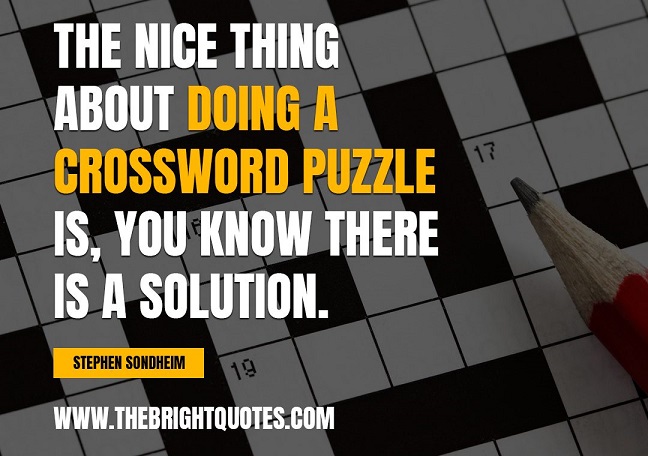
I shall rebut Miss Swift with a Stephen Sondheim quote: “The nice thing about doing a crossword puzzle is, you know there is a solution.”

Okay, we’re back on track.

This might be the most famous quote about crosswords:

8802-retirement

There’s a definite theme of crosswords being associated with retirement and relaxation.

“But I’m really enjoying my retirement. I get to sleep in every day. I do crossword puzzles and eat cake.” — Derek Landy

“I would prefer to live forever in perfect health, but if I must at some time leave this life, I would like to do so ensconced on a chaise longue, perfumed, wearing a velvet robe and pearl earrings, with a flute of champagne beside me and having just discovered the answer to the last problem in a British cryptic crossword.” — Olivia de Havilland

“I enjoy walking my dog and completing crossword puzzles.” — Brian Jacques

Of course, some folks have regrets…

“Do I rue a life wasted doing crosswords? Yes, but I do know the three-letter-word for regret.” — Robert Breault

Others have complaints…

“Wouldn’t it be wonderful if I won a helicopter in a crossword puzzle competition? There is not much hope though I am afraid, as they never give such practical prizes.” — Leonora Carrington

mp-helicopter-cnc-laser-router-scrollsaw-aircraft-o84_1000

But, to be honest, my two favorite quotes about crosswords didn’t come from celebrities or revered thinkers. (At least, not yet revered.) They came from college students on Tumblr, sharing observations, either their own or those of others.

“Who did Jessica Simpson last divorce?! Like, I don’t know. I could tell you all about Rousseau though.” — Girl doing a crossword puzzle in class

I think I’ll give the final word to another Tumblr user, who summed up crosswords brilliantly.

“A crossword puzzle is an unholy marriage of spelling bee, trivia contest, and a troll that lives under a bridge and asks you riddles.”


Do you have any favorite quotes about puzzles, fellow PuzzleNationers? Let us know in the comments section below!

Thanks for visiting PuzzleNation Blog today! Be sure to sign up for our newsletter to stay up-to-date on everything PuzzleNation!

You can also share your pictures with us on Instagram, friend us on Facebook, check us out on TwitterPinterest, and Tumblr, and explore the always-expanding library of PuzzleNation apps and games on our website!

Crossword History: A Timeline

The hundredth anniversary of the crossword is nearly upon us, and we at PuzzleNation Blog thought we’d take a look at the long (yet surprisingly short) road it took to get to this marvelous centennial!

And so, without further ado or folderol, we proudly present:

A Brief History of the Crossword
(by Glenn Dallas and the PuzzleNation Team)

16th – 11th century BC

Inscriptions from New Kingdom-era Egypt (Eighteenth to Twentieth Dynasties) of horizontal and vertical lines of text divided into equal squares, that can be read both across the rows and down the columns, are made. These inscriptions are later referred to by Egyptologists as “Egyptian crossword puzzles.”

19th century

Rudimentary crosswords, similar to word squares, begin appearing in England, and later elsewhere in Europe.

June 22, 1871

Future inventor of the crossword, Arthur Wynne, is born.

March 23, 1897

Future New York Times crossword editor Margaret Farrar is born.

February 25, 1907

Future New York Times crossword editor Will Weng is born.

December 21, 1913

The New York World publishes the first crossword, invented by Liverpool journalist Arthur Wynne.
(The puzzle is originally known as a word-cross.)

January 6, 1916

Future New York Times crossword editor Eugene T. Maleska is born.

1920

Margaret Farrar is hired by The New York World as a secretary, but soon finds herself assisting Arthur Wynne with proofreading puzzles. Her puzzles soon exceed Wynne’s in popularity.

Colonel H.W. Hill publishes the first Crossword Dictionary.

1924

Margaret Farrar publishes the first book of crossword puzzles under contract for Richard L. Simon and Max Schuster, “The Cross-Word Puzzle Book.” It was an instant bestseller, launching Simon & Schuster as a major publisher.

The Sunday Express becomes the first newspaper in the United Kingdom to carry crosswords.

1926

The cryptic crossword is invented by Edward Powys Mathers, who uses the pseudonym of Torquemada. He devises them for The Observer newspaper.

1931

Dell Puzzle Magazines begins publishing.
(Dell Publishing itself was founded in 1921.)

1941

Dell Pocket Crossword Puzzles first published.
(The magazine continues to this day.)

February 15, 1942

The New York Times runs its first Sunday edition crossword. (Click here to read more about this.)

June 2, 1944

Physics teacher and crossword constructor Leonard Dawe is questioned by authorities after several words coinciding with D-Day invasion plans appear in London’s Daily Telegraph. (Click here to read more about this.)

1950

The crossword becomes a daily feature in the New York Times.

August 26, 1952

Future New York Times crossword editor Will Shortz is born.

1968

Lyricist Stephen Sondheim begins creating cryptic crosswords for New York Magazine, helping introduce Americans to British-style crosswords.

1969

Will Weng succeeds Margaret Farrar as the second crossword editor for the New York Times.

1973

Penny Press is founded.

1977

Eugene T. Maleska succeeds Will Weng as the third crossword editor for the New York Times.

1978

First year of the American Crossword Puzzle Tournament,
later featured in the documentary Wordplay.

1979

Howard Garns creates the modern Sudoku puzzle for Dell Magazines (under the name Number Place), the first pen-and-paper puzzle to rival the crossword in popularity (though this spike in popularity would occur decades later under the name Sudoku).

June 11, 1984

Margaret Farrar, while working on the 134th volume in Simon & Schuster’s crossword puzzle book series, passes away.

1993

Will Shortz succeeds Eugene T. Maleska as the fourth crossword editor for the New York Times.

November 5, 1996

One of the most clever and famous crosswords of all time is published, the election-preceding crossword where either BOB DOLE ELECTED or CLINTON ELECTED could read out, depending on the solver’s answers.

June 23, 2006

Wordplay documentary hits theaters, featuring both celebrity solvers of crosswords and the participants and organizers of the 2005 American Crossword Puzzle Tournament.

February 29 – March 2, 2008

Thanks in part to the Wordplay documentary, the American Crossword Puzzle Tournament outgrows its previous setting and moves to Brooklyn.

June 6, 2008

Matt Gaffney launches his Weekly Crossword Contest (MGWCC).

August 2008

Lollapuzzoola, a crossword-solving tournament with a more tongue-in-cheek, freeform style, launches in Jackson Heights, New York.

October 6th, 2008

Patrick Blindauer’s famous dollar bill-inspired crossword puzzle is published.

2009

The city of Lvov, Ukraine, creates a crossword that spans an entire side of a 100-foot-tall residential building, with clues scattered around the city’s major landmarks and attractions. It’s awesome.

October 11th, 2011

PuzzleNation.com goes live.

June 2012

David Steinberg launches the Pre-Shortzian Puzzle Project, intending to create a complete database of every New York Times crossword.

August 13th, 2012

PuzzleNation Blog is launched.

June 14th, 2013

Matt Gaffney celebrates five years of MGWCC,
stating that MGWCC will run for 1000 weeks
(which puts the final edition around August 6th, 2027).

December 21st, 2013

The Crossword officially turns one hundred years old.


Additional information:

February 15th, 1942: The New York Times initially regarded crosswords as frivolous, calling them “a primitive form of mental exercise”; the motivating impulse for the Times to finally run the puzzle (which took over 20 years even though its publisher, Arthur Hays Sulzberger, was a longtime crossword fan) appears to have been the bombing of Pearl Harbor.

In a memo dated December 18, 1941, an editor conceded that the puzzle deserved space in the paper, considering what was happening elsewhere in the world and that readers might need something to occupy themselves during blackouts. The puzzle proved popular, and Sulzberger himself would author a Times puzzle before the year was out.

June 2nd, 1944: The words Omaha (codename for one of Normandy’s beaches), Utah (another Normandy beach codename), Overlord (the name for the plan to land at Normandy on June 6th), mulberry (nickname for a portable harbor built for D-Day), and Neptune (name for the naval portion of the invasion) all appeared in Daily Telegraph crosswords during the month preceding the D-Day landing.

This has been attributed to either an incredible coincidence or Dawe somehow overhearing these words (possibly slipped by soldiers involved) and incorporating them into puzzles unwittingly.


Thanks for visiting the PuzzleNation blog today! You can like us on Facebook, follow us on Twitter, cruise our boards on Pinterest, check out our Classic Word Search iBook (recently featured by Apple in the Made for iBooks category!), play our games at PuzzleNation.com, or contact us here at the blog!