At the center of every great mystery, there is a puzzle. When people look at the pyramids of Egypt or the Moai statues of Easter Island, the puzzle at heart is obvious: how? How were these incredible objects created?
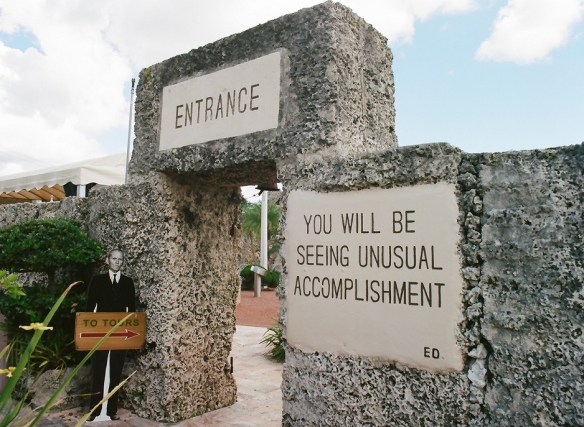
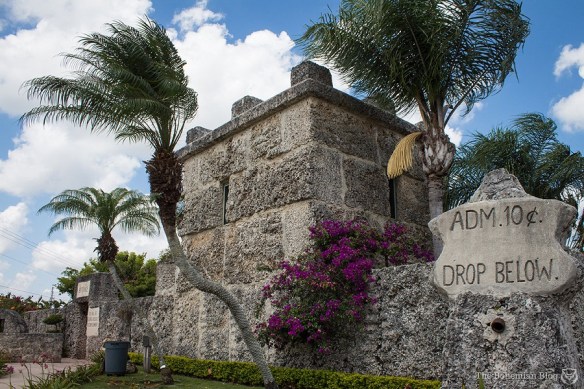
A similar, and no less puzzling mystery, can be found much closer to home for most Americans: the Coral Castle of Florida.
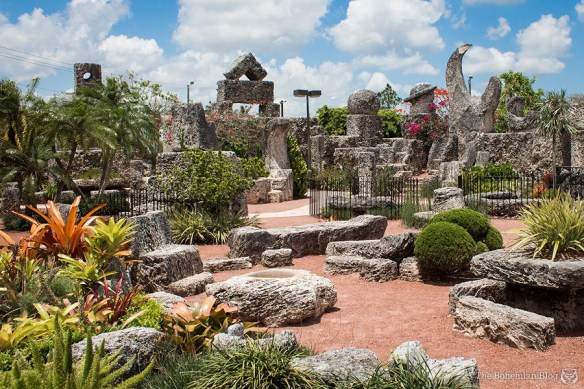
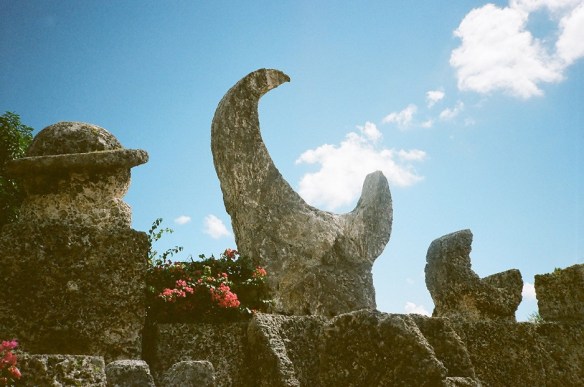
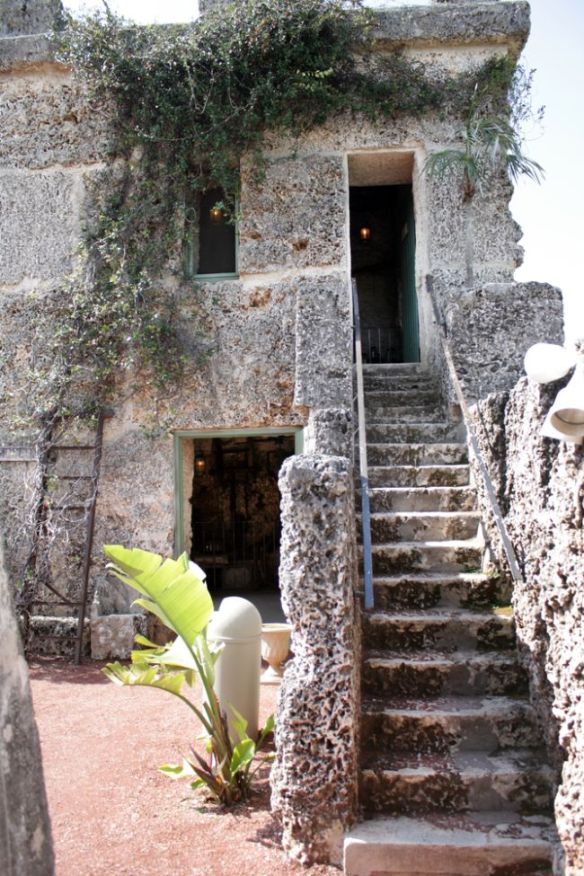
Less a castle and more a varied arrangement of stones into walls, shapes, doorways, and more, the Coral Castle is composed not of coral, but of oolite limestone blocks weighing literal tons. More than 1,000 tons of rock are part of the Coral Castle’s elaborate layout, which was assembled and expanded from 1923 to 1951.
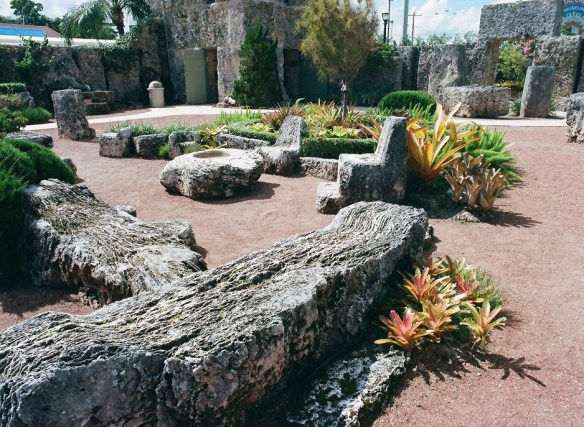
Some of those monstrous stones are seamlessly joined into different structures. Others are so perfectly balanced that they can open like a revolving door with the gentlest push.
There is a sundial, a telescope, and even stone rocking chairs carved from single pieces of rock.
It’s an engineering marvel, to be sure, but what separates the Coral Castle from some of those other creations we mentioned above is the fact that we know who built the Coral Castle.
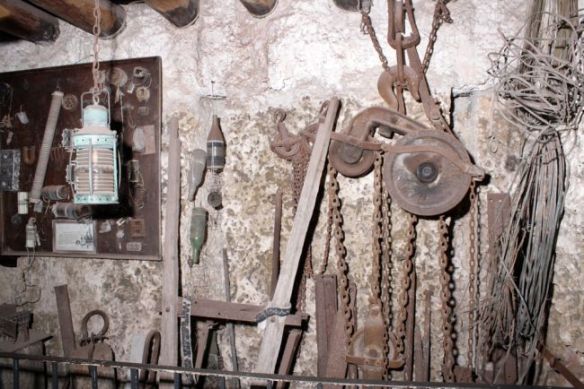
Using basic tools like picks, winches, ropes, and pulleys, Leedskalnin created the Coral Castle in secret, allowing visitors to ponder just how he was accomplishing this remarkable feat.
It’s particularly remarkable when you consider that Leedskalnin only had a fourth-grade education, having gone to work at a young age.
Of course, it’s also worth noting that Leedskalnin was a bit of a kook, claiming he had learned the secrets of the architects of King Solomon’s temples by studying books about the pyramids at the local library.
And yet, he created something amazing. So amazing, in fact, many people attribute the Coral Castle to supernatural efforts, not merely the engineering prowess, cleverness, and determination of a hardworking man.
Over the years, many peculiar theories have circulated surrounding the Coral Castle and Ed Leedskalnin. Unreliable eyewitnesses claimed to see coral blocks floating in the air like balloons while Leedskalnin worked at night.
Some believe Leedskalnin levitated the blocks with telekinesis or psychic powers, or by singing the stones into place. Others attribute the Castle to some sort of strange manipulation of gravity, antigravity, magnetism, ley lines, or earth energies. And, of course, alien technology has been floated as a possibility as well.
(Some people even believe there’s a hidden cipher lurking in several tracts written by Leedskalnin, just waiting to be found to reveal his secrets.)
A friend of Leedskalnin’s wrote a book about the physics and engineering of the Coral Castle, entitled Mr. Can’t Is Dead. It’s one of many books that claims to explain how the Coral Castle came to be.
To me, the Coral Castle seems like one giant mechanical brain teaser, a math problem more about leverage and patience than the paranormal.
And yet, I can’t help but stare at some of these creations with awe. Maybe this one of those puzzles that’s better left unsolved.
Back in 2013, we created a timeline of events from crossword history as part of our celebration of the hundredth anniversary of the crossword.
Although 105 isn’t as prestigious as 100, and the anniversary is technically tomorrow, we thought we’d honor the day this year by updating our comprehensive look at the long (yet surprisingly short) road it took to get to that marvelous centennial!
So, without further ado or folderol, we proudly present:
A Brief History of the Crossword (Updated)
16th – 11th century BC
Inscriptions from New Kingdom-era Egypt (Eighteenth to Twentieth Dynasties) of horizontal and vertical lines of text divided into equal squares, that can be read both across the rows and down the columns, are made. These inscriptions are later referred to by Egyptologists as “Egyptian crossword puzzles.”
19th century AD
Rudimentary crosswords, similar to word squares, begin appearing in England, and later elsewhere in Europe.
June 22, 1871
Future inventor of the crossword, Arthur Wynne, is born.
March 23, 1897
Future New York Times crossword editor Margaret Farrar is born.
February 25, 1907
Future New York Times crossword editor Will Weng is born.
December 21, 1913
The New York World publishes the first crossword, invented by Liverpool journalist Arthur Wynne. (The puzzle is originally known as a word-cross.)
January 6, 1916
Future New York Times crossword editor Eugene T. Maleska is born.
1920
Margaret Farrar is hired by The New York World as a secretary, but soon finds herself assisting Arthur Wynne with proofreading puzzles. Her puzzles soon exceed Wynne’s in popularity.
Colonel H.W. Hill publishes the first Crossword Dictionary.
1923
Margaret Farrar revises the cluing system for crosswords, sorting them into “Horizontal” and “Vertical” clues by number. (It wouldn’t be until the 1940s that the more familiar “Across” and “Down” terminology became the norm.)
1924
Margaret Farrar publishes the first book of crossword puzzles under contract for Richard L. Simon and Max Schuster, “The Cross-Word Puzzle Book.” It was an instant bestseller, launching Simon & Schuster as a major publisher. (Additional information available below the timeline.)
The Daily Express, founded in 1900, becomes the first newspaper in the United Kingdom to carry crosswords.
Crossword-themed novelty songs hit the airwaves as the puzzle craze intensifies, most notably “Crossword Mama, You Puzzle Me (But Papa’s Gonna Figure You Out).”
The Amateur Crossword Puzzle League of America, a self-appointed group of puzzle enthusiasts, lobbies for rotational symmetry in crosswords, which becomes the standard.
Solver Ruth Franc von Phul becomes a minor celebrity after winning The New York Herald-Tribune’s National All Comers Cross Word Puzzle Tournament at the age of 20. (She would win again 2 years later.)
January 15, 1925
“Felix All Puzzled,” the first animated short to feature a crossword, is released.
Disney releases a crossword-themed animated short, “Alice Solves the Puzzle.”
1926
The cryptic crossword is invented by Edward Powys Mathers, who publishes under the pseudonym Torquemada. He devises them for The Observer newspaper.
First reported instances of Braille crosswords.
1931
Dell Puzzle Magazines begins publishing.
(Dell Publishing itself was founded in 1921.)
1941
Dell Pocket Crossword Puzzles first published.
(The magazine continues to this day.)
February 15, 1942
The New York Times runs its first Sunday edition crossword. (Additional information available below the timeline.)
June 2, 1944
Physics teacher and crossword constructor Leonard Dawe is questioned by authorities after several words coinciding with D-Day invasion plans appear in London’s Daily Telegraph. (Additional information available below the timeline.)
1950
The crossword becomes a daily feature in The New York Times.
August 26, 1952
Future New York Times crossword editor Will Shortz is born.
1968
Lyricist Stephen Sondheim begins creating cryptic crosswords for New York Magazine, helping introduce Americans to British-style crosswords.
1969
Will Weng succeeds Margaret Farrar as the second crossword editor for The New York Times.
1973
Penny Press is founded.
1977
Eugene T. Maleska succeeds Will Weng as the third crossword editor for The New York Times.
1978
First year of the American Crossword Puzzle Tournament, later featured in the documentary Wordplay. 149 contestants compete for the title in the first national crossword tournament since the 1930s.
1979
Howard Garns creates the modern Sudoku puzzle for Dell Magazines (under the name Number Place), the first pen-and-paper puzzle to rival the crossword in popularity (though this spike in popularity would occur decades later under the name Sudoku).
June 11, 1984
Margaret Farrar, while working on the 134th volume in Simon & Schuster’s crossword puzzle book series, passes away.
1993
Will Shortz succeeds Eugene T. Maleska as the fourth crossword editor for The New York Times.
November 5, 1996
One of the most clever and famous crosswords of all time is published, the election-preceding crossword where either BOB DOLE ELECTED or CLINTON ELECTED could read out, depending on the solver’s answers.
1998
The Wall Street Journal adds a crossword to its newspaper, and Mike Shenk is appointed editor.
June 23, 2006
Wordplay documentary hits theaters, featuring celebrity solvers of crosswords as well as the participants and organizers of the 2005 edition of the American Crossword Puzzle Tournament.
February 29 – March 2, 2008
Thanks in part to the Wordplay documentary, the American Crossword Puzzle Tournament outgrows its previous setting and moves to Brooklyn.
The city of Lvov, Ukraine, creates a crossword that spans an entire side of a 100-foot-tall residential building, with clues scattered around the city’s major landmarks and attractions. It’s awesome.
David Steinberg launches the Pre-Shortzian Puzzle Project, designed to compile a complete database of every New York Times crossword.
August 13, 2012
PuzzleNation Blog is launched.
June 14, 2013
Matt Gaffney celebrates five years of MGWCC,
stating that MGWCC will run for 1000 weeks
(which puts the final edition around August 6th, 2027).
December 21, 2013
The Crossword officially turns one hundred years old.
Additional information:
1924: The publishing house Simon & Schuster, agreed to a small (3,600-copy) run of a crossword puzzle book, prompted by founder Richard L. Simon’s aunt, who wanted to give such a book to a friend. It became “a runaway bestseller.”
In no time the publisher had to put the book back on press; through repeated printings, it sold more than 100,000 copies. Soon a second collection followed, and then a third and a fourth. In 1924 and 1925 the crossword books were among the top 10 nonfiction bestsellers for the year, besting, among others, The Autobiography of Mark Twain and George Bernard Shaw’s Saint Joan.
February 15, 1942: The New York Times initially regarded crosswords as frivolous, calling them “a primitive form of mental exercise”; the motivating impulse for the Times to finally run the puzzle (which took over 20 years even though its publisher, Arthur Hays Sulzberger, was a longtime crossword fan) appears to have been the bombing of Pearl Harbor.
In a memo dated December 18, 1941, an editor conceded that the puzzle deserved space in the paper, considering what was happening elsewhere in the world and that readers might need something to occupy themselves during blackouts. The puzzle proved popular, and Sulzberger himself would author a Times puzzle before the year was out.
June 2, 1944: The words Omaha (codename for one of Normandy’s beaches), Utah (another Normandy beach codename), Overlord (the name for the plan to land at Normandy on June 6th), mulberry (nickname for a portable harbor built for D-Day), and Neptune (name for the naval portion of the invasion) all appeared in Daily Telegraph crosswords during the month preceding the D-Day landing.
This has been attributed to either an incredible coincidence or Dawe somehow overhearing these words (possibly slipped by soldiers involved) and incorporating them into puzzles unwittingly.
Do you have any suggestions for additions for our Crossword Timeline? Let us know in the comments section below! We’d love to hear from you!
Thanks for visiting PuzzleNation Blog today! Be sure to sign up for our newsletter to stay up-to-date on everything PuzzleNation!
Being a student of history means constantly discovering amazing new things about our world, our culture, and ourselves. There are so many unexpected twists and turns, synchronicities, coincidences, and flat-out mind-blowing facts waiting to be uncovered.
And when you’re a student of history with an interest in puzzles and games, it means you get to discover just how long humans have been dabbling in baffling brain teasers and friendly competition.
Board games, for instance, have been around a long time, longer than most people realize. There is evidence that Go has been played in China for more than 5,500 years!
And many other games also have shockingly long lineages. Chess can be traced back to the seventh century in India. Game boards have been found in king’s courts, university halls, and even former houses used by the Knights Templar, as pictured above.
We’ve previously explored that Viking gravesites from the ninth century reveal that board games were not just a pastime for the Vikings, but that their win-loss records were important enough to be recorded for posterity!
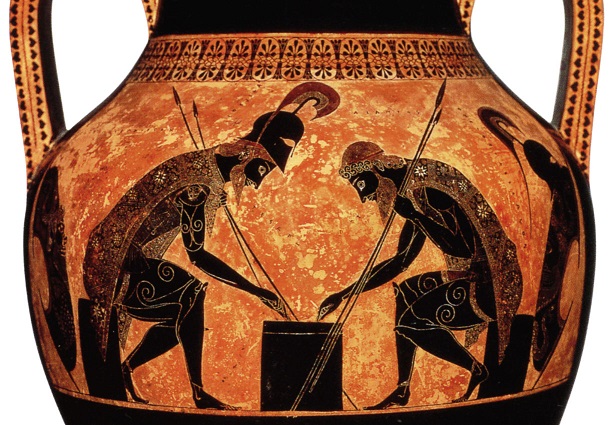
Check this out. It’s an ancient Greek painting on a vase, dating back to 530 BCE. This piece is an example of the black figure technique where images painted on clay turned black when the clay was fired. It depicts the two mightiest warriors of the Trojan War, Achilles and Ajax, playing a board game to keep themselves busy during the siege of Troy.
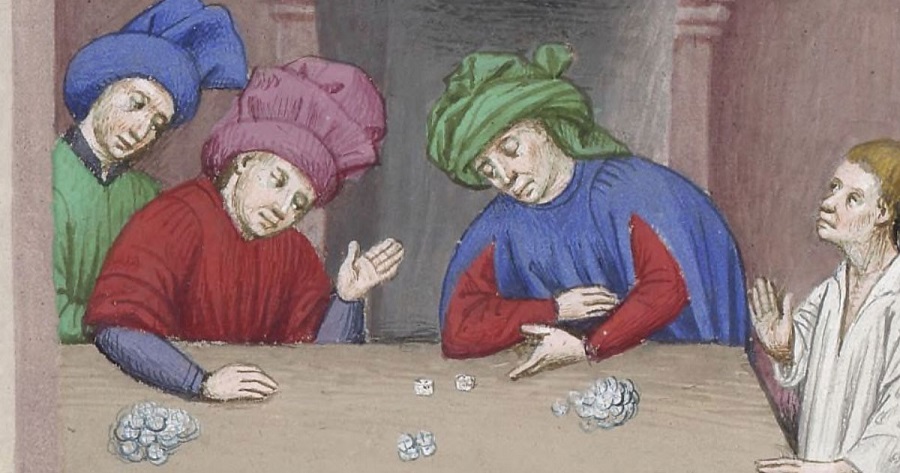
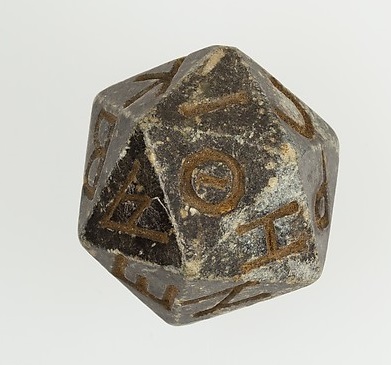
It’s unclear what game they’re playing, though many historians believe the warriors are rolling dice in the image. That would make sense, since astragali (the knuckle-bones of goats and sheep) were used in ancient Greek gambling games.
Dice have an equally ancient history. The Egyptian game of Senet, which was played with dice, dates back over 5,000 years.
Dice games have been uncovered in Mesopotamian tombs (some as far back as the twenty-fourth century BC), and a Vedic Sanskrit text known as the Rigveda, which dates back to India in 1500 BC, also mentions dice.
Tile games have a similarly deep history.
Chinese Dominoes can be traced back to writings of the Song Dynasty, nearly a thousand years ago. Dominoes as we know them first appeared in Italy during the 1800s, and some historians theorize they were brought to Europe from China by traveling missionaries.
Another tile game, Mahjong, has been around for centuries, but there are several different origin stories for the game, one tracing back to the Ming Dynasty (1368-1644), another to the days of Confucius (500 BC).
Perhaps at some point, I’ll try to put together a historical timeline of gaming (similar to the crossword timeline I created around the 100th anniversary of the crossword).
In the meantime, I’ll settle for being utterly fascinated with just how long humans have been socializing, relaxing, and competing through the medium of games.
Thanks for visiting PuzzleNation Blog today! Be sure to sign up for our newsletter to stay up-to-date on everything PuzzleNation!
Oh yes, it’s that time again! It’s to unleash our puzzly and punny imaginations and engage in a bit of sparkling wordplay!
You may be familiar with the board game Schmovie, hashtag games on Twitter, or @midnight’s Hashtag Wars segment on Comedy Central.
For years now, we’ve been collaborating on puzzle-themed hashtag games with our pals at Penny Dell Puzzles, and this month’s hook was #PennyDellPuzzleMyth, mashing up Penny Dell puzzles with anything and everything mythological! Greek, Roman, Egyptian, Celtic, Norse, whatever!
Examples include: Helen of Troy-Angles, Odin and Around, and Heads and Heads and Heads and Heads and Heads and Heads and Heads and Heads and Heads and Tails (because it’s a hydra).
So, without further ado, check out what the puzzlers at PuzzleNation and Penny Dell Puzzles came up with!
There were a few submissions that deserve their own section, as several of our intrepid puzzlers went above and beyond.
Grand Minotaur (obviously in the Labyrinth, son of the Cretan Bull’s-eye Spiral and killed by Theseus Three)
Siren Says “Come down from that Mast-to-hear-our-words” You know the Odysseus… facing yet another Dilemma. Sailors have him Family Tied and only bind him tighter. I’m sure he has A Few Choice Words for them. 😉
Roll the Dionysus before he Looses his Tiles! He had Two at a Time all night!
Riddle Me This in the Middle of the Road: “Which creature walks on four legs in the morning, two legs in the afternoon, and three legs in the evening?” asks the Sphinx guarding the route to the city of Thebe.
Spell and Score: In retribution for Minos the King of Crete’s failure to sacrifice a white bull Poseidon sent him, Poseidon ordered Aphrodite to cast a spell on Minos’ wife, Pasiphae, to fall in love with the Cretan bull; they mated, and their offspring was Minotaur.
Have you come up with any Penny Dell Puzzle Myths entries of your own? Let us know! We’d love to see them!
Thanks for visiting PuzzleNation Blog today! Be sure to sign up for our newsletter to stay up-to-date on everything PuzzleNation!
Welcome to 5 Questions, our recurring interview series where we reach out to puzzle constructors, game designers, writers, filmmakers, musicians, artists, and puzzle enthusiasts from all walks of life!
It’s all about exploring the vast and intriguing puzzle community by talking to those who make puzzles and those who enjoy them! (Click here to check out previous editions of 5 Questions!)
And I’m excited to welcome Jennifer Hrabota Lesser as our latest 5 Questions interviewee!
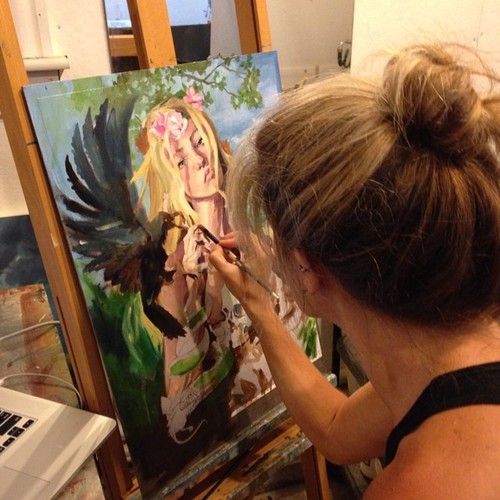
Jennifer Hrabota Lesser is an artist. Whether it’s commissioned artwork, passion projects of her own, or design work for board games and video games, she adds a personal touch to every piece she works on.
Initially getting into the game industry as a way to pay off student loans, she has since gone on to build a small board game company, Wild Power Games, with her husband. She also teaches a summer class on game design at the Rhode Island School of Design.
Jennifer was gracious enough to take some time out to talk to us, so without further ado, let’s get to the interview!
5 Questions for Jennifer Hrabota Lesser
1.) How did you first get into puzzles and games?
I’ve always loved puzzles and games. I think that I’ve always found them to be very calming. As a kid, puzzle books were a great way to get through long car rides. (Back in the days before iPhones!) These days, they are a way to unwind and calm down.
I am definitely a gamer, I adore board games and table top games. I also find Sudoku very soothing and meditative.
2.) I had the pleasure of scrolling through the art on your website, and there’s a really wonderful trend of reaching out that seems to suffuse many of your works. People holding each other, or finding themselves enveloped by things like flowers. Is that an intentional theme, either for your site or for your art in general, or just something I pulled from this sampling of your work?
Connection is an ongoing theme in my work, both connection with other people and connection with nature. I try to portray my subjects in transitional moments, where they may be at a point of finding a deeper connection with someone, or they may feel as if something has just been lost — the moments of feeling untethered. I believe understanding our connection with those around us is important to our health and happiness as individuals and as a society.
3.) How does your art inform your work in games, and vice versa?
My work is strongly influenced by mythology and fables, and the games I work on are often character-centered. I really enjoy working on games that have a story, and I think the same applies to my artwork. There is often an implied narrative in the work I’m doing.
I often like to portray strong female characters, finding their power. Years ago I got to design some great female characters for Guitar Hero 2, which was a blast because I love playing guitar and women tend to be underrepresented in rock. More recently I was able to design some of my favorite goddesses for our tabletop game High Heavens. I particularly loved painting Nut and Isis from the Egyptian pantheon. Illustrating The Mother of Dragons for a recent Game of Thrones expansion was also pretty great.
4.) What’s next for Jennifer Hrabota Lesser?
I am working on a poker deck that will be featuring my artwork, which is going to be an intense undertaking, but one that I am excited about!
5.) If you could give the readers, writers, artists, aspiring game designers, and puzzle fans in the audience one piece of advice, what would it be?
Whatever your creative path is, find time to do it every day. Create when you are inspired, but create when you are uninspired, push through the times when you aren’t feeling it, to get into the habit of working. I love the quote by Pablo Picasso: “Inspiration exists, but it has to find you working.”
We work and work, and sometimes when we least expect it, something amazing happens. It won’t happen if you aren’t doing the work in the first place.
A huge thank you to Jennifer for her time. Be sure to check out her website for the latest updates on all her marvelous endeavors!
Thanks for visiting PuzzleNation Blog today! Be sure to sign up for our newsletter to stay up-to-date on everything PuzzleNation!
You may be familiar with the board game Schmovie, hashtag games on Twitter, or @midnight’s Hashtag Wars segment on Comedy Central.
For years now, we’ve been collaborating on puzzle-themed hashtag games with our pals at Penny Dell Puzzles, and this month’s hook was #PennyDellPuzzleGeography, mashing up Penny Dell puzzles and countries, cities, landmarks, tourist spots and more!
Examples include Stepping Stonehenge, Sri Linkwords, and Istanbul’s-Eye Spiral!
So, without further ado, check out what the puzzlers at PuzzleNation and Penny Dell Puzzles came up with!
Rhyme Times Square / Times Square Deal / Time Squares / Times Squares
Charing Crossroads
Around the Great Bend
Bermuda Triangle Seek / Bermuda Try-Angles
Paris in Rhyme
Build-a-PyraMidland
Arctic Circle Search / Arctic Circle Sums / Arctic Circles in the Square
Hidden Circle in the Squares / Piccadilly circles in the Square
9 of Diamonds Head
MarbleHeadings
Classified Addis Ababa
Grand Tours / Rio Grande Tour / Grand Canyon Tour
Boston Common Bond
In the Middle East
End of the Maginot Line
HidDenali Word Squares
Make the MaConnection / Make the Connecticution
It’s Ural Move / It’s Your Mo-ja-ve
United KingDomino Theory
Quote Niagara Falls / Niagara Quotefalls
Montauk Point the Way / West Point the Way
QuotaGramercy Park
SpinWheeling
Right of Appian Way
Dubl-In and Around
TripLexington
Madriddle Me This
Cancuncellations
Helsinkey Word
Mexicombos
Mount Skill-O-Gram-jaro
Pentagon Match
Missing Sphinx
Word Thames
Crypto-Bolivia
Continent Search
LouisiAnacrostics
Three from Rhine
Middle of the Abbey Road
A-spenwheel
Lake Tahoe Many Squares?
Acropolistics
Egyptograms
Catacombies
Crackerjacksonville
The Appalachian Word Trail
Little Fancy Five Points
Little Rock Puzzler
Mount Places Pleasant / Places, Belize
Eiffel Tower Power / Flowrida-er Sunshine Power
Florida Keywords / Turkeyword
Trafalgar Squares
Minsk Bag / Mixed Baghdad
Dublin Crosser
Amsterdiamond Rings
Birminghome Runs
Madaga-stars and Arrows
Sum-alia Triangles
Alaskan Penin-syllacrostic
Puzzle Der-bai
M_ss_ss_pp_ng V_w_ls
Who’s Whousatonic
Ottawat Is It?
Picture Paris
Chicago Fish
Crypto-Kalamazoo
Pencilvania Pusher
Stockholm Runs
Say That Againsville?
Okefenokeyword Swamp
Angkor What’s Left? / What’s Left Bank?
Finnish the Fours
Battleships Creek
Ken-Kenya
Sierra Leone and Only
Tierra Dell Fuego
Caribbean carnival
Red Rock Challenge
There were a few submissions that deserve their own section, as several of our intrepid puzzlers went above and beyond.
One offered a tourism pitch for a puzzly destination: Mount OddsandEverest: Only a HopSkipandJump ToptoBottom
Another offered the following exchange and puzzly directions:
1: “Excuse me, how do you get to these Places, Please? Could you Point the Way?”
2: “Just follow the Word Trails until you get to the Borderline. If you see the Quotefalls, you’ve gone to far. At the Four Corners, Keep On Moving until you reach the Crossroads. Then it’s just a walk Around the Block and you’ll be at the Crypto-Zoo!”
Finally, one offered a quick tour of her favorite puzzle locale:
One of my favorite locations to visit is Anagram Magic Square, where if you take your PLACES, PLEASE, you can ESCAPE A SPELL to anywhere on earth. You can travel to PARIS in PAIRS, or dine on ALPHABET SOUP at an UPBEAT L.A. SHOP. And whether you’d rather see a SLICK DUBLIN BOG or a GLIB LISBON DUCK, you can find it in the BUILDING BLOCKS of this amazing place.
Have you come up with any Penny Dell Puzzle Geography entries of your own? Let us know! We’d love to see them!
Thanks for visiting PuzzleNation Blog today! Be sure to sign up for our newsletter to stay up-to-date on everything PuzzleNation!







 PuzzCulture