Puzzle Romance!

download

Valentine’s Day is only a few days away, and a friend who knows I write a weekly puzzle blog asked if I’d be penning anything in particular for the blog regarding the holiday.

I replied that I was working on a post about puzzly ideas for Valentine’s Day gifts and experiences, similar to the post I did last year. And he laughed at the very idea of puzzle romance, the poor fool.

“Sir, how dare you doubt the power of puzzles to sway the heart of someone special!” I bellowed back, caught up in the moment.

I mean, seriously. Does this guy not realize that we’ve featured several wonderful stories of puzzle romance in this blog alone?

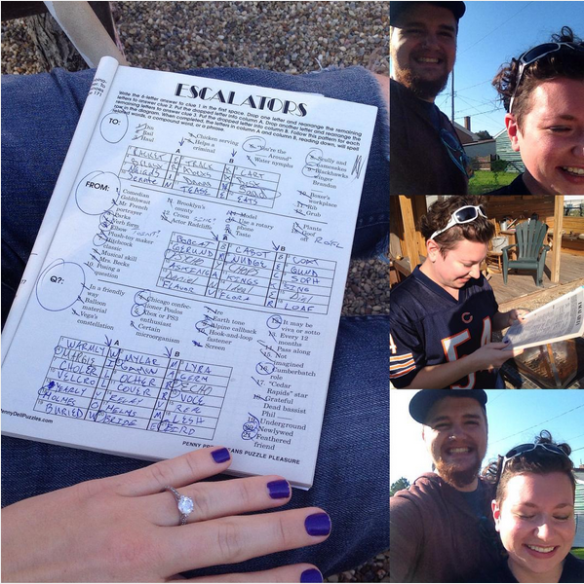
Heck, one of my favorite posts last year was about a puzzly proposal that our friends at Penny Dell Puzzles helped orchestrate.

escalators1

You can get the full story here, but in short, a puzzler in love reached out to PDP for their assistance in hiding his proposal within one of his girlfriend’s favorite puzzles, Escalators. They even did a small print run just for him to camouflage the proposal in a puzzle book!

It was a marvelous team effort, brilliantly executed…oh, and she said yes.

puzzlelove

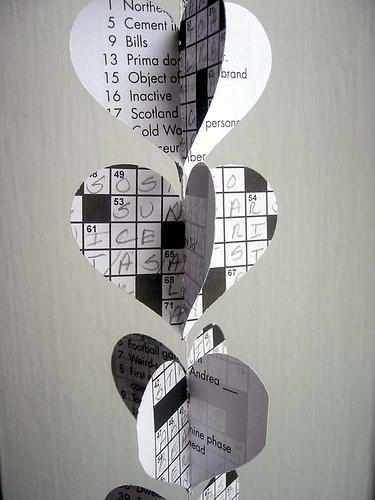
Plus there’s this terrific story about a friend of mine who composed some cryptic-crossword-style clues as part of a gift for his longtime girlfriend. When she solved all of the clues, they spelled out the message “Truly happy being yours.”

There are all sorts of thoughtful and romantic puzzle ideas out there, from a relationship scavenger hunt like the one from Parks and Recreation to this video of a Rubik’s Cube-themed proposal at a speed-solving event:

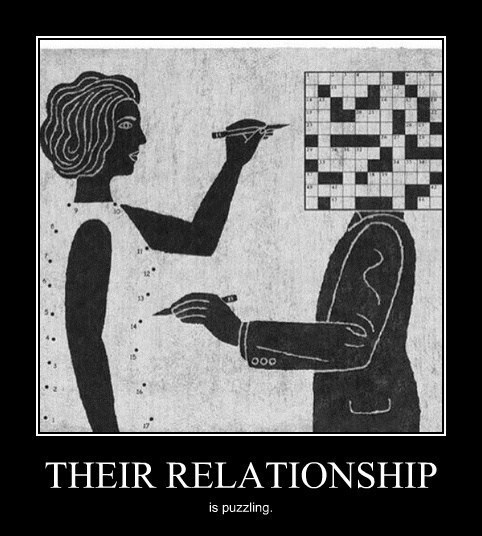
With a little ingenuity — and maybe some puzzly friends — you can create a unique and wonderful experience for someone you love. Puzzle romance is real, my friends. Just look at this happy couple, united by their mutual love of puzzles:

daily-morning-awesomeness-35-photos-2342


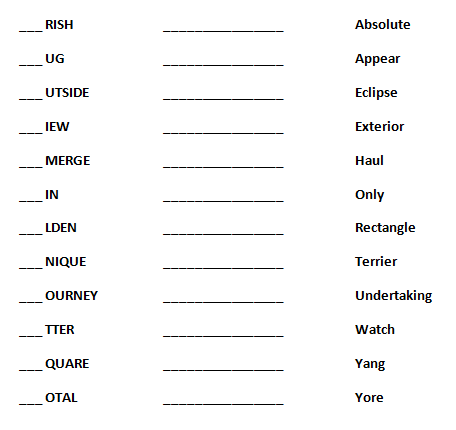
I wanted to close this post out with a little something for all the puzzlers and PuzzleNationers out there. And with Valentine’s Day coming up, it seemed appropriate to whip up a Matchmaker puzzle for you to solve. Enjoy!

Fill in the missing first letter of each word in the column on the left. Next, look for a related word in the group at the right and put it in the blank in the second column. When the puzzle is completed, read the first letters of both columns in order, from top to bottom, to reveal a romantic song lyric.

matchmaker


Thanks for visiting PuzzleNation Blog today! Be sure to sign up for our newsletter to stay up-to-date on everything PuzzleNation!

You can also share your pictures with us on Instagram, friend us on Facebook, check us out on TwitterPinterest, and Tumblr, and explore the always-expanding library of PuzzleNation apps and games on our website, like our Valentine’s Day-themed puzzle set!

2016_february_anim

A puzzly British Christmas card!

One government agency in England celebrates Christmas a little bit differently than most.

The GCHQ — Government Communications Headquarters — provides security and intelligence services for the British government. Back when they were known as GC&CS — Government Code and Cypher School — they were responsible for funding the Bletchley Park successes cracking the German “Enigma” code during World War II.

And for Christmas this year, they’ve released a puzzly Christmas card that’s sure to challenge even the staunchest puzzlers.

Step 1 of the puzzle is a logic art puzzle where you have to deduce where to place black squares on an open grid in order to form a picture.

Each column and row has a series of numbers in it. These numbers represent runs of black squares in a row, so a 1 means there’s one black square followed by a blank square on either side and a 7 means 7 black squares together with a blank square on either side.

Once you’ve solved this puzzle, you can use it to unlock the next puzzle in the chain.

From an article on GCHQ.gov.uk:

Once all stages have been unlocked and completed successfully, players are invited to submit their answer via a given GCHQ email address by 31 January 2016. The winner will then be drawn from all the successful entries and notified soon after.

Players are invited to make a donation to the National Society for the Prevention of Cruelty to Children, if they have enjoyed the puzzle.

This is one majorly challenging Christmas card. After you’ve conquered the logic art puzzle, you’ll confront brain teasers, palindromes, pattern-matching, deduction, number progressions, codebreaking, cryptic crossword-style cluing, and more.

I would highly recommend teaming up with another puzzle-minded friend (or more) and trying your luck. Let us know how far you get! (And you can hit up this article from the Telegraph for aid as well.)


Thanks for visiting PuzzleNation Blog today! Be sure to sign up for our newsletter to stay up-to-date on everything PuzzleNation!

You can also share your pictures with us on Instagram, friend us on Facebook, check us out on TwitterPinterest, and Tumblr, and explore the always-expanding library of PuzzleNation apps and games on our website!

PuzzleNation wordplay = Now radiant puzzle ploy

[Alternate anagrams include “Puzzle patron, now daily” and “Plow into any rad puzzle.”]

Anagrams are a cornerstone of modern pen-and-paper puzzling.

They make frequent appearances in cryptic (or British-style) crossword clues, and many puzzles and puzzle games — from Anagram Magic Square and Text Twist to Secret Word and Bananagrams — rely heavily on anagrams as an integral part of the solve.

I’ve written about them several times in the past, but for the uninitiated, an anagram is a reordering of the letters in a word to form a new word or phrase. PEALS anagrams into LEAPS, PALES, LAPSE, SEPAL, and PLEAS.

As the old joke goes, “stifle” is an anagram of itself.

But the best anagrams rearrange the letters in a word into something related to that word. Fans of The Simpsons may recall that Alec Guinness anagrams into “genuine class.”

There are numerous examples of great anagrams all over the Internet. Here are a few classics:

  • The eyes = they see
  • Clint Eastwood = Old West action
  • Eleven plus two = Twelve plus one
  • Dormitory = Dirty room
  • A decimal point = I’m a dot in place
  • A gentleman = Elegant man

One of the best online anagram programs out there is hosted by wordsmith.org, and at the top of their page, they remind us that “internet anagram server” anagrams into “I, rearrangement servant.”

You can find some unexpected surprises when you play with anagrams. Did you know that William Shakespeare anagrams into both “I am a weakish speller” and “I’ll make a wise phrase”?

There are entire forums online dedicated to terrific anagrams, some fiendishly clever, others impressively insightful. (Of course, sometimes crafty punctuation makes all the difference.)

Madame Curie becomes “Me? Radium Ace.”

Monty Python’s Flying Circus becomes “Strongly psychotic, I’m funny.”

The possibilities seem endless when you delve into longer phrases. I’m going to close out this tribute to anagrams with two of the most amazing ones I’ve encountered during my time as a puzzler.

The first involves the iconic line as humanity took its first steps onto the surface of the Moon:

Neil Armstrong: That’s one small step for (a) man, one giant leap for mankind

anagrams into…

Thin man ran; makes (a) large stride, left planet, pins flag on moon! On to Mars!

[I’ve included both what Neil said and what was broadcast back to Earth. Hence, the A in parentheses in both versions.]

The second takes one of Shakespeare’s best known lines and offers some engagingly meta commentary on the play itself:

To be or not to be, that is the question, whether tis nobler in the mind to suffer the slings and arrows of outrageous fortune…

anagrams into…

In one of the Bard’s best-thought-of-tragedies, our insistent hero, Hamlet, queries on two fronts about how life turns rotten.

So whether you’re playing Scrabble or tackling David L. Hoyt‘s Jumble, anagramming is a worthwhile tool that belongs in every puzzler’s skillset.

Do you have any favorite anagrams, fellow puzzlers and PuzzleNationers? Let me know! I’d love to see them!

Thanks for visiting PuzzleNation Blog today! You can share your pictures with us on Instagram, friend us on Facebook, check us out on TwitterPinterest, and Tumblr, and be sure to check out the growing library of PuzzleNation apps and games!

A puzzler, by any other name…

Fake names, stage names, noms de plume… they’re more common than you might think. Authors, musicians, actors, and performers of all sorts can take on new identities, either to make themselves more marketable, to build a brand, or simply to create a public persona in order to keep their private lives separate.

As I mentioned in a previous blog post, crossword constructors in the UK (known as setters) also employ pseudonyms, literally making a name for themselves as they create challenging cryptic crosswords for their solving audience.

Evocative names like Araucaria, Gordius, Crucible, Otterden, Anax, Charybdis, Tramp, Morph, Paul, Enigmatist, Hypnos, Phi, Nutmeg, Shed, Arachne, and Qaos grace the puzzles in England’s The Guardian newspaper.

That made me wonder… if American constructors were given the same opportunity, what UK-style names would they choose?

So, I reached out to some of my fellow puzzlers, and as I compiled their replies, some curious patterns emerged. I thought I’d share their responses with the PuzzleNation readership.

Whereas several UK setters have employed the names of former members of the Inquisition and other nasty sorts — like Torquemada, Ximenes, and Azed (which is Deza backwards) — to highlight the torturous challenges solvers could expect, some of their American counterparts prefer to highlight the playful, tricky aspect of constructing.

Constructor Robin Stears would publish under the name Loki or Anansi (citing two famous mythological tricksters), while meta-puzzle master Matt Gaffney would ply his craft under the name Puck. (He actually played Puck in sixth grade in a performance of A Midsummer Night’s Dream.)

[Loki, as played by Tom Hiddleston in the
Marvel cinematic universe, seems to approve…]

Other constructors embraced wordplay involving their names, like Brendan Emmett Quigley who chose Beck (his initials pronounced phonetically) or Penny Press variety editor Cathy Quinn, who chose the nom de plume Sequin (for C. Quinn).

Still others revealed their feelings about those curious words that are only found in crosswords. Variety editor Paula Curry opted for the name Ese-Averse to show her disdain for crosswordese, while puzzle historian and constructor David Steinberg selected Osier, both for its crosswordese appeal and its homophone pronunciation (OCR, representing the Orange County Register, for whom David has served as crossword editor for years).

[This crossword features several infamous crosswordese
clues as entries. Do you recognize them all?

Naturally, my fellow puzzlers at Penny Press had some of my favorite puzzly stage names. Will Shortz’s WordPlay editor Leandro Galban sets himself firmly against the heroic solver by choosing Grendel, while variety editor Andrew Haynes opted for either Bob the Settler or The Flying Penguin. (He feels that “the” adds a certain arrogance to the pseudonym, and Bob has that delightfully bland palindromic quality.)

Editor Ariane Lewis would be known simply as Dub, leaving interpretation up to the solvers, while editor Maria Peavy offered a plethora of possible pennames, including Pushkin, Excelsior, Kutuzov (in the spirit of Torquemada), Sphinx (another famous riddler) or Grail.

Or you could adopt a full false moniker like variety editor Keith Yarbrough did, and go by Rufus T. Firefly.

As for me, I haven’t decided if I want something esoteric like Syzygy (alluding to the rare alignment of both planets and quality crossword grids), something obscure and wordnerdy like Snurp or Timmynoggy or Interrobang, or something meaningless but fun to say aloud, like Skylark or Guava.

So watch out, UK setters, because one of these days, you might see names like Sequin or Osier or The Flying Penguin baffling your solvers with cryptic crossword cleverness.

Thanks for visiting PuzzleNation Blog today! You can share your pictures with us on Instagram, friend us on Facebook, check us out on TwitterPinterest, and Tumblr, and be sure to check out the growing library of PuzzleNation apps and games!

But I have all the koalafications!

Good cluing is one of the cornerstones of quality crossword writing. Not only do the clues have to be interesting, clever, and challenging, but they need to be accurate as well. After all, there’s a big difference between playfully misleading and misleadingly wrong.

Thankfully, this is the Golden Age of cluing assistance, and there are numerous cluing archives and websites loaded up with crossword clues galore. Places like Crossword Nexus, Crossword Tracker, Wordplays, and XwordInfo are searchable, not only allowing constructors to look for new clues, but assisting solvers with troublesome clues.

It also makes researching crossword controversies a whole lot easier, like Hugh Stephenson’s koala-centric kerfuffle in The Guardian’s crossword blog.

You see, fellow puzzlers, a setter named Qaos used the following clue in a cryptic crossword:

Bear a left, then a right, then reverse (5)

This clue was intended to point toward the answer KOALA, both with the word “bear” and the directions “a left, then a right” — meaning A L, A OK — “then reverse” — KOALA. But some solvers took issue with Qaos referring to the koala as a bear, despite the common vernacular term “koala bear.”

Now, if we’re going by strict dictionary definition, those solvers are correct. The koala is a marsupial, not a bear. Of course, dictionaries were recently amended to say that “literally” no longer just means “literally” — it can mean “figuratively” as well. So I’m inclined to go beyond the dictionary definition and plumb the depths of crossword clue archives to see where the crossword community as a whole stands on the question of koala vs. koala bear.

The Crossword Solver lists the clue [Australian “bear”], but mostly avoids the controversy with a litany of clues like [Gum leaf eater], [Australian critter], and [Down Under climber].

If you go to Crossword Tracker, you mostly get clues that hedge their bet, like [Australian “bear”], [Marsupial sometimes called a bear], and [Australian bearlike beast], but there are a few hard-nosed clues like [It isn’t really a bear].

Crossword Giant agrees on this front, while Wordplays wavers wildly, citing both [Cute “bear”] and [Cute bear] in its archives.

I’d hoped for a definitive answer when searching XwordInfo, which is dedicated to clues featured in the New York Times Crossword. The Shortz era comes down firmly on the side of “bear”, not bear, but the pre-Shortz era is less rigid, with clues like [Living Teddy bear], [Bear of Down Under], and [Kangaroo bear].

And while I feel that the koala vs. koala bear issue remains unresolved, Mr. Stephenson is firmly in the koala bear camp, jokingly citing the 1983 Paul McCartney / Michael Jackson collaboration “Ode to a Koala Bear” as evidence.

Of course, if we’re going to start citing songs as evidence, that means “pompatus” is a real word, and that opens a whole new can of worms.

Thanks for visiting PuzzleNation Blog today! You can share your pictures with us on Instagram, friend us on Facebook, check us out on TwitterPinterest, and Tumblr, and be sure to check out the growing library of PuzzleNation apps and games!

Crossword History: A Timeline

The hundredth anniversary of the crossword is nearly upon us, and we at PuzzleNation Blog thought we’d take a look at the long (yet surprisingly short) road it took to get to this marvelous centennial!

And so, without further ado or folderol, we proudly present:

A Brief History of the Crossword
(by Glenn Dallas and the PuzzleNation Team)

16th – 11th century BC

Inscriptions from New Kingdom-era Egypt (Eighteenth to Twentieth Dynasties) of horizontal and vertical lines of text divided into equal squares, that can be read both across the rows and down the columns, are made. These inscriptions are later referred to by Egyptologists as “Egyptian crossword puzzles.”

19th century

Rudimentary crosswords, similar to word squares, begin appearing in England, and later elsewhere in Europe.

June 22, 1871

Future inventor of the crossword, Arthur Wynne, is born.

March 23, 1897

Future New York Times crossword editor Margaret Farrar is born.

February 25, 1907

Future New York Times crossword editor Will Weng is born.

December 21, 1913

The New York World publishes the first crossword, invented by Liverpool journalist Arthur Wynne.
(The puzzle is originally known as a word-cross.)

January 6, 1916

Future New York Times crossword editor Eugene T. Maleska is born.

1920

Margaret Farrar is hired by The New York World as a secretary, but soon finds herself assisting Arthur Wynne with proofreading puzzles. Her puzzles soon exceed Wynne’s in popularity.

Colonel H.W. Hill publishes the first Crossword Dictionary.

1924

Margaret Farrar publishes the first book of crossword puzzles under contract for Richard L. Simon and Max Schuster, “The Cross-Word Puzzle Book.” It was an instant bestseller, launching Simon & Schuster as a major publisher.

The Sunday Express becomes the first newspaper in the United Kingdom to carry crosswords.

1926

The cryptic crossword is invented by Edward Powys Mathers, who uses the pseudonym of Torquemada. He devises them for The Observer newspaper.

1931

Dell Puzzle Magazines begins publishing.
(Dell Publishing itself was founded in 1921.)

1941

Dell Pocket Crossword Puzzles first published.
(The magazine continues to this day.)

February 15, 1942

The New York Times runs its first Sunday edition crossword. (Click here to read more about this.)

June 2, 1944

Physics teacher and crossword constructor Leonard Dawe is questioned by authorities after several words coinciding with D-Day invasion plans appear in London’s Daily Telegraph. (Click here to read more about this.)

1950

The crossword becomes a daily feature in the New York Times.

August 26, 1952

Future New York Times crossword editor Will Shortz is born.

1968

Lyricist Stephen Sondheim begins creating cryptic crosswords for New York Magazine, helping introduce Americans to British-style crosswords.

1969

Will Weng succeeds Margaret Farrar as the second crossword editor for the New York Times.

1973

Penny Press is founded.

1977

Eugene T. Maleska succeeds Will Weng as the third crossword editor for the New York Times.

1978

First year of the American Crossword Puzzle Tournament,
later featured in the documentary Wordplay.

1979

Howard Garns creates the modern Sudoku puzzle for Dell Magazines (under the name Number Place), the first pen-and-paper puzzle to rival the crossword in popularity (though this spike in popularity would occur decades later under the name Sudoku).

June 11, 1984

Margaret Farrar, while working on the 134th volume in Simon & Schuster’s crossword puzzle book series, passes away.

1993

Will Shortz succeeds Eugene T. Maleska as the fourth crossword editor for the New York Times.

November 5, 1996

One of the most clever and famous crosswords of all time is published, the election-preceding crossword where either BOB DOLE ELECTED or CLINTON ELECTED could read out, depending on the solver’s answers.

June 23, 2006

Wordplay documentary hits theaters, featuring both celebrity solvers of crosswords and the participants and organizers of the 2005 American Crossword Puzzle Tournament.

February 29 – March 2, 2008

Thanks in part to the Wordplay documentary, the American Crossword Puzzle Tournament outgrows its previous setting and moves to Brooklyn.

June 6, 2008

Matt Gaffney launches his Weekly Crossword Contest (MGWCC).

August 2008

Lollapuzzoola, a crossword-solving tournament with a more tongue-in-cheek, freeform style, launches in Jackson Heights, New York.

October 6th, 2008

Patrick Blindauer’s famous dollar bill-inspired crossword puzzle is published.

2009

The city of Lvov, Ukraine, creates a crossword that spans an entire side of a 100-foot-tall residential building, with clues scattered around the city’s major landmarks and attractions. It’s awesome.

October 11th, 2011

PuzzleNation.com goes live.

June 2012

David Steinberg launches the Pre-Shortzian Puzzle Project, intending to create a complete database of every New York Times crossword.

August 13th, 2012

PuzzleNation Blog is launched.

June 14th, 2013

Matt Gaffney celebrates five years of MGWCC,
stating that MGWCC will run for 1000 weeks
(which puts the final edition around August 6th, 2027).

December 21st, 2013

The Crossword officially turns one hundred years old.


Additional information:

February 15th, 1942: The New York Times initially regarded crosswords as frivolous, calling them “a primitive form of mental exercise”; the motivating impulse for the Times to finally run the puzzle (which took over 20 years even though its publisher, Arthur Hays Sulzberger, was a longtime crossword fan) appears to have been the bombing of Pearl Harbor.

In a memo dated December 18, 1941, an editor conceded that the puzzle deserved space in the paper, considering what was happening elsewhere in the world and that readers might need something to occupy themselves during blackouts. The puzzle proved popular, and Sulzberger himself would author a Times puzzle before the year was out.

June 2nd, 1944: The words Omaha (codename for one of Normandy’s beaches), Utah (another Normandy beach codename), Overlord (the name for the plan to land at Normandy on June 6th), mulberry (nickname for a portable harbor built for D-Day), and Neptune (name for the naval portion of the invasion) all appeared in Daily Telegraph crosswords during the month preceding the D-Day landing.

This has been attributed to either an incredible coincidence or Dawe somehow overhearing these words (possibly slipped by soldiers involved) and incorporating them into puzzles unwittingly.


Thanks for visiting the PuzzleNation blog today! You can like us on Facebook, follow us on Twitter, cruise our boards on Pinterest, check out our Classic Word Search iBook (recently featured by Apple in the Made for iBooks category!), play our games at PuzzleNation.com, or contact us here at the blog!