So it feels apropos to close out the Halloween season with a post about two women who actually unraveled some of the mysteries surrounding an encrypted manuscript involving witches!
This video by Kat Saturn details the fascinating journey she and Rian Hagebeuk embarked upon to unravel the secrets of a book entitled “The Subtelty of Witches,” supposedly published in 1657.
It was one of the longest encrypted works of the period, and yet, it sat in the British Library for decades without anyone digging into the cipher or the manuscript’s contents.
In 2018, Kat stumbled across “The Subtelty of Witches” in a list of encrypted manuscripts, and started investigating.
Along the way, she teamed up with Rian, whose facility with Latin helped immensely in unraveling the manuscript’s true contents. They reached out to professionals and fellow amateurs alike, delving deep down the rabbit hole of this manuscript.
Along the way, she and Rian determined:
the year was incorrect (the text is actually OLDER)
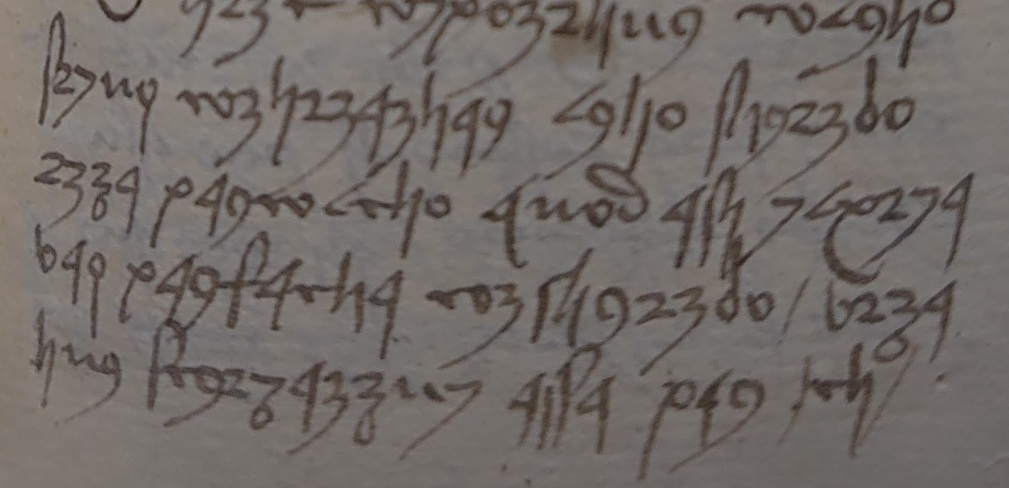
the contents of the manuscript had nothing to do with witches (it’s a list of verbs in Latin and Dutch from a Calepino dictionary)
the cipher was consistently applied throughout (meaning it’s unlikely this was a practice exercise for improving the author’s facility with the cipher)
the real mystery of this text wasn’t in the cipher…
It was in the book’s creation and reason for existing at all.
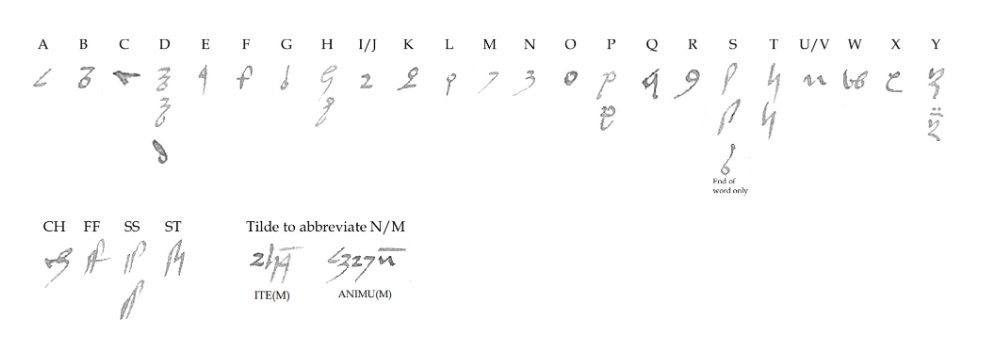
The cipher was easily cracked — a one-to-one substitution cipher wouldn’t deter even a casual puzzler — but so many questions still remain.
Who was the author? Why was the manuscript titled this? Why were a dictionary’s partial contents encoded? What is the meaning behind the cover stamp?
Like some of the more puzzly mysteries we’ve pursued in the blog over the years, there’s always more to uncover once the puzzly part is resolved.
I purposely haven’t gone into too much actual detail — hopefully I’ve included just enough to give you a sense of the story here and pique your interest — because I think you should take the time to watch Kat’s entire video. It’s always best to hear from the creators themselves!
This story is the perfect counterpoint to the Voynich discussion a few weeks ago.
I made a point in that post of highlighting that I wasn’t throwing shade at nonprofessionals in scholarly fields. I simply wanted something more reliable than “this looks like this, so they must be related” and wild conjecture.
And Kat and Rian’s work is exactly what I was talking about.
Kat and Rian aren’t professionals, they’re enthusiastic amateurs, but they are scholars nonetheless. They’ve done fantastic, reproducible work, drawing reasonable and insightful conclusions from verifiable data.
They’ve thoroughly and meticulously documented their steps, they’re continuing to pursue leads, and they have genuinely, impactfully contributed to both awareness of the manuscript and the facts surrounding it.
The Voynich Manuscript is a cryptologic curiosity unlike anything else we’ve seen before, one that has baffled linguists and puzzlers for decades. This hand-written book was discovered over a hundred years ago, but it’s believed to date back to the fifteenth century.
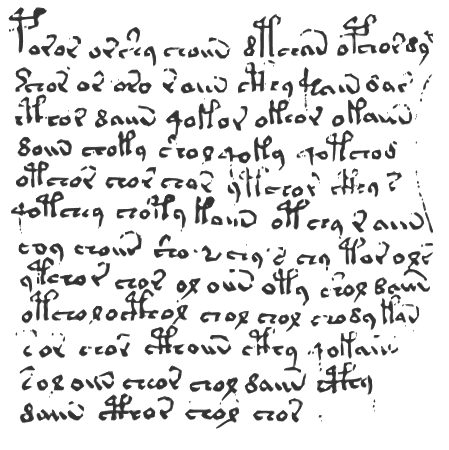
The writing, which reads from right to left, has yet to be identified. It’s unclear if this is some sort of sophisticated code, an unknown or lost language which was then encoded, an invented language, an example of glossolalia (a written equivalent of speaking in tongues), or simply an elaborate hoax.
The only known copy of the text resides in Yale University’s Beinecke Rare Book and Manuscript Library.
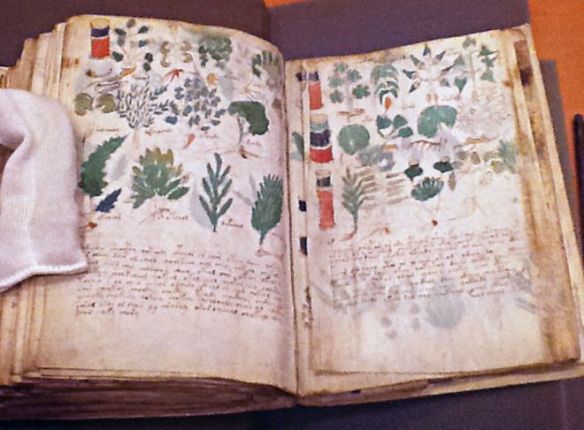
Many call the fifteenth-century codex, commonly known as the “Voynich Manuscript,” the world’s most mysterious book. Written in an unknown script by an unknown author, the manuscript has no clearer purpose now than when it was rediscovered in 1912 by rare books dealer Wilfrid Voynich. The manuscript appears and disappears throughout history, from the library of the Holy Roman Emperor Rudolf II to a secret sale of books in 1903 by the Society of Jesus in Rome. The book’s language has eluded decipherment, and its elaborate illustrations remain as baffling as they are beautiful.
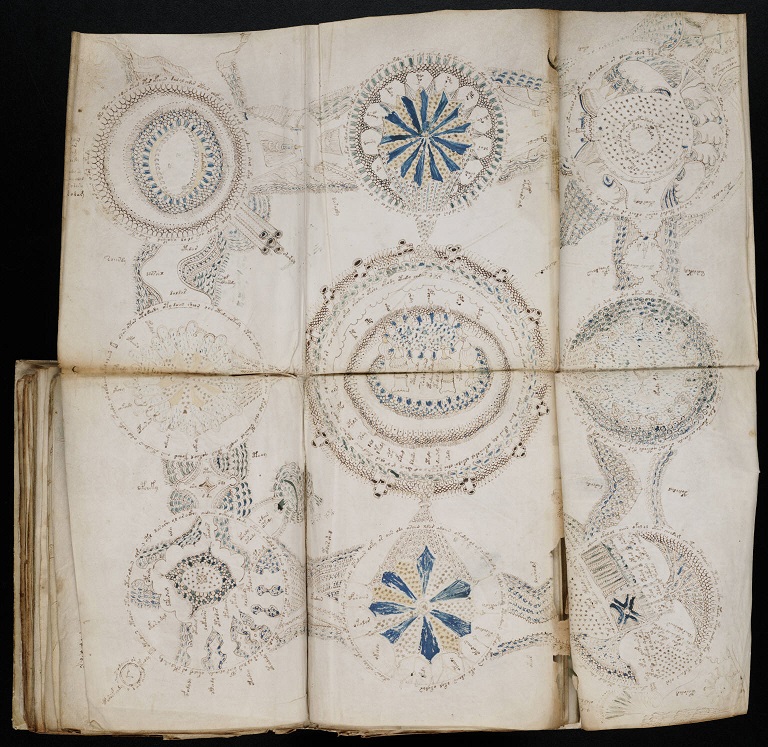
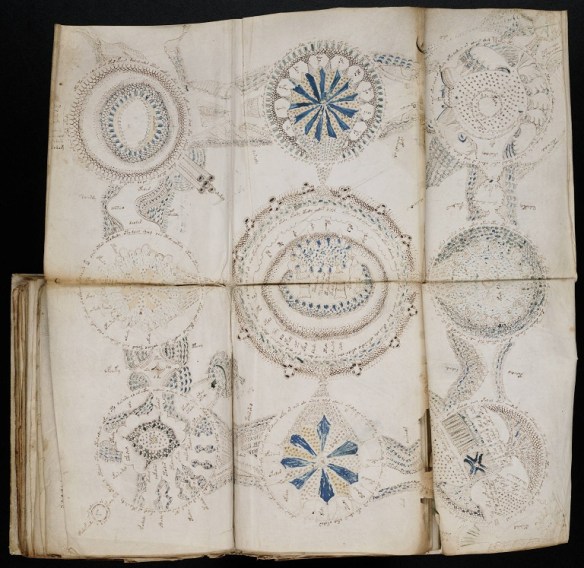
One of several fold-out pages in the manuscript. Image courtesy of Wikipedia.org.
There have been many theories regarding what form of encryption may have been employed in the Voynich Manuscript.
Some investigators theorize that vowels have been removed from the words in the text in order to obscure their meaning further, while others suggest writing that has been mirrored or otherwise written backwards. Anagrams and other forms of word manipulation are another common theory.
Attempts at decryption are further complicated by Lisa Fagin Davis’s 2020 paper that concluded through handwriting analysis that five different scribes contributed to the Voynich Manuscript.
So, what does all this have to do with witches and TikTok?
(There’s also a bunch of stuff about magically growing plants in menstrual blood, but I’ll be ignoring that pseudoscience and focusing on the decoding/interpretation of the manuscript.)
It’s a very interesting theory — the menstrual cycle part, not the casual misandry part — but not exactly a new one.
Given the predominant plant imagery, as well as the drawings that resemble medieval calendars throughout the manuscript, there’s a prominent theory that the plants featured could be used to induce abortions, and were being catalogued as such.
That would be very valuable information to preserve and disseminate, given the power dynamics between men and women at the time and the key role that reproduction served across all levels of feudalist society.
But can I point out the obvious? They didn’t solve the manuscript. They didn’t crack or decode anything. They looked at the images and made assumptions.
The poster talks about women having limited access to written language, which is absolutely true, and claims that they mostly communicated through imagery. When you ask the obvious follow-up question — why the huge swathes of text, then? — she suggests it’s a manufactured language to hide this information from the men hunting down women with this knowledge.
But why? Why would you hunt down people with knowledge of the menstrual cycle, which would be beneficial to reproduction? That doesn’t make any sense. (It would make more sense to hunt down women spreading information about plants that could induce abortions, which is the OPPOSITE of what she’s suggesting.)
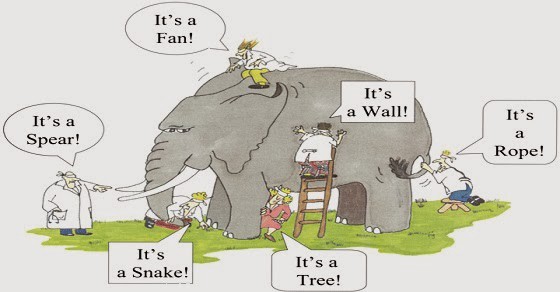
Because she admits to never actually decoding the text, she is drawing all her conclusions from the images. That reminds me of that parable about the blind men and the elephant, where each person touches a different part of the elephant (the trunk, the tail, etc.) and arrives at a different conclusion.
Without any of the text to accompany the images, crucial context is missing.
Now, I don’t mean to demean the efforts of nonprofessionals trying to solve mysteries or cold cases. I myself am an enthusiastic amateur in many respects. Research and discovery are not the sole property of universities and professionals, and some incredible, insightful leaps in many different fields have been made by those that are not part of established organizations.
Could these self-described witches have uncovered or recognized patterns that escaped 125 years of linguistic analysis? Absolutely.
BUT.
The way that they present their argument is reductive. They don’t pose it as a fascinating discovery or a triumph of long-held traditions resurfacing. They sneer at the failure of a century of men trying to solve it. Which is, frankly, stupid.
It’s stupid because it ignores the CRUCIAL role many female linguists and translators have had over the years. Just look at the amazing work Emily Wilson did with her translation of The Odyssey, offering new insight into a classic tale. (Also you need to read her review of the movie, because Nolan claimed he based the movie on her translation, and if that’s the case, boy, did he miss the mark.)
But I digress.
This TikTok post lumps “men” and “professionals” together to the detriment of all women, just to cater to a weird, desperate anti-intellectualism crowd that looks down on years (or even decades) of hard work and study by men, women, and nonbinary researchers in favor of viral shortcuts and faux grassroots equality.
Everyone has failed at cracking the Voynich Manuscript, not just men. This isn’t a gender-based thing. Lisa Fagin Davis, the medievalist and expert in manuscript study I mentioned earlier, is widely considered the foremost researcher when it comes to the Voynich Manuscript, and she spent years handling all the Voynich-related requests and materials while at Yale.
Her 2020 paper about the five scribes of the manuscript is the result of genuine research, analysis, and deduction, not the hand-wavey pseudointellectual astrological alchemical… whatever this TikTok content creator is doing.
I’ve read some of the discourse surrounding all this, trying to get a sense of people’s reactions, both within and outside the WitchTok community. Several commenters shared this Ursula K. Le Guin quote during the discussion, which feels very appropriate for the topic at hand:
But I didn’t and still don’t like making a cult of women’s knowledge, preening ourselves on knowing things men don’t know, women’s deep irrational wisdom, women’s instinctive knowledge of Nature, and so on. All that all too often merely reinforces the masculinist idea of women as primitive and inferior – women’s knowledge as elementary, primitive, always down below at the dark roots, while men get to cultivate and own the flowers and crops that come up into the light. But why should women keep talking baby talk while men get to grow up? Why should women feel blindly while men get to think?
In the end, despite generations of effort, we still don’t know what the Voynich Manuscript says.
And I don’t think it’s because of gatekeeping or snobbish intellectualism or misandry or misogyny or dismissal of female viewpoints.
I think it’s simply because we haven’t figured it out yet.
This kind of decryption can’t always been brute-forced through computer power. Languages are complex and nuanced, and with five different scribes, the handwriting and personal quirks of each writer could be coloring or even masking different options. What if an S in one person’s hand looks like an F in another?
And that’s not taking into account the possibility of an encryption code or an additional linguistic trick like the vowel exclusion I mentioned.
In the end, human ingenuity created it, and a lot of human ingenuity will no doubt be required to finally reveal its secrets. And everyone who contributed or attempted to contribute to the solve, gender be damned, will be a part of that legacy.
We’re all doing our best to keep ourselves and our loved ones engaged, entertained, and sane during these stressful times.
And after weeks of doing so, it’s possible you’re running out of ideas.
But worry not! Your puzzly pals at PuzzleNation are here with some suggestions.
Please feel free to sample from this list of activities, which is a mix of brain teasers to solve, puzzly projects to embark upon, treasure hunts, unsolved mysteries, ridiculous notions, creative endeavors, and a dash of shameless self-promotion.
In all seriousness, we hope these ideas help you and yours in some small way to make the time pass in a fun and puzzly fashion. Be well, stay safe, and happy puzzling.
Thanks for visiting PuzzleNation Blog today! Be sure to sign up for our newsletter to stay up-to-date on everything PuzzleNation!
It’s one of the final blog posts of the year, so what do you say we revisit all of 2018 with a countdown of my ten favorite blog posts from the past year!
But before we get to the countdown, I want to briefly mention two interesting landmarks for the blog in 2018.
In January, we were cited as a source in a college term paper, which is pretty gratifying.
And in April, we were name-dropped in a CNET article about friend of the blog Hevesh5.
Okay, enough bragging. Let’s get to the countdown!
#10 Robot Invasion
With the rise of puzzle-solving programs like Dr. Fill and game-playing AIs like AlphaGo, we’ve been joking for years about machines trying to topple humanity from the top spot as Earth’s resident puzzle-solving masters.
Crosswords are still the #1 paper puzzle in the world. With more than a hundred years of creativity, cluing challenge, and cunning construction behind them, they continue to fascinate and frustrate us. And we had a lot of fun with crossword topics this year in the blog. Two of my personal favorite entries were asking questions about common crossword clues and the post where we explored the brief-lived moral panic sparked by crosswords.
Every year, one of my favorite activities is putting together our Holiday Puzzly Gift Guide. I get to include the best products sent to me for review by top puzzle and game companies, mix in some of my own favorites, and draw attention to terrific constructors, game designers, and friends of the blog, all in the hopes of introducing solvers (and families of solvers) to quality puzzles and games.
#7 Unsung Heroes
They say history is written by the victors, and that’s true in the short term. But in the long term, history belongs to truth, and more and more, unsung heroes are coming to the fore and getting the well-deserved recognition denied to them earlier.
Interacting with the puzzle community is one of the highlights of doing social media for PuzzleNation. And some of the most enjoyable blog posts from this year involved focusing on members of the community and giving them kudos for their contributions to PuzzleNation and the world of puzzles in general.
As such, we created our Citizen Shoutout series to honor those folks, and along the way, we’ve thanked game shops, local escape rooms, and dedicated solvers who make the puzzle community a better place.
April Fools Day pranks are an Internet tradition at this point. Some websites go all out in celebrating the holiday. (Heck, ThinkGeek has started using the holiday to tease the public’s interest level in “fake” products, going on to actually release some of those April Fools pranks as real items later in the year!)
So after last year’s Puzzles for Pets gag was a big hit, we couldn’t resist getting in on the pranking fun again this year. The result — PNVR, a fake virtual reality puzzling experience — was as layered as it was silly, complete with fake quotes, splash pages, photos of people riding bikes while playing, and more. The visuals were amazing and hilarious.
#4 Puzzle Events
There are few things better than spending time with fellow puzzlers and gamers, and we got to do a lot of that this year. Whether it was cheering on our fellow puzzlers at the American Crossword Puzzle Tournament or putting our hands dirty with some knock-down, drag-out, game-playing ferocity during our Tabletop Tournament, these interactions were both invigorating and encouraging. Events like these really help solidify the spirit of community that comes with being puzzly.
And speaking of interacting with fellow puzzlers, for International Puzzle Day this year, we masterminded a little online puzzle hunt for PuzzleNation solvers. Involving clues hidden in both that day’s Daily POP Crosswords puzzle and Penny Dell Crosswords App free daily puzzle, solvers had to anagram and solve their way around the website in order to earn a prize. It was a serious challenge to design, and great fun to unleash on the world.
#2 Women in Crosswords and Roleplaying Games
Using the blog as an amplifier to get the word out about important causes and worthwhile projects is one of the best things about writing here. And this year in particular, we can be proud of doing our damnedest to vocalize the incredibly valuable role that women have played (and continue to play) in the puzzle/game community.
There’s nothing more exciting than getting to announce the launch of a product that has been months or years in the making, so picking #1 was a no-brainer for me. It had to be the announcement of Wordventures.
But it’s not just the app, it’s everything behind the app. I’ve watched it grow and evolve in development, and it’s truly unlike anything we’ve released before. The mix of music, imagery, storytelling, and puzzle-solving is so atmospheric and engaging.
It may sound self-serving or schlocky to talk about our flagship products as #1 in the countdown, but it’s something that we’re all extremely proud of, something that we’re constantly working to improve, because we want to make our apps the absolute best they can be for the PuzzleNation audience. That’s what you deserve.
And it’s part of the evolution of PuzzleNation and PN Blog. Even as we work to ensure our current products are the best they can be, we’re always looking ahead to what’s next, what’s on the horizon, what’s to come.
Thanks for spending 2018 with us, through robots and Rubik’s Cubes, through discoveries and daily delights, through puzzle launches and landmark moments. We’ll see you in 2019.
Thanks for visiting PuzzleNation Blog today! Be sure to sign up for our newsletter to stay up-to-date on everything PuzzleNation!
A year and a half ago, I introduced my fellow puzzlers and PuzzleNationers to the Voynich Manuscript, a cryptologic curiosity unlike anything else we’ve seen before. Discovered over a hundred years ago but believed to date back to the fifteenth century, the Voynich Manuscript is a hand-written book that has baffled linguists and puzzlers for decades.
The writing, which reads from right to left, has yet to be identified. It’s unclear if this is some sort of sophisticated code, an unknown or lost language which was then encoded, an invented language, an example of glossolalia (a written equivalent of speaking in tongues), or simply an elaborate hoax.
The only known copy of the text resides in Yale University’s Beinecke Rare Book and Manuscript Library, although Yale has printed replica texts.
Many call the fifteenth-century codex, commonly known as the “Voynich Manuscript,” the world’s most mysterious book. Written in an unknown script by an unknown author, the manuscript has no clearer purpose now than when it was rediscovered in 1912 by rare books dealer Wilfrid Voynich. The manuscript appears and disappears throughout history, from the library of the Holy Roman Emperor Rudolf II to a secret sale of books in 1903 by the Society of Jesus in Rome. The book’s language has eluded decipherment, and its elaborate illustrations remain as baffling as they are beautiful.
[One of several fold-out pages in the manuscript.
Image courtesy of Wikipedia.org.]
They designed an artificial intelligence program with the intent of figuring out the language in the manuscript. The AI analyzed versions of the UN’s Universal Declaration of Human Rights in 400 different languages in order to establish different linguistic patterns to compare against the text of the Voynich Manuscript.
And according to the AI, the text was most likely written in Hebrew.
Now that they had a language to work with, they needed to begin deciphering precisely how that language was encrypted.
There have been many theories regarding what form of encryption was employed in the Voynich Manuscript. Some investigators theorized that vowels had been removed from the words in the text in order to obscure their meaning further, while others have suggested writing that has been mirrored or otherwise written backwards. Anagrams and other forms of word manipulation are a common theory, and the University of Alberta team went with a variation on the anagram idea.
They theorized that the encoded words were alphagrams, anagrams where the letters in a word are placed in alphabetical order. (For instance, if VOYNICH was encoded this way, it would read CHINOVY.)
Turning loose the AI once again under these parameters, they found that 80% of the words in the Voynich text could be anagrammed into Hebrew words. They managed to cobble together a possible opening sentence for the text:
“She made recommendations to the priest, man of the house and me and people.”
Is it clunky? Sure. But it’s also a partial translation that has held up to some scrutiny, which is better than most amateur AND professional attempts to crack the Voynich Manuscript have done.
The team is currently hoping to team up with experts in ancient Hebrew and continue the process, but until then, they’re excited to apply their AI to other ancient manuscripts to see what it uncovers.
Although we are a long way from calling the Voynich mystery solved, this is a very intriguing step forward for cryptographers and codebreaking enthusiasts everywhere.
Thanks for visiting PuzzleNation Blog today! Be sure to sign up for our newsletter to stay up-to-date on everything PuzzleNation!
The year is quickly coming to a close, and as I look back on an eventful year in the world of puzzles and games, I’m unbelievably proud of the contributions both PuzzleNation Blog and PuzzleNation made to the puzzle community as a whole.
Over the last year, we explored board games and card games, strategy games and trivia games, dice games and tile games, do-it-yourself puzzlers and pen-and-paper classics. We met designers, constructors, authors, artists who work in LEGOs and dominos, and creative types of all kinds.
We unraveled math puzzles and used statistics to play Hangman and Guess Who smarter. We accepted the challenge of diabolical puzzles, optical illusions, Internet memes, and more.
We delved into puzzle history with posts about Bletchley Park, puzzle graffiti from ancient Greece, Viking board games, and modern mysteries like the Kryptos Sculpture and the Voynich Manuscript. We separated fact from fiction when it comes to puzzles and brain health, avoiding highfalutin promises and sticking to solid science.
We spread the word about numerous worthwhile Kickstarters and Indiegogo campaigns, watching as the puzzle/game renaissance continued to amaze and surprise us with innovative new ways to play and solve. We shared amazing projects and worthy causes like Humble Bundles and puzzle/game donation programs for schools that allowed puzzle lovers to help others.
We celebrated International TableTop Day, built a puzzle fort in honor of International Puzzle Day, attended the American Crossword Puzzle Tournament and the Connecticut Festival of Indie Games, and dove deep into puzzle events like the Indie 500, the UK Sudoku Championship, the 2016 UK Puzzle Championship, and Lollapuzzoola. We even celebrated a puzzly wedding proposal, and we were happy to share so many remarkable puzzly landmark moments with you.
It’s been both a pleasure and a privilege to explore the world of puzzles and games with you, my fellow puzzle lovers and PuzzleNationers. We marked four years of PuzzleNation Blog this year, I’m approaching my 650th blog post, and I’m more excited to write for you now than I was when I started.
And honestly, that’s just the blog. PuzzleNation’s good fortune, hard work, and accomplishments in 2016 went well beyond that.
In April, we launched Penny Dell Crosswords Jumbo 3 for iOS users, and in May, we followed that with Penny Dell Crosswords Jumbo for Android. In November, we launched our new Penny Dell Sudoku app on both Android and iOS.
But the standout showpiece of our puzzle app library remains the Penny Dell Crossword App. Every month, we release puzzle sets like our Dell Collection sets or the themed Deluxe sets for both Android and iOS users, and I’m proud to say that every single puzzle represents our high standards of quality puzzle content for solvers and PuzzleNationers.
We even revamped our ongoing Crossword Clue Challenge to feature a clue from each day’s Free Daily Puzzle in the Crossword app, all to ensure that more puzzle lovers than ever have access to the best mobile crossword app on the market today.
And your response has been fantastic! The blog is closing in on 2000 followers, and with our audience on Facebook, Twitter, Instagram, and other platforms continuing to grow, the enthusiasm of the PuzzleNation readership is both humbling and very encouraging.
2016 was our most ambitious, most exciting, and most creatively fulfilling year to date, and the coming year promises to be even brighter.
Thank you for your support, your interest, and your feedback, PuzzleNationers. Have a marvelous New Year. We’ll see you in 2017!
Thanks for visiting PuzzleNation Blog today! Be sure to sign up for our newsletter to stay up-to-date on everything PuzzleNation!