Did Tiktok Witches Just Crack the Voynich Manuscript? … Probably Not.

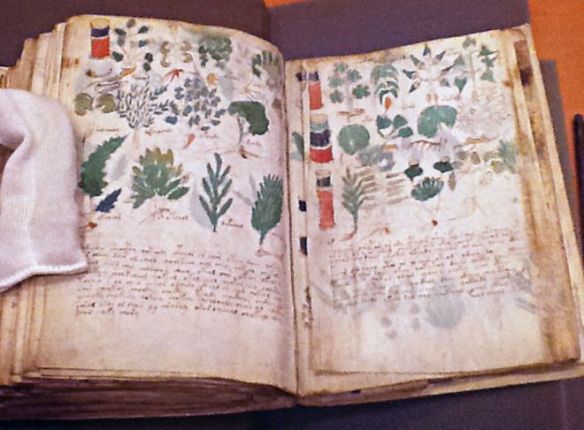
Image courtesy of BBC.com

The Voynich Manuscript is a cryptologic curiosity unlike anything else we’ve seen before, one that has baffled linguists and puzzlers for decades. This hand-written book was discovered over a hundred years ago, but it’s believed to date back to the fifteenth century.

The writing, which reads from right to left, has yet to be identified. It’s unclear if this is some sort of sophisticated code, an unknown or lost language which was then encoded, an invented language, an example of glossolalia (a written equivalent of speaking in tongues), or simply an elaborate hoax.

The only known copy of the text resides in Yale University’s Beinecke Rare Book and Manuscript Library.

From the Yale University website:

Many call the fifteenth-century codex, commonly known as the “Voynich Manuscript,” the world’s most mysterious book. Written in an unknown script by an unknown author, the manuscript has no clearer purpose now than when it was rediscovered in 1912 by rare books dealer Wilfrid Voynich. The manuscript appears and disappears throughout history, from the library of the Holy Roman Emperor Rudolf II to a secret sale of books in 1903 by the Society of Jesus in Rome. The book’s language has eluded decipherment, and its elaborate illustrations remain as baffling as they are beautiful.
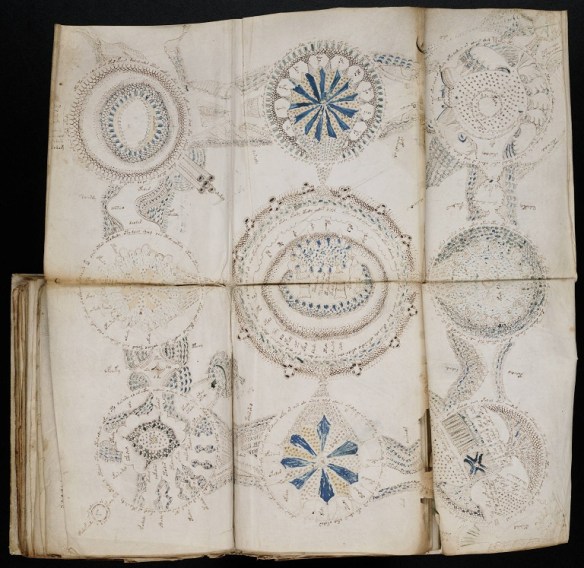
One of several fold-out pages in the manuscript.
Image courtesy of Wikipedia.org
.

There have been many theories regarding what form of encryption may have been employed in the Voynich Manuscript.

Some investigators theorize that vowels have been removed from the words in the text in order to obscure their meaning further, while others suggest writing that has been mirrored or otherwise written backwards. Anagrams and other forms of word manipulation are another common theory.

Attempts at decryption are further complicated by Lisa Fagin Davis’s 2020 paper that concluded through handwriting analysis that five different scribes contributed to the Voynich Manuscript.


So, what does all this have to do with witches and TikTok?

A TikTok user has gone viral claiming to have cracked the Voynich Manuscript. She says it’s a document cataloguing the menstrual cycle, and that the reason it wasn’t cracked sooner is because it was written by women, and male linguists overlooked that possibility for the last century or so.

(There’s also a bunch of stuff about magically growing plants in menstrual blood, but I’ll be ignoring that pseudoscience and focusing on the decoding/interpretation of the manuscript.)

It’s a very interesting theory — the menstrual cycle part, not the casual misandry part — but not exactly a new one.

Given the predominant plant imagery, as well as the drawings that resemble medieval calendars throughout the manuscript, there’s a prominent theory that the plants featured could be used to induce abortions, and were being catalogued as such.

That would be very valuable information to preserve and disseminate, given the power dynamics between men and women at the time and the key role that reproduction served across all levels of feudalist society.
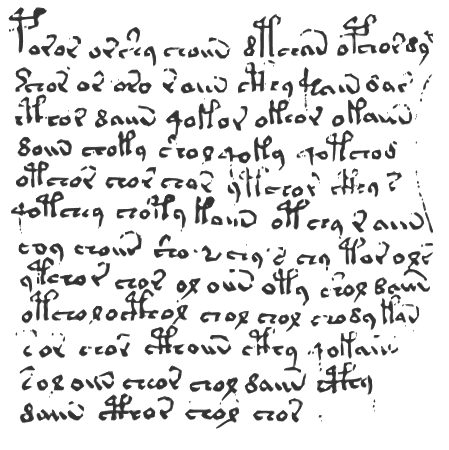
vmsample
Image courtesy of Wikipedia.org.

But can I point out the obvious? They didn’t solve the manuscript. They didn’t crack or decode anything. They looked at the images and made assumptions.

The poster talks about women having limited access to written language, which is absolutely true, and claims that they mostly communicated through imagery. When you ask the obvious follow-up question — why the huge swathes of text, then? — she suggests it’s a manufactured language to hide this information from the men hunting down women with this knowledge.

But why? Why would you hunt down people with knowledge of the menstrual cycle, which would be beneficial to reproduction? That doesn’t make any sense. (It would make more sense to hunt down women spreading information about plants that could induce abortions, which is the OPPOSITE of what she’s suggesting.)
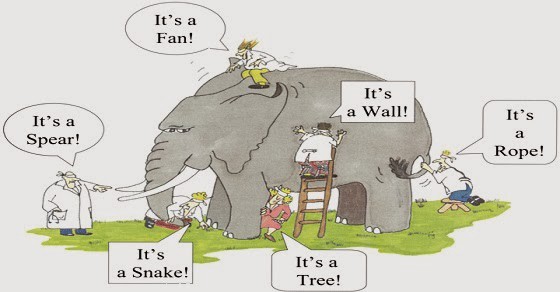
Because she admits to never actually decoding the text, she is drawing all her conclusions from the images. That reminds me of that parable about the blind men and the elephant, where each person touches a different part of the elephant (the trunk, the tail, etc.) and arrives at a different conclusion.

Without any of the text to accompany the images, crucial context is missing.


Now, I don’t mean to demean the efforts of nonprofessionals trying to solve mysteries or cold cases. I myself am an enthusiastic amateur in many respects. Research and discovery are not the sole property of universities and professionals, and some incredible, insightful leaps in many different fields have been made by those that are not part of established organizations.

Could these self-described witches have uncovered or recognized patterns that escaped 125 years of linguistic analysis? Absolutely.

BUT.

The way that they present their argument is reductive. They don’t pose it as a fascinating discovery or a triumph of long-held traditions resurfacing. They sneer at the failure of a century of men trying to solve it. Which is, frankly, stupid.

It’s stupid because it ignores the CRUCIAL role many female linguists and translators have had over the years. Just look at the amazing work Emily Wilson did with her translation of The Odyssey, offering new insight into a classic tale. (Also you need to read her review of the movie, because Nolan claimed he based the movie on her translation, and if that’s the case, boy, did he miss the mark.)

But I digress.

This TikTok post lumps “men” and “professionals” together to the detriment of all women, just to cater to a weird, desperate anti-intellectualism crowd that looks down on years (or even decades) of hard work and study by men, women, and nonbinary researchers in favor of viral shortcuts and faux grassroots equality.

Everyone has failed at cracking the Voynich Manuscript, not just men. This isn’t a gender-based thing. Lisa Fagin Davis, the medievalist and expert in manuscript study I mentioned earlier, is widely considered the foremost researcher when it comes to the Voynich Manuscript, and she spent years handling all the Voynich-related requests and materials while at Yale.

Her 2020 paper about the five scribes of the manuscript is the result of genuine research, analysis, and deduction, not the hand-wavey pseudointellectual astrological alchemical… whatever this TikTok content creator is doing.
I’ve read some of the discourse surrounding all this, trying to get a sense of people’s reactions, both within and outside the WitchTok community. Several commenters shared this Ursula K. Le Guin quote during the discussion, which feels very appropriate for the topic at hand:

But I didn’t and still don’t like making a cult of women’s knowledge, preening ourselves on knowing things men don’t know, women’s deep irrational wisdom, women’s instinctive knowledge of Nature, and so on. All that all too often merely reinforces the masculinist idea of women as primitive and inferior – women’s knowledge as elementary, primitive, always down below at the dark roots, while men get to cultivate and own the flowers and crops that come up into the light. But why should women keep talking baby talk while men get to grow up? Why should women feel blindly while men get to think?


In the end, despite generations of effort, we still don’t know what the Voynich Manuscript says.

And I don’t think it’s because of gatekeeping or snobbish intellectualism or misandry or misogyny or dismissal of female viewpoints.

I think it’s simply because we haven’t figured it out yet.

This kind of decryption can’t always been brute-forced through computer power. Languages are complex and nuanced, and with five different scribes, the handwriting and personal quirks of each writer could be coloring or even masking different options. What if an S in one person’s hand looks like an F in another?
And that’s not taking into account the possibility of an encryption code or an additional linguistic trick like the vowel exclusion I mentioned.

Or that mistakes could’ve been made, so the encryption isn’t consistent. Human error is always a possibility, as we’ve previously seen in the case of Brian Patrick Regan.

In the end, human ingenuity created it, and a lot of human ingenuity will no doubt be required to finally reveal its secrets. And everyone who contributed or attempted to contribute to the solve, gender be damned, will be a part of that legacy.

Of course, if you want to take a crack at solving it yourself, you can pick up a copy from the Yale University Press for $55.

The Beale Ciphers: A Puzzly Treasure Hidden Since the 1800’s?

There’s nothing quite like a treasure hunt to spark the imagination. From The Treasure of the Sierra Madre to the adventures of Indiana Jones, from tales as far back as Poe’s “The Gold-Bug” to stories as recent as an episode of NCIS: New Orleans last year, a treasure hunt can turn a crime story or an adventure tale into an irresistible narrative for the ages.

Thankfully, there are a few treasure hunts lurking out there in the real world, offering clever solvers the chance to live out their own adventure. In the past, we’ve explored the mystery of Forrest Fenn’s Rocky Mountain treasure, we’ve chronicled efforts to locate all of Byron Preiss’s The Secret treasures, and we’ve suggested tactics for cracking Jason Rohrer’s A Game for Someone hunt.

But as intriguing as those hunts are, none of them have spanned more than a century of searching. (Without resulting in unfortunate demises, that is. We’re looking at you, Oak Island.)

No, that singular honor belongs to a treasure hunt known as the Beale Ciphers.

beale_papers

As the story goes, a man named Thomas J. Beale buried a treasure trove of gold and silver somewhere in Bedford County, Virginia, in the early 1800s. Beale then encrypted the location of the treasure, the contents of the treasure, and the names of those he wished to have the treasure. Beale handed off those encryptions to an innkeeper, then vanished, never to be seen again. (His promise of later providing the key for the ciphers was never fulfilled.)

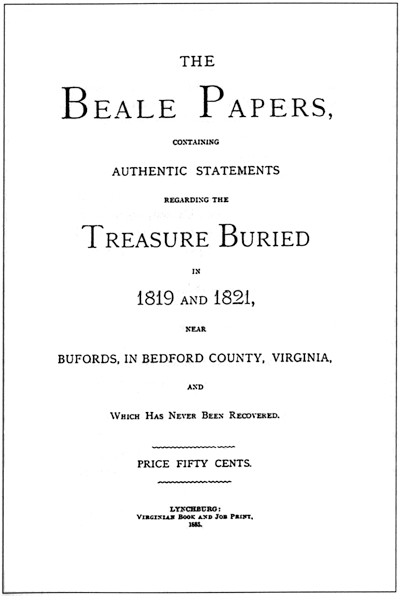
The innkeeper failed to crack the ciphers, then held onto them for decades before passing them along to an unnamed friend before his death. The unnamed friend spent twenty more years trying to unravel the encryptions (managing to solve the second of the three encrypted messages). Eventually, the friend published the encryptions and the story of Beale’s treasure in a pamphlet he began selling in 1885.

So, how do the ciphers work?

It’s simple, really. Take a book, pick a given page, and number all of the words on the page. (Or just start at the beginning of the book.)

If you’re using A Tale of Two Cities, for instance:

1 It
2 was
3 the
4 best
5 of
6 times,
7 it
8 was
9 the
10 worst
11 of
12 times…

So, using the first letters of each word (and the corresponding number), the word BOW could be encrypted 4 11 8 or 4 11 2 or 4 11 10.

This grants people in the know two advantages. The code is incredibly difficult to break on its own, because unlike a cryptogram (or any other message encrypted with a Caesar cipher or a one-to-one relationship between coded letters), each appearance of a given letter could be a different number, not the same one over and over.

Plus, if you know the key (the book and page number), decoding it requires no puzzly skill at all.

It’s diabolical and effective, as proven by Beale’s trio of ciphers, since only one has been cracked (because the solver stumbled upon the Declaration of Independence as the key).

[The second Beale cipher.]

The decrypted text from the second cipher:

I have deposited in the county of Bedford, about four miles from Buford’s, in an excavation or vault, six feet below the surface of the ground, the following articles, belonging jointly to the parties whose names are given in number three, herewith:

The first deposit consisted of ten hundred and fourteen pounds of gold, and thirty-eight hundred and twelve pounds of silver, deposited Nov. eighteen nineteen. The second was made Dec. eighteen twenty-one, and consisted of nineteen hundred and seven pounds of gold, and twelve hundred and eighty-eight of silver; also jewels, obtained in St. Louis in exchange to save transportation, and valued at thirteen thousand dollars.

The above is securely packed in iron pots, with iron covers. The vault is roughly lined with stone, and the vessels rest on solid stone, and are covered with others. Paper number one describes the exact locality of the vault, so that no difficulty will be had in finding it.

bealemap

Of course, there are some problems there, even with the cipher that treasure hunters consider solved. You see, there are some irregularities with the solution. Not only are there four misspellings in the translation, but a variation on the original Declaration of Independence must be used or the cipher doesn’t decode correctly.

Now, mistakes happen. (As we learned with the story of Brian Patrick Regan.) But if there are mistakes in the two unsolved ciphers as well, that only makes the chances of finding the proper key even slimmer, because a mistake in the early numbers of the code might convince someone that they’ve got the wrong key, even if they have the right one!

Do you find that challenge daunting, fellow puzzlers? It’s understandable if you do. The other two ciphers have resisted the best efforts of even master cryptographers and cryptanalysts.

Given that the Declaration of Independence was the key for the second cipher, many aspiring treasure hunters have tried using other famous historical documents as possible keys for the other ciphers, including the Magna Carta, the Constitution, the Monroe Doctrine, and more, as well as the plays of Shakespeare and the Lord’s Prayer.

bealemontvale

There are also plenty of reasons to doubt that this treasure exists at all. (The same question marks hang over some of the other treasure hunts we’ve mentioned, like Forrest Fenn’s.)

There are questions regarding the language in the pamphlet, where the gold was supposedly found, why Beale would bother encrypting the names of the people he wanted to inherit the treasure, and even whether Beale himself ever existed in the first place. (Famous skeptic and investigator of the supernatural Joe Nickell believes the pamphlet is a fraud.)

But does that mean the ciphers are? Not necessarily.

An analysis in 1970 by Dr. Carl Hammer of Sperry-UNIVAC indicated that the number patterns are not random. He believed that further attempts at cracking the ciphers would be worthwhile.

Heck, even our old codebreaking friends Elizebeth Smith Friedman and her husband William tried to unravel the Beale ciphers, but without success. She called the ciphers “a diabolical ingenuity designed to lure the unwary reader.”

And, of course, not every hunter has come away empty-handed. One team of treasure hunters stumbled upon a cache of Civil War artifacts while hunting for Beale’s trove.

So what do you think, PuzzleNationers? Is the Beale treasure real? Will it ever be found? Let us know in the comments section below! We’d love to hear from you.


Thanks for visiting PuzzleNation Blog today! Be sure to sign up for our newsletter to stay up-to-date on everything PuzzleNation!

You can also share your pictures with us on Instagram, friend us on Facebook, check us out on Twitter, Pinterest, and Tumblr, and explore the always-expanding library of PuzzleNation apps and games on our website!

Puzzles Endanger, Then Save, a Nation: The Spy Who Couldn’t Spell

While working on our multi-part series of posts about the history of codebreaking in America during the 20th century, I mentioned that some of the recent revelations about the National Security Agency were the result of Edward Snowden’s actions during his time as a government contractor.

What you might not know is that he has not been the only contractor to sneak information off of government computers in that fashion: a decade before Edward Snowden, there was Brian Patrick Regan.

Regan was a career soldier in the Air Force who eventually reached the rank of Master Sergeant and worked in signals intelligence.

Buried under hundreds of thousands of dollars in credit card debt, Regan decided his only way out of financial ruin was to try to sell US government secrets to a foreign government. He copied page after page of sensitive documents from national defense systems and snuck them out of his office, eventually amassing more than 15,000 pages, CD-ROMs, and other material in his home.

He would later bury bundles of these documents in various locations, including state parks, concealing the GPS coordinates of these valuables caches through a complicated series of encryptions where letters and numbers became three-digit sets.

You see, Regan had spent a fair amount of time studying cryptography, and fancied himself a top-shelf codemaster.

Regan used another set of encryptions of lesser complexity when he attempted to contact agents of the Libyan, Iraqi, and Chinese governments in order to sell off the treasure trove of secrets he’d amassed during his time at the National Reconnaissance Office.

One of these packets — a collection of three parcels intended for Libya — ended up in the hands of an FBI agent named Steven Carr.

From The Spy Who Couldn’t Spell by Yudhijit Bhattacharjee:

In the first envelope was a four-page letter with 149 lines of typed text consisting of alphabets and numbers. The second envelope included instructions on how to decode the letter. The third envelope included two sets of code sheets.

One set contained a list of ciphers. The other, running to six pages, listed dozens of words along with their encoded abbreviations: a system commonly known as brevity codes. Together, the two sets were meant to serve as the key for the decryption.

Some of the document had already been decrypted by FBI agents, and it revealed a member of the US intelligence community — claiming to be CIA, which was unverified, but definitely someone with top secret access — was trying to sell government secrets.

And this person had terrible spelling.

Brian Patrick Regan suffered from severe dyslexia. And, despite concerted efforts to perfect both his encryptions and his plan to net millions by selling government secrets, that dyslexia would be one of the clues that led Steven Carr to Regan’s doorstep.

It took Carr six months to connect Regan to the Libyan package, but once he did, surveillance on Regan began immediately.

When Regan attempted to board a plane to Zurich in 2001 — intending to meet with Iraqi and Libyan embassy officials — he was nabbed by the FBI and taken into custody.

Again, excerpted from The Spy Who Couldn’t Spell:

On searching Regan, officials found a piece of paper tucked between the inner and outer soles of his right shoe, on which were written addresses of Iraqi and Chinese embassies in Europe. The other materials they found on him and in his belongings were more mystifying. In a trouser pocket, Regan was carrying a spiral pad containing a page with 13 words that didn’t add up to anything: like tricycle, rocket and glove.

He had another 26 random words scribbled on an index card. Among the contents of Regan’s wallet was a piece of paper with a string of letters and numbers that read “5-6-N-V-O-A-I …” And in a folder he was carrying in his duffel bag were four sheets with handwritten lines of three-digit numbers.

FBI cryptanalyst Daniel Olson decoded some of the messages found on Regan when he was captured, but he had failed to unravel the multi-stage encryptions that concealed where Regan had buried his secret parcels. The government knew which state parks, but with acres and acres of possible hiding places, they needed more precise information.

And those parcels were the key, because they weren’t just packages to be sold to the highest bidder. No, those parcels doubled as a ransom in order to secure a better deal for himself with the US government. He wanted to blackmail the government for a reduced sentence.

They were his insurance plan.

As Thomas G. West said in Seeing What Others Cannot See, a book about visual thinking and dyslexia, “It’s not hard for a dyslexic to think ‘out of the box’ because they have never been in the box.”

Thankfully, Regan eventually realized that cooperation was in his best interest, and he revealed that each of the elaborate three-digit codes concealed a backdoor key built into the code itself.

Regan designed them this way so that, if he forgot the actual details of the encryption, all he would need is the starter word, a spark that would unlock the built-in key and help him decode the entire message.

This backdoor key system worked in a similar fashion to the Vigenere cipher, where a keyword or key phrase served as the entry point for a longer string of encrypted text. The trouble is… you need to know the cipher word or source in order to crack the code.

For example, during World War II, German agents in Europe used Daphne du Maurier’s Rebecca as the basis of a code for transmitting intelligence from Cairo to support a campaign by the Axis powers against the Allies in North Africa.

The discovery of the book among the possessions of two German radio operators who didn’t read English ultimately led to the breaking of the code, which in turn led to the capture of the German spies in Cairo.

Regan revealed the cipher words for the various hiding spots in state parks — which used cipher words from sources as peculiar as Regan’s own high school yearbook — and soon, the FBI recovered all but one of the buried parcels.

But Regan couldn’t remember the cipher word for the last one.

Daniel Olson would then step in, having learned some of Regan’s techniques as they uncovered the other parcels, and partially decrypting the remaining message enough to spark Regan’s memory. Regan finally came up with the last cipher key, and the final parcel was recovered.

Yes, once again, puzzly perseverance had saved the day!

Regan was found guilty on two counts of attempted espionage and one of gathering national defense information, and sentenced to life imprisonment with parole. Which, quite honestly, is getting off easy, considering that prosecutors were seeking the death penalty for his treasonous acts. (If prosecutors had gotten their way, he would’ve been the first person executed for espionage since the Rosenbergs in the ’50s.)

For the full story, including more in-depth explanations of Regan’s elaborate encryptions, check out The Spy Who Couldn’t Spell by Yudhijit Bhattacharjee.


Thanks for visiting PuzzleNation Blog today! Be sure to sign up for our newsletter to stay up-to-date on everything PuzzleNation!

You can also share your pictures with us on Instagram, friend us on Facebook, check us out on Twitter, Pinterest, and Tumblr, and explore the always-expanding library of PuzzleNation apps and games on our website!