
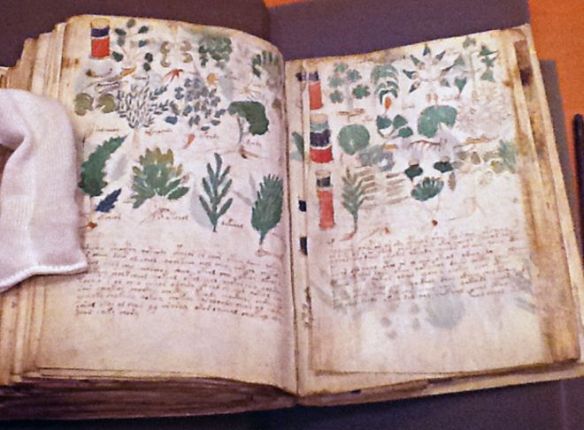
The Voynich Manuscript is a cryptologic curiosity unlike anything else we’ve seen before, one that has baffled linguists and puzzlers for decades. This hand-written book was discovered over a hundred years ago, but it’s believed to date back to the fifteenth century.
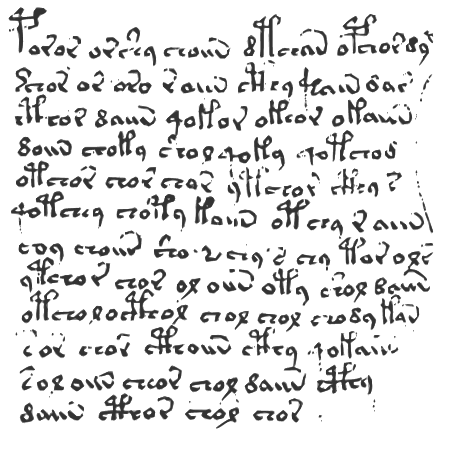
The writing, which reads from right to left, has yet to be identified. It’s unclear if this is some sort of sophisticated code, an unknown or lost language which was then encoded, an invented language, an example of glossolalia (a written equivalent of speaking in tongues), or simply an elaborate hoax.
The only known copy of the text resides in Yale University’s Beinecke Rare Book and Manuscript Library.
From the Yale University website:
Many call the fifteenth-century codex, commonly known as the “Voynich Manuscript,” the world’s most mysterious book. Written in an unknown script by an unknown author, the manuscript has no clearer purpose now than when it was rediscovered in 1912 by rare books dealer Wilfrid Voynich. The manuscript appears and disappears throughout history, from the library of the Holy Roman Emperor Rudolf II to a secret sale of books in 1903 by the Society of Jesus in Rome. The book’s language has eluded decipherment, and its elaborate illustrations remain as baffling as they are beautiful.
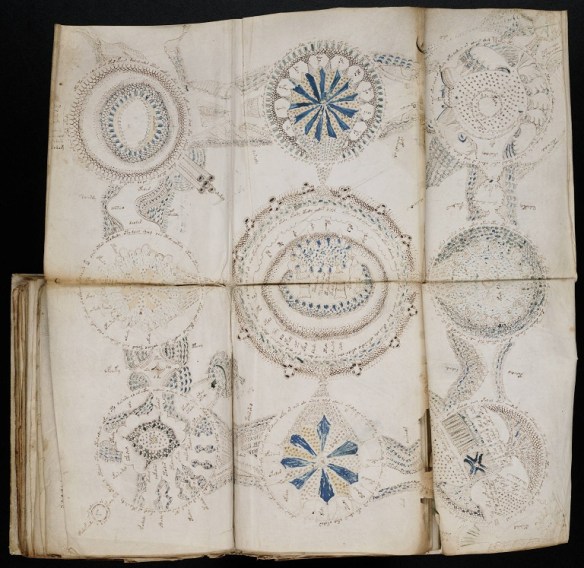
Image courtesy of Wikipedia.org.
There have been many theories regarding what form of encryption may have been employed in the Voynich Manuscript.
Some investigators theorize that vowels have been removed from the words in the text in order to obscure their meaning further, while others suggest writing that has been mirrored or otherwise written backwards. Anagrams and other forms of word manipulation are another common theory.
Attempts at decryption are further complicated by Lisa Fagin Davis’s 2020 paper that concluded through handwriting analysis that five different scribes contributed to the Voynich Manuscript.
So, what does all this have to do with witches and TikTok?
A TikTok user has gone viral claiming to have cracked the Voynich Manuscript. She says it’s a document cataloguing the menstrual cycle, and that the reason it wasn’t cracked sooner is because it was written by women, and male linguists overlooked that possibility for the last century or so.
(There’s also a bunch of stuff about magically growing plants in menstrual blood, but I’ll be ignoring that pseudoscience and focusing on the decoding/interpretation of the manuscript.)
It’s a very interesting theory — the menstrual cycle part, not the casual misandry part — but not exactly a new one.
Given the predominant plant imagery, as well as the drawings that resemble medieval calendars throughout the manuscript, there’s a prominent theory that the plants featured could be used to induce abortions, and were being catalogued as such.
That would be very valuable information to preserve and disseminate, given the power dynamics between men and women at the time and the key role that reproduction served across all levels of feudalist society.
But can I point out the obvious? They didn’t solve the manuscript. They didn’t crack or decode anything. They looked at the images and made assumptions.
The poster talks about women having limited access to written language, which is absolutely true, and claims that they mostly communicated through imagery. When you ask the obvious follow-up question — why the huge swathes of text, then? — she suggests it’s a manufactured language to hide this information from the men hunting down women with this knowledge.
But why? Why would you hunt down people with knowledge of the menstrual cycle, which would be beneficial to reproduction? That doesn’t make any sense. (It would make more sense to hunt down women spreading information about plants that could induce abortions, which is the OPPOSITE of what she’s suggesting.)
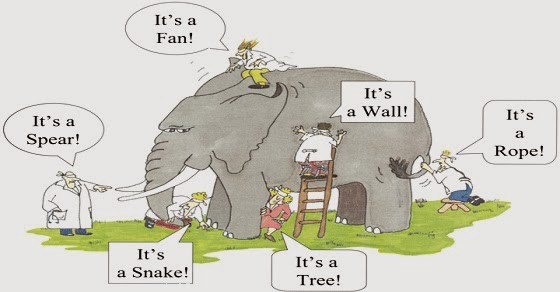
Because she admits to never actually decoding the text, she is drawing all her conclusions from the images. That reminds me of that parable about the blind men and the elephant, where each person touches a different part of the elephant (the trunk, the tail, etc.) and arrives at a different conclusion.
Without any of the text to accompany the images, crucial context is missing.
Now, I don’t mean to demean the efforts of nonprofessionals trying to solve mysteries or cold cases. I myself am an enthusiastic amateur in many respects. Research and discovery are not the sole property of universities and professionals, and some incredible, insightful leaps in many different fields have been made by those that are not part of established organizations.
Could these self-described witches have uncovered or recognized patterns that escaped 125 years of linguistic analysis? Absolutely.
BUT.
The way that they present their argument is reductive. They don’t pose it as a fascinating discovery or a triumph of long-held traditions resurfacing. They sneer at the failure of a century of men trying to solve it. Which is, frankly, stupid.
It’s stupid because it ignores the CRUCIAL role many female linguists and translators have had over the years. Just look at the amazing work Emily Wilson did with her translation of The Odyssey, offering new insight into a classic tale. (Also you need to read her review of the movie, because Nolan claimed he based the movie on her translation, and if that’s the case, boy, did he miss the mark.)
But I digress.
This TikTok post lumps “men” and “professionals” together to the detriment of all women, just to cater to a weird, desperate anti-intellectualism crowd that looks down on years (or even decades) of hard work and study by men, women, and nonbinary researchers in favor of viral shortcuts and faux grassroots equality.
Everyone has failed at cracking the Voynich Manuscript, not just men. This isn’t a gender-based thing. Lisa Fagin Davis, the medievalist and expert in manuscript study I mentioned earlier, is widely considered the foremost researcher when it comes to the Voynich Manuscript, and she spent years handling all the Voynich-related requests and materials while at Yale.
Her 2020 paper about the five scribes of the manuscript is the result of genuine research, analysis, and deduction, not the hand-wavey pseudointellectual astrological alchemical… whatever this TikTok content creator is doing.
I’ve read some of the discourse surrounding all this, trying to get a sense of people’s reactions, both within and outside the WitchTok community. Several commenters shared this Ursula K. Le Guin quote during the discussion, which feels very appropriate for the topic at hand:
But I didn’t and still don’t like making a cult of women’s knowledge, preening ourselves on knowing things men don’t know, women’s deep irrational wisdom, women’s instinctive knowledge of Nature, and so on. All that all too often merely reinforces the masculinist idea of women as primitive and inferior – women’s knowledge as elementary, primitive, always down below at the dark roots, while men get to cultivate and own the flowers and crops that come up into the light. But why should women keep talking baby talk while men get to grow up? Why should women feel blindly while men get to think?
In the end, despite generations of effort, we still don’t know what the Voynich Manuscript says.
And I don’t think it’s because of gatekeeping or snobbish intellectualism or misandry or misogyny or dismissal of female viewpoints.
I think it’s simply because we haven’t figured it out yet.
This kind of decryption can’t always been brute-forced through computer power. Languages are complex and nuanced, and with five different scribes, the handwriting and personal quirks of each writer could be coloring or even masking different options. What if an S in one person’s hand looks like an F in another?
And that’s not taking into account the possibility of an encryption code or an additional linguistic trick like the vowel exclusion I mentioned.
Or that mistakes could’ve been made, so the encryption isn’t consistent. Human error is always a possibility, as we’ve previously seen in the case of Brian Patrick Regan.
In the end, human ingenuity created it, and a lot of human ingenuity will no doubt be required to finally reveal its secrets. And everyone who contributed or attempted to contribute to the solve, gender be damned, will be a part of that legacy.
Of course, if you want to take a crack at solving it yourself, you can pick up a copy from the Yale University Press for $55.

