Crossword History: A Timeline

The hundredth anniversary of the crossword is nearly upon us, and we at PuzzleNation Blog thought we’d take a look at the long (yet surprisingly short) road it took to get to this marvelous centennial!

And so, without further ado or folderol, we proudly present:

A Brief History of the Crossword
(by Glenn Dallas and the PuzzleNation Team)

16th – 11th century BC

Inscriptions from New Kingdom-era Egypt (Eighteenth to Twentieth Dynasties) of horizontal and vertical lines of text divided into equal squares, that can be read both across the rows and down the columns, are made. These inscriptions are later referred to by Egyptologists as “Egyptian crossword puzzles.”

19th century

Rudimentary crosswords, similar to word squares, begin appearing in England, and later elsewhere in Europe.

June 22, 1871

Future inventor of the crossword, Arthur Wynne, is born.

March 23, 1897

Future New York Times crossword editor Margaret Farrar is born.

February 25, 1907

Future New York Times crossword editor Will Weng is born.

December 21, 1913

The New York World publishes the first crossword, invented by Liverpool journalist Arthur Wynne.
(The puzzle is originally known as a word-cross.)

January 6, 1916

Future New York Times crossword editor Eugene T. Maleska is born.

1920

Margaret Farrar is hired by The New York World as a secretary, but soon finds herself assisting Arthur Wynne with proofreading puzzles. Her puzzles soon exceed Wynne’s in popularity.

Colonel H.W. Hill publishes the first Crossword Dictionary.

1924

Margaret Farrar publishes the first book of crossword puzzles under contract for Richard L. Simon and Max Schuster, “The Cross-Word Puzzle Book.” It was an instant bestseller, launching Simon & Schuster as a major publisher.

The Sunday Express becomes the first newspaper in the United Kingdom to carry crosswords.

1926

The cryptic crossword is invented by Edward Powys Mathers, who uses the pseudonym of Torquemada. He devises them for The Observer newspaper.

1931

Dell Puzzle Magazines begins publishing.
(Dell Publishing itself was founded in 1921.)

1941

Dell Pocket Crossword Puzzles first published.
(The magazine continues to this day.)

February 15, 1942

The New York Times runs its first Sunday edition crossword. (Click here to read more about this.)

June 2, 1944

Physics teacher and crossword constructor Leonard Dawe is questioned by authorities after several words coinciding with D-Day invasion plans appear in London’s Daily Telegraph. (Click here to read more about this.)

1950

The crossword becomes a daily feature in the New York Times.

August 26, 1952

Future New York Times crossword editor Will Shortz is born.

1968

Lyricist Stephen Sondheim begins creating cryptic crosswords for New York Magazine, helping introduce Americans to British-style crosswords.

1969

Will Weng succeeds Margaret Farrar as the second crossword editor for the New York Times.

1973

Penny Press is founded.

1977

Eugene T. Maleska succeeds Will Weng as the third crossword editor for the New York Times.

1978

First year of the American Crossword Puzzle Tournament,
later featured in the documentary Wordplay.

1979

Howard Garns creates the modern Sudoku puzzle for Dell Magazines (under the name Number Place), the first pen-and-paper puzzle to rival the crossword in popularity (though this spike in popularity would occur decades later under the name Sudoku).

June 11, 1984

Margaret Farrar, while working on the 134th volume in Simon & Schuster’s crossword puzzle book series, passes away.

1993

Will Shortz succeeds Eugene T. Maleska as the fourth crossword editor for the New York Times.

November 5, 1996

One of the most clever and famous crosswords of all time is published, the election-preceding crossword where either BOB DOLE ELECTED or CLINTON ELECTED could read out, depending on the solver’s answers.

June 23, 2006

Wordplay documentary hits theaters, featuring both celebrity solvers of crosswords and the participants and organizers of the 2005 American Crossword Puzzle Tournament.

February 29 – March 2, 2008

Thanks in part to the Wordplay documentary, the American Crossword Puzzle Tournament outgrows its previous setting and moves to Brooklyn.

June 6, 2008

Matt Gaffney launches his Weekly Crossword Contest (MGWCC).

August 2008

Lollapuzzoola, a crossword-solving tournament with a more tongue-in-cheek, freeform style, launches in Jackson Heights, New York.

October 6th, 2008

Patrick Blindauer’s famous dollar bill-inspired crossword puzzle is published.

2009

The city of Lvov, Ukraine, creates a crossword that spans an entire side of a 100-foot-tall residential building, with clues scattered around the city’s major landmarks and attractions. It’s awesome.

October 11th, 2011

PuzzleNation.com goes live.

June 2012

David Steinberg launches the Pre-Shortzian Puzzle Project, intending to create a complete database of every New York Times crossword.

August 13th, 2012

PuzzleNation Blog is launched.

June 14th, 2013

Matt Gaffney celebrates five years of MGWCC,
stating that MGWCC will run for 1000 weeks
(which puts the final edition around August 6th, 2027).

December 21st, 2013

The Crossword officially turns one hundred years old.


Additional information:

February 15th, 1942: The New York Times initially regarded crosswords as frivolous, calling them “a primitive form of mental exercise”; the motivating impulse for the Times to finally run the puzzle (which took over 20 years even though its publisher, Arthur Hays Sulzberger, was a longtime crossword fan) appears to have been the bombing of Pearl Harbor.

In a memo dated December 18, 1941, an editor conceded that the puzzle deserved space in the paper, considering what was happening elsewhere in the world and that readers might need something to occupy themselves during blackouts. The puzzle proved popular, and Sulzberger himself would author a Times puzzle before the year was out.

June 2nd, 1944: The words Omaha (codename for one of Normandy’s beaches), Utah (another Normandy beach codename), Overlord (the name for the plan to land at Normandy on June 6th), mulberry (nickname for a portable harbor built for D-Day), and Neptune (name for the naval portion of the invasion) all appeared in Daily Telegraph crosswords during the month preceding the D-Day landing.

This has been attributed to either an incredible coincidence or Dawe somehow overhearing these words (possibly slipped by soldiers involved) and incorporating them into puzzles unwittingly.


Thanks for visiting the PuzzleNation blog today! You can like us on Facebook, follow us on Twitter, cruise our boards on Pinterest, check out our Classic Word Search iBook (recently featured by Apple in the Made for iBooks category!), play our games at PuzzleNation.com, or contact us here at the blog!

PuzzleNation Product Review: ThinkFun’s Brain Fitness line

The folks at ThinkFun are always trying to raise the bar when it comes to puzzly games that keep the mind in fighting trim. (You may remember them from our review of Laser Maze over the summer.)

In that vein, they’ve unleashed the Brain Fitness line of puzzle games, offering all sorts of exercises to challenge you one-on-one and put your puzzly skills to the test.

They sent us copies of three Brain Fitness games to review, each with its own distinct flavor.

solitairechess

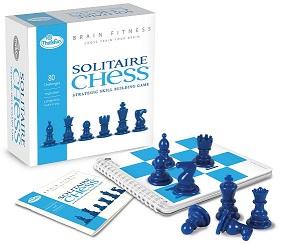
Brain Fitness Solitaire Chess

Solitaire Chess presents you with various layouts of pieces on a 4×4 grid, challenging you to clear the board of all but one piece. Every single move must eliminate a piece until only one remains.

Even the beginner puzzles gave me pause at first, because the need to knock out a piece with every move is a very different style of chess than I’m accustomed to. But I very quickly got into the groove of plotting out the chain of moves necessary to clear each board. With two pawns, two knights, two bishops, two rooks, a queen and a king, there are myriad layouts of varying complexity to solve, and some of them were serious brain melters.

Oddly enough, I found some of the expert-level grids easier than the advanced-level puzzles, though you could easily spend five or ten minutes on a single crafty puzzle.

Not only is it a terrific mental exercise, but it just might make you a better chess player in the long run.

Brain Fitness Chocolate Fix

Chocolate Fix is a marvelous variation on the Sudoku model, offering nine sweets of varying shape and color, and tasking you with deducing the intended position of each in a 3×3 baking sheet.

The beginner-level puzzles are child’s play, and would actually be a terrific introduction for younger puzzlers. But as soon as you reach the intermediate-level challenges, the difficulty begins ratcheting skyward. Some clues give you colors only, others shapes only, and the occasional clue is centered around a given piece’s location on the baking sheet.

Midway through the advanced-level challenges, they stop referencing specific sweets at all, leaving you to do some serious deductive work with shapes and colors alone.

By the time you reach the expert puzzles (which abandon any clues providing all nine squares, leaving you to mentally assemble Tetris-like pieces with shape and color symbols), it becomes a serious mental workout that banishes any false confidence and bravado that the easy early rounds might’ve sparked.

Victory may be sweet, but Chocolate Fix’s later challenges will make you earn it.

Brain Fitness Rush Hour

Rush Hour is a variation on the classic sliding-tile game, except instead of tiles, you’re sliding cars and trucks back and forth in order to clear a path for your heroic little red car to escape the traffic jam.

Rush Hour (in various forms) has been a great success for ThinkFun over the years, and the Brain Fitness version is a brilliantly simple adaptation. Self-contained and perfect for puzzling-on-the-go, Rush Hour takes the chain-move thinking of Chess Solitaire to the next level.

The jump from beginner-level to intermediate-level challenges is a sobering one, if only because the playing grid seems absolutely packed with cars! But you quickly realize that a packed grid means fewer possible moves, which helps to point you toward the solution.

The grid thins out again when you reach the advanced-level puzzles, but greater movement only leads to tougher challenges, since so many more moves are available to you, requiring chains of increasing complexity in order to rescue your little red car.

Having thoroughly tested all three games, I found Rush Hour the most difficult of the three (though Solitaire Chess wasn’t far behind), but I must admit, the multilayered colors / shapes / positioning clue style of Chocolate Fix provided the most unexpected challenge.

As an experienced puzzler, I was thoroughly impressed by the scalability of each idea. The easy puzzles were terrific introductions to the game, and the expert puzzles were challenges quite worthy of your time.

ThinkFun recommends 15 minutes of puzzling time a day with any of their Brain Fitness products in order to give your brain a proper workout, but I suspect you’ll have a hard time stopping there. If only physical workouts were as much fun as these mental ones!

Thanks for visiting the PuzzleNation blog today! You can like us on Facebook, follow us on Twitter, cruise our boards on Pinterest, check out our Classic Word Search iBook (recently featured by Apple in the Made for iBooks category!), play our games at PuzzleNation.com, or contact us here at the blog!
Sudoku: Every number in its place.

Sudoku puzzles are as ubiquitous as reality shows these days, and enthusiastic solvers can find puzzles of nearly any difficulty with ease.

Sudoku puzzles are usually ranked from one to five stars, with five star puzzles being the most difficult. Difficulty can depend not only on the number of starting digits, but their placement and the level of deduction involved.

Sudoku enthusiasts were the first to notice that the lowest number of clues required for a unique solution is 17. Puzzles with 16 clues invariably had alternate solutions.

For comparison purposes, the average newspaper sudoku has 25 set numbers. The sudoku puzzles on PuzzleNation vary in difficulty, but our easy puzzles range from 30 to 36 clues and our expert puzzles range from 25 to 30 clues, with medium and hard puzzles clue counts falling in between.

But the 17-clue threshold was all conjecture until a mathematician from University College Dublin named Gary McGuire put in the time (and the computer processing power) to write a mathematical proof confirming the suspicions of sudoku enthusiasts.

He designed a specific computer algorithm to process various sudoku grid patterns, allowing him to cut down on the computing time necessary to verify his conjecture. (Even with the reduced computing time, it took 7 million CPU hours in total, a monumental amount of processing time.)

From the nature.com article:

The idea behind this was to search for what he calls unavoidable sets, or arrangements of numbers within the completed puzzle that are interchangeable and so could result in multiple solutions. To prevent the unavoidable sets from causing multiple solutions, the clues must overlap, or ‘hit’, the unavoidable sets. Once the unavoidable sets are found, it is a much smaller—although still non-trivial—computing task to show that no 16-clue puzzle can hit them all.

Of course, as I said before, difficulty isn’t just about the number of clues. The puzzle widely regarded as the world’s hardest sudoku puzzle has 21 clues, but their placement makes for a much more mentally-taxing solving exercise.

I guess it just goes to show the old real estate cliche is true: it’s all about location, location, location.

PuzzleNation Book Review: The Puzzle Lady vs. the Sudoku Lady

Welcome to the third installment of PuzzleNation Book Reviews!

All of the books discussed and/or reviewed in PNBR articles are either directly or indirectly related to the world of puzzling, and hopefully you’ll find something to tickle your literary fancy in this entry or the entries to come.

Let’s get started!

Our book review post this time around features Parnell Hall’s novel The Puzzle Lady vs. the Sudoku Lady.

Cora Felton is known far and wide as the Puzzle Lady, powerhouse puzzlemaker and occasional crimesolver, but her reign may be over. Minami, the Sudoku Lady, has come from Japan to challenge Cora for pride, PR, and puzzle-bragging rights. But when dead bodies start turning up and Minami is fingered as the culprit, it’s up to Cora to clear the competition’s good name.

Now, before I get into the review, it’s confession time. This is the second time around for me with this book. I read it a few years ago, and didn’t particularly enjoy it. But I was also sick as a dog at the time, so I wanted to be sure that my general foul mood at the time didn’t impair my ability to appreciate what I was reading at the time.

Turns out my illness had nothing to do with it.

The Puzzle Lady vs. the Sudoku Lady is part of Parnell Hall’s Puzzle Lady Mystery series — which he’s been publishing at the rate of a book a year since 2000 — and I sincerely hope it’s not indicative of the rest of the series. The reader plows through a needlessly convoluted story, confronted by a population of unpleasant characters and a protagonist who is unlikable in the extreme. She’s more grating than curmudgeonly.

Now, to be fair, that’s not to say that bright spots in the novel don’t exist. Hall has a natural adeptness with wordplay and his nigh-Vaudevillian exchanges of dialogue are engaging. Sadly, however, both are severely undermined by the unsympathetic cast of characters.

The sudoku and crossword puzzles included within are both an interesting gimmick and a pleasant treat; my own penchant for puzzling would not be ignored, and I solved each puzzle as it appeared. Unfortunately, those were calm spots in an otherwise stormy narrative.

I must conclude that The Puzzle Lady vs. the Sudoku Lady is at best an uneven reading experience. (Though I might try another Puzzle Lady Mystery someday, for curiosity’s sake.)

Well, I hope you enjoyed the latest installment of PuzzleNation Book Reviews, and I look forward to more book discussions in the future. In the meantime, keep calm, puzzle on, and I’ll catch you later.

This is impossible!

There are puzzles out there for every skill level, from super-easy to staggeringly challenging. And every once in a while, you will come across a puzzle that feels expressly engineered to be as difficult as possible, if not borderline mind-meltingly impossible, even for an experienced solver.

If you’ve ever suspected a puzzlesmith of such diabolical shenaniganry, you’ll probably feel vindicated by Sean Adams’s post on McSweeney’s Internet Tendency, a bitingly funny introduction from a (hopefully) mythical puzzle book.

Enjoy!

For when you get bored playing the expert level of Sudoku.

Do you find your average Super-Challenging God-Level Expert Platinum Blond mode of Sudoku too easy?  Now you can prove it!

A pair of computer scientists from the  Babes-Bolyai University (Romania) and the University of Notre Dame (USA) have made some remarkable connections between Sudoku, the classic k-SAT problem, and the even more classic non-linear continuous dynamics.

Using these connections they’ve been able to come up with a “Richter Scale” to objectively determine the difficulty of a Sudoku puzzle.

So when you encounter a puzzle labelled hard and you find it easy all you need to do is to compute its η, a co-efficient that measures the hardness of the problem.

Simple as that! Now you can have both the challenge (or lack-thereof) of the Sudoku game plus figuring out just how badly the editors mischaracterized its difficulty level!

I’m off to try and figure out how well our Classic Sudoku difficulty ratings stack up….

Source: The Chaos Within Sudoku – A Richter Scale