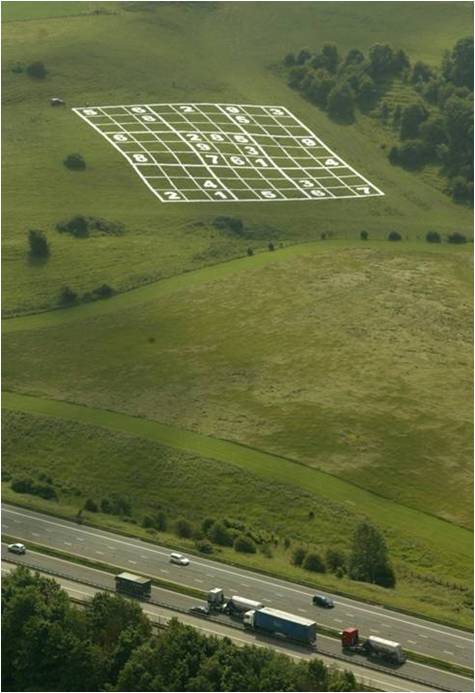
We’re dressed To the Nines and this is the Number Place to be!
I waxed both lyrical and nostalgic about Sudoku in yesterday’s post, so let’s get down to business with today’s bonus puzzle!
I’ve got two different versions of a Cluedoku puzzle for you.
Like Sudoku, Cluedoku involves placing the digits 1 through 9 into each row, column, and 3×3 square in the grid. But unlike Sudoku, there are no set letters.
Instead, you have 81 clues, one for every cell in the grid. Once you’ve solved a clue and placed a number in the grid, standard Sudoku rules apply: that number will only appear once in a row, column, or 3×3 square.
I hope you enjoy this variation on the traditional Sudoku format. And if you have a favorite Sudoku variant that ISN’T Cluedoku, feel free to share it in the comment section below! I’d love to hear from you.
Tomorrow, 9/9, is International Sudoku Day. And while I have a special Sudoku puzzle planned for tomorrow, I wanted to take some time today to talk about this puzzle.
Because, honestly, Sudoku is kind of amazing.
It’s a logic puzzle — a deduction puzzle — that looks like a math puzzle. (And, in fact, its genuinely mathier cousins Kenken and Cross Sums/Kakuro don’t have a tenth of the audience that Sudoku does.)
It’s one of the very few puzzles I can think of that requires no introduction, no words, no guidance. If you just look at that grid, you inherently know what you need to do.
That’s a very rare thing. I mean, sure, if you look at a logic puzzle — the premise, the grid, the hints to help eliminate things — you can pick it up quickly. A crossword is fairly universal, but still requires the outside knowledge of vocabulary, facts, and wordplay each solver brings.
Sudoku is clean, simple, and irrefutable. It crosses linguistic and cultural barriers with ease.
And yet, it took decades to become an overnight sensation.
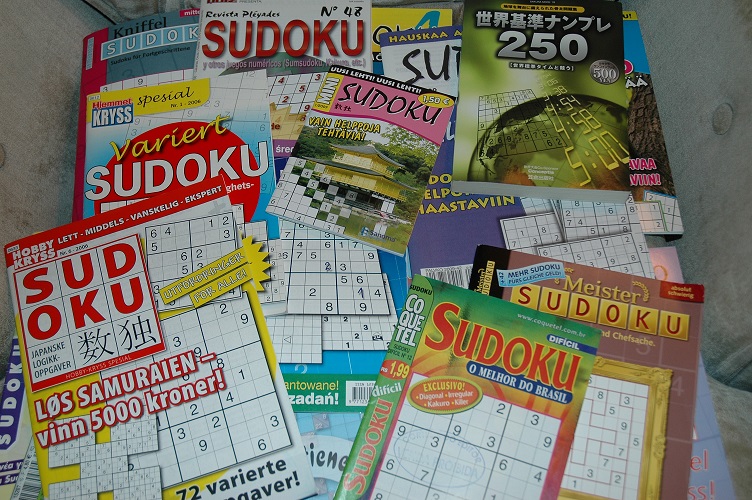
Similar puzzles can be traced back to France in the 1890s, but Sudoku as we know it was featured in Dell Pencil Puzzles and Word Games in 1979 under the name Number Place (though it has also been called To The Nines), thanks to constructor Howard Garns.
Links to a solvable online version of each of those two puzzles are here and here. Try out these half-century-old puzzles!
Wayne Gould kickstarted a UK Sudoku craze after creating a generation program for the puzzles and selling it to The Times in London.
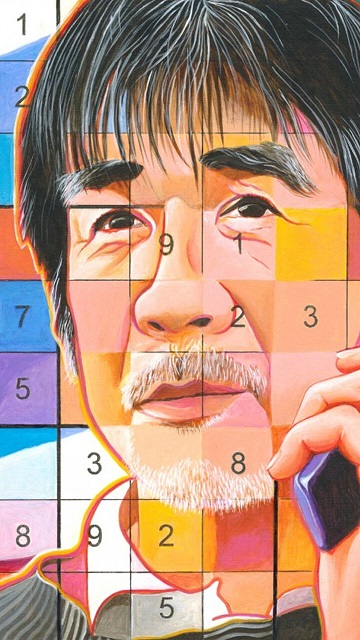
Maki Kaji began championing Sudoku in the 1980s in Japan with his puzzle magazine Nikoli, and he’s why most people know the puzzle as Sudoku now. (Originally the puzzle was called Suuji wa dokushin ni kagiru, or “numbers should be single.” Maki later took the suggestion to shorten it to Sudoku.)
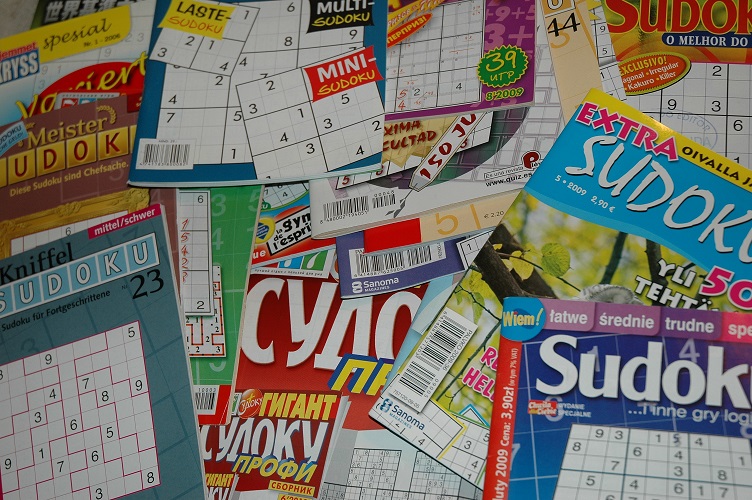
We can literally track the puzzle’s expansion across the years, and its rebirth as Sudoku in the 2000s, because many puzzle solvers have lived through Sudoku’s entire modern lifespan.
And it’s baffling, isn’t it? That Sudoku feels so timeless and universal, but is relatively young, as puzzles go.
We’ve been playing with words for far longer than we’ve been playing with numbers. Anagrams and riddles go back centuries upon centuries. They’ve been playing Go in China for more than 2,500 years, and the Royal Game of Ur dates back to the third millennium BC.
Sudoku is just a pup compared to them, but it’s among the most widely solved and recognizable puzzles.
I’ve spent a lot of timing thinking about (and writing about) Sudoku over the years. A decade ago, I tried to calculate how many of the 5-and-a-half billion possible unique Sudoku puzzles had been published up to that point.
And yet, I’m still fascinated by every new twist. I try every variant I see clever constructors come up with. I inevitably watch every video where someone solves the hot new “impossible” Sudoku.
In less than half the time crosswords have been around, Sudoku has swept across the world and become a household name.
True, there haven’t been any Sudoku musical revues or pop songs — at least, not that I’m aware of! — but it remains one of the most ubiquitous pen-and-paper puzzles in the world today.
“Numbers should be single.” Maybe. But I like the message of Number Place better: every number in its place. An unsolved Sudoku grid shan’t remain empty for long.
For today’s post, I’ve gathered a few tidbits from around the world of puzzles to keep you informed. We’ve got puzzles to solve, a discount code, a new crossword tournament in 2027, and more!
It’s a multi-page printout because the puzzle is loaded with trivia and references to her life, career, and accomplishments. It was clearly a labor of love, one that George kindly allowed me to share with all of you.
A new crossword tournament has been announced for 2027, as crosswords are coming to Canada!
The Canadian Crossword Open will be held on June 5th in Toronto! And they’ve already got constructors announced for the event.
Emma Lawson, Will Nediger, Ada Nicolle, Jess Shulman, and Nam Jin Yoon are all constructing for the tournament.
Not only that, but they’re hosting an open submission contest for Canadian constructors to contribute a puzzle to the inaugural tournament. Click here for more details!
Did you know that September is Sudoku Month? (At least, according to one calendar I saw.)
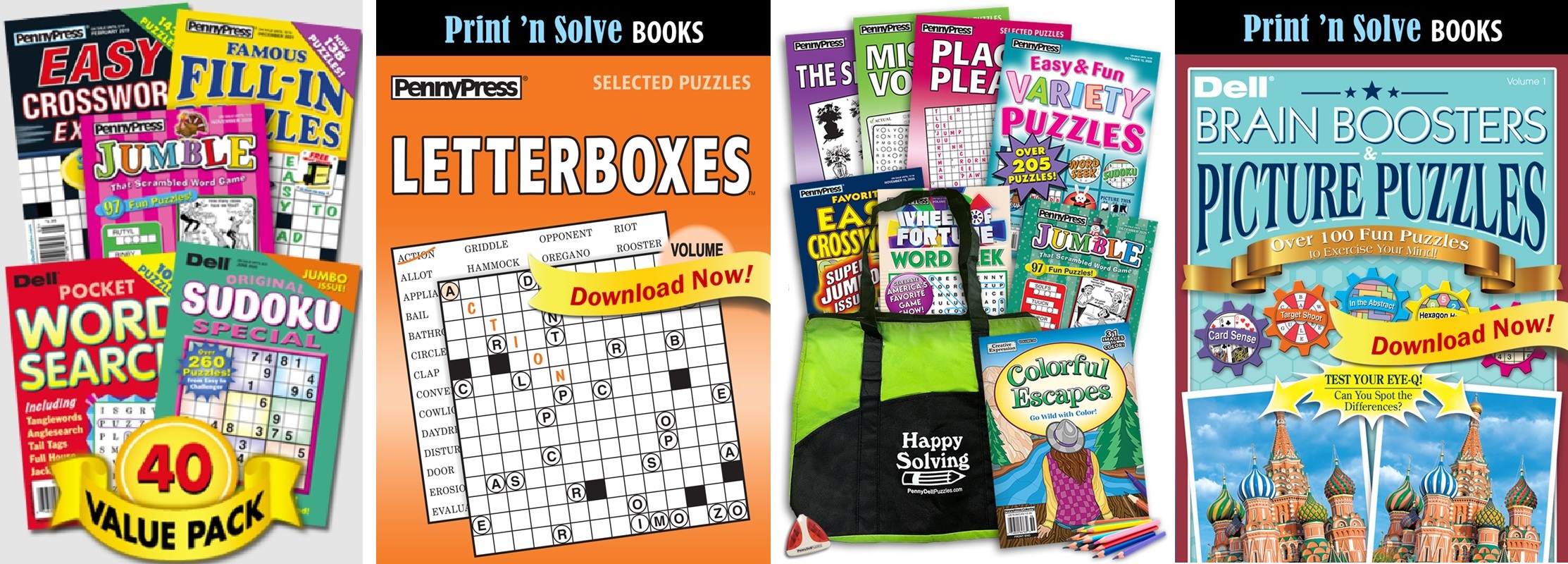
Well, apparently it is, and our friends at Penny/Dell Puzzles are running a promotion all month!
They’re offering a 15% off discount code on all Sudoku magazines, subscriptions, and value packs.
Just use the code “ilovesudoku” on their website to receive your discount and indulge in some Sudoku solving!
It’s always important when a constructor identifies a gap in the market or a group that is being underrepresented in puzzles.
Construct Robin Stears (a previous contributor to The Inkubator, Women of Letters, and several These Puzzles Fund Abortions collections) recently lamented the lack of an outlet featuring women-focused crosswords.
So she decided to create one herself.
Go to her Patreon to sample her Midi puzzles highlighting the accomplishments of women. You can download PDFs or solve digitally with puz versions of these 9×9 crosswords.
It’s a worthwhile endeavor to be sure, so please check it out.
Were there any stories or puzzly promotions this week that I missed? Let me know in the comments section below! I’d love to hear from you.
“The way to deal with an impossible task was to chop it down into a number of merely very difficult tasks, and break each one of them into a group of horribly hard tasks, and each of them into tricky jobs, and each of them…”
A riddle, a puzzle, an impossible task… literary heroes are often forced to unravel, solve, or outmaneuver devious traps, tricks, and plots as part of their heroic journey.
I particularly love when the hero comes up with a unique or creative solution to the problem, often turning it on their opponent. And Sir Terry Pratchett, author of the DiscWorld series (among many other wonderful books) was a master craftsman of scenarios like this.
So today, I thought I would look at some of these puzzling scenarios and impossible tasks, and see how the protagonists penned by Terry Pratchett bested them with brains more than brawn.
One of the classic examples of the Impossible Task is the Gordian Knot. This knot secured an ox cart to a post. The knot was described as several knots all so tightly entangled that it was impossible to find the ends or see how they were fastened. It was said that whoever untied it would rule Asia.
Alexander the Great defeated the knot in one of two inventive ways, depending on the source. He either removed the linchpin from the pole, exposing the two ends of the cord and allowing him to untie it, or more famously, he sliced the knot in two with a single stroke of his sword.
Pratchett had his own take on this concept in The Amazing Maurice and his Educated Rodents, his version of the Pied Piper story where a sentient cat used friendly mice and a fake piper to con villagers out of their money.
In one village where something sinister is afoot, Maurice the cat was confronted by Spider, a rat king (and monstrous psychic being) formed from rats whose tails are intertwined.
Much like Alexander, Maurice unraveled the knot by biting through all the entangled rat tails, forcing them to separate and defeating the amalgamated being.
One of the most deviously clever denizens of the DiscWorld is Esmerelda Weatherwax, aka Granny Weatherwax. She is a witch who serves the people of Lancre, using magic, common sense, and her particular knack for dealing with people, which she calls Headology.
Granny crosses paths with dark forces, ambitious magic users, and other threats to the land of Lancre, and has found herself in puzzling scenarios more than once.
In one example, Granny is trapped somewhere between death and life. Her only companion is the physical embodiment of Death (who gets his own font in DiscWorld books). She is given the choice between venturing into the light and venturing into the dark, with no indication which leads back to the land of the living.
Quite poignantly, Granny turns to face the light, then steps backward into the dark.
Fans have two prevailing interpretations of this moment. Some see it simply as a reflection of the idea of “going into the light” meaning moving on from this realm. But others (myself included) see it as Granny once again choosing to defend others, facing the light, but stepping back into the darkness where she is needed most.
During another adventure, Granny is trapped within a mirror realm, again joined by Death.
But this time, she has to figure out which of a billion reflected versions of her is the true one.
(As you can see, someone was inspired by this scene to get a “This one.” tattoo that would only read out properly in a mirror.)
Granny bets on herself, trusting in her own honesty, strength of character, and insight. And she is served well by that choice.
Another DiscWorld novel sees Granny (and her fellow witches, Nanny Ogg and Magrat Garlick) venturing abroad to save her sister Lily from a witch with a specialty in voodoo.
Granny wagers against the powerful Erzulie Gogol, betting on her mastery of Headology vs. Gogol’s voodoo powers. If Granny wins, Lily goes free and the people of Genua are left to their own devices, free of Gogol’s magical influences.
Gogol agrees to leave the city alone, but not to give up Granny’s evil sister.
‘I don’t want to hurt you, Mistress Weatherwax,’ said Mrs. Gogol.
‘That’s good,’ said Granny. ‘I don’t want you to hurt me either.
Defiantly, Granny ignores Gogol menacing her with a voodoo doll and begins walking toward the stairs that lead to her sister.
Gogol continues threatening to stab the doll of Granny, and Weatherwax persists, even going so far as to point out she would be more ruthless than Gogol.
‘I should box a bit clever if I was you, Esme,’ muttered Nanny Ogg. ‘She’s good at this sort of thing.’
‘I think she could be very ruthless,’ said Magrat.
‘I’ve got nothing but the greatest respect for Mrs. Gogol,’ said Granny. ‘A fine woman. But talks a bit too much. If I was her, I’d have had a couple of big nails right through that thing by now.’
Gogol jabs a long sliver of wood into the doll’s foot, then its arm. Everyone sees Granny wince and react to the painful attacks. But Granny continues to climb the stairs, despite Gogol stabbing another sliver into the doll’s leg, causing Granny to clutch at the banister.
Granny turns toward Gogol, who threatens to stab the doll’s heart this time.
But Granny instead thrusts her own arm into a nearby torch, causing the doll to burst into flames.
In DiscWorld, belief makes things happen. Gogol believes in her magic, and so does everyone else. Granny turns that belief against her. The magic works both ways, you see, and Granny is made of sterner stuff.
It went on blazing even after the witch had screamed and dropped it on to the floor. It went on burning until Nanny Ogg ambled over with a jug of fruit juice from the buffet, whistling between her teeth, and put it out.
Granny withdrew her hand. It was unscathed.
‘That’s headology,’ she said. ‘It’s the only thing that matters. Everything else is just messin’ about. Hope I didn’t hurt you, Mrs. Gogol.’
She went on up the stairs.
Mrs. Gogol kept on staring at the damp ashes. Nanny Ogg patted her companionably on the shoulder.
‘How did she do that?’ said Mrs. Gogol.
‘She didn’t. She let you do it,’ said Nanny. ‘You got to watch yourself around Esme Weatherwax. I’d like to see one of them Zen buggers come up against her one day.’
‘And she’s the good one?’ said Baron Saturday.
‘Yeah,’ said Nanny. ‘Funny how things work out, really.’
My all-time favorite example in the DiscWorld books comes from The Last Hero, an illustrated adventure where a group of aged heroes, The Silver Horde, seek to climb the mountain of the gods and “return fire to them” (by blowing them up with explosives).
As they are confronted by the various Gods, Cohen the Barbarian is challenged by Fate to do the impossible: to roll a seven on a six-sided die.
Similar to the solution of the Gordian Knot, Cohen throws the die in the air and cuts it in two with his sword, causing the two pieces to fall to the ground, revealing a six and a one.
Now that is thumbing your nose at Fate with style.
It’s all well and good to be lucky, or brave, or tough, but clever? Clever is where it’s at. Clever beats monsters, fire, and Death itself. Clever challenges the reader to imagine how THEY’D get out of the impossible scenario, allowing them to best the bad guy or to be equally surprised by the protagonist’s ingenuity.
And very few authors gave readers the opportunity to be clever with the style and aplomb of Terry Pratchett.
“…she was already learning that if you ignore the rules, people will, half the time, quietly rewrite them so that they don’t apply to you.”
Do you have a favorite moment of puzzly cleverness from literature, fellow puzzlers? Do you have a favorite impossible task that was outwitted, or a devious design unraveled by smarts instead of steel? Let me know in the comments section below! I’d love to hear from you.
In a recent Gameplay newsletter, Sam Corbin wrote about three-word instructions / mottos (like “Eat, Drink and Be Merry” or “Live, Laugh, Love”), and pondered a slogan like that for puzzle solving.
It’s a definite challenge for sure, like trying to come up with a poignant six-word memoir. But I’ve never been one to turn down a challenge simply because I’ll probably fail. I WELCOME IT.
So, today, I thought I would pitch in and come up with some slogans (not all fitting the three-word formula) for various puzzle outlets.
Penny Press / Dell Magazines
I’ve always thought a great slogan for them would be “We’re As Puzzled As You Are.” It’s light, a little self-deprecating, and fosters a feeling of camaraderie between publisher and solver.
But a three-word instruction for them?
How about Sample, Savor, Solve? Sample a variety puzzle you’ve never tried. Savor the ones you know you like. And, as always, solve.
The New York Times
I mean, a good motto would obviously be “All the Clues That Are Fit to Print,” playing off the classic NYT slogan.
But for a later-week crossword, how about Determine, Decipher, Discover?
Determine what you know, decipher tricky clues, discover the gimmick.
The Los Angeles Times
Now, The LA Times has several mottos (like “Read the Paper,” which could easily be converted into “Read the Down Clues”), but my favorite is their historical slogan, “Stand Fast, Stand Firm, Stand Sure, Stand True.”
And when it comes to puzzles, that could be Stand Watch, Stand Pat, Stand Back.
Let your eyes go to the clues you know immediately, trust your instincts on ones you’ve filled in, and then stand back and survey your work to unravel the theme.
Doesn’t really work with the three-word motto, though.
Maybe Stop, Drop, and Roll!
Stop what you’re doing and solve a puzzle. Look at those down clues. And keep trying ’til you’ve solved it.
Fireball Crosswords (and other meta outlets)
For me, it was actually easy to come up with a three-word motto for solving these, because it’s what I do when I try to unravel a meta while completing the grid:
Pattern, Exception, Association.
Look for a pattern or rhythm outside the regular solve. Look for exceptions that feel intentional. Look for associations on a second read.
But what about for a general three-word instruction for crossword solving?
For solvers still getting used to crosswords, I would recommend Blanks, Bios, Back-and-forth or Fill, Famous, Flip, which both fit some of my solving advice for newbies.
Fill in the blank, scan clues for famous names, flip to the crossings once a word is filled in and work on that section.
Oh, and if you suspect a puzzle will be difficult, always remember:
Write Light, Alright!?
Hopefully one of these mottos works for you, fellow solver. Do you have any suggestions, leave them in the comment section below! We’d love to hear from you.
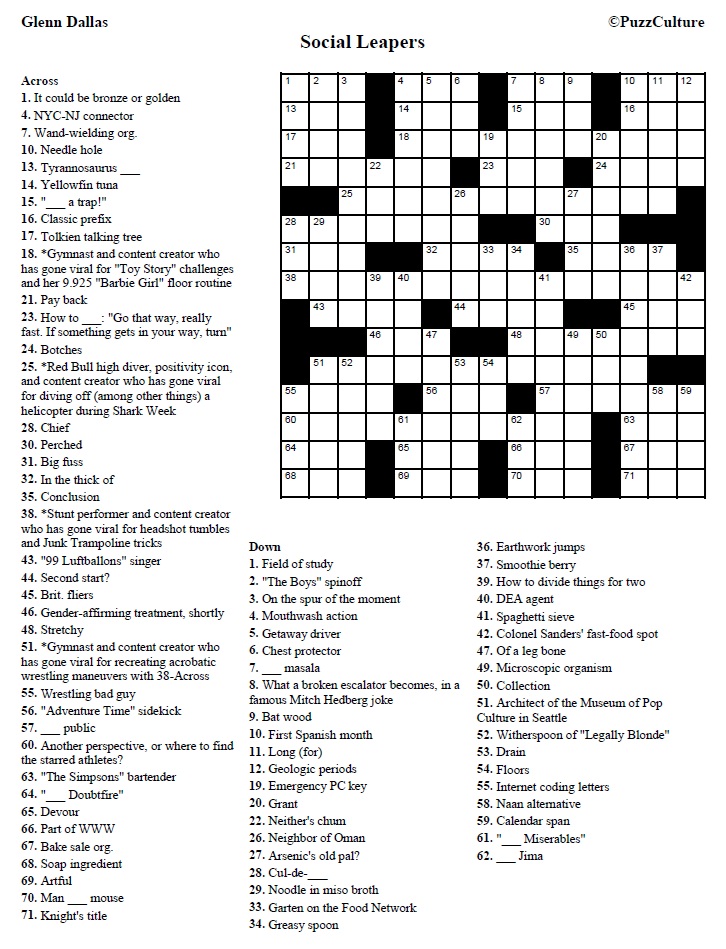
In today’s bonus post, I’ve got a crossword for you to solve, but first, a quick little bit of backstory.
Social media inspired today’s puzzle, as I decided to highlight some of my favorite content creators who first rose to fame for their physical exploits and impressive athletic skills.
From gymnastics to high diving to stunt work, each of these social media icons have proven their dedication, their mettle, and their determination, and continue to do so both in their chosen fields and across apps and video feeds worldwide.
Sadly, there were numerous talented women that I wasn’t able to fit into this particular grid. One that comes to mind is Katelyn Ohashi, a top gymnast who first drew international attention in 2019 for her 10.0 floor routine set to a medley of top hits from Michael Jackson, Tina Turner, and others.
She has recently returned to the public eye after a long hiatus, going viral for equally impressive feats of athleticism, skill, and poise.
Each of the women featured in today’s puzzle have more than earned their place in pop culture, and I hope you enjoy this little puzzly tribute.