PuzzleNation Blog Looks Back on 2017!

2017 is quickly coming to a close, and as I look back on an eventful year in the world of puzzles and games, I’m incredibly proud of the contributions both PuzzleNation Blog and PuzzleNation made to the puzzle community as a whole.

Over the last year, we explored board games and card games, strategy games and trivia games, dice games and tile games, do-it-yourself puzzlers and pen-and-paper classics. We met game designers, constructors, artists, and creative types of all kinds.

We unraveled math puzzles and tackled the Crossword from Hell. We accepted the challenge of diabolical brain teasers, optical illusions, Internet memes, and more, even pondering our place in the world of puzzles as electronic solvers like Dr. Fill and AlphaGo rise in capability.

We delved into puzzle history with posts about the legacy of female codebreakers in World War II, game dice from centuries ago, theories about Shakespeare’s secret codes, and the long history of cryptography and the NSA. We brought to light valuable examples of puzzles in art, popular culture, famous quotations, and even the natural world as we pondered whether bees are verifiable problem-solvers like crows and octopuses.
We spread the word about numerous worthwhile Kickstarters and Indiegogo campaigns, watching as the puzzle/game renaissance continued to amaze and surprise us with innovative new ways to play and solve. We shared worthy causes like Puzzles for Progress, as well as amazing projects like new escape rooms, dazzling corn mazes, and the ongoing Kubrick’s Game interactive experience.

We cheered the 75th anniversary of the New York Times Crossword, and chronicled the many celebrations that marked the occasion, from guest crossword constructors like Bill Clinton and Lisa Loeb to a puzzle-centric cruise across the Atlantic!

We also mourned as friends and fellow puzzlers passed on. We said goodbye to David Lindsey and Raymond Smullyan, two underappreciated giants of the field. The pun-fueled show @midnight this year, which inspired our monthly hashtag game, also closed up shop, sadly.

We celebrated International TableTop Day, made puzzly bouquets in honor of International Puzzle Day, marveled at the records broken at the Rubik’s Cube World Championship, attended the American Crossword Puzzle Tournament and New York Toy Fair, and dove deep into an ever-expanding litany of puzzle events like the Indie 500, BosWords, Lollapuzzoola 10, and Crosswords LA.

We found puzzly ways to celebrate everything from Pi Day, the Super Bowl, and Star Wars Day to Halloween, Thanksgiving, and Christmas, and we were happy to share so many remarkable puzzly landmark moments with you. We even discovered Puzzle Mountain!

It’s been both a pleasure and a privilege to explore the world of puzzles and games with you, my fellow puzzle lovers and PuzzleNationers. We marked five years of PuzzleNation Blog this year, I recently penned my 800th blog post, and I’m more excited to write for you now than I was when I started.

And honestly, that’s just the blog. PuzzleNation’s good fortune, hard work, and accomplishments in 2017 went well beyond that.

Every month, we delivered quality content for the Penny Dell Crosswords App. From monthly deluxe sets and bonus boxes to Dell Collection sets and holiday bundles, dozens upon dozens of topnotch puzzles wended their way to our loyal and enthusiastic solvers.

And just last month, we launched our newest puzzly endeavor — Daily POP Crosswords — bringing you fresh, up-to-date cluing and relatable themes in world-class puzzles created by some of the industry’s best constructors! (Many of whom you’ve gotten to know in our recent interview series, Meet the Daily POP Crosswords Constructors!)

But whether we’re talking about the Penny Dell Crosswords App or Daily POP Crosswords, I’m proud to say that every single puzzle represents our high standards of quality puzzle content crafted for solvers and PuzzleNationers.

And your response has been fantastic! Daily POP Crosswords is thriving, the blog has over 2200 followers, and with our audience on Facebook, Twitter, Instagram, and other platforms continuing to grow, the enthusiasm of the PuzzleNation readership is both humbling and very encouraging.

2017 was our most ambitious, most exciting, and most creatively fulfilling year to date, and the coming year promises to be even brighter.

Thank you for your support, your interest, and your feedback, PuzzleNationers. The new year looms large, and we look forward to seeing you in 2018!


Thanks for visiting PuzzleNation Blog today! Be sure to sign up for our newsletter to stay up-to-date on everything PuzzleNation!

You can also share your pictures with us on Instagram, friend us on Facebook, check us out on Twitter, Pinterest, and Tumblr, and explore the always-expanding library of PuzzleNation apps and games on our website!
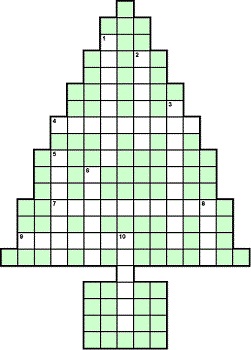
A Puzzly Holiday Quiz!

It’s Santa’s big day, fellow puzzlers and PuzzleNationers, and we thought we’d celebrate this joyous day of family, friends, giving, and delights with a little Christmas Quiz!

Simply answer the holiday-themed clues below! And, if you come up with the correct answers, you’ll reveal a message reading down, formed by the first letter of every answer!

Here we go!

  • Plant with pleasant results for those under its influence?
  • Santa’s helper OR Will Ferrell film
  • Vixen, for one
  • A treasured BB-gun brand
  • He famously sought a peppermint mine
  • One who wassails OR member of a loud festive mob?
  • Nationally observed day off
  • Donner’s son OR reindeer game outcast
  • There was no room here
  • The Grinch’s creator
  • One of the misfit toys
  • Scrooge’s ghostly partner
  • Four Sunday-period OR type of calendar
  • Hang this with care

Did you crack the clues and figure out the message? We hope so! Have a marvelous day!


Thanks for visiting PuzzleNation Blog today! Be sure to sign up for our newsletter to stay up-to-date on everything PuzzleNation!

You can also share your pictures with us on Instagram, friend us on Facebook, check us out on Twitter, Pinterest, and Tumblr, and explore the always-expanding library of PuzzleNation apps and games on our website!
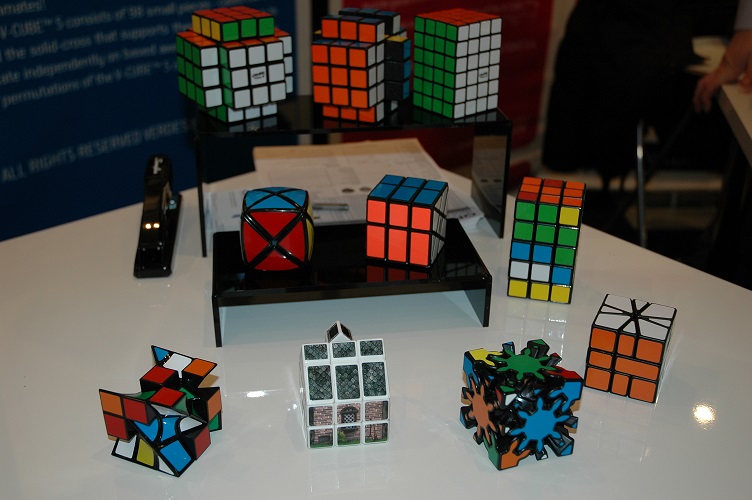
This Rubik’s Cube Feat Is a Real Toss-Up!

You know, every time I think I’ve seen it all when it comes to Rubik’s Cubes, some enterprising solver proves me wrong yet again.

Over the years, I’ve seen a LOT of cool things done with Rubik’s Cubes.

I’ve seen the world’s most complex Rubik’s-style cube being solved, a building turned into a solvable Rubik’s Cube, and a Rubik’s Cube solved one move at a time by strangers across the globe.

I’ve even seen a Rubik’s Cube solved during a skydive.

So when I saw the video below, I originally thought it would fit right in with the cavalcade of impressive solves we’ve shared in the past.

I mean, solving three Rubik’s Cubes in 20 seconds… while juggling them? That’s incredible!

Check it out:

Wait, what’s that?

If you watch very closely, there’s something strange going on in this one.

Yes, it turns out it’s been faked. This is not a real solve.

But the reveal of how they pulled it off is almost more impressive than actually solving them so quickly:

That’s a lot of effort to make it look real.

But has anyone actually done a juggling solve of multiple Rubik’s Cubes?

Yes. A little more searching turns up the following six-minute doozy:

Here, as far as I can tell, is a genuine video of someone solving three Rubik’s Cubes while juggling them. It takes him six minutes, and he solves them one at a time (one twist at a time, every third throw, as you can see if you slow it down).

The camera isn’t steady; it’s constantly moving around. And the daunting length of the video adds to the credibility. You saw all the work that went into digitally animating 20 seconds. Doing so for six straight minutes with far greater variation in light and framing? That would be a Herculean effort in editing.

The only thing that’s weird about this one is how nonchalant everyone around this guy acts while he’s performing an amazing feat of concentration and dexterity.

It might not be a rapid-fire speed-solve, but it is a worthwhile watch nonetheless.

Now, to close out today’s post, here’s the opposite of speed-solving, as two Rubik’s pros take 18 minutes (sped up in the video) to solve the world’s largest Rubik’s Cube:

I like how the sheer size of the cube seems to flummox them a bit. After all, it’s not as easy to look at all sides of the cube and assess it as you would a normal Rubik’s Cube.

Still, it’s a very cool feat to document.

Meanwhile, I’ll be over here, trying to crack a regular old cube. Good thing I’ve got extra time off for the holiday. I’ll need it.


Thanks for visiting PuzzleNation Blog today! Be sure to sign up for our newsletter to stay up-to-date on everything PuzzleNation!

You can also share your pictures with us on Instagram, friend us on Facebook, check us out on Twitter, Pinterest, and Tumblr, and explore the always-expanding library of PuzzleNation apps and games on our website!
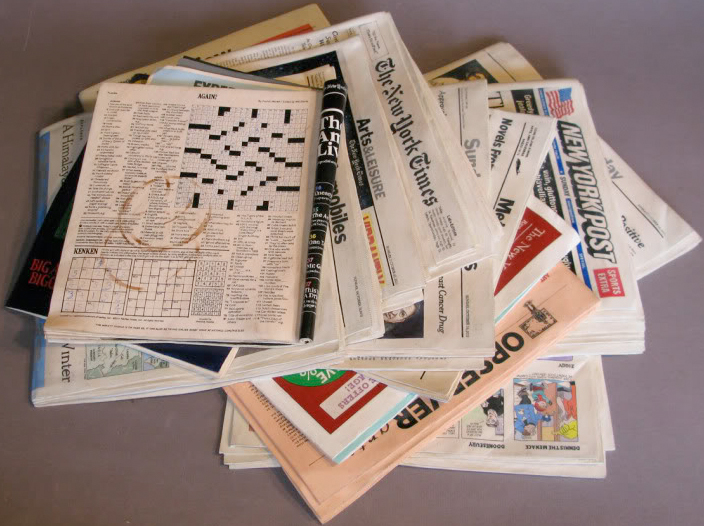
Happy Crossword Puzzle Day!

Hurray Hurray it’s Crossword Day!
Calloo Callay it’s Crossword Day!
With Christmas not so far away,
please do not, to our dismay,
neglect to celebrate or say…
Happy Crossword Puzzle Day!

Yes, my friends and fellow PuzzleNationers, it’s the 104th anniversary of Arthur Wynne publishing the world’s first crossword puzzle, and we simply couldn’t let the day pass by without some sort of puzzly to-do.

So I thought I’d focus on crossword cluing, because there’s so much a constructor can do with clues. As you well know, it goes far beyond just offering a synonym or a fill-in-the-blank to get the solver moving.

No, a crafty constructor can work wonders. I once saw a crossword where every single clue started with the same letter! That’s dedication.

Recently, a constructor snuck a limerick into the first five across clues of a British-style crossword.

So, in honor of the day, here’s a sampling of the best clues I encountered over the last year. These clues are gathered from all over — including The Crosswords Club, The Los Angeles Times, Piece of Cake Crosswords, The Indie 500, Barany and Friends, and many other outlets.

As you might expect, I’m a big fan of misdirection clues, and there were some choice ones this year. For instance, Patti Varol offered “They may be called on account of rain” for CABS.

Peter Gordon clued IAMB with the brilliant “Foot in ‘the door'” while Emory Ediger challenged solvers with “Things you saw while dreaming?” for LOGS.

George Barany had several great clues this year, including “Hawaiian beach ball?” for LUAU — always nice to get a new clue for a classic crossword word! — and “His wife became a pillar of their community” for LOT.

Sarah Kampman gave us “Fresh answers, perhaps” for SASS, while Michael Shteyman played with expectations with “50/50, e.g.” as the clue for ONE.

“Hit close to home” was Mike Shenk’s terrific clue for BUNT. He also offered “Give up possession of, in a way” for PUNT and “One might be responsible for a reduced sentence” for EDITOR.

Patrick Blindauer’s Piece of Cake Crosswords, a series designed to avoid crosswordese and welcome new solvers, allowed him to indulge in some lengthy, delightful clues:

  • Best Picture winner that becomes another Best Picture winner if you add an F to the beginning of it: ARGO
  • “Brown Eyed Girl” syllable followed by lots of la’s: SHA
  • Like some battles, or how my grandpa supposedly walked to school (both ways): UPHILL
  • Surprised cry that would be aha’s cousin if things had cousins the way crosswords seem to think they do: OHO

And no list would be complete without Brendan Emmett Quigley, who paired “Ticker tape?” with ECG.

To close out today’s entry, let’s enjoy a few clues from our friends at Penny Press that didn’t get published, but still highly entertained me.

Crossword guru Eileen Saunders gave us “Camel droppings?” for ASH, which is hilarious, and constructor Keith Yarbrough offered “Get by, barely” for STREAK.

What’s more amazing is that this is just a smattering of the excellent cluing available all across the world of crosswords. Every day, wordsmiths and constructors are bending words and wordplay to their whim. It’s fantastic stuff.

Did you have any favorite clues from crosswords this year? Let us know in the comments section below!


Thanks for visiting PuzzleNation Blog today! Be sure to sign up for our newsletter to stay up-to-date on everything PuzzleNation!

You can also share your pictures with us on Instagram, friend us on Facebook, check us out on Twitter, Pinterest, and Tumblr, and explore the always-expanding library of PuzzleNation apps and games on our website!

The Weird, Wonderful World of Dice

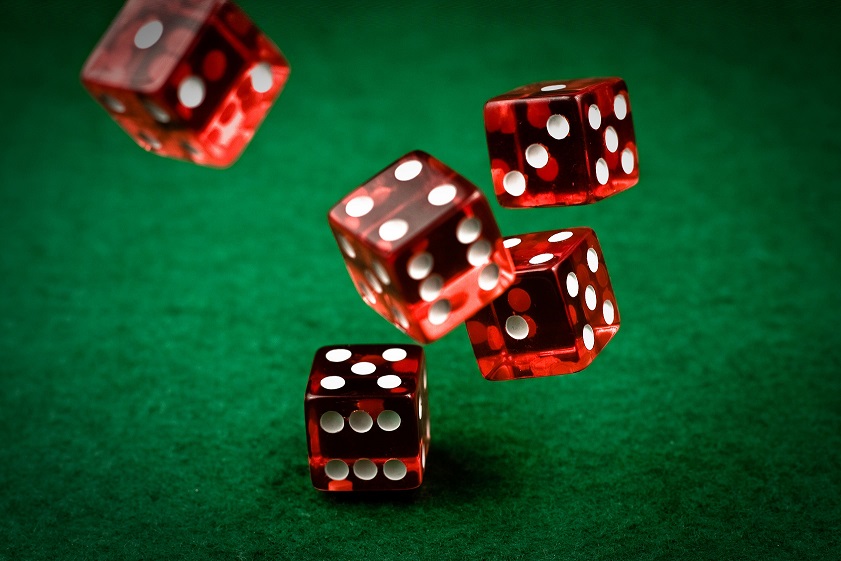
[Image courtesy of ThoughtCo.]

Dice have been an integral part of gaming for centuries. They’re the simplest way to introduce randomness to a game.

The six-sided die is, by leaps and bounds, the most familiar die. The d6, as role-players call it, is a staple of classic board games like Yahtzee and Clue, as well as the centerpiece of role-playing systems like GURPS.

But the d6 is hardly the only kind of die you see in gaming. Plenty of games and role-playing systems rely on dice of other shapes in order to run smoothly.

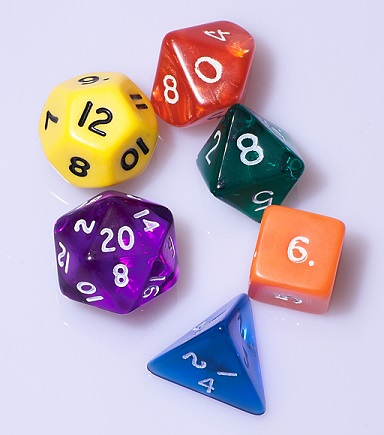
[Image courtesy of Wikimedia.]

If you play World of Darkness role-playing games like Werewolf or Vampire: The Masquerade, then the d10 is your friend. If you enjoy updated editions of Dungeons & Dragons (or even board games like Unspeakable Words or Scattergories), the d20 is a familiar sight, whether it has letters or numbers on it.

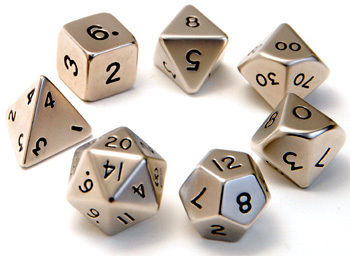
A standard dice set for beginners Dungeons & Dragons contains six different dice shapes: a pyramid-shaped d4, a d6, a d8, a d10, a d12, and a d20. (Many come with 2 d10s, one with single digits and one with double digits, allowing you to calculate percentages).

[Image courtesy of Instructables.]

Heck, if you think about it, flipping a coin to decide something is simply rolling a two-sided die.

But when you start delving into the history of games, it’s amazing to see just how far back some of these traditions and conventions go.

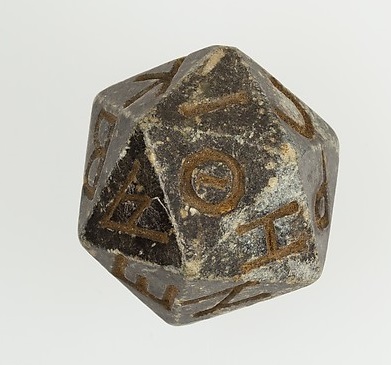
Did you know that The Metropolitan Museum of Art has a d20 in its collection?

Dating back to Roman times (somewhere between the 2nd century BC and the 4th century AD), the above die is inscribed with Greek letters. It’s not certain if this particular die was used for games or religious divination, but there’s no doubt it’s a beautiful example of craftsmanship.

And this is just scraping the surface. One of my favorite dice in my collection is an oversized 3D-printed d20 with Braille markings for every number. Such a cool piece.

Can you think of any strange dice in favorite games of yours, fellow puzzlers? We’d love to hear about them! (Unless they’re fuzzy dice hanging from your rearview mirror. Those don’t make reliable rolls in regular gameplay.)


Thanks for visiting PuzzleNation Blog today! Be sure to sign up for our newsletter to stay up-to-date on everything PuzzleNation!

You can also share your pictures with us on Instagram, friend us on Facebook, check us out on Twitter, Pinterest, and Tumblr, and explore the always-expanding library of PuzzleNation apps and games on our website!
PuzzleNation Product Review: Zendo

[Note: I received a free copy of this game in exchange for a fair, unbiased review. Due diligence, full disclosure, and all that.]

Experienced puzzlers are familiar with deduction as a puzzle-solving method. They may know it from solving logic puzzles, determining who brought what to Thanksgiving dinner. They may know it from asking questions in Clue in order to eliminate possibilities and figure out who killed Mr. Boddy, where, and how. They may know it from brain teasers, riddles, puzzles, or card games.

But they’ve probably never tried their hand at a deduction puzzle game quite like Zendo.

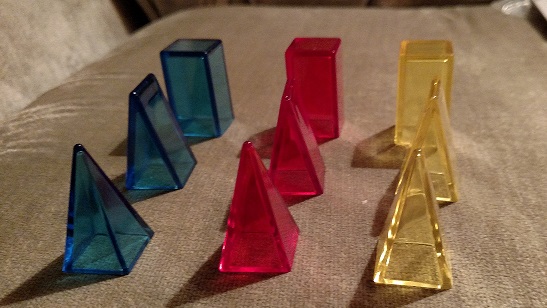
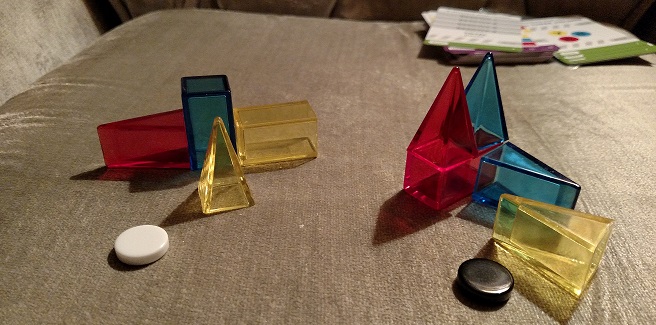
In Zendo, the players pull pieces from a communal pile in order to build different structures, using pyramids, wedges, and blocks. One player, the moderator, chooses a secret rule for the players to uncover, and builds two structures. One of these structures follows the secret rule, and one does not, and both are marked as such.

Secret rules can be as simple as “must contain all three shapes” or “must contain exactly four pieces.” They can be as complex as “must contain more blue pieces than blocks” or “must contain at least one yellow piece pointing at a blue piece.” Some rules involve how pieces touch, or how they’re stacked, while others demand no touching or stacking whatsoever. The field is wide open at the start of the game.

Players then try to deduce the secret rule by building structures themselves, arranging pieces from the communal pile into various patterns and asking the moderator for more information.

[Can you tell what the rule is by looking at these two structures?]

They can do so in one of two ways. The first is by saying “Tell,” wherein the moderator marks the player’s structure with either a white token or black token, depending on whether the structure fits the secret rule.

The second is by saying “Quiz,” wherein every player guesses whether the given player’s structure fits the rule. Every player who guesses right gets a guessing token.

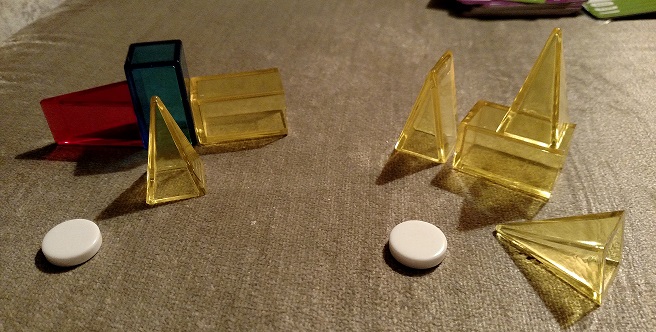
Guessing tokens, as you might suspect, are spent to guess the secret rule. But the moderator doesn’t answer with a simple yes or no. The moderator instead must build a new structure, which will either fit the secret rule (but not the player’s guess, and get marked with a white token) or fits the player’s guess (but not the secret rule, and gets marked with a black token).

This back-and-forth between players can be frustrating or informative, depending on how specifically you frame your guesses. It also tests the creative mettle of your moderator, which adds a curious wrinkle to the game. Not only are you competing with your fellow players to figure out the secret rule, but you have to deal with the often crafty skills of the moderator.

[Does this second sculpture give you any hints?]

It’s an ever-evolving puzzle that can change in an instant with a new bit of information. You might confirm you’re on the right track, or realize you’ve been looking at the structures incorrectly all along, and you’re back to square one (or, you know, pyramid one or wedge one).

But thankfully, Zendo is easily scalable for solvers of any age or solving skill level. You can keep the secret rule simple or make it complex, depending on who is playing. And if you’re the moderator, you have a free hand in determining how much information your structures reveal.

Like Fluxx and other games under the Looney Labs umbrella, Zendo has tons of replay value, and it’s a puzzle-game that ages well, since solvers with more experience are not only better players, but more devious moderators as well. This is some seriously puzzly fun.

Zendo is available from the crafty crew at Looney Labs, and it’s also featured in this year’s Holiday Puzzly Gift Guide!


Thanks for visiting PuzzleNation Blog today! Be sure to sign up for our newsletter to stay up-to-date on everything PuzzleNation!

You can also share your pictures with us on Instagram, friend us on Facebook, check us out on Twitter, Pinterest, and Tumblr, and explore the always-expanding library of PuzzleNation apps and games on our website!