DICE… IN… SPACE!

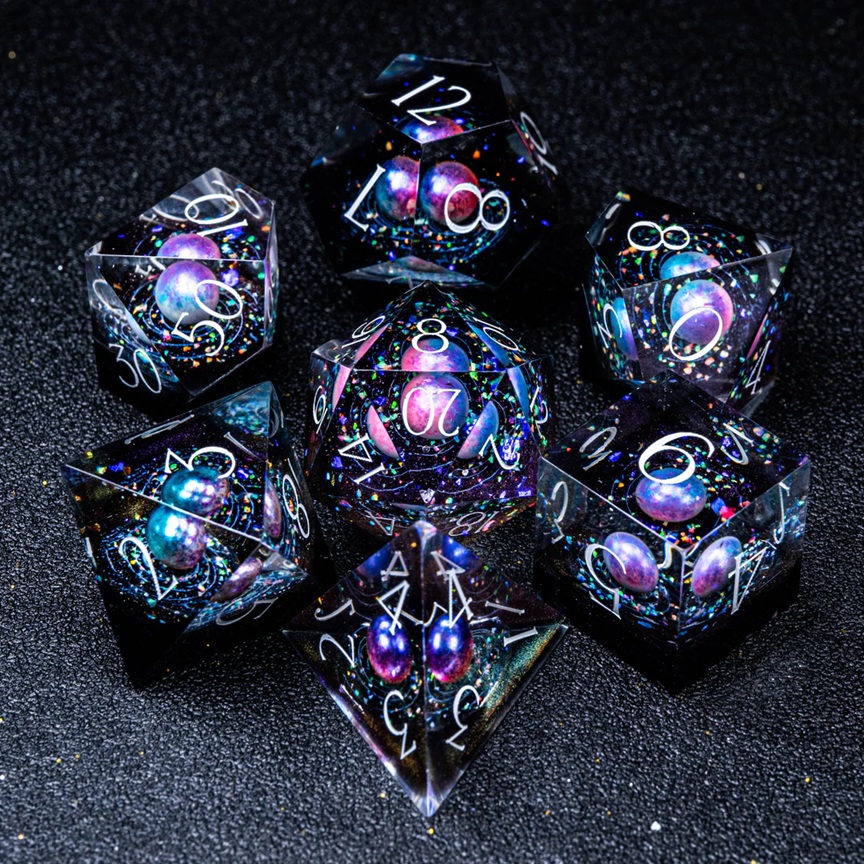
Resin space dice…

Storytelling has been with us as long as humanity has existed. From the first stories told around the campfire to podcasts and television shows and novels, stories are not just part of the human experience, but one of the most crucial parts.

It’s a significant reason why I enjoy roleplaying games so much. I get to sit around with my friends and tell stories, and that story is a magical once-in-a-lifetime combination of the actions each of us take and the random results of dice rolls.

The same people could gather around the same table a hundred times, and each time, the story would turn out a little bit different.

That’s MAGIC.

There are all kinds of roleplaying systems out there. Many use dice, but some use tarot cards, or playing cards, or a Jenga tower, or even more esoteric mechanics.

So there are lots of ways to play. But have we ensured that we can play in other environments?

I haven’t encountered an underwater roleplaying game yet, for instance, but I imagine it would be doable with scuba tanks, laminated character sheets, and some weighted dice so they don’t just float to the surface.
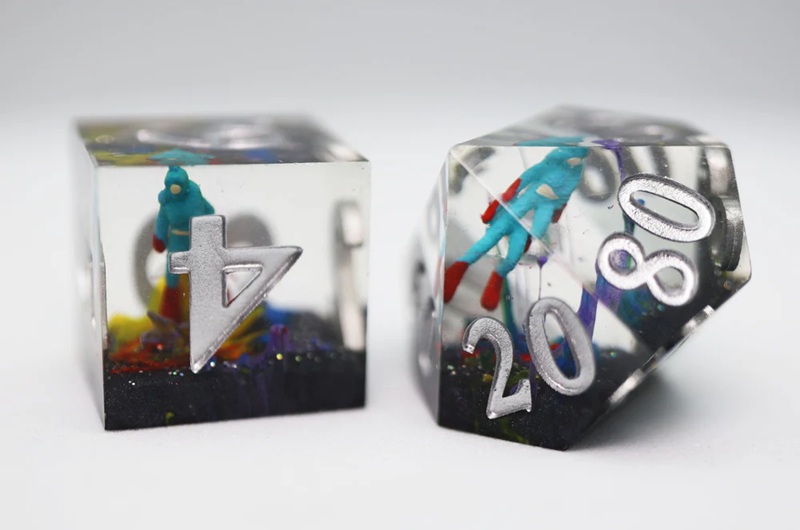
Check out these Steve the Scuba Diver dice

But what about roleplaying in SPACE?

No, I don’t mean playing Starfinder or Traveller or Mothership or Orbital Blues or See You Space Cowboy. I mean actually playing roleplaying games in space.

Well, thankfully, our best and brightest are already investigating the possibility!

Check out this Instagram post from astronaut Rabea Rogge, who was experimenting with how to roll a D20 in space.

Yes, as one of the commenters pointed out, there’s a chance for biasing the die by rolling it so it doesn’t change its axis, but for the most part, Rabea’s technique seems solid.

(Though we really need to get her dice that are easier to read!)

It just goes to show that wherever we go, we will take our stories with us.

The Weird, Wonderful World of Dice

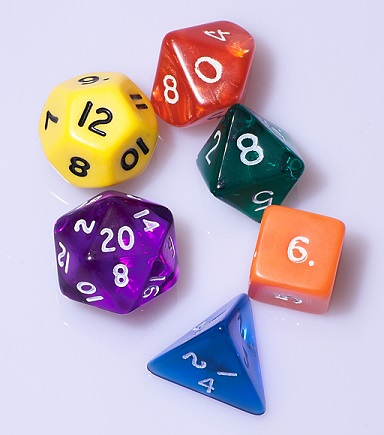
[Image courtesy of ThoughtCo.]

Dice have been an integral part of gaming for centuries. They’re the simplest way to introduce randomness to a game.

The six-sided die is, by leaps and bounds, the most familiar die. The d6, as role-players call it, is a staple of classic board games like Yahtzee and Clue, as well as the centerpiece of role-playing systems like GURPS.

But the d6 is hardly the only kind of die you see in gaming. Plenty of games and role-playing systems rely on dice of other shapes in order to run smoothly.

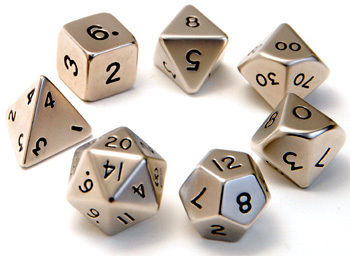
[Image courtesy of Wikimedia.]

If you play World of Darkness role-playing games like Werewolf or Vampire: The Masquerade, then the d10 is your friend. If you enjoy updated editions of Dungeons & Dragons (or even board games like Unspeakable Words or Scattergories), the d20 is a familiar sight, whether it has letters or numbers on it.

A standard dice set for beginners Dungeons & Dragons contains six different dice shapes: a pyramid-shaped d4, a d6, a d8, a d10, a d12, and a d20. (Many come with 2 d10s, one with single digits and one with double digits, allowing you to calculate percentages).

[Image courtesy of Instructables.]

Heck, if you think about it, flipping a coin to decide something is simply rolling a two-sided die.

But when you start delving into the history of games, it’s amazing to see just how far back some of these traditions and conventions go.

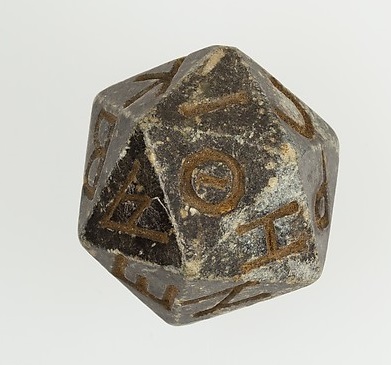
Did you know that The Metropolitan Museum of Art has a d20 in its collection?

Dating back to Roman times (somewhere between the 2nd century BC and the 4th century AD), the above die is inscribed with Greek letters. It’s not certain if this particular die was used for games or religious divination, but there’s no doubt it’s a beautiful example of craftsmanship.

And this is just scraping the surface. One of my favorite dice in my collection is an oversized 3D-printed d20 with Braille markings for every number. Such a cool piece.

Can you think of any strange dice in favorite games of yours, fellow puzzlers? We’d love to hear about them! (Unless they’re fuzzy dice hanging from your rearview mirror. Those don’t make reliable rolls in regular gameplay.)


Thanks for visiting PuzzleNation Blog today! Be sure to sign up for our newsletter to stay up-to-date on everything PuzzleNation!

You can also share your pictures with us on Instagram, friend us on Facebook, check us out on TwitterPinterest, and Tumblr, and explore the always-expanding library of PuzzleNation apps and games on our website!