View a Clue: Crossword Characters

Welcome to the latest edition of PuzzleNation Blog’s most visual feature: the View a Clue game!

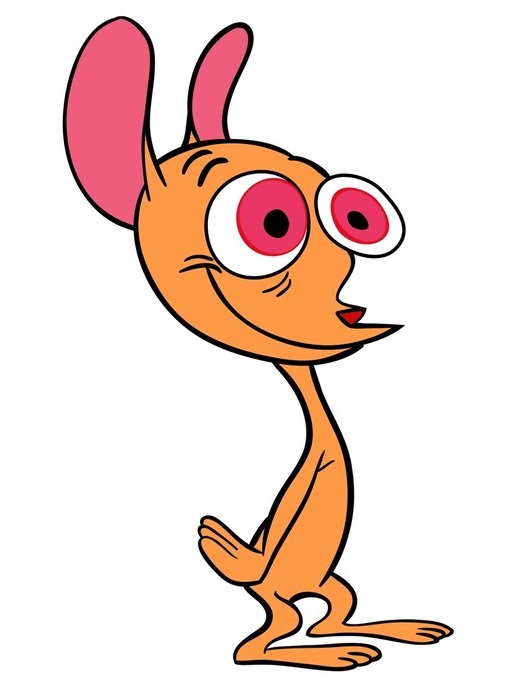
I’ve selected ten fictional characters that commonly show up in crossword grids — some have become crosswordese at this point — and I want to see if the PuzzleNation audience can identify them from pictures. It’s a visual puzzle I call View a Clue!

Without further ado, let’s give it a shot!


#1 (4 letters)

view fcc 1

#2 (4 letters)

view fcc 2

#3 (3 letters)

view fcc 3

#4 (4 letters)

view fcc 4

#5 (4 letters) [I’ve included two possible characters for this one.]

view fcc 5a

view fcc 5b

#6 (4 letters)

view fcc 6

#7 (4 letters)

view fcc 7

#8 (5 letters)

view fcc 8

#9 (4 letters)

view fcc 9

#10 (3 letters)

view fcc 10

[All image credits will be posted with the answers next week.]


How many did you get? Let me know in the comments below! And if you have ideas for another View a Clue game, tell us below!

Thanks for visiting PuzzleNation Blog today! Be sure to sign up for our newsletter to stay up-to-date on everything PuzzleNation!

You can also share your pictures with us on Instagram, friend us on Facebook, check us out on Twitter, Pinterest, and Tumblr, and explore the always-expanding library of PuzzleNation apps and games on our website!

Go Big, Then Go Home: The World’s Biggest Scavenger Hunt

ottawa 1

[Image courtesy of Cornell.edu.]

Have you ever done a scavenger hunt, fellow puzzler? They can be a lot of fun.

Some simply challenge you to find a bunch of random items, while others create a laundry list of activities to complete. Over the last decade or so, businesses have even sprung up to fulfill any party, group, or even city that might require a scavenger hunt for an event.

Yes, you can easily gather a group of friends, hit up any city at a certain point in the year, and find a scavenger hunt event waiting for you. They often involve puzzles, trivia, and other obstacles to success, rather than just a list of tasks to accomplish.

I’ve served as tech support for several, as well as an organizer for themed scavenger hunts at various sci-fi, fantasy, and writing conventions. I was supposed to be running one this weekend; that event, like so many others, was cancelled due to preventative measures to contain COVID-19.

So, as you might expect, I’ve got scavenger hunts on the brain. And with ample time to ponder, I couldn’t help but wonder… how big could you go?

ottawa 2

[Image courtesy of Guinness Book of World Records.]

I mean, if we’re talking a city-wide competition, you’d probably need to complete a half-dozen or a dozen objectives, based on previous city-themed hunts I’ve seen.

But what if it was the biggest scavenger hunt in the world? How many would it be then?

If you said as many as you could from a list of 150, then you have some impressive and specific guessing skills.

On September 10, 2017, the city of Ottawa, Ontario, Canada, hosted a mass scavenger hunt to celebrate the city’s 150th anniversary. (For comparison’s sake, the one listed on the website for this year involved twenty obstacles.)

ottawa 3

[Image courtesy of Ottawa Citizen.]

So, how many people showed up to tackle 150 challenges for this world-record-setting scavenger hunt?

2,733.

Many of them wearing costumes.

Each of them pitched in on answering trivia, solving puzzles, exploring the city, and taking pictures of specific items or scenarios throughout the area.

It sounds like an absolute blast, one that Ottawa went all out for.

I wonder who will try to topple a record like that.

Well, if they do, I can’t wait to see it.


Thanks for visiting PuzzleNation Blog today! Be sure to sign up for our newsletter to stay up-to-date on everything PuzzleNation!

You can also share your pictures with us on Instagram, friend us on Facebook, check us out on Twitter, Pinterest, and Tumblr, and explore the always-expanding library of PuzzleNation apps and games on our website!

Relaxing Games: More Tranquil Than Tactical

Everybody has a copy of Monopoly lying around, but that’s not really the most relaxing game experience, is it?

Most of the classics, however fun, are also pretty competitive. But what about games that help restore your spirit, ease your anxiety, and put you in a good mood?

As much fun as co-op games like Forbidden Island, The Oregon Trail Card Game, and Castle Panic! can be, they can also be a little stressful. And if you’re looking to relax, those might not be the games for you.

So today, I thought we could turn our attention to games that will help you enjoy a more calming gameplay experience.


Now, before I get started, I’m well aware that you might not have these games at the ready. Maybe you’re a jigsaw family and you find calmness and distraction in placing those last few satisfying little pieces and completing the image. Or maybe you like making your own fun with pencil and paper.

Whatever your jam, as long as you’re engaging in play and passing the time in fun ways, you’re already ahead of the game.
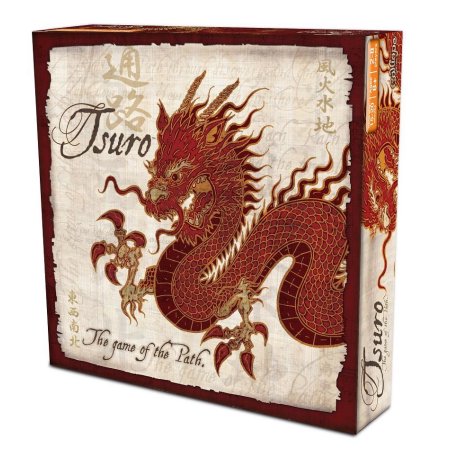

When I asked fellow game enthusiasts for games that are mellow and relaxing, the first one that always comes to mind is Tsuro.

In Tsuro, up to 8 players adopt the role of flying dragons soaring through the sky. Each player chooses from the tiles in their hands in order to build paths on the board, representing their paths through the sky. Naturally, these paths will eventually intersect, and you need to be careful to avoid colliding with another dragon or following a path right off the edge of the board. (Both of those scenarios cause you to lose.)

Despite the potential for competition, most Tsuro games are peaceful affairs as everyone enjoys watching their dragon token loop and swirl across various intersecting paths, hoping to be the last dragon standing on the board. It’s a beautiful, simple game that only takes about twenty minutes to play, and it’s the perfect palate cleanser after a more stressful round of some other game.

beforetherewerestars

[Image courtesy of Board Game Geek.]

Some of the most enjoyable and low-key game experiences are storytelling games. I could recommend one with high-fantasy flavor like Once Upon a Time or one with a tongue-in-cheek Addams Family-esque humor like Gloom. But the one that piques my interest the most is based in mythology and sharing stories around a fire.

In Before There Were Stars…, players claim constellation cards to use in crafting the origin story of the world itself. Each player shares how things were in the beginning, at the dawn of civilization, when a great hero emerges, and at the end of days. Along the way, players grant each other points — little star-shaped point tokens, naturally — for their favorite story moments, as everyone encourages each other in creating epic mythologies.

Although there can be a winner based on points, playing this game always feels more like a storytelling session than a competition, and it can lead to some unforgettable gaming moments.

[Image courtesy of Starlit Citadel.]

Tokaido is another game about movement, but in a very different vein. Players in this game are all travelers, journeying across Japan’s famed East Sea Road from Kyoto to Edo. Whereas most travel-based games are about reaching a destination first, Tokaido is about reaching a destination with the widest array of meaningful experiences.

Along the way, your character can meet new people, enjoy new cuisines, collect souvenirs, visit hot springs, and visit scenic locales. You add experience points for these events (and acquire achievement cards) that represent your traveler partaking of these experiences.

This elegant game bypasses traditional competition entirely, building a unique game mechanic out of living your best life.

[Image courtesy of Board Game Quest.]

Sagrada is another wonderfully visual game about individual accomplishment. In this game, each player is building a stained glass window using different colored dice. No dice of the same color can neighbor each other, so you need to be strategic about how you place the dice you roll.

Each window is different, and has certain rules for maximizing points. (A certain pane can only be a certain color, or a certain die value, etc.) The players can boost their scores by selecting cards that reward them with points if they create certain patterns within their stained glass window.

Except for competing for the best point total at the end, there’s virtually no interaction between players. You’re all simply working simultaneously on the best window, which is a gameplay style that breeds camaraderie more than competitiveness. It’s genuinely encouraging to see fellow players make good choices in dice placement to create the most beautiful, elegant window patterns.

[Image courtesy of Starlit Citadel.]

For a change of pace, let’s look at a game that’s more about interaction with other players. Dixit is a gorgeous card game where each player is given a handful of cards, each depicting a different, unique, evocative piece of art.

Player 1 will choose a card from their hand and say a word or phrase to the other players that has some connection to that card. It could reference color, or part of the imagery. It could be a joke, or an idiom, or a song lyric. The goal is to be vague, but not too vague. The other players will then each select a card from their hand that could also be described by Player 1’s statement, and the cards are all shuffled face down so no one can see who submitted what card.

The cards are then all placed face up, and each player (except Player 1) votes on which piece of art they think Player 1 chose. Player 1 gets points if some (but not ALL) players chose his card. (If every player chooses it, the clue was too easy, and Player 1 gets no points.) And any other player’s card that earns votes also earns that player points.

This sort of associative gameplay really encourages your imagination and teaches you about how the other players think. There’s no other game quite like it on the market today, and it makes for an intriguing, low-key gaming experience.
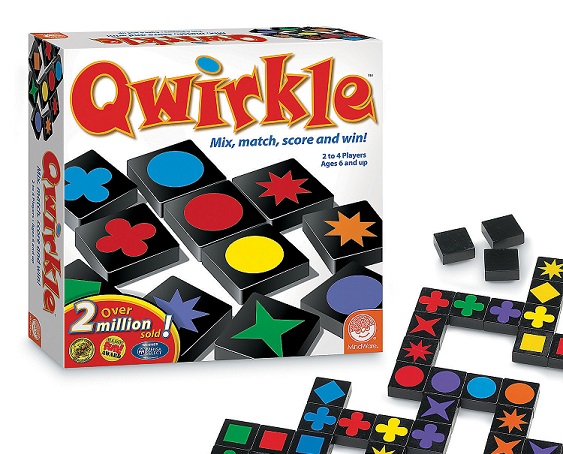
Finally, let’s close out today’s post with a classic tile game that mixes Uno-style color- and pattern-matching with Mexican Train Dominoes-style gameplay. Qwirkle is a bit more competitive than the other games on today’s list, but it’s still a game more about collaborating than outdoing your opponents.

By placing different tiles onto a shared play area — either by matching colors or matching symbols — players earn points. If you complete a Qwirkle — a pattern of all six colors for a given shape or all six shapes in the same color — you earn bonus points.

The lighthearted gameplay style lends itself to friendly competition rather than the cutthroat mien evoked by games like Monopoly. Qwirkle’s not about grinding the other players down, it’s about adding to a colorful world in interesting, inventive new ways.


Thanks for visiting PuzzleNation Blog today! Be sure to sign up for our newsletter to stay up-to-date on everything PuzzleNation!

You can also share your pictures with us on Instagram, friend us on Facebook, check us out on Twitter, Pinterest, and Tumblr, and explore the always-expanding library of PuzzleNation apps and games on our website!

Puzzling From Home!

Problem-solving-crossword

In the wake of puzzly public events like the American Crossword Puzzle Tournament being cancelled, as well as the shutdown of various school districts, workplaces, and businesses in order to limit exposure to the Coronavirus, it’s completely understandable that some puzzle fans may be feeling disappointed or even isolated from their fellow puzzlers.

But fear not! There are all sorts of options available to solvers looking to enjoy a puzzly experience from home, either on their own or with friends.


If you’re looking for crosswords, all you need is your computer. The New York Times, The LA Times, The Washington Post, and many other outlets offer online puzzle-solving, either by subscription or through watching ads before solving.

If you have access to a printer, you can print those puzzles out for the true pencil-and-paper solving experience.

And it’s not just newspapers. Many constructors — Brendan Emmett Quigley comes to mind — offer their own free puzzles semi-regularly (though you’re welcome to tip as a thank you). There is a world of puzzles out there on the Internet awaiting solvers.

But you don’t even have to go to a computer anymore. There are loads of terrific puzzles available right on your phone. Forgive us for tooting our own horn, but Daily POP Crosswords is a great puzzle app with a free puzzle every day and additional puzzle packets available for purchase or through our in-app coin system. (We also offer Word Seeks, Sudoku, and a marvelous story-driven puzzle mystery, Wordventures, if you’re looking for something different.)

Oh, and speaking of something different, if you’re looking to delve into more elaborate puzzles, there are some fantastic puzzle services by mail that offer all sorts of challenges.

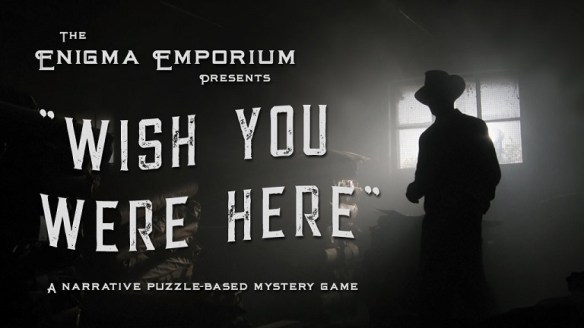
enigmasmall

Wish You Were Here by the Enigma Emporium conceals an entire mystery within a handful of postcards, challenging you to mine them for every scrap of information as you uncover a series of coded messages. It’s spycraft in an envelope, very clever stuff.

The Cryptogram Puzzle Post out of the UK offers something unique, mixing puzzles and encryption with bits of mystery and supernatural narratives to create standalone chapters in an ongoing story. So you can pick one season or an entire year, depending on how deep you want to go!

And for multi-month affairs, there are outlets like Hunt a Killer and The Mysterious Package Company, which create vast, immersive puzzle experiences by mail. (Though according to friends’ recommendations, Hunt a Killer works better without the month wait between installments.)

As you can see, there’s a wide variety of ways you can puzzle from home, whether you prefer to solve online, by email, on the phone, or by mail!


That’s all well and good, you might be saying, but what about the social aspect? Well, there are options there as well, even from the comforts of your home.

Photo by Matt MacGillivray, licensed via Creative Commons

Some puzzlers actually livestream their puzzle-solving online through avenues like Twitch, Facebook, and YouTube. The New York Times periodically does this as well, often with celebrity guest solvers!

You can keep your eyes peeled on Facebook and Twitter for constructors and solvers who do so. It often adds a fun, communal element to puzzle-solving (especially if they struggle with the same tricky clues that you do). Some pub trivia outlets are also moving online to allow for participating from home!

new york times

But if you don’t want to wait for someone to livestream their solving, you can do it yourself! Between Facetime and similar apps on smartphones and all the online avenues for audio and video-chatting (Skype, Google Hangouts, Discord, etc.), you could pair up with a friend and tag-team a crossword puzzle or other puzzly challenge!

It’s like co-working, except with puzzles. Co-solving!

In times like this, where uncertainty abounds and our comfortable routines have been upended, puzzles can offer a wonderful refuge from all the stresses of the world. And with technology on our side, we can even keep the communal joys of puzzling in our lives.

Happy puzzling, friends.


Thanks for visiting PuzzleNation Blog today! Be sure to sign up for our newsletter to stay up-to-date on everything PuzzleNation!

You can also share your pictures with us on Instagram, friend us on Facebook, check us out on Twitter, Pinterest, and Tumblr, and explore the always-expanding library of PuzzleNation apps and games on our website!

A Puzzle Design Competition Hosted by a Secretive Puzzly Society?

yoshi0

[Image courtesy of Activist Post.]

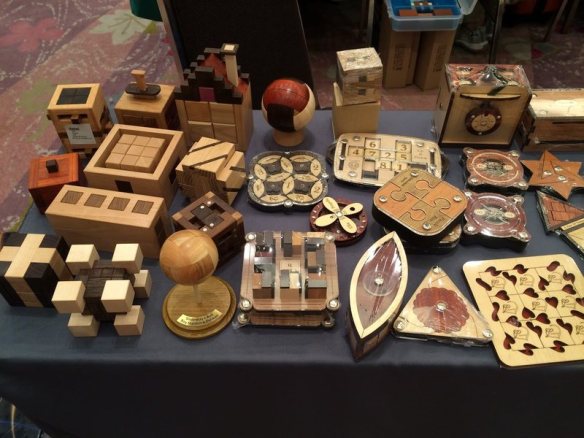
What if I told you that there’s a secret cabal of puzzle enthusiasts lurking in the shadows of the global puzzle community? A group that meets once a year in different locations, rotating between the United States, Europe, and Japan. An invite-only assortment of puzzle collectors and innovators who bring mechanical puzzles to challenge and delight their fellow attendees.

Yes, we’re talking about a clandestine event where puzzle collectors discuss, show off, and trade mechanical puzzles and brain teasers they’ve designed or crafted themselves.

yoshi2

[Image courtesy of Atlas Obscura.]

No commercially available puzzles can be brought as gifts, since you might duplicate a puzzle that’s already in someone’s collection.

But swapping and selling puzzles isn’t all that happens at one of these International Puzzle Party events. No, they’re also home to the Nob Yoshigahara Puzzle Design Competition, an annual award centered around mechanical puzzles. More specifically, the winners of the competition are announced at the IPP.

yoshi1

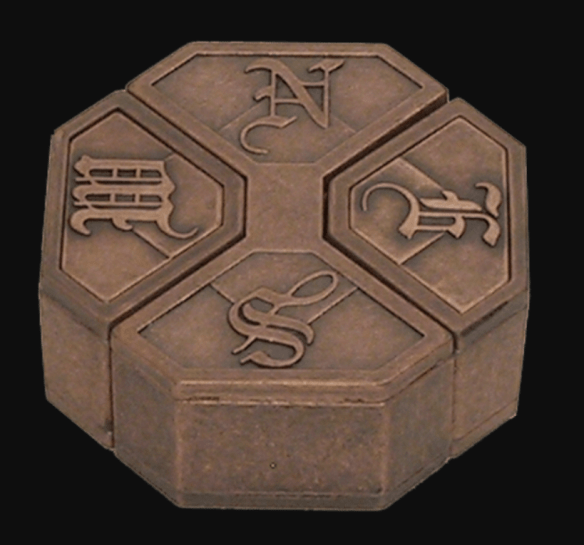
[One of Yoshigahara’s most famous puzzles. Image courtesy of Mr. Puzzle.]

Named after the prolific and innovative puzzle designer Nob Yoshigahara, the competition was founded in 2001, and named after Yoshigahara in 2005.

The entries for this year’s competition have until June 15th, 2020, to submit their puzzle for consideration. (This year’s competition was announced back in November of last year.)

Usually, only 5-7 puzzles out of all those submitted will be selected by one of that year’s judges for consideration. Each puzzle is graded on how innovative the concept is, how well the puzzle is physically designed (both aesthetically and mechanically), and how enjoyable the solving experience is.

[The 2017 competition winner, Kakoi.]

Anyone may submit his or her own mechanical puzzle design, independent of Puzzle Party affiliation.

There is a Puzzlers’ Award for the top design as well as Jury Prizes for other submissions (a grand prize, 1st prize, and honorable mention).

You can check out a listing of the 2018 competition submissions here to see the incredible variety and creativity represented in a single year’s pool of submissions. (Including links for purchase if any of them catch your eye!)

Personally, I’m a sucker for secret societies, invite-only activities, and so on, so I love the concept of a puzzle competition created for and judged by fellow puzzlers.

Oh, wait. Before I go. You may be asking yourself why all the secrecy? Well, apparently, there were several attempts by companies to infiltrate the event and bootleg puzzle ideas for market. It’s simultaneously insane and totally believable for spycraft like this to be taking place at a puzzle event.

In any case, I wish the best of luck to everyone submitting their puzzles to this year’s competition!


Thanks for visiting PuzzleNation Blog today! Be sure to sign up for our newsletter to stay up-to-date on everything PuzzleNation!

You can also share your pictures with us on Instagram, friend us on Facebook, check us out on Twitter, Pinterest, and Tumblr, and explore the always-expanding library of PuzzleNation apps and games on our website!

Intuitive vs. Non-Intuitive Puzzles

littlegirlatgrandmas

[Image courtesy of The Spruce Crafts.]

Sometimes, when you look at a puzzle, you know immediately what to do and how to solve. In my opinion, a great deal of Sudoku’s success is due to its intuitive nature. You see the grid, the numbers, and you know how to proceed.

Crosswords are similarly straightforward, with numbered clues and grid squares to guide new solvers. (The “across” and “down” directions also help immensely.)

That’s not to say that these puzzles can’t be off-putting to new solvers, despite their intuitive nature. I know plenty of people who are put off by crosswords simply by reputation, while others avoid Sudoku because they’re accustomed to avoiding ANY puzzle that involves numbers, assuming that some math is involved. (I suspect that KenKen, despite its successes, failed to replicate the wild popularity of Sudoku for similar reasons.)

But plenty of other puzzles require some explanation before you can dive in. A Marching Bands or Rows Garden puzzle, for instance, isn’t immediately obvious, even if the puzzle makes plenty of sense once you’ve read the instructions or solved one yourself.

The lion’s share of pen-and-paper puzzles fall into this category. No matter how eye-catching the grid or familiar the solving style, a solver can’t simply leap right into solving.

Thankfully, this won’t deter most solvers, who gleefully accept new challenges as they come, so long as they are fair and make sense after a minute or so of thought. Cryptic crossword-style cluing is a terrific example of this. At first glance, the clues might appear to be gibberish. But within each clue lurks the necessary tools to unlock it and find the answer word.

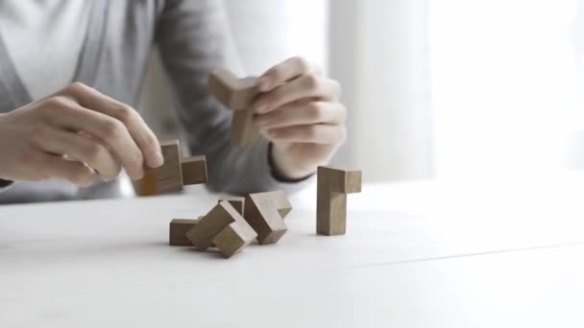
Brain teasers often function the same way. You’re presented with a problem — a light bulb you can’t see and three possible switches for it, for instance — and you need to figure out a way to solve it. It might involve deduction, wordplay, or some clever outside-the-box thinking, but once you find the answer, it rarely feels unfair or unreasonable.

solvingwoodenbrainteaser

[Image courtesy of Deposit Photos.]

But, then again, there are also puzzles that can baffle you even once you’ve read the instructions and stared at the layout for a few minutes. Either the rules are complex or the solving style so unfamiliar or alien that the solver simply can’t find a way in.

In short, puzzles as a whole operate on a spectrum that spans from intuitive to non-intuitive.

Want an example of baffling or non-intuitive? You got it.

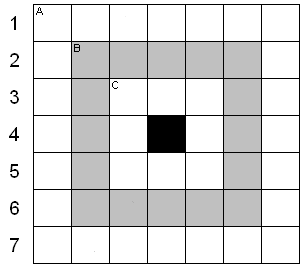
GAMES Magazine once ran a puzzle entitled “Escape from the Dungeon,” where the solver had to locate a weapon in a D&D-style dungeon. A very small crossword puzzle was found in one room on a paper scroll.

But the solution had nothing to do with solving the crossword.

The actual solution was to take the crossword to a magician who removed letters from the fronts of words. Removing the C-R-O-S left you with a sword, completing the overall puzzle.

That sort of thinking is so outside the box that it might as well be in a different store entirely. Video games, particularly ones from the point-and-click era, have more than their fair share of non-intuitive puzzles like this. You can check out these lists for numerous examples.

3122

And as escape rooms grow in popularity, more of them seem to be succumbing to less intuitive puzzling as a result of trying to challenge solvers.

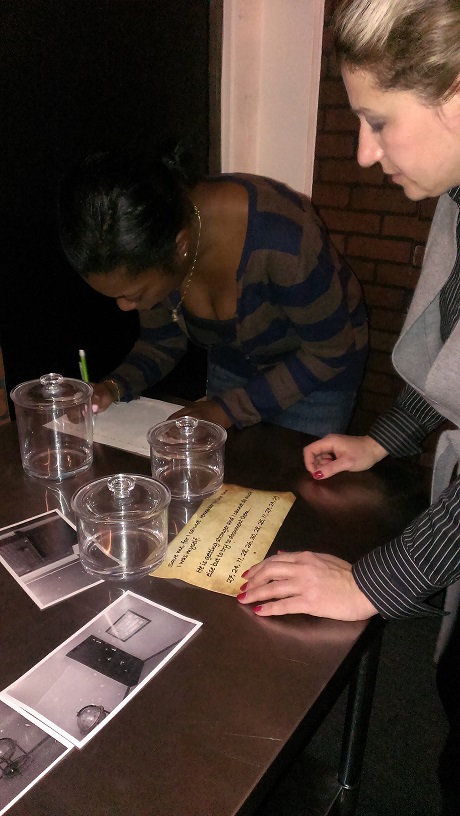
For example, in one escape room I tried, various fellow participants uncovered two stars, a picture of the three blind mice, and four different items that represented the seasons. Amidst all the locks to open, puzzles to unravel, and secrets to find, it never occurred to any of us that these three unconnected numbers would have to be assembled as a combination to a lock. By asking for a hint, we were able to figure out to put them together and open the lock, but it’s not a terribly intuitive puzzle.

Perhaps the greatest challenge for a puzzle constructor — be it a pen-and-paper puzzle, an escape room scenario, or a puzzle hunt dilemma — is not creating a dynamite, unique puzzle, but ensuring that finding the solution is fair, even if it’s difficult or mind-boggling.

This sort of thinking informs not only my work as a puzzlesmith, but the designs for my roleplaying games as well. If my players encounter a gap, there’s some way across. If there’s a locked door, there’s a way through it. Oftentimes, there’s more than one, because my players frequently come up with a solution that eluded me.

In the end, that’s the point. All puzzles, no matter how difficult, exist for one reason: to be solved. To provide that rush, that a-ha moment, that satisfaction that comes with overcoming the clever, devious creation of another sharp mind.

And non-intuitive puzzles are tantamount to rigging the game.


Thanks for visiting PuzzleNation Blog today! Be sure to sign up for our newsletter to stay up-to-date on everything PuzzleNation!

You can also share your pictures with us on Instagram, friend us on Facebook, check us out on Twitter, Pinterest, and Tumblr, and explore the always-expanding library of PuzzleNation apps and games on our website!