There’s a lot of misinformation out there about the connection between puzzles/games and brain health.
If you’re a puzzle fan, no doubt you’ve seen the onslaught of ads about “brain fitness,” “brain training,” and all sorts of promises about memory help and staving off Alzheimer’s, dementia, and other cognitive conditions.
A casual Google search will turn up dozens of articles online arguing both sides. And so much of the data is inconclusive at best.
But!
There are absolutely benefits to playing puzzles and games in very specific circumstances:
The University of Exeter conducted a study involving more than 19,000 participants that concluded that adults age 50 and older who regularly solve puzzles like crosswords and Sudoku have better brain function than those who do not.
An article from Scientific American discussed how crossword solving engages the episodic buffer, one of the mechanisms related to our working short-term memory, our ability to temporarily hold information while performing cognitive tasks.
Jigsaw puzzle solving can induce a mental state similar to dreaming, one that helps with stress, relaxation, and mood.
Anhedonia is the loss of the ability to enjoy things you would normally find pleasure in. Basically, the goal post of “enjoyable” moves, meaning something you previously enjoyed no longer results in the same good feelings it did.
And when you consider that anhedonia is present in an estimated 70 percent of patients with major depression issues, you can see how devastating anhedonia’s moving goal posts would be for someone already struggling with depression.
So how does this game work as a diagnostic tool?
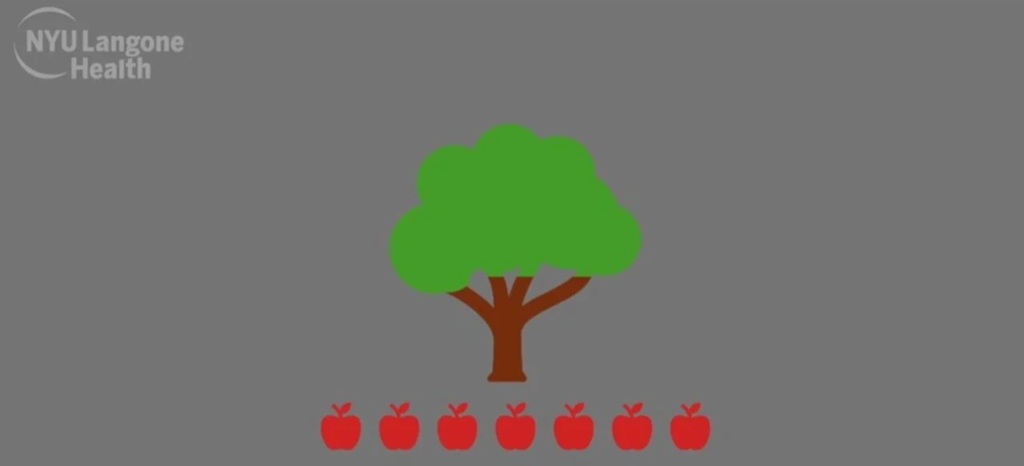
The game challenges the player to collect the most apples from a series of digital trees. With each round of harvesting, fewer apples fall from the tree, and at some point, a player will move on to the next tree.
That moment, that decision point, is where the researchers are focusing their diagnostic attention:
The researchers asked 120 game players—50 diagnosed with major depression and 70 who were not—to compete to collect the most apples falling from digital trees. Researchers use such foraging tasks because reward-seeking circuitry, especially regarding something that looks like food, has been engrained in the mammalian brain by evolution.
And it turns out that the subjects who were previously diagnosed stopped taking pleasure in the game 50 percent sooner than non-diagnosed players.
While the non-diagnosed players would often stick with a tree until its yield dropped to 5 apples, those diagnosed with depression abandoned one tree for the next while the yield was still 8 or 9 apples.
Yes, like most diagnostic tests, this game will probably prove less effective as knowledge of it grows, but it remains a valuable option for researchers.
Dan Iosifescu, MD, a professor in the Department of Psychiatry at NYU Grossman School of Medicine, elaborates on that:
Depression is increasingly thought of as an umbrella term that may include several distinct conditions… Measuring reference points may help us identify a specific subtype of depression linked to anhedonia, clarify its disease-causing brain computations, and tailor treatments.
And we may be able to do this remotely by asking patients, rather than traveling repeatedly for in-person visits, to spend a few minutes per week playing a smartphone game that lets us quickly adjust their treatment.
Greater accessibility of testing is definitely a good thing (although at the moment, the game is not publicly available to try).
Here’s hoping this game and others like it can be used to get specialized help to those who need it.
Do you find certain games and puzzles therapeutic, fellow puzzler? Let us know in the comments section below! We’d love to hear from you.
When it comes to puzzly video games, Tetris is the granddaddy of them all.
Yes, there are some amazing puzzle games that have come along in the years since — Portal, The Talos Principle, and Baba Is You, to name just a few — but Alexey Pajitnov’s creation is ubiquitous. It’s part of our cultural fabric. Everyone knows Tetris with just a glance.
And people are still innovating with Tetris decades later.
Previously I’ve written about variations on Tetris that have caught my eye.
There’s Hatetris, where the computer gives you the worst possible piece on every turn, as well as Lovetris, where the computer gives you the exact piece you need to clear a single line.
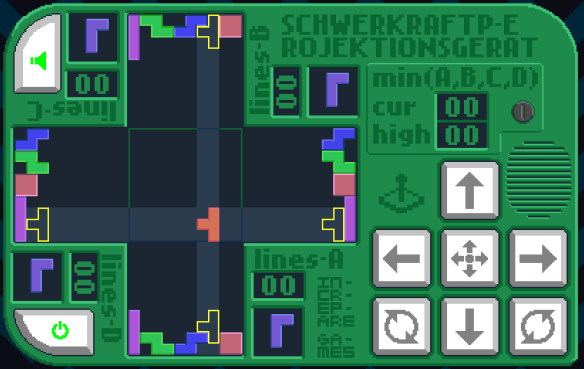
There’s also Schwerkraftprojektionsgerät, aka 4-directional Tetris, where you have four Tetris games running at once.
So when a new version of Tetris catches my eye, you know I’m gonna give it a shot.
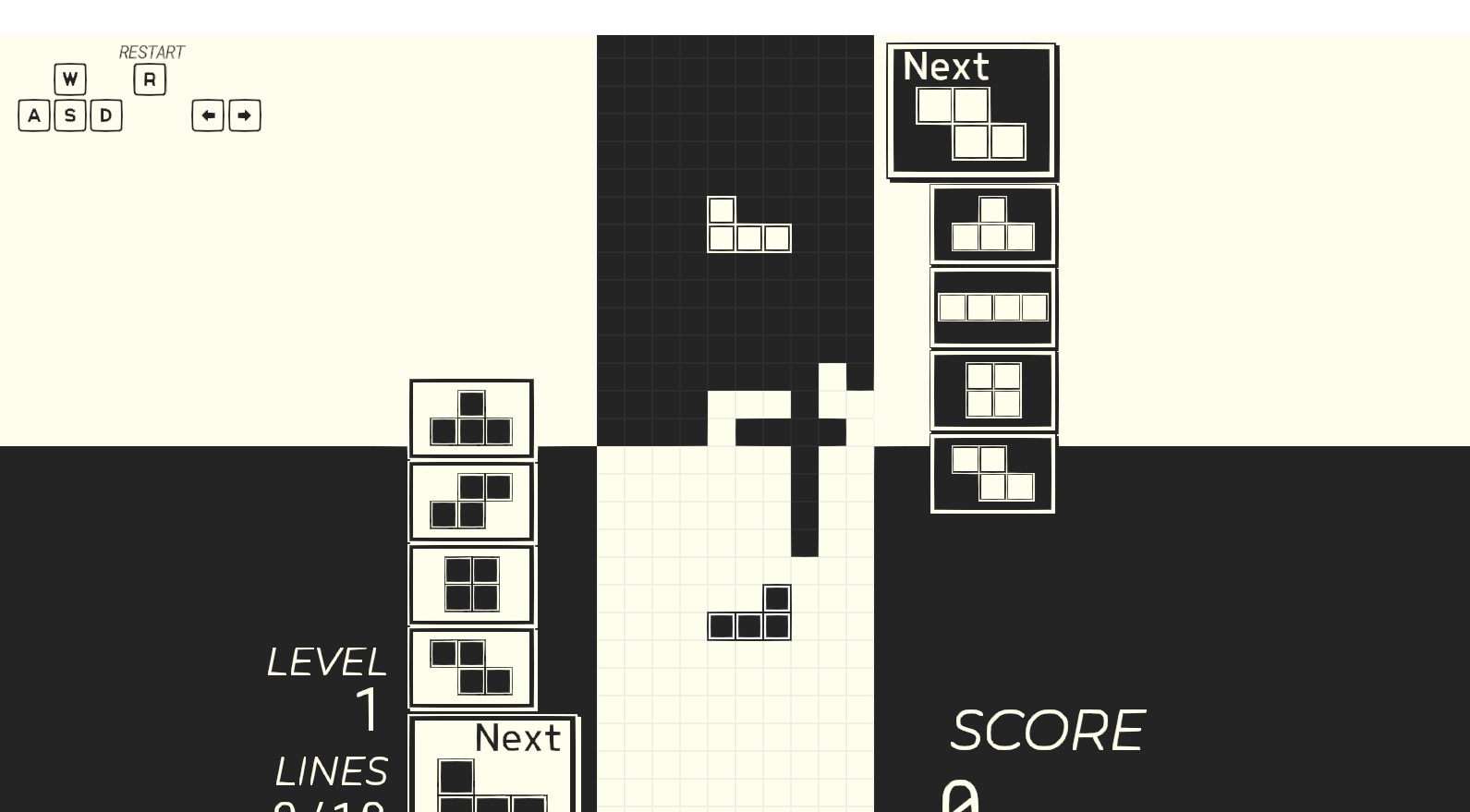
Say hello to Uraomotetris, aka Uraomote Tetris, the creation of gamer and programmer Hirai_Sun.
Uraomote (ウラオモテ) is a Japanese term meaning “two sides” or “front and back,” which is very thematically appropriate, particularly with the stark black and white color scheme.
And although it looks like a two-player game, like the old Push Mode from Tetris DS, this is actually a single-player game.
Your goal is to play the game simultaneously from above and underneath, using the white pieces falling from above and the black pieces rising from below.
You control the rotation of pieces with the arrow keys, and the placement of them with the A, S, D, and W keys. It takes a little getting used to, but once you get into the rhythm of placing one white piece, then one black piece, back and forth and back and forth, it becomes a really engaging puzzle.
You’re not just trying to think in terms of cancelling lines, you’re also trying to set yourself up for success from both sides. You begin plotting two and three moves ahead. You’re stoked when the same piece arrives from above and blow, so you can strategize.
Of course, then I would manage to hit the wrong key and mess it all up.
But a more dexterous player could have an absolute blast with this game.
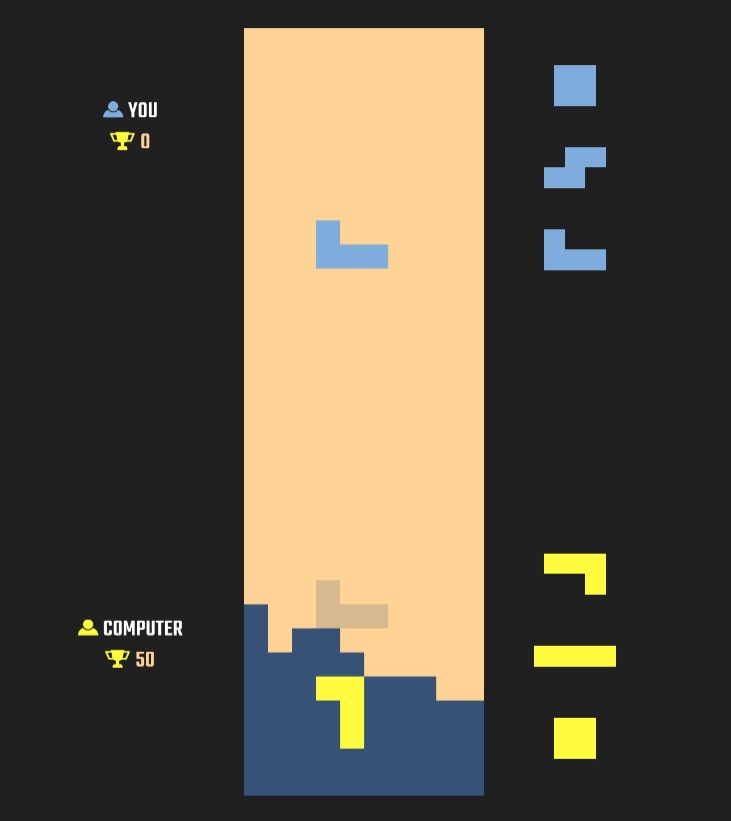
Oh, and if you wanted a two-player competitive version, you can check out Tetrio.io. It allows you to play against the computer in single player or share your link with a friend to compete against them.
The goal is to push your opponent past their border (yours to the north, theirs to the south) by completing lines and lowering their playfield.
This is honestly a great way to practice for Uraomotetris. Once you’ve gotten into the habit of playing your side while defending against your opponent’s, it helps you visualize playing both sides simultaneously on your own.
There’s a wonderful sense of balance in Uraomotetris, because unlike most versions of Tetris, where you’re aiming for the bottom and eliminating lines and pieces, in this game, you really want to keep it as close to the center line as possible.
Your very goal is not to do what you do in every other version of Tetris.
It’s very zen, in a way, and quite lovely. (But also weirdly nerve-wracking at the same time.)
Have you tried any Tetris variants, fellow puzzler? Let me know in the comments section below! I’d love to hear from you.
The goal? To share research, showcase games, and discuss the future of game studies through the lens of BIPOC experiences (Black, Indigenous, and People of Color).
Here is a bullet point list of themes the conference was designed to explore:
Representation and Identity in Video Games
Digital & Analog Games as Cultural Artifact
Games By & About Black and Indigenous Communities
Decolonizing Game Development & Design
Integration of Indigenous & Black Knowledge Systems
Afrofuturism in Gaming
Cultural Preservation & Digital Heritage
Social Impact & Activism Through Games
Diversity, Equity & Inclusion in Playful Technologies
Both board games and video games were topics of discussion across the three-day event, with panels and presentations covering properties as varied as Yu-Gi-Oh!, collegiate Esports, The Last of Us, murder mystery games, Dragon Age, virtual reality, the cultural value of arcades, and more.
“I think one of the most important things to recognize about games is that they are kind of a cultural artifact. And being a cultural artifact, it’s important to ask questions about what these things mean in society, or what these things mean to the people who make them.”
“… One of the things I think is really interesting in game studies is we have the opportunity to think critically about the kinds of problems we’re solving and then also the kinds of solutions we’re offering. So a lot of what people talk about in, say, decolonizing games is about reinvestigating those two questions, what’s the real problem here? What’s the source of that problem? Similarly, how are we solving the problem?”
For years, I have discussed in this blog how the world of puzzles and games not only reflects our culture and choices, but why that’s important. But I can only examine those things through one particular lens, that of a white cishet male. There are blindspots I’m unaware of and experiences I simply don’t have, despite my best efforts.
That’s why it’s so important to have other voices included in the discussion, and events like this are crucial to the health of the games industry and our understanding of why we play games at all.
How the experiences of Black users suffer in virtual reality due to whiteness as a default in so many games.
How the roles of Black and Latinx characters in games like Overwatch and Marvel Rivals contribute to not just representation, but reinforce perceptions of particular ethnic groups only in violent situations, not those of support or providing nonviolent solutions.
How video games are being used to preserve Latinx culture and the artistic legacy of the Hmong.
I learned about topics like Quare Theory and Misogynoir (how racist and anti-Black depictions affect the public perception of Black women), explained through the medium of video games.
But the article I found myself returning to several times over the last few days was “Decolonizing Play: Exploring Frameworks for Game Design Free of Colonial Values.”
It was startling to realize just how many video games are foundationally built on the values of Colonialism, and how easy it would be to NOT reinforce those harmful cyclical patterns.
From the paper by Elaine Gomez: When the topic of colonization arises, many game developers often hesitate to get involved in meaningful and constructive design conversations around how to mitigate values that are heavily ingrained in game theory and player expectations.
Some of the conversations broached by these panels and papers are uncomfortable, but difficult conversations are worth having. Challenging the biases and preconceived notions that games are often built upon is worthwhile. (I’m hoping to reach out to some of the Conference’s participants for more details in the coming weeks to follow up on these enlightening discussions.)
In the meantime, I encourage everyone to read the proceedings from the event and take some time to really ponder the topics presented.
The world of puzzles and games is big enough for everyone, and only gets better when everyone feels included. The 2025 Conference on BIPOC Game Studies is proof of that.
Rochester, New York is the home of The Strong National Museum of Play, and they have a very important mission: to chronicle the history and importance of play.
Child development, social interaction, imagination… all of these key features in a healthy individual are facilitated by play, and the staff at The Strong help us not only understand that process, but celebrates it by hosting both the National Toy Hall of Fame and the World Video Game Hall of Fame under its brightly-colored umbrella.
As you might have guessed, puzzles and games play a significant role in The Strong’s work, and they’re represented in both Halls of Fame. Clue, Chess, Scrabble, the Rubik’s Cube, and Dungeons & Dragons are all inductees in the National Toy Hall of Fame, while Myst, Tetris, The Oregon Trail, and Where in the World is Carmen Sandiego? are among the puzzlier inductees on the video game side of things.
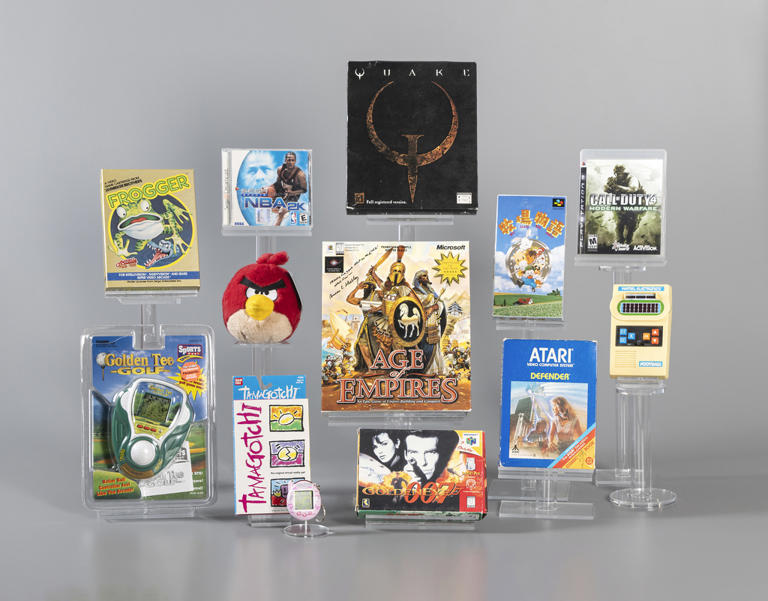
This year’s finalists for the 2025 class run the gamut from 8-bit classes, modern phenomenon, and games that took play to surprising new places, and they represent different genres, play styles, and aspects of gaming across decades.
The 2025 finalists are: Age of Empires, Angry Birds, Call of Duty 4: Modern Warfare, Defender, Frogger, Golden Eye, Golden Tee, Harvest Moon, Mattel Football, Quake, NBA 2K and Tamagotchi.
What a field! Everywhere from arcades (Frogger) to pocket games (Tamagotchi) are on display here, as well as social gaming both in person (Golden Eye) and online (Quake).
The nominees were chosen from thousands of nominations online. The field was then narrowed by staff members at The Strong based on “longevity, geographical reach, and influence on game design and pop culture.” Only a small handful of these finalists will be selected by an international committee of experts as this year’s inductees.
Everyone has an award show that they geek out over, and you’re probably not surprised to discover that these Halls of Fame are two of my favorite awards given out each year. I love seeing deserving games and puzzles get the spotlight they deserve for helping change how we play and interact with each other.
Five years ago, I wrote my first (and until then, only) post about horror movies in this blog. It was part of a series of posts about the best puzzle solvers across various genres, media properties, and franchises. And I really liked that post.
However, at the time, I felt like I had to avoid certain film franchises and subjects to keep the post as family friendly as possible.
But PuzzCulture is a different animal from its predecessor, so let’s push the boundaries a little bit and make the most comprehensive and accurate list possible, shall we? Let’s honor Halloween right by celebrating the sharpest and most cunning characters to ever elude those relentless meat grinders known as horror films and horror video games.
These are the characters you want on your side, because they’re clever, decisive, and immensely capable. After all, most horror movies and games are populated with idiots who are destined to perish before the film’s conclusion.
So instead, these are the characters who break the mold.
When you’re confronted with a monster who hunts people through their dreams, you have to be pretty clever to survive. After all, you have to sleep at some point. When it comes to the Elm Street franchise, they don’t come more clever than young Nancy Thompson.
Nancy discovers she has the ability to pull things from the dreamworld into the real world, and plans to use this ability to stop Freddy Krueger once and for all. She not only sets an alarm to ensure she wakes up before falling victim to Freddy in the dreamworld, but sets numerous booby traps in her house to ensnare and hurt Freddy.
Nancy is a top-notch puzzler for not only figuring out how to use her incredible ability to her advantage, but devising a plan (and a backup plan!) to save herself.
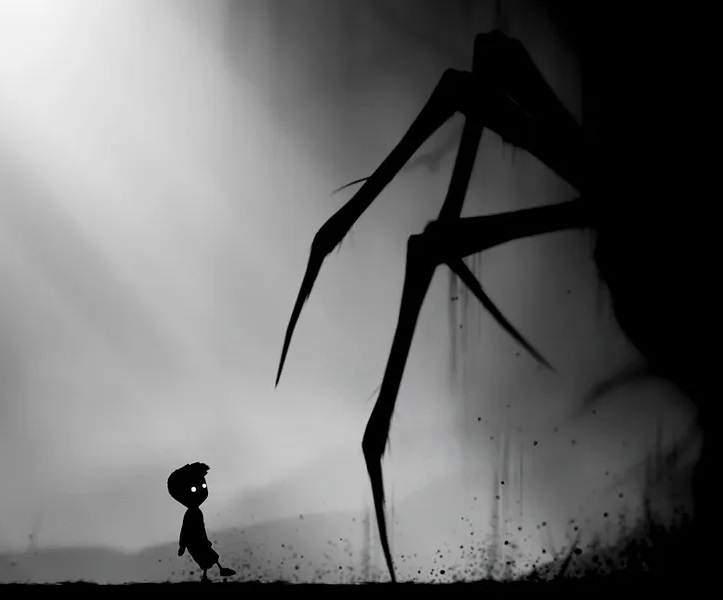
One of my all-time favorite video games, Limbo is a moody, atmospheric puzzle horror game where our silent protagonist ventures through dangerous mechanical traps and shadowy creatures in search of his missing sister.
Easily one of the most clever puzzle platform games of the last twenty years, Limbo allows players to climb, push and pull objects, and manipulate the environment to allow the boy to continue his search. Trial and error is the name of the game here, but it takes some serious puzzle-solving skills to survive to the end.
The Lament Configuration is a Rubik’s Cube-like puzzle box that opens a portal to another dimension, where monstrous beings called Cenobites promise untold delights in exchange for your soul. Unfortunately, Kirsty is a clever enough puzzler to solve the Lament Configuration and open the portal.
Thankfully, Kirsty is also clever enough to outmaneuver the Cenobites, buying herself time by realizing someone has escaped their clutches and working to save herself by finding the fugitive.
So Kirsty not only figures out the rules of monsters from another dimension and how to use them, but solves a difficult puzzle box (first opening it, then solving it in reverse to close it) in order to save herself. A pretty sharp cookie, to be sure.
A young FBI trainee who finds herself tangling with two serial killers — one on the loose, another in custody — Clarice Starling has to not only save a young woman kidnapped by Buffalo Bill, but do so while unraveling the word games and riddles of the devious and brilliant Dr. Hannibal Lecter.
Clarice is perhaps the most overtly puzzly of our heroes, solving anagrams and figuring out the double meaning behind many of Dr. Lecter’s riddles and clues in order to get closer to stopping Buffalo Bill. Along the way, she uncovers information missed by more seasoned investigators, even managing to survive an attack by Buffalo Bill (in the dark!) and saving the kidnapped girl in the process.
If you’re ever in danger, hope that Clarice Starling is on the trail.
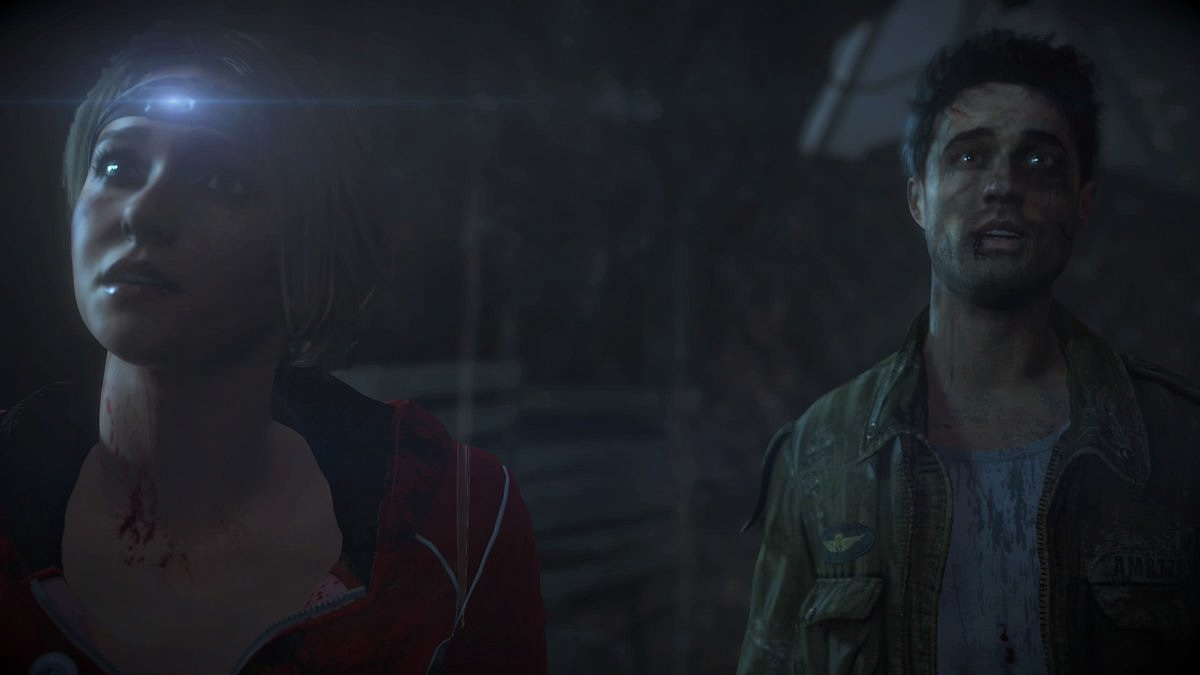
Mike and Sam, Until Dawn
In the interactive horror game Until Dawn, a group of high school pals return to a cabin on a snowy mountain to honor the disappearance of two friends a year earlier. Unfortunately, more tragedy awaits them as a maniac stalks the mountain and evil lurks behind every choice the players make.
Several characters get heroic moments in the game, but nobody more so than Sam and Mike, who manage to wordlessly communicate a plan to stop the dark forces hunting them. (A plan that iron-willed players can help execute, saving Mike and Sam and any other characters that managed to make it to dawn.)
In a game where both characters and players can make clever or clumsy decisions, Sam and Mike definitely stand head and shoulders above the rest.
Imagine that you’re being hunted by a monster that lurks in the dark. It seems like an obvious solution to simply stay in the light, but when that monster is both intelligent and cunning, that’s a taller order than you think. Bret, along with his girlfriend Rebecca and Rebecca’s family, are being pursued by Diana, a creature who can only appear when it’s dark.
When Diana cuts power to the entire neighborhood, everyone must scramble for safety. Thankfully, the resourceful Bret is on their side, and he thwarts Diana’s attacks several times. When she knocks the flashlight from his hands and charges him, he banishes her momentarily with the brightness of his smartphone screen. As he runs for a car outside, she ambushes him from a shadow, but he escapes again by using the key fob in his pocket to activate the car’s headlights.
Effective puzzlers always make the most of the tools at their disposal, and Bret is a most effective puzzler.
We meet many criminal investigators in the Saw franchise, but arguably none are more capable than Agent Peter Strahm. Strahm not only deduces important information about Jigsaw’s apprentice in Saw IV, but he actually outwits one of the apprentice’s traps in Saw V!
Using the same pen he would nervously click to relieve stress, Strahm manages to outlast the Water Trap, where his head was trapped in a cube that quickly filled with water. (I won’t go into detail, but anyone who has watched House, M*A*S*H, or Nobody can probably figure out how.)
Although Strahm doesn’t get to walk off into the sunset (very few do in Saw movies), he proved far more capable than many who chose to tangle with Jigsaw and his apprentices.
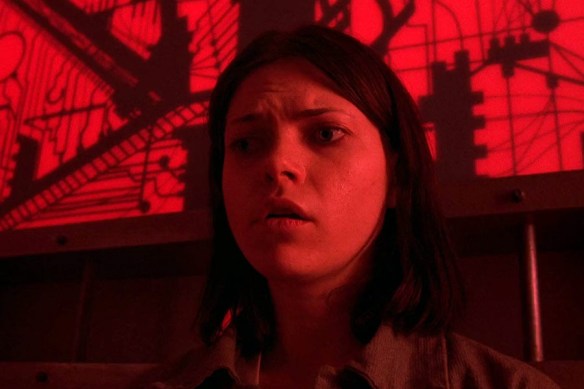
Sometimes, a good puzzler is plunked down in an unfamiliar situation and has to make sense of it all. (This is the premise of many an escape room or a video game, as well as the truth regarding many coded puzzles or puzzles with symbols.) The situation in Cube is like that times a thousand.
Leaven is one of six people trapped in a maze of interconnected cubical rooms, many of them booby-trapped in various ways. As a young mathematics student, Leaven is immediately intrigued by the numbers inscribed in the small passages that connect the various rooms. The group soon realizes that the rooms are shifting periodically, making the maze harder to solve.
After several theories don’t pan out, Leaven manages to unravel the pattern of the trapped rooms — realizing those rooms are related to prime numbers (specifically powers of prime numbers) — and navigates the group through the ever-shifting maze toward an exit.
The stakes may not always be as high as they were for Leaven, but she never gave up and always approached the puzzle from a fresh angle when thwarted. That’s a sign of a true puzzler.
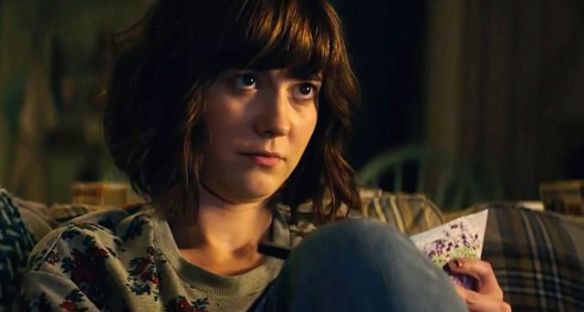
After being run off the road in an accident, Michelle wakes up in a well-stocked underground bunker. She’s been taken there by Howard, the bunker’s owner, who tells her the surface is uninhabitable and the air outside is poisoned. Michelle quickly realizes that Howard is unstable, but must bide her time before attempting to escape.
Michelle is another remarkably resourceful individual, mapping out the ventilation system in the bunker (while doing repairs), fashioning a hazmat suit out of found items, and outwitting Howard long enough to escape. (Once free, she even manages to whip up a Molotov cocktail and dispatch an unexpected threat.)
Some of the most devious puzzles are the ones where you have to figure out how to use what’s in front of you in creative ways to complete a task. Michelle has this skill in spades.
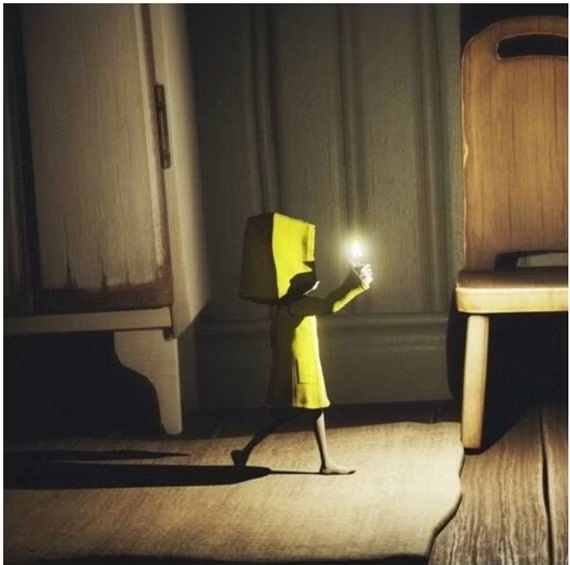
A hungry nine-year-old girl in a yellow raincoat, Six is the protagonist of Little Nightmares, a brilliant puzzle-platformer where the player must outmaneuver hulking monstrosities and sneak their sneakiest sneaky selves through treacherous scenarios.
Six is patient, resourceful, and pragmatic, carefully choosing when to be stealthy and when to be bold, as both are required to survive the game.
Through pattern identification, enemy observation, and learning from your mistakes, you and Six navigate the oversized horrors of the game. (While the puzzles in Limbo often require the player to die more than once before figuring out the correct path forward, Little Nightmares allows players chances to figure out the puzzle ahead of time, making for a different, but equally satisfying, solving experience.)
Erin joins her boyfriend at a family gathering, only for things to turn sour as masked invaders target the party’s guests. But they get more than they bargained for, as Erin quickly reveals herself as one of the most capable horror movie protagonists in the history of the genre.
Erin gathers information, sets traps, outwits the bad guys at seemingly every turn, and generally dazzles with her intelligence, tactical skill, and resourcefulness.
You know that puzzle where you have to connect all the dots in the square with only three lines, but to do so, you have to draw outside the square? That puzzle wouldn’t fool Erin for an instant. She is constantly thinking outside the box — and the house — in order to accomplish the most with the fewest moves.
Horror movies haven’t seen a puzzler like Erin before, and I almost feel bad for any bad guys who get in her way.
Did I miss any world-class puzzlers from horror movies? Let me know in the comments section below! I’d love to hear from you!
There are plenty of terrific video game puzzles out there. Whether you’re talking about video games where the vast majority of the gameplay is puzzle solving (like Myst, Portal, The Witness) or games in other genres that still use puzzles in creative ways (Resident Evil, Silent Hill, Uncharted), puzzles are part of the fabric of video games.
But sometimes, it’s almost more interesting when people introduce puzzly elements to non-puzzle games, because it shows off the creativity, cleverness, and skill of the designer.
People have designed escape room-style puzzles in Super Mario Maker (not to mention working calculators!) and Minecraft is known for its user-generated puzzly challenges.
But I don’t think I ever expected Animal Crossing: New Horizons to end up as a refuge for puzzly minds.
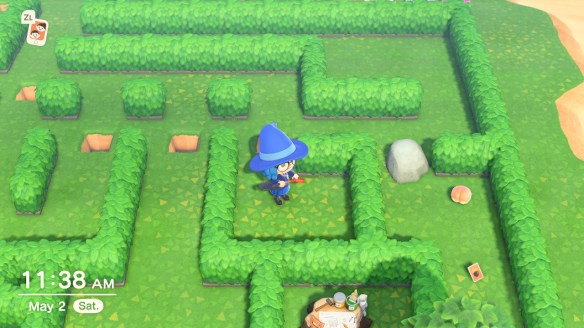
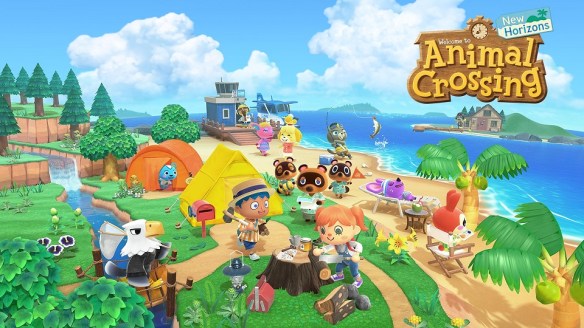
For the uninitiated, Animal Crossing: New Horizons is a game where each player gets their own island, on which they can build a house, create their own paradise, and interact with fellow players. You can collect animals, plants, fruit, and other resources to craft items. There are tasks to complete, and more characters will arrive to explore your island.
We previously reported on Animal Crossing back in May of 2020 when guest blogger Jen Cunningham discussed their May Day event. During the event, game designers created a special island with a maze and a series of tasks for players to complete as they solved the twisty turny path before them. It was a big success, one of many for the game in 2020.
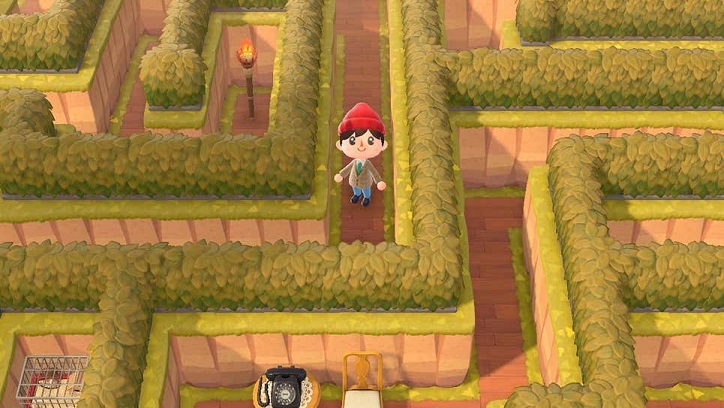
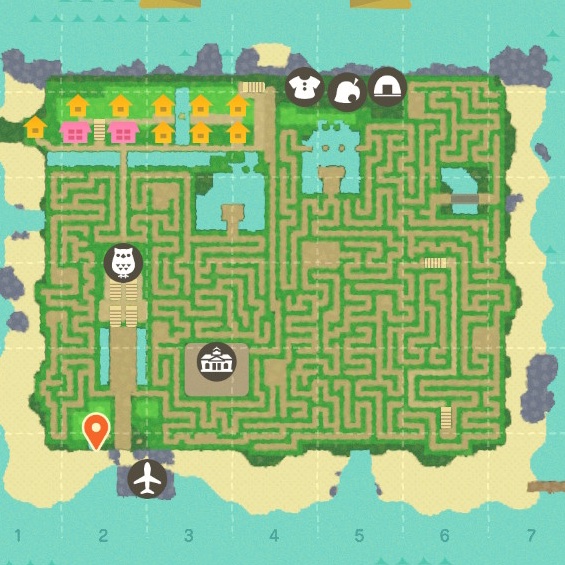
No, a user named Avery Monsen spent about two weeks turning his island into a diabolical labyrinth of his own design. After deep diving into the game, the creation of Avery’s maze was driven by two factors:
1. It was more fun than the traditional game play
2. It would make the game virtually unplayable, which would make it easier to put down for a while.
And it looks like his plan succeeded. Once the maze was finished, he put the game away. (He recently returned to the game to check out a programming update.)
Apparently, the maze is complex enough to cause travel from any key location to any other key location to last ten minutes. And for a game where you’re free to explore wherever, ten minutes to get from place to place is an eternity.
“I wouldn’t say I forgot about my maze, but I definitely forgot how much of a hassle it is. It’s a nightmare,” Monsen said. “So, I took a few screenshots and posted them to my Twitter. I was very quickly flooded with people who were impressed by my dedication and terrified by my obsession. Both of these reactions are valid.”
He has shared the address code so that other players can visit his island and try their hand at his now-famous labyrinth. “I hope people enjoy my island and I hope it doesn’t make me look totally nuts,” he said.
Who knows what other puzzly works are lurking out there in the world of Animal Crossing: New Horizons, just waiting to be revealed?













 PuzzCulture