Find Balance in This New Variation of Tetris: Uraomotetris!

When it comes to puzzly video games, Tetris is the granddaddy of them all.

Yes, there are some amazing puzzle games that have come along in the years since — Portal, The Talos Principle, and Baba Is You, to name just a few — but Alexey Pajitnov’s creation is ubiquitous. It’s part of our cultural fabric. Everyone knows Tetris with just a glance.

And people are still innovating with Tetris decades later.

Previously I’ve written about variations on Tetris that have caught my eye.

There’s Hatetris, where the computer gives you the worst possible piece on every turn, as well as Lovetris, where the computer gives you the exact piece you need to clear a single line.
schwerk2

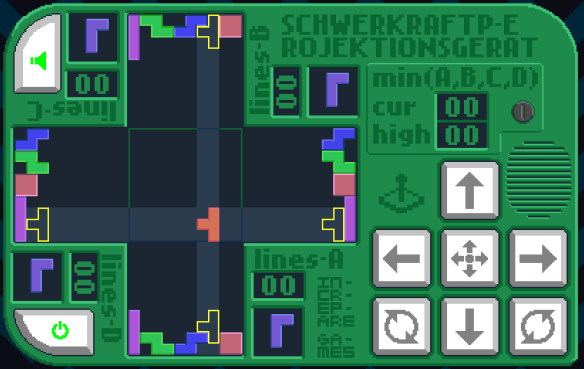
There’s also Schwerkraftprojektionsgerät, aka 4-directional Tetris, where you have four Tetris games running at once.

So when a new version of Tetris catches my eye, you know I’m gonna give it a shot.

Say hello to Uraomotetris, aka Uraomote Tetris, the creation of gamer and programmer Hirai_Sun.

Uraomote (ウラオモテ) is a Japanese term meaning “two sides” or “front and back,” which is very thematically appropriate, particularly with the stark black and white color scheme.

And although it looks like a two-player game, like the old Push Mode from Tetris DS, this is actually a single-player game.
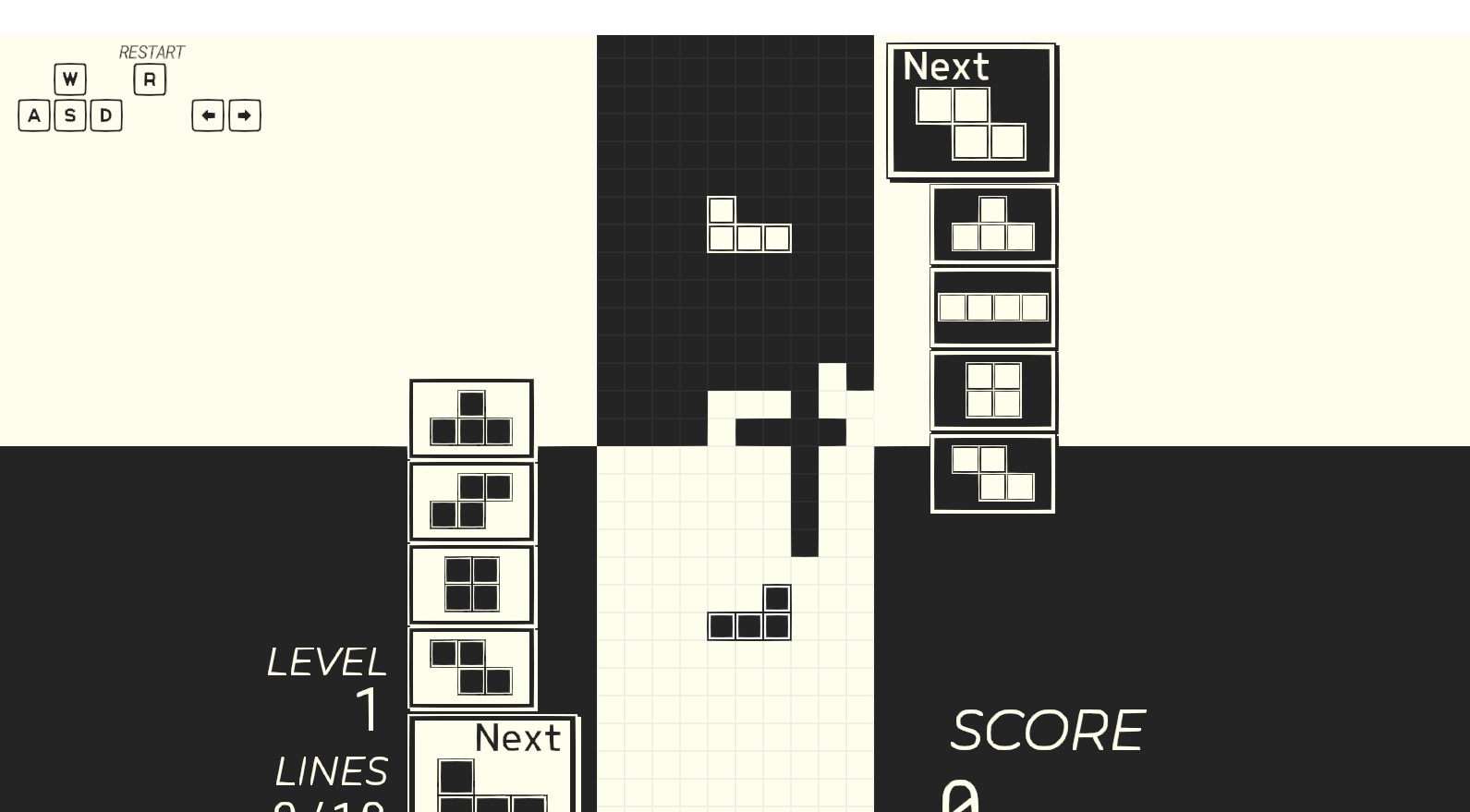
Your goal is to play the game simultaneously from above and underneath, using the white pieces falling from above and the black pieces rising from below.

You control the rotation of pieces with the arrow keys, and the placement of them with the A, S, D, and W keys. It takes a little getting used to, but once you get into the rhythm of placing one white piece, then one black piece, back and forth and back and forth, it becomes a really engaging puzzle.
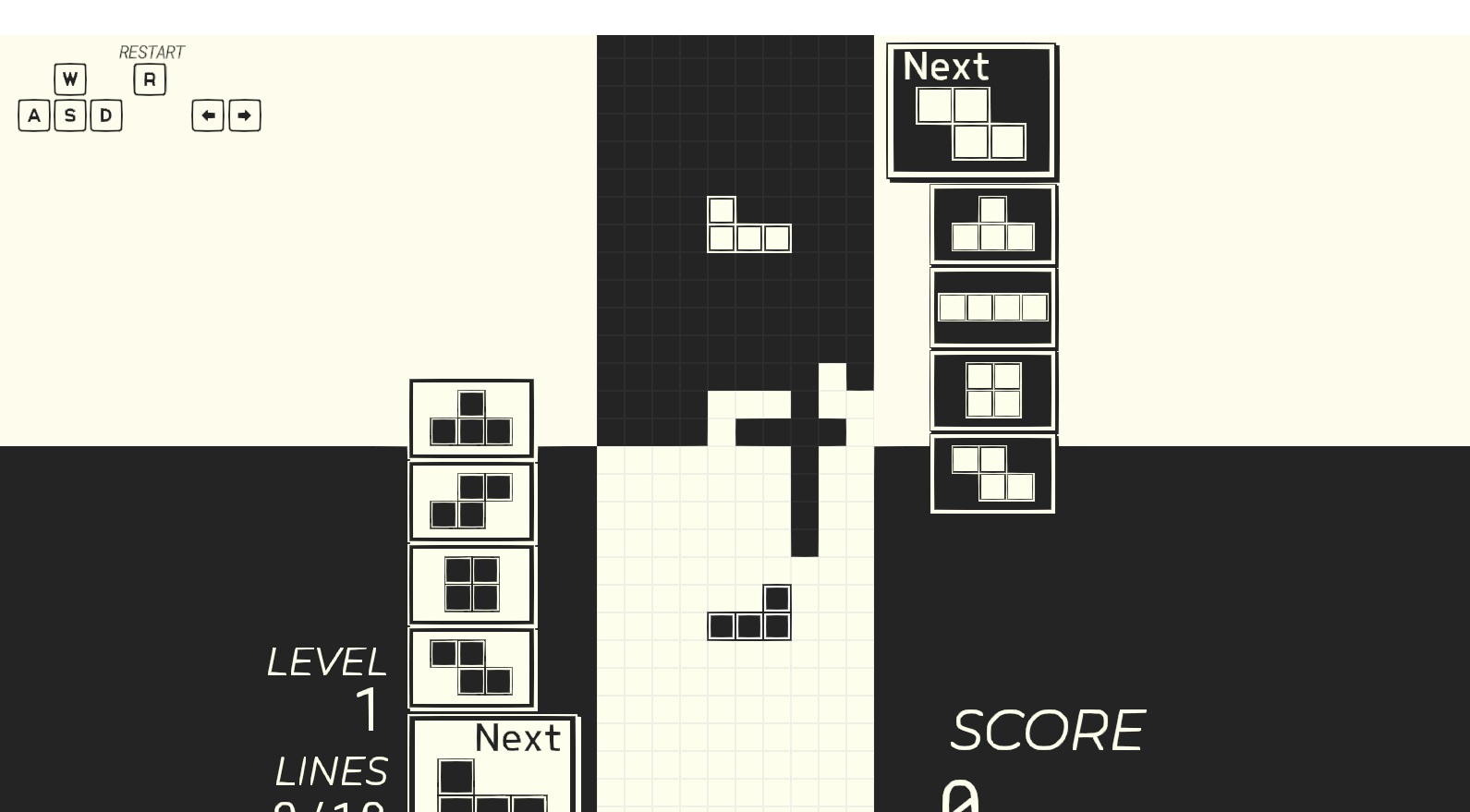
You’re not just trying to think in terms of cancelling lines, you’re also trying to set yourself up for success from both sides. You begin plotting two and three moves ahead. You’re stoked when the same piece arrives from above and blow, so you can strategize.

Of course, then I would manage to hit the wrong key and mess it all up.

But a more dexterous player could have an absolute blast with this game.


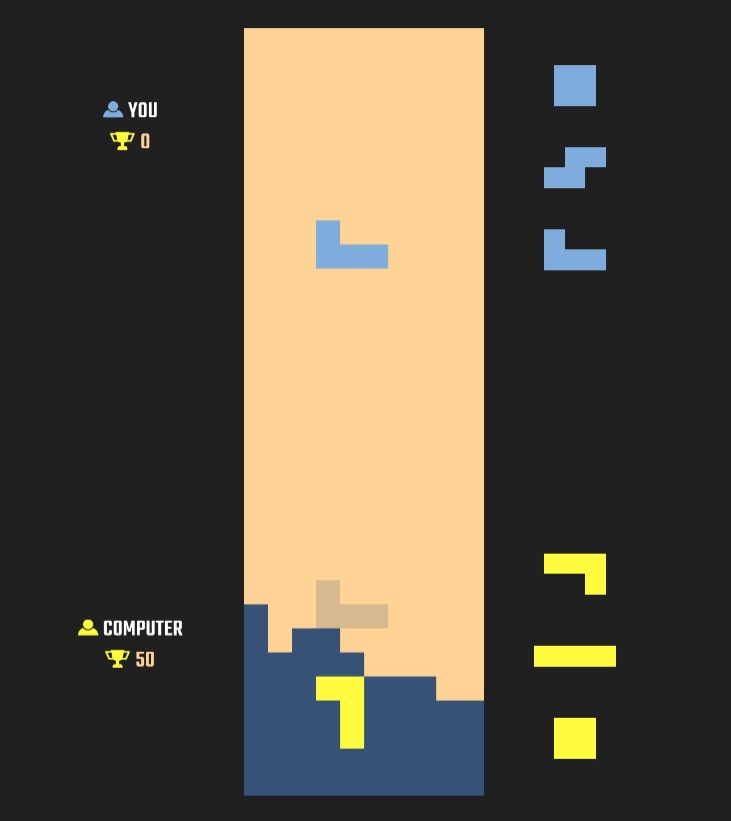
Oh, and if you wanted a two-player competitive version, you can check out Tetrio.io. It allows you to play against the computer in single player or share your link with a friend to compete against them.

The goal is to push your opponent past their border (yours to the north, theirs to the south) by completing lines and lowering their playfield.

This is honestly a great way to practice for Uraomotetris. Once you’ve gotten into the habit of playing your side while defending against your opponent’s, it helps you visualize playing both sides simultaneously on your own.
There’s a wonderful sense of balance in Uraomotetris, because unlike most versions of Tetris, where you’re aiming for the bottom and eliminating lines and pieces, in this game, you really want to keep it as close to the center line as possible.

Your very goal is not to do what you do in every other version of Tetris.

It’s very zen, in a way, and quite lovely. (But also weirdly nerve-wracking at the same time.)


Have you tried any Tetris variants, fellow puzzler? Let me know in the comments section below! I’d love to hear from you.

To Solve This Murder Mystery, You Need to Break the Game

[Image courtesy of Game Informer.]

Our readership isn’t a predominantly video game-savvy audience. We have lots of app users and lots of pencil-and-paper solvers in the PuzzleNation membership, but fewer gamers.

So you may wonder why I periodically write about video games when it’s a niche interest for the majority of our readers. That’s an entirely fair question.

As a puzzle enthusiast, I’m constantly seeking out new ways to build puzzles and solve them. Brain teasers, word problems, riddles, and mechanical puzzles all fit under the umbrella of “puzzles,” but they’re all very different solving experiences. Similarly, there’s a huge difference between a pencil-and-paper puzzle and an escape room, a murder mystery and a scavenger hunt, an encrypted message and a puzzle box.

But they’re all puzzles. And that’s what I find so fascinating. There are endless ways to challenge ourselves in puzzly fashion, and video games are constantly innovating when it comes to puzzle-solving.

[Image courtesy of Zelda Dungeons.]

Whether we’re talking about navigating past guards with well-placed arrow shots in the Thief games, navigating the labyrinth of the Water Temple in The Legend of Zelda: Ocarina of Time, or maneuvering around a room in mind-bending ways with your portal gun in Portal, video games can take 2D puzzle ideas and bring them into the third dimension in amazing ways.

A friend recently told me about a game called Iris Fall, where you actually manipulate light and shadows in order to solve puzzles. That’s not just ingenious, it’s beautiful as well.

There are even games that let you change the rules of the puzzle itself in order to solve it.

[Image courtesy of Born Frustrated Studio.]

And another game in that vein recently came to market, a detective game called File://maniac.

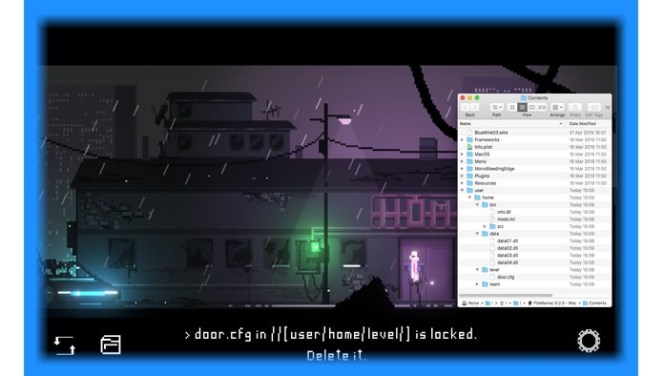
In this murder mystery, you’re tasked with tracking down a devious murderer who happily taunts you with messages as you pursue them. But instead of pursuing leads and accomplishing tasks in more traditional detective-game format, you actually have to manipulate the files of the game itself as you play.

Yes, the very coding and organization of the game is the basis of the puzzles and codes for you to unravel.

Heather Alexandra at Kotaku explains more:

Getting rid of a locked door might require placing the door’s files in your recycling bin. Finding the password to a lock means opening up a handful of notebook files and searching until you find the code. It’s a different sort of puzzle solving, one that encourages the player to be aware of the game world’s artificiality… playing around with the actual game files creates a fun mixture of puzzling and “exploration” as you poke around folders and directories.

[Image courtesy of Go Go Free Games.]

It’s a brilliantly meta concept. Whereas many games and puzzle experiences are all about immersion, ensuring you forget you’re playing a game and encouraging you to dive into the narrative and gameplay itself, File://maniac demands that you not only remember you’re playing a game, but forces you to think like the designers of the game to circumvent each challenge.

It’s like being trapped in a maze, then being able to shift your perspective to an overhead view of the maze and navigate yourself out with omniscient ease. It’s a total perspective shift, and the a-ha moment of figuring out how to change the rules to your advantage is an immensely satisfying reward.

Do you know of any games out there that create unique and unexpected puzzly experiences? Let us know in the comments section below! We’d love to hear from you!


Thanks for visiting PuzzleNation Blog today! Be sure to sign up for our newsletter to stay up-to-date on everything PuzzleNation!

You can also share your pictures with us on Instagram, friend us on Facebook, check us out on TwitterPinterest, and Tumblr, and explore the always-expanding library of PuzzleNation apps and games on our website!

A Puzzle Game That Lets You Change the Rules of Puzzles!

[Image courtesy of Linux Game Consortium.]

Solving puzzles through different mediums can lead to unexpected and challenging solving experiences.

One advantage that video game puzzles have over their pencil-and-paper counterparts is that, while the paper puzzles are a one-stop shop for a puzzle experience, there’s no adaptation, no evolution, no development for the solver or chance to build upon what they’ve learned through multiple solves or repetition.

In video game puzzles, on the other hand, repetition is the name of the game. New skills and techniques are immediately tested by clever twists on established puzzles, so you’re never resting on your puzzly laurels.

For example, while discussing the classic puzzle platforming game Portal, my friend once described it as a game that reprograms your brain with each puzzle you solve, transforming alongside the player. (This is also a hallmark of many of the puzzle games offered by our friends at ThinkFun.)

[Image courtesy of Game Informer.]

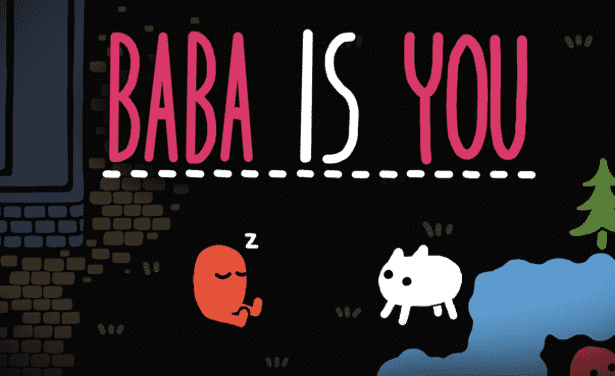
That sort of reprogramming is at the heart of the puzzle experience in a new game called Baba Is You.

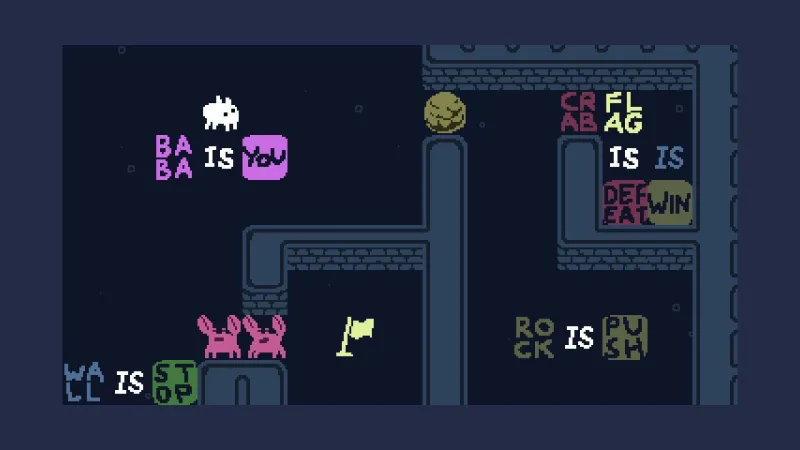
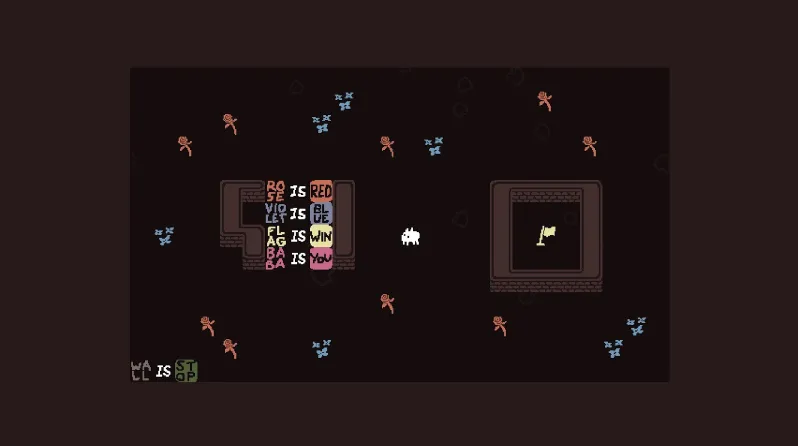
In Baba Is You, the gameplay consists of objects to move and manipulate, as well as word blocks that form rules for the game itself. You start off by being able to move Baba, a small rabbit-like creature, around obstacles, with the goal of reaching a golden flag. So, the word blocks read “Baba is you” and “flag is win,” which both tell you the starting rules and the goal.

[Image courtesy of Kotaku.]

By changing these word blocks, you change the rules, effectively reprogramming what you can do in each level.

Kotaku explains this concept well:

One clump might say “Baba is you,” which means Baba is the character you control. Another might say “Rock is push,” which means you can push rocks, or “Wall is stop,” which means you can’t walk through walls…

You rearrange individual words to solve the puzzles. There are usually multiple options, depending on where the words are placed. In the above example, you could remove “stop” from “wall” and pass through the barrier. You could attach “wall” to “is push” instead of “is stop” and push it out of the way. You could make yourself the wall by pushing the word “wall” before “is you.” Or you could make the wall the win condition and touch that instead of the flag.

[Image courtesy of Kotaku.]

So, essentially, you solve each puzzle by obeying the rules, changing the rules, and then obeying the new rules. And since puzzles are all about figuring out how to accomplish tasks by adhering to certain rules, this creates a fascinating new style of puzzle. It’s almost like improvisational comedy or Calvinball, except it’s not played for humor.

I don’t know that I’ve ever seen a puzzle game that lets you alter HOW you play as drastically and as simply as this. You literally make and break the rules here, depending on how clever you are.

Baba Is You is available for PC and Switch, and I look forward to seeing more diabolical puzzling like this in the future.


Thanks for visiting PuzzleNation Blog today! Be sure to sign up for our newsletter to stay up-to-date on everything PuzzleNation!

You can also share your pictures with us on Instagram, friend us on Facebook, check us out on TwitterPinterest, and Tumblr, and explore the always-expanding library of PuzzleNation apps and games on our website!