Find Balance in This New Variation of Tetris: Uraomotetris!

When it comes to puzzly video games, Tetris is the granddaddy of them all.

Yes, there are some amazing puzzle games that have come along in the years since — Portal, The Talos Principle, and Baba Is You, to name just a few — but Alexey Pajitnov’s creation is ubiquitous. It’s part of our cultural fabric. Everyone knows Tetris with just a glance.

And people are still innovating with Tetris decades later.

Previously I’ve written about variations on Tetris that have caught my eye.

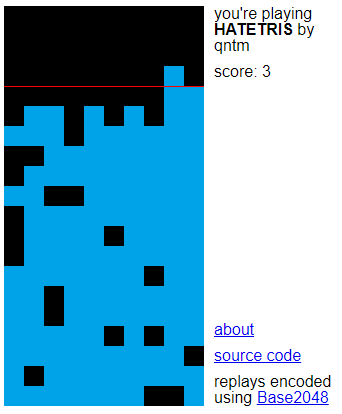
There’s Hatetris, where the computer gives you the worst possible piece on every turn, as well as Lovetris, where the computer gives you the exact piece you need to clear a single line.
schwerk2

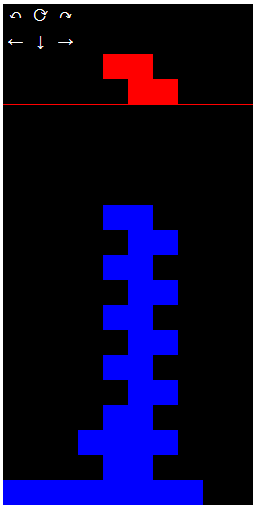
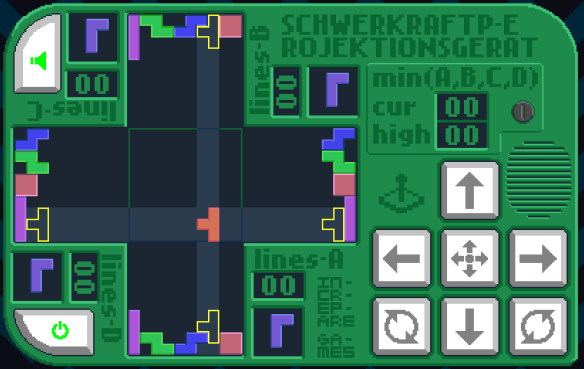
There’s also Schwerkraftprojektionsgerät, aka 4-directional Tetris, where you have four Tetris games running at once.

So when a new version of Tetris catches my eye, you know I’m gonna give it a shot.

Say hello to Uraomotetris, aka Uraomote Tetris, the creation of gamer and programmer Hirai_Sun.

Uraomote (ウラオモテ) is a Japanese term meaning “two sides” or “front and back,” which is very thematically appropriate, particularly with the stark black and white color scheme.

And although it looks like a two-player game, like the old Push Mode from Tetris DS, this is actually a single-player game.
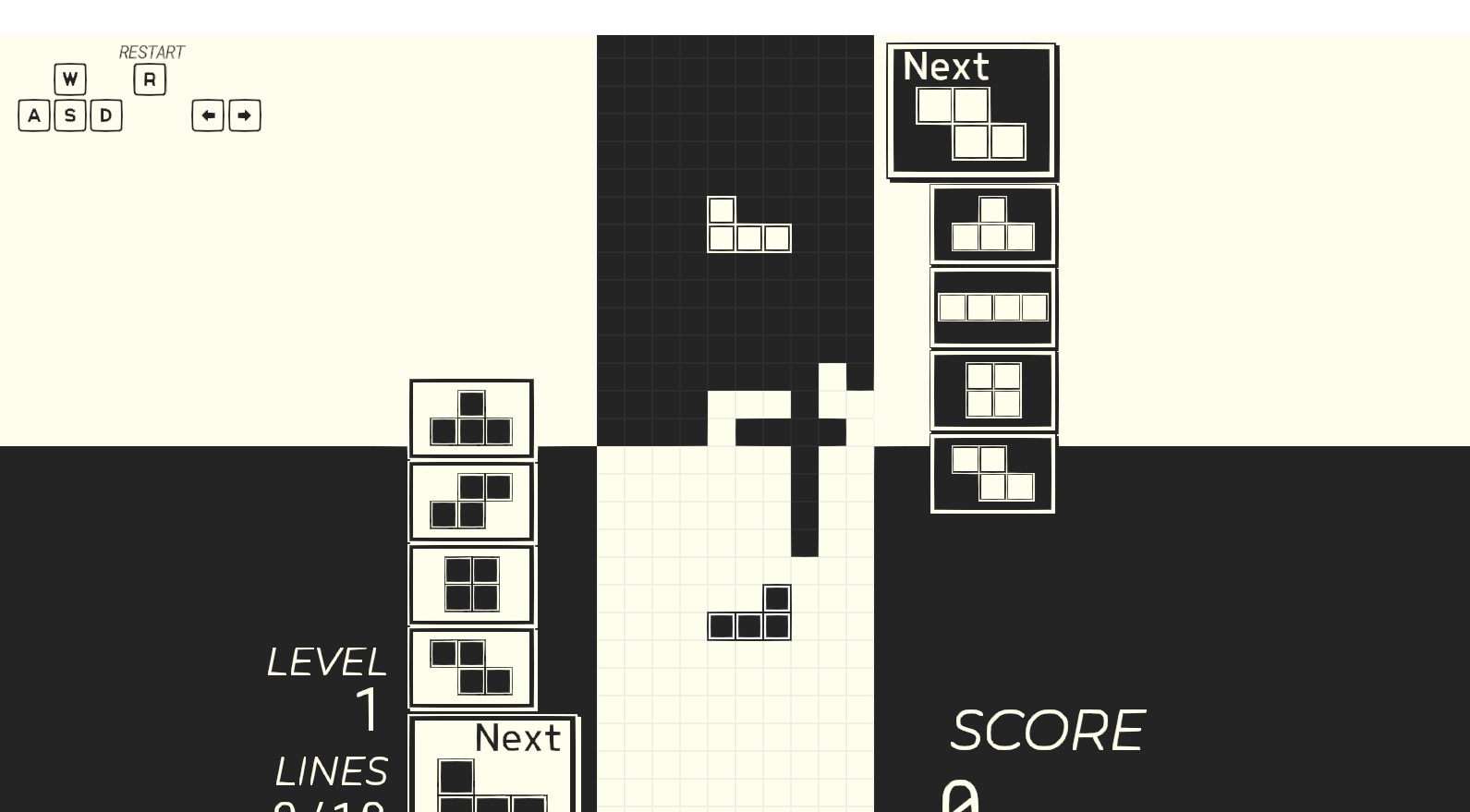
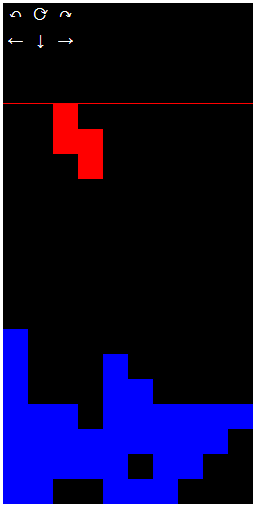
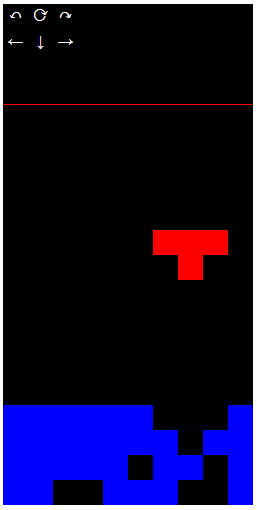
Your goal is to play the game simultaneously from above and underneath, using the white pieces falling from above and the black pieces rising from below.

You control the rotation of pieces with the arrow keys, and the placement of them with the A, S, D, and W keys. It takes a little getting used to, but once you get into the rhythm of placing one white piece, then one black piece, back and forth and back and forth, it becomes a really engaging puzzle.
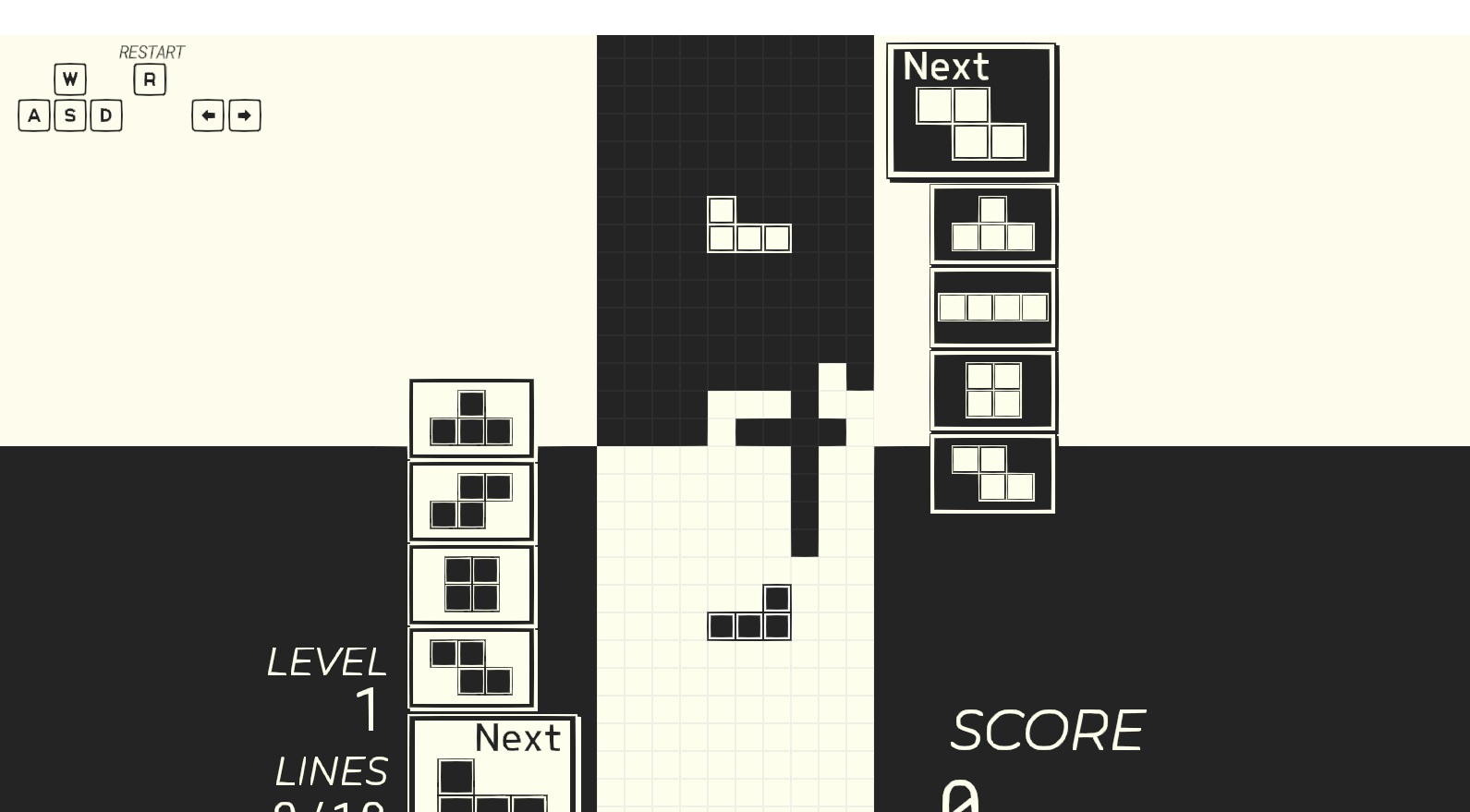
You’re not just trying to think in terms of cancelling lines, you’re also trying to set yourself up for success from both sides. You begin plotting two and three moves ahead. You’re stoked when the same piece arrives from above and blow, so you can strategize.

Of course, then I would manage to hit the wrong key and mess it all up.

But a more dexterous player could have an absolute blast with this game.


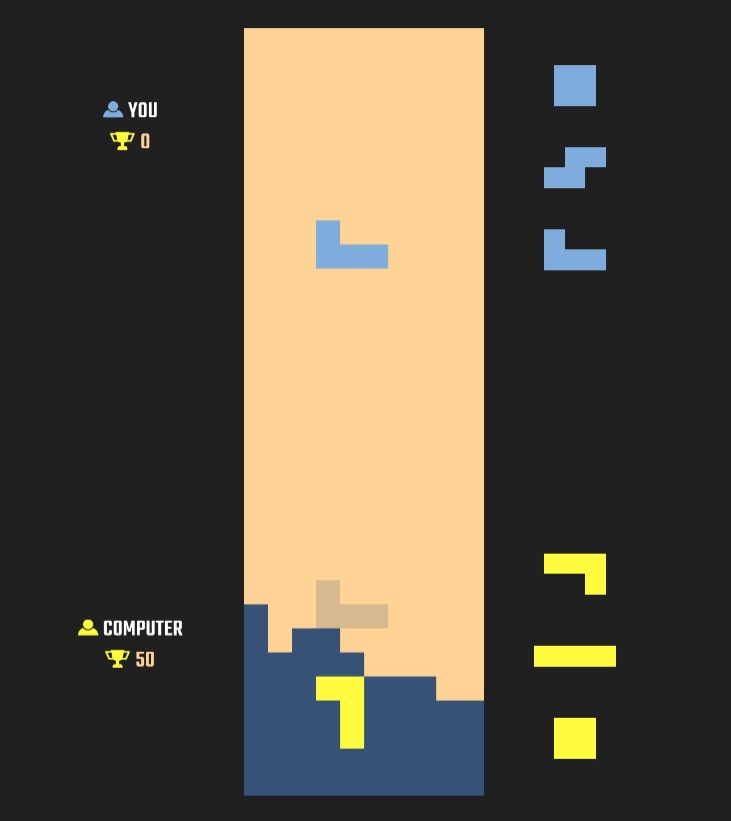
Oh, and if you wanted a two-player competitive version, you can check out Tetrio.io. It allows you to play against the computer in single player or share your link with a friend to compete against them.

The goal is to push your opponent past their border (yours to the north, theirs to the south) by completing lines and lowering their playfield.

This is honestly a great way to practice for Uraomotetris. Once you’ve gotten into the habit of playing your side while defending against your opponent’s, it helps you visualize playing both sides simultaneously on your own.
There’s a wonderful sense of balance in Uraomotetris, because unlike most versions of Tetris, where you’re aiming for the bottom and eliminating lines and pieces, in this game, you really want to keep it as close to the center line as possible.

Your very goal is not to do what you do in every other version of Tetris.

It’s very zen, in a way, and quite lovely. (But also weirdly nerve-wracking at the same time.)


Have you tried any Tetris variants, fellow puzzler? Let me know in the comments section below! I’d love to hear from you.


A Kinder, Gentler Tetris? How!?

[Image courtesy of Eurogamer.]

If there was a Mount Rushmore of puzzle games, Tetris would have to be up there. It made the Game Boy one of the most successful mobile platforms in gaming history. It has been played on every continent AND aboard the International Space Station.

Everyone has played Tetris at one time or another. In fact, it’s so ubiquitous that you’ve probably not only played the original, but some variation on the classic version as well.

And there is no shortage of options on that list. Heck, Tetris creator Alexey Pajitnov himself created several famous variations on Tetris, like Hatris (stacking similar hats to clear them from the board), Faces…tris III (where you create famous faces Tetris-style), and Welltris (where pieces fall down all four sides of a cube, and the bottom part is the communal playspace).

[A game of Welltris in progress.]

So what else is out there in the world of Tetris?

There is four-player Tetris (Familiss), Tetris with bombs (Super Tetris), Tetris in a cylinder (V-Tetris), color-specific Tetris (Tetris 2), 3-D Tetris, 3-D Tetris in a sphere (Tetrisphere), speed Tetris (20G or Tetris: The Grand Master), Tetris with earthquakes and meteors (Tetris Elements) and many many more.

As you can see, many of these variations are designed around making the classic game harder. One that we’ve discussed in the past, a 4-directional Tetris variation called Schwerkraftprojektionsgerät, was a personal favorite for a long time.

But easily the most diabolical version was created eleven years ago, and it was aptly named.

Hatetris.

Hatetris is designed to give you the worst possible piece on every turn.

hatetris 1

After figuring out what to do with multiple S pieces, Hatetris throws me a curveball with an I piece.

hatetris 2

Then once I’ve placed the I piece, they flip the script on me with a Z piece. Diabolical.

For the record, after about 30 minutes of play, my record was 3 lines.

hatetris 3

That is brutal.

And after the year or so that many of us have had, who needs brutal?

lovetris 2

Thankfully, the spiritual opposition to Hatetris has appeared for everyone to enjoy. It is, of course, called Lovetris, and it is designed to drop the exact piece you need to clear a line.

lovetris 3

Now, I know what you’re thinking. After a few easy ones, doesn’t it lose its flavor?

On the contrary! It actually offers some new challenges if you approach it from a different direction.

The designer warns that setting up a tetris — eliminating four lines with a single piece — can be difficult when the game is geared toward clearing single lines. That’s one possible challenge for you to solve.

Another that I quite enjoyed was trying to arrange the pieces so I cleared the board entirely. Can you arrange the pieces so that, once you’re done, you’re left with a clean slate to try over with?

A third option is to purposely drop five or six pieces in a row randomly — or even in a tower in the center of the screen — and then work with the program to dig your way out of your predicament.

lovetris

[Even with the AI’s help, this is a doozy to clear.]

Amazing that it took 37 years for someone to come up with this.

So what do you think, fellow puzzlers and PuzzleNationers? Will you be trying out Lovetris, or enduring Hatetris for a spell, or trying out one of these many variants? Let us know in the comments section below! We’d love to hear from you.


Thanks for visiting PuzzleNation Blog today! Be sure to sign up for our newsletter to stay up-to-date on everything PuzzleNation!

You can also share your pictures with us on Instagram, friend us on Facebook, check us out on TwitterPinterest, and Tumblr, and explore the always-expanding library of PuzzleNation apps and games on our website!