A 5-Letter Word Related to Crossword Skills? Try “Music”

A few years ago, I wrote a post discussing the curious intersection of music and puzzles. It centered around several studies about the effects both listening to music and performing music can have on individuals taking tests or solving puzzles.

There were two intriguing takeaways from these studies:

  • Both adults and children perform better on tests, puzzles, and problem-solving exercises when music is involved (ex.: if they listen to music before or during the test).
  • Children who are given music lessons often achieve greater heights in other subjects, including math and sports.

But it didn’t occur to me until much later that the connection between music and crosswords in particular has been in evidence for quite some time.

There are two 7-time champions in the history of the American Crossword Puzzle Tournament: Dan Feyer and Jon Delfin. Think about that. Fourteen out of forty-one ACPT tournaments have been won by one of these men. Practically one out of every three!

And both of them have a musical background as pianists and music directors.

But they’re not the only ones. Constructor Patrick Blindauer, puzzler and actress Whitney Avalon, Lollapuzzoola co-founder Brian Cimmet, and even our own Director of Digital Games Fred Galpern are all musicians.

So what’s the connection between music and crossword puzzles?

No one can say for sure, but there are theories.

In the crossword documentary Wordplay (and quoted from the article linked below), former New York Times Public Editor Daniel Okrent mentioned why he felt that musicians and mathematicians were good fits as crossword solvers:

Their ability to assimilate a lot of coded information instantly. In other words, a piano player like John Delfin, the greatest crossword player of our time, he sits down and he sees three staffs of music and he can instantly play it. He’s taken all those notes and absorbs what they mean, instantaneously. If you have that kind of mind, and you add it to it a wide range of information, and you can spell, you’d be a really great crossword puzzler.

Crossword constructor and psychology professor Arthur Schulman — known for a series of seminars entitled “The Mind of the Puzzler” at the University of Virginia — would agree with that statement. He posited a correlation between word puzzles, math, and music, in that they all involve a quick and intuitive understanding of symbols. It’s about “finding meaning in structure.”

In an interview with the New York Times, Dan Feyer built on this idea, stating that music, math, and puzzles all have pattern recognition in common, quickly recognizing combinations of blanks and spaces and mentally filling in possible answer words, even before reading the clues.

Now, clearly, musical skill and proficiency isn’t required to be a good crossword solver — I’d classify myself as a pretty good solver and I have an almost magical lack of musical talent — but it’s intriguing to ponder how puzzling could easily be wrapped up with a musical bow.

Do you know any other puzzlers with a musical background, or are you a lyrical solver yourself? Let us know in the comments section below! We’d love to hear from you!


Thanks for visiting PuzzleNation Blog today! Be sure to sign up for our newsletter to stay up-to-date on everything PuzzleNation!

You can also share your pictures with us on Instagram, friend us on Facebook, check us out on TwitterPinterest, and Tumblr, and explore the always-expanding library of PuzzleNation apps and games on our website!

A Dollar For Your Thoughts? It’s the Hundred Dollar Puzzle!

[Image courtesy of ColourBox.com.]

That’s right, fellow puzzlers and PuzzleNationers! It’s that time again when we pit our puzzly minds against a fiendish brain teaser and test our mental mettle!

You might’ve seen this brain teaser making the rounds on social media. It’s known as the hundred dollar puzzle, and unlike most brain teasers, this one is less about the puzzle and more about how we got to the solution.

Intrigued? You’re not the only one. Let’s take a look at the brain teaser:

A young man sees a shirt for $97. He borrows $50 from mom and $50 from dad. He buys the shirt and is left with $3 change.

He gives $1 to mom, $1 to dad, and keeps $1 for himself. Now he owes his mom $49 and his dad $49.

$49 + $49 = $98 + his remaining $1 = $99. Where did the other $1 go?

[Image courtesy of CollecTons.]

People love brain teasers like this, because at first glance, and even at second glance, the math SEEMS to hold up.

But the real trick to this one is that it’s asking the wrong question. The other dollar didn’t go anywhere.

The problem here is… as soon as he pays his parents back, it’s no longer about one hundred dollars. It’s about ninety-eight dollars.

Let’s look at total borrowings versus borrowings after paying back his parents. The original specs were:

What he owed: $100
What he had: $3 and a $97 dollar shirt.

But the goalposts changed when he paid his parents back a dollar each. (And if he plans to pay the loan off a dollar at a time, it’s going to take FOREVER for them to get their money back.)

What he now owes: $98
What he has: $1 and a $97 dollar shirt.

The math adds up. Your total borrowings go from $100 to $98 dollars, and you spent $97 dollars and put the extra dollar in your pocket.

So the final equation in the brain teaser is flawed. It’s not $49 + $49 = $98 + his remaining $1 = $99. It’s $49 + $49 = $98 = his remaining $1 and his fancy shirt $97.

[Image courtesy of Ali Express.com.]

Sometimes, brain teasers aren’t about crunching numbers, but finding the logical flaw in the puzzle itself.

We hope you enjoyed unraveling the hundred dollar puzzle, and if you have any brain teasers, riddles, or other puzzly suggestions for mental challenges to conquer, let us know in the comment section below! We’d love to hear from you!


Thanks for visiting PuzzleNation Blog today! Be sure to sign up for our newsletter to stay up-to-date on everything PuzzleNation!

You can also share your pictures with us on Instagram, friend us on Facebook, check us out on TwitterPinterest, and Tumblr, and explore the always-expanding library of PuzzleNation apps and games on our website!

The Fine Art of Puzzle Cabinetry

Earlier this year, I wrote a post about puzzle furniture, a small but growing niche of the puzzle world. We explored modular sofa, chair, and desk designs, as well as impressive tables designed by the puzzle wizards at Praktrik.

But what happens when you combine a designer of fiendishly clever puzzle boxes and a furniture designer with an impeccable knack for melding mechanical puzzles and beautiful woodworking?

You get the Wisteria Puzzle Cabinet, an absolute masterpiece that serves as both a stylish cabinet and an incredibly complex puzzle box.

It’s the most beautiful and complicated safe you could ever want, and it would hide in plain sight in your home.

Check out this video detailing some — but I suspect not all — of its secrets, including hidden compartments, an internal elevator, and multi-piece keys that must be uncovered, assembled, and reused:

The puzzly aspects were designed by Robert Yarger (also known as Stickman in the puzzle box world) and the actual cabinet built by Craig Thibodeau, and together, they’ve brought this mind-blowing piece of puzzle art to life.

Granted, the price of an piece like this is pretty steep.

On his website, Thibodeau states that his “latest work exploring mechanical furniture, puzzles and hidden compartments is the most expensive furniture I build due to the highly complex design and fabrication process. These pieces typically start at around $30,000 and go up from there due to the complexity of the internal mechanisms and the variety of hidden details incorporated into the design of these highly unique pieces.”

Although that’s out of my price range, it’s a testament to how much preparation, design, and labor goes into a puzzle as gorgeous and labyrinthine as this cabinet. Even at five figures, it seems well worth the price.

Oh, and if you’re looking for more puzzly furniture, you can also check out the table designs of David Lundell on YouTube, like this magic-themed coffee table:

Now, if you’ll excuse me, I’m going to go check every piece of furniture in my house for secret compartments. You know, just in case.


Thanks for visiting PuzzleNation Blog today! Be sure to sign up for our newsletter to stay up-to-date on everything PuzzleNation!

You can also share your pictures with us on Instagram, friend us on Facebook, check us out on TwitterPinterest, and Tumblr, and explore the always-expanding library of PuzzleNation apps and games on our website!

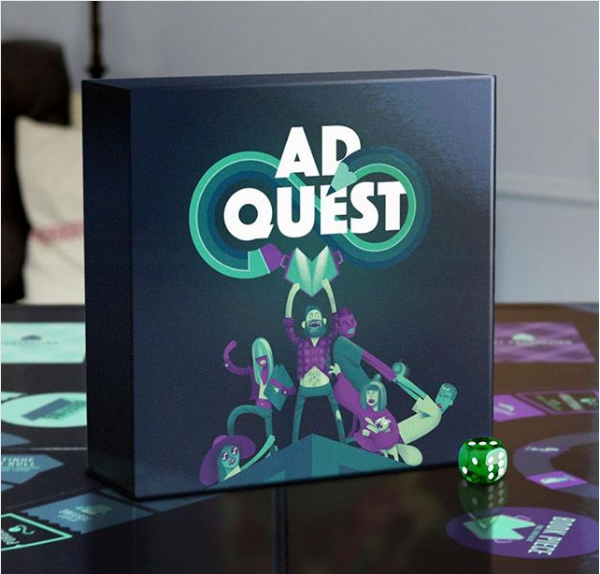
Kickstarter Roundup: Ad Quest!

A well-designed board game can make nearly any endeavor a fun and engaging gameplay experience.

Sure, there are games where you endure monstrous onslaughts (Castle Panic!, Dead of Winter), cure outbreaks (Pandemic), escape dungeons (Welcome to the Dungeon, Escape: The Curse of the Temple), and conquer rival civilizations (Small World, Risk).

But there are also games where you manage a farm (Agricola), grow bamboo (Takenoko), run a newspaper (Penny Press), or build a stained glass window (Sagrada). Your goal doesn’t have to be earth-shaking to be worthwhile and engrossing.

And there’s a game currently seeking funding on Kickstarter that fits the latter pattern. You might not be slaying dragons or toppling empires, but you will definitely be in for the fight of your life.

The game is called Ad Quest, and I think you should give it a look.

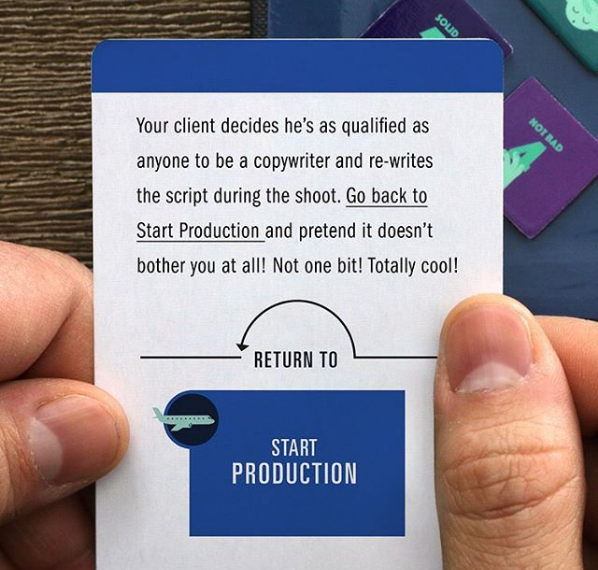
Ad Quest places you in the shoes of an advertising creative team. You’ll conceive your ideas, deal with clients, test your ad, produce it, and polish it until it’s a shining example of your work, fit for your portfolio.

Designed with a razor-sharp wit and a potent dose of cynicism, Ad Quest creates a challenging and entertaining gauntlet for you and your fellow players to run, peppered with obstacles like focus groups, rogue clients, and celebrity meltdowns.

The game board is sleek, the cards are wonderfully designed, and the game strikes an elegant balance between real-world frustrations and clever design, ensuring that you’ll be kept on your toes throughout the entire game.

You can check out the Kickstarter campaign here, and be sure to follow the Ad Quest Instagram account for more details, pictures, and behind the scenes glimpses into the game and design process. Additional details can also be found at adquestgame.com.

I think creators Adam Samara and Michael Camarra have a real winner on their hands here.


Thanks for visiting PuzzleNation Blog today! Be sure to sign up for our newsletter to stay up-to-date on everything PuzzleNation!

You can also share your pictures with us on Instagram, friend us on Facebook, check us out on TwitterPinterest, and Tumblr, and explore the always-expanding library of PuzzleNation apps and games on our website!

The (Increasingly Lengthy) History of Games

Being a student of history means constantly discovering amazing new things about our world, our culture, and ourselves. There are so many unexpected twists and turns, synchronicities, coincidences, and flat-out mind-blowing facts waiting to be uncovered.

And when you’re a student of history with an interest in puzzles and games, it means you get to discover just how long humans have been dabbling in baffling brain teasers and friendly competition.

Board games, for instance, have been around a long time, longer than most people realize. There is evidence that Go has been played in China for more than 5,500 years!

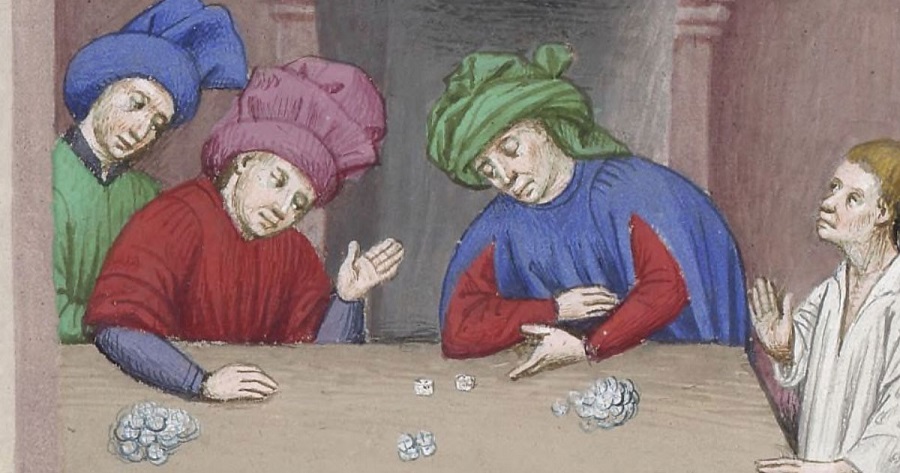
And many other games also have shockingly long lineages. Chess can be traced back to the seventh century in India. Game boards have been found in king’s courts, university halls, and even former houses used by the Knights Templar, as pictured above.

We’ve previously explored that Viking gravesites from the ninth century reveal that board games were not just a pastime for the Vikings, but that their win-loss records were important enough to be recorded for posterity!

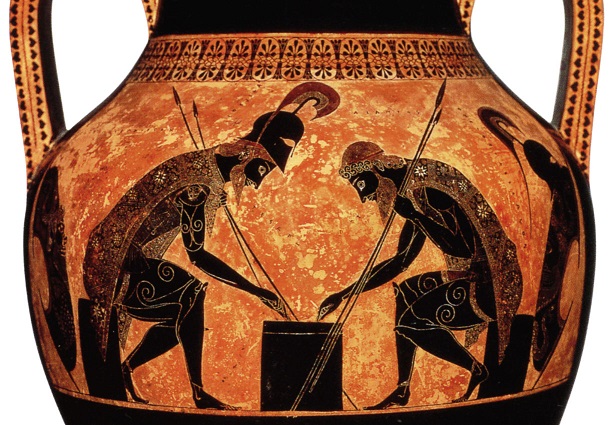
Check this out. It’s an ancient Greek painting on a vase, dating back to 530 BCE. This piece is an example of the black figure technique where images painted on clay turned black when the clay was fired. It depicts the two mightiest warriors of the Trojan War, Achilles and Ajax, playing a board game to keep themselves busy during the siege of Troy.

It’s unclear what game they’re playing, though many historians believe the warriors are rolling dice in the image. That would make sense, since astragali (the knuckle-bones of goats and sheep) were used in ancient Greek gambling games.

Dice have an equally ancient history. The Egyptian game of Senet, which was played with dice, dates back over 5,000 years.

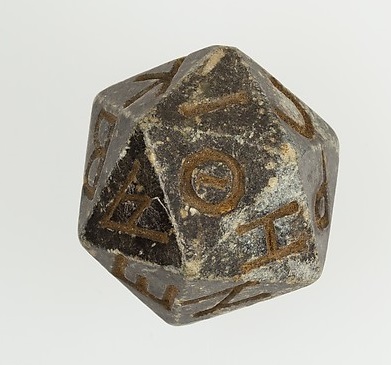
Dice games have been uncovered in Mesopotamian tombs (some as far back as the twenty-fourth century BC), and a Vedic Sanskrit text known as the Rigveda, which dates back to India in 1500 BC, also mentions dice.

Tile games have a similarly deep history.

Chinese Dominoes can be traced back to writings of the Song Dynasty, nearly a thousand years ago. Dominoes as we know them first appeared in Italy during the 1800s, and some historians theorize they were brought to Europe from China by traveling missionaries.

Another tile game, Mahjong, has been around for centuries, but there are several different origin stories for the game, one tracing back to the Ming Dynasty (1368-1644), another to the days of Confucius (500 BC).

Perhaps at some point, I’ll try to put together a historical timeline of gaming (similar to the crossword timeline I created around the 100th anniversary of the crossword).

In the meantime, I’ll settle for being utterly fascinated with just how long humans have been socializing, relaxing, and competing through the medium of games.


Thanks for visiting PuzzleNation Blog today! Be sure to sign up for our newsletter to stay up-to-date on everything PuzzleNation!

You can also share your pictures with us on Instagram, friend us on Facebook, check us out on TwitterPinterest, and Tumblr, and explore the always-expanding library of PuzzleNation apps and games on our website!
Putting the “Daily” Into “Daily POP Crosswords”

One of my favorite features built into the Daily POP Crosswords app is the ability to keep track of the puzzles you’ve solved. The Calendar screen is always a treat, with a special, unique icon appearing on the calendar for every puzzle you’ve completed.

But in addition to those daily icons, there’s also a Streak counter that details both the number of days in a row you’ve solved the daily puzzle and the date your solving streak began.

You can see your streak on the Home screen in the lower left corner (next to your coin total), as well as on the Calendar screen in the upper right corner, on your Profile screen beside your Solver ID, and on your Scores screen at the top of the page.

The app keeps track of your streak even if you haven’t linked it to your Facebook account, just as it keeps track of your daily icons on the Calendar page. (Of course, if you link your FB account to the app, you get bonus coins with which to solve additional puzzles. Hint hint.)

Naturally, watching my own Streak counter rise, only to reset when I accidentally miss a day, makes me wonder… What’s the longest streak amongst Daily POP Crosswords solvers?

I took to social media to ask the PuzzleNation readership, and the top Streak counts that solvers reported hovered between the 50 and 60 day mark. Which is quite impressive! That’s nearly two months without missing a single day!

But, as it turns out, I didn’t have to go far to find the highest Streak count I’ve encountered thus far in my search. How high was the Streak count, you ask?

152!

Yes, one hundred fifty-two days in a row! Nearly five months of solving without missing a day!

This total was amassed by friend of the blog and fellow puzzler Lori, who revealed her impressive puzzly feat to me around the 90-something day mark, and has been dutifully solving ever since!

She sheepishly admitted to me this week that it had slipped her mind to solve on Monday, and she was devastated to have broken her Streak, as she’d been hoping to go a full 365 days.

What do you think about that, fellow puzzlers and PuzzleNationers? Do you have a Daily POP Crosswords Streak that rivals super-solver Lori’s? Let us know where your Streak stands in the comment section below!


Thanks for visiting PuzzleNation Blog today! Be sure to sign up for our newsletter to stay up-to-date on everything PuzzleNation!

You can also share your pictures with us on Instagram, friend us on Facebook, check us out on TwitterPinterest, and Tumblr, and explore the always-expanding library of PuzzleNation apps and games on our website!