Puzzmo is one of the best puzzle game apps out there. Their puzzles are terrific, their games are as diverse as they are engaging, and if you’re not using the app, you’re missing out.
And they just put out a request for puzzle game submissions to add to their dynamite lineup:
We’re thinking about having a handful of games from members of our community appear on Puzzmo later this year. We’re always working towards Puzzmo being the place for thoughtful puzzles, so this project is us trying to connect our platform and community with interesting new games that otherwise don’t have a perfect place to be noticed and played on the internet.
But be timely about it, the window for submissions only lasts until October 2nd!
And speaking of puzzles, I’ve got one for you to solve today.
I didn’t have time to finish this one last weekend, so sadly, it’s not as timely as I’d like.
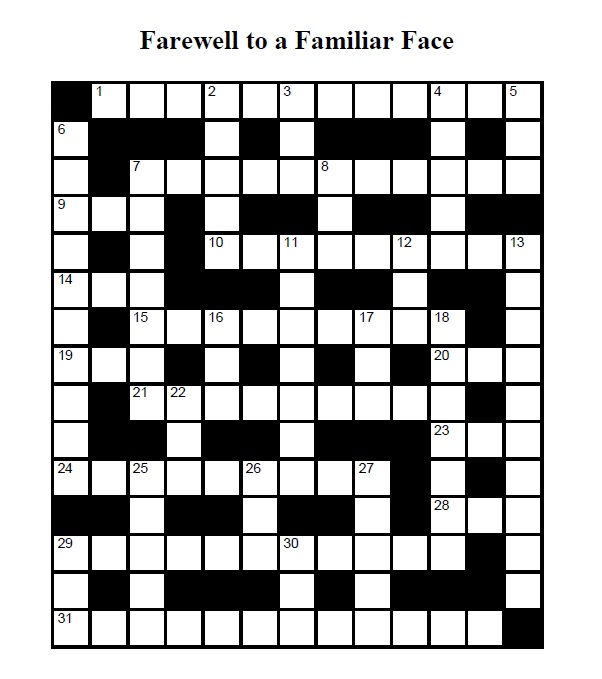
One of my favorite character actors, Gerrit Graham, passed away recently, and I wanted to do a little tribute puzzle to him. Rather than a usual crossword grid, I thought I’d use a cryptic-style grid, so I could put more themed entries in the puzzle than a traditional crossword would allow.
Even with this looser format and fewer crossings, I still couldn’t fit in all the film and TV references I wanted to. I had to leave out the films Used Cars, The Little Mermaid, and Police Academy 6: City Under Siege (which sucks, but he’s GREAT in), as well as noteworthy appearances on Star Trek: Deep Space Nine, Star Trek: Voyager, Parker Lewis Can’t Lose, Tales from the Crypt, Sledge Hammer!, The Tick, and Babylon 5. (He also wrote teleplays for The Twilight Zone!)
I wanted to do one more Sudoku-centric post for Sudoku Month, so I figured I’d take a look at different solving techniques!
Sudoku is all about deduction, but you’d be surprised what you can learn from different number patterns and arrangements. There is plenty of information lurking in those grids beyond the given digits.
Let’s take a look!
Many how-to-solve guides suggest utilizing candidates to assist with your solving. Candidates are all of the possible numbers that could be in a given cell, and most Sudoku apps have a feature allowing you to list them onscreen for ease of solving.
It can absolutely be an advantage, especially if you have a hard time keeping track of possible numbers in different locations of the grid while you’re solving.
But keep in mind, especially for solvers newer to Sudoku, the amount of information can also be a bit overwhelming, obscuring paths forward.
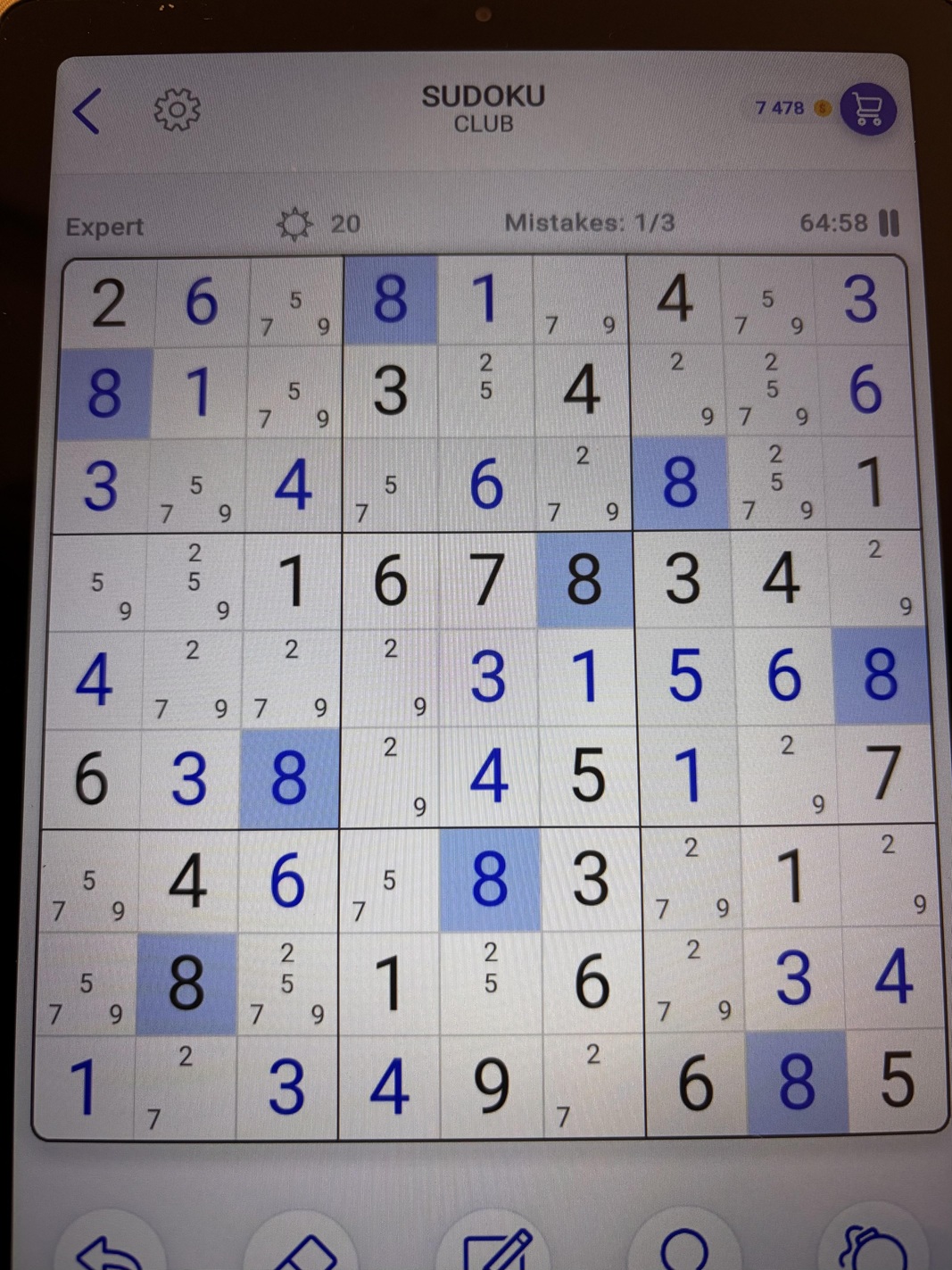
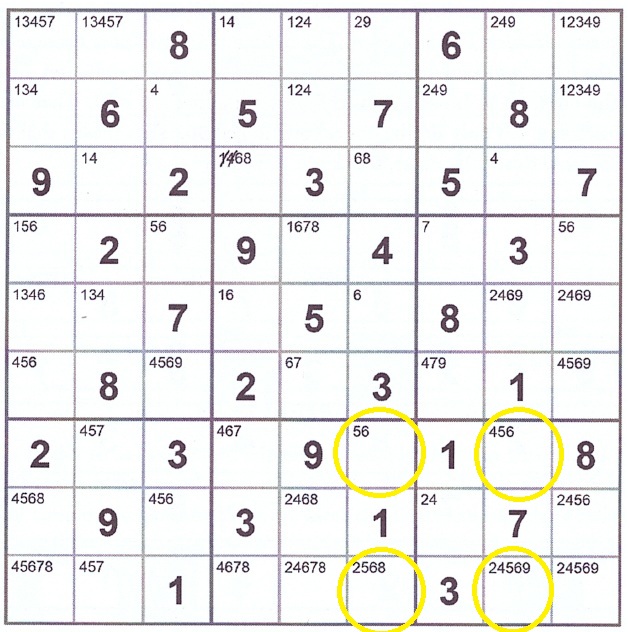
In this grid (which I nabbed from r/Sudoku), you can see all the candidates placed. But I suspect a less experienced solver might not spot my next step because of ALL the noise onscreen. Viewing all the candidates can take some getting used to.
But if you look in Box 7 (the lower-left 3×3 section of the grid), you’ll find your next move.
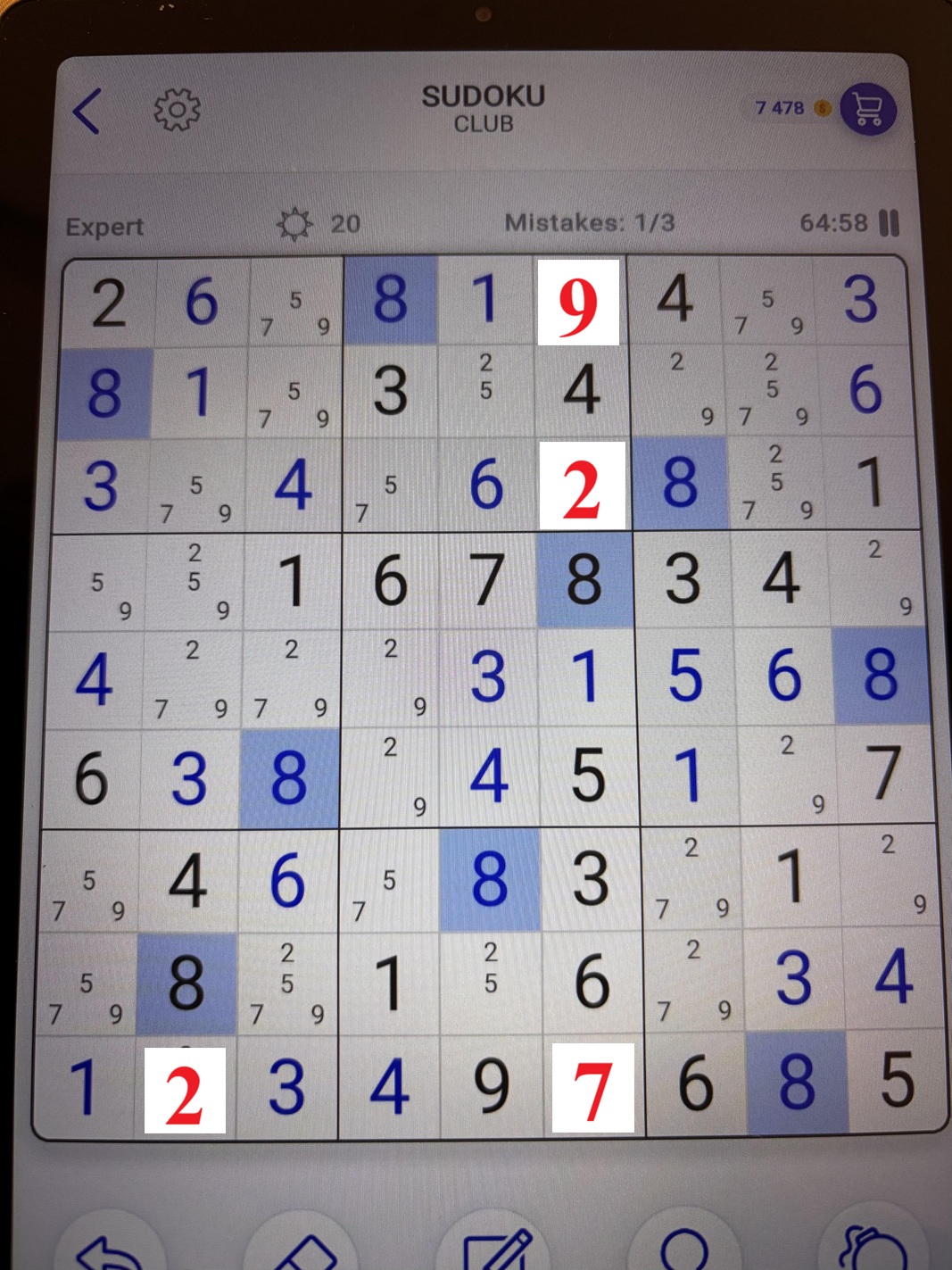
There, if you look at the first column, you can see that the 7 can only be in one of those two boxes. (Otherwise, there’s no 7 at all in that column.) Which means the seven isn’t a candidate for the bottom cell or the cell to the right of the 8. In fact, that means we can place that 2 in the bottom cell immediately.
And from that point, we can place the 7 in Box 8, as well as the 9 and the 2 in Box 2 (column 6). One quick deduction, and we’ve placed four digits!
From that point, we can fill in the rest of Box 8 and we’re off to the races.
Now that was pretty simple, so let’s look at something a little more complex. This technique is called X-Wings, and it’s all about pattern recognition.
Start looking for columns or rows with only two instances of a particular candidate (for example, the number 4). If you can find two rows, each with only two places that a 4 can be, and they’re the same in both rows, you might have an X-Wing. Now check the crossing columns. If two columns also have only two instances of that candidate 4 in the same position (making a square or rectangle), you’ve got an X-Wing.
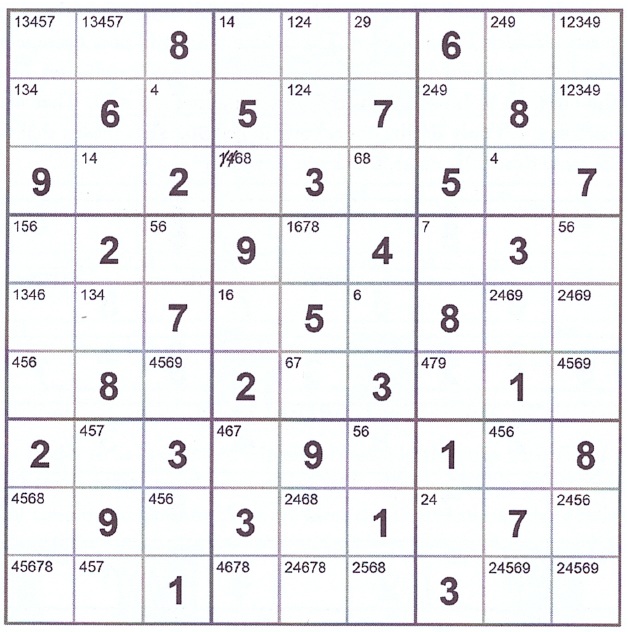
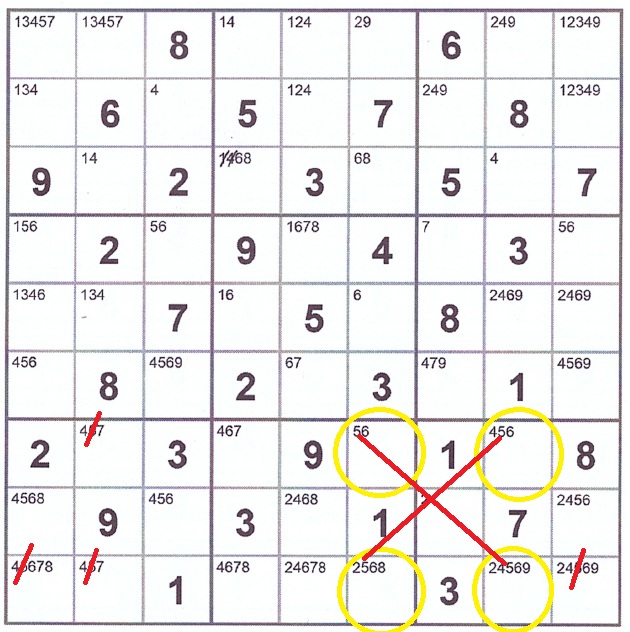
Okay, I know that was A LOT, so let’s look at it in grid form to help you visualize. (This grid comes from the book Sudoku Rocks! by David Klein.)
In this example, look at columns 6 and 8. Each column only has two candidate 5s (in Box 8 and Box 9, respectively). And those candidate 5s are in the same positions in the crossing rows (row 7 and 9).
Those four candidate 5s form a square, so we’ve got an X-Wing here.
How does that help us?
Well, we know that there are no other 5s in those two columns. But what we also know is that, no matter which 5 is correct, both of those intersecting rows (rows 7 and 9) are also covered. That X-Wing will contain two 5s diagonally one way or the other.
So that means any of the other 5s listed as candidates in those two rows can be crossed out.
This may seem trivial, but we can already place a number because of it. By crossing out the 5s in Box 7, there is only one place in column 2 that a 5 can go. Right at the top, in Box 1.
This pattern in the lower right-hand corner just gave us a confirmed number in the upper left-hand corner. Pretty cool!
Now, after learning X-Wings, we can explore another pattern variation: Y-Wings (also known as XY-Wings).
In an XY-Wing, you’re identifying a square or rectangular pattern of candidates in the grid that influence each other, similar to an X-Wing layout.
One of the corners of the square will be the target, where you hope to eliminate one of the candidates. The neighboring corners of the square will be the pincers, closing in on your answer. And the final corner is called the pivot. By testing the candidates in this square (pivoting between the choices), we will learn something about our target cell.
It takes some practice to learn to spot XY-Wings, but when you manage it, you’ve added a valuable tool to your Sudoku solving kit.
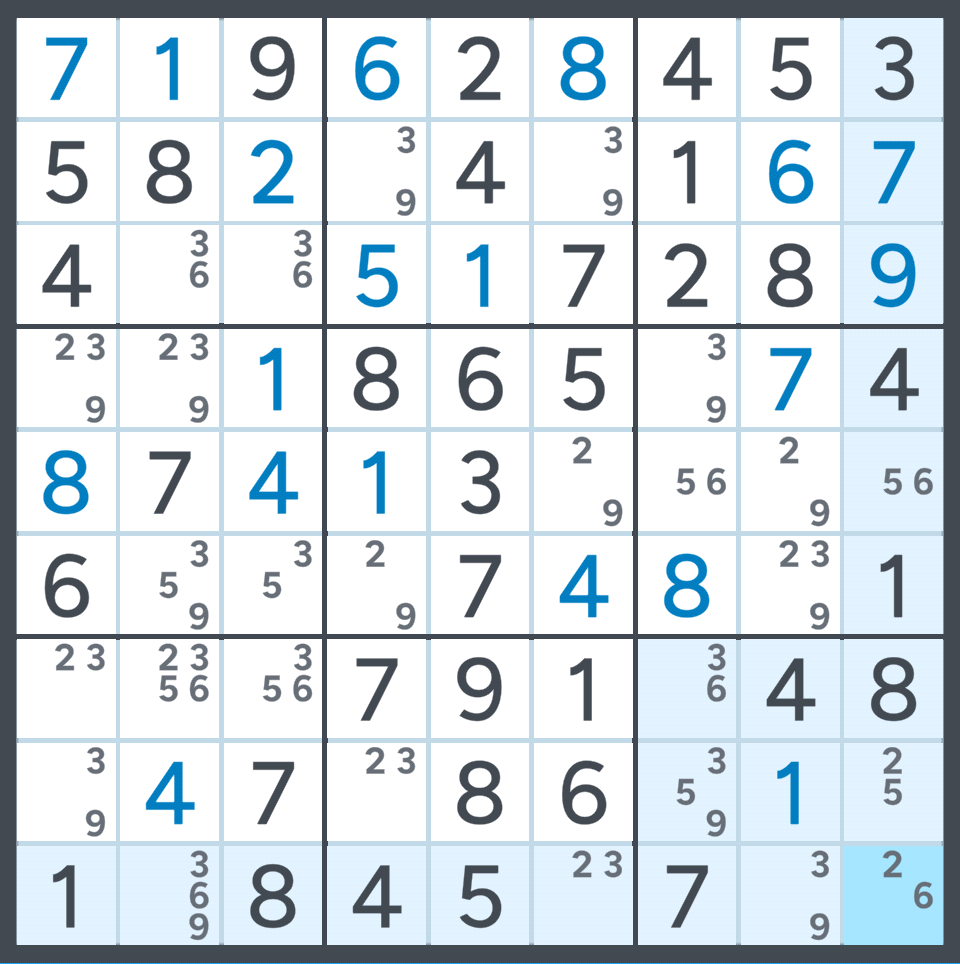
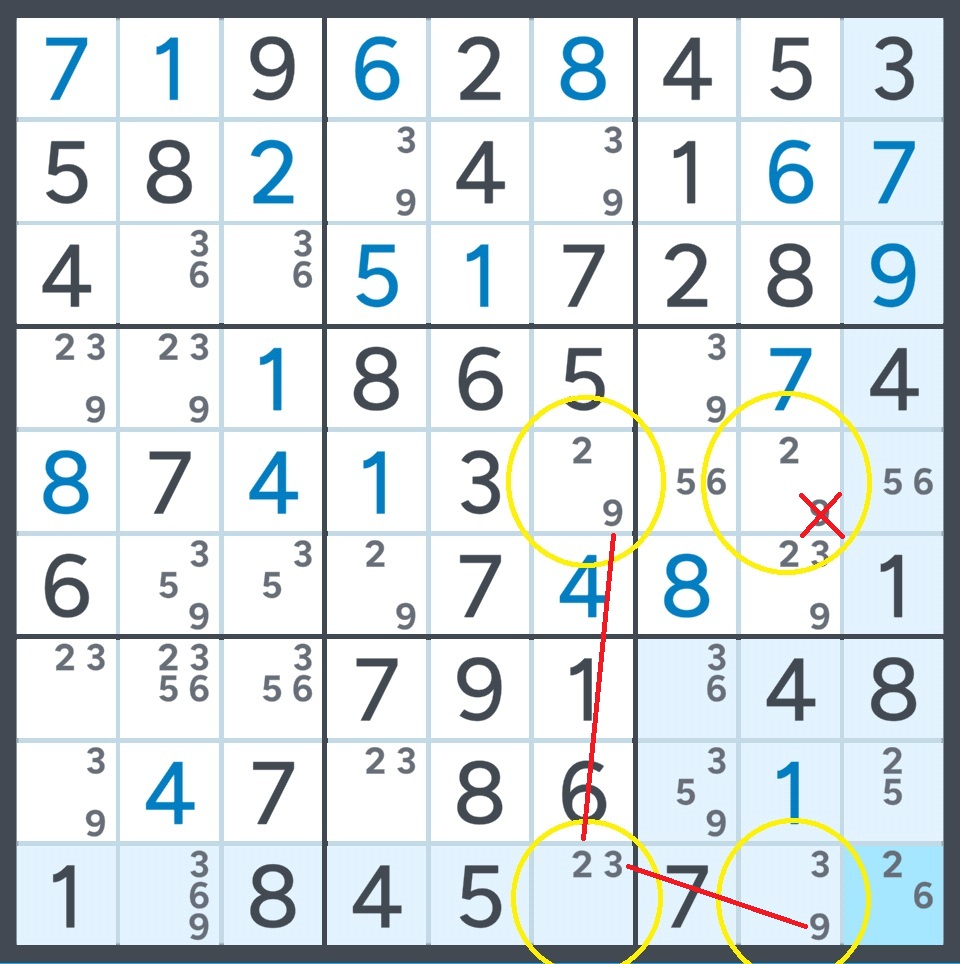
Here is another grid I grabbed off r/Sudoku. Can you spot the XY-Wing in the lower right-hand corner of the grid?
It’s okay if you can’t! It definitely took me a minute to spot it.
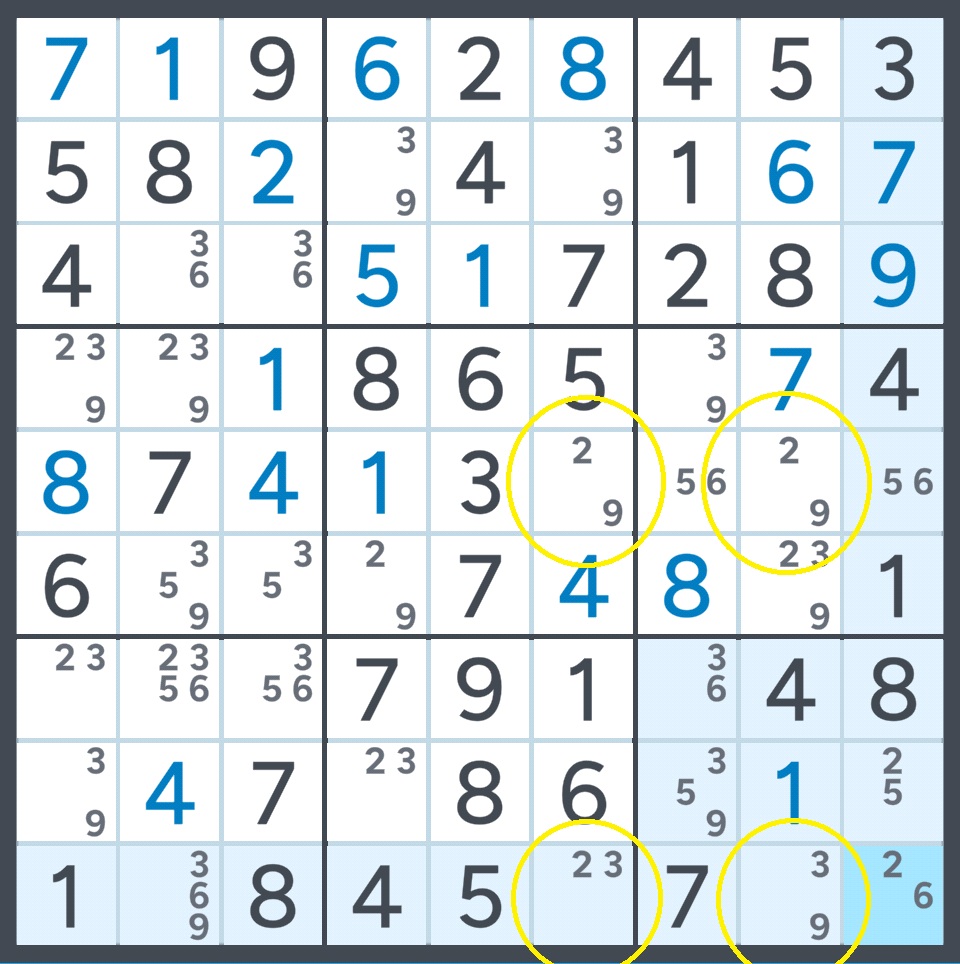
In this case, the cell in Box 6 will be our target, the cell in Box 8 is our pivot, and the other two are our pincers.
In Box 8, our circled cell has two options, 2 and 3. If the answer is 2, the pincer above in Box 5 is a 9. If the answer is 3, the pincer to the right in Box 9 is a 9. So, no matter what’s in Box 8, one of those two pincers will be a 9.
And since both of those pincers are in a row or column with the circled cell in Box 6, we know that cell CANNOT be a 9. So it must be a 2.
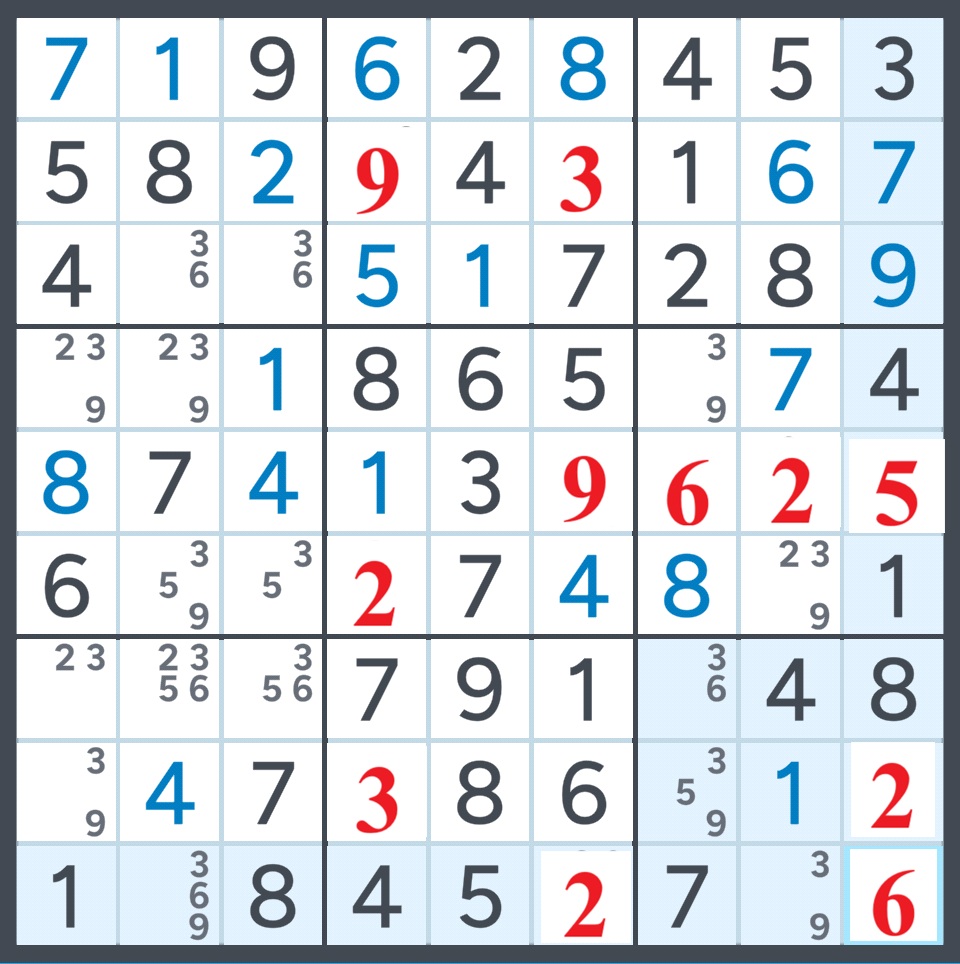
And once we’ve placed that 2, we can place the 9 in Box 5, the 2 in Box 5, the 3 in Box 2, the 9 in Box 2, and more! All from one deduction.
Hopefully these tools and techniques will help you with your Sudoku solving in the future, fellow puzzler!
Would you like me to return to this subject in the future? There are plenty of advanced techniques out there to explore, like Two-String Kite, Skyscraper, or Finned X-Wings. If you’d like to see more posts like this (for Sudoku or other puzzles), please let me know in the comment section below! I’d love to hear from you.
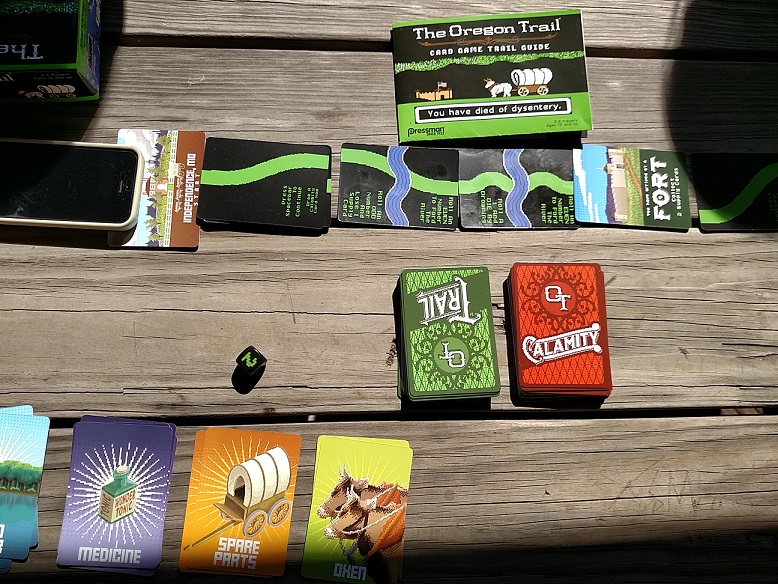
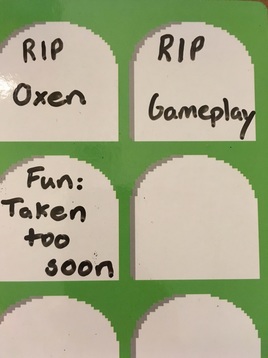
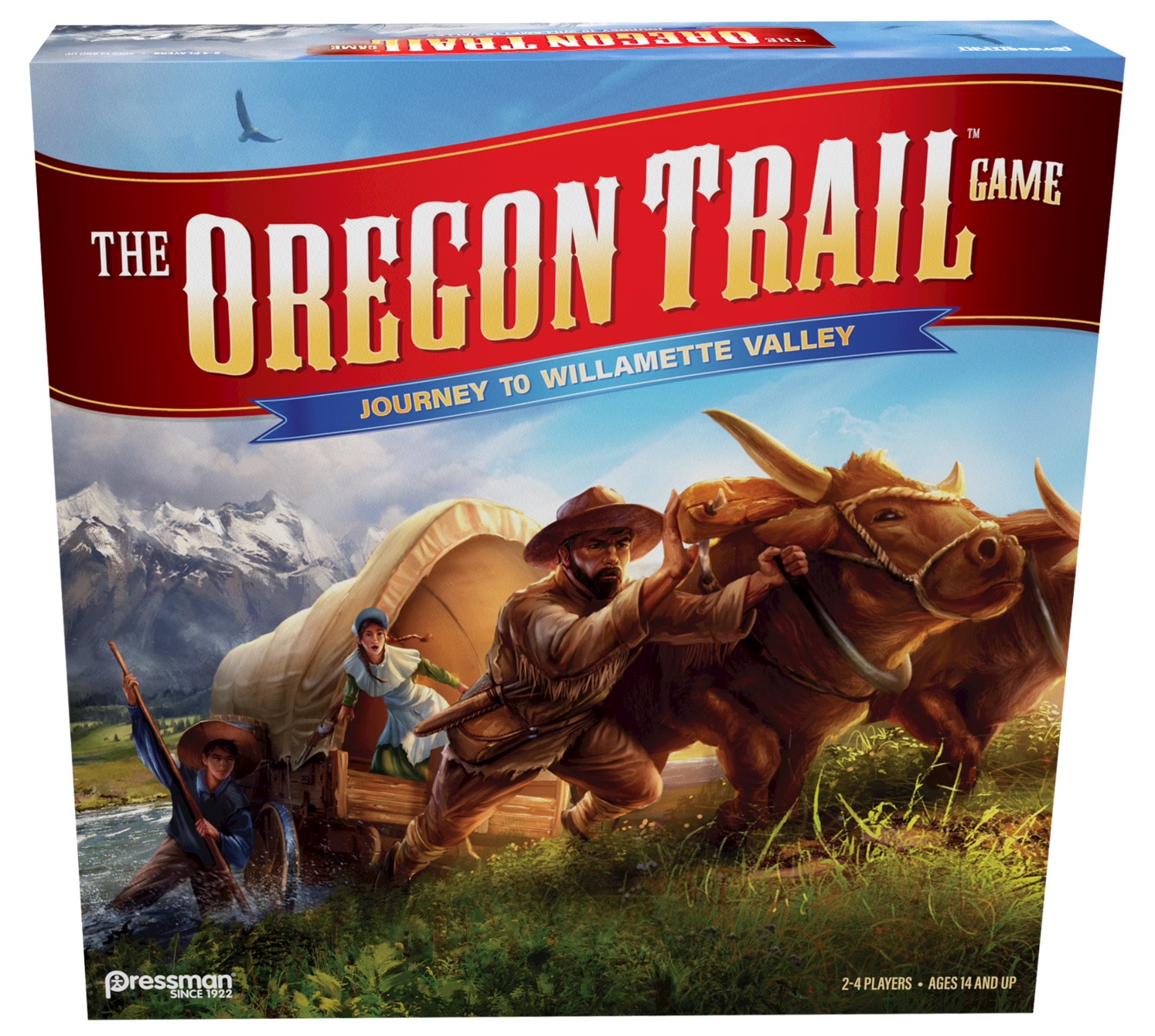
And I made a passing reference to The Oregon Trail Card Game and my work group’s Sisyphean efforts to conquer the game.
Some of the readers politely requested more details on that endeavor, so today, let’s look back on our repeated attempts to survive the Oregon Trail.
For those not in the know, The Oregon Trail was a computer game designed to explore 19th-century pioneer life on the long journey between Independence, Missouri, and Oregon’s Willamette Valley. Players would manage food, supplies, and the pace of the trek in their covered wagon, occasionally dealing with dangers like disease, thieves, broken equipment, accidents, and treacherous rivers to cross.
So when it made the jump from the digital realm to the analog one with a card-game version, I immediately snapped up a copy to play.
But my fellow travelers and I quickly discovered that the card game was harder than the computer game. I don’t know that I’ve ever encountered a game that stacks the deck against the player quite so brutally.
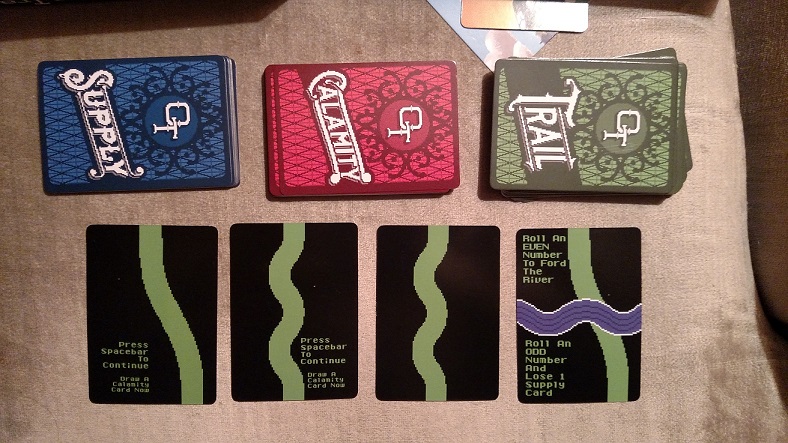
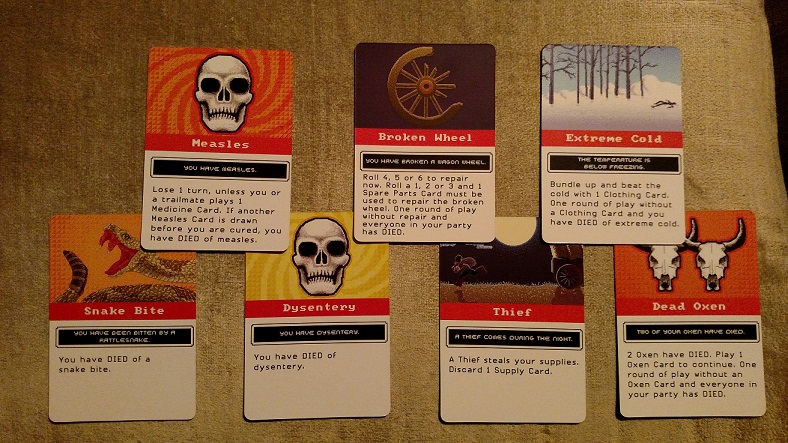
To make the journey to Oregon successfully, players must traverse 50 trail cards, avoiding illness and unpleasant twists of fate along the way (represented by the calamity cards that come up all too often), managing meager supplies, and testing their luck against river crossings (where a roll of the die determines your fate).
This quickly becomes a strategic battle of resource management, trying to hold onto fort and town cards for as long as possible (since they provide some of the rare opportunities to gain new supplies), playing trail cards (which must link up in a continuous line), and deciding whether it’s better to spend medicine and clean water supplies on saving fellow players stricken by illness or letting players die and hoarding supplies for the survivors.
Of course, we didn’t realize that going in, so on our first attempt, we only made it 40% of the way to Oregon before losing the entire traveling party.
(I died of Cholera, Measles, and drowning all at the same time. I am, if nothing else, an overachiever.)
On our second attempt a week later, we did slightly better, making it halfway to Oregon.
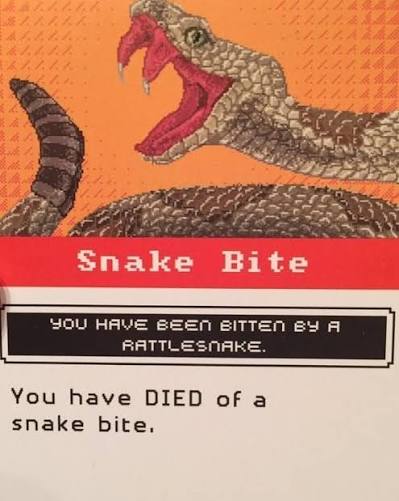
(I died of a rattlesnake bite on the very first turn of the game. Brutal!)
Our third attempt was far more promising, making it 80% of the way to Oregon, but being forced to stop because lunchtime was over. Two members of the party had died, and supplies were low, but we were making progress!
(I died of extreme cold. At least I keep switching up the deaths to avoid being repetitive!)
But by week four, the cards were on our side and our tactics were dialed in. The party made it to Oregon! Sure, our supplies were low and we lost three party members, but we had reached the promised land!
(I actually survived this time, but in my notes, I decided that, upon arrival, I drank myself to death in victory by accident.)
After our glorious victory, we took a break for a few months before trying our luck again. We also took another look at the rules and realized only a maximum of six players were allowed, and we had triumphed with seven players.
Our victory was invalid. WE HAD TO TRY AGAIN.
And the Oregon Trail was vengeful. We were one card away from our sole survivor making it to Oregon, the rest of the party having perished along the way. My notes state: “Lone survivor’s corpse coasted into Oregon at the last minute, drawn by loyal oxen. We’re calling it a win.”
(I died of Typhoid.)
The second attempt of the new year was our first true success. Two out of six players made it to Oregon! No asterisks in the win column this time.
(Since we could only have six players, I sat out this game… having been trampled to death by a runaway emu before boarding the wagon.)
It wasn’t until the next summer that we once again tried our luck on the unforgiving Oregon Trail.
Our first attempt resulted in a TPK, as we only made it 70% of the way to Oregon. There would be no back-to-back victories on this day.
(I died once again of a rattlesnake bite. I’m just too delicious, I guess.)
On our second attempt, we made it 85% of the way to Oregon before the party succumbed to accidents, ailments, and all manner of obstacles.
(I again sat this one out, having been gunned down in the street the night before our departure by the dreaded outlaw “Frosty” Wendy McSpicychicken. Can you guess what I had for lunch that day?)
Our third attempt was similarly disheartening, only making it 70% of the way to Oregon. This is when we truly realized that no matter how good your gameplay was, sometimes the cards simply aren’t in your favor.
(I died of extreme cold.)
Our fourth attempt was our closest yet, making it 90% of the way to Oregon. Despite a valiant final push by our two survivors, a ravenous river and one player’s on-again, off-again relationship with the oxen sealed the party’s fate. Our victory the year before was starting to look like a fluke.
(I died once again of a rattlesnake bite. You think I would’ve learned by now!)
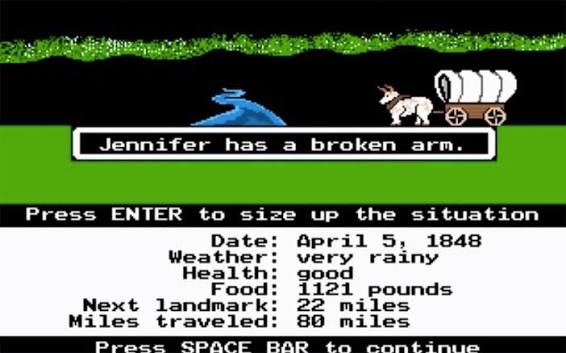
The next week, we ventured out on the Oregon Trail for a fifth try. But the road was kind — despite several broken arms — and our lone survivor made it to the Promised Land! Success!
(The extreme cold got me again this time. Some Oregon Trail travelers just can’t be taught, I suppose.)
Haven’t tried this version yet. Oregon still awaits…
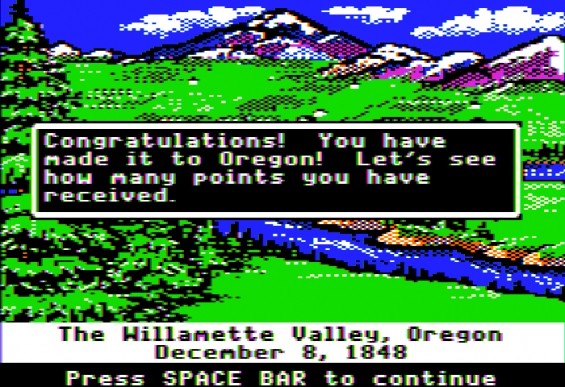
As you can see, getting all the way to Oregon is no small feat. Across 11 attempts and 68 travelers, only two true successful trips were made, and only 3 travelers saw Oregon’s Willamette Valley.
(And I died numerous times, but somehow, never of the dreaded dysentery.)
And yet, it was an absolute blast every time. The cruel turns of fate we met with laughter, not frustration, and the teamwork developed along the way was a genuine delight.
The Oregon Trail Card Game might not be everyone’s cup of tea, but I will always think of the game fondly.
Have you ever attempted the Oregon Trail in card game form, fellow players? Let us know in the comment section below! We’d love to hear from you.
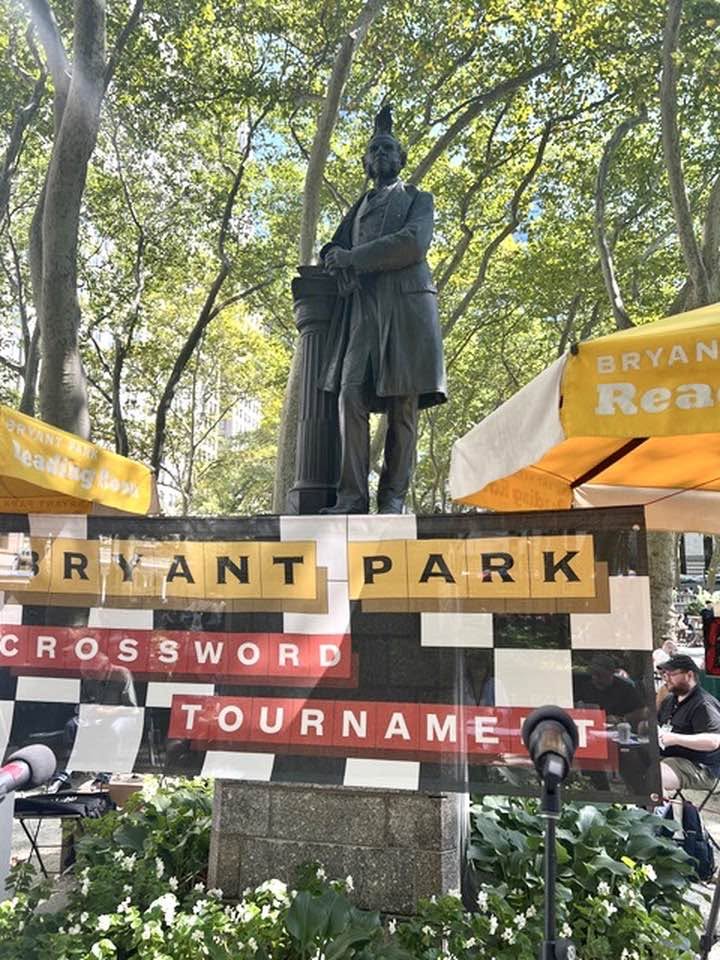
Although you’re welcome to walk in and participate, things go much smoother if you register ahead of time. Click here to get started!
They’ve even borrowed Will Shortz’s clock for the tournament!
With three Mike Shenk puzzles waiting for competitors, you should absolutely make an effort to participate in this year’s event.
The Boswords Fall Themeless League Returns Soon!
And speaking of crosswords, there’s still time to register for this year’s Fall Themeless League, which starts up on Monday, October 5 (though they have a preseason puzzle launching the week before on September 28th).
If you’re unfamiliar, the Boswords Fall Themeless League is a clever weekly spin on traditional crossword tournament-style solving. Instead of cracking through a number of puzzles in a single day (or two), the Fall Themeless League consists of one themeless / freestyle crossword each week, scored based on your accuracy and how fast you complete the grid.
Look at that lineup of talent!
Each week’s puzzle only has one grid, but there are three sets of clues, each representing a different difficulty level for solvers. Smooth is the least challenging, Choppy is the middle ground, and Stormy is the most challenging. (When you register to participate, you choose the difficulty level that suits you best.)
Each week’s puzzle is accompanied by a one-hour broadcast on Twitch, starting with a preseason puzzle and broadcast.
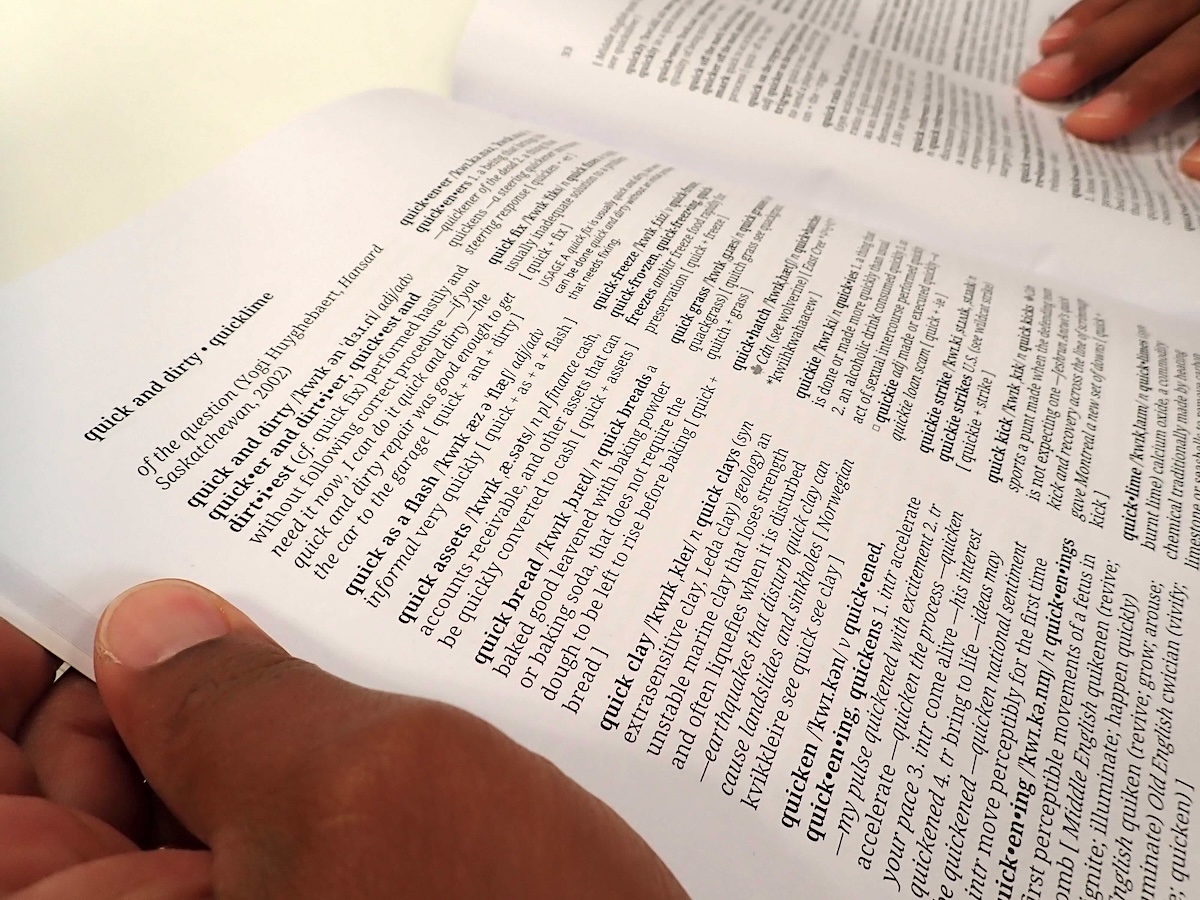
The Tyee dropped an article recently about a group of Canadian linguists, the Society for Canadian English, that are working on a new Canadian English Dictionary.
And they’ve started with the letter Q.
“Q is a short fascicle, but not as trivially so as X, and it’s a favourite among Scrabble players,” its quintet of authors explained, in an article published in Dictionaries: The Journal of the Dictionary Society of North America.
“Q has plenty of quite quintessentially quirky and quotable words that are useful in attracting attention to our project.”
They wish to raise awareness of their undertaking, not just for public support, but to find a publisher and secure funding for the project.
Check out the full article here. It’s an in-depth and fascinating exploration of the intersection of language, culture, play, and politics.
Two Puzzle Games to Try Out!
One of the coolest things about running PuzzCulture is getting to learn about new puzzles and creators in the puzzle space. Several enterprising constructors have reached out to me recently, and I’m pleased to help spread the word about their puzzly endeavors.
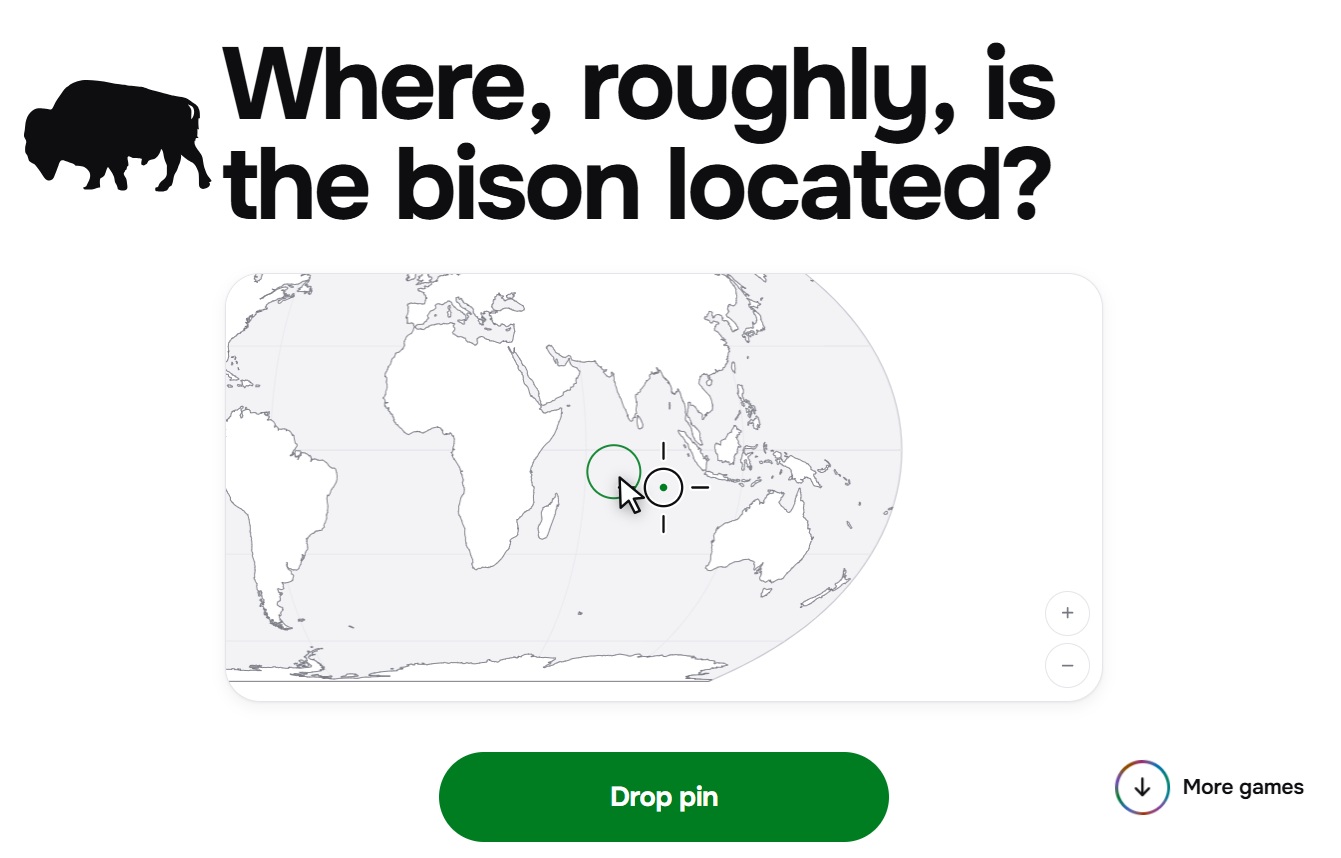
The first is Esteban Martin’s daily decathlon of click-and-drag puzzles, Roughly.Is.
Each day, solvers are presented with ten minigames that pose a question for the reader. Some are simply trivia, others are guessing games or games of skill.
I’m a sucker for puzzles that teach me things, so the games of Roughly.Is are a delight. How big is a blue whale, compared to a Saturn V rocket? What did a steak cost in Zurich in 1970? Where do bison live?
The variety of topics means you’re sure to learn something new or find something to entertain you for a minute. What more can you ask for?
Check out Roughly.Is for all ten minigames, no ads and no login required.
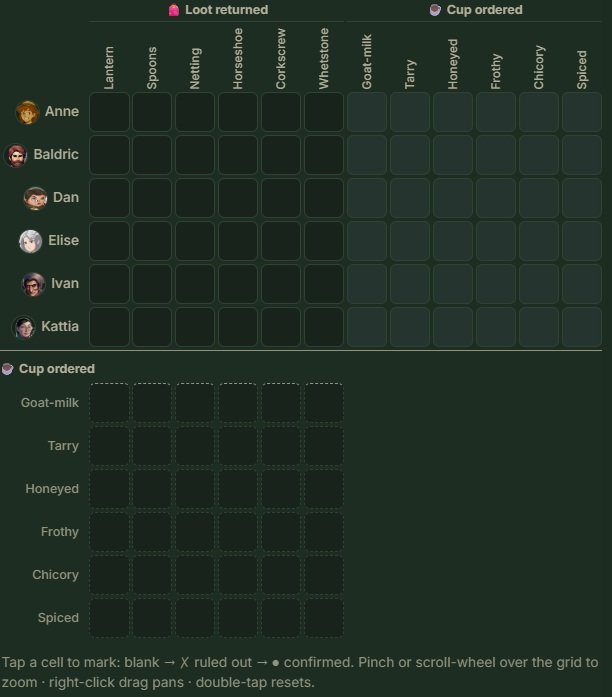
But if you’re looking for a meatier daily challenge, consider Jeff Doka’s Morning Mystery.
Part of the BossFeed puzzle lineup, Morning Mystery is a logic puzzle that invites solvers to use the facts at hand to determine the puzzly truth.
The twist? You can’t trust all of the facts you’re presented with. Some are guaranteed to be genuine, but others could be the characters in the mystery misleading you.
Let’s wrap up today’s post with some insight into Widow’s Bay, fresh off a record-setting bevy of wins at the Emmy Awards.
Widow’s Bay is a horror comedy that’s drawing all sorts of eyes, and for good reason. It’s brilliantly cast, well-paced, and razor-sharp.
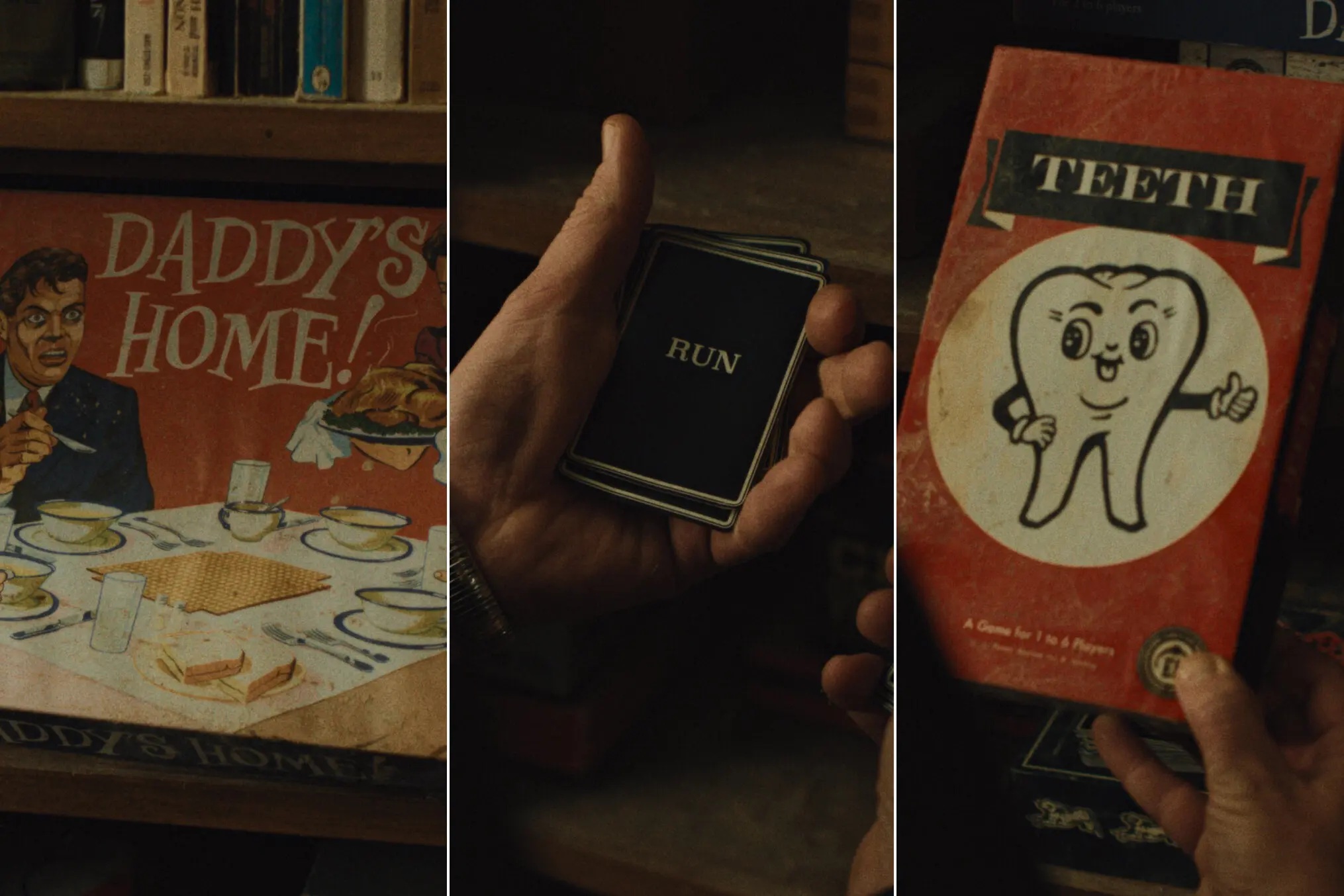
And, if you’re a board game fan, there was a creepy treat for you in episode two, as the mayor visited a local inn and discovered a number of board games with unnerving art and unpleasant implications
Obviously, I tried to keep it light. I genuinely strive for the tone of PuzzCulture to be positive. I love puzzles. I love games. I love RPGs. And writing about them, for the most part, is a blast, and I hope it’s fun to read about them as well.
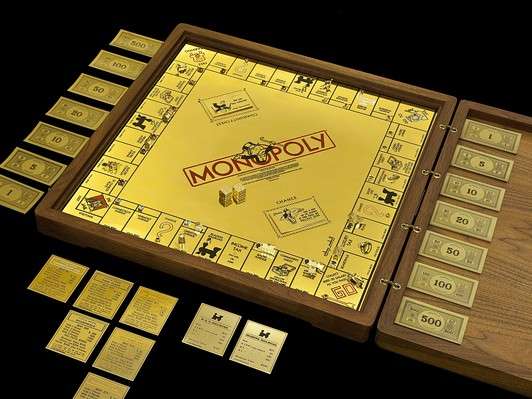
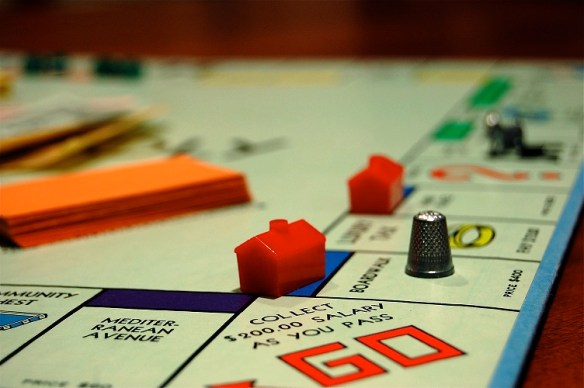
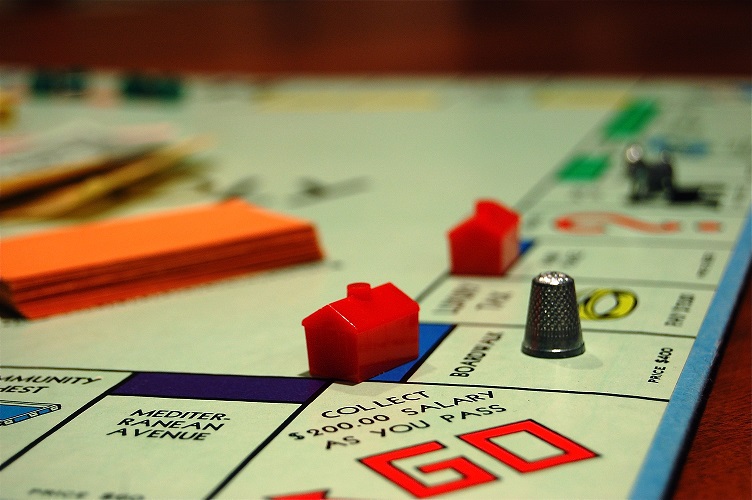
And last week, I avoided discussing Monopoly because, well, it’s difficult to maintain a positive tone about Monopoly. I don’t particularly enjoy playing Monopoly.
Monopoly has its issues. It takes a long time to play, and if you fall behind, it’s incredibly difficult to catch up. Plus, if you get eliminated, it’s not much fun to watch other people keep going.
But Monopoly is a best-selling game. It’s one of the most well-known games. Clearly there are things about Monopoly that many people quite enjoy.
So that’s the notion behind today’s post. Let’s take a look at different aspects of Monopoly that people enjoy, and then look at other games that do those things as well or better!
That’s keeping it positive, isn’t it?
Here we go!
Maybe you enjoy buying property and building it up with enhancements and generating money with it.
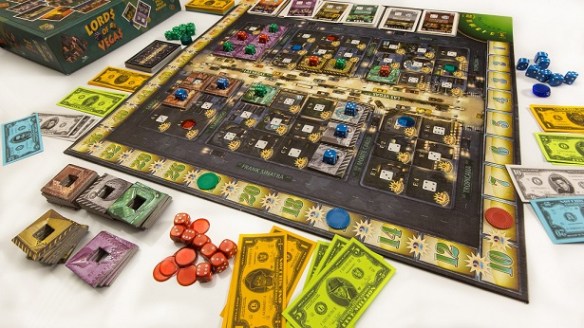
That’s great. You should check out Lords of Vegas.
It’s a casino-building game set in the early days of Las Vegas. It’s got play money, dice, all sorts of strategy, plus a gambling mechanic where you can make up for monetary shortfalls. It’s a brilliant game and so so much fun.
It recently got a six-player refresh and some new mechanics, but at heart, it’s a lot of the guts of Monopoly in a more streamlined, more immersive package.
Other recommendations for property games:The Estates, Suburbia, For Sale.
Maybe it’s collecting valuable cards, negotiating and trading with other players that you enjoy most about Monopoly.
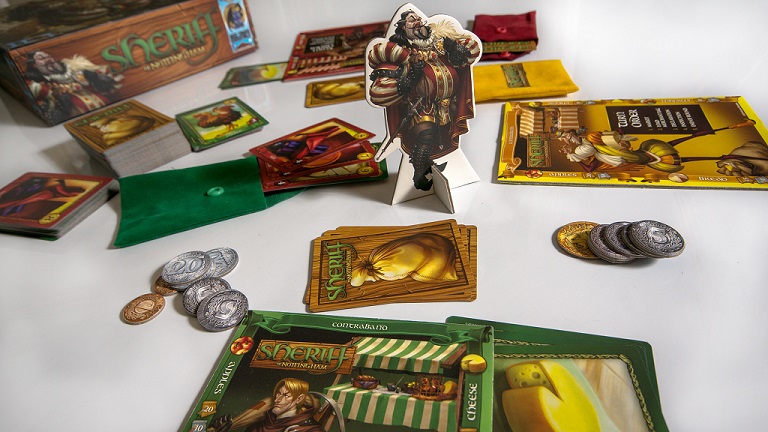
Terrific! You should try Sheriff of Nottingham.
In Sheriff of Nottingham, players collect cards that represent different goods for you to take to market — apples, chickens, bread, and cheese — as well as cards of contraband items (like spices, mead, and weapons).
Each turn, one player is the Sheriff, trying to stop the other players from sneaking contraband into the market. So you can bluff, or bribe, or try to sneak goods past the Sheriff, or just play it straight with regular goods.
The game allows for trading, cutting deals, being sneaky, and bonuses for being the person with the most of certain goods (apples, for instance) at the market. It’s a blast, and allows for lots of fun interaction throughout the game, since nobody is ever eliminated.
It’s the bargaining and negotiating aspect of Monopoly turned up to 11, but with some craftiness built into the dealings. It’s a can’t-miss choice.
Other recommendations for negotiating games:Bohnanza, Chinatown, Illuminati.
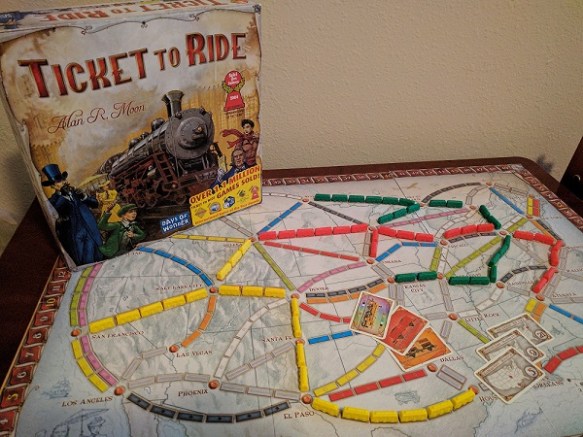
Do you like completing colored sets of items? Outmaneuvering other players? Claiming valuable property that other players want? Pretty much everything involved in Monopoly is also part of Ticket to Ride.
In Ticket to Ride, players collect cards and play cards on a map in order to complete different train routes to earn points. Not only can you score by completing those routes under your banner, but you gain bonus points if you can connect distant locations through your railways.
It covers a lot of the strategy and forward planning that made Monopoly famous, but in a sleeker, quicker package. (And like Monopoly, it has different varieties set in different locations!)
Other recommendations for Monopoly But More: Food Chain Magnate, Cosmic Encounter, Power Grid.
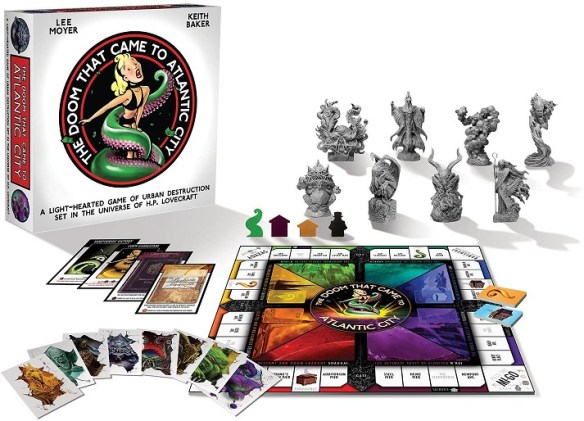
Oh, and if you want a totally off-the-walls Monopoly-inspired game, there’s always The Doom That Came to Atlantic City.
In this game, you crush houses to claim properties, play Chants (instead of Chance) cards, and basically try to be the best doomsday cultist at the table. It’s a race between various Lovecraftian cults, all hoping to summon their particular monstrous world-ending god before the other players can.
It’s delightfully tongue-in-cheek, a riotous time, and a hilarious inversion of a lot of classic Monopoly tropes. I highly recommend it.
Are you a Monopoly fan, fellow player? Please tell us what you love about Monopoly in the comment section below! And if you’re not a fan, tell us what you prefer to play instead!
I was talking about board games with a friend of mine over the weekend, and he asked me what I thought the worst board game was.
That’s a difficult question to answer, because a lot of factors go into it. Some games are fundamentally flawed, while others might not connect with you personally, but other folks love them.
Some games simply don’t explain their rules well, leaving players scrambling and baffled on their first playthrough. Some games have a simple gimmick that is fun once, but has very little replay value. Are those bad games?
A game can be mechanically bad, but if you still have fun at the table with your friends while playing it, is it a bad game?
It’s a lot to unpack.
Many of the old classics end up on lists of worst games: Risk, Battleship, Twister, Candy Land, Trivial Pursuit, Chutes & Ladders, Guess Who?, and of course, Monopoly.
I don’t know that it’s necessarily fair to put simpler children’s games on a list of worst games, simply because they’re not as fun to play when you’re older. (Or if you don’t have polio, in the case of Candy Land.)
I also don’t think that games belong on the list simply because they can take a long time, like Risk or Monopoly.
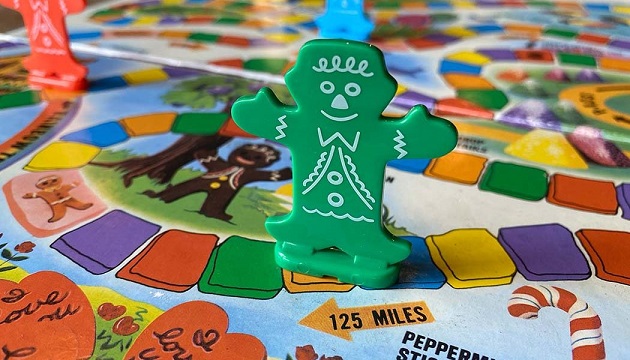
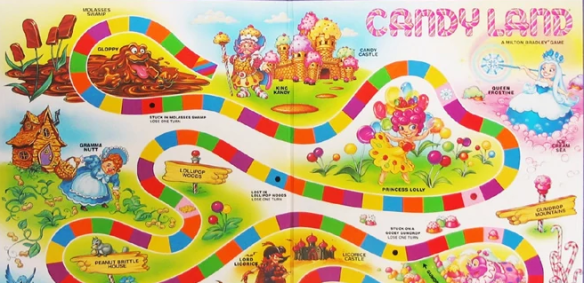
To be fair, some of these games aren’t games at all. Candy Land and Chutes & Ladders involve NO player agency and NO meaningful choices. (Though, in the past, we’ve suggested ways to make Candy Land better.)
And some of the major flaws of these games can be fixed with house rules.
The main issue with Trivial Pursuit, for instance, is that you have to be on very specific squares to earn your wedges, so a lot of the trivia-answering and die-rolling feels pointless or tedious.
But you can fix that with a house rule like “answering three questions of the same color earns you a wedge” or “answer two questions in a row and you immediately proceed to a wedge spot.” Simple fix!
As for Monopoly… well, it has earned its reputation. And yet, it remains one of the bestselling games. Clearly some people are out there enjoying it. (And I wish to know their secrets.)
But newer games aren’t immune to ending up on lists of the worst games.
Munchkin often appears there, but I think that’s due less to gameplay and more to how difficult it can be to get into the gameplay, given how child-friendly the art style is.
The Oregon Trail Card Game appears on some lists, which I found surprising. Sure, the game is hard, almost unfairly so, but that’s kinda the point. My work team and I had a blast chronicling our attempts at beating it every week at lunch, as well as the numerous deaths I personally endured during play. It was a Sisyphean joy!
A lot of pop culture tie-in games are generally awful because they’re cash grabs, not genuine attempts to make a fun game. (The Twin Peaks Murder Mystery Game is truly wretched, for instance. But, then again, The Golden Girls version of Clue is delightful. It’s a mixed bag.)
Personally, I would put Cards Against Humanity on the list, because it encourages lame edgelord humor and reaching for low-hanging fruit, comedically. Cleverness and wit often loses to shock value.
But then again, it can be the seedling for a better game. I’ve played Charades Against Humanity (where you have to act out a White Card from the game) many a time and had an absolute blast. Again, house rules save the day.
So, at the end of the day, what is the worst board game?
Whichever one you enjoy the least.
Or Monopoly. Who can say?
I can, however, with one hundred percent certainty, tell you the worst card game. And no, astonishingly, it’s not War. (Though War suffers from the same flaw as Candy Land.)
The worst card game of all time is Guess the Card.
Here’s how to play, if you’re a masochist:
Shuffle a deck of cards.
Put the deck of cards in front of you.
Try to guess the card on top.
Flip over the card and see if you’re right.
That’s it. It’s maddening and insane and barely a game, and I have a friend who makes us play it before every game night she hosts because it makes her laugh hysterically.
So, while it’s the worst card game in the world for most of us, it’s her favorite.
To each their own, I guess.
What’s your least favorite card game or board game? Or, better yet, what’s your favorite? Let’s end on a positive note, shall we? Let me know in the comments section below! I’d love to hear from you.