
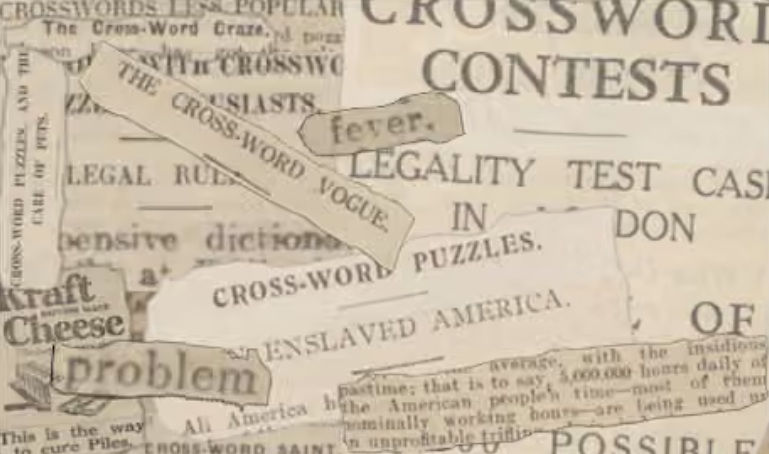
The 1920s were a huge time for crosswords, and as an enthusiastic amateur crossword historian, it has been a joy to delve into the archives and look back on some of these now century-old moments in crossword history.
And this comment from a crossword trivia website definitely caught my eye:
1926: First reported instances of Braille crosswords, as newspapers mention Helen Keller solving Braille crosswords and recommending them to the blind.
Naturally, I went digging for more information about the connection between Helen Keller and crosswords for the visually impaired.
Along the way, I got to explore the fascinating history of Braille crosswords and learn some interesting and unexpected facts.
So please take a walk with me through a forgotten chapter of crossword history.
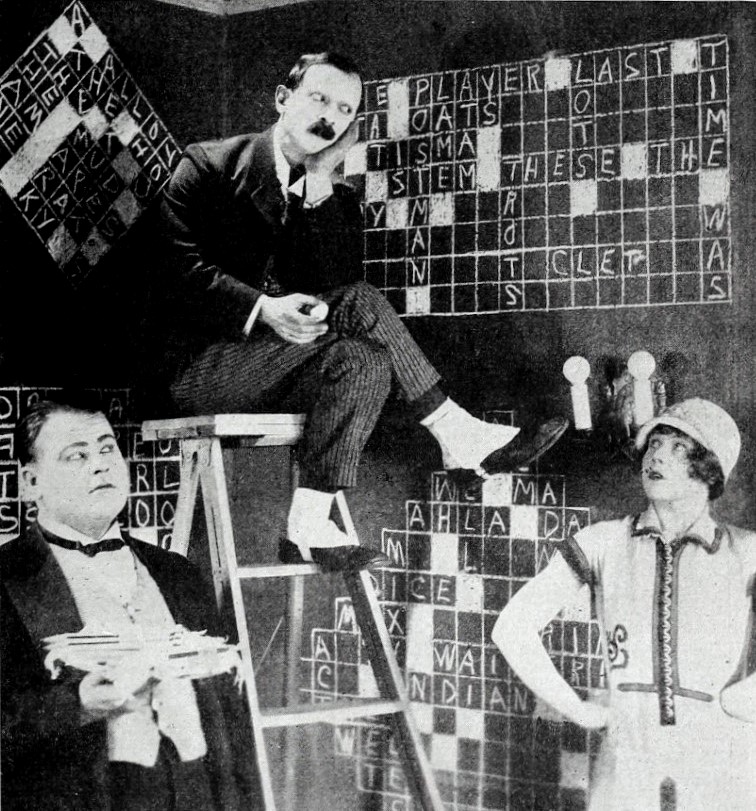
In 1925, the crossword craze was at an all-time high. There were crossword outfits, crossword songs, and even a crossword musical!
And efforts were already being made to bring the crossword phenomenon to those with visual impairments.
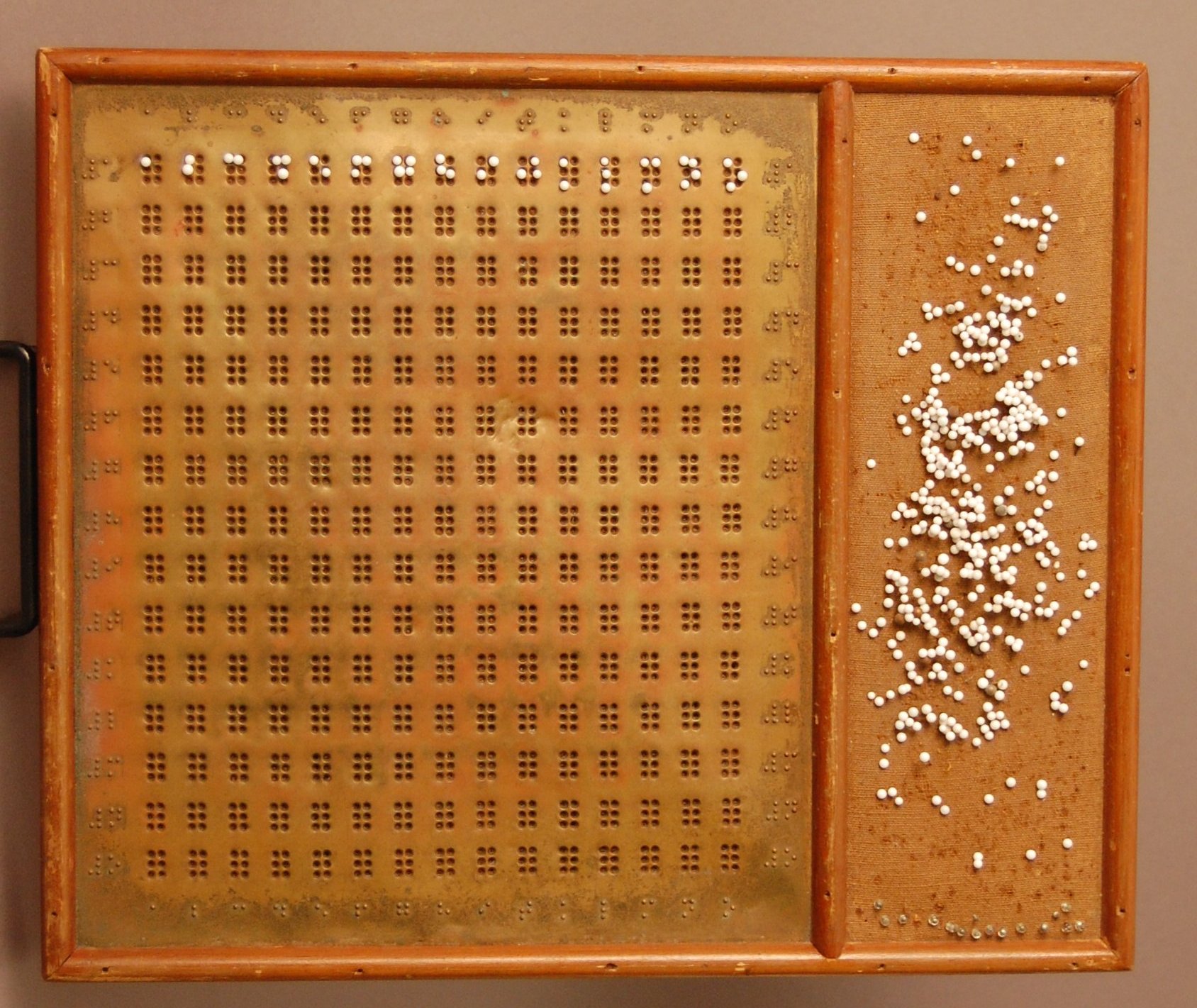
The Howe Memorial Press introduced their “crossword puzzle board usable by anyone acquainted with braille” in 1925. They manufactured 24 of them that year, and the one pictured above found its way into the classroom of Corrine Delesdernier, who taught blind students out of her home in Connecticut.
This 15×15 layout allows pins to be placed into one of six holes in each of the 225 perforated cells, allowing the user to create any braille letter.
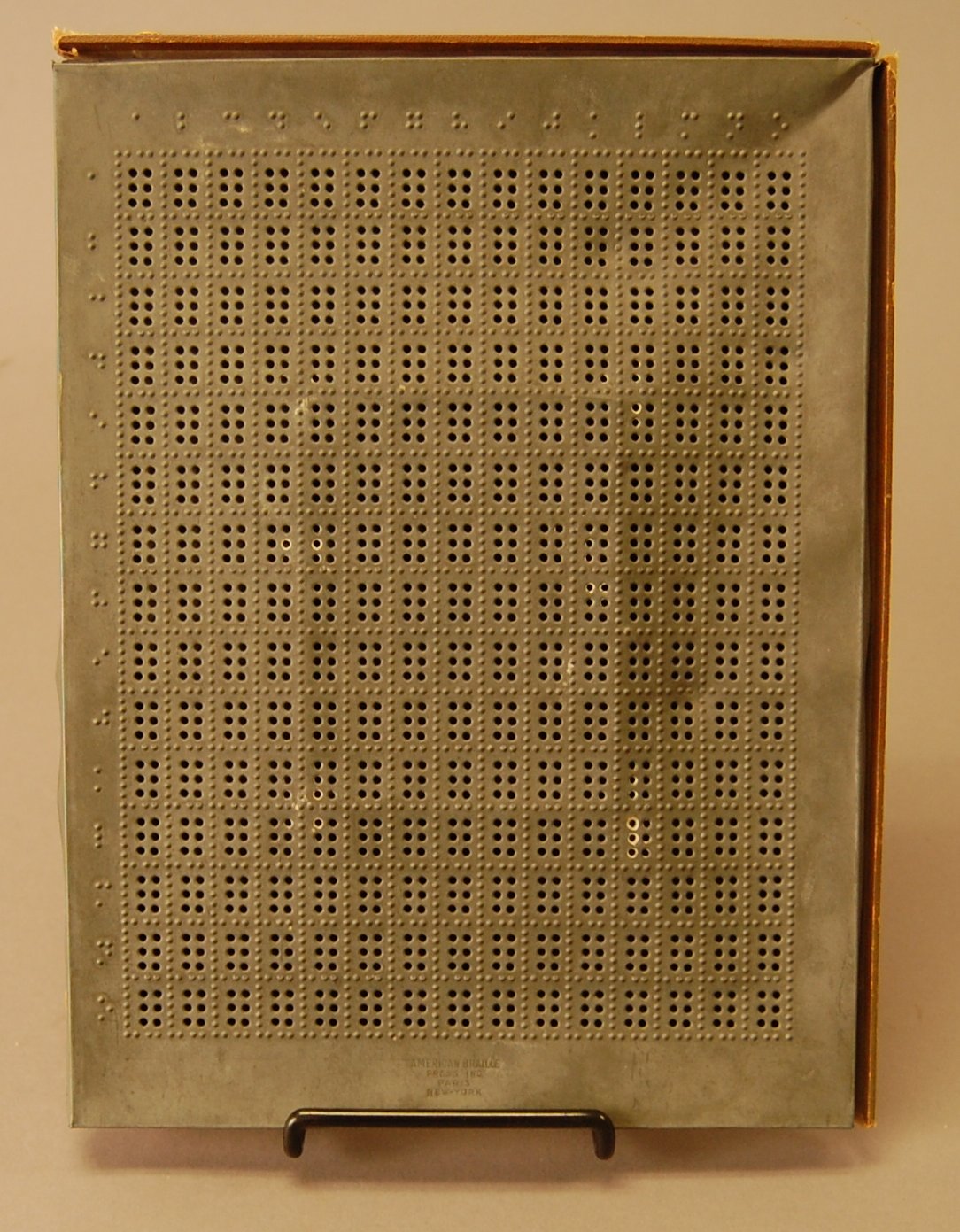
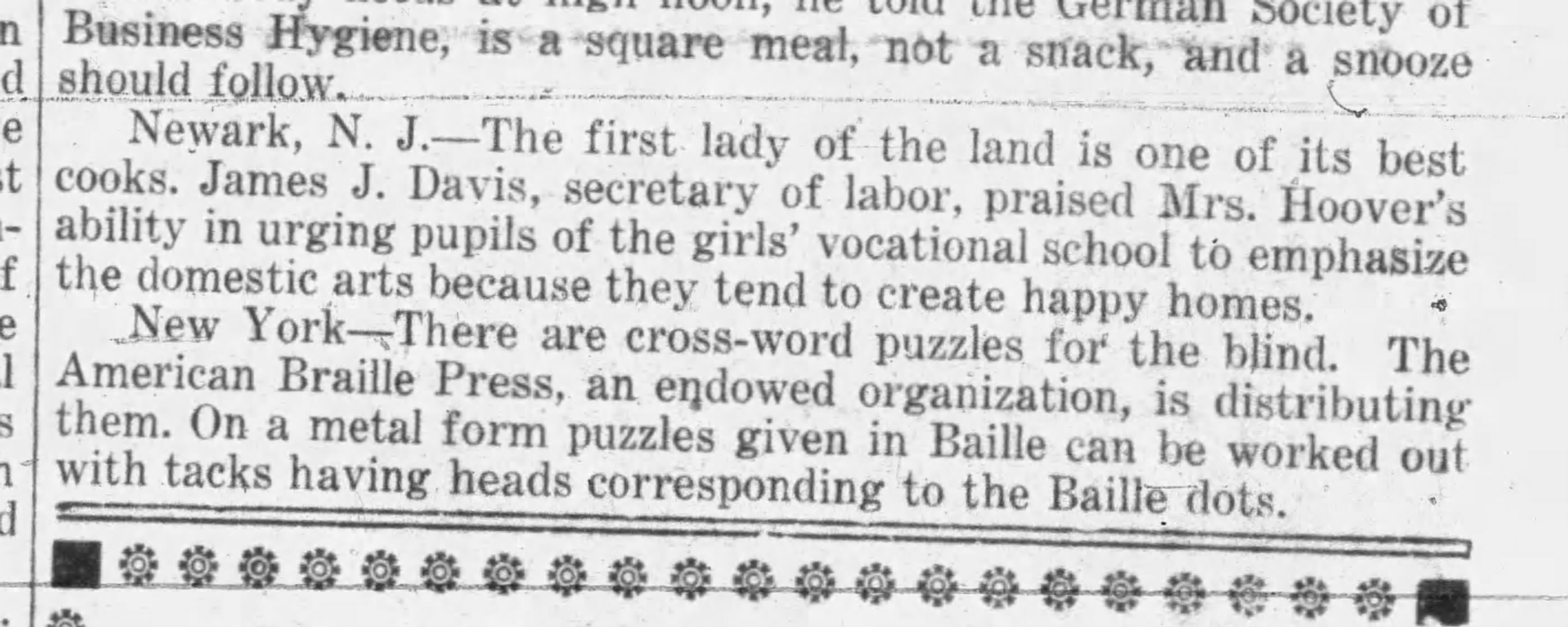
This similar design was produced by American Braille Press circa 1930, and would be featured in catalogs and periodicals focusing on the blind throughout the 1930s (even the ones that couldn’t spell Braille properly).
By 1926, England’s National Institute of the Blind was already advertising numerous Braille publications, including “a family monthly (with patterns, crossword puzzles, etc.),” but it’s unclear what form those crossword puzzles might’ve taken.
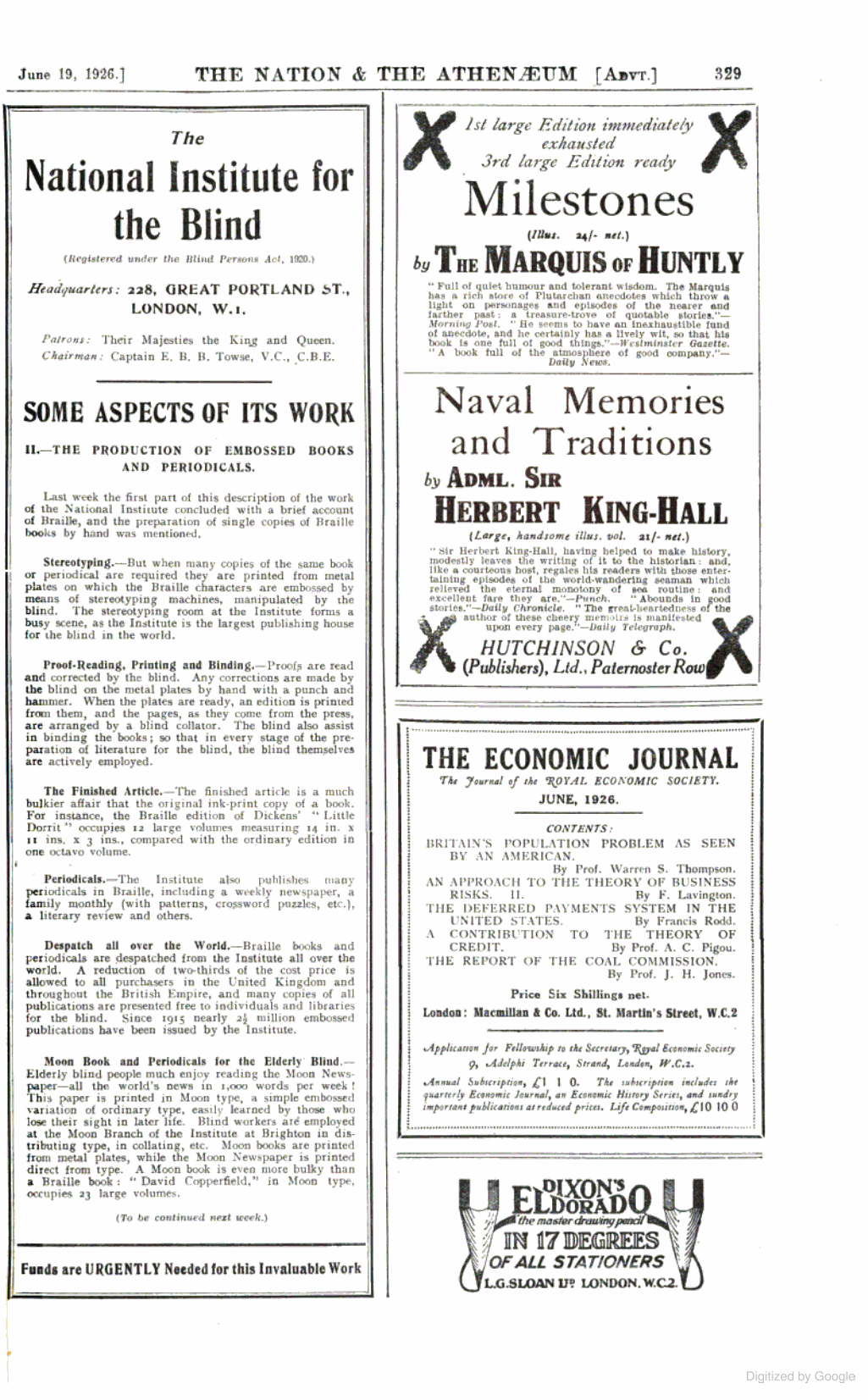
I reached out to the Royal National Institute of Blind People (or RNIB, as the NIB is now known), and they were kind enough to share some of their documentation with me.
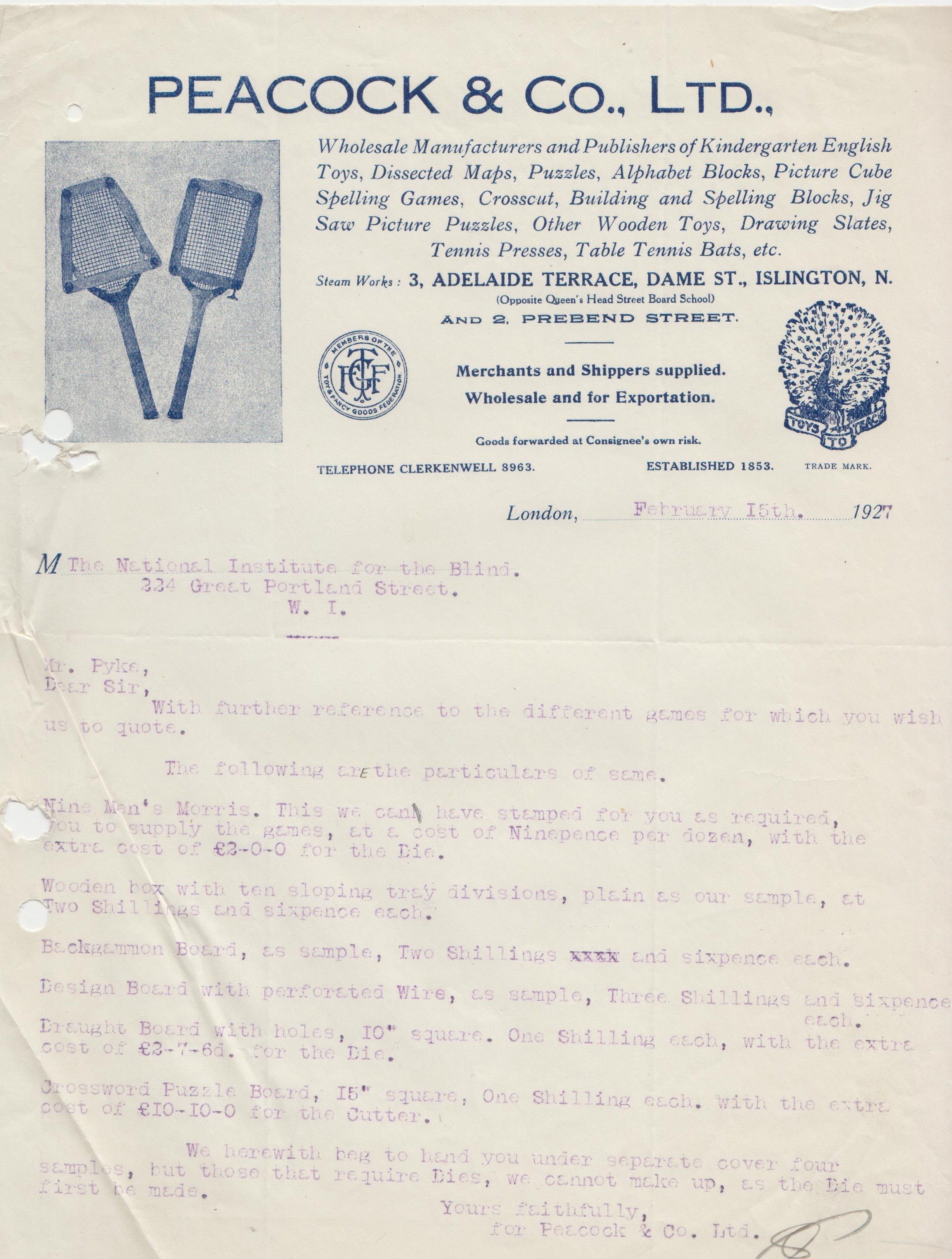
They had a quote from a manufacturer, Peacock & Co. Ltd, citing prices for production copies of Braille crosswords, backgammon boards, and games of Nine Men’s Morris. Incredibly, a 15″ Braille crossword board was quoted at 1 shilling per unit.
In the 1930s, a new name emerged in the world of Braille crosswords: Dr. Frederick William Alexander.
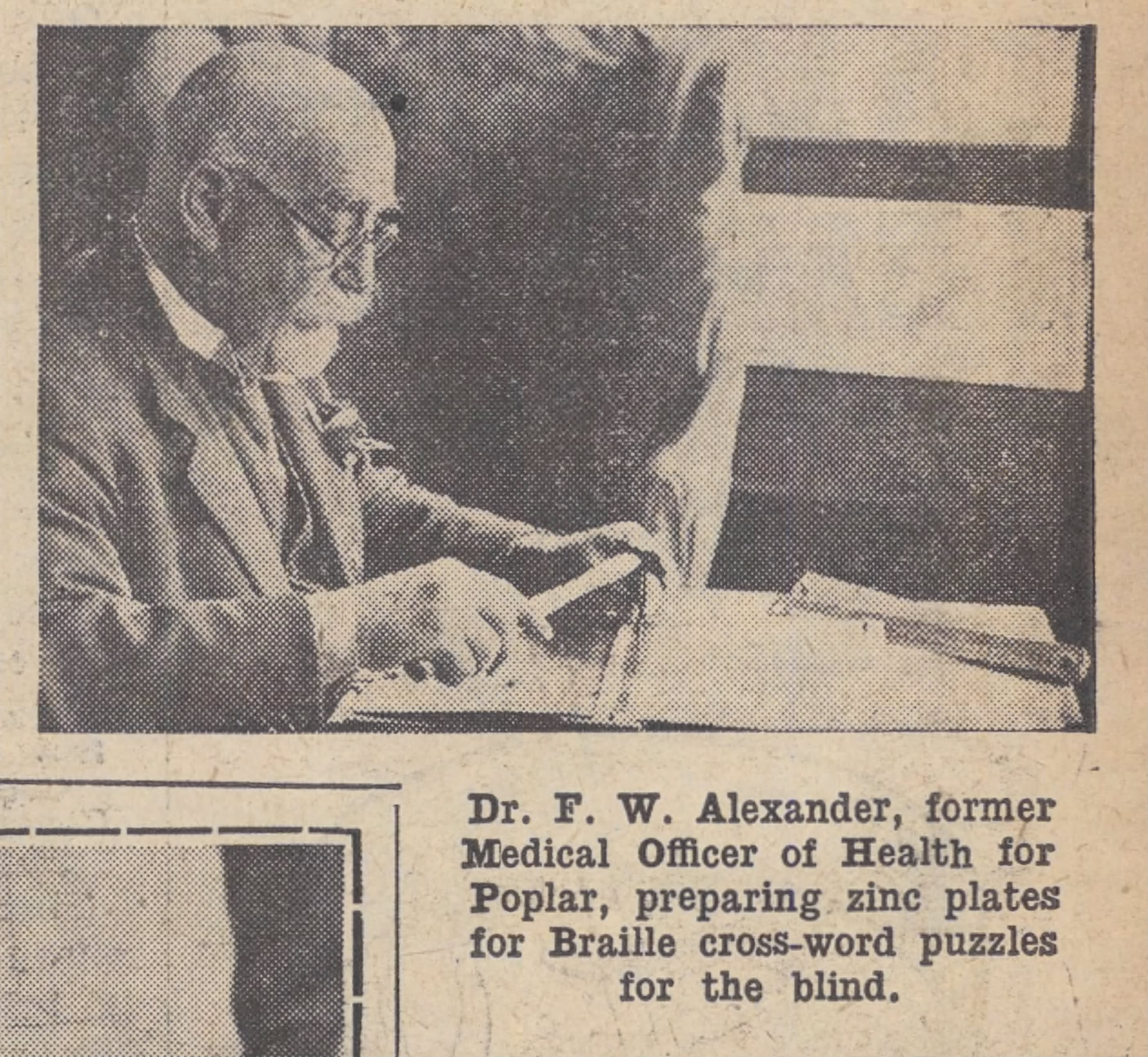
He developed zinc plates upon which he could model crossword designs in Braille, but he was having difficulty reproducing those Braille patterns on paper without damaging the tactile dots that would allow sightless solvers to enjoy the puzzles.
But after numerous failed attempts with various pieces of machinery intended for printing, he found his solution in an unlikely place… a laundry appliance wholesaler.
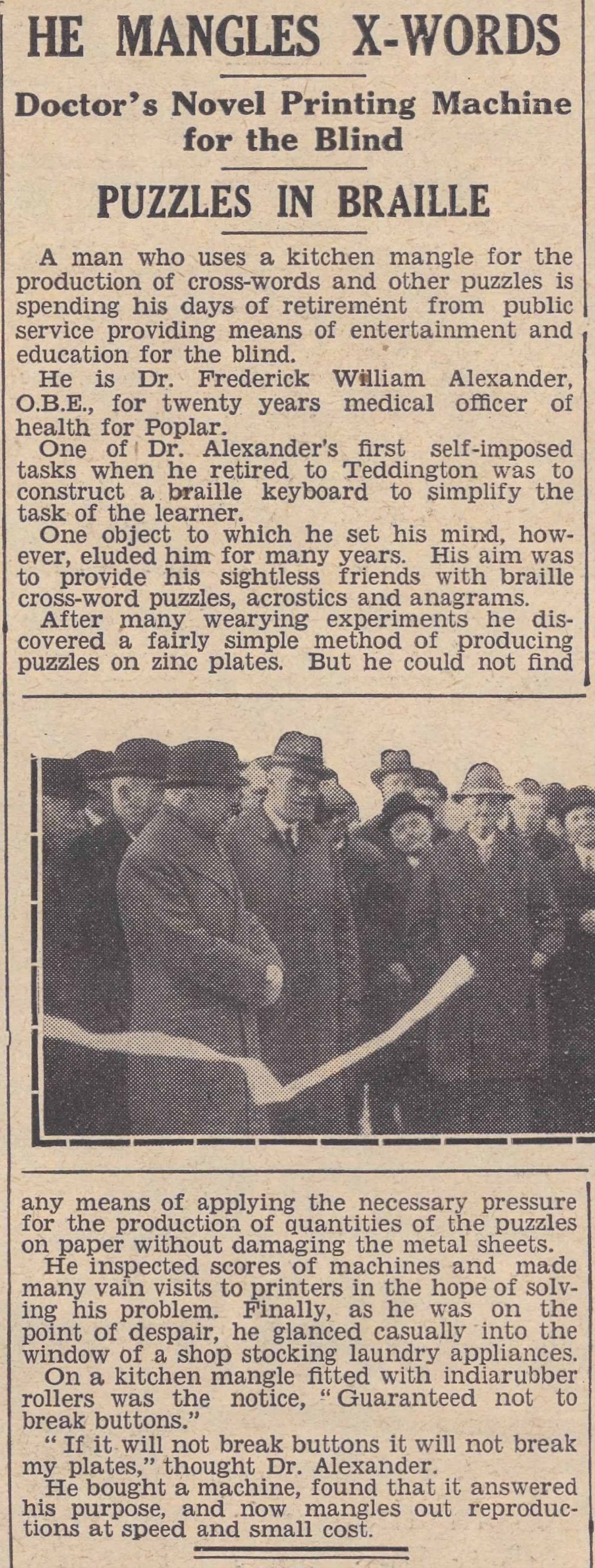
Yes, he would roll the paper and zinc plate through a laundry mangler in order to reproduce his patterns en masse without damaging the paper.
He also produced acrostics and anagrams in Braille for solvers, and I hope further investigations might turn up one of his zinc plates, because I would love to see what sort of puzzles Dr. F.W. Alexander was cooking up.
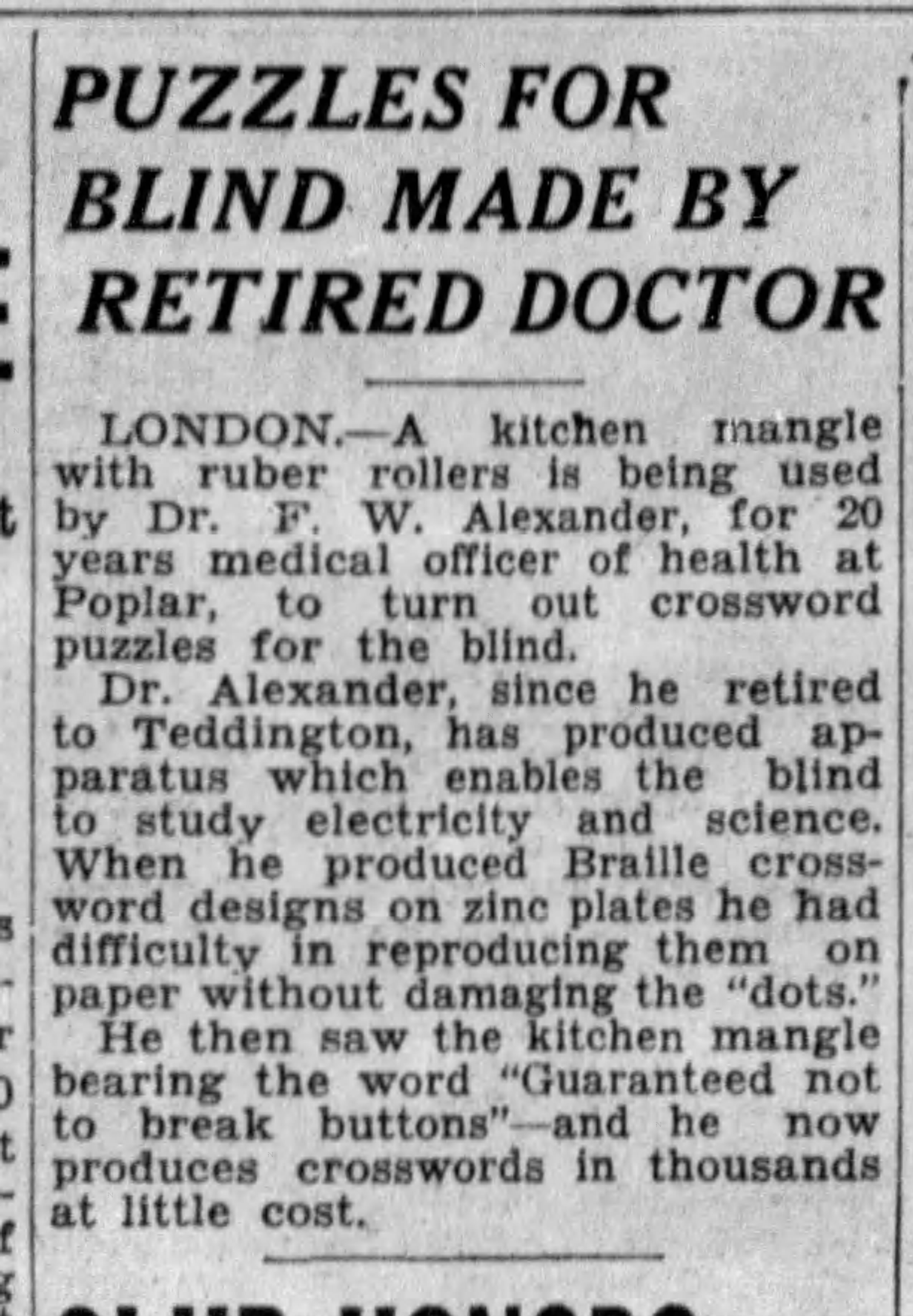
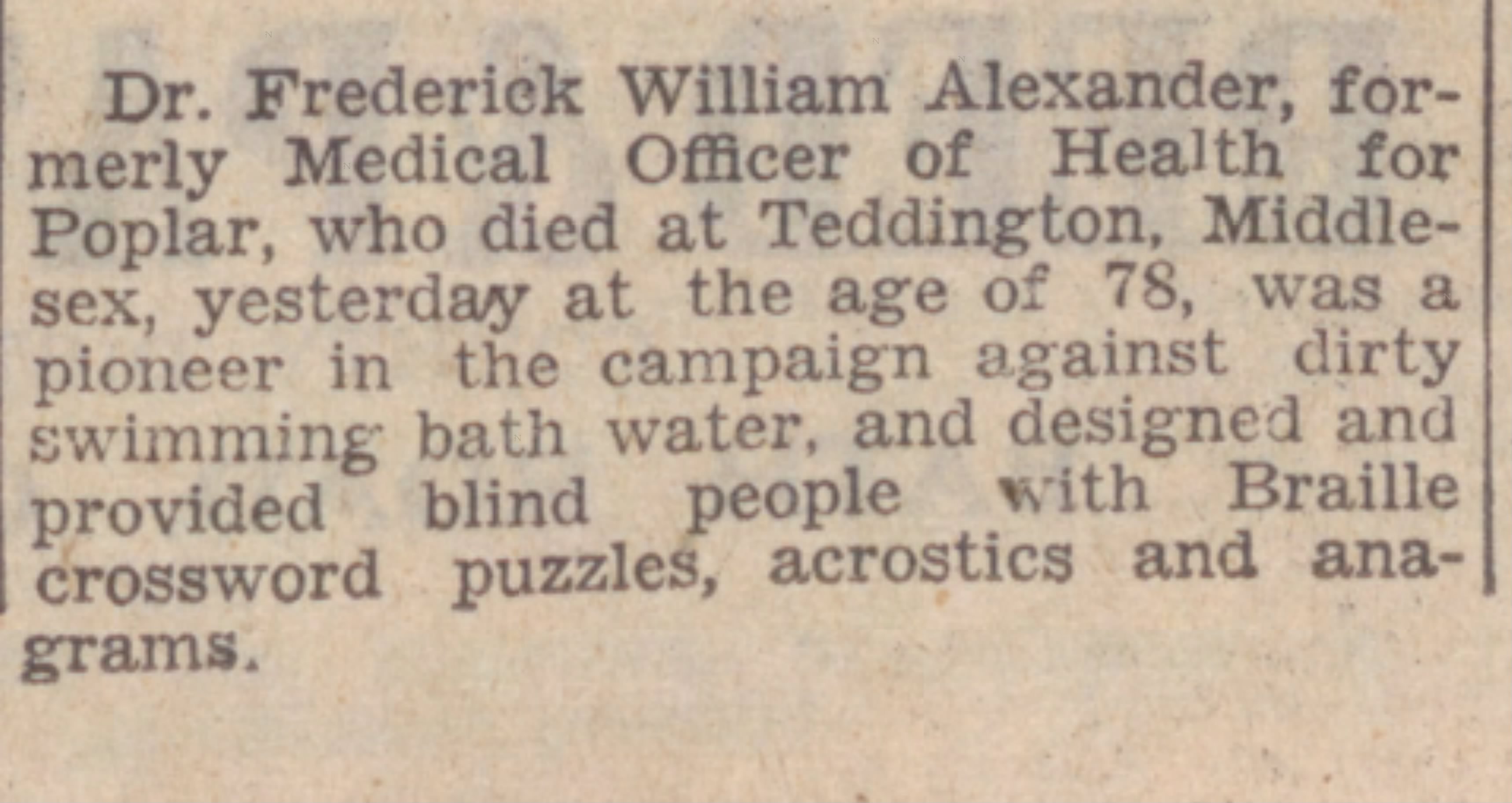
His efforts began gaining traction in 1932 and 1933, but sadly, the crossword world would only have his puzzles for a scant few years, as he would pass away on March 14th, 1937 at the age of 78.
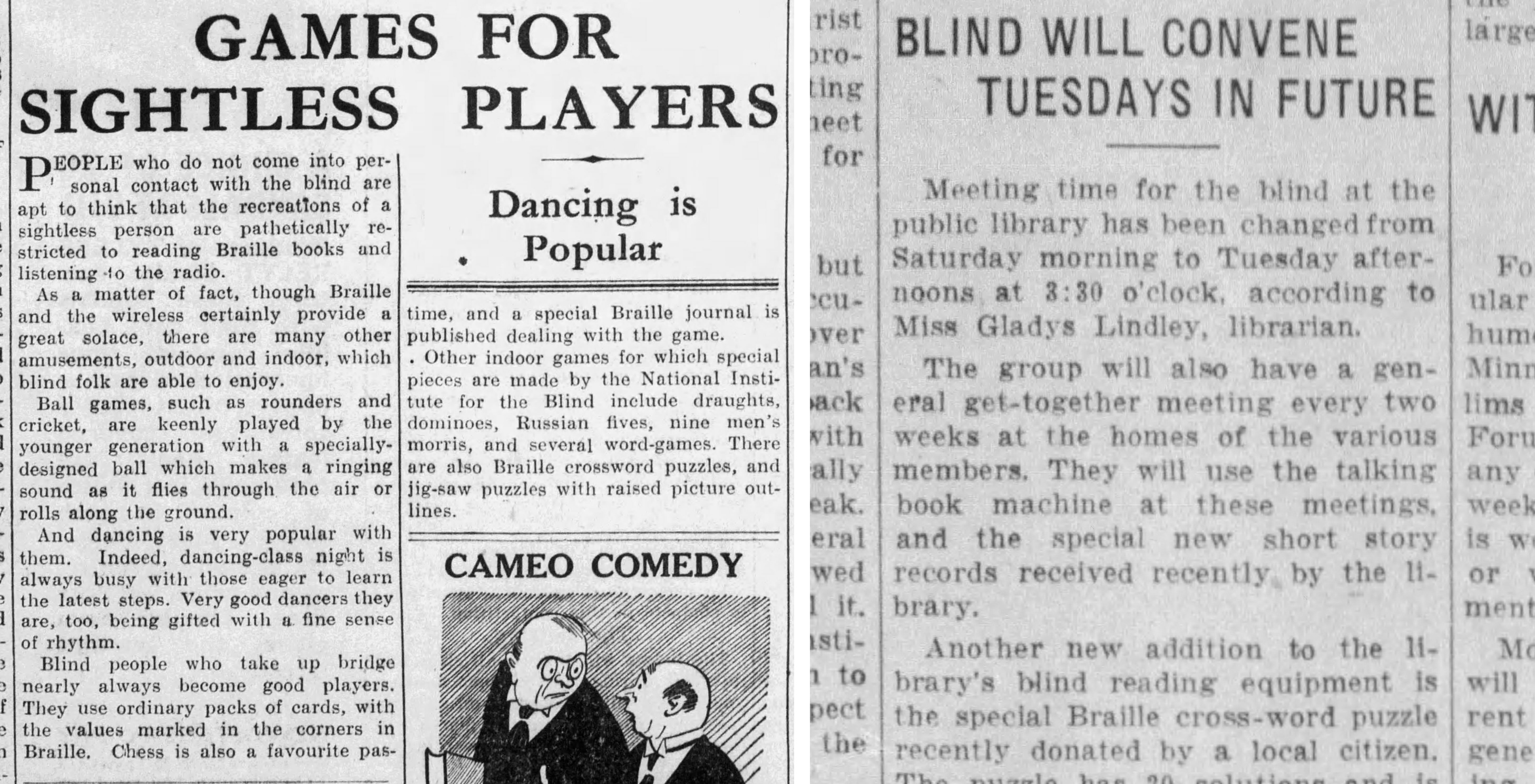
By the time of Alexander’s passing, Braille crosswords were growing more common, mentioned in articles about library events for the blind and ongoing efforts to adapt beloved pastimes to be played by touch alone.
The 1940s and 1950s were relatively quiet on the crosswords front, at least when it comes to Braille crosswords. But the early 1960s would see a resurgence of attention for Braille crosswords thanks to a new design.
The earliest reference to this design that I could find was on October 18th, 1963 in the Jim Thorpe Times News. They credited “engineers at the American Foundation for the Blind” with “recently” developing a braille crossword puzzle.
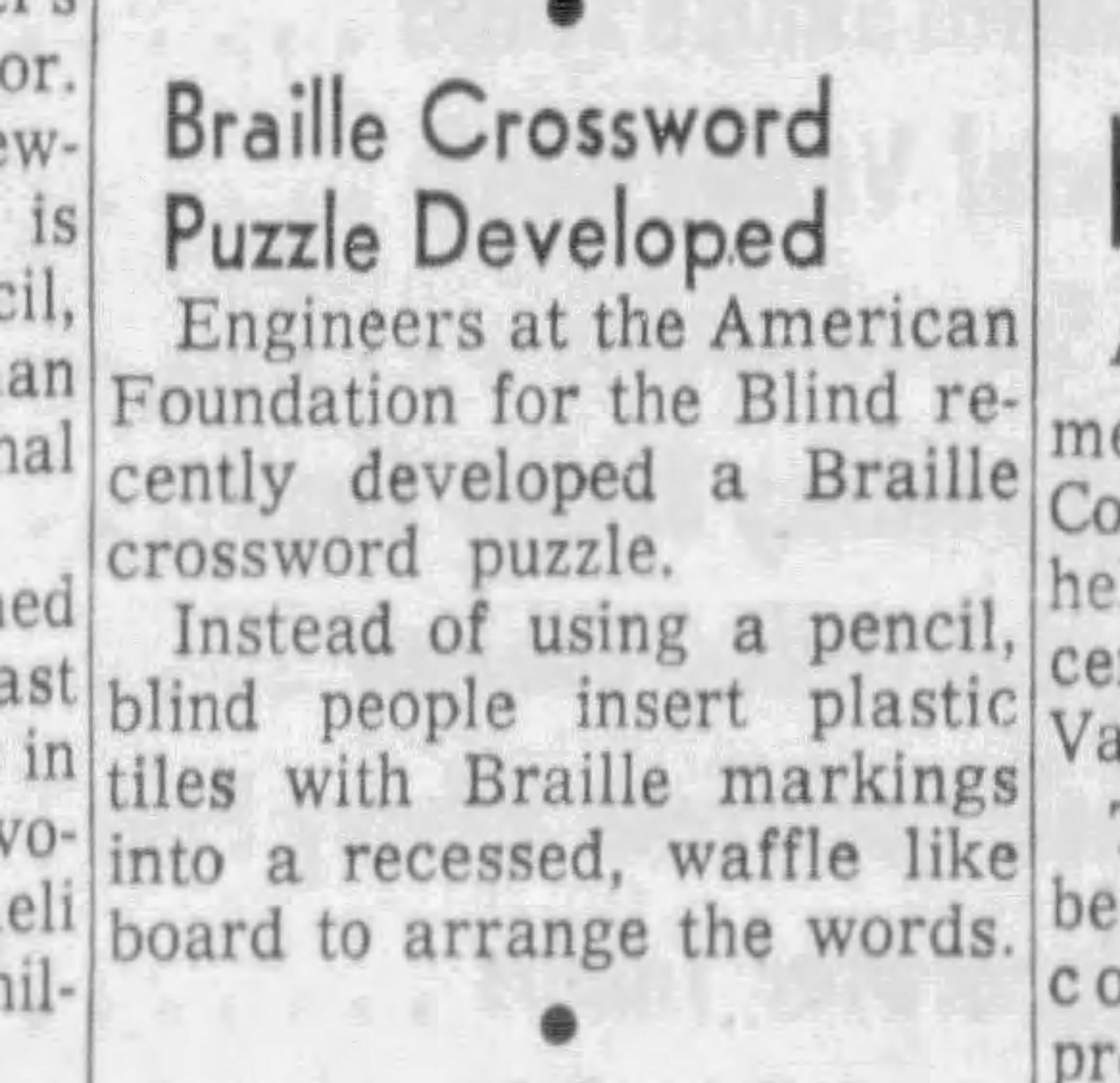
I put “recently” in quotes for a reason. You see, this exact same text would appear in newspapers across the country for the next year and a half. They wouldn’t always cite the AFB as the creators, but every single one would mention that you could “insert plastic tiles with braille markings into a recessed, waffle-like board to arrange the words.”
I found references throughout 1964 and into March of 1965. (Some newspapers even printed it twice, months apart. Same text and all.) “Recently” was certainly doing a lot of heavy lifting in those news briefs!
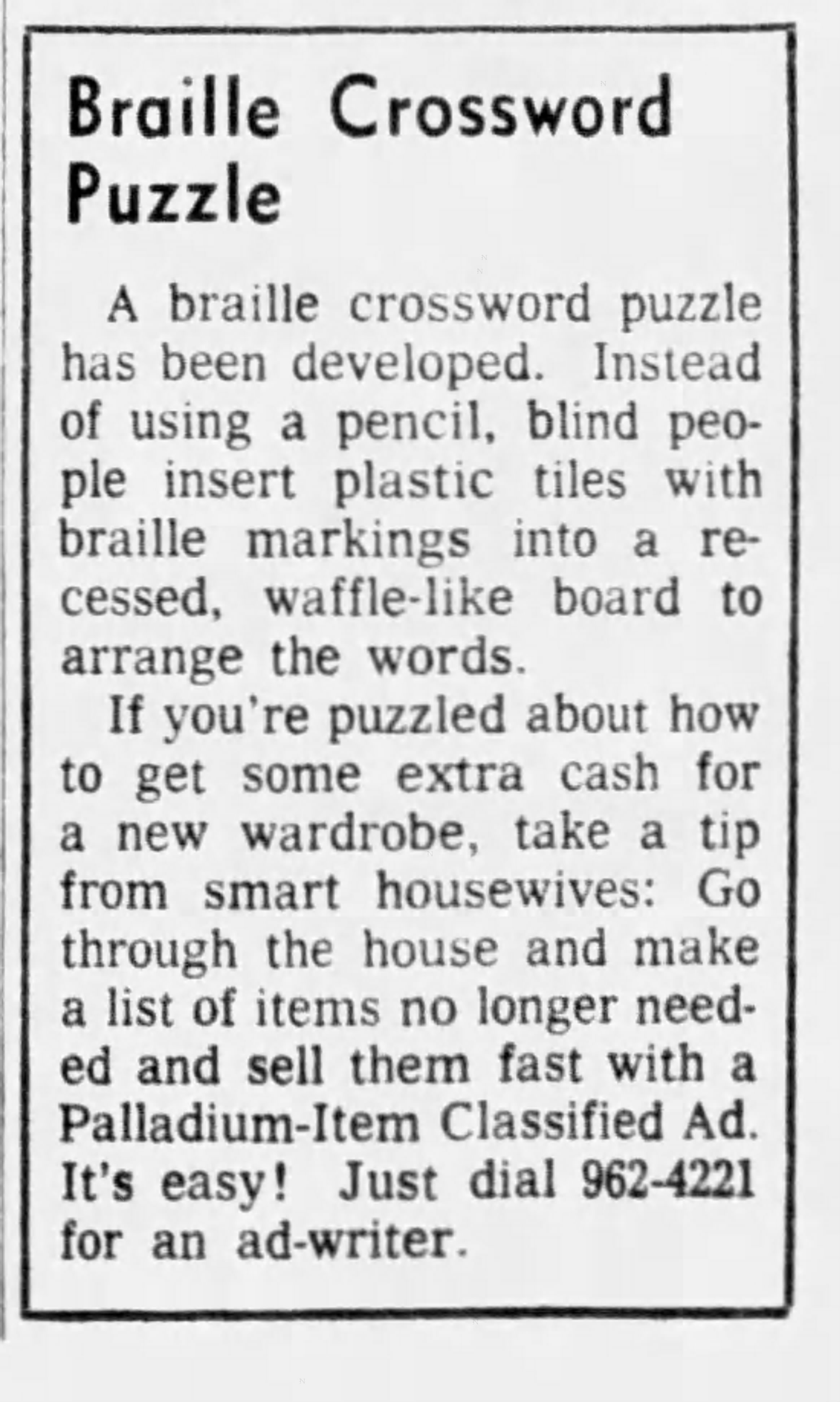
Later uses of this ubiquitous text incorporated a sales pitch into the post.
As you can see, actual details were slim. But if you go hunting, a richer story emerges, involving a collaboration between the American Foundation for the Blind and a former plastic manufacturer named Oran C. Wilson.
In 1962, Wilson retired as president of Wilson Plastics Co., and at a testimonial dinner, was awarded a plaque that declared him “World Champion Plastic Wall Tile Manufacturer.” Given the estimated 1.1 billion pieces of wall tile manufactured during his tenure, that title seems well deserved.
Wilson had already made a name for himself in philanthropic efforts after donating 20,000 checkerboard sets to the blind, and he was already preparing to develop a new Braille crossword.
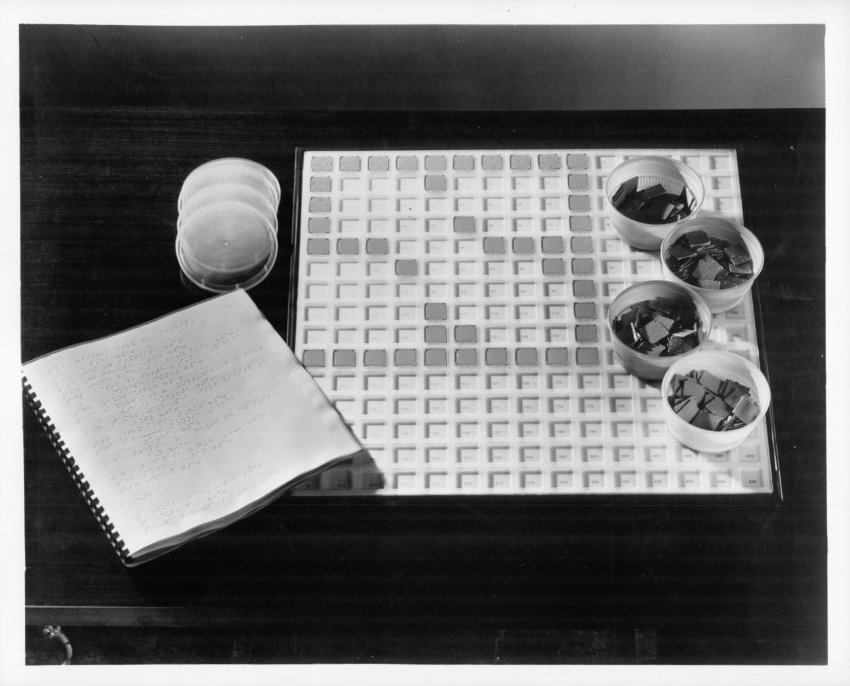
Unlike the designs of the past, this one would be tile-based. (I know, shocker!) The design was Wilson’s, but he was able to fully realize it in collaboration with the AFB. They tested the design over two months with thirty blind players before distributing the puzzle.
It was formally debuted in a demonstration at the Americana Hotel in April of 1963 by AFB staff member Ruth Wartenberg, where it was celebrated as the first of its kind.
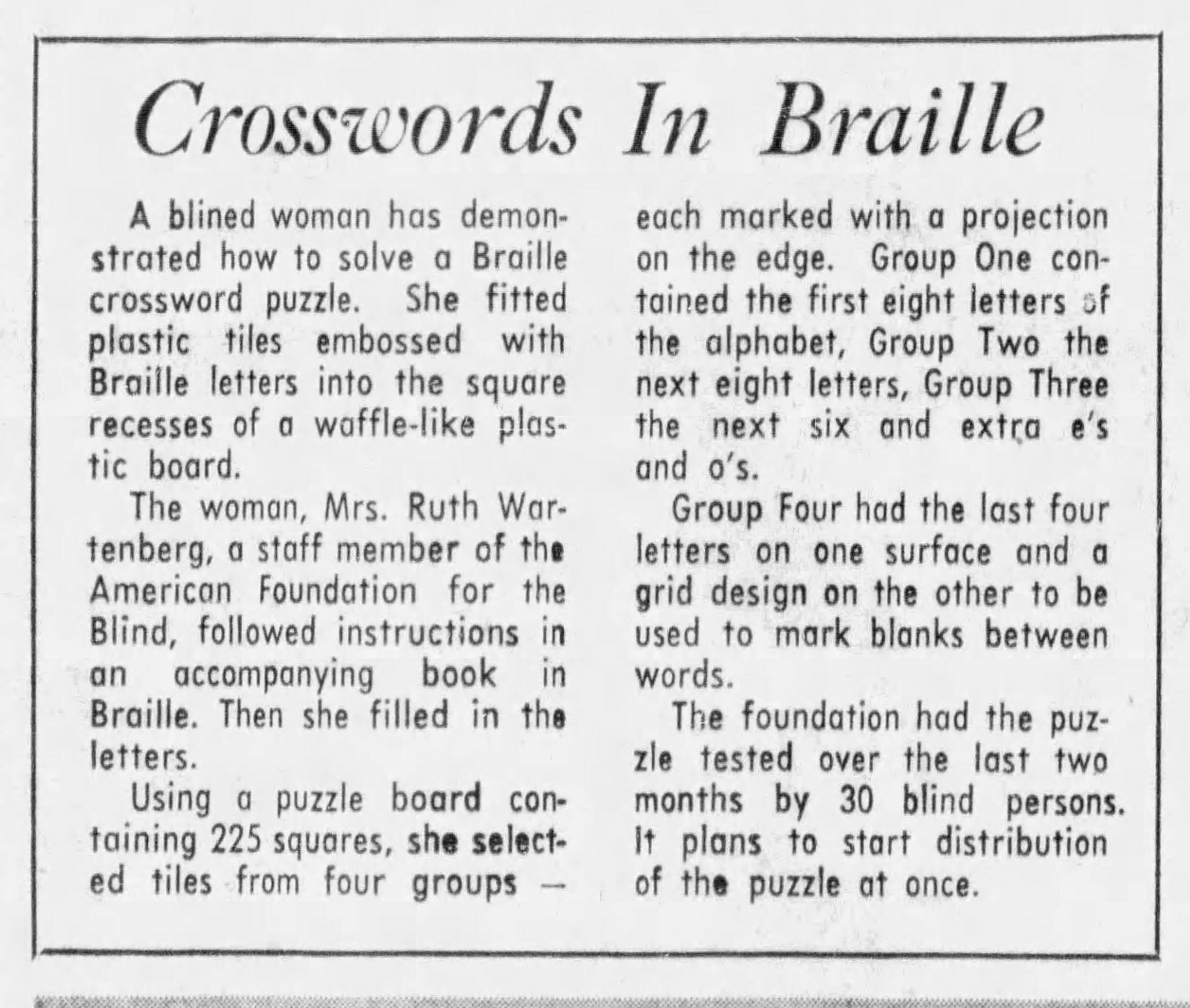
Obviously, that’s not entirely true, but it’s probably safe to say it was the first Braille crossword in this particular style. The tiles would have a Braille-patterned letter on one side and a different letter on the other, and were grouped in separate containers to make it easier to sort through and find the necessary letter for the grid.
This Scrabble-like design was an immediate hit, garnering attention across the country and beyond. I found a pair of articles about the debut of these Braille crosswords in Honolulu newspapers!
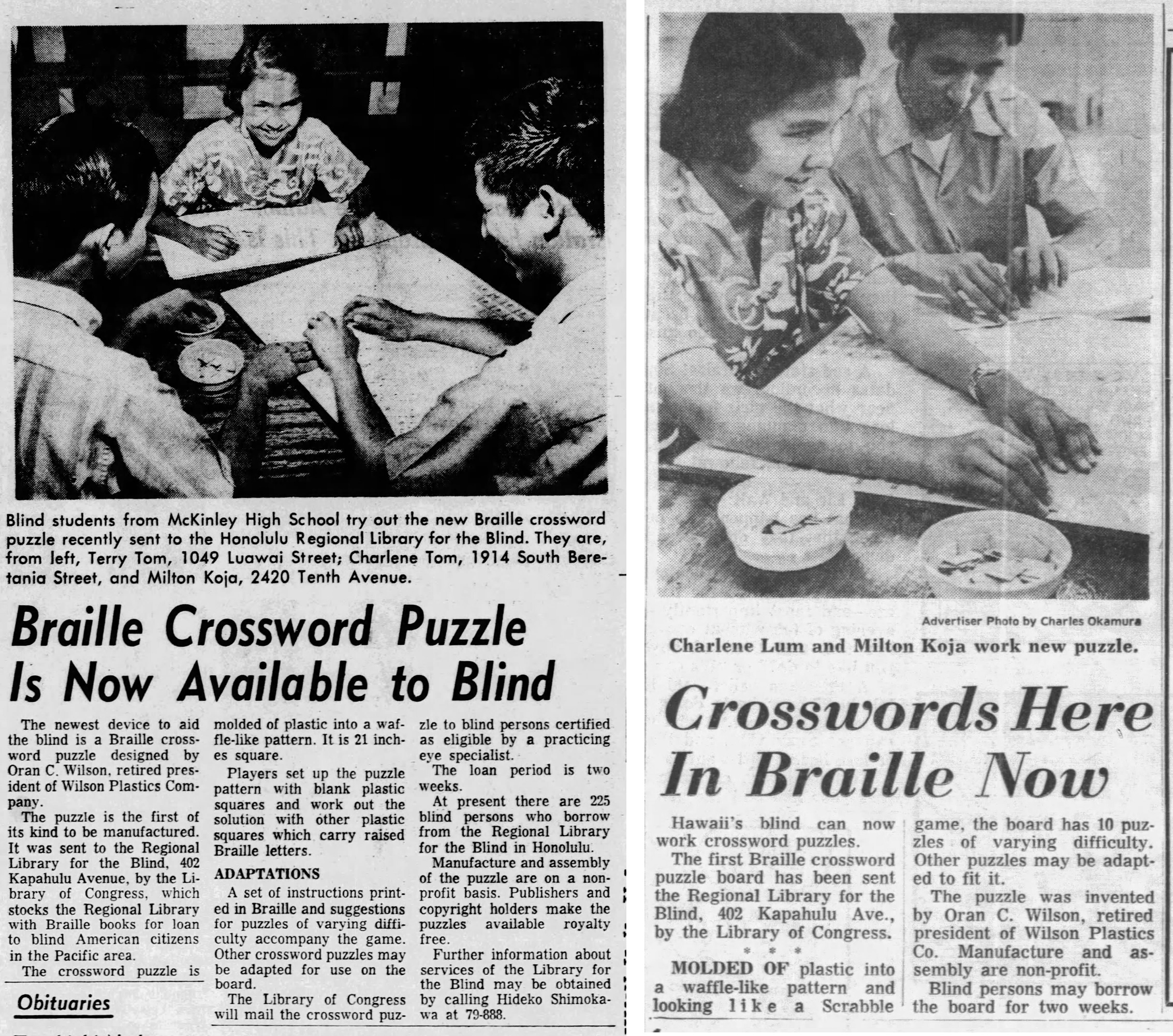
I found references well into the 1970s of a Braille crossword marketed by the American Foundation for the Blind, which I can only presume to be this design.
And funnily enough, it seems to be a recurring theme in Braille crosswords where someone touts their design as the first of its kind. Whether this is due to development being siloed / isolated, or whether one design hasn’t penetrated the market well enough to become an emblematic example, I can’t say.
The archives of the Royal National Institute of Blind People also had a letter, penned by a home teacher of the blind, D. Eldridge, hoping that his design for a Braille crossword might be of use. The Institute had introduced their own design earlier, but Eldridge waited to reach out, hoping for the assistance of a local technical college to improve on his model.
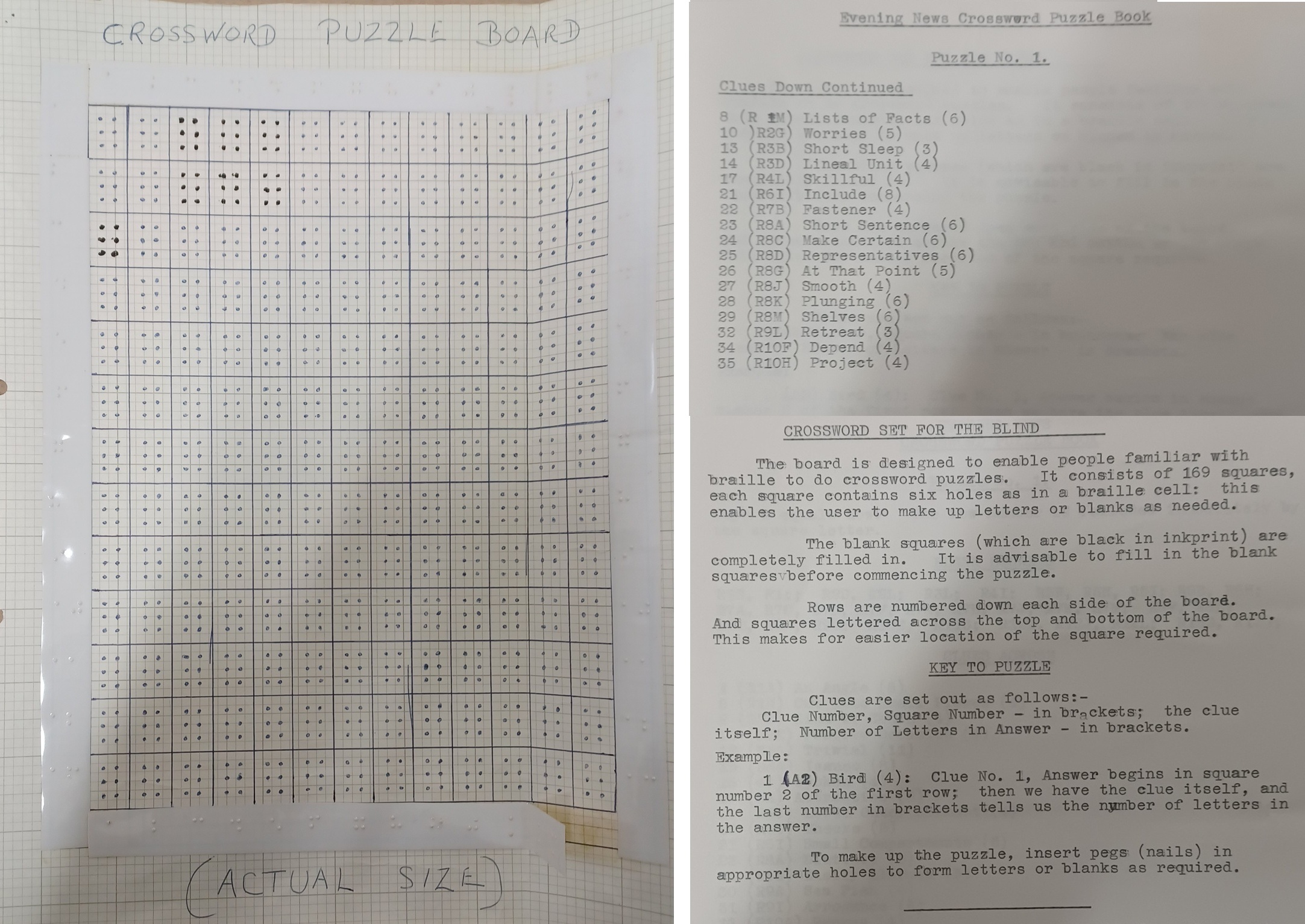
As you can see, his design is quite similar to the American Braille Press design from decades earlier (although using a 13x layout rather than a 15x layout). Great minds think alike.
Braille crosswords would continue to advance and develop as materials improved.
In 1977, the Detroit Free Press ran a brief story about Kevin Gibbs, a jazz pianist who was born legally blind.
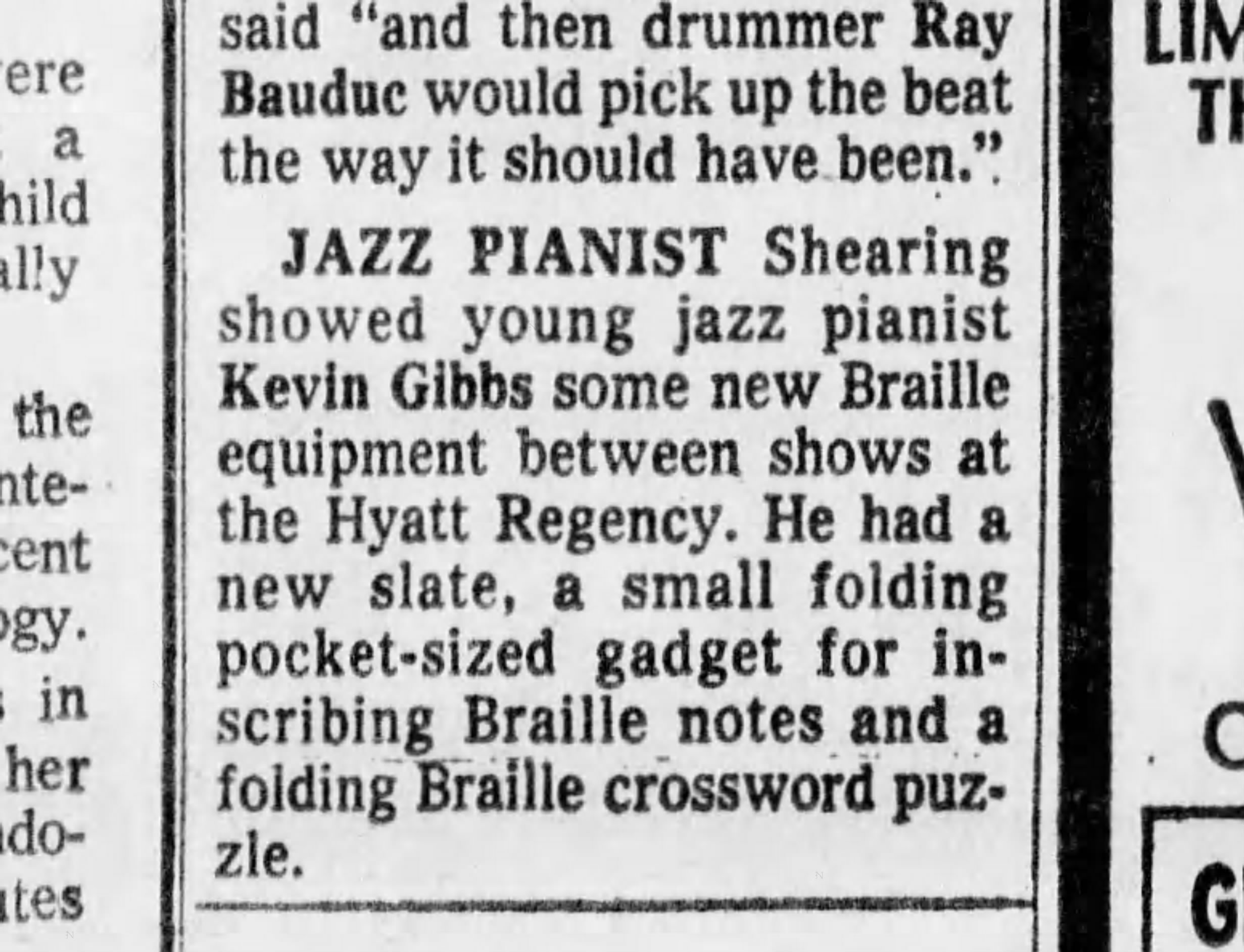
He met up with Sir George Shearing, an influential jazz pianist who was also born blind. Shearing showed him several new devices that incorporated Braille, including “a folding Braille crossword puzzle.”
I can’t say for certain, but I suspect it was either this Unilet portable Braille crossword puzzle or something similar.
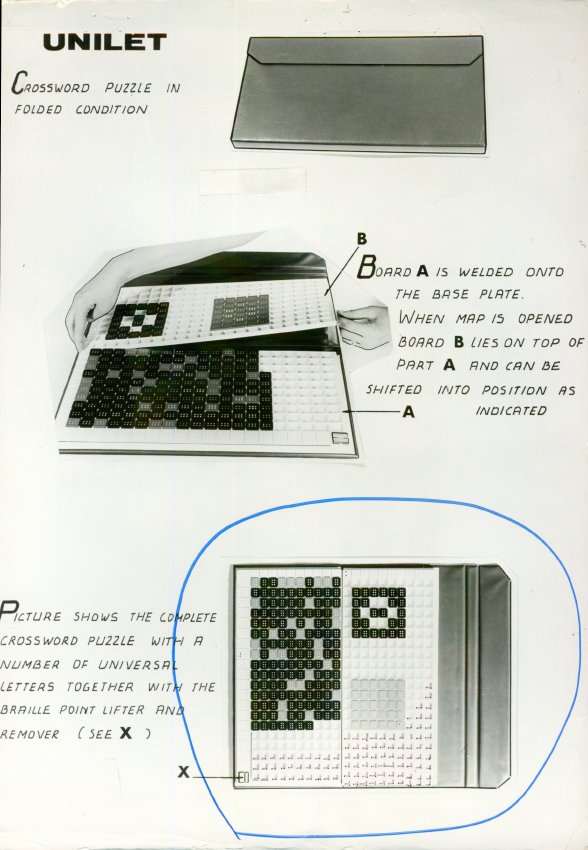
Portability was clearly a big design motivator in the 1970s, as we also saw one of the most elegantly designed Braille crosswords reach the market.
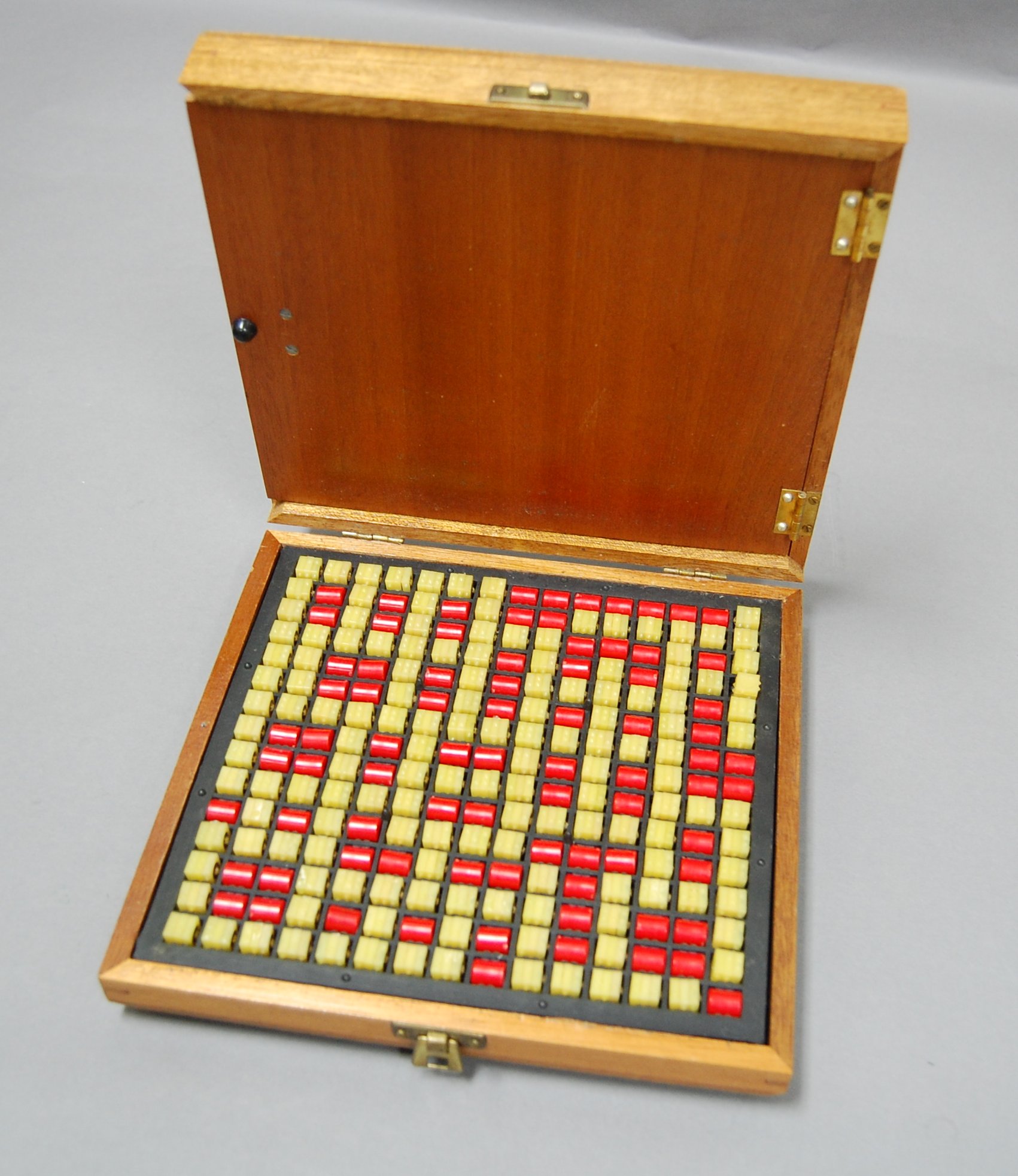
This piece utilizes smooth cylindrical spacers to serve as the black boxes for the grid, while the yellow cubes have different patterns of Braille on each side, allowing the solver to spell out their answer words.
This piece is absolutely beautiful and looks like the most satisfying tactile solving experience we’ve yet encountered in Braille crossword puzzles.
Before we journey into the 1980s and beyond, I would be remiss if I didn’t share this peculiar post from The Daily Tar Heel on July 9th, 1974, “celebrating” Gerald Ford as Vice President:
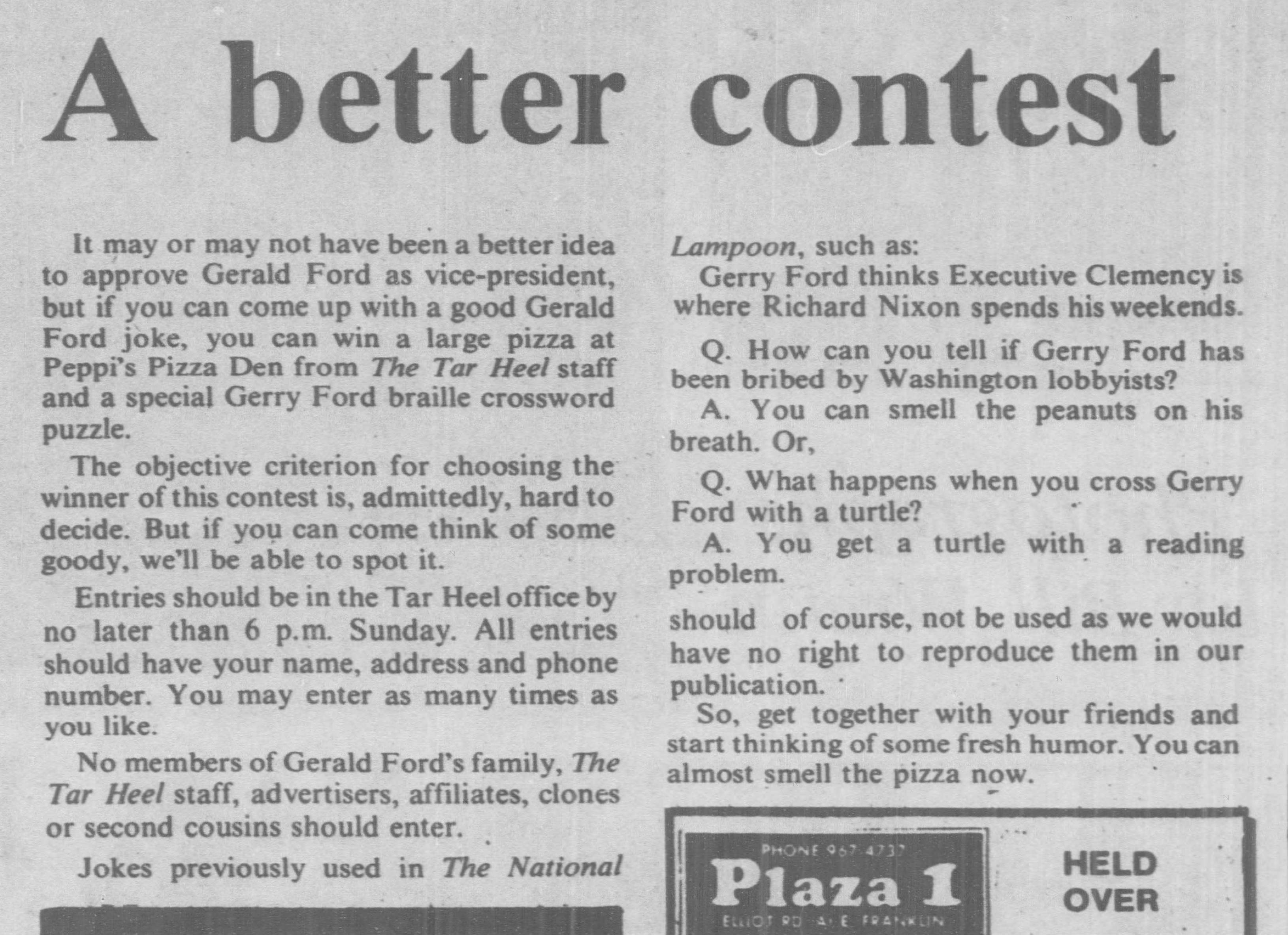
I’m not sure where they managed to source a Gerald Ford-themed Braille crossword, but I am hungry for pizza now.
In the 1980s, there are examples of several different prominent designs for Braille crosswords.
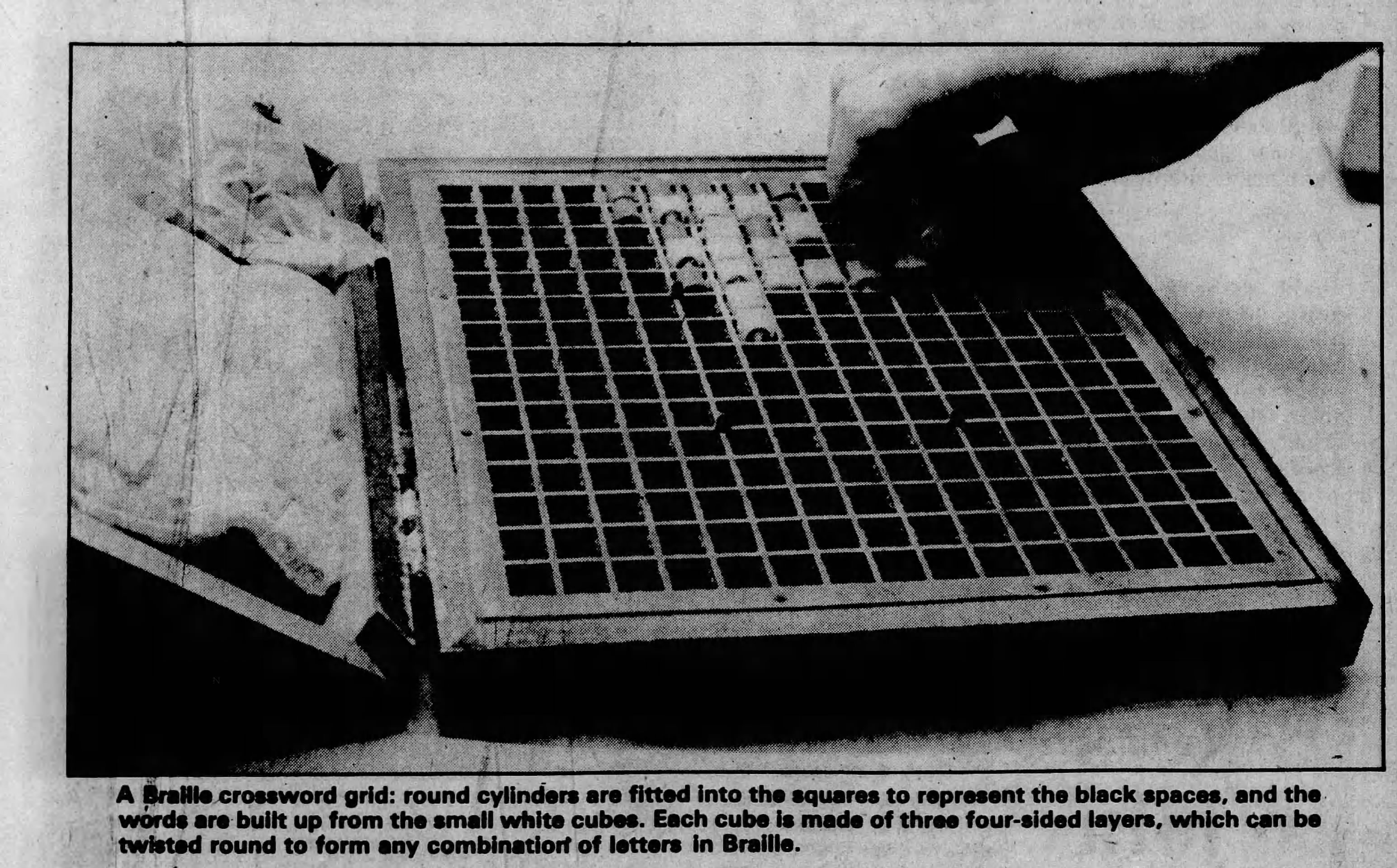
This design was still getting attention from newspapers, while another design spearheaded by Camille Petrecca, as well as the transcribers at Sisterhood, Sons of Zion synagogue, was being touted across the country in Patricia Galbreaith’s syndicated column, Hints for the Handicapped.
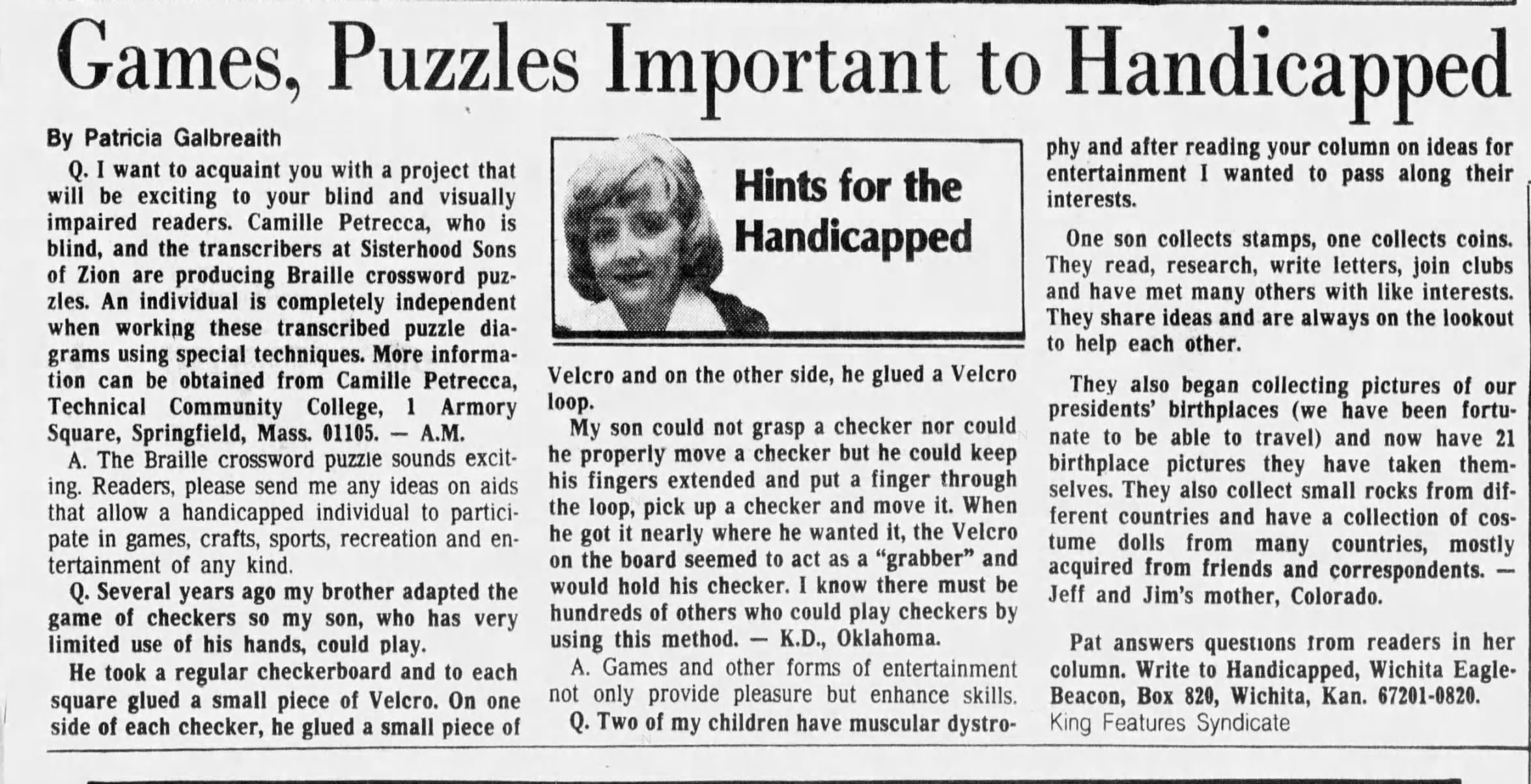
Camille has been an outspoken advocate for the blind for decades, particularly in the Connecticut and Massachusetts area, but unfortunately I wasn’t able to find out anything more about this particular Braille crossword she was involved in creating.
But I was able to find photos of another Braille crossword design born in the 1980s.
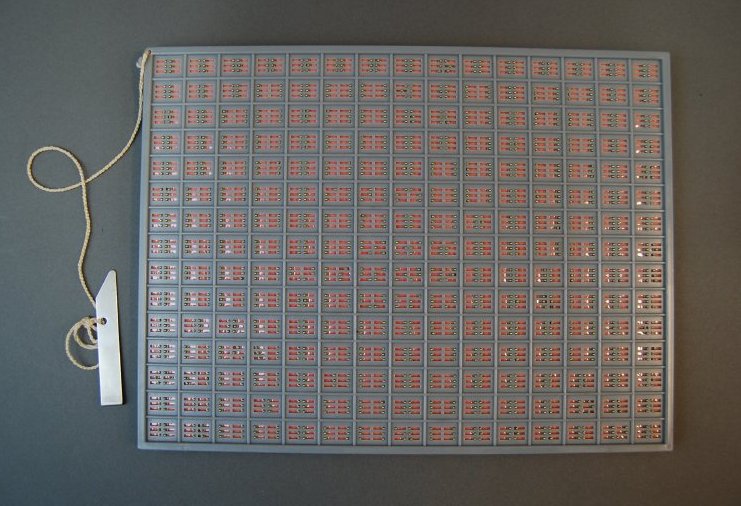
Johann Renfer Sarl created a Braille crossword in 1985 that feels very reminiscent of the early programming age. You use a small aluminum stylus in each recessed rectangle, sliding metal pins in six horizontal slots back and forth to form different Braille characters across the board. It’s an updated version of the pushpin design we saw decades earlier.
You can see how this and several other Braille crosswords featured in this post actually work in this video, courtesy of the American Printing House of the Blind:
Curiously, the first reference I could find involving the use of computers to create Braille crosswords also dates back to 1985.
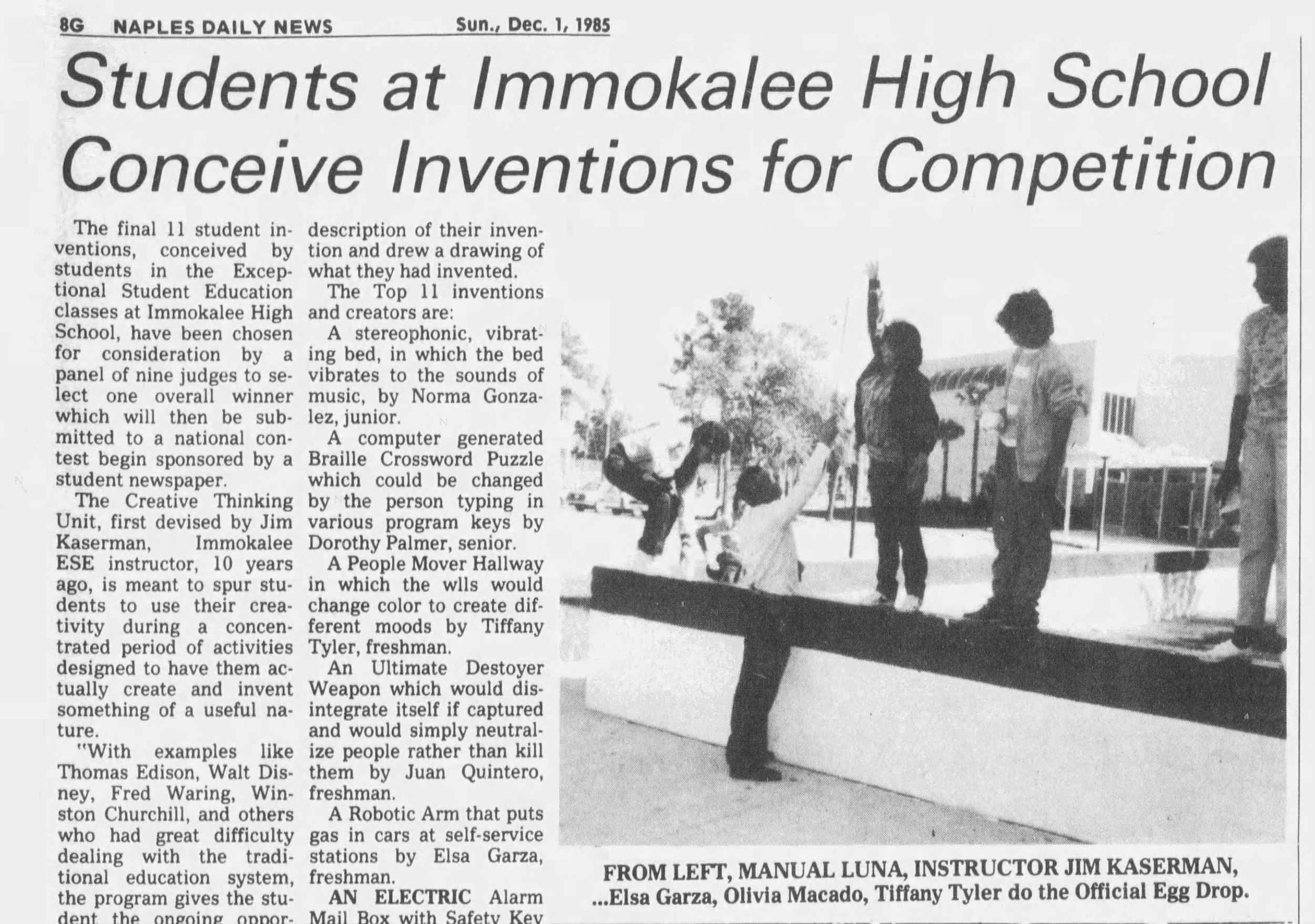
The Naples Daily News shared a piece about inventions created by the Exceptional Student Education classes at Immokalee High School. One of the featured ideas was “A computer generated Braille Crossword Puzzle which could be changed by the person typing in various program keys by Dorothy Palmer, senior.”
It would be fascinating to see what that would have looked like in 1985 technology!
In the modern day, not only are large print crossword books more readily available, but computers and crosswords for the visually impaired go hand-in-hand.
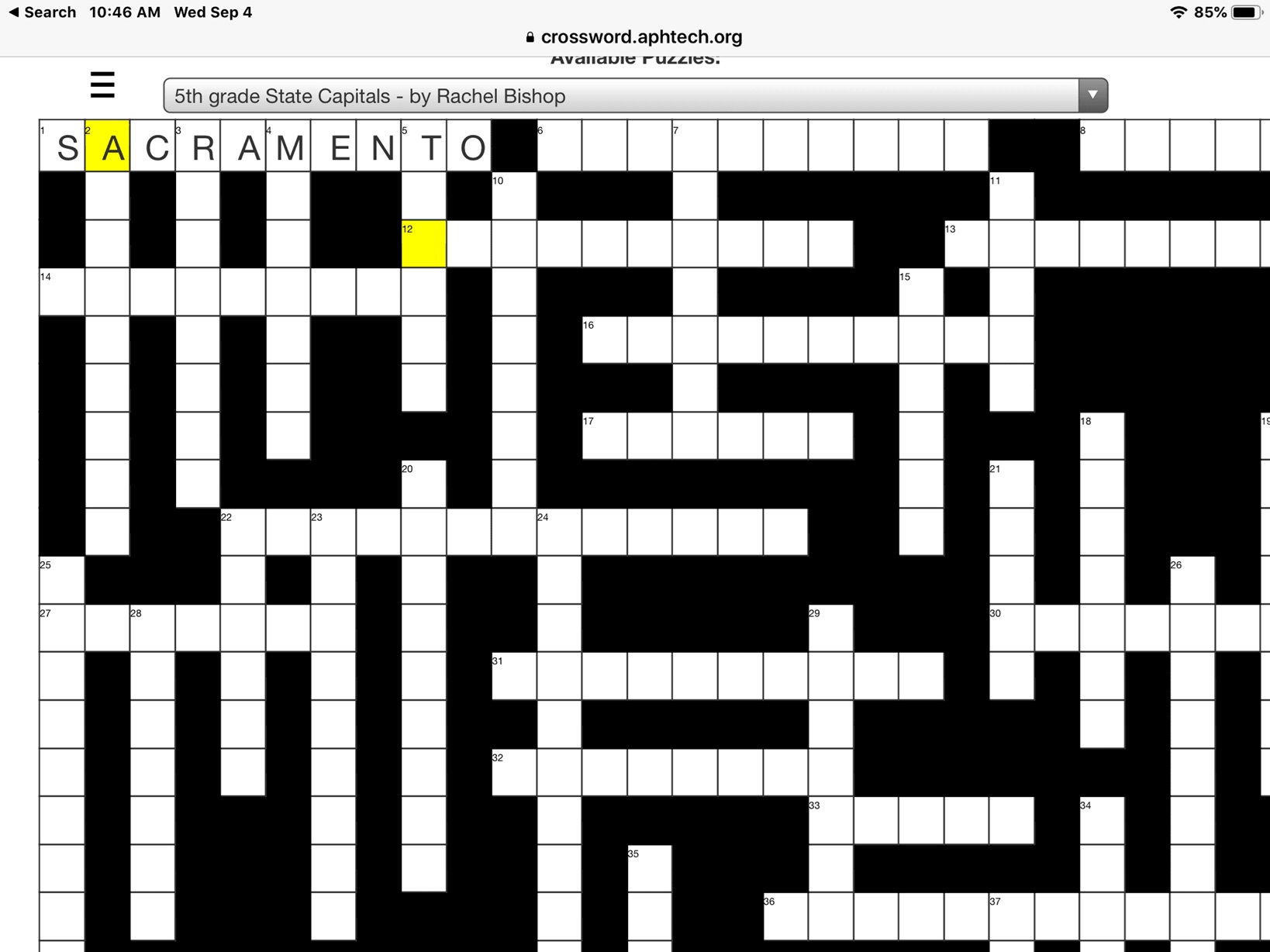
APH maintains their Accessible Crossword Puzzle App, which features larger boxes and characters, as well as a feature that announces the column and row number, and reads the clues aloud for you.
There are other interface programs as well, like A-Cross and Word Speaking Vocal Crossword, though APH’s seems to be the most accessible and well-maintained.
Now, at this point, we’ve journeyed through decades of Braille crossword designs, and we haven’t really mentioned Helen Keller much at all.
And that’s not an accident.
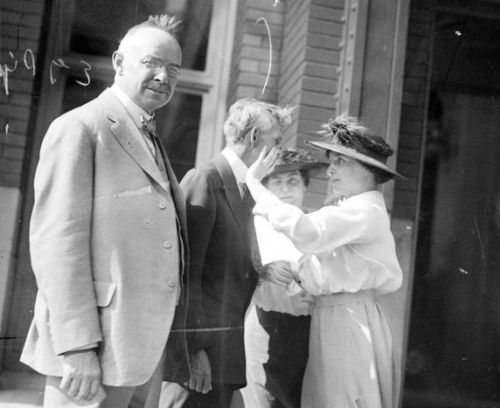
Helen Keller’s legacy of advocacy for the blind is undeniable. She fought to establish Braille libraries, tactile teaching materials, and radio sets for the blind. She demanded proper education systems for the blind.
But it turns out, she wasn’t really a fan of Braille crosswords.
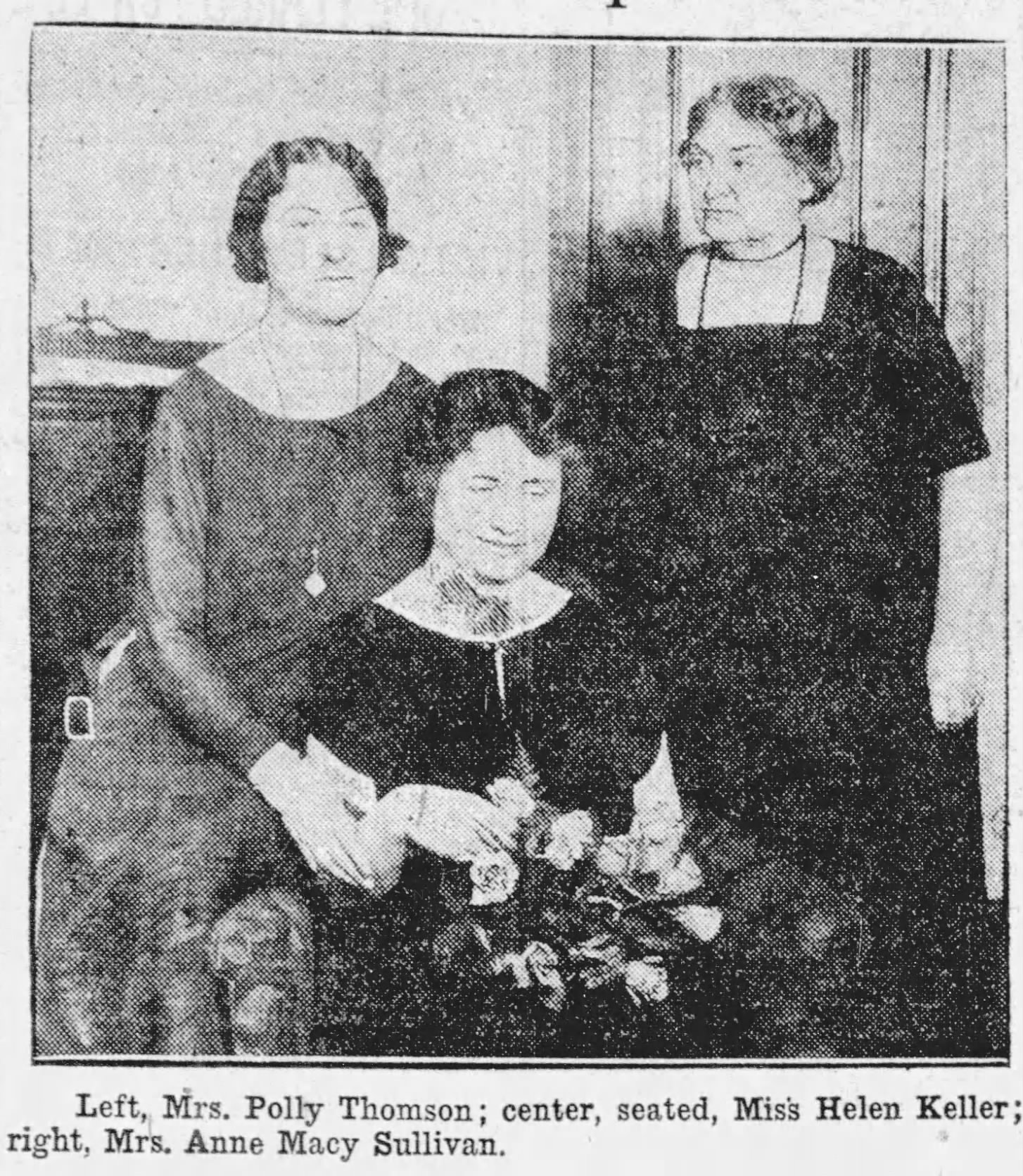
I managed to find an interview with her from February of 1925, and when asked about hobbies or special interests, well…
Next to reading, she enjoys walking most. She has never displayed much interest in Braille cross-word puzzles, preferring to devote her time, she said, to something more interesting, when she has spare moments.
OUCH!
Now, to be fair, it is the funniest possible outcome. I spent days searching through newspaper archives, looking for the connection between Helen Keller and Braille crosswords, only to finally find that connection, and it turns out to be, “meh, not so much.”
I laughed out loud when I found the article.
So, where did the misconception come from?
I have a theory.
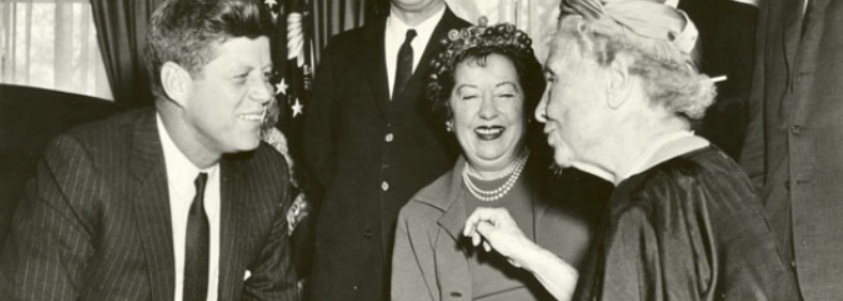
Keller served on the board of directors of World War I’s Permanent Blind War Relief Fund. The American Braille Press was born out of that organization, and it later became the American Foundation for Overseas Blind. Keller served as counselor on international relations for them. She worked with the organization for decades and met 13 presidents while doing so.
And since the American Braille Press was touting a Braille crossword puzzle design, it’s entirely possible that her work with them would’ve seemed synonymous with their work in general, including their Braille crosswords.
It’s the power of association at work.
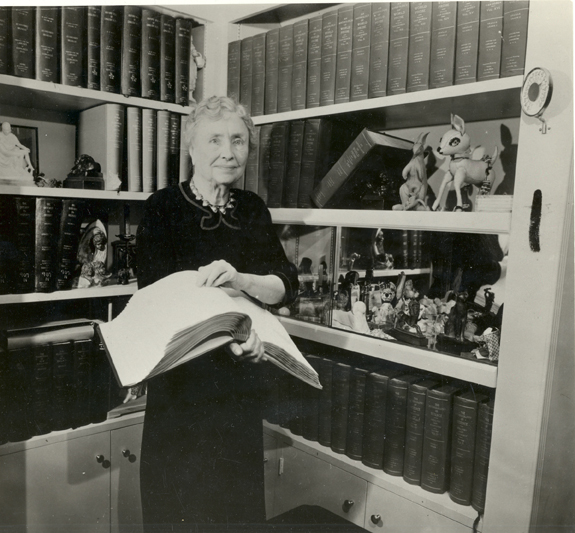
Although she didn’t have kind words to say about Braille crosswords, she did pen a lovely tribute to Louis Braille when he died, and I’d like to share part of it with you:
Braille’s invention was as marvellous as any fairy tale. Only six dots! Yet when he touched a blank sheet of paper, lo! it became alive with words that sparkled in the darkness of the blind! Only six dots! Yet he made them vibrate with harmonies that charmed away their lonely hours! Only six dots! Yet the magic of his genius gave them the power of mighty vehicles of thought! With them he captured words that sing and dance with the joy of life — words that sigh and moan — words burning with holy fire, words that weave bonds of companionship between those who cannot see and those who can, words that bring to us the dawn, the rainbow and the splendor of sunset skies, words that, like swift ships, bear us far away from the monotony of blindness, the trivial incidents of time and place and the pain of thwarted effort! So long as the memory of brave men is cherished in the world, there shall be warm gratitude to Louis Braille who, himself blind, was a light to stumbling feet along the paths of knowledge and intelligence.
I ponder those six dots, and their simplicity, and the world they open for so many, and I cannot help but think of the similar simplicity of crosswords. Black and white squares. Rows and columns. Immediately identifiable patterns. But ones that open a world of wordplay and humor and knowledge and wonder.
A world we get to share with the visually impaired because of people like F.W. Alexander and Oran C. Wilson, D. Eldridge and Dorothy Palmer, American Braille Press and Unilet.
Happy puzzling, everyone!
My sincere thanks to Will Shortz, Deb Amlen, Mary Beth Williams with American Printing House / the Dot Experience, Justin Gardner with the Helen Keller Archives/APH/Dot Experience, and Sean Wilcox of the Royal National Institute of Blind People for their insight, access to materials, and guidance in putting this post together. It quite literally could not have happened without them.





 PuzzCulture