PuzzleNation Product Review: Knot Dice and Knot Dice Squared

knot dice

[Note: I received a free copy of this game in exchange for a fair, unbiased review. Due diligence, full disclosure, and all that.]

You can easily lose yourself in a Celtic knot design if you stare long enough. Elaborate unbroken paths, formed within circles, crosses, and other shapes, weave together in compelling patterns.

There are many dice games on the market today, but none of them capture the same intricate flow and beauty found in Celtic knots. Except for one, that is, which just so happens to be the subject of today’s review: Knot Dice.
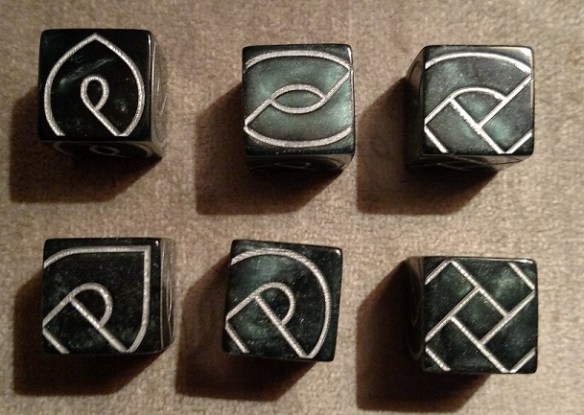
dice types

[The six faces of a Knot die. Top row: end-cap, chain, branch;
Bottom row: sharp corner, rounded corner, crossing.]

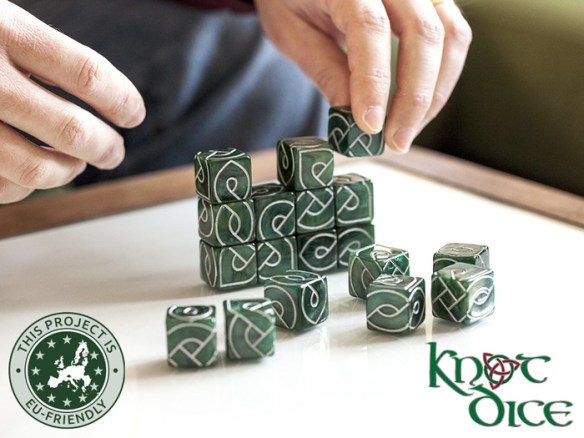
In the puzzle game Knot Dice, you have eighteen identical six-sided dice featuring a different pattern on each face of the die. In order to form a completed design — in either one dimension or three dimensions — a solver uses the patterns on each face to form unbroken paths.

You can create designs both simple and complex as you play around with these gorgeous dice. I’ve seen players just freeform different patterns as they explore the potential of the dice in front of them, their imagination coming to life as they tinker with all six sides.

There are two rulebooks included, one for single-player puzzles, and the other for single-player and multi-player games that utilize both the dice and a small selection of tokens.

dice stack

The puzzles center around completing designs by moving dice, sliding them, or rotating them, depending on the puzzle, and many of the puzzles begin with starting patterns provided by the game designer. These puzzles are simple and quite elegant, making wonderful use of the various patterns on each die.

The games are a bit more inventive, many of them centered around Celtic history and mythology. Whether you’re collaborating with other players to build elaborate knotworks, racing to complete different knots, or capturing your opponent’s token, there are numerous clever and creative ways to employ the patterned dice to their fullest potential. (There’s even a game board and a score sheet included in the rulebook.)

dice patterns

And those possibilities only expand when you incorporate Knot Dice Squared, a second set of dice that offer new puzzle opportunities and game options for solo solving and multi-player engagement.

Designed to work in conjunction with the original Knot Dice, Knot Dice Squared offers 26 dice with fresh patterns to create more elaborate designs and more involved gameplay styles.

Unlike the dice in the base game with their standard six-sides, the dice in the expansion consist of four types of knot dice: crossed, squared, rounded, and bridge. Not all of these dice line up perfectly with the originals, meaning you have to be more creative to complete the various designs as presented. This adds a delightful new wrinkle to each of the games already familiar to Knot Dice solvers.
dice pop

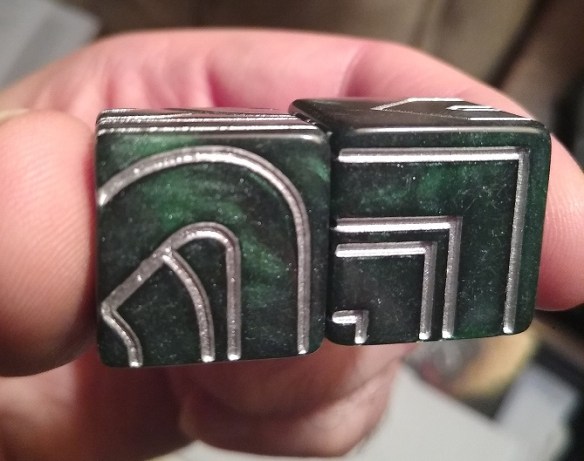
It cannot be overstated how beautiful these dice are. They’re arguably the best part about this game. Whether you’re using the classic green shading or the alternate blue dice (pictured below), the richness of color makes the intricate patterns pop, drawing the eye immediately.

The original game took almost a year to deliver to Kickstarter backers, and much of that time was spent making sure that the mass-produced dice for the game met the high standards of Matthew O’Malley’s early designs. He wanted the dice to be vivid, polished, and usable for the numerous puzzles and games that had been devised for the set. That rigorous attention to detail and demand for perfection has clearly paid off; it’s obvious in the dice, the packaging, the rulebooks, and the overall presentation of the entire product.

The end result is a truly eye-catching game as fun to look at as it is to play.

blue knot dice

Knot Dice and Knot Dice Squared take a step back from traditional dice games, injecting a patient, methodical, aesthetic style of puzzly engagement to the usual luck-of-the-draw rolling. By doing so, it puts a new twist on the genre, allowing for fluid gameplay and design that appeals to both puzzlers and game fans alike.

[Knot Dice and Knot Dice Squared are available from Black Oak Games and will be part of this year’s upcoming Holiday Puzzly Gift Guide, launching in a few weeks!]


Thanks for visiting PuzzleNation Blog today! Be sure to sign up for our newsletter to stay up-to-date on everything PuzzleNation!

You can also share your pictures with us on Instagram, friend us on Facebook, check us out on TwitterPinterest, and Tumblr, and explore the always-expanding library of PuzzleNation apps and games on our website!
PuzzleNation Product Review: 13 Monsters

13monsters0

It’s nearly Halloween, and monsters are a seminal part of the season’s festivities.

Maybe you’re hunting them alongside Buffy, the Winchester brothers, or agents Mulder and Scully. Maybe you’re trying to survive them, like any number of nubile teens at parties, secluded cabins, lakeside retreats, or after hours at the school.

Or maybe, you’re making them.

There’s a grand tradition in pop culture of monster-making, from Dr. Frankenstein and Dr. Moreau to Rita Repulsa and Mr. Sinister.

And who hasn’t wanted to make their own monster at one time or another?

13monsters5

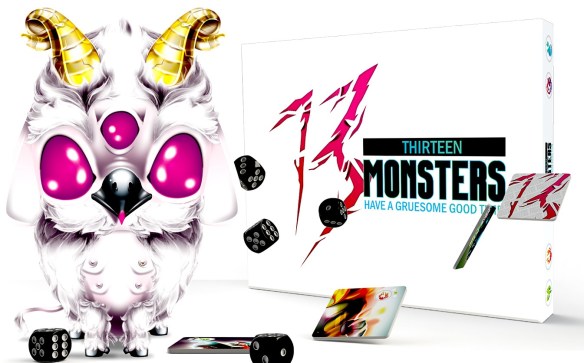
Well, you get your chance in 13 Monsters, a cutesy-spooky build-’em-and-fight-’em game with a load of skill and a little luck required.

13 Monsters combines the attentiveness of Memory, the dice-rolling skills of Yahtzee or Tenzi, and the tactical timing of Bears Vs. Babies or Fluxx to create an enjoyable gameplay experience that’s more fraught with tension than you might expect from a game featuring such heartwarming big-eyed monsters.

13monsters2

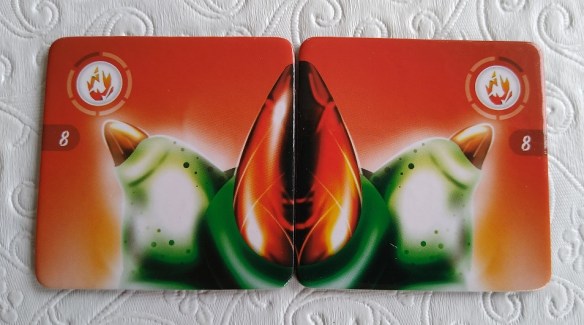
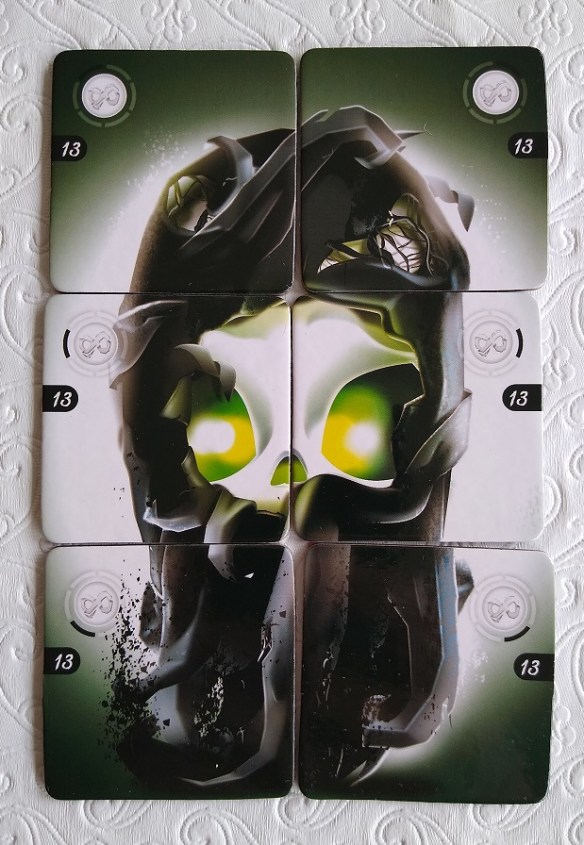
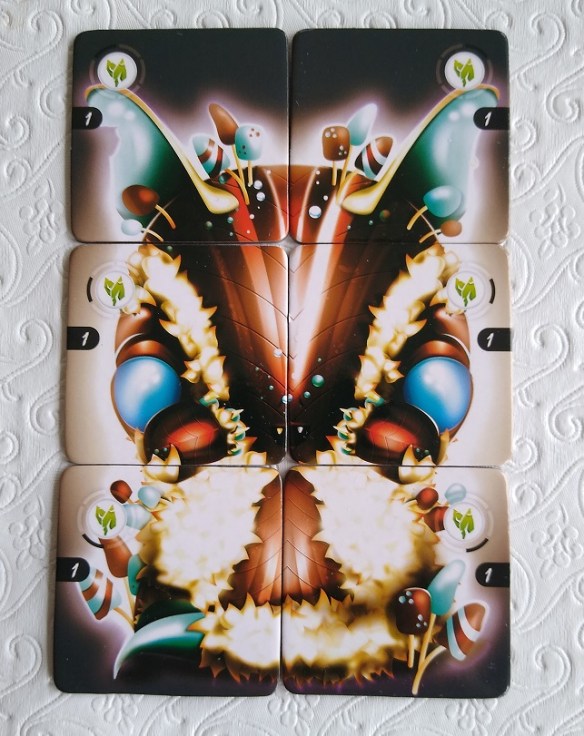
And while we’re on the subject, the art for these thirteen monsters is out of this world. The creatures are visually striking, gorgeously rendered onto the tile pieces, and so vivid that they practically pop out into 3-D.

Each has a distinct flavor, adding horns, fangs, wings, and all sorts of tiny details to hint at the deeper, darker worlds they might inhabit. I cannot say enough good things about the art direction behind this game.

13monsters7

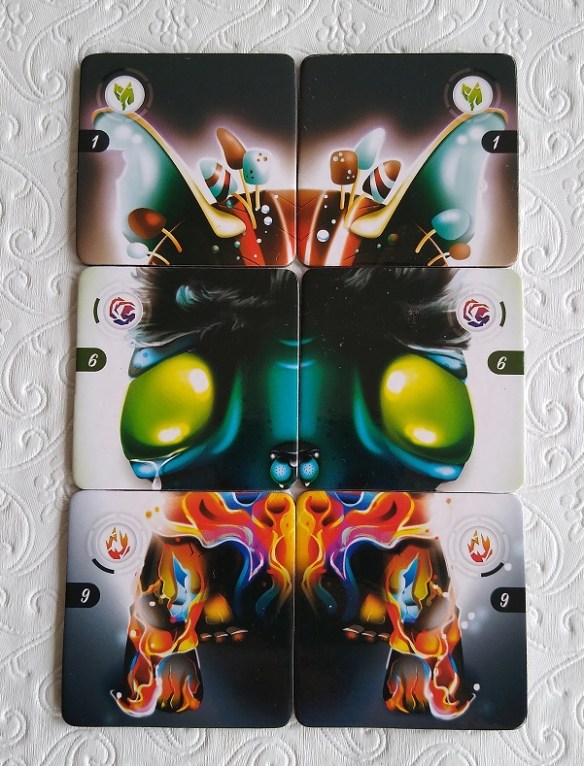
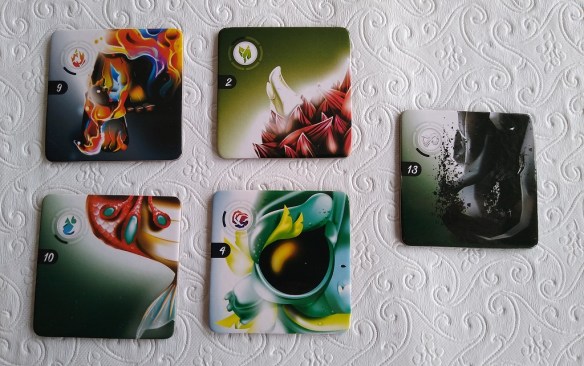
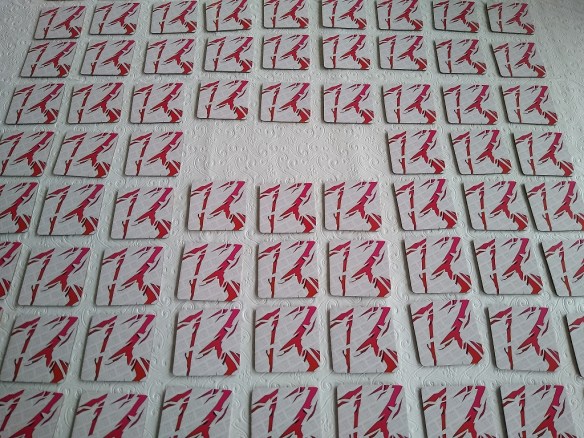
The game starts with a 9×9 grid of tiles, all face down. The pieces of thirteen different monsters are scattered across this grid, and you must find matching pairs of monster pieces to build your gruesomely adorable fighters. If you flip two tiles and they don’t match, your turn is over.

13monsters8

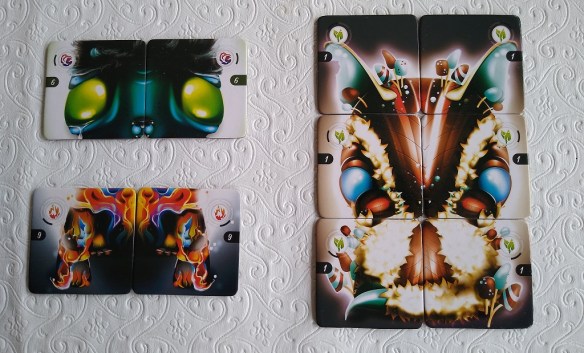
Once you locate a pair — the two tiles making up the top of the head, the two tiles making up the eyes, or the two tiles making up the body — you place it in the play area in front of you, and you may draw again. You can keep drawing until you fail to make a match.

13monsters6

If you have all three sets — no matter if they’re from the same monster or their element symbols match — you combine them to form a full monster.

13monsters1

Once you have a full monster, you can attack your opponents with the goal of taking one of their matched pairs for yourself. (This is one way to assemble a complete, matching monster.)

Different monster combinations have different powers as well, depending on how many of your sets match. This can grant you the power to swap parts between your monsters, freeze tiles on the memory board to prevent other players from taking them, or look at additional tiles on the memory board.

13monsters4

As you can see, there’s a lot going on at once, and the more monsters you assemble, the more options you have available. You need to keep track of what tiles have been revealed, what pairs your opponents have, what pairs you need, how dangerous their monsters are, and how dangerous your monster is. (There’s also the threat of the thirteenth monster out there, which is the most powerful.)

Testing your memory, your ability to assemble the best monster from the pieces you have available, and gauging when to strike for maximum effect, this game will keep board gamers and puzzle fans alike on their toes.

13monsters3

We were impressed by how much gameplay was packed into what seemed like a simple memory/combat mashup game. The wealth of options available, the stunning artwork, and the addictive gameplay quickly made it a hit at the gaming table.

Plus the relative family friendliness of the monsters ensured that younger players could get into the game as well, exposing themselves to several different gameplay styles all at once.

While it may remind you of Dr. Frankenstein’s famous creation, 13 Monsters is no cobbled-together stroke of luck. It’s a well-assembled machine.

[13 Monsters is available from 13-monsters.com and select European outlets.]


Thanks for visiting PuzzleNation Blog today! Be sure to sign up for our newsletter to stay up-to-date on everything PuzzleNation!

You can also share your pictures with us on Instagram, friend us on Facebook, check us out on TwitterPinterest, and Tumblr, and explore the always-expanding library of PuzzleNation apps and games on our website!
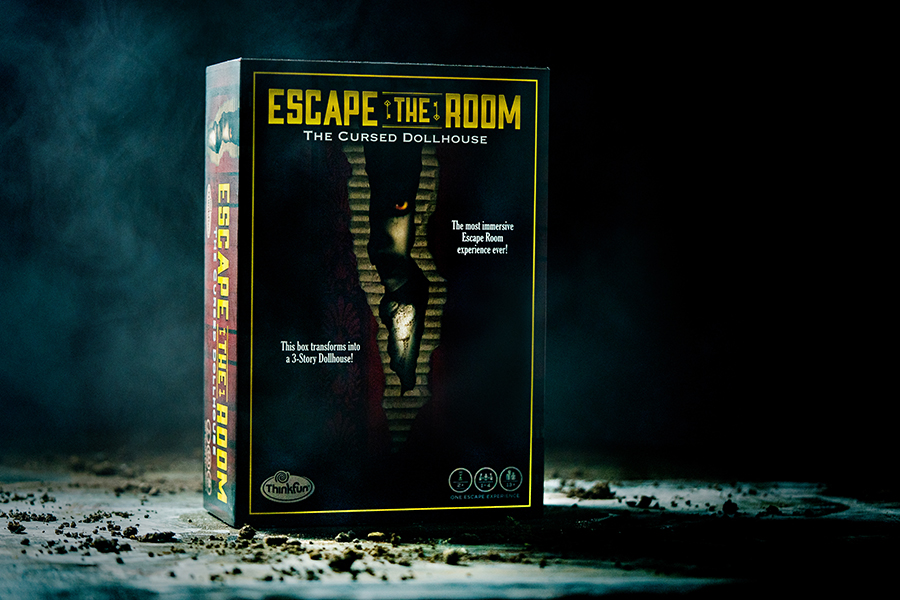
PuzzleNation Product Review: Escape the Room: The Cursed Dollhouse

[Note: I received a free copy of this game in exchange for a fair, unbiased review. Due diligence, full disclosure, and all that.]

All this week, we’ve been discussing different ways to enjoy escape room-style solving from home. We’ve measured each style against the various elements present in most escape rooms — searching the space, finding clues, interacting with the environment, solving puzzles, and experiencing the narrative — to see which ones help scratch this particular puzzly itch from the comfort of your own house.

Today, we continue that journey as we look at ThinkFun’s most elaborate and engaging escape room puzzle game yet. Join us as we accept the challenge of Escape the Room: The Cursed Dollhouse.

Now, unlike our typical reviews which are absolutely loaded with pictures showing you the art, the puzzle layout, different solving styles, and so on, this review may feel a little sparse on the details. But unfortunately, when you’re talking about an escape room puzzle game that’s this involved, this elaborate, and this labor-intensive to bring it to fruition, I wouldn’t want to ruin a single moment of puzzle-solving fun for one of our readers.

So instead, let’s get into the spirit with a nice, spooky little intro.


Every neighborhood has that one house, the one kids whisper about. The one that inspires spooky stories and dares to see how far you can progress into the yard before you panic and run back to your friends.

Your neighborhood is no different. Mr. Garrity’s house has become that mysterious house, ever since his young daughter went missing. Now there are strange lights coming from the shed in his backyard, and other children have been reported missing.

What is going on in that mysterious shed? You decide to find out.

You sneak in, and you’re baffled to find nothing suspicious at all. Just a dollhouse sitting on the work table.

Except it’s glowing…

Drawing you closer…

Until you take one step too many…

Suddenly, the real game begins. And your puzzly skills are the only thing standing between you and a monstrous curse!


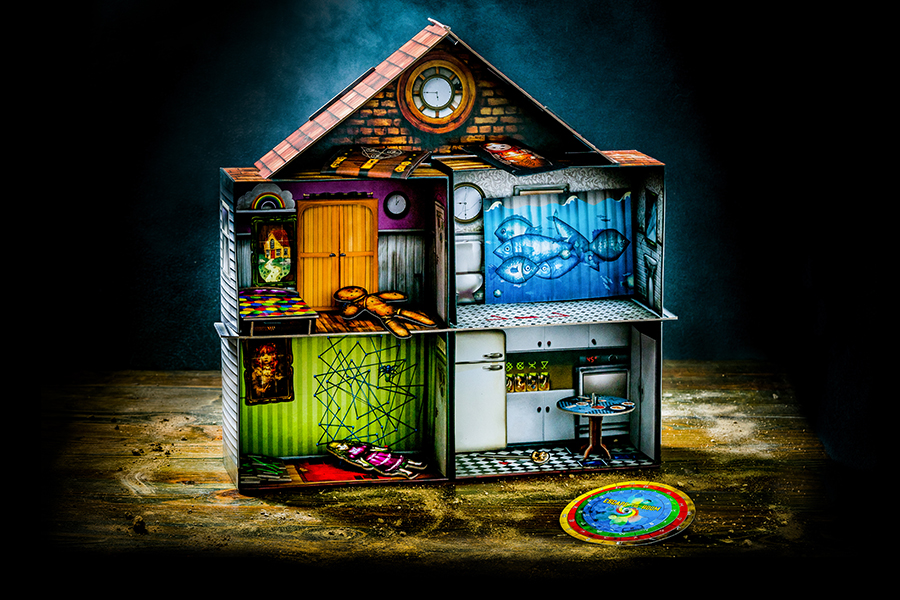
A three-dimensional interactive puzzle-solving experience, Escape the Room: The Cursed Dollhouse is one of the most impressive puzzle games I’ve ever seen from ThinkFun. (And when you consider their previous efforts involving magnets, lasers, and other fantastic elements, that’s really saying something.)

Designed for solvers 13 and older, The Cursed Dollhouse is expected to take upwards of two hours to solve, and between the setup, exploring the various rooms, and tackling the numerous different puzzles inside, that feels like a very fair assessment.

After sliding the box from its protective (spoiler-preventing) sleeve, both the top and bottom of the box itself open up to form the frame of the dollhouse. Thick punch-out boards provide the floor, roof, and various pieces of furniture for the house, and an envelope full of different materials await eager solvers to challenge their minds with mechanical puzzles, riddles, deduction, and outside-the-box thinking.

Furniture, walls, ceiling, floor… every inch of the playspace is utilized in some form or fashion, creating one of the most immersive escape room game experiences I’ve ever played. Heck, some puzzle apps aren’t this engaging, and that’s with no physical barriers or restrictions when it comes to the puzzles.

One of the hardest things to replicate from the escape room experience is the tactile sensation of puzzle solving. The sheer joy and satisfaction of physically manipulating pieces, moving objects, finding secrets, fitting pieces together, and completing tasks is very difficult to simulate in miniature.

But this game has that solving fun in SPADES. Virtually every piece has to be handled or used in some way, and getting to play around with these pieces puts all sorts of solving skills to the test, whether it’s jigsaw-style puzzling, pattern recognition, brain teasers, or logical deduction.

And anyone who experienced their fair share of escape rooms knows the feeling of dealing with puzzles in stages. Some of the game pieces and items you find are relevant to the puzzles at hand, while others must be tucked aside or saved to be carried forward into different areas. The Cursed Dollhouse is no different, offering puzzles for each room in the house as well as information and game pieces to keep with you that will prove vital later.

It can be a bit overwhelming to have so much at hand at once, but it’s immensely satisfying to slowly assign different pieces to their particular puzzles and eliminate them one by one. It’s like whittling down the puzzliest to-do list of all time, and it’s great fun.

They’ve even added a new spin to a classic puzzler’s tool.

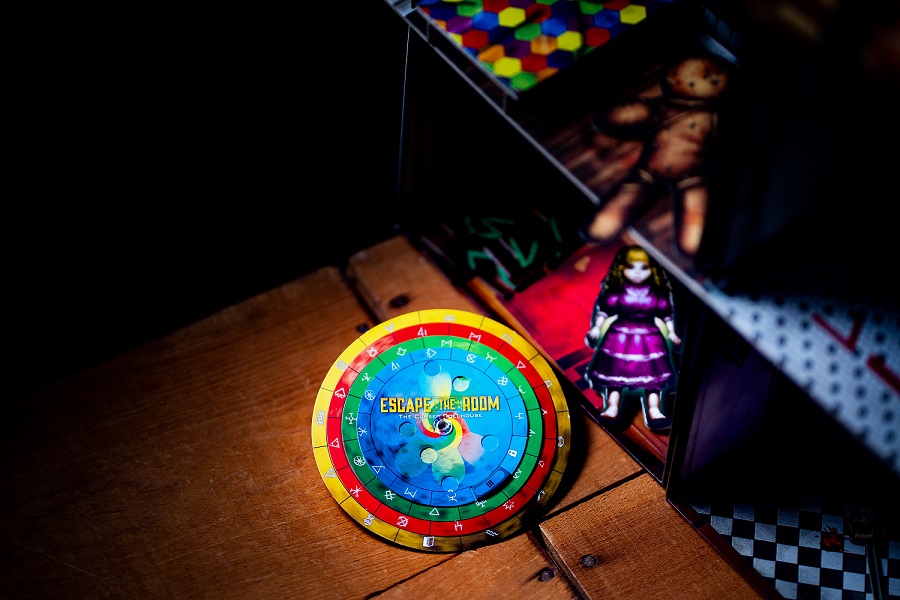
Anyone who has bent their brain with one of ThinkFun’s earlier Escape the Room games, as well as readers of yesterday’s post, will be familiar with one of the key solving elements: the decoder ring.

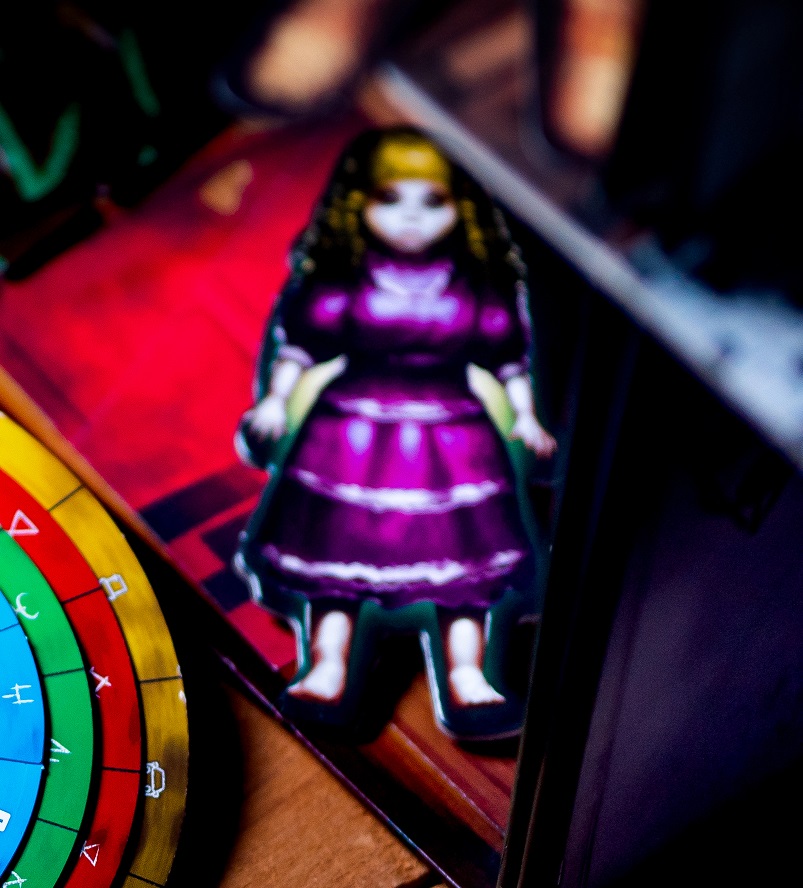
Utilizing a system of symbols for every puzzle, the decoder ring even has a locking feature to add a touch more suspense to the proceedings. Once you’ve turned each wheel and lined up your symbols, you slide the locking lever to the side, and several small windows open in the center of the disc. If the symbols revealed match the puzzle symbol, you’ve got the correct solution!

It’s a nice little touch that adds a lot to an age-old solving trope, and seeing the faces of younger solvers light up when the ring confirms their solve is a terrific moment of puzzling to treasure.

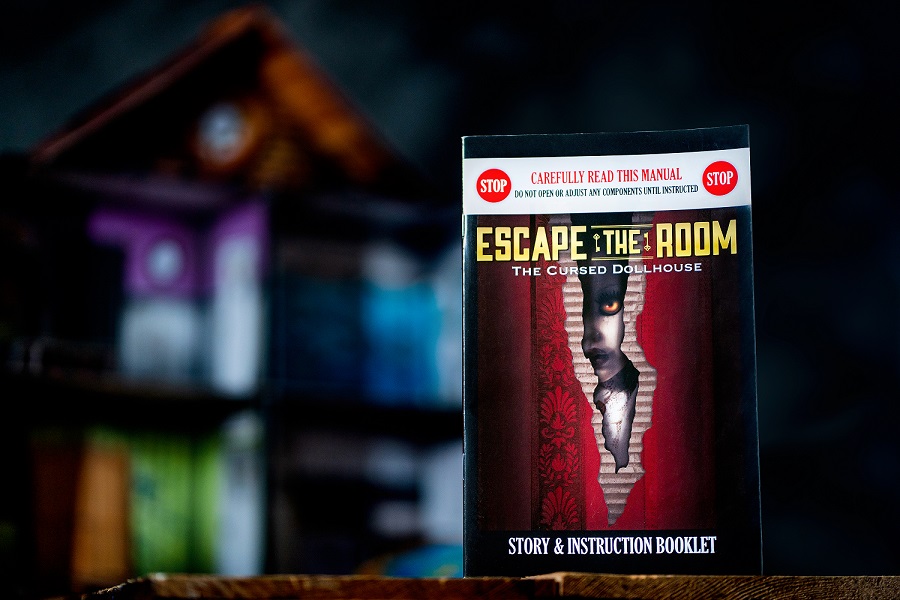
Similar to the Exit: The Game products, The Cursed Dollhouse also has a guidebook. It offers descriptions of the narrative as you progress and instructions on when you can proceed. For younger solvers, it’s a solid framework for the sometimes chaotic and undirected energy of escape room-style solving.

The Cursed Dollhouse offers fewer moments of frantic running around, but you won’t miss it; you’ll be too busy poring over every inch of the house and the gameplay pieces to miss all the skittering about you’re used to.

Be careful, though; younger solvers and older alike should be wary of the tape and sticky substances holding many of the various gameplay elements in the house in place. I worried on more than one occasion that I might damage one of the gamepieces just trying to free it. They’ve traded a bit of user-friendliness in service to keeping the puzzle elements in their places.

The game also offers an online resource to print and recreate any puzzle elements you manipulate or destroy in the course of your solve, so that you can reset the game for other players. It’s a nice touch that ensures more players get a chance to tackle this devious series of puzzles, and also helps mitigate a price point that’s a little higher than the average at-home escape room set.

The webpage also offers solving hints and solutions for any puzzles that flummox you, complete with visuals and videos, so you can not only progress forward, but learn precisely how the puzzle works (so if you encounter a similar puzzle in the future, you’ll know what to do).

I really can’t say anymore with giving something away, so I can only hope this review has managed to convey just how impressed I am by this puzzle game. The amount of thought, detail, and care that has gone into it is staggering, only matched by the ingenuity and deviousness of the puzzle designers. It brings the escape room experience home like never before, and young solvers and older alike will find plenty to enjoy in this meticulously crafted package.

Plus it’s gloriously spooky, which makes it perfect for fall and Halloween solving.

Escape the Room: The Cursed Dollhouse will be available on October 1st from Amazon for $42.99, and it’s worth every penny.


Thanks for visiting PuzzleNation Blog today! Be sure to sign up for our newsletter to stay up-to-date on everything PuzzleNation!

You can also share your pictures with us on Instagram, friend us on Facebook, check us out on TwitterPinterest, and Tumblr, and explore the always-expanding library of PuzzleNation apps and games on our website!
Escape Room Gameplay at Home: Unlock! and Exit: The Game

mind bender escape room

[Image courtesy of The Portland Press Herald.]

In yesterday’s post, we discussed different ways you can enjoy escape room-style puzzling at home. We covered books, apps, and audio formats, but we left the largest category for today’s post: escape room games.

There are a myriad of games that try to encapsulate the escape room experience — searching the space, finding clues, interacting with the environment, solving puzzles, and experiencing the narrative — with varying degrees of success.

Escape Room: The Game, Escape Room in a Box, Escape from Iron Gate, Escape from the Grand Hotel, and Escape Tales: The Awakening are just five examples that turned up with a cursory search. That’s just the tip of the iceberg, of course, when you consider games that incorporate escape room-style or timed elements, like Mission X-Code, Cut the Wire, Bomb Squad Academy, Fuse, and Two Rooms and a Boom.

But all of those games are dwarfed in the marketplace by the industry leaders — based on sheer number of available puzzly experiences, anyway — so we decided to sample those and explore escape room gameplay from.

I solved three games from the Exit: The Game franchise and three games from the Unlock! franchise.

Let’s dive in, shall we?


Exit-the-game-1024x550

[Image courtesy of Meeple Mountain.]

Exit: The Game products create an escape room experience by combining a deck of cards, a guidebook, a sliding decoder ring, and miscellaneous items to be used throughout the game. The deck of cards is divided into red riddle cards (labeled by letter), blue answer cards (labeled by number), and green help cards (labeled by symbol).

There is an app as well that hosts a tutorial, your timer, atmospheric sounds and music, and a star-based scoring mechanism rating your performance at the end of the playthrough.

In the easier games, the guidebook progresses page by page, and you’re meant to go no further until the answer cards tell you to do so. You’ll use what’s on each page, along with the information on the riddle card to solve each puzzle.

Most of the puzzles will result in a three-digit number, which you enter into the decoder wheel. The decoder wheel will reveal a card number, which you will pull from the answer card deck. If you’re completely wrong, you flip the card to reveal a red X and go back to the drawing board. If you’re on the right path, the answer card will have different card numbers for each of the different puzzle symbols. You find your symbol, then go to the card in the answer deck indicated.

For instance, if you’re solving a puzzle with a triangle symbol, you solve the puzzle with a three-digit code, and enter that code into the decoder wheel. It sends you to, say, card 29. On card 29, you look for the triangle symbol, and you go to the card number listed. If you’re correct, you move forward in the game with new riddles, rooms, and in the easier games, the next page in the guidebook. (In harder games, the entire guidebook is “in play” the whole time, and you must figure out which pages connect with which puzzles and riddle cards.)

Some of the riddle cards and guidebook pages must be cut, manipulated, or destroyed in order to complete the various puzzles, so each Exit game is a one-time play experience. Each also requires some outside-the-box thinking (sometimes literally!) in order to crack various riddles.

I found each game to be an enjoyably interactive experience, and it felt like many of the above activities associated with escape rooms were replicated nicely. (One of the harder games not only had the puzzles and riddles to solve, but a murder mystery as well, which really kept me on my toes, because I wasn’t just thinking about the next riddle and discarding the bits and bobs I’d used. I had to pore over every detail in order to solve the murder!)

In case you’re interested, the three games I tackled were The Haunted Roller Coaster (difficulty: 2/5), The Abandoned Cabin (difficulty: 2.5/5), and Dead Man on the Orient Express (difficulty: 4/5).


20181220_152554-min-1080x675

[Image courtesy of Escape Games Canada.]

Unlike the Exit series, Unlock! games consist of entirely of a deck of cards and your app. But that doesn’t make it any less interactive. Instead of the guidebook, decoder ring, and riddle cards being manipulated, more of those experiences are handed through the app.

The cards provide locations, challenges, helpful items, solutions, and warnings, all identified with numbered or lettered cards in the deck. So you can end up with quite an array of cards in front of you while you solve.

The app, on the other hand, hosts your timer, atmospheric sounds and music, a penalty button (which removes time from your timer!), a hint button, a machine button, and a code button. Any codes you unravel are entered into the code screen (instead of a decoder ring), and certain puzzles are mechanical, which you manipulate in the app. The app then tells you what number/letter card(s) to draw from the deck to proceed.

The number system for the Unlock! cards is interesting. Each card representing a puzzle to be solved or an item to be used has a number associated with it; to see if you solved the problem correctly, you add its two numbers (one for the challenge, one for the solution).

If you combine a helpful item’s card number with a challenge’s card number, the total equals another card in the deck. If you’ve solved the challenge correctly, the card matching that sum reveals something: an opened lock, a new room, additional puzzles and helpful items, etc. If you’ve combined items incorrectly, the card matching that sum reveals a time penalty. (For instance, if you have a key on card 16 and a keylock on card 25, you’d go to card 41 in the deck.)

There is no destroying cards or anything here, so if you wished, you could reshuffle the deck and allow someone else to try the game. (It wouldn’t be much challenge for you, since you know all the riddle solutions now. But it’s nice to know I could walk less experience escape room solvers through the game on a replay, enjoying their efforts. That’s not possible with an Exit game.)

In case you’re interested, the three games I tackled were The Night of the Boogeymen (difficulty: 1/3), The House on the Hill (difficulty: 1/3), and Squeek & Sausage (difficulty: 2/3).


Each brand has its pluses and minuses.

While the guidebooks in Exit are more detailed than the location cards in Unlock! games — and the miscellaneous items are a nice touch — I found I had to do more searching with the location cards. I would scrutinize every nook and cranny, because some numbers were hidden in shadow, or written at odd angles so your eye slides right past them. Exit is less devious with that aspect, but only because it has more space to play with for puzzles in the guidebook.

Both game systems had red-marked cards to indicate your failure on a given puzzle, but in Unlock!, you were penalized twice over, because you’ve already lost the time on the clock you spent on that dead end, and then you get the timer penalty as well.

Unlock! definitely makes greater use of its app. Honestly, except for the star-ranking system and some nice atmospherics, you could do without the Exit app. (Particularly since group solving can be pretty noisy, so the atmospherics are mostly lost unless you’re in quiet contemplation.)

I was thoroughly impressed by how both systems tried to recreate so many aspects of the escape room experience. Searching the space, finding clues, interacting with the environment, solving puzzles, and experiencing the narrative were all included to some degree, and I felt genuine pressure watching the minutes and seconds tick away as a particularly vexing puzzle left me baffled, if only momentarily.

I would recommend games from either series to anyone trying to recapture that escape room spirit in these trying times. But they’re also terrific icebreakers for people who have never tried an escape room, but don’t want to feel the pressure of being on-location, instead solving from the comfort of home.


I hope this brief look at these two puzzly franchises — I purposely stayed light on actual puzzle or scenario details to avoid ruining the experience for anyone — offered yet another avenue for you to explore as you enjoy escape room solving from home!

Don’t forget, tomorrow is the finale of Escape Room Puzzle Week, as we review ThinkFun’s latest diabolical creation, Escape the Room: The Cursed Dollhouse!


Thanks for visiting PuzzleNation Blog today! Be sure to sign up for our newsletter to stay up-to-date on everything PuzzleNation!

You can also share your pictures with us on Instagram, friend us on Facebook, check us out on TwitterPinterest, and Tumblr, and explore the always-expanding library of PuzzleNation apps and games on our website!
PuzzleNation First Look: Everything Board Games Magazine

cover

The world of board games is expanding and evolving in new ways every day. Encompassing everything from traditional board and dice games to card games, roleplaying games, and more, we’re talking about an ever-expanding universe of gameplay possibilities.

So when I heard about a new publication called Everything Board Games Magazine, I simply had to investigate. Based on the ambitiousness alone, I was intrigued.

The debut issue of the magazine is now available for free on their website, and I’ve gotta say… I’m pretty impressed.

It’s 82 pages, a full-color reading experience that is vibrant, visually engaging, and absolutely jam-packed with content. I’m pretty plugged into the board game world, and I discovered half a dozen games I knew nothing about.

hot shots

After a few pages of ads, we’re greeted with a letter from the editor, and you immediately get a sense of the passion and excitement that permeates every page of the magazine:

Thank you for taking the time to read through the first ever issue of Everything Board Games Magazine! We know there are a lot of voices vying for your attention in the wonderful world of board games. We’ve strived to produce something that will bring value and joy to the gamer in every walk of life. Our team of board game fanatics have scoured the wide-world of gaming to bring you a diverse and interesting selection of articles, interviews, game reviews, previews and more! It is our hope and desire to connect with you once every two months, filling your mind with gaming pleasures.

Every piece in the magazine — whether it’s a game review, informational article, or interview — is loaded with enthusiasm. The writing crackles with excitement, and every contributor clearly loves the world of board games.

And honestly, in a world where a lot of genre-focused content seems to drip with sarcasm and know-it-all condescension, it’s refreshing to read pieces full of sincerity and affection, even when offering constructive criticism.

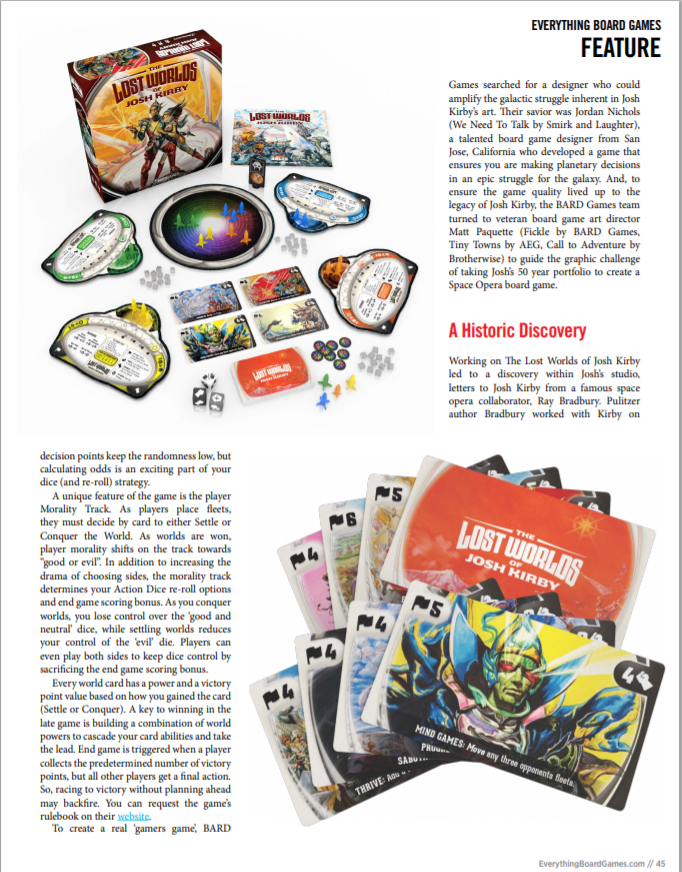
The magazine has teasers for upcoming games and Kickstarter campaigns, loads of reviews (though many reviews are just links to the full reviews on their website), as well as interviews about hobby gaming, board game design, running a board game cafe, and more.

Giveaways, polls, board game art, a bi-monthly top 5 games countdown… every page is packed with content.

preview

And every last page is interactive. Links with more information, links to websites, links for ads, links for email, links to contribute or suggest content or offer feedback. Interactive everything. (And thankfully, no auto-play ads or videos or audio clips to spoil the experience.)

In this first issue alone, they featured games based on history, monsters, latte art, the golden age of sci-fi, theme parks, mythology, war, painting, and crime-solving.

They even managed to throw in a free print-and-play stock trading game AND a free RPG adventure for Dungeons & Dragons.

Aside from a few typos here and there, the debut issue of Everything Board Games Magazine was a brisk, engaging, thoroughly enjoyable read. The only bad thing is waiting two months for the next one.

You can check it out and sign up for your free subscription here.


Thanks for visiting PuzzleNation Blog today! Be sure to sign up for our newsletter to stay up-to-date on everything PuzzleNation!

You can also share your pictures with us on Instagram, friend us on Facebook, check us out on TwitterPinterest, and Tumblr, and explore the always-expanding library of PuzzleNation apps and games on our website!

PuzzleNation Product Review: Chicken War

chicken war header

[Note: I received a free copy of this game in exchange for a fair, unbiased review. Due diligence, full disclosure, and all that.]

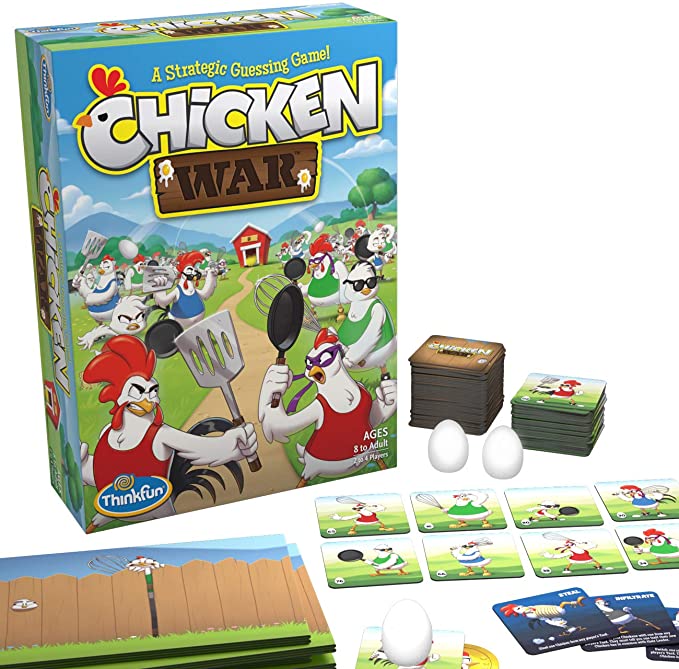
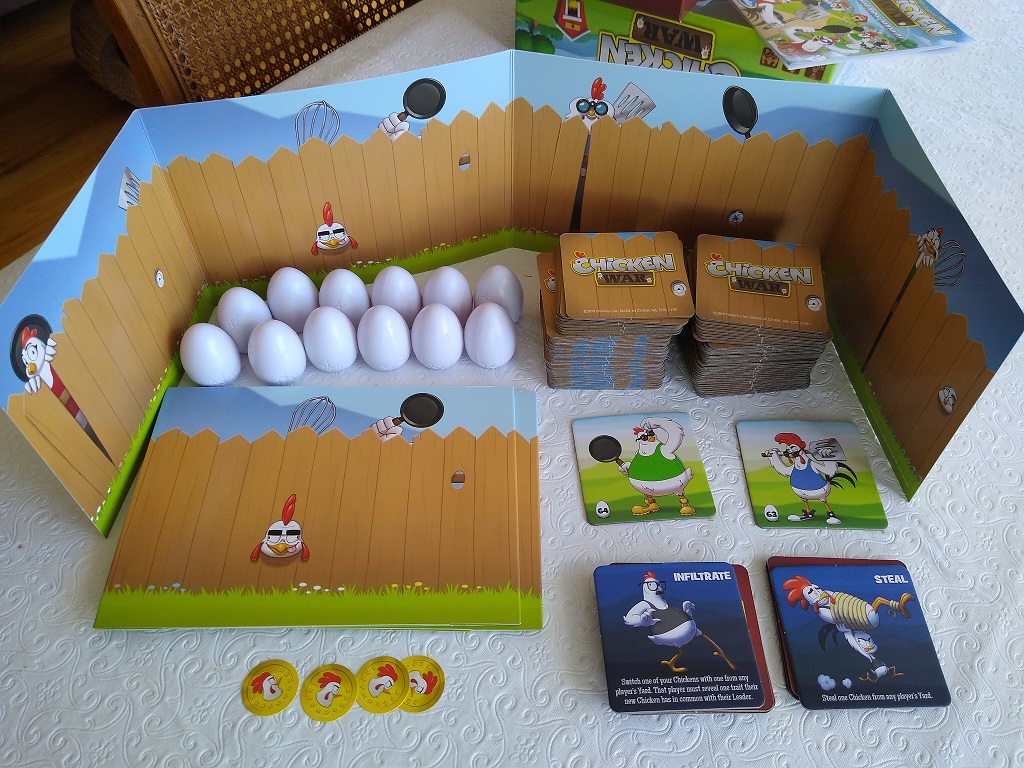
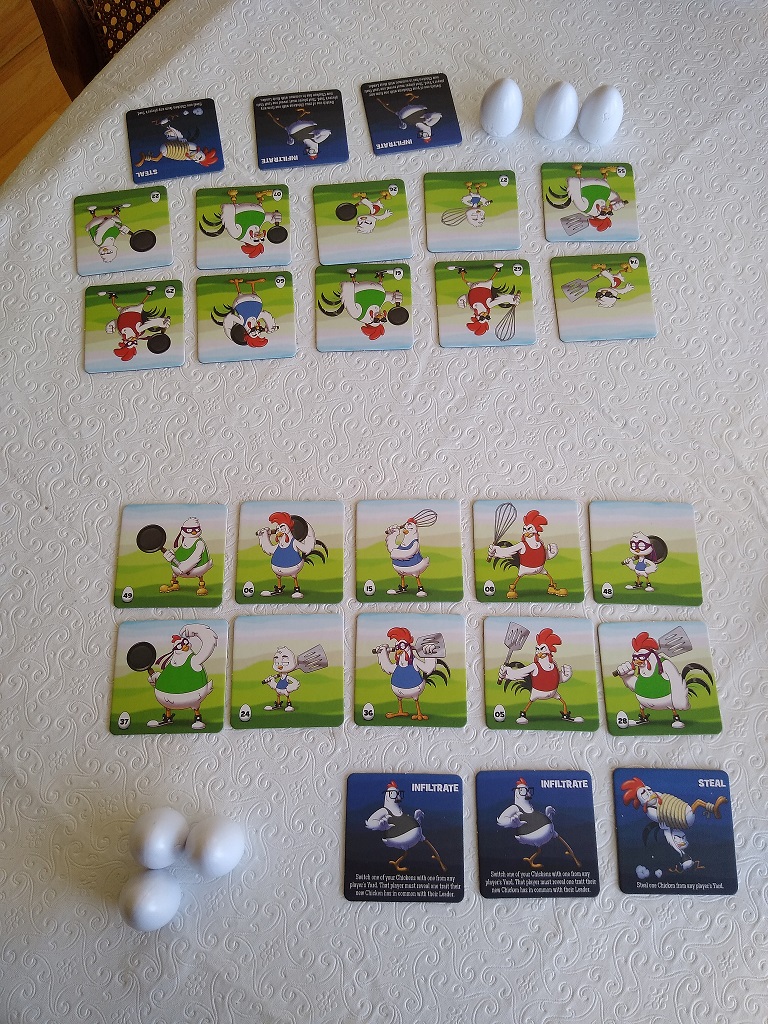
The farm is no longer the quiet, idyllic escape you pictured when learning the sounds barnyard animals make. Instead, it has fallen to factional fury and un-cooped combat between various groups of chickens vying for victory. Such is the setting for ThinkFun‘s latest brain-training game, the colorful and crafty tile game Chicken War.

chickenwar1

There are two ways to win Chicken War. You can either be the last player standing or the first player to complete their army. To be the last player standing, your opponents’ leaders must be identified. To be the first player to complete your army, you have to have nine other chickens with two traits in common with your leader.

As you can see, Chicken War’s hybrid style of play combines the player observation of a game like Throw Throw Burrito or Scrimish with the deductive reasoning of a game like Clue.

chickenwar2

Each player is trying to recruit chickens for their army, and must do so in full view of the other players. This means that you have to strategize not only your recruitment process, but how to do so without revealing too much to your opponents. Plus you have to do all that while keeping an eye on your opponents’ efforts to recruit!

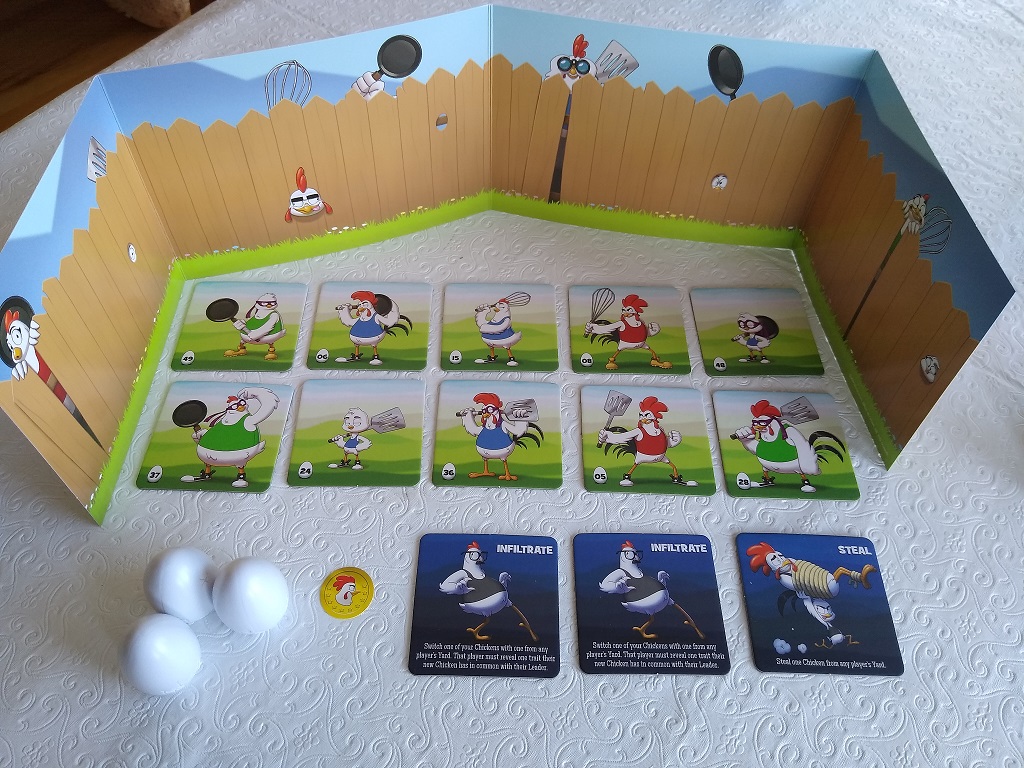
First, you select your leader from the ten starting chickens in your yard. Optimally, you’ll pick a leader where many of the other starting chickens already share two traits, which gives you a leg up in building your army.

chickenwar3

You’ll hide your leader token under that particular chicken to mark it, using your screen to do so away from the prying eyes of other players.

Remember, that’s two traits and only two traits in common.

chicken war trait

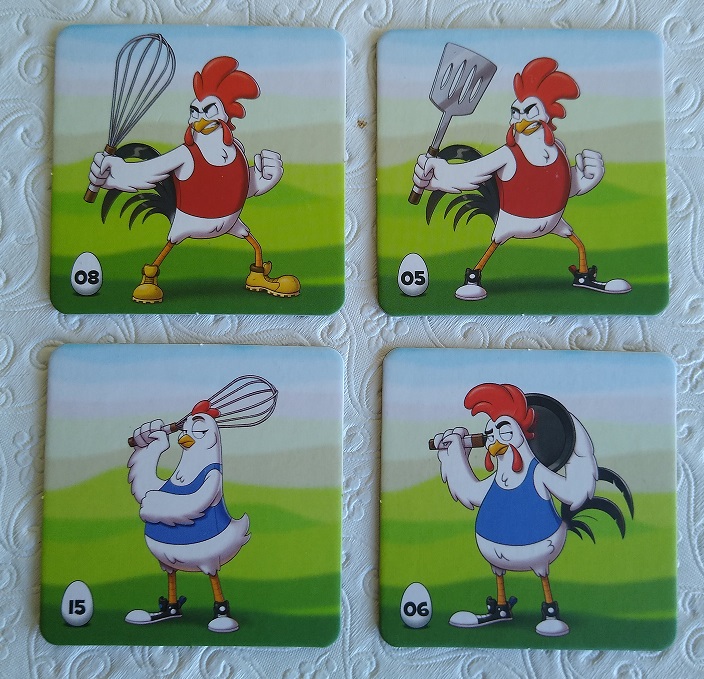
The four possible traits, as shown above, are weapon, shirt color, eyewear, and footwear. Each trait has three variations. For instance, shirt color can be blue, red, or green. Eyewear can be sunglasses, mask, or none.

(Keep those four traits in mind. Body type, pose, and style of tail are all irrelevant, but can be distracting.)

chickenwar9

As you can see here, the top two chickens have two traits in common: shirt color and eyewear. (Footwear and weapon differ.) The two bottom chickens have three traits in common: shirt color, eyewear, and footwear. Therefore, if 05 and 06 are leaders, 05 has a recruit, but 06 does not.

How do you recruit chickens? By drawing from the discard pile. You either keep the new chicken and discard one of the chickens from your yard, or you immediately discard the new chicken.

chickenwar4

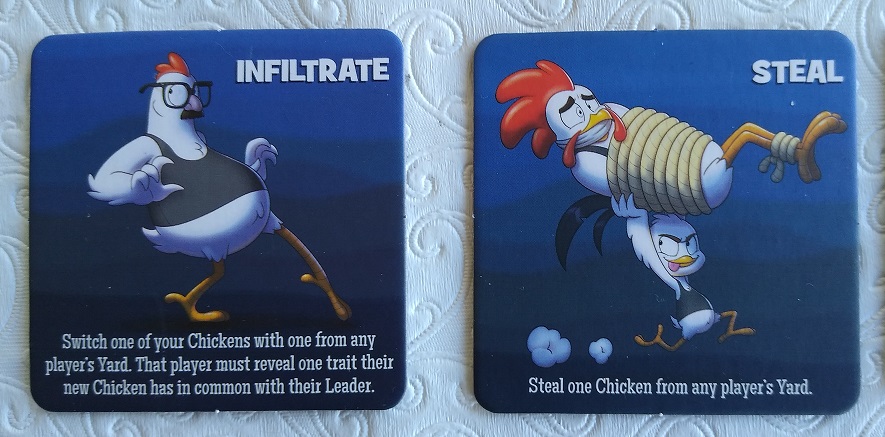
The only other ways to recruit chickens are to use the two special tiles: steal and infiltrate.

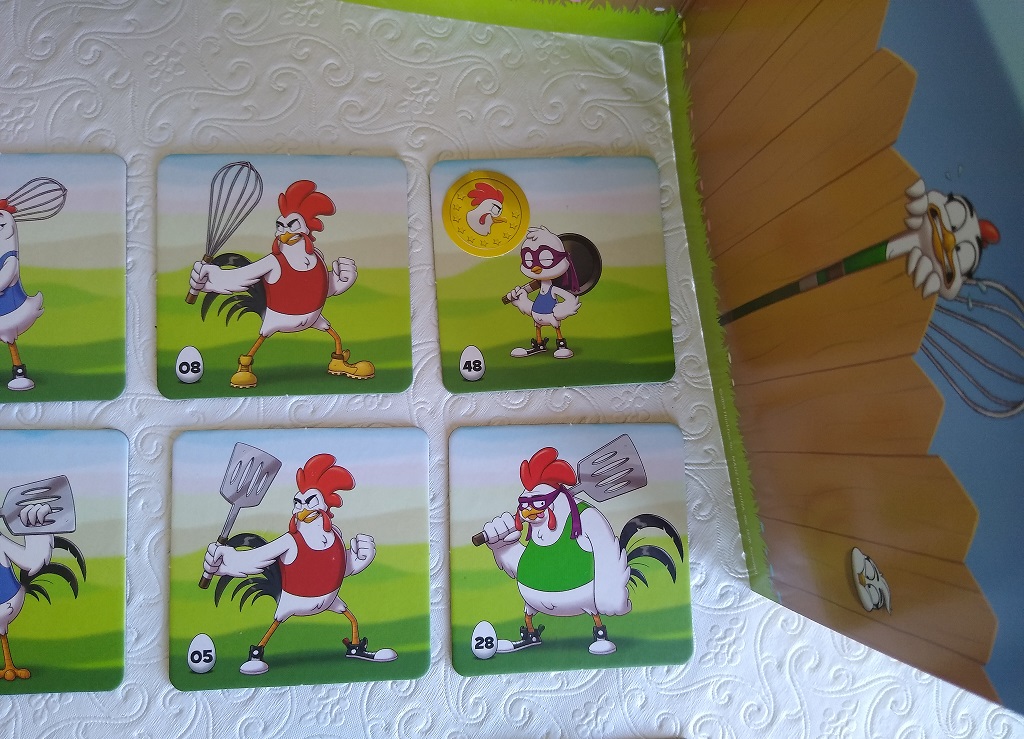
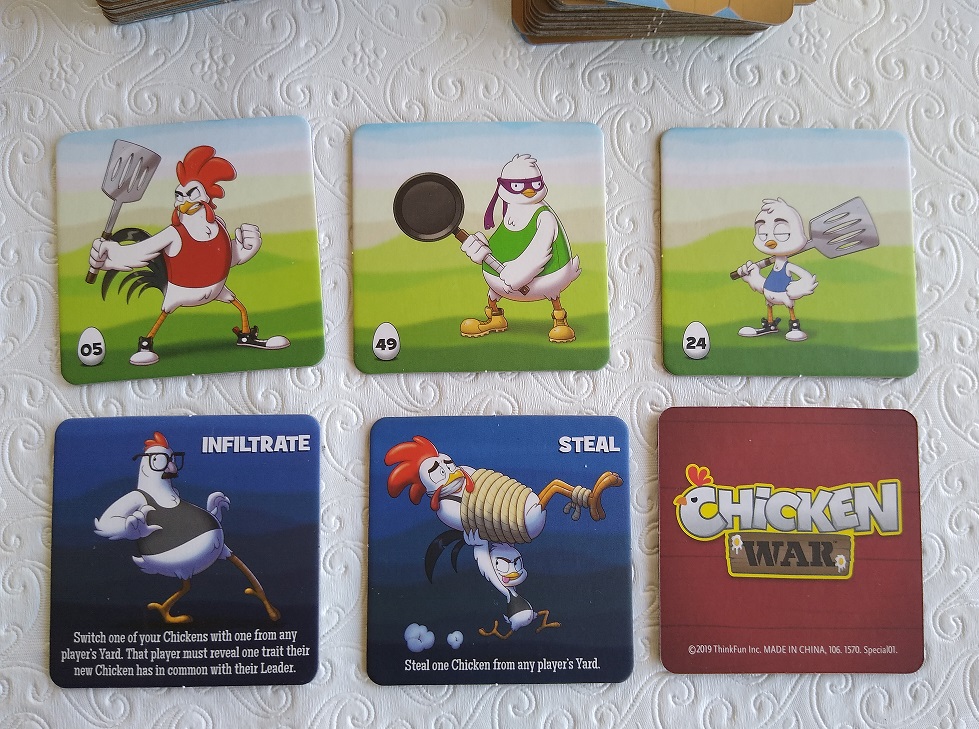
Steal lets you take a chicken from another player’s yard and discard one of your unwanted chickens into the discard pile. This not only gives you a new chicken, but leaves your opponent one chicken short. This can be a strategic advantage, because any player with fewer than 10 chickens can’t lob an egg and cannot win the game, even if their remaining chickens all match the leader.

chickenwar8

Infiltrate allows you to swap one of your chickens with one of your opponents’ chickens. That player must then tell you one trait your chicken (the one placed in their yard) has with their leader. If there are no traits in common with the leader, they must tell you that instead. And if you accidentally trade for their leader, they must pick a new leader and start over. So in any case, you gain a new chicken and important knowledge about your opponent’s game.

If multiple players gang up on a single player, the Infiltrate card can prove very dangerous, eventually outing the player’s leader and making them easy pickings for an egg and elimination from the game. (This tactic is more likely to catch new players, as more experienced players would endeavor to repeat the same revealed trait over and over, whenever possible.)

So each turn, you must either draw a chicken from the discard pile or lob an egg.

chickenwar5

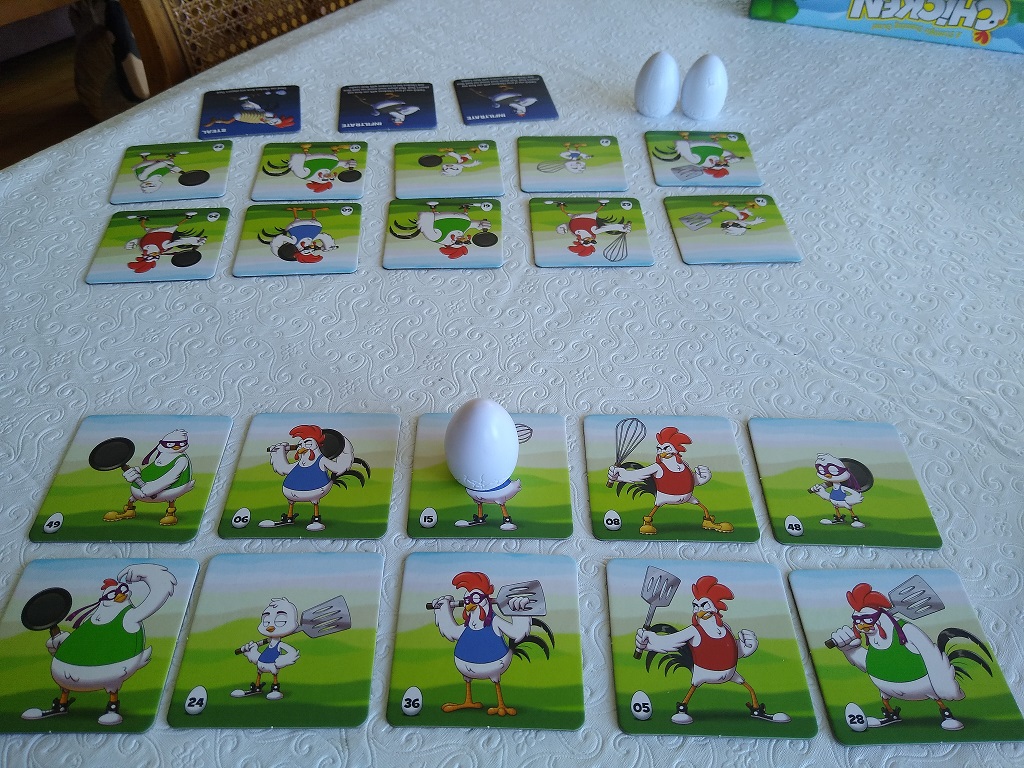
Lobbing one of your three eggs means you place your egg on a chicken in another player’s yard that you suspect is their leader. If you’re correct, that player is out.

But if you’re wrong, you lose an egg and have to discard two chickens from your yard, leaving yourself two chickens short of victory. (Also, as we stated before, you can’t win the game or lob an egg with fewer than 10 chickens in your yard.)

chickenwar6

The two methods of winning can often lead to two different styles of gameplay. Either a player focuses on their recruitment, hoping to be the first to complete their army, or they focus on eliminating another player by sussing out who their leader chicken is.

This adds a lot of variety to the game, particularly when it comes to repeat playthroughs. Figuring out your opponents’ tactics can inform your own, and yet, you don’t want to tip your hand.

Once I had one or two playthroughs behind me, I really started getting invested in the gameplay and trying to get into my opponents’ heads. (Also, there’s something delightfully demented about these chickens all being armed with “weapons” we would use to make breakfast from their eggs. That’s a nice touch.)

chickenwar7

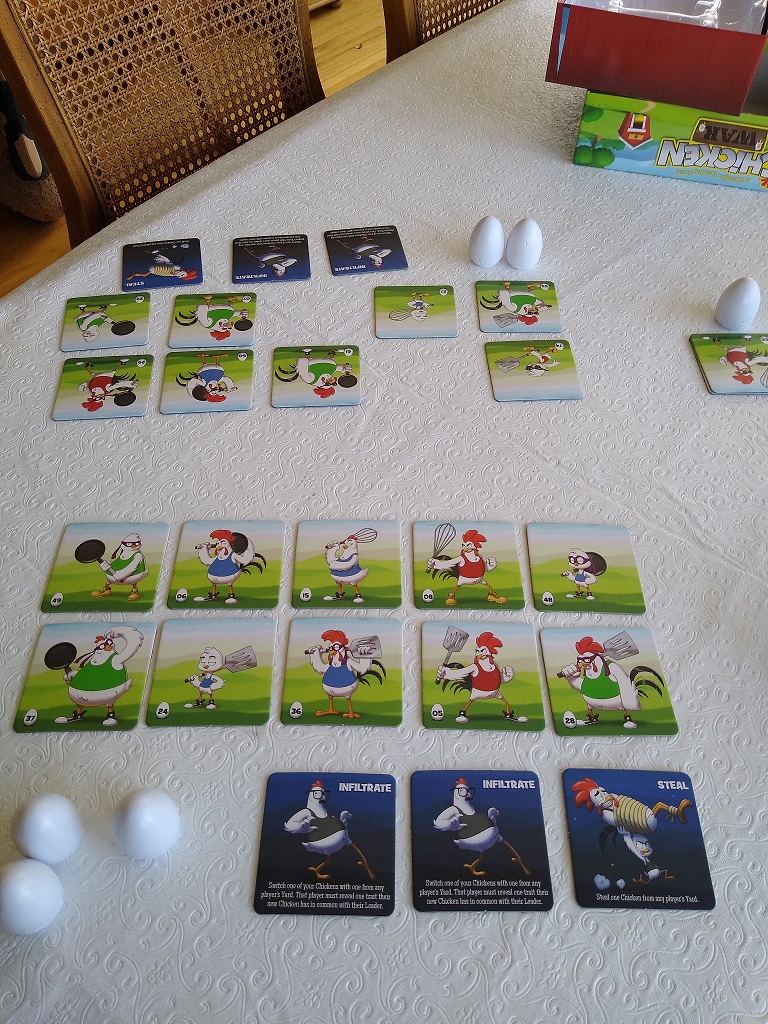
Although it makes for a tense, enjoyable one-on-one game, the full potential of Chicken War comes alive with all four players involved. It forces to split your attention, retain a lot of information, and constantly adapt your strategy to an ever-shifting landscape.

As you can see, there’s a surprising amount of thought, strategy, and complexity behind this so-called guessing game, and it makes Chicken War a terrific gateway game to other board games in the same style, but with more complex rulesets or player choices. War is hell, but Chicken War is healthy brain-fueled fun.

[Chicken War is available from ThinkFun and other retail outlets.]


Thanks for visiting PuzzleNation Blog today! Be sure to sign up for our newsletter to stay up-to-date on everything PuzzleNation!

You can also share your pictures with us on Instagram, friend us on Facebook, check us out on TwitterPinterest, and Tumblr, and explore the always-expanding library of PuzzleNation apps and games on our website!