Escape Room Gameplay at Home: Unlock! and Exit: The Game

mind bender escape room

[Image courtesy of The Portland Press Herald.]

In yesterday’s post, we discussed different ways you can enjoy escape room-style puzzling at home. We covered books, apps, and audio formats, but we left the largest category for today’s post: escape room games.

There are a myriad of games that try to encapsulate the escape room experience — searching the space, finding clues, interacting with the environment, solving puzzles, and experiencing the narrative — with varying degrees of success.

Escape Room: The Game, Escape Room in a Box, Escape from Iron Gate, Escape from the Grand Hotel, and Escape Tales: The Awakening are just five examples that turned up with a cursory search. That’s just the tip of the iceberg, of course, when you consider games that incorporate escape room-style or timed elements, like Mission X-Code, Cut the Wire, Bomb Squad Academy, Fuse, and Two Rooms and a Boom.

But all of those games are dwarfed in the marketplace by the industry leaders — based on sheer number of available puzzly experiences, anyway — so we decided to sample those and explore escape room gameplay from.

I solved three games from the Exit: The Game franchise and three games from the Unlock! franchise.

Let’s dive in, shall we?


Exit-the-game-1024x550

[Image courtesy of Meeple Mountain.]

Exit: The Game products create an escape room experience by combining a deck of cards, a guidebook, a sliding decoder ring, and miscellaneous items to be used throughout the game. The deck of cards is divided into red riddle cards (labeled by letter), blue answer cards (labeled by number), and green help cards (labeled by symbol).

There is an app as well that hosts a tutorial, your timer, atmospheric sounds and music, and a star-based scoring mechanism rating your performance at the end of the playthrough.

In the easier games, the guidebook progresses page by page, and you’re meant to go no further until the answer cards tell you to do so. You’ll use what’s on each page, along with the information on the riddle card to solve each puzzle.

Most of the puzzles will result in a three-digit number, which you enter into the decoder wheel. The decoder wheel will reveal a card number, which you will pull from the answer card deck. If you’re completely wrong, you flip the card to reveal a red X and go back to the drawing board. If you’re on the right path, the answer card will have different card numbers for each of the different puzzle symbols. You find your symbol, then go to the card in the answer deck indicated.

For instance, if you’re solving a puzzle with a triangle symbol, you solve the puzzle with a three-digit code, and enter that code into the decoder wheel. It sends you to, say, card 29. On card 29, you look for the triangle symbol, and you go to the card number listed. If you’re correct, you move forward in the game with new riddles, rooms, and in the easier games, the next page in the guidebook. (In harder games, the entire guidebook is “in play” the whole time, and you must figure out which pages connect with which puzzles and riddle cards.)

Some of the riddle cards and guidebook pages must be cut, manipulated, or destroyed in order to complete the various puzzles, so each Exit game is a one-time play experience. Each also requires some outside-the-box thinking (sometimes literally!) in order to crack various riddles.

I found each game to be an enjoyably interactive experience, and it felt like many of the above activities associated with escape rooms were replicated nicely. (One of the harder games not only had the puzzles and riddles to solve, but a murder mystery as well, which really kept me on my toes, because I wasn’t just thinking about the next riddle and discarding the bits and bobs I’d used. I had to pore over every detail in order to solve the murder!)

In case you’re interested, the three games I tackled were The Haunted Roller Coaster (difficulty: 2/5), The Abandoned Cabin (difficulty: 2.5/5), and Dead Man on the Orient Express (difficulty: 4/5).


20181220_152554-min-1080x675

[Image courtesy of Escape Games Canada.]

Unlike the Exit series, Unlock! games consist of entirely of a deck of cards and your app. But that doesn’t make it any less interactive. Instead of the guidebook, decoder ring, and riddle cards being manipulated, more of those experiences are handed through the app.

The cards provide locations, challenges, helpful items, solutions, and warnings, all identified with numbered or lettered cards in the deck. So you can end up with quite an array of cards in front of you while you solve.

The app, on the other hand, hosts your timer, atmospheric sounds and music, a penalty button (which removes time from your timer!), a hint button, a machine button, and a code button. Any codes you unravel are entered into the code screen (instead of a decoder ring), and certain puzzles are mechanical, which you manipulate in the app. The app then tells you what number/letter card(s) to draw from the deck to proceed.

The number system for the Unlock! cards is interesting. Each card representing a puzzle to be solved or an item to be used has a number associated with it; to see if you solved the problem correctly, you add its two numbers (one for the challenge, one for the solution).

If you combine a helpful item’s card number with a challenge’s card number, the total equals another card in the deck. If you’ve solved the challenge correctly, the card matching that sum reveals something: an opened lock, a new room, additional puzzles and helpful items, etc. If you’ve combined items incorrectly, the card matching that sum reveals a time penalty. (For instance, if you have a key on card 16 and a keylock on card 25, you’d go to card 41 in the deck.)

There is no destroying cards or anything here, so if you wished, you could reshuffle the deck and allow someone else to try the game. (It wouldn’t be much challenge for you, since you know all the riddle solutions now. But it’s nice to know I could walk less experience escape room solvers through the game on a replay, enjoying their efforts. That’s not possible with an Exit game.)

In case you’re interested, the three games I tackled were The Night of the Boogeymen (difficulty: 1/3), The House on the Hill (difficulty: 1/3), and Squeek & Sausage (difficulty: 2/3).


Each brand has its pluses and minuses.

While the guidebooks in Exit are more detailed than the location cards in Unlock! games — and the miscellaneous items are a nice touch — I found I had to do more searching with the location cards. I would scrutinize every nook and cranny, because some numbers were hidden in shadow, or written at odd angles so your eye slides right past them. Exit is less devious with that aspect, but only because it has more space to play with for puzzles in the guidebook.

Both game systems had red-marked cards to indicate your failure on a given puzzle, but in Unlock!, you were penalized twice over, because you’ve already lost the time on the clock you spent on that dead end, and then you get the timer penalty as well.

Unlock! definitely makes greater use of its app. Honestly, except for the star-ranking system and some nice atmospherics, you could do without the Exit app. (Particularly since group solving can be pretty noisy, so the atmospherics are mostly lost unless you’re in quiet contemplation.)

I was thoroughly impressed by how both systems tried to recreate so many aspects of the escape room experience. Searching the space, finding clues, interacting with the environment, solving puzzles, and experiencing the narrative were all included to some degree, and I felt genuine pressure watching the minutes and seconds tick away as a particularly vexing puzzle left me baffled, if only momentarily.

I would recommend games from either series to anyone trying to recapture that escape room spirit in these trying times. But they’re also terrific icebreakers for people who have never tried an escape room, but don’t want to feel the pressure of being on-location, instead solving from the comfort of home.


I hope this brief look at these two puzzly franchises — I purposely stayed light on actual puzzle or scenario details to avoid ruining the experience for anyone — offered yet another avenue for you to explore as you enjoy escape room solving from home!

Don’t forget, tomorrow is the finale of Escape Room Puzzle Week, as we review ThinkFun’s latest diabolical creation, Escape the Room: The Cursed Dollhouse!


Thanks for visiting PuzzleNation Blog today! Be sure to sign up for our newsletter to stay up-to-date on everything PuzzleNation!

You can also share your pictures with us on Instagram, friend us on Facebook, check us out on Twitter, Pinterest, and Tumblr, and explore the always-expanding library of PuzzleNation apps and games on our website!

PuzzleNation First Look: Everything Board Games Magazine

cover

The world of board games is expanding and evolving in new ways every day. Encompassing everything from traditional board and dice games to card games, roleplaying games, and more, we’re talking about an ever-expanding universe of gameplay possibilities.

So when I heard about a new publication called Everything Board Games Magazine, I simply had to investigate. Based on the ambitiousness alone, I was intrigued.

The debut issue of the magazine is now available for free on their website, and I’ve gotta say… I’m pretty impressed.

It’s 82 pages, a full-color reading experience that is vibrant, visually engaging, and absolutely jam-packed with content. I’m pretty plugged into the board game world, and I discovered half a dozen games I knew nothing about.

hot shots

After a few pages of ads, we’re greeted with a letter from the editor, and you immediately get a sense of the passion and excitement that permeates every page of the magazine:

Thank you for taking the time to read through the first ever issue of Everything Board Games Magazine! We know there are a lot of voices vying for your attention in the wonderful world of board games. We’ve strived to produce something that will bring value and joy to the gamer in every walk of life. Our team of board game fanatics have scoured the wide-world of gaming to bring you a diverse and interesting selection of articles, interviews, game reviews, previews and more! It is our hope and desire to connect with you once every two months, filling your mind with gaming pleasures.

Every piece in the magazine — whether it’s a game review, informational article, or interview — is loaded with enthusiasm. The writing crackles with excitement, and every contributor clearly loves the world of board games.

And honestly, in a world where a lot of genre-focused content seems to drip with sarcasm and know-it-all condescension, it’s refreshing to read pieces full of sincerity and affection, even when offering constructive criticism.

The magazine has teasers for upcoming games and Kickstarter campaigns, loads of reviews (though many reviews are just links to the full reviews on their website), as well as interviews about hobby gaming, board game design, running a board game cafe, and more.

Giveaways, polls, board game art, a bi-monthly top 5 games countdown… every page is packed with content.

preview

And every last page is interactive. Links with more information, links to websites, links for ads, links for email, links to contribute or suggest content or offer feedback. Interactive everything. (And thankfully, no auto-play ads or videos or audio clips to spoil the experience.)

In this first issue alone, they featured games based on history, monsters, latte art, the golden age of sci-fi, theme parks, mythology, war, painting, and crime-solving.

They even managed to throw in a free print-and-play stock trading game AND a free RPG adventure for Dungeons & Dragons.

Aside from a few typos here and there, the debut issue of Everything Board Games Magazine was a brisk, engaging, thoroughly enjoyable read. The only bad thing is waiting two months for the next one.

You can check it out and sign up for your free subscription here.


Thanks for visiting PuzzleNation Blog today! Be sure to sign up for our newsletter to stay up-to-date on everything PuzzleNation!

You can also share your pictures with us on Instagram, friend us on Facebook, check us out on Twitter, Pinterest, and Tumblr, and explore the always-expanding library of PuzzleNation apps and games on our website!

PuzzleNation Product Review: Chicken War

chicken war header

[Note: I received a free copy of this game in exchange for a fair, unbiased review. Due diligence, full disclosure, and all that.]

The farm is no longer the quiet, idyllic escape you pictured when learning the sounds barnyard animals make. Instead, it has fallen to factional fury and un-cooped combat between various groups of chickens vying for victory. Such is the setting for ThinkFun‘s latest brain-training game, the colorful and crafty tile game Chicken War.

chickenwar1

There are two ways to win Chicken War. You can either be the last player standing or the first player to complete their army. To be the last player standing, your opponents’ leaders must be identified. To be the first player to complete your army, you have to have nine other chickens with two traits in common with your leader.

As you can see, Chicken War’s hybrid style of play combines the player observation of a game like Throw Throw Burrito or Scrimish with the deductive reasoning of a game like Clue.

chickenwar2

Each player is trying to recruit chickens for their army, and must do so in full view of the other players. This means that you have to strategize not only your recruitment process, but how to do so without revealing too much to your opponents. Plus you have to do all that while keeping an eye on your opponents’ efforts to recruit!

First, you select your leader from the ten starting chickens in your yard. Optimally, you’ll pick a leader where many of the other starting chickens already share two traits, which gives you a leg up in building your army.

chickenwar3

You’ll hide your leader token under that particular chicken to mark it, using your screen to do so away from the prying eyes of other players.

Remember, that’s two traits and only two traits in common.

chicken war trait

The four possible traits, as shown above, are weapon, shirt color, eyewear, and footwear. Each trait has three variations. For instance, shirt color can be blue, red, or green. Eyewear can be sunglasses, mask, or none.

(Keep those four traits in mind. Body type, pose, and style of tail are all irrelevant, but can be distracting.)

chickenwar9

As you can see here, the top two chickens have two traits in common: shirt color and eyewear. (Footwear and weapon differ.) The two bottom chickens have three traits in common: shirt color, eyewear, and footwear. Therefore, if 05 and 06 are leaders, 05 has a recruit, but 06 does not.

How do you recruit chickens? By drawing from the discard pile. You either keep the new chicken and discard one of the chickens from your yard, or you immediately discard the new chicken.

chickenwar4

The only other ways to recruit chickens are to use the two special tiles: steal and infiltrate.

Steal lets you take a chicken from another player’s yard and discard one of your unwanted chickens into the discard pile. This not only gives you a new chicken, but leaves your opponent one chicken short. This can be a strategic advantage, because any player with fewer than 10 chickens can’t lob an egg and cannot win the game, even if their remaining chickens all match the leader.

chickenwar8

Infiltrate allows you to swap one of your chickens with one of your opponents’ chickens. That player must then tell you one trait your chicken (the one placed in their yard) has with their leader. If there are no traits in common with the leader, they must tell you that instead. And if you accidentally trade for their leader, they must pick a new leader and start over. So in any case, you gain a new chicken and important knowledge about your opponent’s game.

If multiple players gang up on a single player, the Infiltrate card can prove very dangerous, eventually outing the player’s leader and making them easy pickings for an egg and elimination from the game. (This tactic is more likely to catch new players, as more experienced players would endeavor to repeat the same revealed trait over and over, whenever possible.)

So each turn, you must either draw a chicken from the discard pile or lob an egg.

chickenwar5

Lobbing one of your three eggs means you place your egg on a chicken in another player’s yard that you suspect is their leader. If you’re correct, that player is out.

But if you’re wrong, you lose an egg and have to discard two chickens from your yard, leaving yourself two chickens short of victory. (Also, as we stated before, you can’t win the game or lob an egg with fewer than 10 chickens in your yard.)

chickenwar6

The two methods of winning can often lead to two different styles of gameplay. Either a player focuses on their recruitment, hoping to be the first to complete their army, or they focus on eliminating another player by sussing out who their leader chicken is.

This adds a lot of variety to the game, particularly when it comes to repeat playthroughs. Figuring out your opponents’ tactics can inform your own, and yet, you don’t want to tip your hand.

Once I had one or two playthroughs behind me, I really started getting invested in the gameplay and trying to get into my opponents’ heads. (Also, there’s something delightfully demented about these chickens all being armed with “weapons” we would use to make breakfast from their eggs. That’s a nice touch.)

chickenwar7

Although it makes for a tense, enjoyable one-on-one game, the full potential of Chicken War comes alive with all four players involved. It forces to split your attention, retain a lot of information, and constantly adapt your strategy to an ever-shifting landscape.

As you can see, there’s a surprising amount of thought, strategy, and complexity behind this so-called guessing game, and it makes Chicken War a terrific gateway game to other board games in the same style, but with more complex rulesets or player choices. War is hell, but Chicken War is healthy brain-fueled fun.

[Chicken War is available from ThinkFun and other retail outlets.]


Thanks for visiting PuzzleNation Blog today! Be sure to sign up for our newsletter to stay up-to-date on everything PuzzleNation!

You can also share your pictures with us on Instagram, friend us on Facebook, check us out on Twitter, Pinterest, and Tumblr, and explore the always-expanding library of PuzzleNation apps and games on our website!
PuzzleNation Product Review: Pocket Brainteasers

4j0

[Note: I received a free copy of each brain teaser in exchange for a fair, unbiased review. Due diligence, full disclosure, and all that.]

Whether it’s composed of two simple pieces of twisted metal or a elaborate arrangement of parts, a mechanical brain teaser are great fun. It’s a plaything, a curiosity to be fiddled with, tinkered with, and explored, twisted and turned every which way until you feel like you’ve got a handle on all the different ways you can manipulate it.

And then, suddenly, BAM. Inspiration strikes! The a-ha moment happens, and you unravel its secrets.

ThinkFun, purveyors of deduction and logic puzzle games galore, have returned to the field recently, and in today’s product review, we look at a collection of brain teasers that each offer their own unique a-ha moment, if you’re willing to work at it.

ThinkFun’s Pocket Brainteasers range in difficulty from one to four (one being the easiest/least challenging), and you’ll find your puzzle skills tested in several ways as you tackle each. Although intended for solvers 8 and up, older solvers will still enjoy the puzzly tricks awaiting them in ThinkFun’s latest line of puzzle products.


4j1

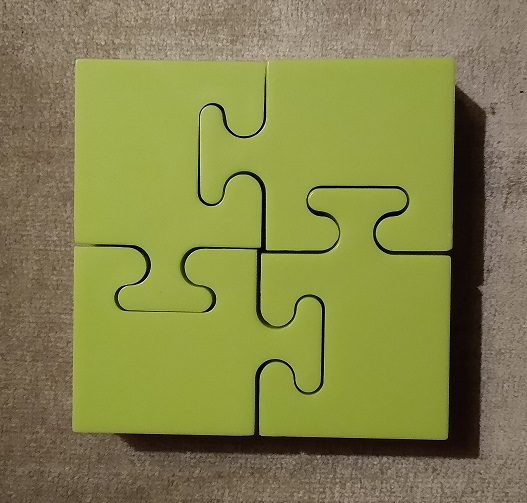
4-Piece Jigsaw

It sounds simple, doesn’t it? A four-piece jigsaw puzzle. Better yet, it’s already assembled for you! All you have to do is take it apart.

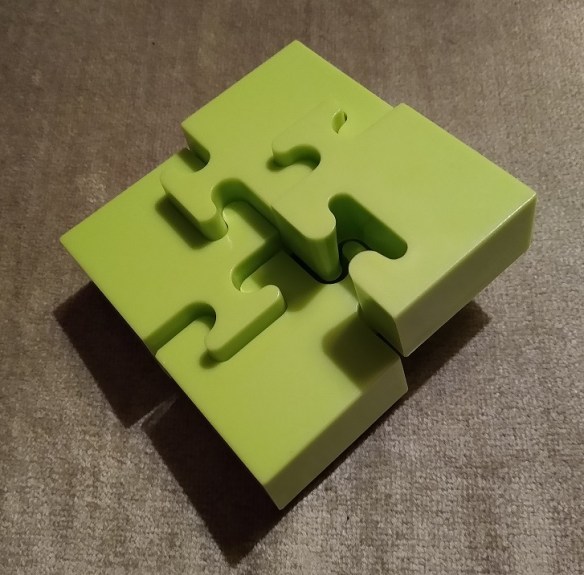
This level 1 brainteaser is obviously more than meets the eye, as the puzzle pieces shift back and forth but never quite seem to separate the way you’d expect.

4j2

The large plastic pieces are perfect for younger solvers to play around with, solid and resistant to the sometimes harsh manipulations of younger hands.

It’s not much of a challenge for an experienced solver, but it was genuine fun to suss out how the pieces worked together and how to finally separate them.

4j3

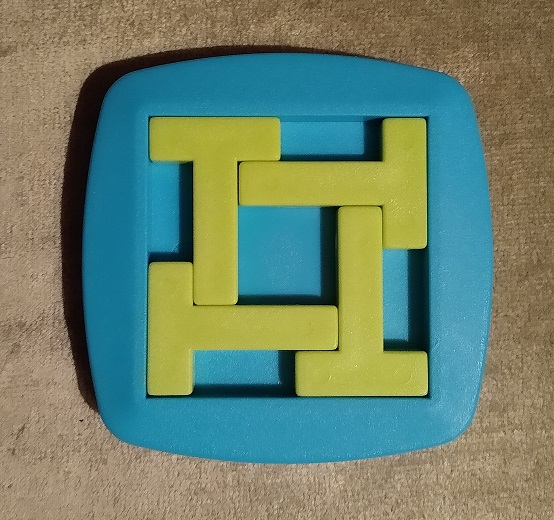
4-T Puzzle

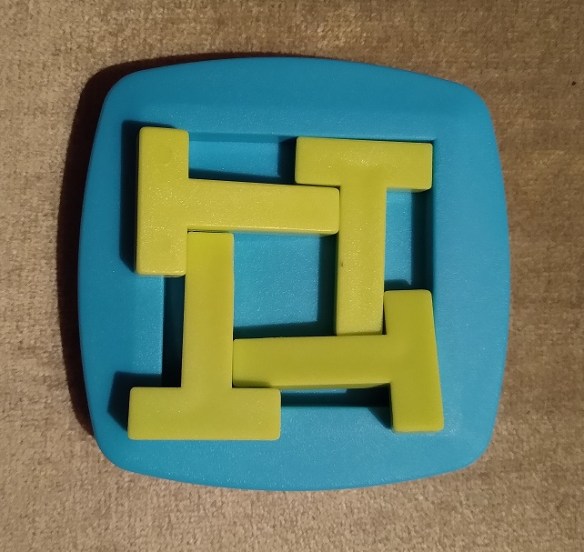
This level 2 brainteaser followed the same basic formula as 4-Piece Jigsaw — four pieces to assemble — but in this case, their interactions were constrained by the small tray included with the puzzle.

4j4

As you can see, the solution offered on one side simply won’t work on the other because the tray is smaller, so solvers will have to be extra crafty to place all four T-blocks into the available space.

The T-shaped pieces made for curious solving — since they don’t fit flush with the corners the way traditional tangrams or Tetrominoes would — but patience and cleverness will be rewarded. It’s amazing how a relatively simple set-up — shapes and a tray — can result in a satisfying puzzly experience.

4j5

The Fifth Chair

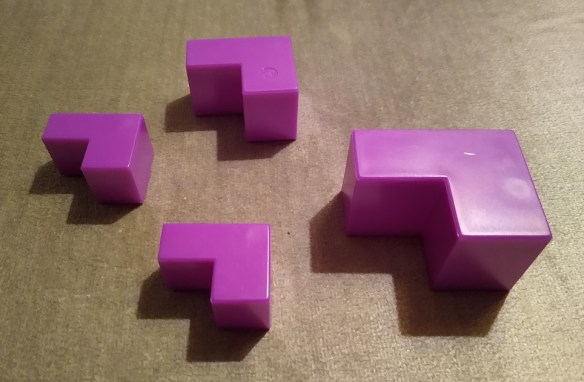
This time around, there’s no tray or framework to negotiate. Instead, you’ve got four L-pieces (or “chairs”) and your goal is to make a larger L-shaped chair by combining the four you already have.

Like a three-dimensional version of tangrams, The Fifth Chair is an enjoyable solve, requiring you to maneuver the chairs in all sorts of combinations, seeing different relationships between them all as you try to figure out how to bring the fifth chair to life.

Despite being the level 3 puzzle in the set, I actually found this to be the most challenging of the quartet, as I was briefly overwhelmed by the sheer number of options available to me.

Of course, as soon as I figured out the solution, it felt obvious, and I breathed a sigh of puzzly relief as I conquered the third of four brainteasers for the evening.

4j6

Rec-Tangle

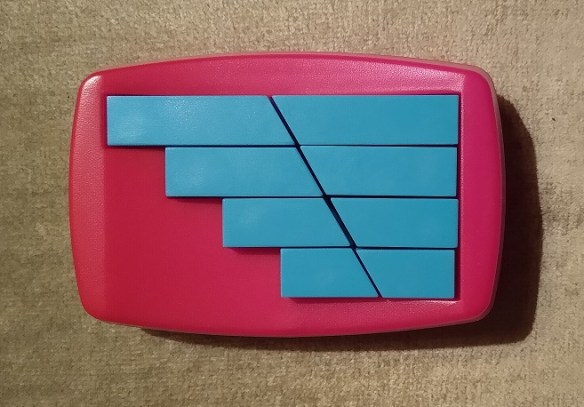
Designed to resemble the service bars of a cellphone or an internet connection, the “bars” are cut diagonally into halves, leaving the solver with 8 pieces to arrange.

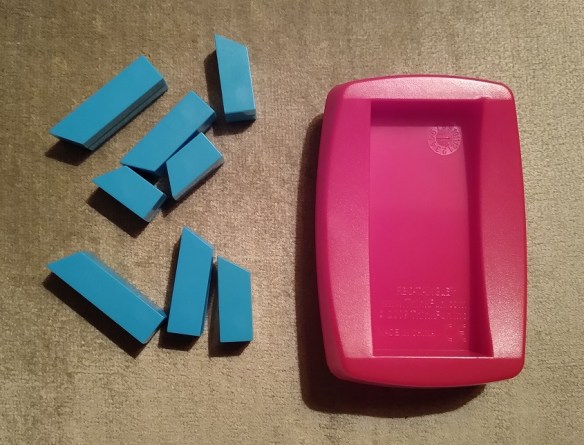
This level 4 puzzle solves quite similarly to 4-T Puzzle. You have an array of pieces to place into a smaller space on the backside of the puzzle tray.

4j7

The unusual pieces — long and thin, with an angled edge on one side and a flat end on the other — offered all sorts of possibilities when it comes to placement in the tray, so I found myself discarding quite a few theories and ideas before alighting on the correct solution.

Nonetheless, I would still consider this puzzle easier than The Fifth Chair, though still harder than 4-T Puzzle or 4-Piece Jigsaw.


Tackling this tetrad of brainteasers was a treat, especially as it felt like I was exercising plenty of puzzly skills that aren’t used nearly as often as pen-and-paper puzzles usually demand.

The combination of spacial awareness, physical manipulation of puzzle pieces, and the strategy involved in cracking each made for a feast of puzzly experiences. Any one of the four would be fun, so getting to try all four was a delight.

Whether intended as stocking stuffers or affordable little puzzly surprises for the solver in your life, I suspect these pocket-sized puzzles will have the younger solvers you know puzzling away for a while to come.

Pocket Brainteasers are available from ThinkFun and select online retailers, only $6.99 each for 4-Piece Jigsaw, 4-T Puzzle, The Fifth Chair, and Rec-Tangle!


Thanks for visiting PuzzleNation Blog today! Be sure to sign up for our newsletter to stay up-to-date on everything PuzzleNation!

You can also share your pictures with us on Instagram, friend us on Facebook, check us out on Twitter, Pinterest, and Tumblr, and explore the always-expanding library of PuzzleNation apps and games on our website!

PuzzleNation Product Review: Astronomy Fluxx

astrofluxx0

[Note: I received a free copy of this game in exchange for a fair, unbiased review. Due diligence, full disclosure, and all that.]

There are plenty of games that center around space, whether you’re forming constellations, repairing your ship, traveling the galaxy, escaping a black hole, or building a civilization. But while you’re worrying about air supply, celestial objects, or other aspects of life in space, you’re rarely reminded of the incredible wonders that can be found beyond the Earth.

It’s unusual indeed for a game to evoke that sense of awe, no matter how fun the actual gameplay may be. Which makes Astronomy Fluxx, the latest offering from the crew at Looney Labs, such a delight.

astrofluxx1

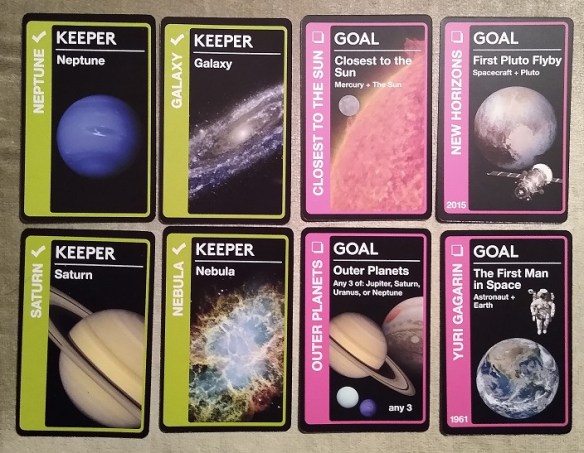
For the uninitiated, Fluxx is a card game where you collect keeper cards and put them into play. Different combinations of keeper cards complete different goals, and each player has the chance to put different keeper cards and goal cards into play in order to win. So you might find yourself working toward completing the goal at hand when suddenly somebody plays a new goal, and the object of the game changes.

Along the way, players affect how the game is played by utilizing action cards and new rule cards which alter what players can and can’t do. Suddenly, you’ll have to trade your hand with another player, or start drawing three cards each turn instead of one.

In Astronomy Fluxx, the gameplay is simplified from previous editions of the game — there are no ungoals or creepers complicating play this time around — but the gameplay doesn’t suffer in the slightest.

astrofluxx2

Before I get into the rule cards and other ephemera of the game, I have to mention how blown away I was by the art. Using NASA images as photographic source material (instead of the usual charming drawings usually seen in Fluxx games) really infuses the theme of the game into every aspect of the gameplay. The planets burst to life in every keeper card, and the goal cards are eye-catchingly gorgeous.

Some of the goal cards reference specific events from the history of space exploration — from the first man in space and the moon landing to more recent endeavors like the New Horizons spacecraft flyby of Pluto — which certainly brings a smile to this astronomy buff’s face each time I play.

astrofluxx3

In addition to the usual rule change cards regarding how many cards to draw, how many to play, hand limits, and so forth, they’ve introduced rules to make use of bonus educational information at the bottom of each keeper card. One card allows you to draw additional cards if you can name the year certain events happened, and another offers a bonus card per turn for a constellation you can name. These cards continue the tradition of Math Fluxx, Chemistry Fluxx, and Anatomy Fluxx of rewarding players for learning about the subject of the game.

Astronomy Fluxx also incorporates the planets into the gameplay in a unique way with certain rule cards that involve planetary orbits and centers of gravity that move from player to player during the game. Each adds an intriguing mechanic that I’ve never really seen before in a Fluxx game, and it really creates a fresh challenge, even for experienced Fluxx players.


All in all, I was absolutely wowed by the depth of creativity that went into the latest offering from Looney Labs. This is a game that lives up to the chaotic, replayable spirit of Fluxx, but with innovative gameplay, solid educational information, and a game-changing shift in artistic style. Their educational Fluxx series continues to impress.

Astronomy Fluxx is available now from Looney Labs and select retailers!


Thanks for visiting PuzzleNation Blog today! Be sure to sign up for our newsletter to stay up-to-date on everything PuzzleNation!

You can also share your pictures with us on Instagram, friend us on Facebook, check us out on Twitter, Pinterest, and Tumblr, and explore the always-expanding library of PuzzleNation apps and games on our website!

PuzzleNation Product Review: Minecraft Magnetic Travel Puzzle

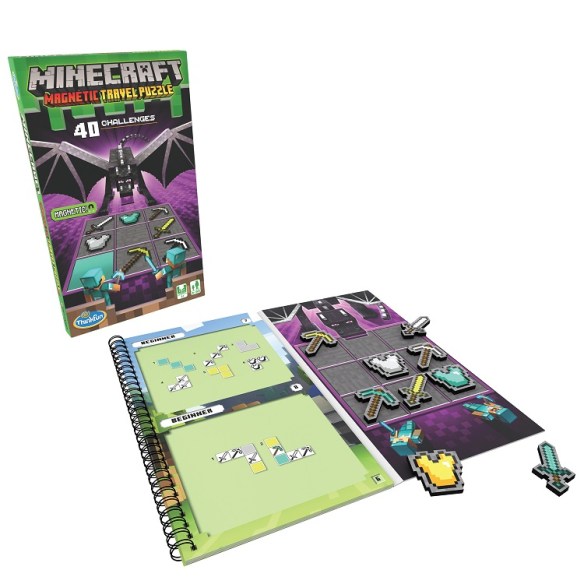
tfmine1

[Note: I received a free copy of this product in exchange for a fair, unbiased review. Due diligence, full disclosure, and all that.]

Minecraft is one of the biggest indie video game success stories of the last twenty years. A simple block-style game about building things (and destroying things) is now a multimedia empire, complete with toys, LEGOs, and of course, video games across numerous platforms.

It was only a matter of time before it made the leap to puzzles, and as it turns out, the clever folks at ThinkFun were just the designers to bring Minecraft into a puzzlier world.

Minecraft Magnetic Travel Puzzle pits the player against devious deduction puzzles with elements of the Minecraft universe included. By using the clues provided on each challenge card, the player must arrange three swords, pickaxes, and pieces of armor (all different colors, making nine unique game pieces) on the 3×3 crafting table in a particular pattern.

tfmine2

Completing the grid is the only way to bypass the ender dragon (who is placing these challenge obstacles in your path) and continue onto the next world in your journey.

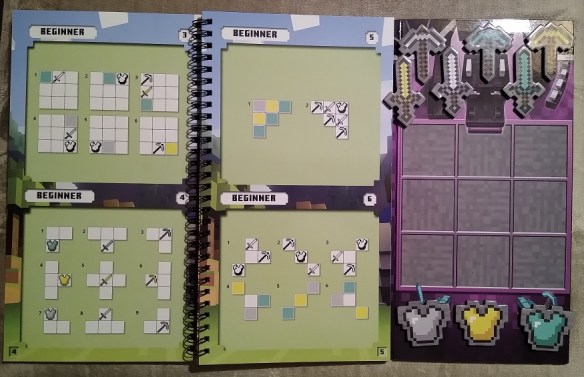
The instructions, puzzles, solutions, game board, and pieces are all contained within the single spiral-bound game book, making this one of ThinkFun’s most portable products yet. The magnetic pieces are fairly sturdy, as is the game board, so it will hold up nicely to the rigors of travel (and being stuffed into various carry-on bags).

tfmine3

The gameplay itself is all about interpreting the clues provided with each challenge card. Some clues offer hints on where to place pieces according to color, others according to shape. Additional clues center around a given piece’s location on the grid or in relation to another piece.

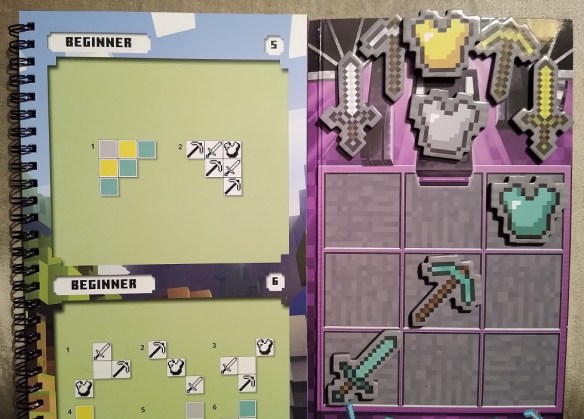
For instance, in Beginner Challenge #5 in the image below, the solver gets two hints: one about color and the other about the game pieces.

All three of the blue pieces will be placed along the diagonal, according to the first hint. And according to the second hint, a piece of armor will be in the upper right corner and a pickaxe will be in the middle square. Combining these two hints tells us where to place the blue armor and blue pickaxe. And since only one blue gamepiece is left, the blue sword goes in the lower left corner.

tfmine4

Similarly, the combination of the yellow square in the center of the top row in the first hint and the sword image in the center of the top row in the second hint tells us where to place the yellow sword. Once that’s in place, we look at the remaining sword image on the second hint and know where to place the gray sword.

The gray square in the upper left corner of the first hint and the pickaxe image in the upper left corner of the second hint point to where to play the gray pickaxe (and the yellow pickaxe by process of elimination).

tfmine5

With two game pieces left and one unoccupied yellow square in the first hint, the solver can easily complete this challenge, besting the ender dragon’s latest obstacle and moving forward.

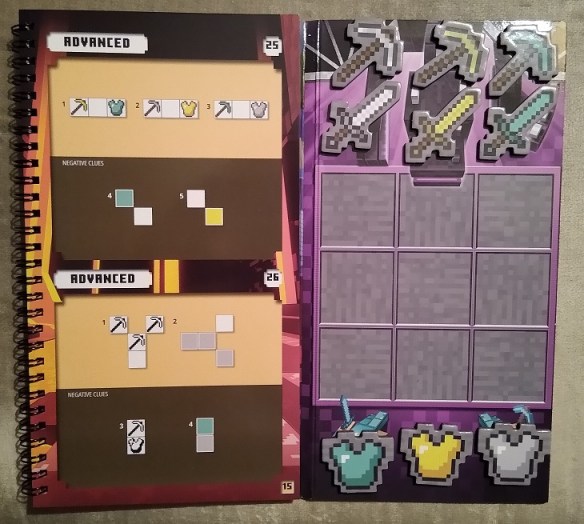
Once you graduate from the Beginner and Intermediate difficulty levels, you’ll face a new wrinkle: negative clues. Negative clues are layouts that must be avoided, so instead of telling you where to place a piece, they tell you expressly where NOT to place a piece, ratcheting up the difficulty.

For instance, in Advanced Challenge #25, the negative hints tell us that a gray gamepiece can never be directly below and to the right of a blue gamepiece, or above and to the left of a yellow gamepiece.

tfmine6

These restrictions will prove to be valuable hints going forward, often telling a savvy solver more about the layout of the crafting table than the regular clues!

By gradually teaching deductive reasoning — slowly introducing new ways to provide information and eliminate possibilities — the solver quickly grasps a key component of strategy and planning: “If this, then that” thinking.

This sort of cause-and-effect observation allows a solver to hold several pieces of information in your head at once, eliminating red herrings and unhelpful possibilities until you’re left with one solution that fits all the requirements. (Just as every Sudoku puzzle is an exercise in deduction, so is every challenge card in Minecraft Magnetic Travel Puzzle.)

Fun for younger solvers and older alike, ThinkFun’s latest deduction puzzle game turns Minecraft into Mindcraft, adding a valuable puzzly tool to the arsenal of every solver.

Minecraft Magnetic Travel Puzzle is available from ThinkFun and certain online retailers.


Thanks for visiting PuzzleNation Blog today! Be sure to sign up for our newsletter to stay up-to-date on everything PuzzleNation!

You can also share your pictures with us on Instagram, friend us on Facebook, check us out on Twitter, Pinterest, and Tumblr, and explore the always-expanding library of PuzzleNation apps and games on our website!