Variety Crosswords: What’s Black and White and Crossed All Over

It’s an awesome time to be a crossword fan.

You’ve got LOADS of outlets doing traditional crosswords, both themed and themeless / freestyle. There are minis and midis for quicker solving (but equally creative themes and tricks!), and cryptic / British crosswords for a different flavor of cluing.

But that’s just scraping the surface of different kinds of crosswords out there. So today, let’s explore the world of variety crosswords and see all the challenging ways constructors can add a twist to the familiar crossword formula.

(These examples are from Penny Dell Puzzles, GAMES Magazine, and Puzzlecraft by Mike Selinker and Thomas Snyder.)
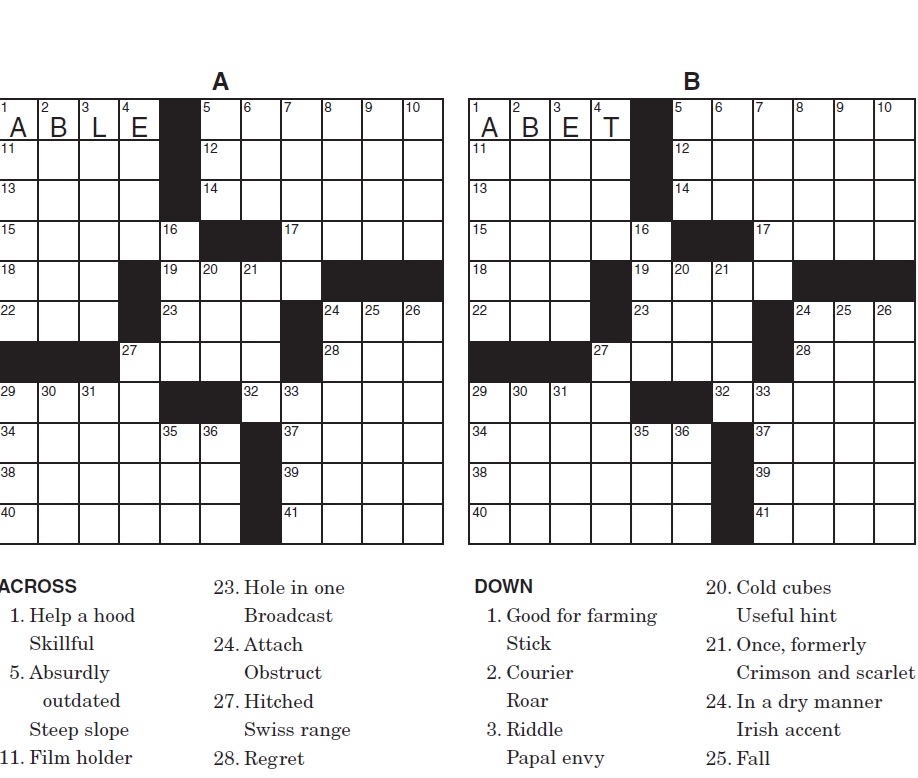

Twin Crosswords (also known as Twinlets) is a puzzle that offers two identical grids and the clues for both grids, but all mixed up. 1-Across gets two clues, one for each grid, but you don’t know which. (Unless the first word is set for you, like in the example above.) That continues for every coordinate, both across and down. Can you figure out which clue applies to which grid?

For an extra challenge, constructors sometimes use the same clue for two different words, testing the solver’s flexibility of mind as well as their vocabulary.
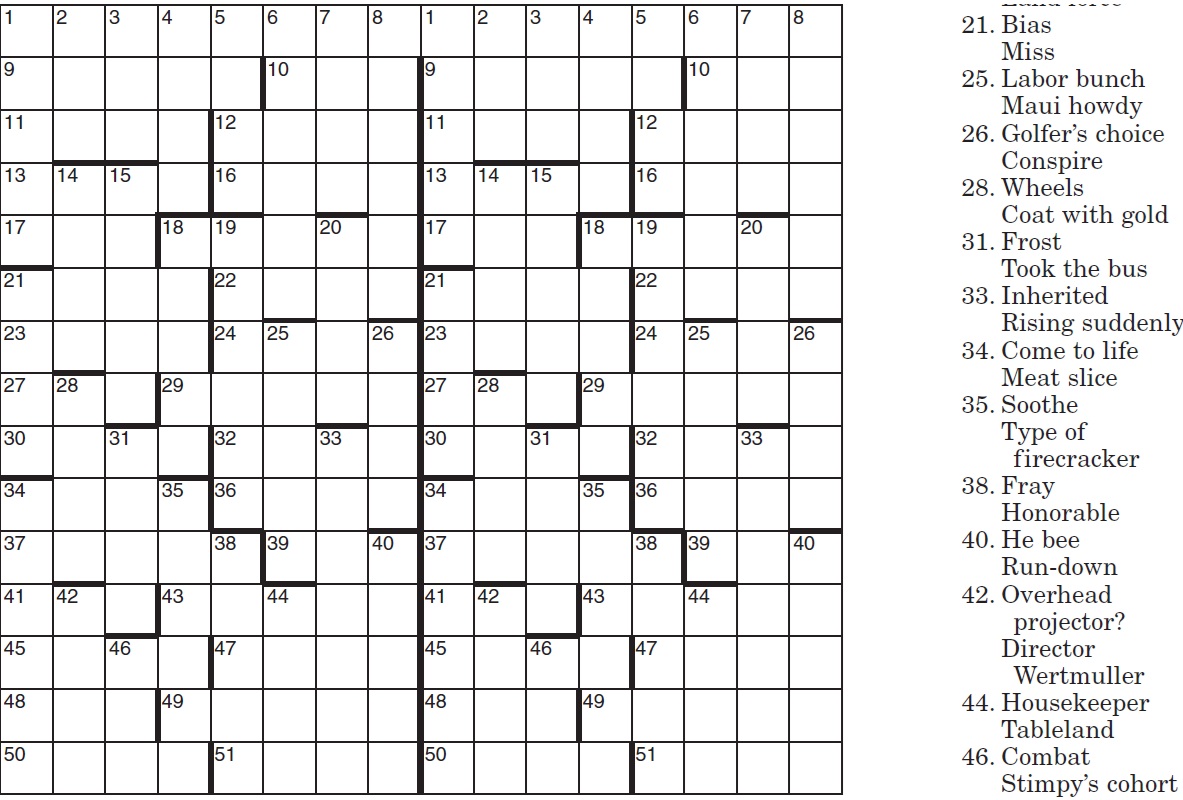
There is a variation on Twin Crosswords known as a Dilemma crossword. In this case, the mix-matched clues apply to two different sections in the same grid. A single unifying entry runs across the top of the grid, with two identical columns below.

Black lines divide answer words instead of black squares, making this a challenging puzzle to construct and to solve! (Crosswords without black squares are also called Blackout puzzles.)
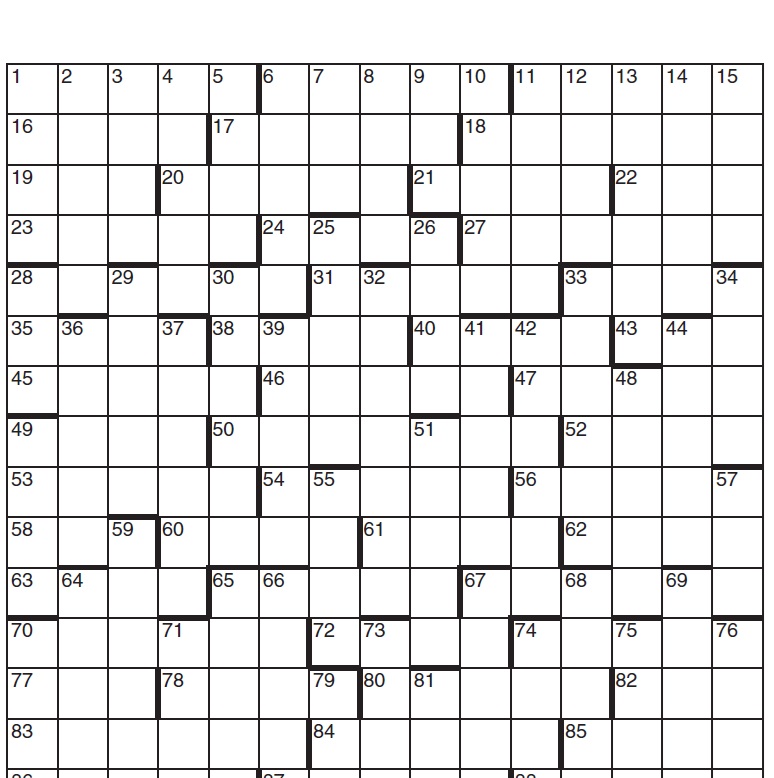
Similar to Dilemma, a Stoplines puzzle has black lines instead of black squares, leading to a dense interconnected grid with traditional rotational symmetry, but lacking that single grid-spanning entry across the top.

But at least a Stoplines puzzle gives you black lines to figure out word lengths for your answers. A Wordsworth puzzle has the same dense grid, but without any indicators of word length. An empty 15x grid space awaits a Wordsworth solver. (It’s like a Diagramless without any black squares.)
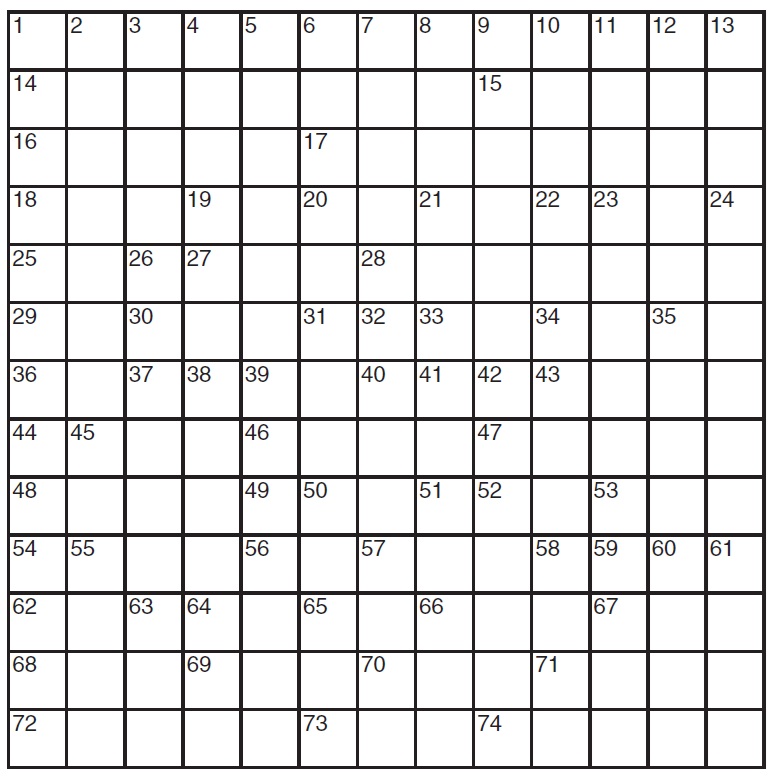
Oh, and for an extra challenge for an already difficult task, Clapboard has no black squares AND all of the entries overlap by 1 or 2 letters.


For a break from the tight grids and difficulty, let’s check out a Brick by Brick crossword.
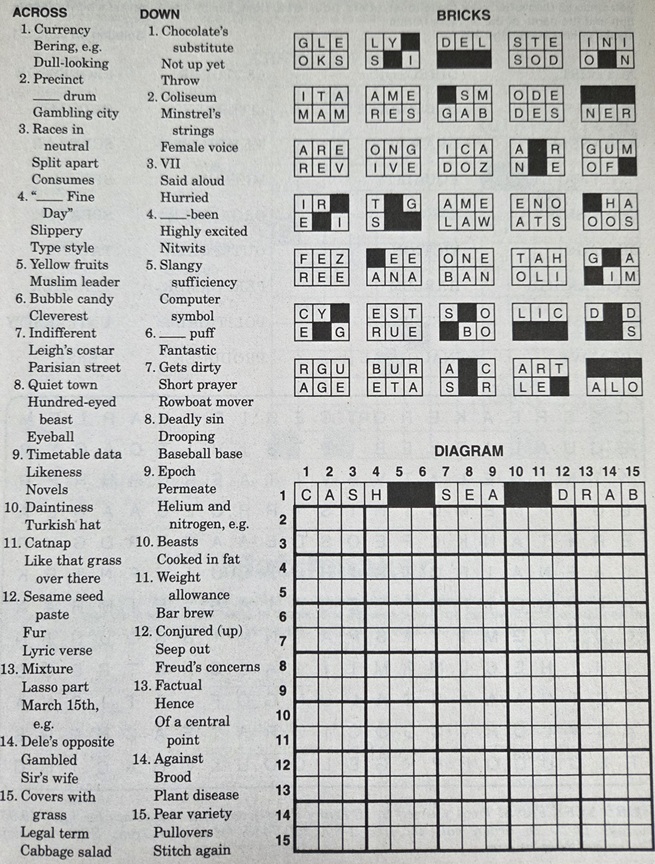
This is a traditional crossword, except you have the additional advantage of the grid being split up into 3×2 “bricks” and randomly gathered next to the clues.

So solvers can either traditionally solve this crossword or put their jigsaw skills to the test assembling the grid visually brick by brick.

I really like this puzzle as an introduction to crosswords. That extra element adds a safety net for nervous solvers who find a traditional crossword grid daunting.
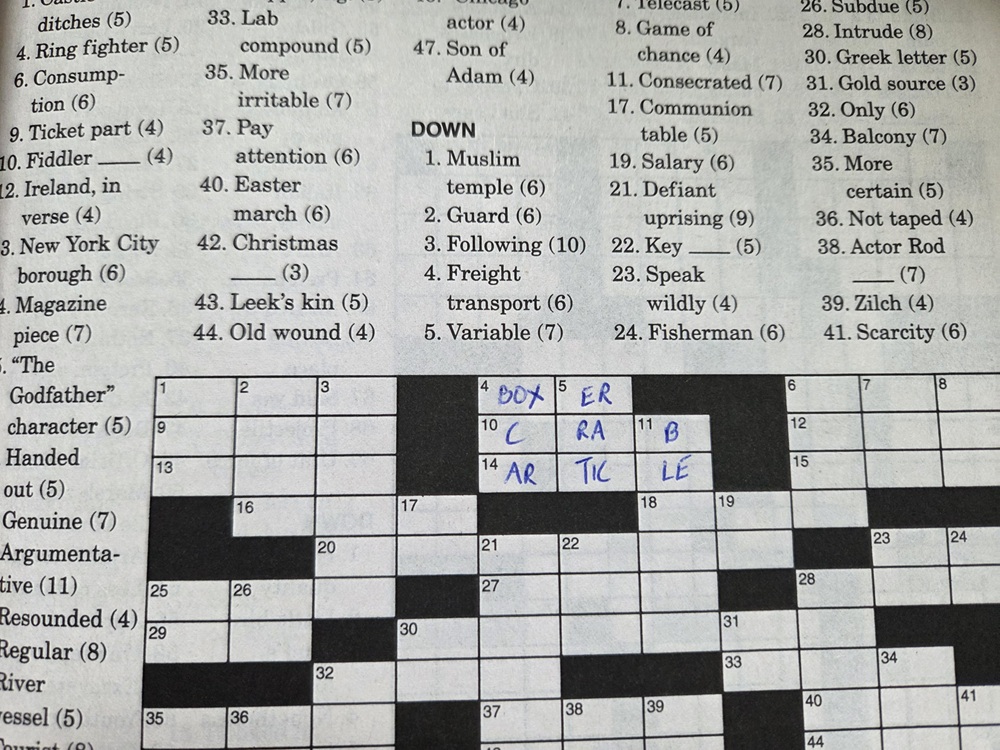
If you’re a fan of rebus-style crosswords — grids where a cell can hold more than one letter, often as part of a tricky gimmick or theme — you should check out Double Trouble crosswords (also known as Crushword puzzles).

Every box in this puzzle contains either 1, 2, or 3 letters, making the crossings extra challenging to work out so that every answer fits.

(There’s even a Diagramless Double Trouble for the truly masochistic solver.)


Sometimes, the variation isn’t in the grid design, it’s in the cluing.

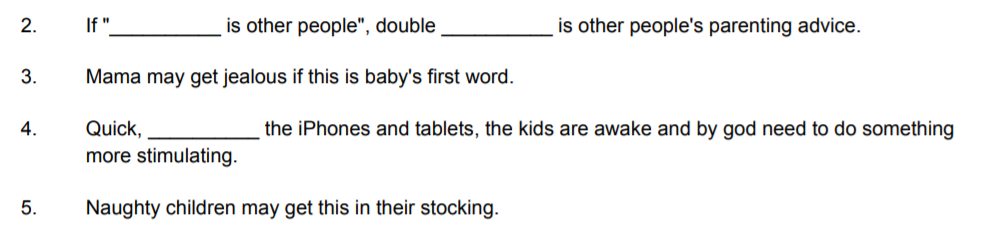
For instance, instead of a traditional crossword clue, a Triple Play puzzle offers three words that form phrases with the intended answer word. For example, the clue SNAIL, BOX, ORDER points to the answer word MAIL (snail mail, mailbox, mail order).

The trios replace some (but not all) of the usual clues, offering a more associative clue to unravel.
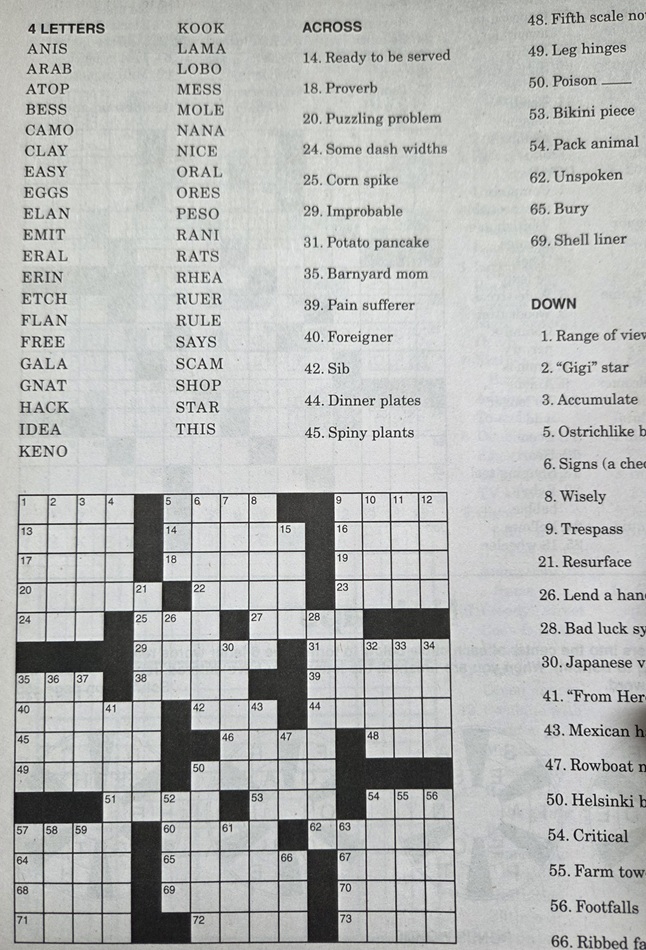
Other times, not every entry gets clued at all. In a Four-Most, every four-letter word in the grid isn’t clued, it’s listed alphabetically in a separate word list instead. So while the clues handle the 3-letter, 5-letter, and entries of other lengths, you have to fit the four-letter words into grid from their crossings.

Similarly, an At 6’s & 7’s crossword does the same, but with all of the six-letter words and all of the seven-letter words removed from the clue list. They still get clued, but alphabetically, not by grid coordinates.
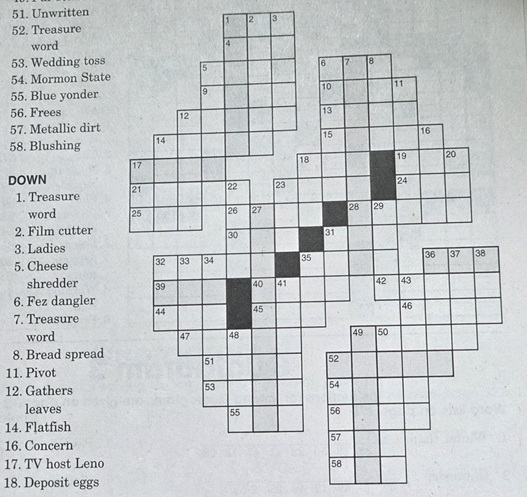
In a Buried Treasure puzzle, the shaded grid entries are related words that fit a particular theme, and they’re only clued in the grid as “Treasure Word.” So you have to fill them in from their crossings and figure out what the Treasure Words have in common.


I’m going to close out today’s post with two of my favorite crossword variants. One is a cluing variant, the other a grid variant.
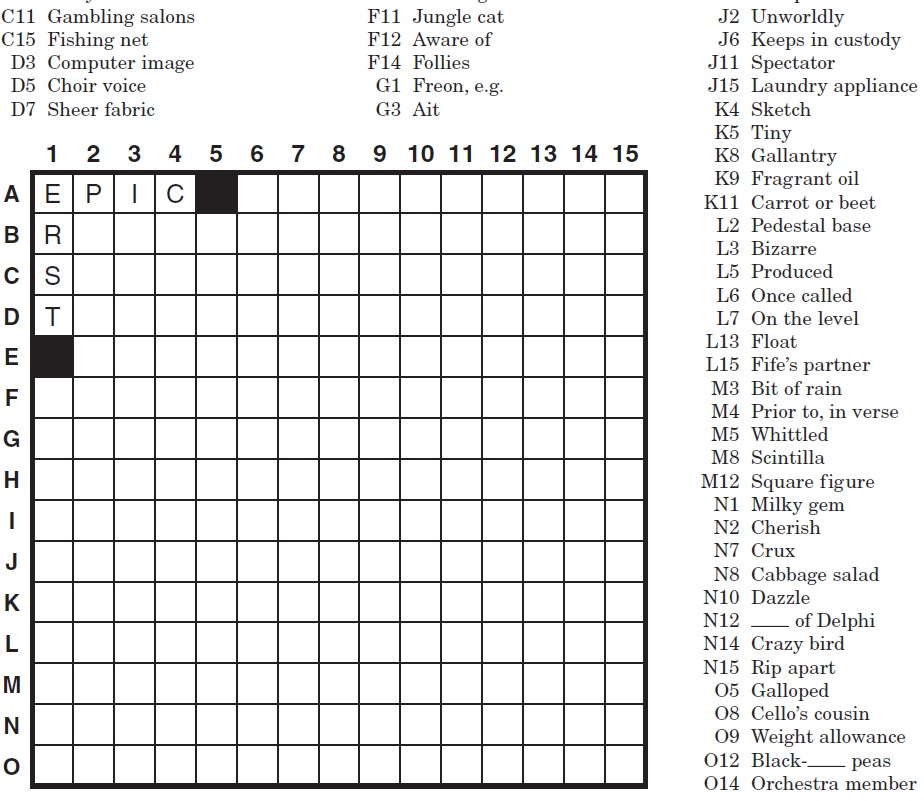
For an additional level of deduction in your crossword solve, there’s Battleships.

In this puzzle, you don’t get the across and down grid coordinates. Instead, you get one Battleship-style coordinate that the word will occupy. You don’t know if the answer word is reading across or down, only that word crosses that coordinate somewhere in the grid.

You get set words to get you started, but it’s still fun to puzzle out exactly how to fit the grid together.
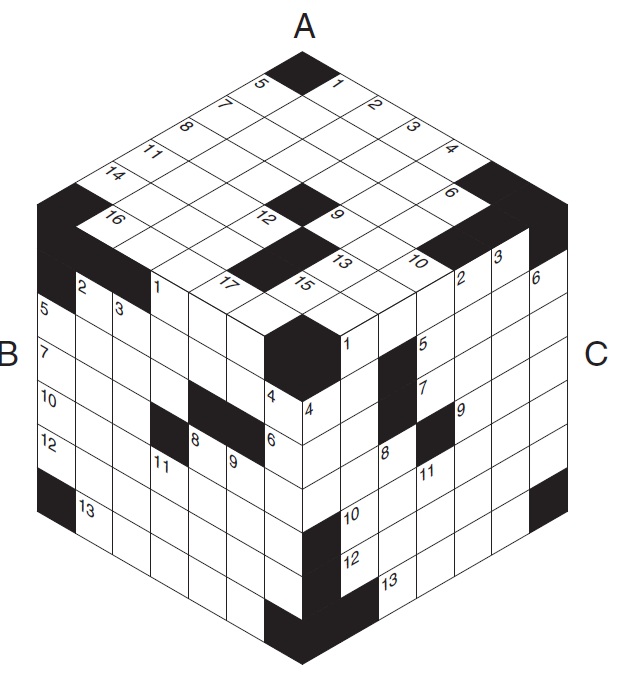
For a nice change of pace visually, there’s Three-D Crossword.

This puzzle offers the same grid three times, side by side by side, like looking at one half of a cube corner first.

It’s genuinely eye-catching and leads to some interesting crossings, allowing for longer entries without all the extra grid fill of a traditional 17x puzzle or larger.

They’re a pleasure to solve and surprisingly fun to construct.


Crosswords have endured in the public eye and in the hearts of puzzlers because of the endless creativity they represent. A clever mind can take a crossword places solvers didn’t expect, challenging and delighting them in equal measure.

It’s one of the many reasons crosswords have stood the test of time, and will continue to do so for years to come.


Are you a traditional crossword solver, a mini/midi enthusiast, a cryptic crossword devotee, or a fan of variety crosswords like the ones above? Did we introduce you to any new favorites? Let us know in the comments section below. We’d love to hear from you!
A PuzzleNation First Look: Setka

Making a new puzzle is challenging. You have to strike a balance between established solving styles (those that are familiar and effective) and innovative twists, mechanics, and variations, all without making the puzzle too convoluted, too tedious, too easy, or too hard.

In the world of crosswords, some variant success stories include Double Trouble, cryptic crosswords, Brick by Brick, and diagramless. With Sudoku, there are variants like Extreme Sudoku (aka X-Sudoku or Diagonal Sudoku), Samurai Sudoku, and Word Sudoku.

I’m always on the lookout for new puzzles and variations to try out, so when the folks behind Setka contacted me, I was more than happy to try out their puzzle brand and explore their signature attempt to combine Sudoku and clued-puzzle elements.

setka1

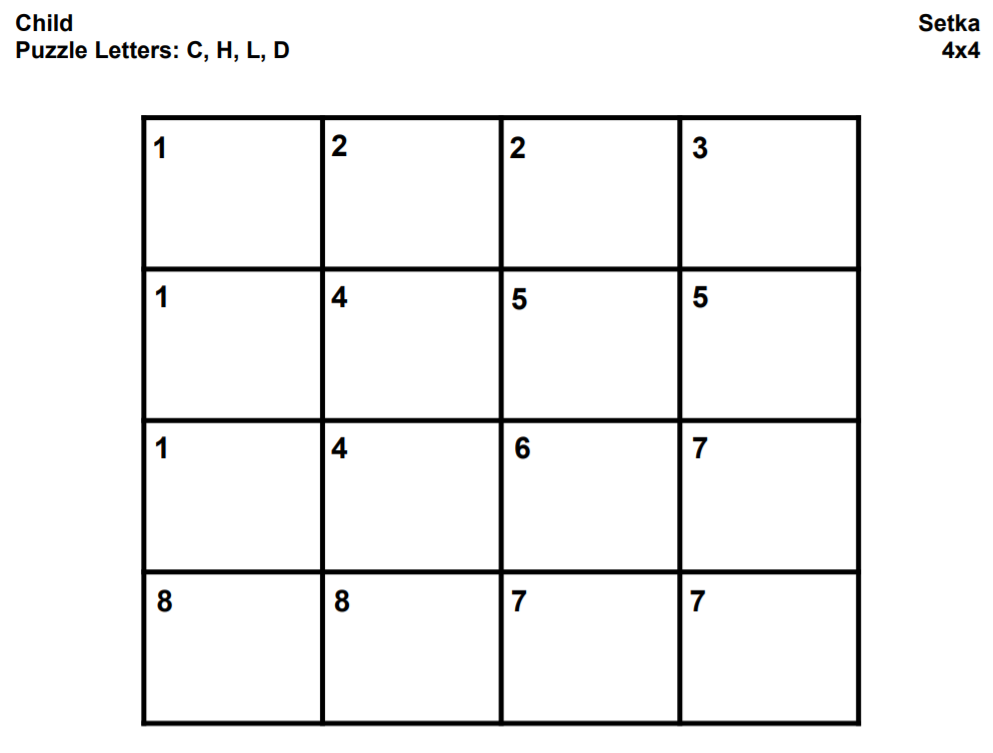
In short, Setka puzzles start with a single word. The consonants of that word not only form the answers to the clues, but also provide the letters to place in the accompanying grid.

For example, if the starting word was INFORM, the key letters would be N, F, R, and M. Every clue answer would feature one or more of those letters. The answer words, like the starting word, ignore the vowels. So you could have answers like NeaR, MoRoN, or MaiNFRaMe. (In the case of duplicate letters, like ReRaN, any duplicates are dropped, so the key letters here would be RN.)

And since there are four letters, there would be an accompanying 4×4 grid for you to fill in, where no letter is repeated in any row or column, Sudoku-style.

To place the letters, the clues are numbered, and the relevant cells in the grid are numbered to match. So, for NeaR (let’s say it’s clue 2), there would be two neighboring cells in the grid with a number 2 in them, and you could place the letters as RN or NR. Words that are three letters or above can read backward, forward, or in an L-shape in the grid.

This mechanic separates Setka from other clued or letter-placement puzzles, because you need both the clue answer AND the Sudoku no-repeats rule in order to complete a grid. Without the clue answers, there can be alternate solves where grid letters swap. And without the Sudoku-style placement, it would be virtually impossible to actually place the answer letters into the grid, because there’s more than one way to do so.

setka2-1

The cluing style alternates between standard crossword-style clues (but usually longer and a little more conversational or trivia-based) and fill-in-the-blank clues. The clues also fit the theme established by the starting word. For instance, the clues above all have to do with kids, which fits the puzzle’s theme word, CHILD.

It takes time to get used to seeking out answer words from the given consonants (since you have to supply any vowels or duplicate consonants missing in order to come up with the correct answer word), but once you’re a few puzzles in, it becomes second nature and a fun component to the solving experience.

Setka puzzles range in size from 4×4 to 7×7, with its signature size being 5×5. Honestly, 5×5 is really where it becomes a proper puzzle. With a 4×4 grid, once you have a few letters placed, it becomes an elementary logic puzzle and you don’t really need the clues.

setka3

[A selection of Setka sizes and themes.]

The puzzle itself is reminiscent of another puzzle we tried late last year — Cluedoku — but Setka’s letter-based theme and smaller grids make for a far more sustainable puzzle going forward, and the mechanic of placing the words in the grid (rather than just individual letters/numbers) adds an intriguing wrinkle to the solve.

All in all, I enjoyed trying out Setka — I solved a half-dozen or so puzzles to get a feel for different sizes and difficulties — and I think they’ve forged an engaging and clever combination of crossword-style cluing and Sudoku-style solving.

You can try Setka for yourself on their website, either playing interactive versions of Setka on the site or printing and solving PDF copies of Setka puzzles. They also offer a subscription where you can receive a Setka puzzle each week along with news and updates.

What do you think of Setka, fellow puzzlers and PuzzleNationers? Let us know in the comments below! We’d love to hear from you.


Thanks for visiting PuzzleNation Blog today! Be sure to sign up for our newsletter to stay up-to-date on everything PuzzleNation!

You can also share your pictures with us on Instagram, friend us on Facebook, check us out on TwitterPinterest, and Tumblr, and explore the always-expanding library of PuzzleNation apps and games on our website!

Come On Down! It’s Prime Time for Puns and Puzzles!

Yes, yes, it’s that time again. It’s hashtag game time!

For years now, we’ve been collaborating on puzzle-themed hashtag games with our pals at Penny Dell Puzzles, and this month’s hook was #PennyDellPuzzleTV, mashing up Penny Dell puzzles with television shows, characters, catchphrases, actors, actresses, hosts, and more!

Examples include: I Love Loose Tile, Will Shortz & Grace, and Match Game of Thrones.

So, without further ado, check out what the puzzlers at PuzzleNation and Penny Dell Puzzles came up with!


Puzzle TV Shows!

The Good Places, Please

Mighty Morphin’ Flower Power

Leave It To Weaver Words

Spinwheel of Fortune / Wheels of Fortune

Father You Know the Odds Best

The Addams Family Ties / Modern Family Ties / Family Ties Matters / All in the Family Ties / All Fours in the Family / Railroad Family Ties

All in the Crypto-Family

Mama’s Crypto-Family

Crypto-Family Feud

Tales From The Crypt-o-grams / Tales from the Crypto-Verses / Tales from the Crypto-Family

Bewitched Way Words

Sabrina the Teenage Which Way Words

My Three of a Kind Sons

Starspell Trek

ALF-abet Soup

Alphabet Talk Soup

Charlie’s Try-Angles

My Two at a Time Dads

Perfect Fit Strangers

Brooklyn Nine-Nine of Diamonds

Take it from St. Elsewhere

The Odds and Evens Couple / You Know the Odds Couple

Guess Who’s the Boss / Who’s Calling the Boss?

Trade-Off Spaces

Home Runs Improvement

Rowan & Martin’s Fill-In

Dr. Fill-In

Doctor Guess Who

Doctor Who’s Calling?

Whose End of the Line is it Anyway?

Scoreboardwalk Empire

Scoremaster of None

Late Night with David Letterboxesman

Tosh.O and Turning

America’s Next Top to Bottom Model

Throwbacks Horseman

3rd Rock from the Sunrays

Everybody Loves Sunrays

It’s Always Sunrays in Philadelphia

Square Deal or No Deal

Spider’s Webster

The White Shadow

Kaku-Rizzoli and Loose T-Isles

Rocky and Bull’s Eye Spiral

Dancing with the Starspell

Nine(teen Kids) of Diamonds (and Counting), Add One, Plus Fours, Seven Up…

American Pickers-Upper

Give and Take Two

These Three’s Company

Trading Off Spaces

Sister, Sister: Double Trouble

Little Puzzler on the Prairie

Battleships Galactica

Smallville Change

Simon & Simon Says

Knight Ride-of-Way-r

The Price Is Right of Way

Happy Daisy

Daisy of Our Lives

Match-Upstairs, Downstairs

Match-Up Game

Say That Again to the Dress

Riddle Me This Is Us

One Day at a Rhyme Time

One Day at a Time Machine

First and Last Comic Standing

Three to One-der Years

Unsolved Mystery Movie (or Person or Melody or State)

Heads & Tails of the Class

McHale’s Na-V Words

Wizard Words of Waverly Place


Puzzle TV Miscellany!

“No Alphabet Soup for You!”

“Heeeeeeerrree…. (and There’s) Johnny!”

Benedict CumberBattleships

Sherlock Holmeruns

The Walking Dead Keep on Moving

Simon Says: Curb Your Enthusiasm

Home Reruns

In Living Colors

“I’ll Be (Here and) There for You”

“Those Were the Daisy”


And members of the PuzzleNation readership also got in on the fun!

On Twitter, the intrepid Screenhog contributed “Tales of the Cryptoquizzes.” Excellent stuff! Keep it coming, Screenhog!


Have you come up with any Penny Dell Puzzle TV entries of your own? Let us know! We’d love to see them!

Thanks for visiting PuzzleNation Blog today! Be sure to sign up for our newsletter to stay up-to-date on everything PuzzleNation!

You can also share your pictures with us on Instagram, friend us on Facebook, check us out on TwitterPinterest, and Tumblr, and explore the always-expanding library of PuzzleNation apps and games on our website!

Other puzzles you might not know! (Volume 1)

We’re all puzzle fans here, right? And sometimes we need something new, something fresh and engaging to rejuvenate our love of puzzles. We know all the classics — crosswords, fill-ins, logic puzzles, word seeks, Sudoku, cryptograms, and anagram puzzles — but there’s a whole wide world of puzzles out there to explore that you might not even know about!

So, in today’s post, I’m going suggest some puzzles to check out, based on each of those classic solving experiences.


Let’s start with crosswords.

From the New York Times and LA Times crossword puzzles to the Penny Dell Crossword App, there’s no shortage of terrific crosswords of all difficulty ranges awaiting solvers.

But there are also some terrific variant crosswords for you to try out, like Double Trouble.

[Click here or on the grid for a larger version, complete with clues.]

In a Double Trouble crossword, you can put one, two, or three letters into a box, making for a more difficult solve that the standard one-letter one-box crossword.

But if you want to go a little farther afield, you can try something like Marching Bands.

[Image courtesy of Brendan Emmett Quigley’s website.]

A Marching Bands puzzle has two sets of clues. The first set clues the rows reading across, with two clues per line. But the second set is where things get interesting. See those alternating rings of light and dark shading? The second set clues words reading clockwise along those rings, or bands.

So instead of words meshing across and down, as in a standard crossword, you have across clues and band clues interacting to help you fill the grid. It’s a wonderful variation on familiar crossword rules, but one challenging enough to keep you interested. (For a more in-depth look, click here!)

But maybe you like crossword cluing but you’d like an answer more interesting than just a grid filled with words. Fair enough, have you ever tried Crostics?

[Click here or on the grid for a larger version.]

Crostics, also known as Anacrostics (from our friends at Dell Magazines) or Acrostics (as made by friend of the blog Cynthia Morris), feature a series of clues and letter blanks to be filled.

Those letter blanks each have coordinates assigned, so that when you fill the correct letters into those blanks, you’re also filling blanks in a grid below to spell out a bonus message, quotation, or anecdote. (It’s a one-to-one ratio, so each letter blank corresponds to a letter blank in the grid. If there’s one J in the message, you’ll find a J in the answer words.)

Although you don’t have the overlapping entries to help you puzzle out answers like crosswords or Marching Bands do, you can use the grid below as a solving aid. As each word in the message emerges, you can fill in those letters in the blanks above (using those same coordinates).

And for something along the same vein, you’ve got Word Games Puzzles.

[Click here or on the grid for a larger version.]

You still get the message reading out in a grid and the letter blank coordinates like in Crostics, but instead of a bunch of crossword-style clues, you instead get four mini-games to solve. One might be trivia or encryption, another might involve some wordplay, another might offer themed clues, and the fourth might be an anagram game.

Each will challenge you in different ways, and the use of repeated letters — a change from Crostics with their one-to-one letter blank to grid letter ratio — gives you more than one chance to fill in the final message.

Hopefully, one or more of these puzzles will pique your interests and offer a welcome new solving experience!


Next week, I’ll have recommendations for fans of Fill-In puzzles, and in future installments, we’ll tackle word seeks, logic puzzles, Sudoku, and more! If you’ve got recommendations for your fellow puzzlers, please let us know in the comments!

Thanks for visiting PuzzleNation Blog today! Be sure to sign up for our newsletter to stay up-to-date on everything PuzzleNation!

You can also share your pictures with us on Instagram, friend us on Facebook, check us out on TwitterPinterest, and Tumblr, and explore the always-expanding library of PuzzleNation apps and games on our website!

A crossword like you’ve never seen before

When someone sends me a link, claiming they’ve uncovered the most difficult crossword they’ve ever seen, I’m usually skeptical.

I mean, I’ve seen some diabolical crosswords in my day. From puzzle 5 at the American Crossword Puzzle Tournament and the meta-puzzles lurking in Matt Gaffney‘s Weekly Crossword Contests to the Diagramless and Double Trouble crosswords offered by our friends at Penny Dell Puzzles, it’s hardly tough to find challenging crosswords these days.

But this puzzle, originally created for the 2013 MIT Mystery Puzzle Hunt and made solvable (and rotatable!) online by Greg Grothaus, might just take the cake:

As you can see, there are clues across three sides of the hexagonal grid: the across clues, the down-to-the-left clues, and the up-to-the-left clues.

But these clues are unlike anything I’ve seen before.

It turns out that these are regexps, or regular expressions, sequences of characters and symbols that represent search commands in computer science.

Now, anyone who has used graphing features in Excel or crossword-solving aids on websites like XWordInfo, Crossword Tracker, or OneLook is probably familiar with simple versions of regexp. For instance, if you search C?S?B?, you’ll probably end up with CASABA as the likely top answer.

Of course, the ones in this puzzle are far more complicated, but the overlapping clues in three directions make this something of a logic puzzle as well, since you’ll be able to disregard certain answers because they won’t fit the other clues (as you do in crosswords with the across and down crossings in the grid).

But if, like me, you don’t know much about reading regexp, well then, you’ve got yourself a grid full of Naticks.

If anyone out there is savvy with regexp, let me know how taxing this puzzle is. Because, for me right now, it’s like doing a crossword in a foreign language.

But I’m not the only one who feels this way. When I first checked out the post on Gizmodo, they titled it “Can You Solve This Beautifully Nerdy Crossword Puzzle?” and I laughed out loud when the very first comment simply read “Nope.”

Glad to see I’m not alone here.


Thanks for visiting PuzzleNation Blog today! Be sure to sign up for our newsletter to stay up-to-date on everything PuzzleNation!

You can also share your pictures with us on Instagram, friend us on Facebook, check us out on TwitterPinterest, and Tumblr, and explore the always-expanding library of PuzzleNation apps and games on our website!