5 Questions for Artist and Game Designer Jennifer Hrabota Lesser

Welcome to 5 Questions, our recurring interview series where we reach out to puzzle constructors, game designers, writers, filmmakers, musicians, artists, and puzzle enthusiasts from all walks of life!

It’s all about exploring the vast and intriguing puzzle community by talking to those who make puzzles and those who enjoy them! (Click here to check out previous editions of 5 Questions!)

And I’m excited to welcome Jennifer Hrabota Lesser as our latest 5 Questions interviewee!

jhl1

Jennifer Hrabota Lesser is an artist. Whether it’s commissioned artwork, passion projects of her own, or design work for board games and video games, she adds a personal touch to every piece she works on.

Initially getting into the game industry as a way to pay off student loans, she has since gone on to build a small board game company, Wild Power Games, with her husband. She also teaches a summer class on game design at the Rhode Island School of Design.

Jennifer was gracious enough to take some time out to talk to us, so without further ado, let’s get to the interview!


5 Questions for Jennifer Hrabota Lesser

1.) How did you first get into puzzles and games?

I’ve always loved puzzles and games. I think that I’ve always found them to be very calming. As a kid, puzzle books were a great way to get through long car rides. (Back in the days before iPhones!) These days, they are a way to unwind and calm down.

I am definitely a gamer, I adore board games and table top games. I also find Sudoku very soothing and meditative.

2.) I had the pleasure of scrolling through the art on your website, and there’s a really wonderful trend of reaching out that seems to suffuse many of your works. People holding each other, or finding themselves enveloped by things like flowers. Is that an intentional theme, either for your site or for your art in general, or just something I pulled from this sampling of your work?

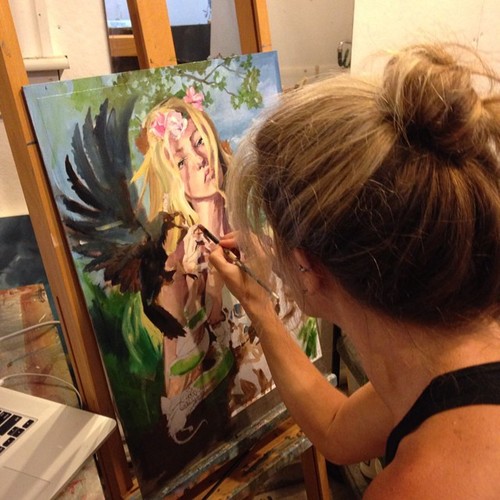
Connection is an ongoing theme in my work, both connection with other people and connection with nature. I try to portray my subjects in transitional moments, where they may be at a point of finding a deeper connection with someone, or they may feel as if something has just been lost — the moments of feeling untethered. I believe understanding our connection with those around us is important to our health and happiness as individuals and as a society.
jhl2

3.) How does your art inform your work in games, and vice versa?

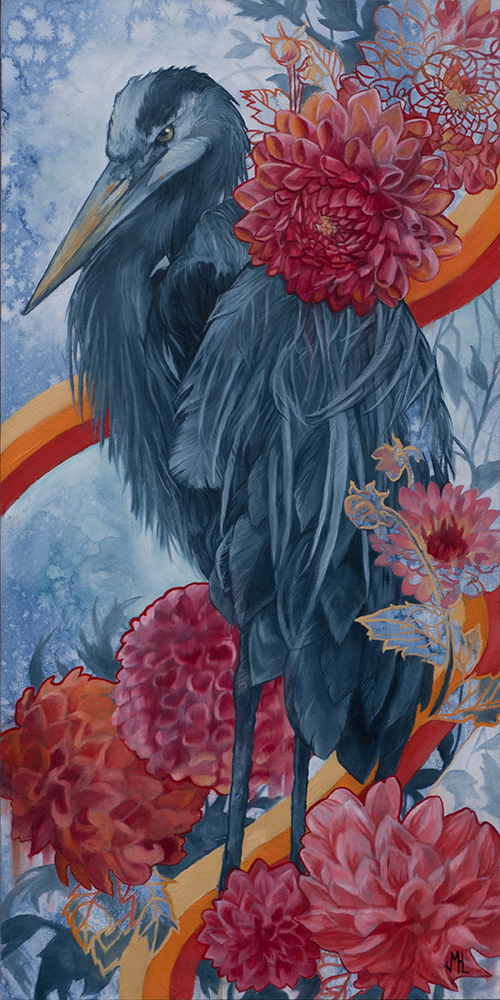
My work is strongly influenced by mythology and fables, and the games I work on are often character-centered. I really enjoy working on games that have a story, and I think the same applies to my artwork. There is often an implied narrative in the work I’m doing.

I often like to portray strong female characters, finding their power. Years ago I got to design some great female characters for Guitar Hero 2, which was a blast because I love playing guitar and women tend to be underrepresented in rock. More recently I was able to design some of my favorite goddesses for our tabletop game High Heavens. I particularly loved painting Nut and Isis from the Egyptian pantheon. Illustrating The Mother of Dragons for a recent Game of Thrones expansion was also pretty great.
heron_jennifer_hrabota_lesser_sm

4.) What’s next for Jennifer Hrabota Lesser?

I am working on a poker deck that will be featuring my artwork, which is going to be an intense undertaking, but one that I am excited about!

5.) If you could give the readers, writers, artists, aspiring game designers, and puzzle fans in the audience one piece of advice, what would it be?

Whatever your creative path is, find time to do it every day. Create when you are inspired, but create when you are uninspired, push through the times when you aren’t feeling it, to get into the habit of working. I love the quote by Pablo Picasso: “Inspiration exists, but it has to find you working.”

We work and work, and sometimes when we least expect it, something amazing happens. It won’t happen if you aren’t doing the work in the first place.


A huge thank you to Jennifer for her time. Be sure to check out her website for the latest updates on all her marvelous endeavors!

Thanks for visiting PuzzleNation Blog today! Be sure to sign up for our newsletter to stay up-to-date on everything PuzzleNation!

You can also share your pictures with us on Instagram, friend us on Facebook, check us out on Twitter, Pinterest, and Tumblr, and explore the always-expanding library of PuzzleNation apps and games on our website!

The Diabolical Long Division Brain Teaser!

From time to time, I’ll receive an email with a brain teaser I’ve never seen before. Sometimes they come from friends, or fellow puzzlers. Other times, PuzzleNationers will ask for my assistance in solving a puzzle that has flummoxed them.

That was the case with today’s puzzle, and I’ll admit, this one was a bit of a doozy to unravel.

longdiv1

Yup, an entire long division problem with only a single digit set. No letters or encryption to let us know which digits were repeated, as there are in Word Math puzzles published by our friends at Penny Dell Puzzles.

Just a 7 and a bunch of asterisks. “Is this doable?” the sender asked.

Yes, this is entirely doable, friend. Let’s break it down step by step.

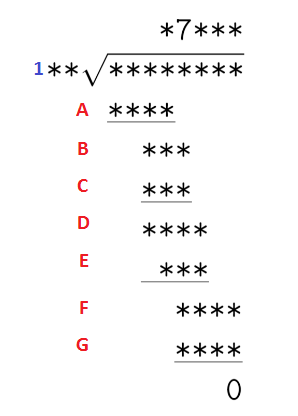
First, we need to know our terminology. The 8-digit number being divided is our dividend. The 3-digit number we’re dividing into it is the divisor. The 5-digit number on top is our quotient.

For the other lines, let’s label them A through G for ease of reference later.

longdiv2

There we go. Now, where do we go from here? We start with what we know.

We know that 7 is the second digit in our quotient.

So our divisor, times 7, equals the number on line C. That’s a 3-digit number, which means the first number in our divisor is 1. Why? Because if it was 2, 2 times 7 would give us 14, which would be a 4-digit number on that line.

longdiv3

That means the quotient is somewhere between 100 and 142. (Why 142? Easy. I divided 1000 by 7, and 142 is the last 3-digit number you can multiply 7 against and still end up with a 3-digit answer for line C. 143 times 7 is 1001, which is too high.)

What else do we know from the puzzle as it stands?

Well, look at lines E and F. We bring both of the last two digits in the dividend down for the final part of the equation. What does that mean?

Remember how long division works. You multiply the divisor by whatever number gets you closest to the given digits of the dividend, subtract the remainder, bring down the next digit from the dividend, and do it all over again until you get your answer.

You multiply the first digit of the quotient times the divisor to get the number on line A. You multiply 7 times the divisor to get the number on line C. You multiply the third digit of the quotient times the divisor to get the number on line E.

Following this route, you would multiply the fourth digit of the quotient against the divisor to get the number on line G. But bringing just one digit down didn’t give us a number high enough to be divided into. Instead of needing more lines (H and I, in this case), we bring the last digit of the dividend down and press onward.

That means the fourth digit of the quotient is 0, because the divisor went into the dividend zero times at that point.

longdiv4

And there’s more we can glean just from the asterisks and what we already know. We know that every one of those 4-digit numbers in the equation begin with the number 1.

How do we know that? Easy. That first number in the divisor. With a 1 there, even if the divisor is 199 and we multiply it times 9, the highest possible answer for any of those 4-digit numbers is 1791.

So let’s fill those numbers in as well:

longdiv5

Now look at lines D, E, and F. There’s nothing below the 1 on line D. The only way that can happen is if the second digit in line D is smaller than the first digit on line E. And on line F, you can see that those first two columns in lines D and E equal zero, since there’s nothing on line F until we hit that third column of digits.

That means the second digit on line D is either a 0 or a 1, and the first digit on line E is a 9. It’s the only way to end up with a blank space there on line F.

longdiv6

I realize there are a lot of asterisks left, but we’re actually very close to knowing our entire quotient by now.

Look at what we know. 7 times the divisor gives us a 3-digit answer on line C. We don’t yet know if that’s the same 3-digit answer on line E, but since it’s being divided into a 4-digit number on line E and only a 3-digit number on line C, that means the third digit in our quotient is either equal to or greater than 7. So, it’s 7 or 8.

Why not 9? Because of the 4-digit answers on lines A and G. Those would have to be higher than the multiplier for lines C and E because they result in 4-digit answers, not 3. So the digit in the first and fifth places in the quotient are higher than the digit in the third. So, if the third digit in the quotient is 7 or 8, the first and fifth are either 8 or 9.

So how do we know whether 7 or 8 is the third digit in the quotient?

Well, if it’s 7, then lines C and E would have the same 3-digit answer, both beginning with 9. But line C cannot have an answer beginning with 9, because line B is also 3 digits. The highest value the first digit in line B could have is 9, and 9 minus 9 is zero. But the number on line D begins with 1, ruling out the idea that the numbers on lines C and E are the same.

That makes the third digit in the quotient 8, and the first and fifth digits in the quotient 9.

longdiv7

We know our quotient now, 97809. What about our divisor?

Well, remember before when we narrowed it down to somewhere between 100 and 142? That’s going to come in handy now.

On line F, we know those first two digits are going to be 141 or below, because whatever our divisor is, it was larger than those three digits. That’s how we ended up with a 0 in our quotient.

So, the number on line D minus the number on line E equals 14 or below. So we need a 900-something number that, when added to a number that’s 14 or below, equals 1000 or more. That gives us a field from 986 to 999.

And that number between 986 and 999 has to be divisible by 8 for our quotient to work. And the only number in that field that fits the bill is 992. 992 divided by 8 gives us 124, which is our divisor.

longdiv8

From that point on, we can fill out the rest of the equation, including our lengthy dividend, 12128316.

longdiv9

And there you have it. With some math skills, some deduction, and some crafty puzzling, we’ve slain yet another brain teaser. Nice work everyone!

[After solving the puzzle, I did a little research, and apparently this one has been making the rounds after being featured in FiveThirtyEight’s recurring Riddler feature, so here’s a link.]


Thanks for visiting PuzzleNation Blog today! Be sure to sign up for our newsletter to stay up-to-date on everything PuzzleNation!

You can also share your pictures with us on Instagram, friend us on Facebook, check us out on Twitter, Pinterest, and Tumblr, and explore the always-expanding library of PuzzleNation apps and games on our website!

Rise of the Machines!

hqdefault5

I don’t mean to alarm you, fellow puzzlers and PuzzleNationers, but the machines may be taking over.

First, there was Deep Blue, defeating Russian chess grandmaster Garry Kasparov under standard chess tournament time constraints.

Then, there was IBM’s supercomputer Watson, sitting at the buzzer on Jeopardy!, besting previous champions Brad Rutter and Ken Jennings to nab a million-dollar prize.

An AI program called Deep Mind can play several Atari games with superhuman proficiency.

These days, you can design robots with LEGOs that are capable of solving Rubik’s Cubes in seconds flat.

And, of course, crossword fans probably know of Dr. Fill, the crossword-solving computer program that competes at the American Crossword Puzzle Tournament each year. In a matter of five years, it has jumped from 141st place in the 2012 tournament to 11th place in the 2017 tournament.

drfill_400x400

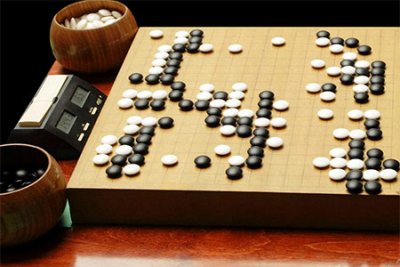
Now, the machines are coming for Go players next. Google has developed an artificial intelligence known as AlphaGo which twice conquered Ke Jie, the 19-year-old Go tournament champion ranked number one in the world.

This strategy board game is played with white and black gamepieces called stones, and the objective is to surround a greater total amount of territory on the game board than your opponent. Along the way, you can surround your opponent’s pieces in order to capture them and remove them from play.

Wikipedia aptly describes the depth and difficulty of the game:

Despite its relatively simple rules, Go is very complex, even more so than chess, and possesses more possibilities than the total number of atoms in the visible universe. Compared to chess, Go has both a larger board with more scope for play and longer games, and, on average, many more alternatives to consider per move.

go-game

People have been playing Go for over 2,500 years, and yet, machines have already surpassed our greatest player.

Science fiction movies have been warning us about this for years. I just never expected them to come after our games and hobbies first.


Thanks for visiting PuzzleNation Blog today! Be sure to sign up for our newsletter to stay up-to-date on everything PuzzleNation!

You can also share your pictures with us on Instagram, friend us on Facebook, check us out on Twitter, Pinterest, and Tumblr, and explore the always-expanding library of PuzzleNation apps and games on our website!
The Indie 500 Crossword Tournament returns tomorrow!

indie5002017

That’s right! Tomorrow, June 3rd, will mark the third annual edition of the tournament, and although registration is closed (because the event is full!), you can still participate from home for only $10! Click here for details!

Not only that, but once again they’ve whipped up a meta-suite of puzzles to boot, and you name your own price for it!

I expect great things from the immensely talented team of constructors and directors they’ve assembled: Tracy Bennett, Erik Agard, Angela Olson Halsted, Andy Kravis, Paolo Pasco, Allegra Kuney, and Neville Fogarty. With a curious time-centric theme, topnotch constructors, and pie (there’s always pie), you can’t go wrong!

You can click here for the Indie 500 home page, and click here for a rundown of last year’s puzzles!

Will you be competing? Or participating from home? Let us know in the comments below!


Thanks for visiting PuzzleNation Blog today! Be sure to sign up for our newsletter to stay up-to-date on everything PuzzleNation!

You can also share your pictures with us on Instagram, friend us on Facebook, check us out on Twitter, Pinterest, and Tumblr, and explore the always-expanding library of PuzzleNation apps and games on our website!

Visual Video Trickery!

illusion1

Visual trickery plays an important role in puzzles. It can be the clever rebus that challenges you to find the words each image represents, or a visual brain teaser that forces you to think outside the box.

But nowhere in the realm of puzzles is visual trickery more obvious or more disconcerting than in optical illusions. Some are simple, like the famous old woman/young woman image above (or this hilarious video version). But others are not only more complex, they’re absolutely mind-bending.

Few optical illusions are as effective as those done on video. Drawings and photos are all well and good, but incorporating movement and performance into the illusion are something else entirely.

And stop-motion animator Kevin Parry has some doozies in his Instagram feed.

Check out this one involving a mirror and a wooded area. I’ve watched it a half-dozen times and I haven’t figured it out yet:

He’s also a dab hand at forced perspective illusions, as he shows in this video with a can of soda:

With innovators like Kevin at work, we will never run short of visual wonders, that’s for sure.


Thanks for visiting PuzzleNation Blog today! Be sure to sign up for our newsletter to stay up-to-date on everything PuzzleNation!

You can also share your pictures with us on Instagram, friend us on Facebook, check us out on Twitter, Pinterest, and Tumblr, and explore the always-expanding library of PuzzleNation apps and games on our website!

The Puzzly Art of Carmina Figurata

We don’t discuss poetry all that often in the blog. To be fair, when it comes to poetry and crosswords, all you really need to know are E’ER, O’ER, ODE, E’EN, and ‘NEATH.

But there is one form of poetry that lends itself quite handily to our favorite field of study, sitting at the crossroads of art, poetry, and puzzles. Today, we’re going to talk about carmina figurata.

carminafig1

[A poem shaped like an altar, a work by Publilius Optatianus Porphyrius.
Image courtesy of Some Grey Matter.]

A carmina figuratum is a poem wherein either the entire body of the poem or select parts form a shape or pattern. Often this shape reflects the subject of the poem.

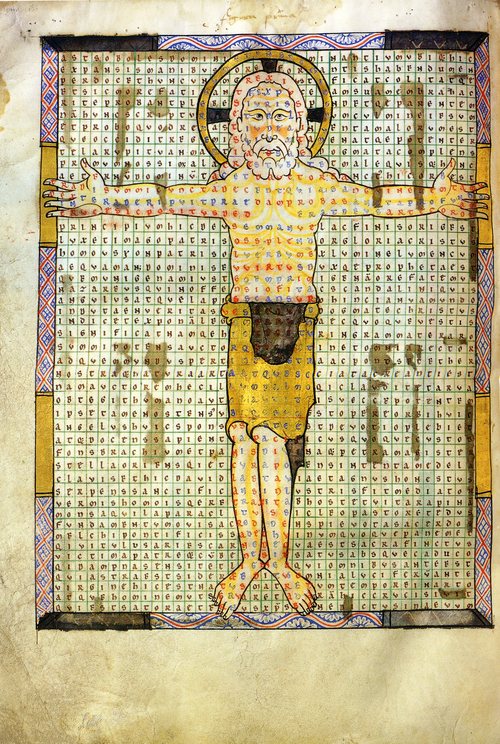
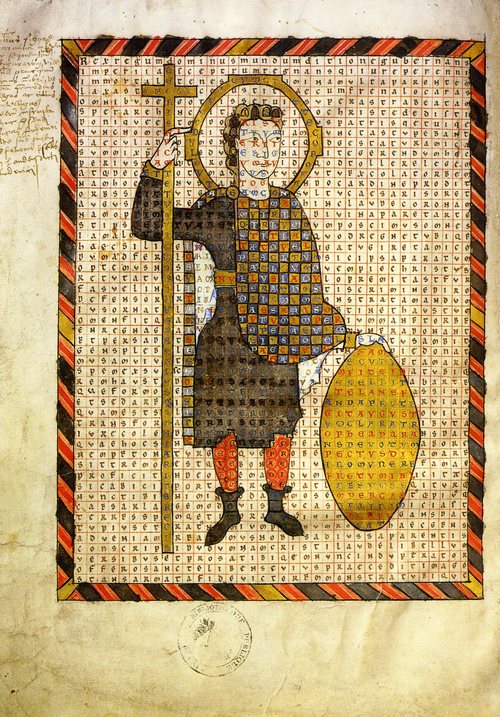
But that’s what the term has come to mean over time, as poetry has evolved and grown. The original carmina figurata were religious-based poems where letters were colored red to stand out from the regular black lettering in order to draw attention to or highlight a certain religious figure.

tumblr_m6a31vnnxo1qggdq1

[“De laudibus sanctae Crucis” by Oliverus.
Image courtesy of WTF Art History.]

For instance, in this image, titled “Praises to the Holy Cross,” you can see “rex,” meaning “king” in red above Christ’s head and “virtu” on his stomach, among other words. Obviously, having the image superimposed over the text helps highlight the words, representing John 1:14, ““And the Word became flesh and made His dwelling among us.”

Quite a bit to unpack in such a small piece.

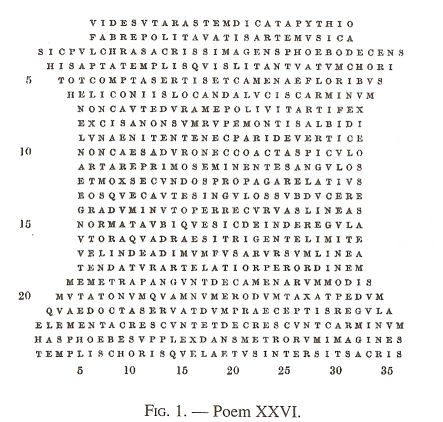
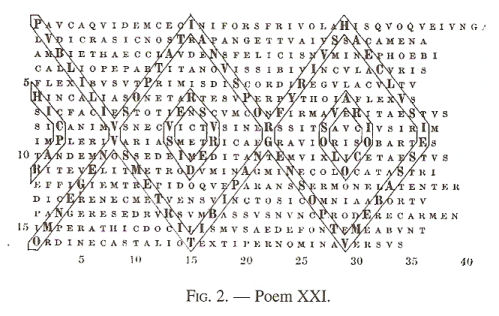
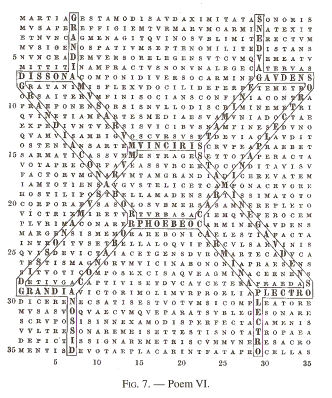
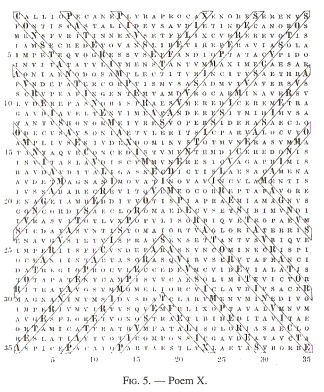
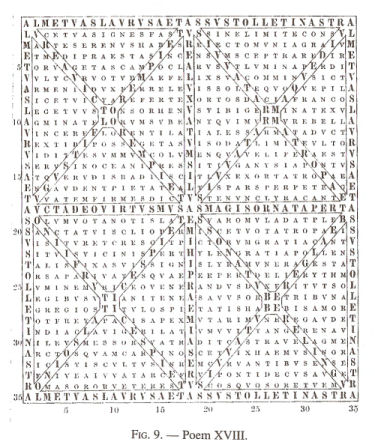
Other carmina figurata have no color or imagery, relying on the cleverness of the reader to uncover the hidden messages within the text. This was particularly true of the poet Publilius Optatianus Porphyrius, who wrote dozens of carmina figurata of increasing complexity.

Some of these hidden messages honored the same rulers the poems were meant to impress. Other messages referenced the date the poem was written or the poet himself. Some even concealed drawings or designs.

carminafig2

carminafig7

carminafig5

carminafig9

[Several of Porphyrius’s most ambitious creations, revealing just how far a reader would have to delve to uncover the hidden messages. Images courtesy of Some Grey Matter.]

From the article on Some Grey Matter:

The poems contain supplementary text ‘hidden’ within the main body of the individual poems and intended to be ‘discovered’ by the reader. These versus intexti poems were apparently intended to dazzle Constantine with their technical virtuosity and thereby inspire the hoped–for recall of their creator…

Now that’s ambition. Imagine you’re constructing a Marching Bands puzzle, with the overlapping lines and loops of text, but all in the hope of courting favor with a major political player. And to do so, you need to hide even more information in the grid. That’s next-level puzzling, to be sure.

Whether you’re moved by the artistry, impressed by the construction, or intrigued by the puzzly challenges they represent, you must admit: carmina figurata are works of puzzle art unlike anything else.

tumblr_m6a3h2cqos1qggdq1


Thanks for visiting PuzzleNation Blog today! Be sure to sign up for our newsletter to stay up-to-date on everything PuzzleNation!

You can also share your pictures with us on Instagram, friend us on Facebook, check us out on Twitter, Pinterest, and Tumblr, and explore the always-expanding library of PuzzleNation apps and games on our website!