Puzzles in Pop Culture: Twin Peaks: The Return

On Tuesday, I concluded a multi-part series about the history of American codebreaking. In a related story, a fellow puzzler pointed out that there might be a new code out there awaiting an enterprising codebreaker.

In a recent episode of the television show Twin Peaks: The Return, there was a brief scene with an airplane flying over a snowy mountain. Sharp-eyed viewers noticed that the plane’s windows seemed to disappear and reappear as it flew.

Naturally, when you have a show that’s all about trying to unravel mysteries and finding deeper meaning in even the most obscure clues, fans leapt onto this possibility and began trying to crack the code of the windows.

There are six windows, and they disappear and reappear numerous times in the brief scene. (There’s also a spot closer to the tail that also appears and disappears.)

[One solver’s breakdown of the plane window pattern.]

Charting out a possible pattern in the windows has led to several intriguing theories. While attempts to translate the pattern into morse code, binary, and other languages have yielded nothing so far, some fans posit that it’s a musical pattern, since one of the characters, FBI agent Gordon Cole, plays a 6-hole flute. (A villain from the original series, Windom Earle, also played a flute.)

While this may simply be a red herring, I suspect there’s more to the window mystery than just providing a distraction in a show littered with distractions.

People have gone so far as to track down the original footage of the plane flying, so they can see what was altered to produce the window pattern:

What do you think, PuzzleNationers? Is there a message or a tune lurking in plain sight on Twin Peaks: The Return? Or is this much ado about nothing?


Thanks for visiting PuzzleNation Blog today! Be sure to sign up for our newsletter to stay up-to-date on everything PuzzleNation!

You can also share your pictures with us on Instagram, friend us on Facebook, check us out on Twitter, Pinterest, and Tumblr, and explore the always-expanding library of PuzzleNation apps and games on our website!

PuzzleNation Product Review: Roller Coaster Challenge

ThinkFun’s products are all about learning through experimentation. Whether you’re making music note-by-note with Compose Yourself, mastering the basics of programming in Robot Turtles, or tackling complete-the-path puzzles with marbles, lasers, robots, or electronic circuits, kids and adults alike get the chance to put their puzzly chops to the test.

Roller Coaster Challenge is the largest, most ambitious ThinkFun puzzle game to date, featuring several dozen pieces and challenge cards galore to test your ability to bend momentum and gravity to your will as you complete unfinished roller coaster tracks!

[With multiple track lengths, posts for building support pylons, 90-degree turns to navigate, and even a loop you can construct, you’ve got all the ingredients you need for a roller coaster worthy of the name.]

The concept is fairly simple. You have challenge cards that offer a starting layout. You’re given the beginning and ending points of the track, and some pieces in between. You are also told which pieces you’ll need to use to bridge the gaps and finish the track. Now it’s up to you to place them correctly and then test your creation with the little red roller coaster car.

Not only is the building plate bigger than those in any previous ThinkFun puzzle game, but the sky is the limit as you build onwards and upwards in order to solve your challenge card and give your little roller coaster car the ride of its life!

The challenge cards serve as the perfect introduction to solving the game’s puzzles, teaching the solver how to identify pieces by length, how to avoid missteps, and even how to get the most out of the available pieces.

But the challenge cards are just the beginning. Roller Coaster Challenge encourages you to develop your own roller coaster layouts, and even share them with the company!

After battling my way through numerous challenge cards of all difficulties — ranked from easy to super hard — I began indulging my creative side by constructing my own layout.

Naturally I had to go above and beyond, trying to weave two tracks together so one would use the loop, and the other would rocket the roller coaster car through the loop and over a gap before reuniting with the track itself.

[OSHA would shut down my roller coaster so fast…]

In terms of scale, creativity, and sheer visual panache, Roller Coaster Challenge is the most ambitious and impressive ThinkFun puzzle game to date. The DIY encouragement built into the solving experience really adds something extra to the enjoyable (and sometimes challenging) layouts provided by the game’s designers.

Roller Coaster Challenge was the result of ThinkFun’s first venture into crowdfunding, and when it came time to go big or go home, they went big, and solvers reap the benefits with this dynamic, fun product.

Roller Coaster Challenge is available through ThinkFun and other vendors for the very affordable price of $29.99.


Thanks for visiting PuzzleNation Blog today! Be sure to sign up for our newsletter to stay up-to-date on everything PuzzleNation!

You can also share your pictures with us on Instagram, friend us on Facebook, check us out on Twitter, Pinterest, and Tumblr, and explore the always-expanding library of PuzzleNation apps and games on our website!

Puzzle History: Codebreaking and the NSA, part 3

[Image courtesy of NSA’s official Twitter account.]

At the end of part 2 in our series, we left off during the early days of the NSA, as American cryptographers continued to labor under the shadow of the Black Friday change in Russian codes.

You may have noticed that part 2 got a little farther from puzzly topics than part 1, and there’s a reason for that. As the NSA evolved and grew, codebreaking was downplayed in favor of data acquisition. The reasons for this were twofold:

1. Context. You need to understand why given encrypted information is important in order to put it toward the best possible use. As Budiansky stated in part 1, “The top translators at Bletchley were intelligence officers first, who sifted myriad pieces to
assemble an insightful whole.”

2. Russian surveillance and bugging continued to grow more clever and sophisticated, pushing attention away from codebreaking. After all, what good is breaking codes or developing new ones if they can just steal unencrypted intel firsthand by monitoring
agents in the field?

Moving forward, the NSA would continue to pursue all manner of data mining, eventually leaving behind much of the codebreaking and analysis that originally formed the backbone of the organization. But that was in years to come. Cryptography was still a major player in NSA operations from the ’50s and onward.

[The progression of “secret” and “top secret” code words.
Image courtesy of NSA’s official Twitter account.]

In May 1956, NSA cryptanalytic veterans pushed a proposal titled “Recommendations for a Full-Scale Attack on the Russian High-Level Systems,” believing that specially designed computers from IBM could provide the key for cracking the impenetrable Russian cryptography wall. Some cryptographers believed that ever-increasing processor speeds would eventually outpace even sophisticated codes.

By 1960, the NSA had spent $100 million on computers and analytical tools.

The problem? The NSA was collecting so much information that their increasingly small team of cryptoanalysts couldn’t dream of processing even a tiny portion of it.

But the quest for data access would only grow more ambitious.

In the wake of Sputnik’s launch in October of 1957, US signals intelligence would go where no man had gone before. The satellite GRAB, launched alongside Transit II-A in June of 1960, was supposedly meant to study cosmic radiation. (GRAB stood for Galactic Radiation and Background.)

[Image courtesy of NSA’s official Twitter account.]

But it was actually intended to collect radar signals from two Soviet air-defense systems. This was the next step of ELINT, electronic intelligence work. (The younger brother of SIGINT.)

The NSA would later find a huge supporter in President Lyndon Johnson, as the president was heavily invested in SIGINT, ELINT, and any other INTs he could access. This did little to quell the intelligence-gathering rivalry growing between the CIA and NSA.

Of course, that’s not to say that the NSA ceased to do any worthwhile work in codebreaking. Far from it, actually.

During the Vietnam War, NSA analysts pored over North Vietnamese signals, trying to uncover how enemy pilots managed to scramble and respond so quickly to many of the US’s airstrikes conducted during Operation Rolling Thunder.

Careful analysis revealed an aberrant character (in Morse code) in messages that appeared in North Vietnamese transmissions before 90 percent of the Rolling Thunder airstrikes. By identifying when the enemy used that aberrant character, the analysts
were able to warn US pilots whether they were heading toward a prepared enemy or an unsuspecting one during a given sortie.

Other NSA teams worked to protect US communications by playing the role of an enemy analyst. They would try to break US message encryptions and see how much they could learn from intercepted US signals. Identifying flaws in their own procedures — as well as members of the military who were cutting corners when it came to secured communications — helped to make US communications more secure.

[Image courtesy of NSA.gov.]

In 1979, Jack Gurin, the NSA’s Chief of Language Research, wrote an article in the NSA’s in-house publication Cryptolog, entitled “Let’s Not Forget Our Cryptologic Mission.” He believed much of the work done at the agency, and many of the people
hired, had strayed from the organization’s core mission.

The continued push for data acquisition over codebreaking analysis in the NSA led to other organizations picking up the slack. The FBI used (and continues to use) codebreakers and forensic accountants when dealing with encrypted logs from criminal organizations covering up money laundering, embezzlement, and other illegal activities.

And groups outside the government also made impressive gains in the field of encryption, among them IBM’s Thomas J. Watson Research Center, the Center for International Security and Arms Control, and even graduate student programs at universities like MIT and Stanford.

For instance, cryptographer Whitfield Diffie developed the concept of the asymmetric cipher. Joichi Ito explains it well in Whiplash:

Unlike any previously known code, asymmetric ciphers do not require the sender and receiver to have the same key. Instead, the sender (Alice) gives her public key to Bob, and Bob uses it to encrypt a message to Alice. She decrypts it using her private key. It no longer matters if Eve (who’s eavesdropping on their conversation) also has Alice’s public key, because the only thing she’ll be able to do with it is encrypt a message that only Alice can read.

This would lead to a team at MIT developing RSA, a technique that implemented Diffie’s asymmetric cipher concept. (It’s worth noting that RSA encryption is still used to this day.)

[Image courtesy of Campus Safety Magazine.com.]

The last big sea change in encryption came when the government and military realized they no longer had a monopoly on codebreaking technology. Increased reliance and awareness of the importance of computer programming, greater access to computers with impressive processing power, and a groundswell of support for privacy from prying government eyes, led to dual arms races: encryption and acquisition.

And this brings us to the modern day. The revelations wrought by Edward Snowden’s leak of NSA information revealed the incredible depth of government data mining and acquistion, leading some pundits to claim that the NSA is “the only part of government that actually listens.”

Whatever your feelings on Snowden’s actions or government surveillance, there is no doubt that the National Security Agency has grown and changed a great deal since the days of cracking the ENIGMA code or working with the crew at Bletchley Park.

Where will American codebreaking go next? Who knows? Perhaps quantum computing will bring codes so complicated they’ll be impenetrable.

All I know is… it’s part of puzzle history.


I hope you enjoyed this multi-part series on the history of 20th-century codebreaking in America. If you’d like to learn more, you can check out some of the valuable sources I consulted while working on these posts:

Code Warriors: NSA’s Codebreakers and the Secret Intelligence War Against the Soviet Union by Stephen Budiansky

Whiplash: How to Survive Our Faster Future by Joichi Ito

The Secret Lives of Codebreakers by Sinclair McKay


Thanks for visiting PuzzleNation Blog today! Be sure to sign up for our newsletter to stay up-to-date on everything PuzzleNation!

You can also share your pictures with us on Instagram, friend us on Facebook, check us out on Twitter, Pinterest, and Tumblr, and explore the always-expanding library of PuzzleNation apps and games on our website!
Puzzle History: Codebreaking and the NSA, part 2

[Image courtesy of NSA’s official Twitter account.]

At the end of part 1 of our look at the history of the NSA and American codebreaking, we left off with the pivotal Black Friday event.

On November 1, 1948, all intel coming from monitored Soviet signals went quiet. All traffic on military, naval, and police radio links was replaced with dummy messages. It was such an unprecedented and alarming event that London and Washington briefly considered that it might’ve been the first indication of preparations for war.

According to Code Warriors author Stephen Budiansky:

The full extent of the disaster only became apparent the following spring when real traffic started reappearing on the radio nets, now employing greatly improved — and completely unbreakable — technical and security procedures. The keying errors or other mistakes that had allowed most of the Soviets’ machine-enciphered military traffic to be routinely read by US and British codebreakers for the last several years had been corrected, and the much more disciplined systems that now replaced them slammed the cryptanalytic door shut.

Even the one-time pads that had offered some hope to attentive American codebreakers were updated, eliminating the ability to sort messages by which organization they originated from.

Codemakers had suddenly outpaced codebreakers.

[The Kryptos sculpture outside CIA Headquarters. The NSA cracked
several of its codes before the CIA did. Image courtesy of Slate.com.]

The Office of Naval Intelligence wanted to take over from Signals Intelligence (SIGINT), demanding to see “everything” so they could do the job. They claimed SIGINT should limit their work to message translation, leaving interpretation to “the real experts.” This sort of territorial gamesmanship would continue to hamper government organizations for decades to come.

And that demand to see everything? That probably sounds familiar, in light of the revelations about government data collection and the PRISM program that were revealed in Edward Snowden’s leaks.

Black Friday was the start of all that, a shift from codecracking to the massive data collection and sifting operation that characterized the NSA for decades to come.

More amazingly, there was SO MUCH information collected during World War II that SIGINT was still poring over it all in 1949, decrypting what they could to reveal Soviet agents in the U.S. and England.

The fact that a high-ranking member of British Intelligence at the time, Kim Philby, was actually a Soviet double agent complicated things. After a decade under suspicion, Philby would flee to the Soviet Union in 1963, stunning many friends and colleagues who had believed in his innocence.

[The spy and defector, honored with a Soviet stamp.
Image courtesy of Britannica.com.]

Although the Russians had flummoxed SIGINT, other countries weren’t so lucky. The East German police continued to use ENIGMA codes as late as 1956. Many of the early successes in the Korean War were tied to important decryption and analysis work by SIGINT. Those successes slowed in July of 1951, when North Korea began mimicking Russia’s radio procedures, making it much harder to gain access to North Korean intel.

Finally, the chaotic scramble for control over signal-based data gathering and codebreaking between the government and the military resulted in the birth of the National Security Agency on November 4, 1952, by order of President Truman.

One of the first things the NSA did? Reclassify all sorts of material involving historical codebreaking, including books and papers dating back to the Civil War and even the American Revolution.

[The actual report that recommended the creation of the NSA.
Image courtesy of NSA’s official Twitter account.]

The creation of the NSA had finally, for a time at least, settled the issue of who was running the codebreaking and signals intelligence operation for the United States. And they were doing fine work refining the art of encryption, thanks to the work of minds like mathematician and cryptographer Claude Shannon.

One of Shannon’s insights was the inherent redundancy that is built into written language. Think of the rules of spelling, of syntax, of logical sentence progression. Those rules define the ways that letters are combined to form words (and those words form sentences, and those sentences form paragraphs, and so on).

The result? Well, if you know the end goal of the encoded string of characters is a functioning sentence in a given language, that helps narrow down the amount of possible information contained in that string. For instance, a pair of characters can’t be ANYTHING, because letter combinations like TD, ED, LY, OU, and ING are common, while combos like XR, QA, and BG are rare or impossible.

By programming codecracking computers to recognize some of these rules, analysts were developing the next generation of codebreakers.

Unfortunately, the Russian line was holding. The NSA’s failure to read much, if any, Soviet encrypted traffic since Black Friday was obviously becoming more than just a temporary setback.

Something fundamental had changed in the nature of the Russian cryptographic systems, and in the eyes of some scientific experts called in to assess the situation, the NSA had failed to keep up with the times.


I hope you’re enjoying this look at the early days of America’s 20th-century codebreaking efforts. Part 3 will continue next week, with the sea change from active codebreaking to data mining, plus Vietnam, the space race, and more!


Thanks for visiting PuzzleNation Blog today! Be sure to sign up for our newsletter to stay up-to-date on everything PuzzleNation!

You can also share your pictures with us on Instagram, friend us on Facebook, check us out on Twitter, Pinterest, and Tumblr, and explore the always-expanding library of PuzzleNation apps and games on our website!
Codecrafting with Crosswords!

We’ve discussed ciphers and codecracking numerous times in the past, and rightly so. It’s a style of puzzling that has literally affected the outcomes of battles, helped shape key historical moments, and changed the face of spycraft.

And it’s a puzzle form that continues to evolve to this day. We’ve moved far beyond the simple one-to-one replacement encryptions of your standard newspaper cryptogram, and intrepid solvers are always looking for newer and more devious ways to conceal their messages.

Tumblr user Cipherface has cooked up a pretty ingenious system that actually uses another style of puzzling in its execution: crosswords.

tumblr_nfh6mgvdtf1t4n39mo1_540

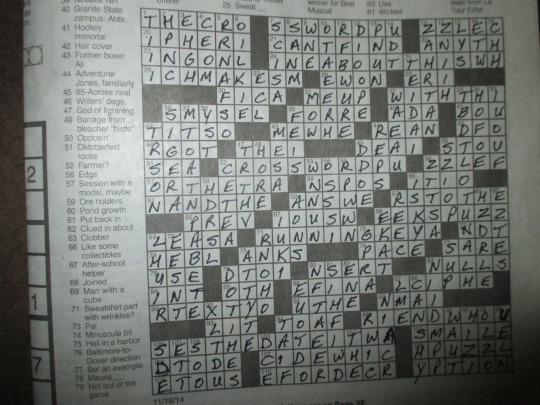
Here’s how it works. You write your message out in the open spaces of the crossword, ignoring the black squares.

tumblr_nfh6mgvdtf1t4n39mo2_r1_1280

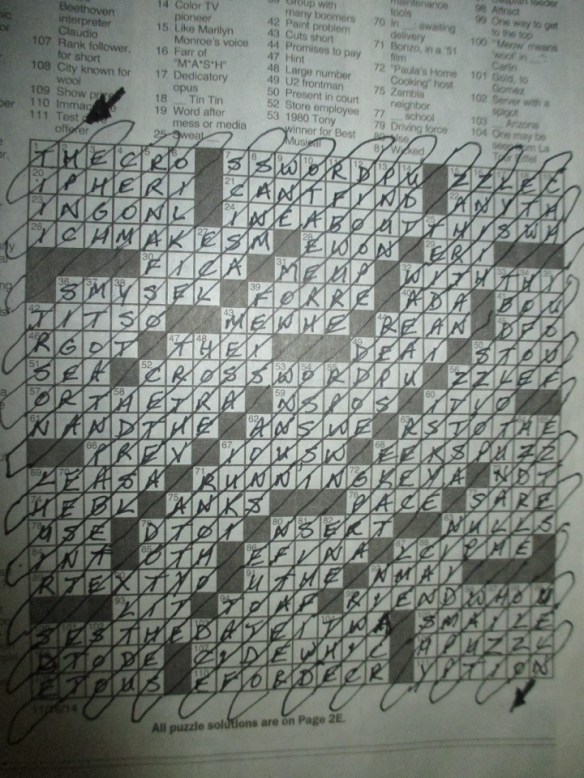
Then, map out this diagonal path as the first step to encrypting your message.

tumblr_nfh6mgvdtf1t4n39mo4_r1_1280

Do the same with the puzzle’s answer key, and you’ve got your running key, the text used to substitute letters for the letters in your actual message.

table2

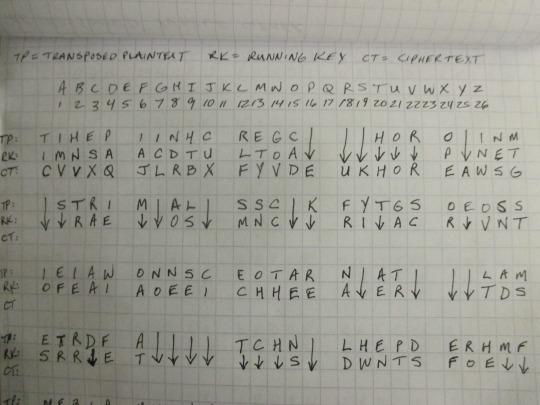
Then you run your message through the tabula recta, a table where you use the letter you want revealed and the letter in your running key to pick the letter in your encryption.

tumblr_nfh6mgvdtf1t4n39mo5_r1_540

Here, we can see Cipherface mapping out the encrypted message using this method.

From the Tumblr writeup:

The idea is to use a crossword puzzle for the transposition and the answers to the previous weeks puzzle as a running key. And the blank spaces are used to insert nulls into the final ciphertext. You then mail it to a friend who uses the date it was mailed to decide which puzzle to use for decryption.

It’s a pretty clever way to leave your encryption key in plain sight, and yet keep your messages secret. The running key keeps changing, so it’s more effective than traditional running keys, which stayed the same for longer periods of time.

Not to mention, using the puzzle’s publishing date? What a quick and easy way to keep your friend informed in an innocuous way. You’d just need to decide ahead of time which newspaper to use.

And it figures. The best way to make a puzzle better? Add another puzzle.


Thanks for visiting PuzzleNation Blog today! Be sure to sign up for our newsletter to stay up-to-date on everything PuzzleNation!

You can also share your pictures with us on Instagram, friend us on Facebook, check us out on Twitter, Pinterest, and Tumblr, and explore the always-expanding library of PuzzleNation apps and games on our website!

Pun in the Sun! It’s a Summer Wordplay Party!

Oh yes, it’s that time again! It’s to unleash our puzzly and punny imaginations and engage in a bit of sparkling wordplay!

summerpuzzles

You may be familiar with the board game Schmovie, hashtag games on Twitter, or @midnight’s Hashtag Wars segment on Comedy Central.

For years now, we’ve been collaborating on puzzle-themed hashtag games with our pals at Penny Dell Puzzles, and this month’s hook was #PennyDellSummerPuzzles, mashing up Penny Dell puzzles and vacations, the summer months, surf movies, camp, activities… anything and everything you associate with summer!

Examples include Summer Triangles, Beach Blanket Bingo, or Suntan-glewords!

So, without further ado, check out what the puzzlers at PuzzleNation and Penny Dell Puzzles came up with!


Summertime, and the Living is Easy Sudoku

School’s Out of Place for Summer

Camp Tanglewood

Which Way to San Jose Words

Summer lovin’, had me a blips

You’re invited to a neighborhood block party; come at 6’s and 7’s

Cancellations my reservation

Summerdoku

Picknic and Choose

Hopscotch the globe

Middle of the Road Warrior

Sisterhood of the Traveling Spanners

Grand Tourist Trap

The End-of-the-Line-less Summer

Rods & Wheels

Word Maze Runner

Kakuro Vs. the Volcano

A Perfect Hang Ten

Annetagrams Funicello

Fiddler’s Crab Frame

Surfs-Up and Downs

Ups and Dunes

Sun’rays’ burn

Junebox Jumble

Abagust

I Know What You Did First and Last Summer / Insiders Know What You Did Last Summer

Catalina Caperfect Fit

Bit Sand Pieces

Bricks Sand Mortar / Bricks and S’mortar

Surfin’-sert-a-Bird

Take a Letter from Camp

Point the Way Home


There were a few submissions that deserve their own section, as several of our intrepid puzzlers went above and beyond.

-Glossing and Burning in Extreme Sundoku

-Exchange Boardwalks featuring Ice Cream Dots and Dashes

-Have a nice cool “coco nutty crossword” smoothy!

-“Rapid Reader Encounters Bookworms on Word Trails; You Can Take It From There”

And one solver took it to an entirely unexpected rhyming level:

Kellermans we come together, Simon Says as one
We have Shared-a-Letter seasons Takeout, Piggybacks, and fun.
Summer days will soon be Odds & Evens, soonly Autumn starts
And tonight our Mixmaster whispers softly in our Heads & Tails.


Have you come up with any Penny Dell Summer Puzzles entries of your own? Let us know! We’d love to see them!

Thanks for visiting PuzzleNation Blog today! Be sure to sign up for our newsletter to stay up-to-date on everything PuzzleNation!

You can also share your pictures with us on Instagram, friend us on Facebook, check us out on Twitter, Pinterest, and Tumblr, and explore the always-expanding library of PuzzleNation apps and games on our website!