The Weird, Wonderful World of Dice

[Image courtesy of ThoughtCo.]

Dice have been an integral part of gaming for centuries. They’re the simplest way to introduce randomness to a game.

The six-sided die is, by leaps and bounds, the most familiar die. The d6, as role-players call it, is a staple of classic board games like Yahtzee and Clue, as well as the centerpiece of role-playing systems like GURPS.

But the d6 is hardly the only kind of die you see in gaming. Plenty of games and role-playing systems rely on dice of other shapes in order to run smoothly.
[Image courtesy of Wikimedia.]

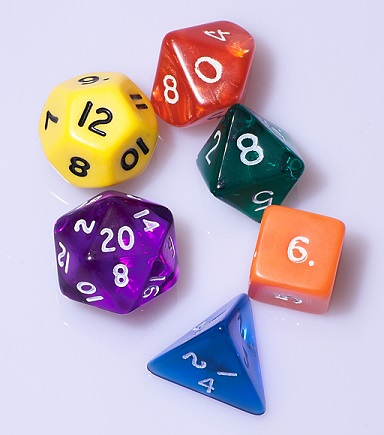
If you play World of Darkness role-playing games like Werewolf or Vampire: The Masquerade, then the d10 is your friend. If you enjoy updated editions of Dungeons & Dragons (or even board games like Unspeakable Words or Scattergories), the d20 is a familiar sight, whether it has letters or numbers on it.

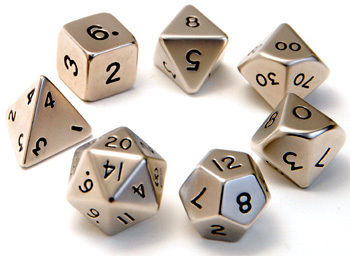
A standard dice set for beginners Dungeons & Dragons contains six different dice shapes: a pyramid-shaped d4, a d6, a d8, a d10, a d12, and a d20. (Many come with 2 d10s, one with single digits and one with double digits, allowing you to calculate percentages).
[Image courtesy of Instructables.]

Heck, if you think about it, flipping a coin to decide something is simply rolling a two-sided die.

But when you start delving into the history of games, it’s amazing to see just how far back some of these traditions and conventions go.
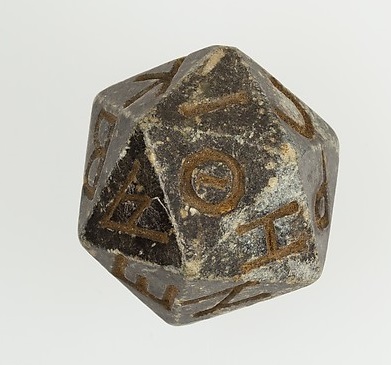
Did you know that The Metropolitan Museum of Art has a d20 in its collection?

Dating back to Roman times (somewhere between the 2nd century BC and the 4th century AD), the above die is inscribed with Greek letters. It’s not certain if this particular die was used for games or religious divination, but there’s no doubt it’s a beautiful example of craftsmanship.

And this is just scraping the surface. One of my favorite dice in my collection is an oversized 3D-printed d20 with Braille markings for every number. Such a cool piece.

Can you think of any strange dice in favorite games of yours, fellow puzzlers? We’d love to hear about them! (Unless they’re fuzzy dice hanging from your rearview mirror. Those don’t make reliable rolls in regular gameplay.)


Thanks for visiting PuzzleNation Blog today! Be sure to sign up for our newsletter to stay up-to-date on everything PuzzleNation!

You can also share your pictures with us on Instagram, friend us on Facebook, check us out on TwitterPinterest, and Tumblr, and explore the always-expanding library of PuzzleNation apps and games on our website!

PuzzleNation Product Review: Zendo

[Note: I received a free copy of this game in exchange for a fair, unbiased review. Due diligence, full disclosure, and all that.]

Experienced puzzlers are familiar with deduction as a puzzle-solving method. They may know it from solving logic puzzles, determining who brought what to Thanksgiving dinner. They may know it from asking questions in Clue in order to eliminate possibilities and figure out who killed Mr. Boddy, where, and how. They may know it from brain teasers, riddles, puzzles, or card games.

But they’ve probably never tried their hand at a deduction puzzle game quite like Zendo.

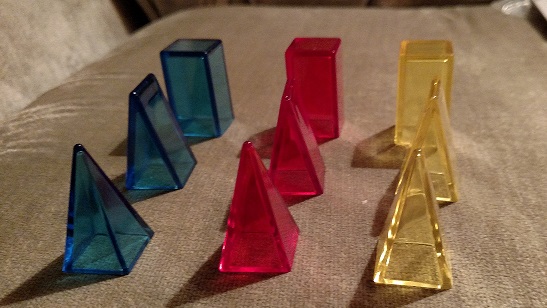
In Zendo, the players pull pieces from a communal pile in order to build different structures, using pyramids, wedges, and blocks. One player, the moderator, chooses a secret rule for the players to uncover, and builds two structures. One of these structures follows the secret rule, and one does not, and both are marked as such.

Secret rules can be as simple as “must contain all three shapes” or “must contain exactly four pieces.” They can be as complex as “must contain more blue pieces than blocks” or “must contain at least one yellow piece pointing at a blue piece.” Some rules involve how pieces touch, or how they’re stacked, while others demand no touching or stacking whatsoever. The field is wide open at the start of the game.

Players then try to deduce the secret rule by building structures themselves, arranging pieces from the communal pile into various patterns and asking the moderator for more information.

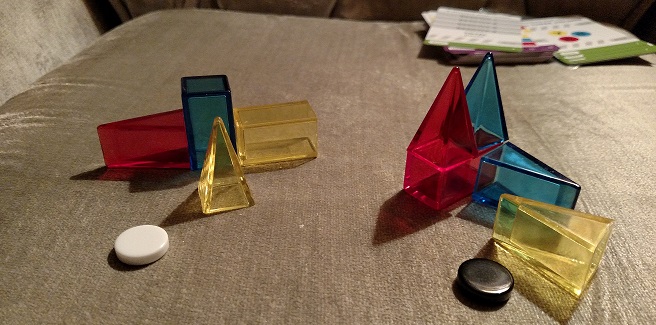
[Can you tell what the rule is by looking at these two structures?]

They can do so in one of two ways. The first is by saying “Tell,” wherein the moderator marks the player’s structure with either a white token or black token, depending on whether the structure fits the secret rule.

The second is by saying “Quiz,” wherein every player guesses whether the given player’s structure fits the rule. Every player who guesses right gets a guessing token.

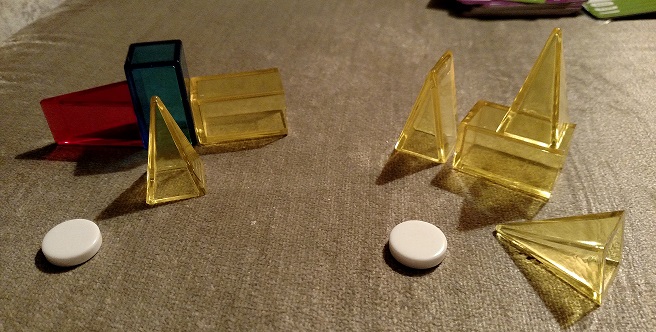
Guessing tokens, as you might suspect, are spent to guess the secret rule. But the moderator doesn’t answer with a simple yes or no. The moderator instead must build a new structure, which will either fit the secret rule (but not the player’s guess, and get marked with a white token) or fits the player’s guess (but not the secret rule, and gets marked with a black token).

This back-and-forth between players can be frustrating or informative, depending on how specifically you frame your guesses. It also tests the creative mettle of your moderator, which adds a curious wrinkle to the game. Not only are you competing with your fellow players to figure out the secret rule, but you have to deal with the often crafty skills of the moderator.

[Does this second sculpture give you any hints?]

It’s an ever-evolving puzzle that can change in an instant with a new bit of information. You might confirm you’re on the right track, or realize you’ve been looking at the structures incorrectly all along, and you’re back to square one (or, you know, pyramid one or wedge one).

But thankfully, Zendo is easily scalable for solvers of any age or solving skill level. You can keep the secret rule simple or make it complex, depending on who is playing. And if you’re the moderator, you have a free hand in determining how much information your structures reveal.

Like Fluxx and other games under the Looney Labs umbrella, Zendo has tons of replay value, and it’s a puzzle-game that ages well, since solvers with more experience are not only better players, but more devious moderators as well. This is some seriously puzzly fun.

Zendo is available from the crafty crew at Looney Labs, and it’s also featured in this year’s Holiday Puzzly Gift Guide!


Thanks for visiting PuzzleNation Blog today! Be sure to sign up for our newsletter to stay up-to-date on everything PuzzleNation!

You can also share your pictures with us on Instagram, friend us on Facebook, check us out on TwitterPinterest, and Tumblr, and explore the always-expanding library of PuzzleNation apps and games on our website!
Meet the Daily POP Crosswords Constructors: Angela Halsted

One of the Daily POP Crosswords app’s best features is the level of involvement from topnotch constructors. We’ve assembled one heck of a team when it comes to creating terrific, exciting, fresh themed crosswords.

And over the next few weeks, we’ll be introducing you to some of them. Some names you may know, some you may not, but they’re all doing amazing work on these puzzles and deserve a little time in the limelight.

In this installment, allow us to introduce you to constructor Angela Halsted!

How did you get started in crosswords?

I solved crosswords off and on when I was a kid but it wasn’t until 2006 that I got obsessed with them. I don’t even remember what puzzle I was doing, but I was Googling for an answer and came upon the Rex Parker blog. I loved the blog and I loved all the commentary, and that made me want to solve puzzles every day so I could participate.

The first time I decided to comment on the blog, I was required to have a username. I wasn’t very creative and I just felt like I was in a hurry to share my thoughts, so I typed in “PuzzleGirl.” Pretty boring. But it’s stuck all these years!

I submitted my first puzzle to The New York Times in December 2008. It was… terrible. But I knew it was something I could be good at if I kept trying. My first published puzzle was a collaboration with Michael Sharp in The Los Angeles Times in January 2011. Since then, I have had puzzles published in The New York Times, The Washington Post, The AV Club, The Wall Street Journal, and other venues. Most of those are collaborations with Doug Peterson, though I’ve also collaborated with Jeff Chen and Erik Agard.

The part I have the most trouble with when constructing is coming up with the theme. I think that’s why I collaborate so much. For me, it’s a lot easier (and more fun) to brainstorm and hone a theme with a partner.

What do you enjoy about working on Daily POP Crosswords?

Oh, speaking of themes, one reason I like writing puzzles for Daily POP Crosswords so much is that the themes can be very simple, which I can handle! Also, I feel like I’m getting a lot of practice generating themes so maybe I’ll get better at it with puzzles for other venues too.

But the best thing about writing for Daily POP Crosswords is working with Patti Varol. She is a phenomenal editor. She is so smart, so efficient, and so motivated. I have a blast talking with her about puzzles and I’m learning a LOT from her.

I also really love being a part of this project because the puzzles are accessible to new solvers. That’s who these puzzles target and I hope they appeal to people who might be really interested in trying crosswords but are intimidated by harder puzzles.

When I had my first Friday themeless published in The New York Times earlier this year, I couldn’t really distribute it to my co-workers, you know? It was hard and probably would have just made them feel bad about themselves. But I’m constantly telling people about Daily POP Crosswords because I know the puzzles are accessible to new solvers and there’s a possibility they’ll get hooked!

I guess the last thing I want to mention is that Patti has assembled a great group of constructors that includes many women. She is also very open to themes about women. And I like that because crossword publishing and construction are generally male-dominated.

Now, don’t get me wrong. Some of my best friends are male crossword constructors. But it’s nice to see someone branching out a little. I hope Daily POP Crosswords will inspire women solvers to take up constructing. That would be amazing.


A huge thank you to Angela for her time! Be sure to keep your eyes peeled for her puzzles in the Daily POP Crosswords app, free to download for both iOS and Android users!

Thanks for visiting PuzzleNation Blog today! Be sure to sign up for our newsletter to stay up-to-date on everything PuzzleNation!

You can also share your pictures with us on Instagram, friend us on Facebook, check us out on TwitterPinterest, and Tumblr, and explore the always-expanding library of PuzzleNation apps and games on our website!
Answers to our Thanksgiving Logic Puzzle!

It’s been a week since Thanksgiving, so it’s about time we gave you the answer to our Turkey Day logic puzzle!

In case you missed it, here’s the puzzle:

Connor, Emma, Russell, and Taylor are celebrating Thanksgiving together. To save money, each of them is bringing a different side dish (cranberry sauce, green beans, mashed potatoes, or yams). Each of them is also bringing a different dessert (apple pie, chocolate cream pie, pumpkin pie, or sugar cookies). With the help of the clues below, can you puzzle out who brought which side dish and which dessert?

1. Emma didn’t bring the green beans, but she did bring pumpkin pie.
2. Connor brought the cranberry sauce, but he didn’t bring chocolate cream pie or apple pie.
3. The person who brought the yams also brought the chocolate cream pie.
4. Taylor brought the green beans.


Okay, last chance to solve it before we give you the solution!

Here we go!


Now, this isn’t as difficult as some of the diabolical brain teasers we’ve tackled in the past, but for someone new to logic puzzles and deduction, a puzzle like this can be daunting.

The key to logic puzzles is to organize your information in a simple and efficient way, so that you maximize the amount of information you glean from each clue.

So let’s list out our four holiday guests and all of the possible food options.

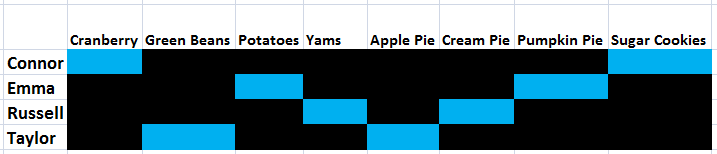
Now, let’s proceed through the clues and fill in our chart.

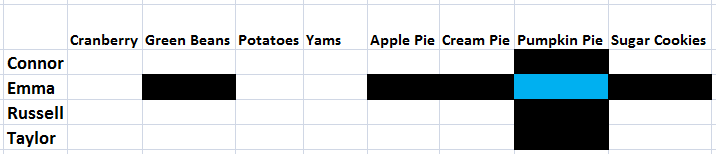
1. Emma didn’t bring the green beans, but she did bring pumpkin pie.

Since we know nobody brought the same dessert as Emma, we can black out pumpkin pie for everyone else, as well as blacking out the other dessert options for Emma, since each person only brought one dessert.

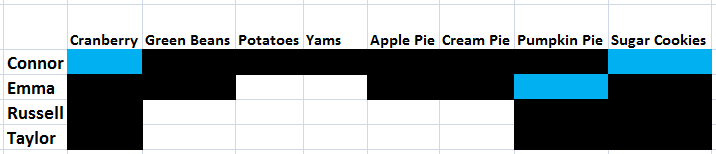
2. Connor brought the cranberry sauce, but he didn’t bring chocolate cream pie or apple pie.

When you add Connor’s info to Emma’s, you not only get his side dish and his dessert, since he didn’t bring chocolate cream pie, apple pie, or Emma’s pumpkin pie.

3. The person who brought the yams also brought the chocolate cream pie.

At first, this clue doesn’t seem to tell us much, because we don’t know who brought the yams or the chocolate cream pie. But we do know that Emma didn’t bring the chocolate cream pie, so she didn’t bring the yams either.

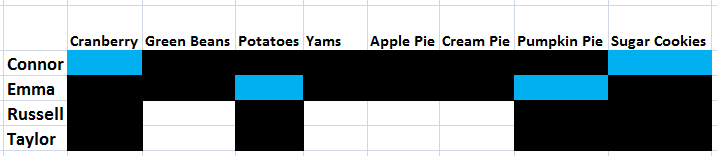
And if she didn’t bring the yams, the green beans, or Connor’s cranberry sauce, by process of elimination, she brought the mashed potatoes.

4. Taylor brought the green beans.

This last clue ties it all together. If Taylor brought the green beans, then Russell had to bring the yams. And since the person who brought the yams brought the chocolate cream pie, we know that was Russell as well, and Taylor brought the apple pie by default.

And there you have it. All that info in four simple clues.

We hope you enjoyed our little Thanksgiving logic puzzler!


Thanks for visiting PuzzleNation Blog today! Be sure to sign up for our newsletter to stay up-to-date on everything PuzzleNation!

You can also share your pictures with us on Instagram, friend us on Facebook, check us out on TwitterPinterest, and Tumblr, and explore the always-expanding library of PuzzleNation apps and games on our website!
A Puzzle For Thanksgiving!

Happy Thanksgiving, PuzzleNationers!

On a day dedicated to celebratingwith family and friends, giving thanks for all the good things in our lives, we here at PuzzleNation want to thank and celebrate our fellow puzzlers and PuzzleNationers, because you help make PuzzleNation one of the greatest puzzle communities in the world today.

And when it comes to saying thanks, a Thanksgiving puzzle seems like the perfect offering.

So we’ve cooked up a little Thanksgiving logic puzzle for you to enjoy!

Can you unravel this holiday puzzler?

Connor, Emma, Russell, and Taylor are celebrating Thanksgiving together. To save money, each of them is bringing a different side dish (cranberry sauce, green beans, mashed potatoes, or yams). Each of them is also bringing a different dessert (apple pie, chocolate cream pie, pumpkin pie, or sugar cookies). With the help of the clues below, can you puzzle out who brought which side dish and which dessert?

1. Emma didn’t bring the green beans, but she did bring pumpkin pie.
2. Connor brought the cranberry sauce, but he didn’t bring chocolate cream pie or apple pie.
3. The person who brought the yams also brought the chocolate cream pie.
4. Taylor brought the green beans.

Good luck, and Happy Thanksgiving!


Thanks for visiting PuzzleNation Blog today! Be sure to sign up for our newsletter to stay up-to-date on everything PuzzleNation!

You can also share your pictures with us on Instagram, friend us on Facebook, check us out on TwitterPinterest, and Tumblr, and explore the always-expanding library of PuzzleNation apps and games on our website!

These Puzzly Puns Will Echo Through Eternity…

Oh yes, it’s that time again! It’s time to unleash our puzzly and punny imaginations and engage in a bit of sparkling wordplay!

You may be familiar with the board game Schmovie, hashtag games on Twitter, or the Hashtag Wars segment that used to run on @midnight on Comedy Central.

For years now, we’ve been collaborating on puzzle-themed hashtag games with our pals at Penny Dell Puzzles, and this month’s hook was #PennyDellPuzzleHistory, mashing up Penny Dell puzzles with historical figures, historical moments, and historical quotations!

Examples include: Daisy Defeats Truman, V-Words-Day, or “Ask not what your mystery country can do for you…”

So, without further ado, check out what the puzzlers at PuzzleNation and Penny Dell Puzzles came up with!


Penny Dell Puzzle Historical References!

Oregon Word Trails

Monrows Garden Doctrine

Woodstock Flower Power

Right of Wayflower Compact

Christopher Explore-a-word Columbus

Samson says and Dilemma

Lucky Star of Bethlehem

Lincolnwords

Federalist-a-Crostic Papers

Hannibal Crisscrossing the Alps

Washington Cross Pairs the Delaware

Military Sudo-coup

Alan Turing’s Codebreaking and Cryptocrossing during WWII

Fancy Ninety-Five Theses / Ninety-Five of Diamonds

Transcontinental Railroad Ties

Circles in the Tiananmen Square

Enigmatch-up Machines (for making Codewords)

Middle of the Silk Road

Boston Three-D Party

Sum Totals of ’69

Spanners Armada

The Treaty of Versyllability

The Stars-Spangled On Parade Word Search Banner


Penny Dell Puzzle History Quotes!

“Four Letter Score and seven years ago” / “Plus fours scorewords and seven-up years ago…”

“Other than that Mrs. Lincoln, how was the Word Play?

“Read my Blips: No new text messages…”

“The Buck Stoplines Here” / “The Buck Stops Here & There”

“Ich bin ein Berlinkworder…”

Napoleon: “Never interrupt your enemy when he’s making a Give-and-Take.”

Churchill: “The Battleship of Britain is about to begin.”

“Letterboxes them eat cake!”

Bill Parcells: “No matter how much you’ve won, no matter how many games, no matter how many championships, no matter how many Super Bowls, you’re not winning now, so you stink.”

Even Shakespeare can get into the hashtag game! From The Tempest:

ALONSO
And Trinculo is reeling ripe. Where should they
Find this grand liquor that hath gilded ’em?—
How camest thou in a pickle?

TRINCULO
I have been in such a pickle since I saw you last that,
I fear me, will never out of my bones. I shall not fear flyblowing.


There were also several submissions that deserve their own section, as these intrepid puzzlers went above and beyond.

One player offered this historical summation: HubCaptain Smith Who Became More than a Blip When He Ventured Across and Down with His Ship: A Titanic Tradeoff

Another player created his own puzzly Pledge of Allegiance:

“I pledge Accordion Words, to the flag, of the Untied Mystery States of America.
And to the republic, for which it Anagrams, one nation under Guess Who,
in Decisions, with liberty and Jigsaw Puzzles for all.”


Have you come up with any Penny Dell Puzzle History entries of your own? Let us know! We’d love to see them!

Thanks for visiting PuzzleNation Blog today! Be sure to sign up for our newsletter to stay up-to-date on everything PuzzleNation!

You can also share your pictures with us on Instagram, friend us on Facebook, check us out on TwitterPinterest, and Tumblr, and explore the always-expanding library of PuzzleNation apps and games on our website!