Demystifying Role-Playing Games

When you hear the words “role-playing game,” what comes to mind? A bunch of nerds in a basement, hunched around a table debating weird and esoteric rules? Practitioners of the black arts, thumbing their noses at God and all that is natural? Or nothing at all?
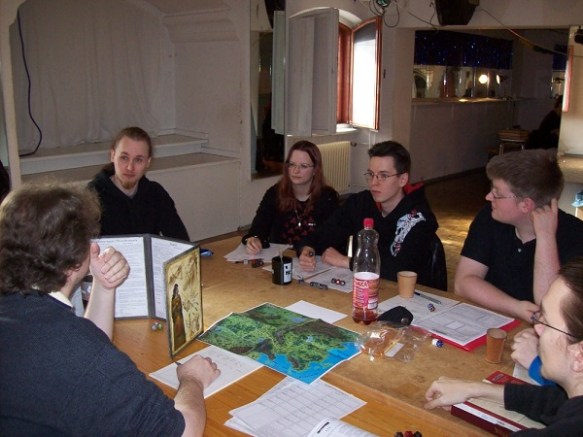
rpg-2009-berlin-2

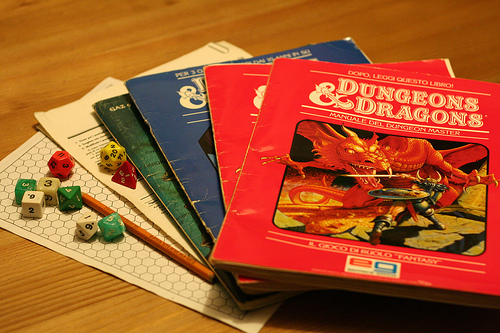
Some TV shows, like Community and Freaks & Geeks, have displayed role-playing games in a positive light, but for the most part, role-playing games in general, and Dungeons & Dragons in particular, have gotten a bad rap over the last few decades, maligned as (at best) a game for lonely friendless types and (at worst) a tool to corrupt children.

(This might sound ridiculous to many of you, but folks like Pat Robertson continue to talk about role-playing games as if they’re synonymous with demon worship.)

But in reality, role-playing games are simply a way for a group to tell one collaborative story.
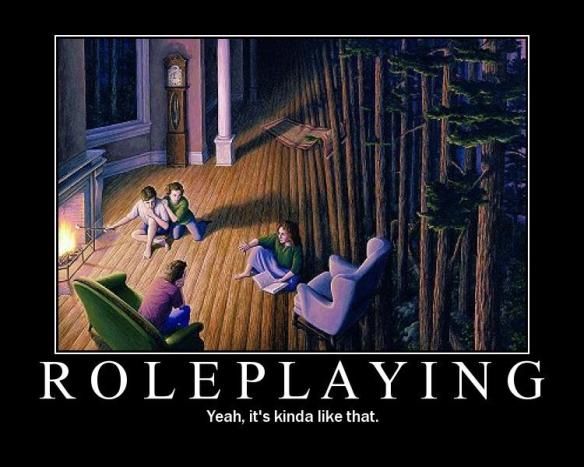
roleplaying-kinda-like-that

There are two major elements to this storytelling. The first is managed by a single person who oversees that particular game or gaming session. In Dungeons & Dragons, this person is called the Dungeon Master, or DM; in other games, this person is the Game Master, the Storyteller, or bears some other title tied to the game or setting. For the sake of simplicity, from this point on, I’ll refer to this person as the DM.

So, the DM manages the setting and sets up the adventure. In this role, the DM will describe what the player characters (or PCs) see and explain the results of their actions. The DM also plays any characters the players interact with. (These are known as NPCs, or non-player characters.) Essentially, the DM creates the sandbox in which the other players play.
1951073350_7e357dbdec_3

Which brings us to the second element in role-playing storytelling: the players. Each player assumes a role, a character, and plays that character for the length of the session, or the game, if there are multiple sessions. (Some games last months or years, so these characters evolve and grow; players often become quite attached to their characters.)

The PCs navigate the world created by the DM, but their actions and decisions shape the narrative. No matter how prepared a DM is or how carefully he or she has plotted out a given scene or adventure, the PCs determine much of what happens. They might follow the breadcrumbs exactly as the DM laid them out, or they might head off in an unexpected direction, forcing the DM to think on the fly in order to continue the adventure.
dd2

That’s what makes role-playing games so amazing: you never quite know what you’re going to get. The PCs usually don’t know what the DM has in store, and no DM can predict with perfect clarity what the PCs will do. You’re all crafting a story together and none of you knows what exactly will happen or how it all ends.

For instance, I run a role-playing game for several friends that is set in the universe of Buffy the Vampire Slayer, and my PCs routinely come up with solutions to problems and puzzles that I didn’t expect, but that nonetheless would work. They constantly keep me on my toes as a DM, and it’s one of my favorite aspects of the game.

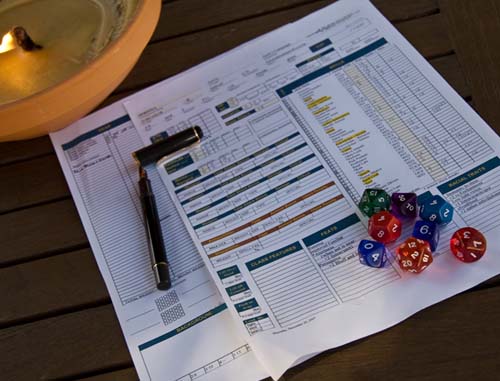
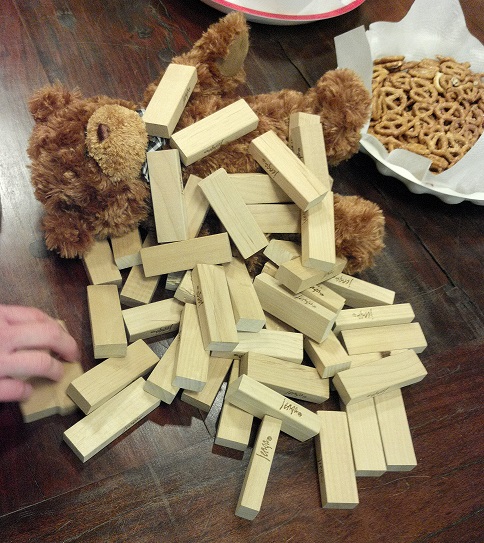
Oftentimes, major events and key moments are determined by dice rolls, adding an element of chance to the story. (In some games, players have replaced dice rolls with a Jenga-style block tower, and they must remove pieces from it to achieve certain goals. That adds a marvelous sense of real-world tension to the narrative tension already present!)
tabletop6

And while I’ve talked quite a bit about the game aspect, some of you might be wondering where the puzzly aspect comes in.

Some of the best, most satisfying puzzle-solving experiences of my life have come from role-playing games.

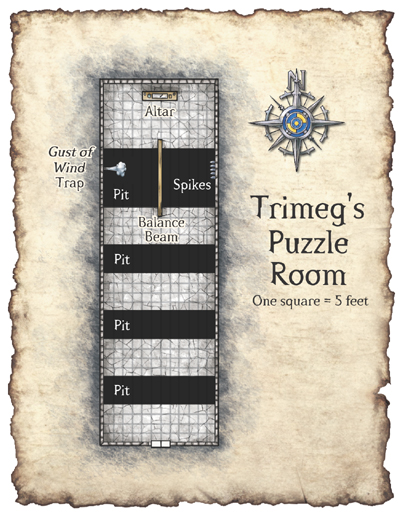
These puzzles can be as simple as figuring out how to open a locked door or as complicated as unraveling a villain’s dastardly plot for world domination. It can be a poem to be parsed and understood or a trap to be escaped.

There are riddles of goblins and sphinxes, or the three questions of trolls, or even the brain teasers and logic problems concocted by devious fey hoping to snare me with clever wordplay. I’ve encountered all sorts of puzzles in role-playing games, and some of them were fiendish indeed.
trimegspuzzleroom

One time, during a LARP session (Live-Action Role-Playing, meaning you actually act out the adventure and storytelling), I thought I’d unraveled the meaning of a certain bit of scripture (regarding a key that would allow me to escape the room) and acquired a sword as my prize, only to realize much much later that the key I’d spent the entire session searching for was the sword itself, which unlocked the door and released me.

And designing puzzles for my players to unravel is often as much fun as solving the puzzles myself. Especially when they’re tailored to specific storytelling universes or particular player characters.

(Trust me, it doesn’t matter if you’re dealing with a Jedi or a paladin; riddles stop pretty much everybody in their tracks.)

b7052aee1c93bff98f4c513e4470fbb6

Whether it’s Dungeons & Dragons or Pathfinder, Legend of the Five Rings or Star Wars, GURPS or Ninja Burger, there’s a role-playing game out there for everyone, if you’re just willing to look.


This post was meant as a brief overview of role-playing games as a whole. If you’d like me to get more in depth on the subject, or if you have specific questions about role-playing games, please let me know! I’d be happy to revisit this topic in the future.

Thanks for visiting PuzzleNation Blog today! Be sure to sign up for our newsletter to stay up-to-date on everything PuzzleNation!

You can also share your pictures with us on Instagram, friend us on Facebook, check us out on TwitterPinterest, and Tumblr, and explore the always-expanding library of PuzzleNation apps and games on our website!

Penny Dell Crosswords App Update: Now Available!

It’s a PuzzleNation News exclusive! (If only we had James Earl Jones introducing our PNN broadcasts…)

I love announcing new puzzle sets for the Penny Dell Crosswords app, because I’m immensely proud of the quality puzzles available to the PuzzleNation audience.

But today, I’m not only announcing a new puzzle set… I’m announcing a new update for the Penny Dell Crosswords app itself!

Not only does the app now offer a brand-new animated home screen tutorial to walk you through the solving experience, but there’s an animated screen tour for our daily puzzle and new animations in our in-app store!

Heck, even the October Deluxe puzzle set has an animated cover!

But that’s not all! We’re also introducing Mega Pack Plus collections! Just look for the + sign in the App Store, and you’ll find these awesome new collections, complete with alternate clues for all puzzles!

PuzzleNation is dedicated to bringing you the best mobile puzzle experience available today, and our new app updates and Mega Pack Plus collections are two more terrific reasons to download the app and check it out today!

Thanks for visiting PuzzleNation Blog today! Be sure to sign up for our newsletter to stay up-to-date on everything PuzzleNation!

You can also share your pictures with us on Instagram, friend us on Facebook, check us out on TwitterPinterest, and Tumblr, and explore the always-expanding library of PuzzleNation apps and games on our website!

PuzzleNation Book Review: Two Across

Welcome to another installment of PuzzleNation Book Reviews!

All of the books discussed and/or reviewed in PNBR articles are either directly or indirectly related to the world of puzzling, and hopefully you’ll find something to tickle your literary fancy in this entry or the entries to come.

Let’s get started!

Our book review post this time around features Jeff Bartsch’s novel Two Across.

Vera is a math prodigy whose childhood has been spent in rundown motels as her mother’s sales job takes them all around the country. Stanley is an overworked master of trivia, living in a hotel under the thumb and watchful eye of his reclusive mother.

Vera wants adventure, intrigue, and freedom from her mother’s itinerant lifestyle. Stanley wants to abandon the Harvard-bound track his mother has railroaded him toward and take up his true passion: creating crossword puzzles.

When the two of them meet at a prestigious spelling bee, they form a curious bond in that nebulous gray area between friends and more-than-friends.

Stanley’s master plan is for them to fake a wedding for the cash and gifts, funding their plans to escape their mothers and live their own lives. But the scam is complicated by Vera’s growing feelings for Stanley and his singleminded focus on his goals.

As we follow them through Vera’s college career and beyond, we watch their relationship evolve and change, haunted by Stanley’s selfishness and Vera’s willingness to pick up at a moment’s notice and start a new life elsewhere.

But, through the peaks and valleys of friendship and more, Vera and Stanley’s mutual love of crosswords proves to be not only common ground, but the thread that may draw them back together.

Partly a coming-of-age story, partly a romantic comedy of errors, miscues, and unintended consequences, Two Across is an interesting look at the social awkwardness that often comes hand-in-hand with intellect, as well as the many curious ways peoples’ lives connect over time.

Stanley is, admittedly, a putz — proving the old adage that being smart doesn’t necessarily make you wise — and he becomes at times a frustrating character to follow, almost serving as something of an antagonist in the story.

Vera on the other hand, for all her foibles and quirks, is sincere, engaging, and believable, someone who forges her own path. While you do root for Stanley to right his ship and make up for his failings, it’s far easier to cheer for Vera when she picks up the pieces (more than once) and continues onward toward a hopefully brighter future.

And since this is a puzzle blog, I would be remiss if I didn’t discuss the crosswordier aspects of the novel.

The puzzle references for the most part are clever, with sharp themes and playful cluing. (Though a reference to having the 8-letter RIFFRAFF as a center entry made me wary.)

Stanley’s early puzzle efforts in particular are great, in one case cluing words like BUTTERFLIES, CONCERN, and APPREHENSION with “winged insects,” “business,” and “the catching of a suspect,” while allowing the anxiety theme to emerge. In another, he creates a New York-themed puzzle where the boroughs are located geographically in the grid.

(Sadly, we only hear about these ambitious grids, we never see them.)

But it’s Vera’s puzzles that drive the narrative. When difficulties between them arise, Stanley hopes that she will reach out to him through published puzzles, solving obsessively so he won’t miss out if she does.

As someone who has forged many friendships (and a relationship or two) on shared puzzly interests like crosswords, spelling bees, and trivia, I related to a lot of the awkward moments in this book, and I suspect many other readers will as well.

The novel does drag a bit near the end as it diverts from the Stanley-Vera focus for an unexpected interlude, but for the most part, Bartsch delivers an enjoyably Ross and Rachel-style romance for the world of puzzles.


Thanks for visiting PuzzleNation Blog today! Be sure to sign up for our newsletter to stay up-to-date on everything PuzzleNation!

You can also share your pictures with us on Instagram, friend us on Facebook, check us out on TwitterPinterest, and Tumblr, and explore the always-expanding library of PuzzleNation apps and games on our website!

Well, that escalated quickly.

I talk a lot in this blog about the role puzzles have played in history, in our culture, and as touchstones for particular individuals. But it’s far more rare for me to talk about one puzzle in particular that changed someone’s life.

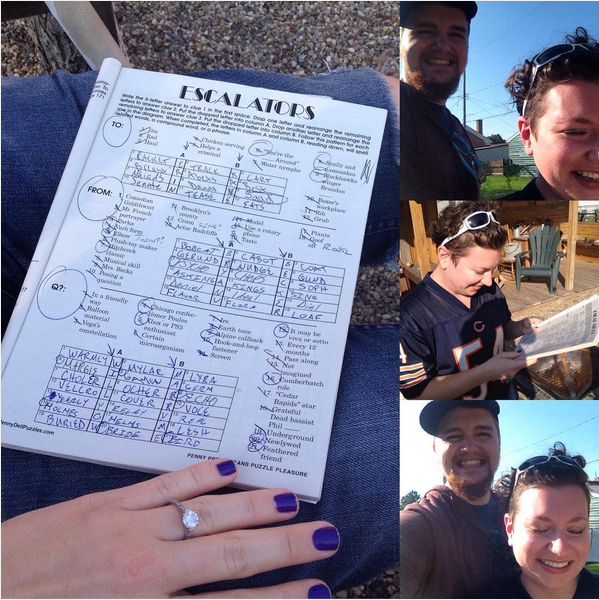
Today, I have the privilege of doing precisely that, because a puzzle crafted by our friends at Penny Dell Puzzles has changed two lives for the better.

One day, a gentleman named Bryan reached out to Penny Dell Puzzles with an audacious proposition: his girlfriend is a big fan of their puzzles and he wanted their help in crafting a special puzzly proposal of marriage!

He supplied ideas for clues and entry words, and a topnotch editor accepted the challenge of crafting a page of Escalators puzzles specially tailored for the occasion.

(For the uninitiated, an Escalators puzzle involves clued entries where a 6-letter word loses a letter and anagrams into a 5-letter word, then loses another letter and is anagrammed into a 4-letter word. Those lost letters end up spelling out words and phrases reading down when each grid is complete.)

So this singular puzzle featured his girlfriend’s name, then his name, and then the fateful question: will you marry me?

And to really cap off the presentation, the puzzle was inserted into an actual puzzle magazine (in a special limited run at the printers), so that our hero could deftly guide her toward the puzzle with her being none the wiser.

It’s an absolutely awesome idea, a testament to puzzly ingenuity, and honestly, just about the cutest proposal story I’ve ever heard.

I’ll let Bryan take it from here, in an email to his fellow collaborators at Penny Dell Puzzles:

I wanted to let you know that I proposed to Erin today with the puzzle and she said yes! It went perfectly. The puzzle looked great in the book and Erin thought nothing of it, thinking it was just another Escalators puzzle.

Once we got about halfway through the puzzle and she saw my name, it became kind of obvious, and once I knew that she knew, I got down on one knee and popped the question.

She was so surprised and blown away she even forgot to say yes and was just asking how I made it happen! She did eventually say yes after a lot of hugging, kissing, and tears, and then we continued to solve the puzzle before making calls to the rest of our family and friends.

Congratulations to Bryan and Erin! I wish them nothing but the best on their journeys to come.

And kudos to our friends at Penny Dell Puzzles for truly going the extra mile for puzzle fans and romantics alike.


Thanks for visiting PuzzleNation Blog today! Be sure to sign up for our newsletter to stay up-to-date on everything PuzzleNation!

You can also share your pictures with us on Instagram, friend us on Facebook, check us out on TwitterPinterest, and Tumblr, and explore the always-expanding library of PuzzleNation apps and games on our website!

It’s Follow-Up Friday: Rubik’s Magic edition!

Welcome to Follow-Up Friday!

By this time, you know the drill. Follow-Up Friday is a chance for us to revisit the subjects of previous posts and bring the PuzzleNation audience up to speed on all things puzzly.

And today I’d like to return to the subject of puzzle magic!

Oh yes, puzzle magic is most definitely a thing. Arguably the most famous practitioner is friend of the blog and crossword constructor David Kwong, who not only contributes both puzzles and magic to television shows and film projects, but has created some truly mindblowing magic tricks involving puzzles.

The other night, I was watching Penn and Teller: Fool Us, a show where magicians and performers from all around the world present their best tricks, illusions, and bits of magical wizardry to try and stump the famous duo. And lo and behold, another master of puzzle magic appeared!

But where David Kwong works his magic with crosswords, Steven Brundage uses a different puzzly tool: Rubik’s Cubes.

Check out this video where he dazzles Penn and Teller with several quick solves and feats of puzzly manipulation:

That behind-the-back trick was pretty fantastic, wasn’t it? You can check out more of Steven’s magic on his YouTube page! And let me know if you’ve seen any other acts of puzzle magic! I’d love to check them out!


Thanks for visiting PuzzleNation Blog today! Be sure to sign up for our newsletter to stay up-to-date on everything PuzzleNation!

You can also share your pictures with us on Instagram, friend us on Facebook, check us out on TwitterPinterest, and Tumblr, and explore the always-expanding library of PuzzleNation apps and games on our website!

View a Clue: Common Crossword Words!

Welcome to a brand-new feature on PuzzleNation Blog: the View a Clue game!

I talk about crosswords a lot here, and rightfully so. Crosswords are the most famous pen-and-paper puzzles in the world, and here at PuzzleNation, you can always find terrific, fresh puzzle content for our Penny Dell Crosswords App!

And although I love running our daily Crossword Clue Challenge on Facebook and Twitter, I wanted to try something different today.

I’ve selected ten words that commonly show up in crossword grids — some crosswordese, some not — and I want to see if the PuzzleNation readership can identify them from pictures. It’s a visual puzzle I call View a Clue!

Let’s give it a shot!


#1 (4 letters)

#2 (4 letters)

#3 (4 letters)

#4 (4 letters)

#5 (4 letters)

#6 (4 letters)

#7 (3 letters)

#8 (4 letters)

#9 (4 letters)

#10 (4 letters)


How many did you get? Let me know in the comments below! And if you’d like to see another View a Clue game (maybe about common names in crosswords or crosswordy animals!), tell us below!

Thanks for visiting PuzzleNation Blog today! Be sure to sign up for our newsletter to stay up-to-date on everything PuzzleNation!

You can also share your pictures with us on Instagram, friend us on Facebook, check us out on TwitterPinterest, and Tumblr, and explore the always-expanding library of PuzzleNation apps and games on our website!