Prep for College the Puzzly Way!

It’s summer here in the United States, which means many high-school graduates are already looking forward to starting college. But for those soon-to-be freshmen, as well as high schoolers looking for an edge before university, have you considered puzzles and board games?

Now, it comes as no shock to me, but this article from the U.S. News and World Report website might surprise some, since it lists puzzles and board games as two of its five tools to develop critical thinking skills before college!

Naturally, I’ve been an advocate of puzzles as a learning tool for a long time, so it’s gratifying to see a major publication sharing the same views and ideas.

From the article:

Collections of crossword puzzles, logic problems, riddles, sudoku, word problems and word searches can be found at your local bookstore or library. The puzzles in these books are a wonderful strategy to activate different parts of your brain for a round or two of mental gymnastics, and many collections even discuss what each puzzle is meant to target within the mind.

Allow me to expand on this for a bit. Different puzzles can target different skills, so which puzzles you solve can make a big difference when it comes to critical thinking.

Crosswords encourage deduction (figuring out words from a few common letters) and a facility with wordplay (dealing with crafty clues and alternate definitions), while word searches offer great practice in pattern recognition and quick reaction times.

And the demand that Sudoku puzzles place on active attentiveness and concentration exercises parts of the brain associated with forming new memories, encouraging better memory retention.

[All three of the above pics come from our line of puzzle apps! Perfect for puzzly pre-college practice! Shameless plug now concluded!]

But the article also mentioned that certain board games can be excellent tools for honing valuable mental skills for college.

Choose board games that require more than luck – namely, strategy – for players to win. Any game where players must carefully consider their next move, recognize patterns and remember details will aid in honing critical thinking skills.

The article goes on to suggest some classics, like Chess, Checkers, and Mastermind for learning chain-thinking (planning several steps ahead) as well as Scrabble and Boggle (speedy information analysis, as well as word formation) and Clue and Risk (anticipating and reacting to the gameplay of others).

But I think they’re excluding some prime examples of board games that could benefit younger minds.

  • You could pick a cooperative game like Pandemic or Forbidden Island, which not only encourage strategic thinking, but teamwork and the free exchange of ideas (something that forced group exercises in school never really managed).
  • You could choose a rapid-change game like Fluxx (either the board game or the card game), which forces the players to adapt quickly to constantly changing rules and gameplay (a perfect microcosm of problem-solving in the real world, where things rarely remain static for long).
  • You could select a mixed-play game like The Stars Are Right, which incorporates several forms of gameplay (in this case, pattern-forming, tile-shifting, and a strategic card game akin to Magic: The Gathering or Munchkin) and forces players to exercise different forms of strategy and puzzle-solving all at once.

Just think about it. You could turn Family Game Night or Family Puzzle Time into College Prep Time in a snap. It’s win-win, or perhaps even win-win-win. What could be simpler, or more fun, than that?

Thanks for visiting PuzzleNation Blog today! You can share your pictures with us on Instagram, friend us on Facebook, check us out on TwitterPinterest, and Tumblr, and be sure to check out our library of PuzzleNation apps and games!

It’s Follow-Up Friday: Apps and Alex edition!

Welcome to Follow-Up Friday!

For those new to PuzzleNation Blog, Follow-Up Friday is a chance for us to revisit the subjects of previous posts and update the PuzzleNation audience on how these projects are doing and what these people have been up to in the meantime.

And today, I’ve got two terrific announcements for you all!

First and foremost, we’ve updated our Apps and iBooks page to reflect the latest puzzles and platforms available! Crosswords, Classic Word Search, and Sudoku puzzles await you there, ready for your mobile devices! Enjoy!

And second, since we’ve been talking about trivia recently, it seems utterly apropos that I stumbled across this video on the Guinness Book of World Records website this week.

It’s host Alex Trebek accepting the certificate for Most Game Show Episodes Hosted by the Same Presenter (Same Program), officially documented by Guinness (hardly the show’s first world record, but easily its most impressive).

For the record (and the Record!), Alex zoomed into first place by hosting his 6,829th episode of Jeopardy!:

Thank you for checking out Follow-Up Friday! If there have been any posts or puzzle-centric stories featured here that you’d like us to follow up on, let us know! It could be the subject of next week’s Follow-Up Friday post!

Puzzles and Brain Health

There is a lot of talk nowadays about brain boosting and other attempts to combat the effects of aging on the brain. There are numerous websites and products boasting that they can help keep your wits sharp, your memory keen, and the threat of Alzheimer’s at bay.

From visual acuity and perception to coordination, critical thinking to spatial reasoning, from observational skill to improved memory, there are a lot of promises being made about brain health.

Unfortunately, there’s a wealth of conflicting and inconsistent data out there. (This article by The New York Times points out some of the inconsistencies in brain health reporting when it comes to puzzles.)

From a recent NPR article:

Molly Wagster, chief of the behavioral and systems neuroscience branch at the National Institute on Aging, studies how puzzles can benefit brains. “What we know is that it probably makes us better at puzzle solving, but it may not necessarily make us better at other types of cognitive activities,” Wagster explains.

However, in general, experts agree that puzzle solving is good for us. But what puzzles do the most good, and when should you start solving?

I’ve done my best to comb through the available data — both through reports from news sources and scientific papers themselves — and there’s one thing that they all seem to agree on…

Start puzzling when you’re young.

A study by the University of Chicago said that children who play with jigsaws and other shape-based puzzles at a young age tend to develop better spatial and math-related skills.

And there are other studies that support the idea that a fundamental base of puzzling at a young age contributes to better brain health later in life.

A study at Berkeley published in the Archives of Neurology (and covered by CBS News) found a correlation between crossword puzzle solving (and other challenging mind games) and a decreased likelihood to develop a particular marker for Alzheimer’s disease.

This study also said that when you engage in these activities is a factor. Like the University of Chicago study, the Berkeley study states that adults who engaged in crosswords and similarly brain-stimulating activities in their early and middle years had the lowest amount of these markers.

There is plenty of data to suggest that crosswords and other associative puzzles can have unexpected brain health benefits.

My friend Jake had major brain surgery years ago, and part of his post-surgery recovery consisted of solving crosswords. It was considered excellent speech/occupational therapy, and he sought out more crosswords post-recovery.

(This article from The New York Times discusses in detail another example of the curious relationship between crosswords, memory, and post-surgery treatment.)

But what about those who’ve come to puzzles later in life? Are all the promises made by those websites and brain-boosting products possible?

It depends on the puzzle. There are plenty of puzzles that are great at exercising various brain functions and observational skill, but there’s precious little scientific data to back up whether these games and puzzles actually help with memory retention or other faculties challenged by age.

But a recent article by Dr. Rob Winningham suggests that certain types of puzzle solving are more beneficial than others.

Crossword puzzles involve getting a cue and then attempting to retrieve previously learned information, which is something that people with age related cognitive impairment and even early to mid stage dementia can do fairly well.

Age related changes in cognition and earlier stages of dementia are primarily associated with impairments in the ability to concentrate, pay attention, and make new memories; crossword puzzles don’t really exercise those abilities, but Sudoku puzzles do.

According to Dr. Winningham, the heavy demand Sudoku puzzles place on concentration and active attention-keeping — especially when solved with distractions like television or conversation in the mix — exercise those parts of the brain associated with the formation of new memories, encouraging better memory retention and other mental faculties so many solvers of all ages want to keep in top condition.

While there’s still more research to be done to narrow down exactly what puzzles are best for your brain in the long term, there’s no denying that puzzle solving is always a healthy decision.

Thanks for visiting the PuzzleNation blog today! You can like us on Facebookfollow us on Twitter, cruise our boards on Pinterest, check out our Tumblr, download our puzzle apps and iBooks, play our games at PuzzleNation.com, or contact us here at the blog!

PuzzleNation How-to: Sudoku!

Sudoku is one of the most popular paper puzzles in the history of puzzling, perhaps the only puzzle to rival crosswords in the hearts of solvers worldwide.

That being said, I frequently encounter people who have either never tried to solve Sudoku puzzles or had a dismal first showing that dissuaded them from trying again. And today, I’d like to reach out to the Sudoku disenfranchised out there with a PuzzleNation How-To.

How to solve Sudoku, to be specific!

[Brief historical tidbit: The Sudoku puzzle as we know it was created in 1979 for Dell Magazines by puzzler Howard Garns (though it was introduced under the name Number Place). Before its rebranding in the modern era, it was also known as To the Nines.]

The rules of Sudoku seem simple enough. It’s the solver’s job to place the numbers 1 through 9 in every row, column, and 3×3 square in a 9×9 grid.

[Additional brief historical tidbit: Each row and column add up to 45, making every Sudoku puzzle a variation on the classic Magic Square puzzle concept. Only Extreme Sudoku puzzles — puzzles where the numbers 1 through 9 also appear along the diagonals — qualify as true Magic Squares, grids where the sum of every row, column, and diagonal all add up to the same number. Magic Squares have been around for more than 2000 years, giving Sudoku an impressive puzzly pedigree.]

Sudoku puzzles come in all sorts of sizes and difficulty rankings — most of which are dependent on where numbers are set, how many are set, and what numbers are set — and the placement of set numbers often adheres to the same diagonal symmetry as black squares in crosswords.

Let’s look at a sample puzzle, shall we?

The best way to start a Sudoku puzzle is to scan for numbers that appear most frequently, since they’ll offer more hints pointing toward where to place other numbers.

For instance, we’ve got a 7 in the top left-hand 3×3 grid (on the top row) and a 7 in the top center grid (in the middle row), so let’s try placing a 7 in the top right-hand grid.

Since a number can only appear once in each row, column, and 3×3 grid, we can draw imaginary lines crossing out the open spaces in the top row, the middle row, and the rightmost column, leaving only one space remaining where the 7 could possibly go.

Let’s continue with 7s and see if we can place a 7 in the middle left-hand grid.

Between the 7s in the top row, the middle row, and the second column from the left, there’s only one open space for that 7.

With this new 7 in place, we can also determine the 7 in the bottom left-hand grid.

Our new 7 eliminates any spots in the leftmost column, and the given 7s in the second column and the middle row eliminate all possibilities but one.

With this new information, we can place the last 7 in the bottom right-hand grid.

Focusing on one number can deliver a lot of new information early on.

Now, after filling in a few more numbers, we can move into more of the deduction aspects of Sudoku solving.

Look at the middle grid on the left-hand side. There are only two numbers missing from this 3×3 square, the 5 and the 8. While we don’t have enough information to place them, this box can help us place numbers in the top and bottom left-hand squares.

The second column has four numbers missing — the 1, the 2, the 5, and the 8 — and we know the 5 and the 8 will be in that middle grid.

This means that there are only two options for the 1 and the 2, the top left-hand space and the bottom left-hand space.

And since there’s already a 1 in the top left-hand square and a 2 in the bottom left-hand square, it’s easy to place our numbers.

That sort of deduction can be extremely helpful when it comes to harder Sudoku puzzles. Here’s another example, a little farther into our solve.

In this case, we’re going to try to place a 3 in the center 3×3 square. We know from the placement of other 3s in the grid that the 3 cannot be in the bottom row or the middle row.

Unfortunately, we don’t know which of the open boxes in the top row will hold our 3.

But, thanks to this information, we can place the 3 in the middle grid on the right-hand side. Here’s the grid with the 3s we know for certain.

Since we know the center square’s 3 will occupy one of two places in that top row, we can also eliminate that row from the possibilities for the middle grid on the right-hand side.

We can now place the 3 in the remaining square, and move forward with our solve.

From this point onward, you’ll be able to fill the entire grid with ease, adding the first of many vanquished Sudoku puzzles to your solving experience.

I hope you found this PuzzleNation How-to helpful. All of the graphics came from our Classic Sudoku app, now available for the iPad!

(Although the black lines were for illustrative purposes only, you can place possible numbers in blue just as I did with our Candidates feature.)

Thanks for visiting the PuzzleNation blog today! You can like us on Facebookfollow us on Twitter, cruise our boards on Pinterest, check out our Tumblr, download our puzzle apps and iBooks, play our games at PuzzleNation.com, or contact us here at the blog!

Classic Sudoku is here!

A few weeks ago when we announced the Penny/Dell Jumbo Crosswords App, we also teased that a certain number-based puzzle would be getting the PuzzleNation App treatment very soon.

Today, I’m proud to announce that Classic Sudoku has just launched for the iPad!

With four levels of difficulty (easy, medium, hard, and expert), a touch-to-scroll feature for entering numbers, and a timed option for competitive scoring, Classic Sudoku is ready for solvers of all skill levels.

Plus, with our Candidates feature, you can list possible solutions in a box without jeopardizing your score or your time!

Classic Sudoku joins the terrific lineup of Crossword apps and Classic Word Search iBooks from PuzzleNation and Penny/Dell Puzzles, and we’re so excited to add another world-class puzzle to our mobile library.

Thanks for visiting the PuzzleNation Blog today. Stop in again soon for the latest puzzle news, app announcements, and all sorts of puzzly goodness!

Bigger really is better, sometimes…

giantsudoku

[A massive Sudoku grid, created to promote a Sudoku gameshow in England in 2005.]

There’s just something about puzzles on a grand scale. From the Great Urban Race’s citywide scavenger hunts to the Internet-spanning curiosity that is Cicada 3301, puzzly ambition makes for some truly mindblowing experiences.

But those are puzzles of staggering complexity and scope, not actual physical size. When it comes to sheer dimensions, you have to go building-size.

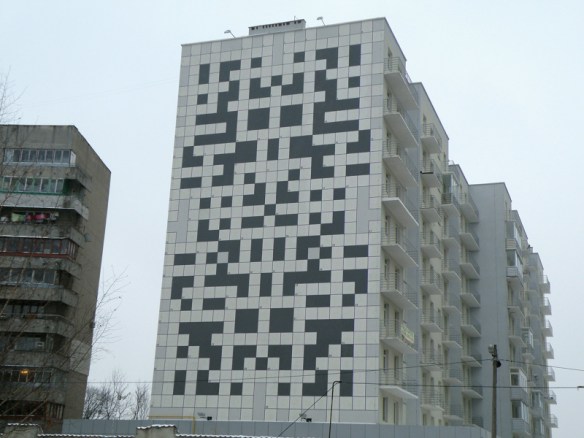
There is, of course, the solvable crossword from Lviv, Ukraine, where the grid takes up the entire side of an apartment building, with clues hidden all over the city. It’s a brilliant tourism move and a terrific challenge (especially if you don’t read Cyrillic).

OLYMPUS DIGITAL CAMERA

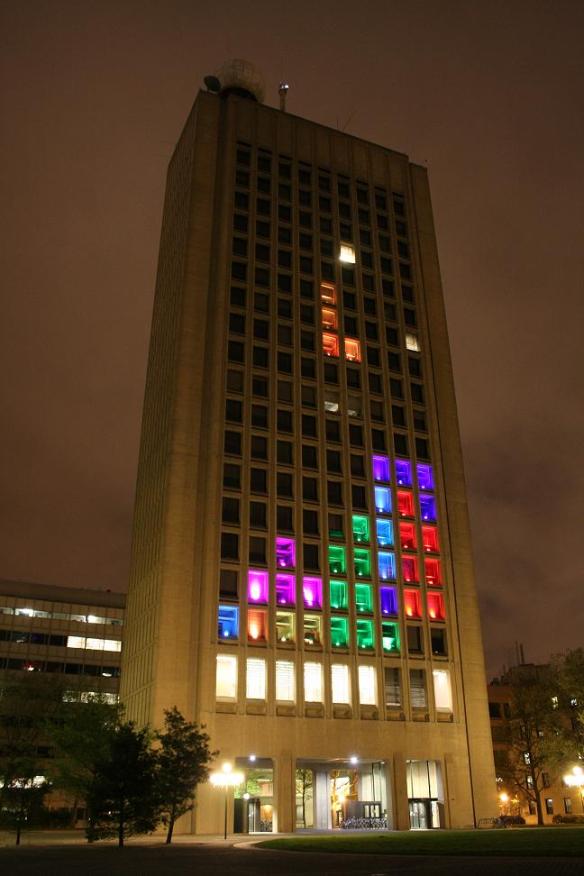
There was also the classic MIT hack from 2012 where ambitious miscreants transformed one side of the Green Building into a multicolored, playable Tetris game. (I recently learned that students from Brown University in Rhode Island accomplished a single-color version of the same feat back in 2000. You can find video of both hacks here.)

tetris1_img6080

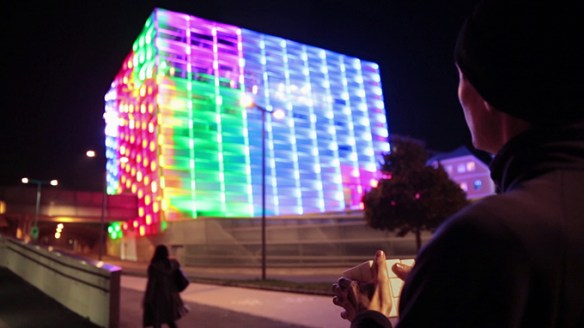
But Javier Lloret has upped the ante with Puzzle Facade, an art installation which transforms the Ars Electronica building in Linz, Austria into a solvable Rubik’s Cube.

Using a small handheld cube as an interface, a solver can manipulate the cube and watch the same changes carried out across two entire sides of the building in full color.

rubikbuilding

As you might expect, having only two sides of the cube available makes for a greater solving challenge, but who cares when you’re lighting up a building with every twist and turn!

It’s a fantastic meeting of puzzly fun and electronic wizardry, and the latest in a grand tradition of massive-scale creativity. I cannot wait to see what intrepid puzzlers come up with next.

Thanks for visiting the PuzzleNation blog today! You can like us on Facebookfollow us on Twitter, cruise our boards on Pinterest, check out our Tumblr, download our Classic Word Search iBook (recently featured by Apple in the Made for iBooks category!), play our games at PuzzleNation.com, or contact us here at the blog!