A PuzzleNation First Look: Will Sudoku

Sudoku puzzles haven’t been around all that long, especially when compared to the hundred-plus years of longevity that the crossword puzzle brings to the table. Nonetheless, Sudoku puzzles remain one of the most popular puzzles these days, whether solved with pen and paper or in app form.

I’ve written about some of the many Sudoku variants before, but today’s post is something different. It’s the debut of a brand-new type of Sudoku. That’s right! I have the distinct pleasure of introducing you to Will Sudoku, the creation of topnotch puzzler Bassey Godwin.

This is a standard Will Sudoku grid. (Not to be confused with the Will Shortz’s Sudoku magazine.)

Named in honor of puzzle master and New York Times Crossword editor Will Shortz, Will Sudoku offers a challenge that your average Sudoku puzzle cannot match.

Instead of placing the numbers 1-9 in a 9×9 grid so that each row, column, and 3×3 box features all nine numbers without repeats, Will Sudoku tasks you with filling in the grid in such a way that the numbers 1-8 appear only once in each of the rows and columns as well as the 4×4 boxes.

As you can see, each row and column is split into two tracks, inside and outside. Horizontal lines are indicated by the similar triangular cells in the corresponding boxes in a row. For instance, horizontal line 1 contains 45238761; horizontal line 2 contains 23816457, as shown above.

The vertical lines work the same way, with outside and inside tracks within each column. This tight arrangement means a LOT of information is available to a keen-eyed solver, but there are also more spots to place your numbers.

There are numerous variations included in this puzzle bundle:

  • Will Triangular Box Sudoku: Instead of 4×4 squares, the grid is divided into large triangles that contain all 8 numbers
  • Will Horizontal Bar Sudoku and Will Vertical Bar Sudoku: Instead of the 4×4 squares, the grid is divided into vertical or horizontal bars that contain all 8 numbers
  • Will Variable Boxes Sudoku: A mix of 4×4 squares, vertical and horizontal bars, and triangles appear in a single grid

In addition to these variations, Bassey experiments with the form and offers a few new twists on his established template.

  • Will Sudoku Word Search: Instead of the numbers 1-8, eight letters appear in a grid, and once you’ve finished placing them all, you search the grid Word Seek-style to find an 8-letter word reading out in some direction
  • Will Trigonal Sudoku: A Will Sudoku grid is divided diagonally, leaving you half a grid to solve. Cleverly enough, each of the three sides of the triangle also adhere to standard Will Sudoku rules, with all 8 digits appearing once each.
  • Finally, and most challengingly, there is Will Samurai Sudoku, where you confront five interconnected Will Sudoku grids in one monster puzzle.

This debut collection of Will Sudoku offers 150 puzzles for $10!

As a solver, I was very impressed with how many different solving styles emerged from the Will Sudoku template. And going from nine numbers to eight certainly didn’t decrease the puzzle’s difficulty! (The new inside and outside tracks in each column and row certainly took a little getting used to.)

The puzzles marked “average” will keep you on your toes, and some of the ones marked “tough” will really test your deduction and logic skills. But for the price, you simply can’t go wrong.

Thank you to Bassey Godwin for giving PuzzleNation Blog the exclusive first look at Will Sudoku and allowing us to share this clever new Sudoku variant with our fellow PuzzleNationers and the online puzzle community at large!

But before I go, I want to leave you with one last surprise: a video of Bassey himself solving a Sudoku puzzle blindfolded! It’s mind-blowing stuff, and the perfect sendoff for this post. Take it away, Bassey!


Thanks for visiting PuzzleNation Blog today! Be sure to sign up for our newsletter to stay up-to-date on everything PuzzleNation!

You can also share your pictures with us on Instagram, friend us on Facebook, check us out on Twitter, Pinterest, and Tumblr, and explore the always-expanding library of PuzzleNation apps and games on our website!

It’s Follow-Up Friday: Broadway Puzzles edition!

Welcome to Follow-Up Friday!

By this time, you know the drill. Follow-Up Friday is a chance for us to revisit the subjects of previous posts and bring the PuzzleNation audience up to speed on all things puzzly.

And today, I’m posting the results of our #PennyDellBroadwayPuzzles hashtag game!

[Sir Ian McKellen, exhausted from coming up with puns all night.]

You may be familiar with the board game Schmovie, hashtag games on Twitter, or @midnight’s Hashtag Wars segment on Comedy Central.

For the last few months, we’re been collaborating on puzzle-themed hashtag games with our pals at Penny/Dell Puzzles, and this month’s hook was Penny/Dell Broadway Puzzles!

Examples of shows might be “Oooooooooooooklahoma Runs!” and examples of songs might be “(I Am) Sixteen Going on Seven-Ups” or “Give and Take My Regards to Broadway.”

So, without further ado, check out what the puzzlers at PuzzleNation and Penny/Dell Puzzles came up with!


Shows!

Figgerits on the Roof / Fiddler’s Frame on the Roof (featuring the smash song Matchmaker)

Keep On Movin’ Out

Les MiséraBubbles

The Bookworms of Mormon / The Book of Bricks and Mortar

La Cage aux Fill-Ins

Lucky Starlight Express

Jesus Christ Superstarspell / Jesus Christ Superscore

The Mystery Word of Edwin Drood / The Mystery Person of Edwin Drood

A Chorus Line ‘em Up / Draw the Chorus Line / End of the Chorus Line / A Crostic Line

A Funny Thing Happened on the Way to the Foursomes / Four(-um) Corners / Four Square

How to Succeed in Boxes Without Really Trying

A Little Puzzler Night Music

The Fan Words of the Opera / The Shadow of the Opera

Sunrays Boulevard

Oh! (Quote) Cal-cu(la)ta!

Hair-A-Letter

The Best Little Scoreboard in Texas / The Best Little “Score”house in T(ripl)ex-as

Annie-gram

Annie-gram Get Your Gun

Fill-Into the Woods / Drop-In to the Woods

Avenue (Q)uotagrams

Kiss Me, Kate-gories

The Curious Incident of the Dog in the Timed Framework

Godspell(down) / Godspellbound / God Spell it out

Can-Can Cancellations

Les Miz(sing Vowels)

The WIZard Words

Wizard Words of Oz, featuring the song “Follow the Yellow Brick By Brick Road”

Bowl Mame

The Pajama Bowl Game

Cactus Flower Power

The 25th Annual Putnam County Starspelling Bee

Odds and Evens Couple by Neil Simon Says

The Merry Window Boxes

A Balancing Act of God

Kiss of the Spider’s Web

Drummerman of La Mancha


Songs!

“Ya Got Double Trouble” (The Music Man)

“Sit Down, You’re Rockin’ the Quick Quote” (Guys and Dolls)

“There’s a Places, Please for Us” (West Side Story)

“The Circle Sums of Life” (The Lion King)

“Dance: Ten, Looks: Three from Nine” / “Dance a Perfect Ten, Looks Three of a Kind” (A Chorus Line)

“I Don’t Need Anything But You Know the Odds” (Annie)

“Scoremaster of the House” (Les Miserables)

“Getting to Know You Know the Odds” (The King & I)

“Mamma Mia needs some Alphabet Soup!!” (Mamma Mia)

“Surrey with the Fringe On Top to Bottom” (Oklahoma!)

“Ease on Down the Crossroads” (The Wiz)

“Cell Blockbuilders Tango” (Chicago)

“I Don’t Know How To Solve This” (and I’ve solved so many puzzles before…) (Jesus Christ Superstar)

“No Places, Please Like London” (Sweeney Todd)

“No Good Deal” (Wicked)

“Grease Is the Codeword” (Grease)

“A Whole New Word Trails” (Aladdin)

“I’m Still Here & There” (Follies)


Some of our Twitter followers also got in on the fun, with @MicMcCracken tweeting “Les Misery Loves Company!”

And, naturally, it wouldn’t be a PuzzleNation game unless someone went above and beyond the call of duty. This time around, fellow PuzzleNationer Debra created a puzzly version of the opening stanza of “My Favorite Things”!

Crosswords and Word Seeks and Sudoku
Fill-Ins and Ken-Kens and Logic Problems too
Codewords and Crostics and Diamond Rings
These are a few of my favorite things!


All in all, the game was great fun!

Have you come up with any Penny/Dell Broadway Puzzles of your own? Let us know! We’d love to see them!

Thanks for visiting PuzzleNation Blog today! You can share your pictures with us on Instagram, friend us on Facebook, check us out on Twitter, Pinterest, and Tumblr, and be sure to check out the growing library of PuzzleNation apps and games!

Sudoku Around the World!

sudokuworld18

Sudoku is the most popular pen-and-paper puzzle since the crossword. No other puzzles come close. Whether it’s in your local paper, our iPad app, or one of the magazines offered by our friends at Penny/Dell Puzzles, chances are you’ve solved a Sudoku puzzle at one time or another.

And the solving experience is an integral part of its success. When you look at a Sudoku grid, you instinctively know what sort of puzzle you’re dealing with and what the goal is. You don’t need the instructions or any elaborate explanations. You can simply dive right in.

That sort of simplicity and accessibility gives Sudoku major appeal, and has contributed to its success as an iconic puzzle worldwide.

sudokuworld2

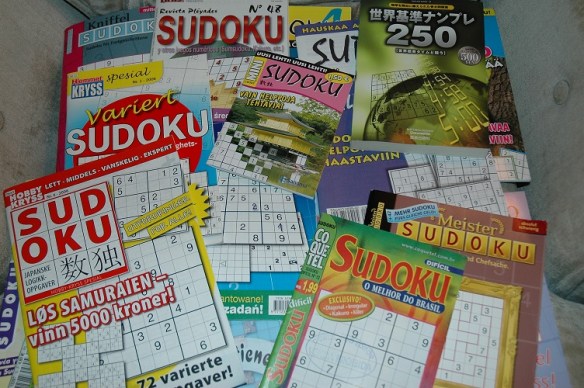
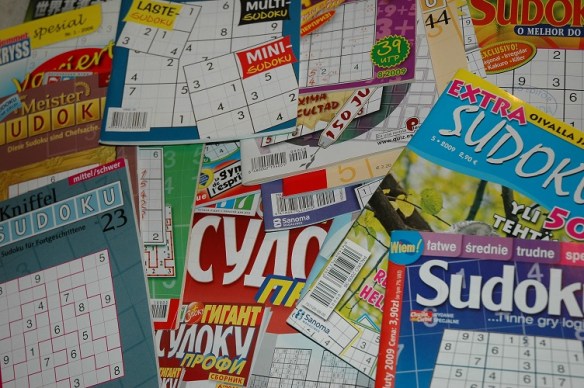
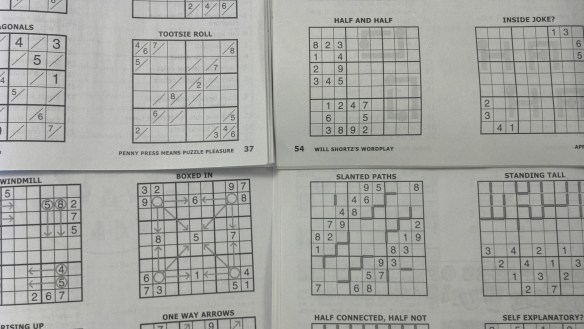
Look at this stack of puzzle books from around the world, loaned to me by a friend of the blog!

There are Sudoku books in Russian, French, Japanese, and other languages! And yet, you could pick up any one of these magazines and start solving immediately.

sudokuworld7

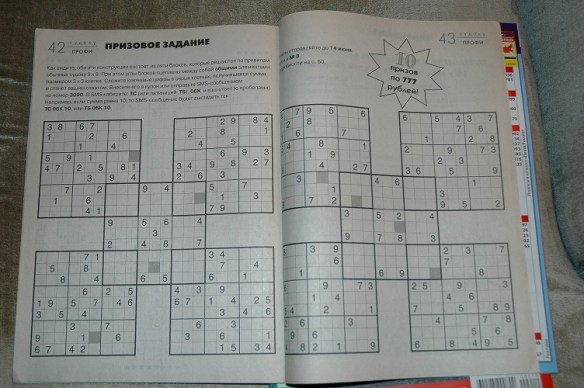
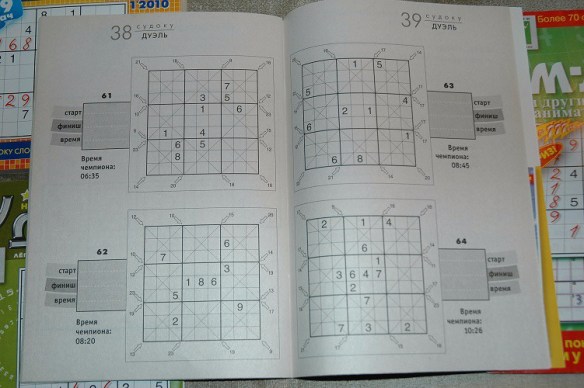
Here are two Samurai Sudoku from a Russian puzzle magazine. Again, these are identical to the overlapping grids you find in the States.

sudokuworld12

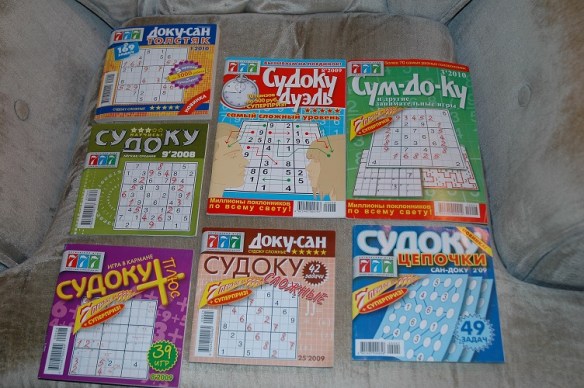
I did, however, encounter a few intriguing variations I was unfamiliar with as I perused these magazines published by 777.

sudokuworld14

Instead of providing sums in smaller boxes within the grid like Sum-Doku puzzles, or along the edges like Kakuro, these puzzles offer totals that correspond to the three diagonal boxes in a line a given arrow points to.

sudokuworld16

In this Sudoku variant, there are no repeats of the numbers 1 through 8 in a given row or column, but there are also no repeats within each group of connected circles.

Again, although I couldn’t read the instructions for these new puzzles, I was easily able to figure out the mechanics of each and start solving within a few minutes. Very few puzzles have that sort of universal accessibility.

sudokuworld9

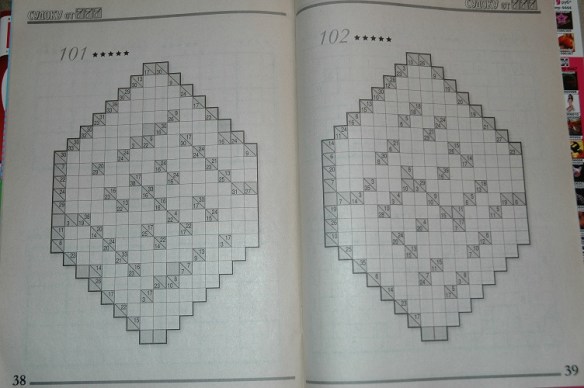
While I’m very familiar with Kakuro (or Cross Sums) puzzles, I’ve never encountered cut-style grids like these. I just love the simple elegance of these diamond-shaped grids. Very eye-catching.

Believe it or not, this is just a sampling of the hundreds and hundreds of Sudoku magazines and puzzle books released over the last decade.

Although the puzzle as we know it has been around since the ’70s under other names (To the Nines and Number Place, among them), it was only relatively recently that it exploded in popularity, becoming a true cultural touchstone and undeniable puzzle phenomenon.

[For another blog post exploring puzzle books from around the world, click here!]

Thanks for visiting PuzzleNation Blog today! You can share your pictures with us on Instagram, friend us on Facebook, check us out on Twitter, Pinterest, and Tumblr, and be sure to check out the growing library of PuzzleNation apps and games!

PuzzleNation App Review: Hedgehog Gardens

Welcome to the another edition of PuzzleNation App Reviews! Today we continue our quest to explore the world of puzzly games and apps for your tablet or smartphone!

Our resident app player and puzzle fiend Sherri has another intriguing game for us today, so let’s get down to business and dive into her review of Hedgehog Gardens for iPad and iPhone!


Hedgehog Gardens is an iOS game that offers a cute twist on a simple counting game. But in this case, it isn’t so simple at all!

A pretty efficient hedgehog has taken up residence in the Back Garden. His goal, and yours, is to clear out all of the vegetables. To do this, you must number the tiles from 1 to 36, while following specific rules. In much higher puzzles, you must count even higher!

[Where would you place a 3 to continue the
hedgehog’s clockwise path around the garden?]

Each Back Garden puzzle is divided into four different sections, each of which is filled with a different vegetable. There are three rules to follow in order to clear the vegetables and number the tiles: you must move clockwise around the board, you must move in a straight line from section to section, and you can’t revisit a tile.

Now don’t panic about where to start because when you start a puzzle, some of the tiles have already been numbered. Your goal is to complete the puzzle by guessing the remaining numbers and having the hedgehog follow a path from 1 to 2 to 3 and so on.

Once you complete enough Back Garden puzzles, you open up the Orchard, which has its own set of rules. There are other sections you can open once you complete enough puzzles.

If you enjoy counting and Sudoku-type games, this is a great game to play. You get over 1,000 puzzles spread over several sections. However, all of the puzzles are not immediately available. The more you play, the more you open. The sheer volume of puzzles will keep a player busy.

Counting and Sudoku-type games aren’t really my thing, but I find myself playing a puzzle here and there because they are puzzling and almost soothing. They are a pleasant way to work the mind. And I have to admit, the rolling hedgehog is very cute.

Ratings for Hedgehog Gardens:

  • Enjoyability: 3/5 — If you enjoy Sudoku-type numbering games, this one is for you. The sheer number of puzzles, over 1,000, should keep you occupied for a quite a while.
  • How well puzzles are incorporated: 4/5 — The puzzles get progressively harder and bigger the later you go into each section. Since each puzzle has a unique solve, you really need to think and puzzle out how to complete each one, especially with the rule changes in other sections.
  • Graphics: 2/5 — They’re pretty basic, just static pictures related to each particular section. For example, pictures of vegetables in the Back Garden. The rolling hedgehog is rather cute.
  • Gameplay: 2/5 — It’s pretty much the same thing through all of the puzzles. There are different rules for each section, but you’re really just counting. There isn’t much variety.

Thanks for visiting PuzzleNation Blog today! You can share your pictures with us on Instagram, friend us on Facebook, check us out on Twitter, Pinterest, and Tumblr, and be sure to check out the growing library of PuzzleNation apps and games!

What crosswords have taught me

I’m a huge proponent of puzzles not just being fun, but being great for the brain as well. There are numerous studies (and PuzzleNation blog posts) touting the ways that certain puzzles can keep you sharp and perhaps even stave off developmental issues later in life.

Whether it’s crosswords helping with retrieval of previously learned information or Sudoku exercising your concentration, attention, and formation of new memories, puzzles are good brain food.

[Please note that I am making no promises about potential health benefits of our puzzles; I’m simply reporting on the results of certain studies regarding puzzles and brain health. The jury is definitely still out on this subject.]

And then there are the curious facts and new words we learn simply by solving crosswords and other puzzles.

In the decade plus that I’ve been constructing and editing puzzles, I’ve encountered all sorts of strange vocabulary and interesting trivia that wouldn’t have crossed my path in other fields.

Through proper crossword cluing and fact-checking, I’ve learned the difference between Inuit and Eskimo (and why they are not interchangeable). I’ve learned which Hawaiian islands the nene calls home.

I now know that cows are fed magnets in order to cope with the random bits of wire and other metals that they unintentionally swallow. A puzzle about rationing during World War II taught me that an ordinary piano contains enough steel, copper wire, and brass to make a dozen bayonets, a corps radio, and sixty-six thirty-caliber cartridges.

My Latin has certainly improved from years of studying word etymologies. Did you know that “ita erat quando hic adveni” is Latin for “it was like that when I got here?” That’s a handy phrase to have in your back pocket.

Heck, I now know how pineapples grow because of crosswords. How cool is that?

And it doesn’t stop there.

Crosswords provoke your curiosity and lead you down unexpected avenues of thought. Crossword clues cause you to ask questions you probably never would otherwise, like “Is ‘L.A. Law’ two words or three?” or “Is ‘bat-signal’ hyphenated?”

(Both of those are actual topics of discussion for puzzles of mine in the past.)

What sorts of interesting facts and weird vocabulary have crosswords introduced you to, fellow puzzlers? Let me know! I’d love to hear about it!

Thanks for visiting PuzzleNation Blog today! You can share your pictures with us on Instagram, friend us on Facebook, check us out on Twitter, Pinterest, and Tumblr, and be sure to check out the growing library of PuzzleNation apps and games!

The Wide World of Sudoku

hypersudokufromsudokusolverdotnet

[A classic Sudoku grid with a colorful twist, where the 3×3 blue squares also have all 9 numbers inside them. One of many MANY Sudoku variants. Grid from Sudoku-Solver.net]

For more than a century now, crosswords have been the premier pencil-and-paper (or pen-and-paper, if you’re confident) puzzle, but a close second would have to be Sudoku, which has exploded in popularity over the last decade or so.

The simple concept behind Sudoku — a 9×9 grid arranged so that the numbers 1 through 9 only appear once in each row, column, and 3×3 square — is easily modified for any difficulty level, from beginners to topnotch solvers.

The classic form of Sudoku, originally known as Number Place or To the Nines, is instantly recognizable.

screen480x480

[A Sudoku grid from PuzzleNation’s own free Classic Sudoku app for iPad.]

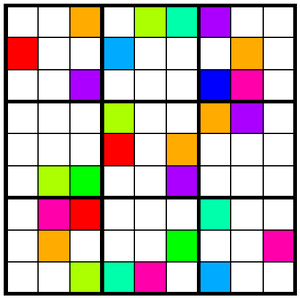
But virtually any set of nine different symbols, characters, numbers, or letters can be used as clues for a Sudoku-style solve. That gives us variations like Picture Sudoku or Color Sudoku, where the same deduction is involved, but the solution is a bit more vibrant.

colorsudokufromalphedotse

[A color Sudoku from Aleph.se.]

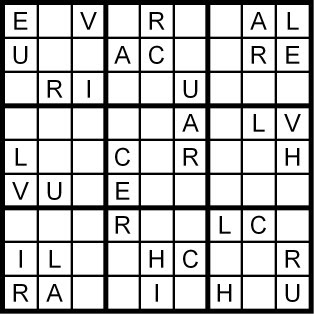
Word Sudoku follows the same concept, replacing the numbers 1 through 9 with letters, allowing for the added bonus of a 9-letter word reading out along one of the rows. I’ve seen Word Sudoku variations in all sorts of languages, which is neat, because you can still solve the puzzle even if you don’t know the language; you’re simply choosing different symbols.

wordsudokufrommagicwordsquareonblogspot

[A Word Sudoku from Magic Word Square on Blogspot.]

Using letters instead of numbers often factors into larger Sudoku puzzles. While Penny/Dell’s Mega Sudoku is a 16×16 grid using the numbers 1 through 16, other large-scale Sudoku puzzles use letters instead of numbers above 10, while others go so far as to remove the numbers altogether, giving you the option of puzzles that span nearly the entire alphabet!

25gridfromcolinjdotcodotuk

[A 25×25 monster Sudoku grid using letters, courtesy of colinj.co.uk]

And since we’re already discussing bigger Sudoku puzzles, it’s worth mentioning smaller Sudoku puzzles. Often called Mini-Sudoku or Sub-Doku, these puzzles start at 4×4 grids (using only the numbers 1 through 4) and increase in size all the way up to the standard 9×9 grid.

Those are just the puzzles that use standard Sudoku rules. There are numerous types of Sudoku that add new rules or curious wrinkles to the standard solve.

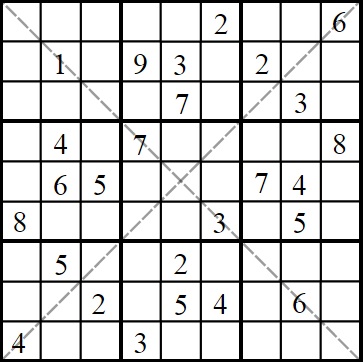
Perhaps the most famous variant is known as Extreme Sudoku, Diagonal Sudoku, or X-Sudoku, and there’s one crucial difference: the numbers 1 through 9 also appear only once along each diagonal. This additional rule helps with solving, but Extreme Sudoku puzzles often have fewer set numbers in order to keep the difficulty level interesting.

extremesudoku

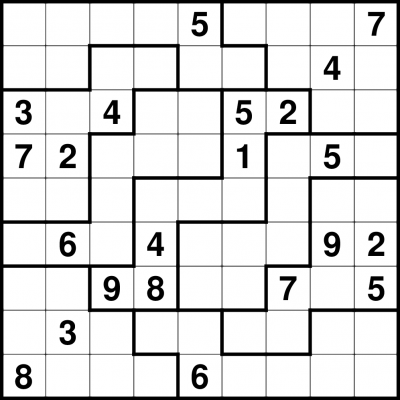
Another popular variation is known as Jigsaw Sudoku or Geometric Sudoku. These puzzles abandon the standard 3×3 boxes, instead using various Tetris-like shapes within the 9×9 grid. Each of these pieces contains each number 1 through 9, and the standard rule of no repeats within a row or a column remains.

These puzzles can either have random shapes or shapes with the same diagonal symmetry that rules both crossword grids and the placement of set numbers in classic Sudoku grids.

jigsawsudokufromanypuzzledotcom

[A Jigsaw Sudoku grid from AnyPuzzle.com]

Some variations involve more deduction as well, like Neighbor Order Sudoku or Greater Than Sudoku. These puzzles feature small arrows that indicate whether the number in a given square is larger or smaller than its neighbor.

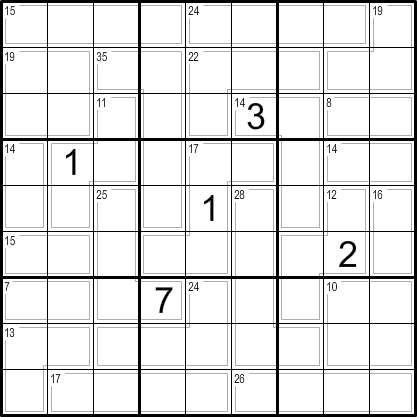
That’s just the start of math-based Sudoku variants that exist. Sum-Doku or Killer Sudoku uses the standard one-per-row, column, and 3×3 box Sudoku rule, but also adds numerous smaller Tetris shapes and boxes, each with a total. The numbers within that smaller box add up to that total.

Those totals are a crucial aid for solving, since Sum-doku puzzles often feature many fewer starting numbers. (The shapes of the smaller boxes often follow the diagonal symmetry of the set numbers.)

sumdokufromcrossworddotnalenchdotcom

[A Sum-Doku grid from Crossword.Nalench.com]

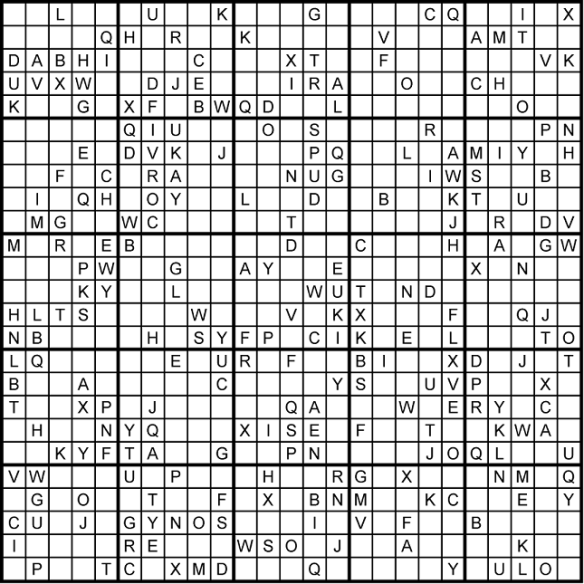
Another popular variant involves overlapping Sudoku grids. You could have two 9×9 grids that share one 3×3 box, or two 9×9 grids sharing four 3×3 boxes, or you could have more grids overlapping in all sorts of ways.

overlappingquadruplesudokufromformsofenjoysudokudotcom

[A quadruple overlapping Sudoku grid, courtesy of the forums of enjoysudoku.com]

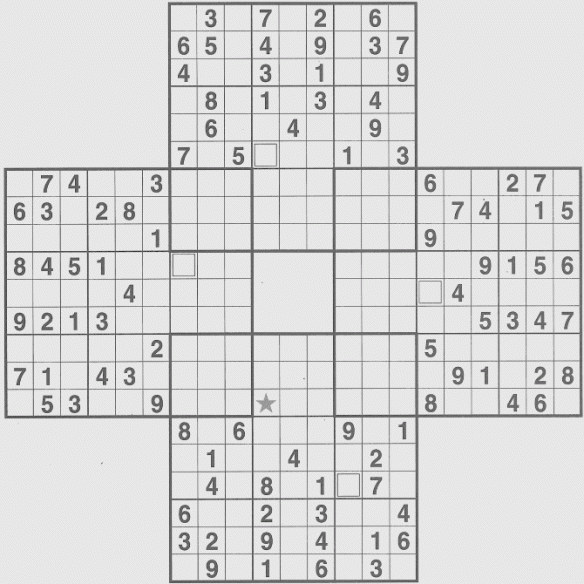
The best known overlapping Sudoku puzzle is probably Samurai Sudoku, which features five 9×9 grids, one at the center and one at each corner, so the 4 corner 3×3 boxes of the center grid link the puzzle together.

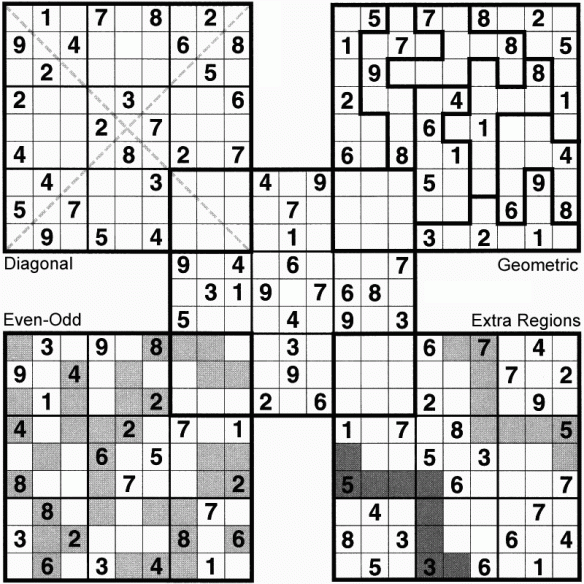
Check out this masterpiece I discovered on mathpuzzle.com:

5-way-hybridsudokufrommathpuzzledotcom

Not only is it a Samurai Sudoku with diagonal symmetry for all the set numbers, but each of the four corner grids operates under a different set of variant rules.

The upper left grid uses Extreme Sudoku (or Diagonal Sudoku) rules, the upper right grid is an asymmetric Jigsaw Sudoku (or Geometric Sudoku), the lower left grid has shaded the location of every even-numbered number to aid your solving, and the bottom right has two shaded ribbons weaving throughout the grid, each of which also includes each number from 1 through 9 once.

As you might expect, there are plenty of variations of Samurai Sudoku. My personal favorite is known as Shogun Sudoku; it’s two linked Samurai Sudoku grids — meaning there are ELEVEN linked 9×9 grids — and there are even larger variations out there for the solver who simply can’t get enough of overlapping Sudoku puzzles.

2014-12-04_10-11-41_260

[Upper left: Tight Fit Sudoku, Upper Right: Thermo Sudoku,
Lower Left: Arrow Sudoku, Lower Right: Consecutive Sudoku.]

Our friends at Penny/Dell Puzzles have several titles that offer a variety of different Sudoku puzzles. The four grids above all appear in various issues of Will Shortz’s WordPlay, all courtesy of Sudoku constructor Thomas Snyder.

You should also check out the Sudoku Spectacular title (featured in our Holiday Puzzly Gift Guide!) as well as their upcoming Will Shortz’s Sudoku title.


I would also be remiss if I didn’t mention the mathier cousins of Sudoku.

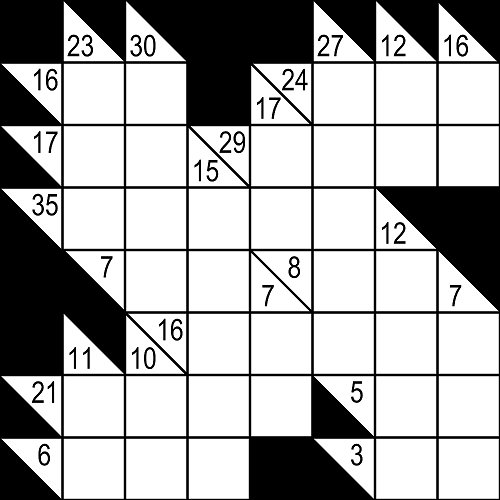
2000px-kakuro_black_box-svg

Kakuro, also known as Cross Sums, follows the same no-repeats rule of classic Sudoku, but the grids are much closer to Crosswords. The numbers along the top and left-side are the total for each row or column, and they are the primary clues for solving the puzzle. Kakuro rarely features set numbers the way Sudoku does, instead opting for a single filled-in row or column to get the solver started.

kenkenfromthemathmagazineonblogspot

[A 6×6 KenKen grid, courtesy of The Math Magazine on Blogspot]

KenKen takes the addition from Sum-Doku and adds subtraction, multiplication, and division to the mix. Each box has a number and a mathematical symbol. The number is the total, and the symbol is how the missing numbers interact to reach that total. For instance, in the upper right corner of the grid, there’s 24X. That means the two missing numbers from that box, when multiplied, equal 24.

And since this is a 6×6 grid, following the same one-per-row and column rules of Sudoku, you know that 4 and 6 are the missing numbers in that box, but you don’t necessarily know where to place them yet.

When it comes to Sudoku, the variations on shapes and layouts are seemingly endless. I’ve seen diamonds and snowflakes, cubes and five-pointed stars, in all sorts of sizes. You can get Samurai Sudoku with 6×6 grids, Jigsaw Sudoku in miniature, and Word Sudoku with Egyptian hieroglyphics.

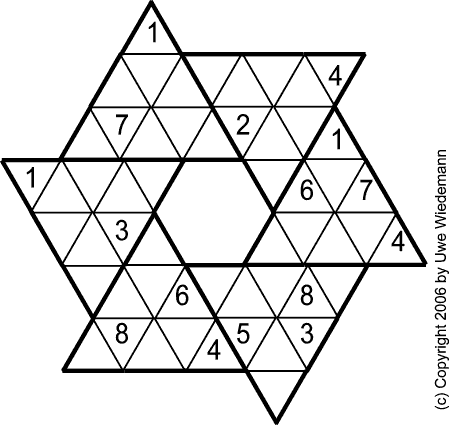
While researching this post, I encountered this marvelous Sudoku variant, which the constructor calls Star Sudoku.

starsudoku1

The numbers 1 through 9 appear once in each triangle, and there are no repeats along any row or slanted column. This puzzle is not only clever, it’s flat-out neat.

So, fellow puzzlers, what’s your favorite variation of Sudoku? Or do you prefer to stick with the classic version? Let me know! I’d love to hear from you!

Thanks for visiting PuzzleNation Blog today! You can share your pictures with us on Instagram, friend us on Facebook, check us out on Twitter, Pinterest, and Tumblr, and be sure to check out the growing library of PuzzleNation apps and games!