It’s Follow-Up Friday: Welsh Landmarks edition!

Welcome to Follow-Up Friday!

By this time, you know the drill. Follow-Up Friday is a chance for us to revisit the subjects of previous posts and bring the PuzzleNation audience up to speed on all things puzzly.

And today, let’s return to the subject of vocabulary and pronunciation!

[Image courtesy of Savethewords.org]

One of the best things about doing puzzles is that you get to learn new words.

Whether they’re obscure or antiquated, hip new slang, borrowings from foreign languages, or simply neat words you’ve never encountered before, these words can be a delight to encounter while solving. (Even if you’re baffled while solving and have to look them up afterward.)

But the problem with some of these words is that if you only see them in print, you might not know how to pronounce them. For instance, it took me quite a long time to connect the written word “quinoa” with the spoken word that sounded like “keen-wah.” I know I’m not alone on that one.

So, imagine, if you will, you’re on vacation in the United Kingdom, and you stumble upon this small town:

Welcome to Llanfairpwllgwyngyllgogerychwyrndrobwllllantysiliogogogoch, a town in Anglesey in the UK.

This 58-character place name is actually only 51 letters long, as certain character groups in Welsh are considered as one letter (LL, NG, and CH among them).

Would you be able to pronounce it? I don’t think I would!

But check out this TV weatherman, who doesn’t blink twice at tackling this mind-boggling word:

Now that’s a puzzler who won’t be daunted by some uncommon vocabulary.


Thanks for visiting PuzzleNation Blog today! You can share your pictures with us on Instagram, friend us on Facebook, check us out on TwitterPinterest, and Tumblr, and be sure to check out the growing library of PuzzleNation apps and games!

PuzzleNation Product Review: Tak•tak

When it comes to strategy puzzle games, no matter how complex or how simple the actual game mechanics, the game itself hinges on the two players involved. After all, two extremely tactical puzzlers can make checkers look like chess.

Now, imagine a game that combines the pattern-matching of Uno, the strategy of chess, and the mechanics of Upwords, and adds a scoring element to boot. It might sound complicated, but I promise, it’s as simple as checkers.

Tak•tak is a two-player strategy scoring game designed by the folks at Twizmo Games, and it’s another puzzle game brought to life thanks to a successful crowdfunding campaign. Although Twizmo Games is best known for twisty puzzles (or Rubik’s Cube-style puzzles), they’ve taken a strong step into the traditional board game market with Tak•tak.

Each player starts with 12 tiles, each tile bearing a different score (10, 20, 30, or 40) and a different color (green, blue, or yellow). The two rows nearest the player form that player’s safe zone. The three rows in the middle are the war zone.

Your goal is to get as many points as possible into your opponent’s safe zone by stacking your tiles, crossing the war zone, and either capturing or maneuvering around your opponent’s tiles. You can only move forward (either straight or diagonally), so this is a game about tactics and initiative.

You build your stacks by matching either point values or colors. For instance, you can stack a yellow 20 and a yellow 40, or a yellow 30 and a green 30, and either of those new stacks would represent 60 points. This enables you to move more tiles around the board quickly. (But careful: once you’ve stacked tiles, they stay stacked for the rest of the game.)

But those matching rules also apply to your opponent’s tiles! When you and your opponent cross paths in the war zone, you can stack your tiles onto theirs and steal those points for yourself. (The stacks you make from your own tiles can only go three tiles high, but stacks made from your tiles AND your opponent’s tiles can go as high as you want! Heck, a stack might change owners several times and tower over the game board!)

The game ends when one player has no more available moves. (There are other ways to end the game if you choose to use the advanced game play rules, but we’ll stick with the basic rules for now.) And then it’s time to count your tiles.

You earn points for all of the tiles you’ve moved into your opponent’s safe zone (including any of your opponent’s tiles that are in stacks you control), plus points for any tiles your opponent never moved into the war zone. (Meaning they were never “in play.”) Highest score wins!

Tak•tak builds a lot of versatility and play possibilities into a game with checkers-simple mechanics, and the more you play, the more fun it is to delve deeper into tactics and strategy. It was worth losing 50 points for keeping a few tiles in my safe zone when they prevented a stack of my opponent’s tiles from scoring.

The clever mix of classic game-play elements not only makes Tak•tak so easy to dive into, but also ensures new players can more time actively playing and less time worrying about learning the rules (a common downfall for more complicated strategy games).

The designers claim the game is appropriate for ages 8 through 108, and I think they’re right on the money.


Thanks for visiting PuzzleNation Blog today! You can share your pictures with us on Instagram, friend us on Facebook, check us out on TwitterPinterest, and Tumblr, and be sure to check out the growing library of PuzzleNation apps and games!

TV Trivia for Tipplers!

[Geeks Who Drink, hosted by Zachary Levi from Disney’s Tangled and NBC’s Chuck.]

Back in July, I discussed The Chase, 500 Questions, and BOOM!, three game shows that represent a resurgence in TV trivia over the last year or so.

Naturally, a week or so after I posted, another trivia-based game show debuted, this time on SyFy: Geeks Who Drink.

Now, bar trivia fans may recognize that name, as Geeks Who Drink is a trivia company that licenses trivia questions for bars all over America to use on Trivia Nights to bring in customers. (My first Geeks Who Drink experience was in Alaska while visiting my sister, and I was pretty impressed by the wide variety of clever questions and themes.)

Like its namesake, punny team names are encouraged on the show. A few of my favorite team names include “Hot Pub Time Machine” and “Beer Me Up, Scotty.”

Unlike its namesake, the TV show version focuses pretty heavily on science fiction and fantasy movies, TV shows, and books. (Understandable, given its host network.)

Whether you’re putting horror movies in order based on the year they debuted, naming as many Stephen King novels as possible, or solving a math problem by adding the number of horcruxes in Harry Potter to the number of wheels on the DeLorean from Back to the Future, you’ll definitely find your knowledge of pop culture put to the test.

[Eric Christian Olsen from NCIS: Los Angeles leads the team “Han Solo Cups.”]

The show also incorporates celebrity guests as team captains and bar-game-style physical challenges — imagine a boozy version of Double Dare — to spice up the show. Now, we have to be a little liberal with the definition of “celebrity guest” here, in the same vein as the “Stars” on Dancing with the Stars, but they do add a lot of humor to each show.

Although it may be a bit too niche for most viewers, I think genre fans in the puzzle community will find plenty to enjoy here. And with each episode only running 30 minutes, it’s an easy time investment.

Geeks Who Drink airs on SyFy at 11 PM Eastern on Thursdays.


Thanks for visiting PuzzleNation Blog today! You can share your pictures with us on Instagram, friend us on Facebook, check us out on TwitterPinterest, and Tumblr, and be sure to check out the growing library of PuzzleNation apps and games!

It’s Follow-Up Friday: Labor Day Puzzles edition!

Welcome to Follow-Up Friday!

By this time, you know the drill. Follow-Up Friday is a chance for us to revisit the subjects of previous posts and bring the PuzzleNation audience up to speed on all things puzzly.

So let’s return to one of my favorite subjects: the Penny Dell Crosswords app!

In addition to offering a free daily puzzle, we’re constantly pushing to provide you with fresh puzzle content and the best crosswords on the mobile market today.

And just in time for your long weekend, we’ve got a brand-new puzzle set for you! It’s our September Deluxe Set!

That’s right, Labor Day weekend is upon us, and our September Deluxe set offers 35 terrific puzzles.

Not only do you get 30 easy, medium, and hard puzzles, but there are 5 themed bonus puzzles you can unlock as you solve! And it’s available for in-app purchase right now!

It’s the perfect puzzly treat for a three-day weekend!


Thanks for visiting PuzzleNation Blog today! You can share your pictures with us on Instagram, friend us on Facebook, check us out on TwitterPinterest, and Tumblr, and be sure to check out the growing library of PuzzleNation apps and games!

PuzzleNation Product Reviews: Fluxx Dice and Adventure Time Fluxx

fluxxdice1

The flagship game of the Looney Labs brand, Fluxx, at its core, is a card game that mixes flexibility and strategy in gloriously chaotic fashion. The basic mechanics of Fluxx — collecting keeper cards in order to complete a certain goal — remain the same each time you play, but with constantly shifting rules and goals (as well as obstacles your fellow players employ), every time you play, it’s a brand new game.

And quite honestly, given how often the rules change during a game, I didn’t think Fluxx could get more chaotic.

Enter Fluxx Dice.

fluxxdice2

Fluxx Dice adds five cards to your Fluxx deck, and they all concern using (or not using) the two Fluxx Dice to change how many cards you draw per turn and how many you play per turn.

The addition of dice-rolling randomness to an already hectic game offers a level of unpredictability that even a well-shuffled deck cannot. Especially since a sufficiently tactical Fluxx player can often overcome the game’s inherent instability with the proper strategy. But no one can prepare for a chance roll of the dice!

Although I’ve only tried Fluxx Dice with the standard game, Batman Fluxx, and today’s other review product so far, I can confidently say that you will not believe how big an impact five little cards and two dice will have on your gameplay. What a terrific way to add a touch more luck and consequence to a game that already employs both so deftly.

This brings us to Adventure Time Fluxx.

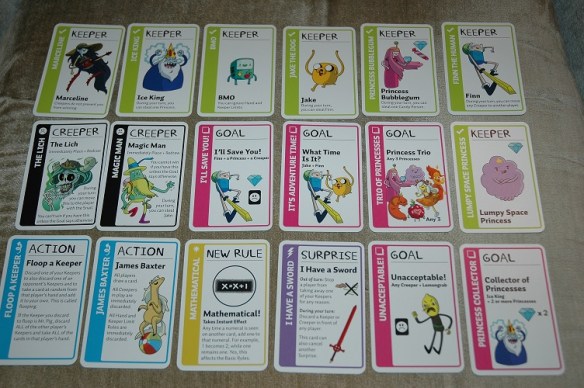
adventuretime1

[A small sampling of cards given the Adventure Time touch.]

Adventure Time is a Dungeons and Dragons-inspired cartoon show about a boy named Finn and his best friend, a shape-shifting dog named Jake, as they have adventures in the Land of Ooo. In a world populated by talking sweets, numerous princesses, and monsters galore, Finn and Jake must deal with the return of magic to the world and the aftermath of the Great Mushroom War.

As you can see, the show’s fingerprints are all over this themed Fluxx deck, and given that the show itself has a very strong “anything can happen” vibe to it, this is clearly a match made in heaven.

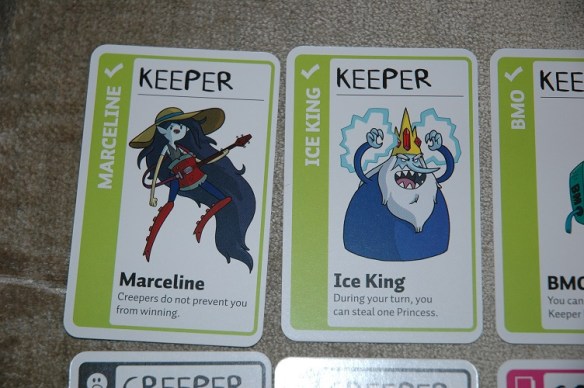
adventuretime2

[Two of my favorite characters become valuable Keeper cards in this edition of Fluxx.]

Although I hoped some of the cards would offer fans of the show gameplay incentives — akin to the Batman Fluxx card that rewarded players wearing something with the Batman symbol on it — my fellow players and I did come up with an appropriate Adventure Time-fueled variant.

Each time a keeper card was played, the person who played it had the opportunity to repeat a quote or popular line from that character. If they did so, they received either an additional card to be played immediately OR a roll of the Fluxx Dice to alter the current rules of the game.

For a show that rewards sharp-eyed attentive viewers with in-jokes and humor, this felt like a suitably Adventure Time-y wrinkle to add to the game.

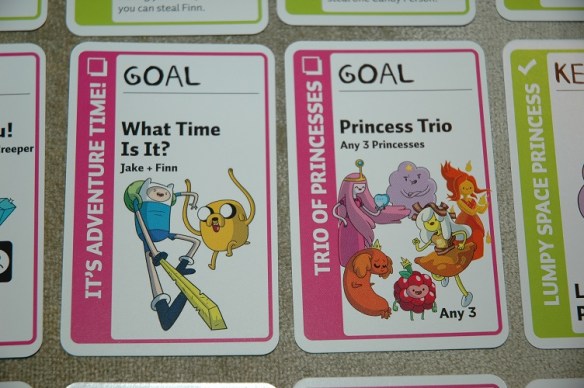
adventuretime3

The family of Fluxx games continues to grow, and although Adventure Time Fluxx didn’t really bring anything new to the table gameplay-wise, the immense charm of its themed cards and references to the show still make it a worthwhile addition to any Fluxx fan’s collection.

And as for Fluxx Dice, it may be a small set, but in terms of sheer gameplay impact, it packs one heck of a punch.


Thanks for visiting PuzzleNation Blog today! You can share your pictures with us on Instagram, friend us on Facebook, check us out on TwitterPinterest, and Tumblr, and be sure to check out the growing library of PuzzleNation apps and games!

A Guide to Crossword Clues

[Image courtesy of npr.org.]

For someone who has never solved a crossword before — or has solved them before with less-than-stellar results — the field of clues that accompanies the grid is a daunting sight.

But if you take those clues one at a time, you’ll quickly find that there are different kinds of crossword clues, each with their own flavor and level of difficulty.

Now, I’m referring to American-style crosswords here. Cryptic or British-style crosswords have a completely different language when it comes to cluing. (Let me know if you’d like me to do a post on cryptic cluing!)

By far the most common style of crossword cluing is the synonym clue. The default form of cluing is simply offering a synonym or definition of the word. You practically can’t have a crossword puzzle without at least one.

Some recent examples of synonym clues from our Crossword Clue Challenge every weekday on Facebook and Twitter include “Before sunrise” for PREDAWN, “Ample” for ENOUGH, and “Talent” for KNACK. Simple and straightforward.

Another common cluing form is the fill-in-the-blank clue.

These clues can vary wildly in difficulty depending on how much information is offered. For instance, “Quentin Tarantino’s ____ Fiction” is a super-easy clue, whereas “____ Sea” would be pretty tough, even knowing how many letters are in the answer.

Along the same lines are the see-also clues. These are clues that reference other clues in the same puzzle, often by spreading a multiple-word answer across several entries.

For instance, you look at 3 Across, and it says “See 9 Down.” And when you look at 9 Down, it says, “With 3 Across, popular song by The Verve.” But you might need help from the crossings to get BITTER SWEET SYMPHONY reading across several spaces in the grid.

[Wait, wrong Clue…]

Some clues offer more information than you expect, if you’re observant. For instance, it’s common in many crosswords to signal a variant spelling, a foreign word, or an abbreviated word as an answer within the clue.

For instance, if the answer is AMEER (instead of EMIR), you might clue it as “Moslem chief” instead of “Muslim chief” to indicate the variant spelling. For REP, a standard clue would be “D.C. fig.” For SRA — short for SENORA — you might get “Mrs., in Madrid”.

(You can also employ wordplay with entries like these. For a French-fueled clue, how about “Nice, in Nice” for BIEN?)

And that serves as a marvelous segue into our final crossword cluing style: wordplay clues!

[Image courtesy of Rocky Smith Files.]

Wordplay clues employ some sort of pun or linguistic trickery to take them a step beyond the average clue. Often, these clues are marked with a question mark, indicating that there’s something going on beyond the surface meaning of the clue.

As you’d expect, wordplay clues are a favorite of mine, and they’ve been featured several times in our weekday Crossword Clue Challenge. Some previous examples include “Tot rod?” for TRICYCLE, “Tread the boards?” for WALK THE PLANK, “Star trek?” for SPACEWALK, and “Take the honey and run?” for ELOPE.

If you’ve never solved a crossword before — or never had much luck with them in the past — hopefully you’ll find some helpful tools here to guide you toward crossword-solving success.

And hey, if you need more practice, you can always check out the Crossword Clue Challenge every day at 2 PM EST on Facebook and Twitter!

Good luck!


Thanks for visiting PuzzleNation Blog today! You can share your pictures with us on Instagram, friend us on Facebook, check us out on TwitterPinterest, and Tumblr, and be sure to check out the growing library of PuzzleNation apps and games!