It’s Follow-Up Friday: ACPT View a Clue answers!

Welcome to Follow-Up Friday!

Follow-Up Friday is an opportunity to look back on past posts and puzzly topics. Whether we’re updating you with new developments, providing answers to a previously posted brain teaser or puzzle, or simply revisiting a subject with a fresh perspective, Follow-Up Friday lets us look back and look forward.

In today’s post, I’ve got the answers to last Friday’s pre-ACPT edition of the View a Clue game!


If you recall, we selected ten animals that commonly show up in crossword grids — some have become crosswordese at this point — to see if the PuzzleNation audience could identify them from pictures.

So, without further ado, let’s get to it!


#1 (3 letters)

Answer: GNU, also known as a wildebeest

#2 (4 letters)

Answer: LYNX, a wild cat native to the colder regions of the Northern Hemisphere

#3 (6 letters)

Answer: ONAGER, a wild Asian donkey-like animal

#4 (4 letters)

Answer: RHEA, a flightless South American bird

#5 (6 letters)

Answer: IMPALA, an African antelope

#6 (9 letters)

Answer: SPRINGBOK, an African gazelle

#7 (4 letters)

Answer: ZEBU, a humpbacked bull native to India

#8 (5 letters)

Answer: COYPU, a South American beaverlike rodent, also known as a nutria

#9 (4 letters)

Answer: KUDU, another type of African antelope

#10 (5 letters)

Answer: HYRAX, a rodent-sized relative of the elephant, native to Africa and Asia


How did you do? Let us know in the comments below!

Thanks for visiting PuzzleNation Blog today! Be sure to sign up for our newsletter to stay up-to-date on everything PuzzleNation!

You can also share your pictures with us on Instagram, friend us on Facebook, check us out on Twitter, Pinterest, and Tumblr, and explore the always-expanding library of PuzzleNation apps and games on our website!

Other puzzles you might not know! (Volume 3)

In previous editions of this series, we’ve presented some new puzzles for crossword devotees and Fill-In fans to try out. Today, let’s turn our attention to Sudoku enthusiasts.

Now, before we talk about other types of puzzles, there are numerous Sudoku variants to choose from, if you’d like just a little twist on the familiar Sudoku formula. In fact, I did an entire blog post about them, as well as posts about new variants like Will Sudoku and Pentdoku Puzzles!

There are a few lesser-known number-placement puzzles out there that might scratch your puzzly itch if you’re a Sudoku fan: Futoshiki and Beehive Hidato.

[Futoshiki image courtesy of PuzzleMagazine.com.]

Futoshiki will seem fairly familiar, since the row and column rules of Sudoku are in effect. But you have an additional placement rule to consider: the less than/greater than signs in the grid, which indicate where to place lower or higher numbers in the grid. (Futoshiki translates to “not equal” in Japanese.)

[Hidato image courtesy of TheGuardian.com.]

Beehive Hidato eschews the traditional Sudoku row/column system of the deduction in favor of chain-placement of numbers in its hexagonal grid. Your goal is to fill every cell in the grid by filling in the missing numbers between 1 and the highest number. So, instead of placing the same numbers in every row and column, you’re placing a different number in each cell, forming a single chain from 1 to the last number.

The cell containing the number 1 must neighbor the cell containing the number 2, and the cell containing the number 2 must neighbor the cell containing the number 3, and so on, all the way around the grid.

If you’re looking to go a little farther afield and leave numbers behind, I’ve got you covered.

After all, some people tend to think of Sudoku as a math puzzle, but it’s really not; it’s more of a deduction and placement puzzle. You could check out not only Fill-Ins, but also all the puzzles I’ve previously recommended for Fill-In fans. That’s a great place to start.

You could also try your hand at Brick by Brick.

[Click here or on the grid for a larger version.]

Brick by Brick puzzles are a terrific bridge between placement puzzles and crosswords, using aspects of both. You’re given the complete first row of a crossword, and all of your clues, both across and down.

But, instead of the black squares you’d normally rely on to help guide you through answering those clues and placing your words, you’ve got 3×2 bricks filled with letters and black squares, a scrambled jigsaw puzzle to reassemble.

Here you can use your deductive Sudoku skills to place black squares and entire bricks into the grid as you apply crossword-solving skills toward answering the across and down clues, working back and forth between the two to complete your grid, assembling chunks of answer words as bricks fit neatly together.

And if you prefer quote puzzles to crossword puzzles, there’s always Quotefalls.

[Click here or on the grid for a full page of Quotefalls.]

Quotefalls gives you all of the letters in a given quote, plus the black squares that separate each word from the next. But it’s up to you to figure out where in each column to place the letters above so that the quotation reads out correctly.

Sometimes that’s easy, like in the fourth column of puzzle 2 above. Since there’s three black squares and only one open square, you know exactly where that E will go. Seedling letters like that can go a long way toward helping you fill each word, and eventually, the entire quote.

It’s a different form of deduction, but one not too terribly far from the number-placement solving of Sudoku.

Any one of these puzzles could add some welcome variety to your puzzle solving, while still honoring the style and play inherent in your favorite puzzle. Give them a shot, and let us know how you like them.


Next time, we’ll be tackling recommendations for Cryptogram fans, but if you’ve got puzzle recs for your fellow puzzlers in the meantime, please let us know in the comments!

Thanks for visiting PuzzleNation Blog today! Be sure to sign up for our newsletter to stay up-to-date on everything PuzzleNation!

You can also share your pictures with us on Instagram, friend us on Facebook, check us out on Twitter, Pinterest, and Tumblr, and explore the always-expanding library of PuzzleNation apps and games on our website!

Follow-Up Friday: ACPT View a Clue edition!

Welcome to Follow-Up Friday!

Follow-Up Friday is an opportunity to look back on past posts and puzzly topics. Whether we’re updating you with new developments, providing answers to a previously posted brain teaser or puzzle, or simply revisiting a subject with a fresh perspective, Follow-Up Friday lets us look back and look forward.

In today’s post, we’ve got another edition of the View a Clue game!

In fact, the PuzzleNation audience is getting the first look at the View a Clue game I’ve put together for the American Crossword Puzzle Tournament this weekend!

We’ve got ten animals that commonly show up in crossword grids — some have become crosswordese at this point — and I want to see if the PuzzleNation audience can identify them from pictures. It’s a visual puzzle I call View a Clue!

And, as an extra treat, people who submit their answers will have a chance to win a copy of Scrimish, provided by the creative team behind that terrific card game!

So, without further ado, let’s get to it!


#1 (3 letters)

#2 (4 letters)

#3 (6 letters)

#4 (4 letters)

#5 (6 letters)

#6 (9 letters)

#7 (4 letters)

#8 (5 letters)

#9 (4 letters)

#10 (5 letters)


Submit your answers in the comments below (or reach out to us across all of our social media platforms) for a chance to win! Good luck, and enjoy!

Thanks for visiting PuzzleNation Blog today! Be sure to sign up for our newsletter to stay up-to-date on everything PuzzleNation!

You can also share your pictures with us on Instagram, friend us on Facebook, check us out on Twitter, Pinterest, and Tumblr, and explore the always-expanding library of PuzzleNation apps and games on our website!

A puzzle in your pocket

Brain teasers come in all shapes and sizes, but there’s one particular brand of brain teaser that fits in your pocket. Today we’re talking about matchstick puzzles (or toothpick puzzles).

Matches as we know them (relying on friction to ignite, rather than dipping or crushing) were invented in 1826 by English chemist John Walker, and in the decades that followed, numerous improvements were made, especially in terms of safety and ease of use. Matchsticks soon grew ubiquitous and match companies started putting little puzzles on their boxes.

And the matchstick puzzle was born.

(I have no historical documentation to back me up on this, but I suspect that bar bets also played a role in the rise of matchstick puzzles, because the sort of cleverness and trickery that goes into solving some of these puzzles would be perfectly at home in the repertoire of someone looking to con a few free drinks out of fellow tipplers.)

So, for the uninitiated, what are matchstick puzzles?

These are rearrangement or transformation puzzles, where you’re given a certain shape (laid out in matchsticks, toothpicks, straws, pencils, or anything else of equal length), and you have to move the items into another shape or configuration. Sometimes, it’s simply about placing the matchsticks economically, but other times, you have to get crafty and think outside the box to complete your task.

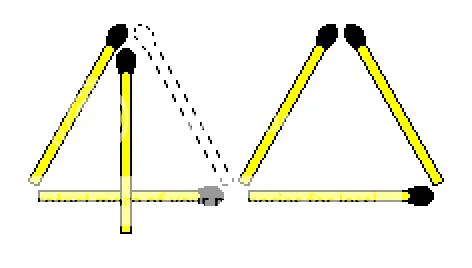
For instance, here’s the first matchstick puzzle I ever remember seeing:

[This image, and the one below, courtesy of Matchstick Puzzles on Blogspot.]

You have two triangles formed from six matchsticks. Move one matchstick to make four triangles.

Now, you could easily use all of these matchsticks to make four triangles, but that would involve moving more than one of them. So clearly there’s something else at work here if you only need to move one to solve the puzzle.

That something, in this case, is a little visual trickery.

As you can see, you turn one triangle into a numeral four, making the matchsticks literally read out “4 triangle.” Sneaky sneaky.

There are literally hundreds of these puzzles if you go hunting for them. (I found a treasure trove of them here.)

A curious variation, though, applies the same rules to mathematical formulas laid out in matchstick form.

Here’s one that’s been making the rounds on Facebook recently:

Now, the big difference between these mathematical ones and the shape ones mentioned above, as far as I’ve found, is that the math ones are far more alternate prone.

For instance, this equation puzzle has at least four solutions that I’ve found:

  • You can move one match to make the 6 a 0, so that 0+4=4.
  • You can move one match from the 6 to the second 4 to make the 6 a 5 and the 4 a 9, so that 5+4=9.
  • You can move one match from the plus sign to the 6 to make the plus sign a minus sign and the 6 an 8, so that 8-4=4.
  • You can move one match from the plus sign to the equal sign to make the plus sign a minus sign and the equal sign a doesn’t-equal sign, so that 6-4 does not equal 4.

As you can see, with matchstick puzzles,  the possibilities are endless and the building blocks — whether matches, toothpicks, Q-Tips, or straws — are easily accessible.

I’ll leave you one more to ponder, this time provided by the folks at IO9:

Using six matchsticks of equal length, create four identical, equilateral triangles. There’s no need for snapping, burning, or otherwise altering the matchsticks.

Good luck!


Thanks for visiting PuzzleNation Blog today! Be sure to sign up for our newsletter to stay up-to-date on everything PuzzleNation!

You can also share your pictures with us on Instagram, friend us on Facebook, check us out on Twitter, Pinterest, and Tumblr, and explore the always-expanding library of PuzzleNation apps and games on our website!

Follow-Up Friday: Other puzzles you might not know! (Volume 2)

Welcome to Follow-Up Friday!

Follow-Up Friday is an opportunity to look back on past posts and puzzly topics. Whether we’re updating you with new developments, providing answers to a previously-posted brain teaser or puzzle, or simply revisiting a subject with a fresh perspective, Follow-Up Friday lets us look back and look forward.

In today’s edition, now that we’ve presented some new puzzles for crossword devotees to try out, let’s turn our attention to Fill-In puzzle fans.

Fill-Ins feature the same grid-filling solving as crosswords, but instead of coming up with the answers to clues, you’re given all of the words in advance, organized by length, and it’s up to you to deduce which words fit the across boxes and which fit the down boxes.

Fill-Ins don’t demand the same level of recall and vocabulary as crosswords, but the deduction aspect more than makes up for it. And if you’re a Fill-In fan, but looking for something different, there are plenty of options out there for you.

Like Frameworks, for instance.

[Click here or on the grid for a larger version.]

A Framework puzzle is like a Fill-In, but without the rigid crossword-style grid. Instead, the grid is looser, allowing for longer words and interesting themes to be incorporated into the puzzle. The trade-off here is that, with fewer letters crossing, you have fewer hints for placing words in the grid. You’ll have to rely on knowing word lengths and counting boxes to complete these grids.

But for something a little less familiar, how about Places, Please?

[Click here or on the grid for a larger version.]

Places, Please gives you all of the words to place in the grid, just as Fill-Ins do, but there are no black squares to help guide you. Instead, you’re told where the first letter of each word will be placed, and you have to figure out in which direction each word will read.

You’ll want to start with the longest words first, seeing which directions will allow them to be placed. As you place each word, those letters offer clues for placing other words. Eventually, you’ll fill the entire grid! (It’s like a word seek in reverse!)

And if that’s a bit too open-ended for you, let’s talk Stretch Letters.

[You get the idea.]

Stretch Letters puzzles offer the same word-list format as Fill-Ins (organized by word length), but you’ll only enter them reading across. The wrinkle here is that some of the words above and below each row will share those letters, stretching the boxes (and the letters themselves).

It’s a visually striking take on word-placement puzzles, and the stretched letters make for a fun and interactive grid. One S could provide S’s for a half-dozen words or more!

Of course, if you enjoy the deductive side of Fill-Ins — figuring out word placement in the grid — you should also consider trying traditional Logic Puzzles.

[Yup.]

Now, I know these grids can seem a little daunting to new solvers, but they’re simply a way of organizing information. As you work your way through the different clues in the Logic Puzzle, you exclude possibilities in the grid by putting an X in the box where those two options cross.

For instance, in the above Logic Problem, based on clue 7, you’d place an X in the box where Esther (listed under First Name) crosses Tyson (listed under Last Name), eliminating it as a possibility.

The more boxes you fill with X’s, the greater the amount of information you garner from the grid, and eventually, you’ll know their full names, ages, and instrument of choice based on those seven clues. Pretty impressive deduction there.


Next week, we’ll take a break from these puzzle recommendations posts, but if you’ve got puzzle recs for your fellow puzzlers in the meantime, please let us know in the comments!

Thanks for visiting PuzzleNation Blog today! Be sure to sign up for our newsletter to stay up-to-date on everything PuzzleNation!

You can also share your pictures with us on Instagram, friend us on Facebook, check us out on Twitter, Pinterest, and Tumblr, and explore the always-expanding library of PuzzleNation apps and games on our website!

Other puzzles you might not know! (Volume 1)

We’re all puzzle fans here, right? And sometimes we need something new, something fresh and engaging to rejuvenate our love of puzzles. We know all the classics — crosswords, fill-ins, logic puzzles, word seeks, Sudoku, cryptograms, and anagram puzzles — but there’s a whole wide world of puzzles out there to explore that you might not even know about!

So, in today’s post, I’m going suggest some puzzles to check out, based on each of those classic solving experiences.


Let’s start with crosswords.

From the New York Times and LA Times crossword puzzles to the Penny Dell Crossword App, there’s no shortage of terrific crosswords of all difficulty ranges awaiting solvers.

But there are also some terrific variant crosswords for you to try out, like Double Trouble.

[Click here or on the grid for a larger version, complete with clues.]

In a Double Trouble crossword, you can put one, two, or three letters into a box, making for a more difficult solve that the standard one-letter one-box crossword.

But if you want to go a little farther afield, you can try something like Marching Bands.

[Image courtesy of Brendan Emmett Quigley’s website.]

A Marching Bands puzzle has two sets of clues. The first set clues the rows reading across, with two clues per line. But the second set is where things get interesting. See those alternating rings of light and dark shading? The second set clues words reading clockwise along those rings, or bands.

So instead of words meshing across and down, as in a standard crossword, you have across clues and band clues interacting to help you fill the grid. It’s a wonderful variation on familiar crossword rules, but one challenging enough to keep you interested. (For a more in-depth look, click here!)

But maybe you like crossword cluing but you’d like an answer more interesting than just a grid filled with words. Fair enough, have you ever tried Crostics?

[Click here or on the grid for a larger version.]

Crostics, also known as Anacrostics (from our friends at Dell Magazines) or Acrostics (as made by friend of the blog Cynthia Morris), feature a series of clues and letter blanks to be filled.

Those letter blanks each have coordinates assigned, so that when you fill the correct letters into those blanks, you’re also filling blanks in a grid below to spell out a bonus message, quotation, or anecdote. (It’s a one-to-one ratio, so each letter blank corresponds to a letter blank in the grid. If there’s one J in the message, you’ll find a J in the answer words.)

Although you don’t have the overlapping entries to help you puzzle out answers like crosswords or Marching Bands do, you can use the grid below as a solving aid. As each word in the message emerges, you can fill in those letters in the blanks above (using those same coordinates).

And for something along the same vein, you’ve got Word Games Puzzles.

[Click here or on the grid for a larger version.]

You still get the message reading out in a grid and the letter blank coordinates like in Crostics, but instead of a bunch of crossword-style clues, you instead get four mini-games to solve. One might be trivia or encryption, another might involve some wordplay, another might offer themed clues, and the fourth might be an anagram game.

Each will challenge you in different ways, and the use of repeated letters — a change from Crostics with their one-to-one letter blank to grid letter ratio — gives you more than one chance to fill in the final message.

Hopefully, one or more of these puzzles will pique your interests and offer a welcome new solving experience!


Next week, I’ll have recommendations for fans of Fill-In puzzles, and in future installments, we’ll tackle word seeks, logic puzzles, Sudoku, and more! If you’ve got recommendations for your fellow puzzlers, please let us know in the comments!

Thanks for visiting PuzzleNation Blog today! Be sure to sign up for our newsletter to stay up-to-date on everything PuzzleNation!

You can also share your pictures with us on Instagram, friend us on Facebook, check us out on Twitter, Pinterest, and Tumblr, and explore the always-expanding library of PuzzleNation apps and games on our website!