By this time, you know the drill. Follow-Up Friday is a chance for us to revisit the subjects of previous posts and bring the PuzzleNation audience up to speed on all things puzzly.
And today, I’d like to return to the subject of puzzly holidays!
Saturday, April 30, is the fourth annual International TableTop Day, a day that has been set aside for family and friends to get together and play games. Board games, card games, role-playing games, puzzles…anything that involves gathering in person and having fun around a table fits the bill!
Although the actual holiday is tomorrow — making today TableTop Day Eve — we celebrated early! The PuzzleNation Crew got together with our friends from Penny Dell Puzzles for a few hours of TableTop Day fun on Tuesday! Games were played, snacks were consumed, and fellow puzzlers and PuzzleNationers were introduced to some terrific games.
[The spread of games available for the event. Can you name them all?]
As usual, the event started with people picking out their favorites and introducing new players to the game. This was the case with Just Desserts (a card game all about serving desserts to hungry customers; guaranteed to make you hungry) and Timeline (a card game about history where you don’t need to know what year things happened, just if they happened before or after other important moments).
One attendee opted to tackle the challenge of Puzzometry (a diabolical jigsaw puzzle) while I played a few rounds of Geek Out! and tested the pop culture and trivia knowledge of my fellow puzzlers.
[The conference room is abuzz with TableTop Day energy and fun, players strategizing deeply.]
I started recommending some new games to the players at this point, and the hit of the day was easily Red Flags, a Cards Against Humanity-style game all about building the perfect dates for other players.
The uproarious laughter inspired by the game was constant background noise while I explained the ever-changing rules of Fluxx to some curious players.
[Forgive the lack of further photos. I was so busy explaining games that I neglected to take more pictures. As a small gesture of apology, please accept this picture of me beneath a half-collapsed puzzle fort.]
We then closed out the event with two terrific card games for smaller groups: 12 Days and Loonacy. (12 Days is a lowest-card-wins wagering game based on the 12 Days of Christmas, and it has the most beautiful cards I’ve ever seen; Loonacy is a pattern-matching card game that rewards quick reflexes.)
The day was a total success, and it was a wonderful break in the middle of the day, allowing for a fun way to interact and recharge before returning to a thoroughly puzzly workday.
But that wasn’t all! To include fellow puzzlers who couldn’t attend the event in person, we had our own in-house session of Schmovie running all day.
I gave participants five What? cards (Undercover, Magical, Teenage, Flying, The Last) and five Who? cards (Barista, Chef, Princess, Pro Wrestler, Spy) to combine as they saw fit, and then challenged them to come up with the funniest Schmovie titles for those subjects.
Here are a few of my favorites:
Undercover chef: The Tsai Who Loved Me
Teenage barista: Latte to Class
Magical barista: Starbucks: The Foam Awakens
Teenage princess: Medieval Times at Ridgemont High
Flying spy: The Airborne Identity
Undercover princess: Leia Confidential
Are you celebrating TableTop Day? Let us know your plans in the comments! We’d love to hear about it, see photos, and share in the fun!
Thanks for visiting PuzzleNation Blog today! Be sure to sign up for our newsletter to stay up-to-date on everything PuzzleNation!
I recently read in Owen O’Shea’s book The Call of the Primes that there are 5,472,730,538 unique solutions for a 9×9 Sudoku grid.
Yes, five billion is a very big number, but these days, billions aren’t what they used to be. I mean, think about how many newspapers, magazines, and puzzle books feature Sudoku puzzles. It’s a huge amount of material every year.
So, the thought occurs to me…how long before those 5,472,730,538 unique solutions run out?
To be fair, it’s not like reaching Peak Oil or a point of no return. I’ve solved a lot of Sudoku puzzles, and never once have I felt like I was re-solving a grid I’ve seen before, even if I was. This is purely a matter of mathematical curiosity. How long would it take for us to use up every last possible 9×9 grid?
Man, where do I begin?
Well, if I’m going to talk Sudoku puzzles, it makes sense to start with our friends at Penny Dell Puzzles.
Across seventeen Sudoku titles, they publish approximately 23,236 Sudoku puzzles a year, and probably an additional 350 per year across their Crossword/Variety and Variety titles for a total of 23,586 puzzles in a calendar year.
Now, Penny Dell Puzzles is the top puzzle publisher in North America — #humblebrag — and let’s assume there are another half-dozen publishers worldwide matching their output. That gives us a ballpark of 165,100 Sudoku puzzles published worldwide.
But what about newspapers?
According to the Newspaper Association of America, there were 1,331 daily newspapers in 2014, and there were 1,450 daily newspapers in 2005, making an 8.2% decrease from a decade before. If we apply that percentage to the number of daily newspapers worldwide as of 2005, 6,580 titles, we get 6,040 daily newspapers worldwide. And although they may not ALL have a daily Sudoku, this will help cover some of the major magazines that also carry Sudoku that I’ve excluded from my ballpark calculations.
That gives us 6,040 newspapers x 365 puzzles a year for a total of 2,204,600 puzzles a year.
Now, for other publishing efforts regarding Sudoku, Amazon.com lists 20,718 results for Sudoku, and if we apply an average of 217 puzzles per title — which seems a fair approximation, based on the stats published by our friends at Penny Dell Puzzles, the fact that some books will have more puzzles, and some results will be ABOUT Sudoku and probably contain few to none actual puzzles — that’s 4,495,806 puzzles available right now in the world’s biggest bookstore. (Yes, obviously not all of them were published this year, but hey, this is meatball mathematics.)
Unfortunately, statistics on Sudoku are sketchy at best for the mobile app market, online puzzling, and downloadable puzzles through Playstation Network, Wii, and other gaming platforms, so I can’t factor those puzzles into my calculations.
But just with the numbers I’ve got here, we’re talking about 6,865,506 Sudoku puzzles worldwide. So, if each of those Sudoku puzzles is unique — which is possible, if unlikely — that barely makes a dent in our total of possible Sudoku grid layouts, which you recall is 5,472,730,538.
So, if we’re producing 6,865,506 unique Sudoku puzzles a year, it’ll take nearly 800 years to use every possible 9×9 grid! (For the folks at Penny Dell Puzzles, it would take nearly 232,033 years! So they’re in the clear. *laughs*)
I guess we won’t be running out anytime soon.
Thanks for visiting PuzzleNation Blog today! Be sure to sign up for our newsletter to stay up-to-date on everything PuzzleNation!
By this time, you know the drill. Follow-Up Friday is a chance for us to revisit the subjects of previous posts and bring the PuzzleNation audience up to speed on all things puzzly.
You may be familiar with the board game Schmovie, hashtag games on Twitter, or@midnight’s Hashtag Wars segment on Comedy Central.
For the last few months, we’ve been collaborating on puzzle-themed hashtag games with our pals at Penny Dell Puzzles, and this month’s hook was #PennyDellPuzzleComedy, mashing up Penny Dell puzzles and anything and everything having to do with stand-up comics, film and television comedians, funny movies, funny shows, funny plays… even one-liners or jokes!
Examples include: David Letterboxesman, The Three Anagr-amigos, or “Take a Letter, Please!”
So, without further ado, check out what the puzzlers at PuzzleNation and Penny Dell Puzzles came up with!
Puzzle Comedians!
Rodney Danger-Textfields
George Carlinkwords
“Weird Al”-phagrid Yankovic
Dr. Dementossing and Turning
Fill-In Diller / Phyll-Ins Diller
Kenken Jeong
David Cross Pairs
Lewis Blackout!
Andrew Dice Game
Cryptomedian Adam Scrambler
Rows-anne Garden
Alphabet Soupy Sales
Dan Ayk-wordplay
Gilda-Quote Radner
Rose-anagrams Rose-anagrams Dannagrams
Puzzle Comedy Films!
History of the World, Part One and Only
Happy Fill-in More!
Meet the Frameworks
You Don’t Maze with the Zohan
Austin Flower Powers
April Sillycrostics!
Four Square Weddings and a Funeral
Three from Nine to Five
Roxanne-agrams
Across and Down and Out in Beverly Hills
Alphabet Duck Soup
Animal Crackers House
Puzzle Comedy TV Shows!
A Bits and Pieces of Fry and Laurie
Two for One and a Half Men
Rowan and Martin’s Fill-In
Three of a Kind’s Company
“I Love Loosey Tiles!”
Saturday Night Line ‘Em Up
Sanford and Sunrays
All in the Family Ties
Happy Daisy
Leave It to Weaver Words
The Odds and Evens Couple
[Plus there were a few Seinfeld references in puzzly form:]
“By the way, they’re real, and they’re Sudoku Spectacular!”
“The Bubbles Boy”
Puzzle Jokes and Routines!
“Who’s on first and last?” / “Who’s Calling on first! What’s Left on second!”
Knock, Knock! Who’s Calling?
Why did the chicken cross the Middle of the Road? To get to the other Slide-o-gram!
“Nehh…What’s Left, Doc?”
How do you send a message to a skeleton? By Crypt-O-Gram!
What do you get when you insult a puzzle editor’s work? Cross words!
Have you heard about the most amazing Framework ever constructed? It was a Revelation!
In previous editions of this series, we’ve presented some new puzzles for crossword devotees and Fill-In fans to try out. Today, let’s turn our attention to Sudoku enthusiasts.
Now, before we talk about other types of puzzles, there are numerous Sudoku variants to choose from, if you’d like just a little twist on the familiar Sudoku formula. In fact, I did an entire blog post about them, as well as posts about new variants like Will Sudoku and Pentdoku Puzzles!
There are a few lesser-known number-placement puzzles out there that might scratch your puzzly itch if you’re a Sudoku fan: Futoshiki and Beehive Hidato.
Futoshiki will seem fairly familiar, since the row and column rules of Sudoku are in effect. But you have an additional placement rule to consider: the less than/greater than signs in the grid, which indicate where to place lower or higher numbers in the grid. (Futoshiki translates to “not equal” in Japanese.)
Beehive Hidato eschews the traditional Sudoku row/column system of the deduction in favor of chain-placement of numbers in its hexagonal grid. Your goal is to fill every cell in the grid by filling in the missing numbers between 1 and the highest number. So, instead of placing the same numbers in every row and column, you’re placing a different number in each cell, forming a single chain from 1 to the last number.
The cell containing the number 1 must neighbor the cell containing the number 2, and the cell containing the number 2 must neighbor the cell containing the number 3, and so on, all the way around the grid.
If you’re looking to go a little farther afield and leave numbers behind, I’ve got you covered.
After all, some people tend to think of Sudoku as a math puzzle, but it’s really not; it’s more of a deduction and placement puzzle. You could check out not only Fill-Ins, but also all the puzzles I’ve previously recommended for Fill-In fans. That’s a great place to start.
Brick by Brick puzzles are a terrific bridge between placement puzzles and crosswords, using aspects of both. You’re given the complete first row of a crossword, and all of your clues, both across and down.
But, instead of the black squares you’d normally rely on to help guide you through answering those clues and placing your words, you’ve got 3×2 bricks filled with letters and black squares, a scrambled jigsaw puzzle to reassemble.
Here you can use your deductive Sudoku skills to place black squares and entire bricks into the grid as you apply crossword-solving skills toward answering the across and down clues, working back and forth between the two to complete your grid, assembling chunks of answer words as bricks fit neatly together.
And if you prefer quote puzzles to crossword puzzles, there’s always Quotefalls.
[Click here or on the grid for a full page of Quotefalls.]
Quotefalls gives you all of the letters in a given quote, plus the black squares that separate each word from the next. But it’s up to you to figure out where in each column to place the letters above so that the quotation reads out correctly.
Sometimes that’s easy, like in the fourth column of puzzle 2 above. Since there’s three black squares and only one open square, you know exactly where that E will go. Seedling letters like that can go a long way toward helping you fill each word, and eventually, the entire quote.
It’s a different form of deduction, but one not too terribly far from the number-placement solving of Sudoku.
Any one of these puzzles could add some welcome variety to your puzzle solving, while still honoring the style and play inherent in your favorite puzzle. Give them a shot, and let us know how you like them.
Next time, we’ll be tackling recommendations for Cryptogram fans, but if you’ve got puzzle recs for your fellow puzzlers in the meantime, please let us know in the comments!
Thanks for visiting PuzzleNation Blog today! Be sure to sign up for our newsletter to stay up-to-date on everything PuzzleNation!
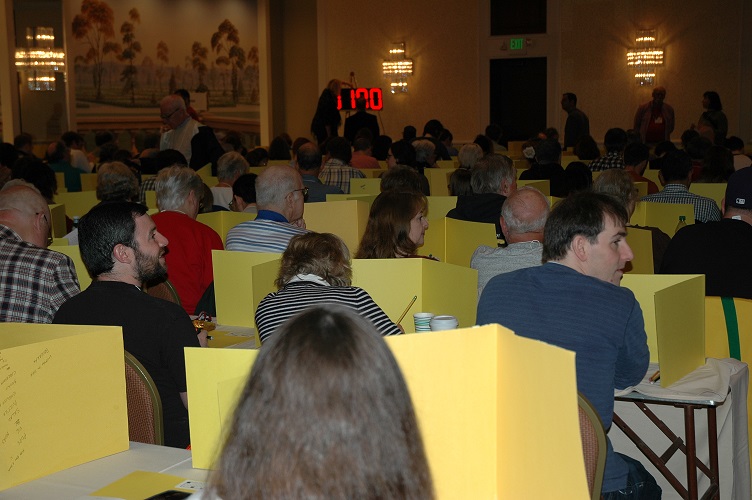
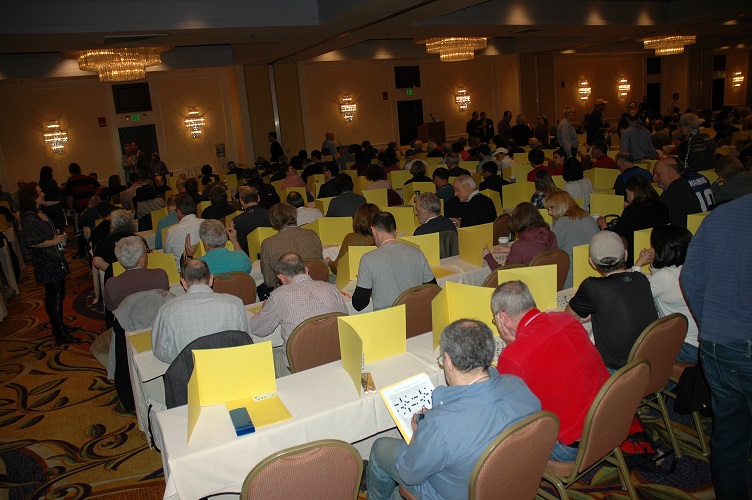
The 39th annual American Crossword Puzzle Tournament was this weekend, and puzzlers descended on the Stamford Marriott Hotel to put their puzzly chops to the test in what is lovingly called “the Nerd Olympics.”
The tournament takes place over two days, with six puzzles to solve on Saturday, followed by one on Sunday. Then the top three finishers solve the championship puzzle on white boards in front of the audience.
On Friday and Saturday night, there are often puzzle events, demonstrations, and panels by top puzzlers and figures in the puzzle world as well.
(This year, Friday night featured author and puzzler Eric Berlin hosting an Escape the Room-themed puzzle hunt that received rave reviews from participants, and Saturday night saw the first Merl Reagle Memorial Lifetime Achievement Award in crossword construction presented to constructor Maura Jacobson. Her husband accepted on her behalf from Merl’s widow, and there wasn’t a dry eye in the house.)
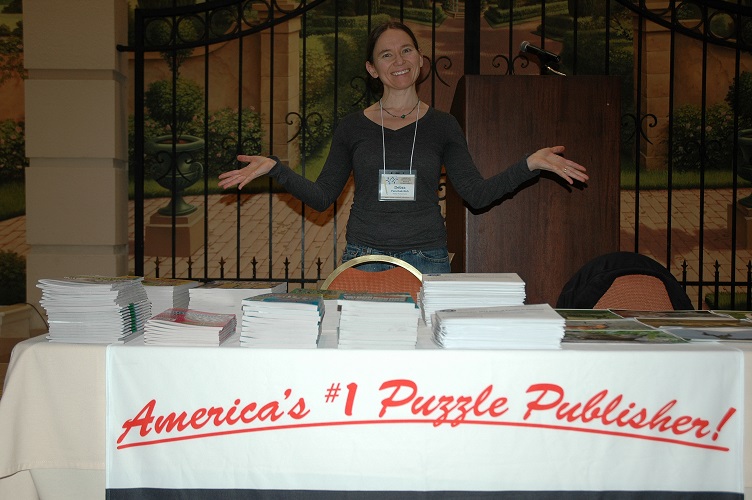
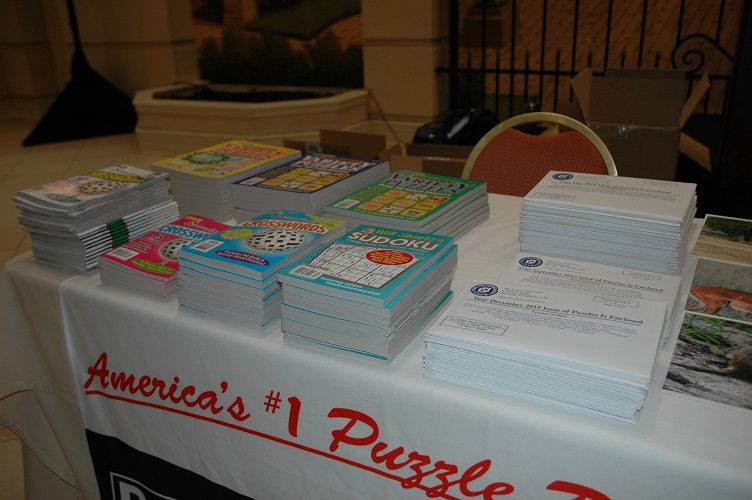
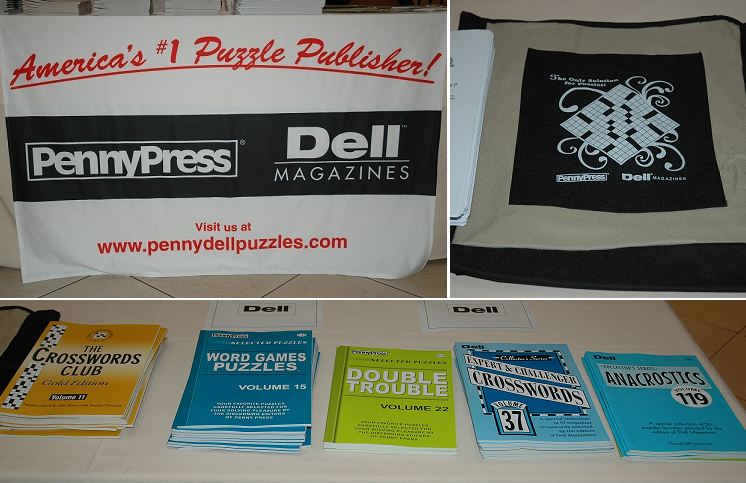
I made the journey down to Stamford myself Saturday morning and sat in with my friend, proofreader and puzzler Debra Yurschak Rich, at the Penny Dell Puzzles booth.
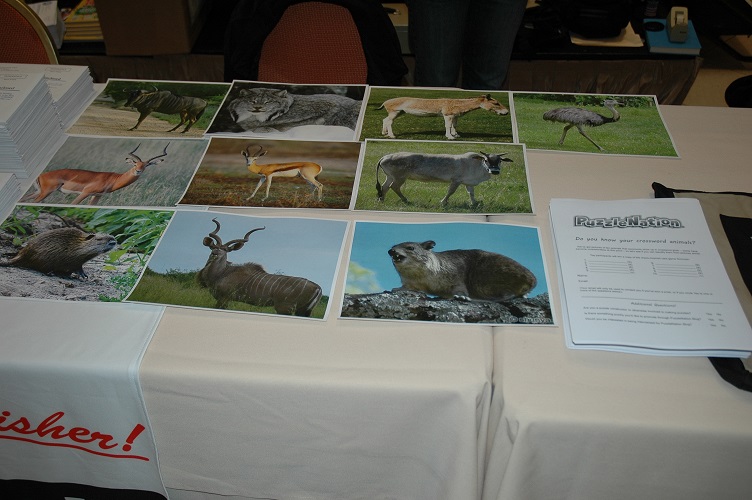
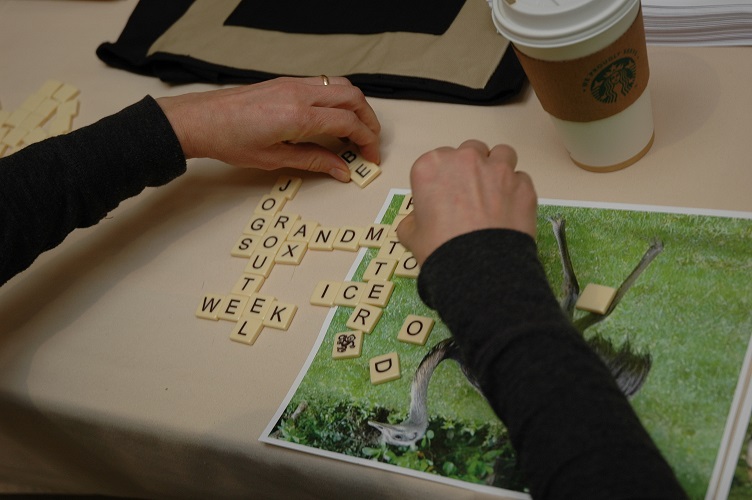
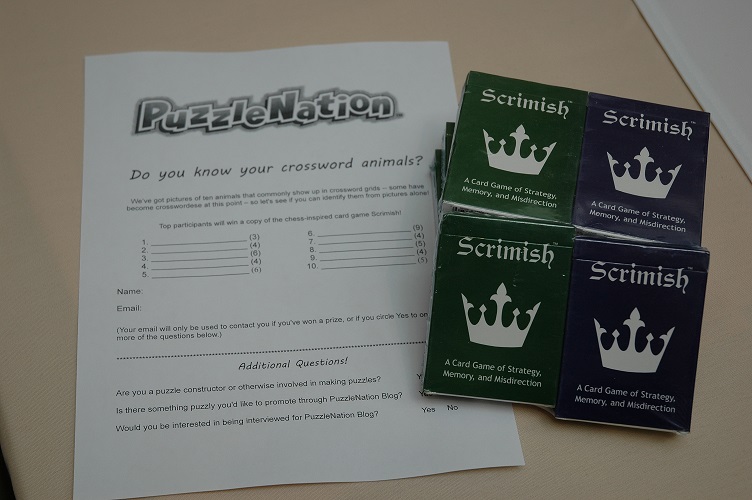
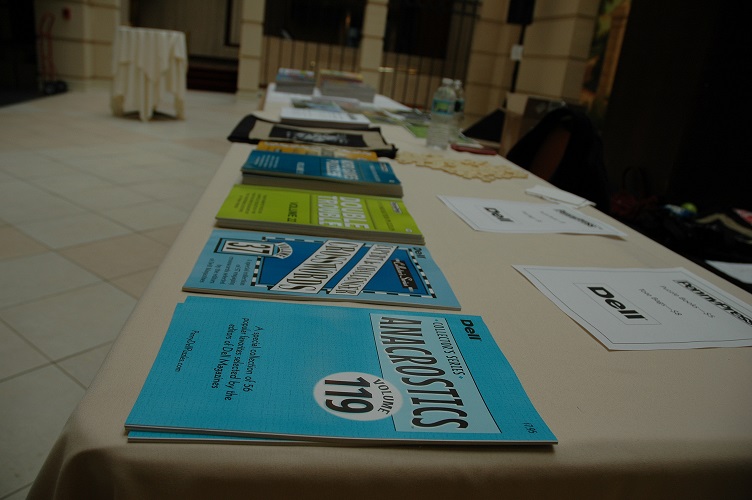
And they didn’t mind at all when I conquered and annexed the middle of the table for PuzzleNation’s in-person version of Friday’s View a Clue crossword animals puzzle. Many competitors stopped by the table to try their luck, allowing some to thoroughly impress their fellow puzzlers with their knowledge of African antelopes, while others were flummoxed trying to match names they’d written into grids dozens of times with images of the actual animal!
(One woman told me she’d seen many of these animals during a trip to South Africa, and even EATEN some of them, but she couldn’t identify them by name. I imagine it’s quite rare to know what an animal tastes like but not what it LOOKS like.)
At 9 AM, the tournament was two hours away, but the marketplace was up and running. In addition to the usual ACPT swag, the marketplace included Hayley Gold and her Across & Down comics, the aforementioned Eric Berlin (repping his Winston Breen books and Puzzle Your Kids subscription puzzles), a collection of Merl Reagle’s puzzle books, and an impressive selection of puzzly titles from the marvelous crew at The Village Bookstore in Pleasantville, New York!
Plus I got to see friends of the blog like Crosswords Club editor Patti Varol, constructor Ian Livengood, crossword gentleman Doug Peterson, and Penny Press variety editor Keith Yarbrough!
Another treat of the tournament is getting to chat with numerous puzzle luminaries I’ve gotten to know through PuzzleNation Blog, like New York Times Wordplay blogger Deb Amlen, constructor and Pre-Shortzian Puzzle Project curator David Steinberg, constructor Joon Pahk, top solver and former champion Ellen Ripstein, constructor George Barany, Evan Birnholz of Devil Cross, top competitor Tyler Hinman, and, of course, New York Times puzzle editor Will Shortz.
The two hours before showtime passed quickly, and soon, the marketplace emptied and the ballroom filled as competitors took their seats for Puzzle 1.
Puzzle 1 didn’t stagger any of the participants, although there was no repeat of Dan Feyer’s blisteringly fast under-two-minute solve like last year. Three minutes seemed to be the benchmark for the top performers this year.
But Puzzle 2 had a crossing that flummoxed several solvers: CORTANA crossing CONTE. Constructor Patrick Blindauer, not in attendance, was no doubt on the receiving end of some Puzzle 5-level heat for that one. But when Doug reached out to Blindauer, it turns out that THAT wasn’t Blindauer’s corner! It had been edited, with MONTANA becoming CORTANA.
I had no idea puzzles accepted for the tournament were edited that much!
Puzzles 3 and 4 passed without incident, and people seemed to enjoy both the camaraderie of the event and the opportunity to compete against their own best times from previous years.
[In our downtime, Debra and I indulged in a round or two of Bananagrams, because it was a day for wordplay of all sorts.]
Then Patrick Berry’s Puzzle 5 arrived, complete with zigzagging entries and a thoroughly impressive fill. (“Wow” was uttered several times by competitors describing their impression of the always-dreaded fifth puzzle of the day.)
Between puzzles 5 and 6, I handed out prizes for our View a Clue crossword animals game: copies of Scrimish, donated by that game’s terrific design team!
Two copies went to our top performers — one got ALL TEN and another got nine out of ten — and two copies went in a drawing from all of the players who gave it their best shot. So congratulations to Robert Moy (who pitched a shut-out), Robert Kern, Abbie Brown, and the man known only as Dan (who got all but one)!
After the diabolical inventiveness of Puzzle 5, Puzzle 6 was tackled by the solvers, who declared it a fun and fair end to the day’s competition. The solvers dispersed to rest their brains; we packed up the table, and headed for home.
And although I wasn’t present for Sunday’s tournament finale, I continued to get updates from friends and fellow puzzlers.
The day started off with Lynn Lempel’s Puzzle 7, which received strong reviews, but did little to alter the standings of the top competitors.
Soon, it was time for the finalists to be announced. When it came time for the top three to solve on their whiteboards in front of their fellow competitors, two of the names were quite familiar to attendees: Dan Feyer, defending six-time champion, and Howard Barkin, four-time champion and perennial participant in the finals.
Conspicuous by his absence was another familiar name and former champion, the performer who made last year’s finals such a nail-biting showdown: Tyler Hinman. An unfortunate error in Puzzle 2 took him out of the running, so the final member of the live-solving trio would be David Plotkin. (Joon Pahk, Francis Heaney, Al Sanders, Jon Delfin and other regular key performers were also near the top.)
He and Howard prepared for a thoroughly wordy and daunting battle with Mr. Feyer, whose excellent performance in the seven previous puzzles had him leading his competitors by three minutes.
You can watch the final puzzle being solved below:
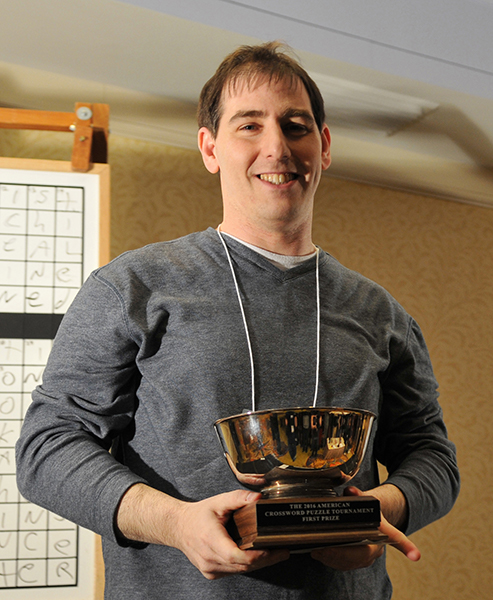
In a stunning upset, Howard Barkin did the seemingly impossible, besting Dan Feyer and claiming the top spot! The room erupted for him as others sat by, stunned that the expected seventh straight win for Dan was not to be.
[Howard poses with his well-earned trophy.]
But that’s not all! Friend of the blog and crossword gentleman Doug Peterson placed 13th overall AND won the finals for Division B! Congratulations to Doug!
And it was a strong showing for many other familiar names! Patti Varol placed 97 (up from last year’s 109 showing), David Steinberg 113th, Kathy Matheson 237th, and Keith Yarbrough 266th out of a field of nearly 600 participants.
It was certainly a day for surprises, strong emotions, and puzzly camaraderie. It’s always great fun to spend time with fellow puzzlers and wordplay enthusiasts, immersing myself in the puzzle community and enjoying all the charm and weirdness that comes part and parcel with it.
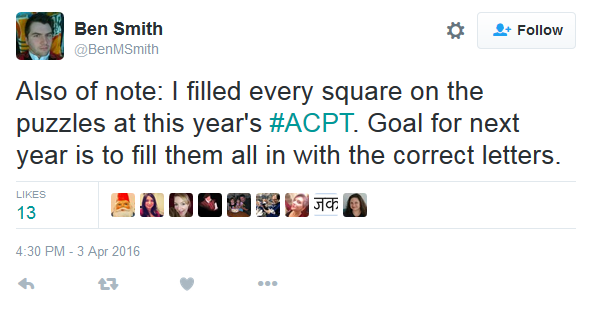
That would’ve been my closing statement, but I think the final word belongs to competitor Ben Smith:
Thanks for visiting PuzzleNation Blog today! Be sure to sign up for our newsletter to stay up-to-date on everything PuzzleNation!
Follow-Up Friday is an opportunity to look back on past posts and puzzly topics. Whether we’re updating you with new developments, providing answers to a previously-posted brain teaser or puzzle, or simply revisiting a subject with a fresh perspective, Follow-Up Friday lets us look back and look forward.
Fill-Ins feature the same grid-filling solving as crosswords, but instead of coming up with the answers to clues, you’re given all of the words in advance, organized by length, and it’s up to you to deduce which words fit the across boxes and which fit the down boxes.
Fill-Ins don’t demand the same level of recall and vocabulary as crosswords, but the deduction aspect more than makes up for it. And if you’re a Fill-In fan, but looking for something different, there are plenty of options out there for you.
A Framework puzzle is like a Fill-In, but without the rigid crossword-style grid. Instead, the grid is looser, allowing for longer words and interesting themes to be incorporated into the puzzle. The trade-off here is that, with fewer letters crossing, you have fewer hints for placing words in the grid. You’ll have to rely on knowing word lengths and counting boxes to complete these grids.
But for something a little less familiar, how about Places, Please?
Places, Please gives you all of the words to place in the grid, just as Fill-Ins do, but there are no black squares to help guide you. Instead, you’re told where the first letter of each word will be placed, and you have to figure out in which direction each word will read.
You’ll want to start with the longest words first, seeing which directions will allow them to be placed. As you place each word, those letters offer clues for placing other words. Eventually, you’ll fill the entire grid! (It’s like a word seek in reverse!)
And if that’s a bit too open-ended for you, let’s talk Stretch Letters.
Stretch Letters puzzles offer the same word-list format as Fill-Ins (organized by word length), but you’ll only enter them reading across. The wrinkle here is that some of the words above and below each row will share those letters, stretching the boxes (and the letters themselves).
It’s a visually striking take on word-placement puzzles, and the stretched letters make for a fun and interactive grid. One S could provide S’s for a half-dozen words or more!
Of course, if you enjoy the deductive side of Fill-Ins — figuring out word placement in the grid — you should also consider trying traditional Logic Puzzles.
Now, I know these grids can seem a little daunting to new solvers, but they’re simply a way of organizing information. As you work your way through the different clues in the Logic Puzzle, you exclude possibilities in the grid by putting an X in the box where those two options cross.
For instance, in the above Logic Problem, based on clue 7, you’d place an X in the box where Esther (listed under First Name) crosses Tyson (listed under Last Name), eliminating it as a possibility.
The more boxes you fill with X’s, the greater the amount of information you garner from the grid, and eventually, you’ll know their full names, ages, and instrument of choice based on those seven clues. Pretty impressive deduction there.
Next week, we’ll take a break from these puzzle recommendations posts, but if you’ve got puzzle recs for your fellow puzzlers in the meantime, please let us know in the comments!
Thanks for visiting PuzzleNation Blog today! Be sure to sign up for our newsletter to stay up-to-date on everything PuzzleNation!





 PuzzCulture