Two Brain Teasers, Courtesy of Conway

John_H_Conway_2005_(cropped)

Last week, we penned a post celebrating the life and puzzly legacy of mathematician John Horton Conway, and several of our fellow PuzzleNationers reached out with their own thoughts or questions about Conway.

One recurring subject was about his love of puzzles and what kind of puzzles he enjoyed solving. So, naturally, I went hunting for some of Conway’s favorite puzzles.

As it turns out, Alex Bellos of The Guardian had me covered. Alex has a recurring puzzle feature on The Guardian‘s website where brain teasers and other mental trickery awaits intrepid solvers.

Years ago, Alex had asked Conway for suggestions for his column, and Conway offered up two tricky puzzles.

And now, I happily share them with you.


#1: The Miracle Builders

I had a window in the north wall of my house. It was a perfect square, 1 meter wide and 1 meter high. But this window never let in enough light. So I hired this firm, the Miracle Builders, who performed the impossible. They remodeled the window so it let in more light. When when they’d finished the window was a perfect square, 1 meter high and 1 meter wide.

How did they do it?


#2: The Ten Divisibilities

I have a ten digit number, abcdefghij. Each of the digits is different.

The following is also true:

  • a is divisible by 1
  • ab is divisible by 2
  • abc is divisible by 3
  • abcd is divisible by 4
  • abcde is divisible by 5
  • abcdef is divisible by 6
  • abcdefg is divisible by 7
  • abcdefgh is divisible by 8
  • abcdefghi is divisible by 9
  • abcdefghij is divisible by 10

What’s my number?

[To clarify: a, b, c, d, e, f, g, h, i, and j are all single digits. Each digit from 0 to 9 is represented by exactly one letter. The number abcdefghij is a ten-digit number whose first digit is a, second digit is b, and so on. It does not mean that you multiply a x b x c x…]


Did you solve one or both of these fiendish mind ticklers? Let us know in the comments section below! We’d love to hear from you.

Thanks for visiting PuzzleNation Blog today! Be sure to sign up for our newsletter to stay up-to-date on everything PuzzleNation!

You can also share your pictures with us on Instagram, friend us on Facebook, check us out on TwitterPinterest, and Tumblr, and explore the always-expanding library of PuzzleNation apps and games on our website!

Celebrating the Puzzly Legacy of John Horton Conway

The worlds of puzzles and mathematics overlap more than you might think. I’m not just talking about word problems or mathy brain teasers like the Birthday Puzzle or the jugs of water trap from Die Hard with a Vengeance.

For twenty-five years, Martin Gardner penned a column in Scientific American called Mathematical Games, adding a marvelous sense of puzzly spirit and whimsy to the field of mathematics, exploring everything from the works of M.C. Escher to visual puzzles like the mobius strip and tangrams. He was also a champion of recreational math, the concept that there are inherently fun and entertaining ways to do math, not just homework, analysis, and number crunching.

And on more than one occasion, Gardner turned to the genius and innovative thinking of John Horton Conway for inspiration.

John_H_Conway_2005_(cropped)

[Image courtesy of Wikipedia.]

Conway was best known as a mathematician, but that one word fails to encapsulate either his creativity or the depth of his devotion to the field. Conway was a pioneer, contributing to some mathematical fields (geometry and number theory among them), vastly expanding what could be accomplished in other fields (particularly game theory), and even creating new fields (like cellular automata).

Professor of Mathematics, Emeritus, Simon Kochen said, “He was like a butterfly going from one thing to another, always with magical qualities to the results.” The Guardian described him in equally glowing terms as “a cross between Archimedes, Mick Jagger and Salvador Dalí.”
lifep

[Image courtesy of Cornell.edu.]

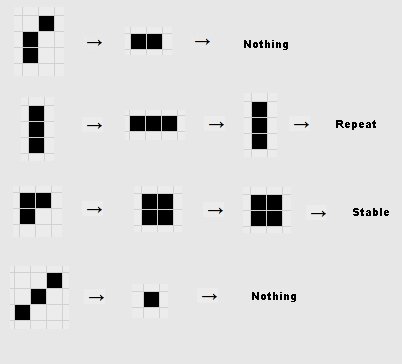
His most famous creation is The Game of Life, a model that not only visually details how algorithms work, but explores how cells and biological forms evolve and interact.

Essentially, imagine a sheet of graph paper. In The Game of Life, you choose a starting scenario, then watch the game proceed according to certain rules:

  • Any live cell with fewer than two live neighbors dies, as if by underpopulation.
  • Any live cell with two or three live neighbors lives on to the next generation.
  • Any live cell with more than three live neighbors dies, as if by overpopulation.
  • Any dead cell with exactly three live neighbors becomes a live cell, as if by reproduction.

The process plays out from your starting point completely without your intervention, spiraling and expanding outward.

It’s the ultimate if-then sequence that can proceed unhindered for generations. It is a literal launchpad for various potential futures based on a single choice. It’s mind-bending and simple all at once. (And you can try it yourself here!)

JHC-GOL-600x170px

[Image courtesy of Sign-Up.To.]

But that’s far from Conway’s only contribution to the world of puzzles.

Not only did he analyze and explore puzzles like the Soma cube and Peg Solitaire, but he created or had a hand in creating numerous other puzzles that expanded upon mathematical concepts.

I could delve into creations like Hackenbush, the Angel Problem, Phutball/Philosopher’s Football, Conway’s Soldiers, and more — and perhaps I will in the future — but I’d like to focus on one of his most charming contributions: Sprouts.

Sprouts is a pencil-and-paper strategy game where players try to keep the game going by drawing a line between two dots on the paper and adding a new dot somewhere along that line.

The rules are simple, but the gameplay can quickly become tricky:

  • The line may be straight or curved, but must not touch or cross itself or any other line.
  • The new spot cannot be placed on top of one of the endpoints of the new line. Thus the new spot splits the line into two shorter lines.
  • No spot may have more than three lines attached to it.

Check out this sample game:

sprouts

[Image courtesy of Fun Mines.]

It’s a perfect example of the playfulness Conway brought to the mathematical field and teaching. The game is strategic, easy to learn, difficult to master, and encourages repeated engagement.

In a piece about Conway, Princeton professor Manjul Bhargava said, “I learned very quickly that playing games and working on mathematics were closely intertwined activities for him, if not actually the same activity.”

He would carry all sorts of bits and bobs that would assist him in explaining different concepts. Dice, ropes, decks of cards, a Slinky… any number of random objects were mentioned as potential teaching tools.

Professor Joseph Kohn shared a story about Conway’s enthusiasm for teaching and impressive span of knowledge. Apparently, Conway was on his way to a large public lecture. En route, he asked his companions what topic he should cover. Imagine promising to do a lecture with no preparation at all, and deciding on the way what it would be about.

Naturally, after choosing a topic in the car, the lecture went off without a hitch. He improvised the entire thing.

Of course, you would expect nothing less from a man who could recite pi from memory to more than 1100 digits? Or who, at a moment’s notice, could calculate the day of the week for any given date (employing a technique he called his Doomsday algorithm).


Conway unfortunately passed away earlier this month, due to complications from COVID-19, at the age of 82.

His contributions to the worlds of mathematics and puzzles, not to mention his tireless support of recreational math, cannot be overstated. His work and his play will not soon be forgotten.
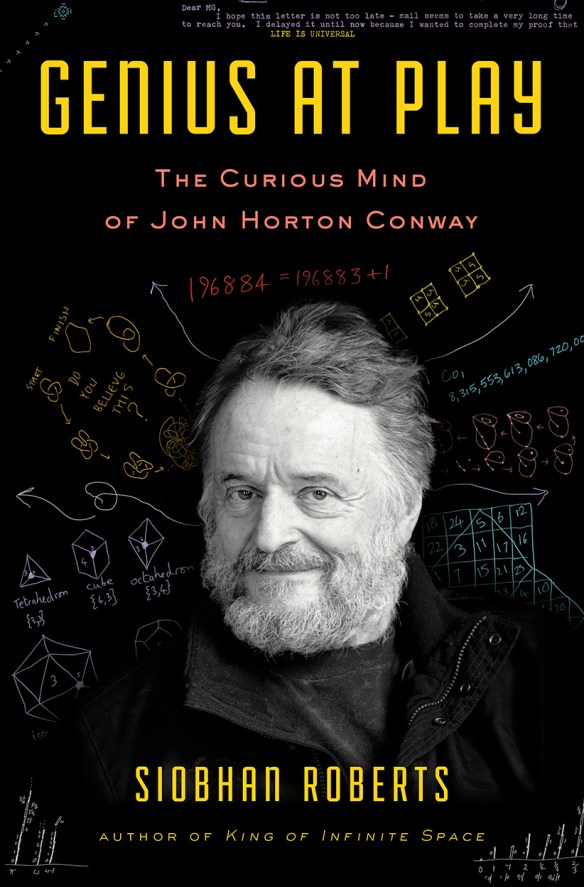
MAC31_BOOKS_COVERS_POST02

[Image courtesy of Macleans.]

If you’d like to learn more about Conway, be sure to check out Genius at Play: The Curious Mind of John Horton Conway by Siobhan Roberts.

[My many thanks to friend of the blog Andrew Haynes for suggesting today’s subject and contributing notes and sources.]


Thanks for visiting PuzzleNation Blog today! Be sure to sign up for our newsletter to stay up-to-date on everything PuzzleNation!

You can also share your pictures with us on Instagram, friend us on Facebook, check us out on TwitterPinterest, and Tumblr, and explore the always-expanding library of PuzzleNation apps and games on our website!

A Coin Puzzle: My Two Cents (Plus 97 More)

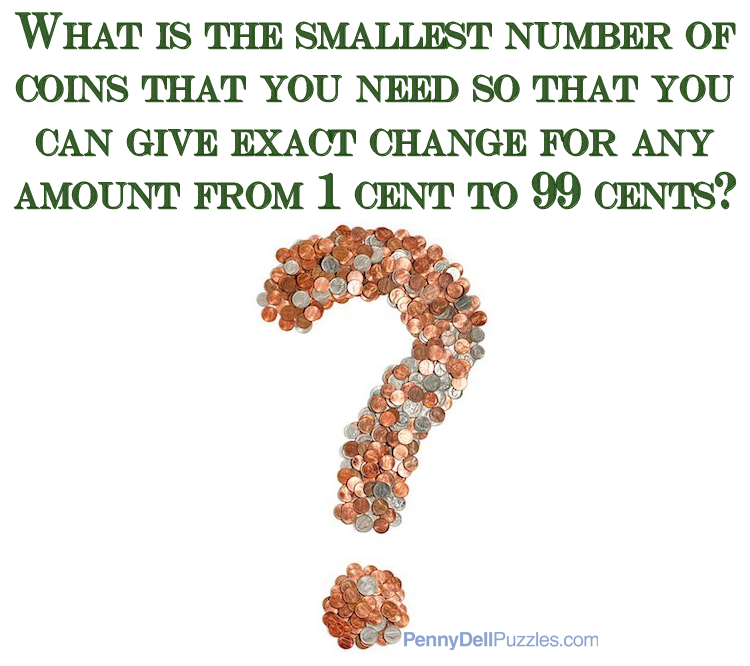
Our friends at Penny Dell Puzzles recently shared the following brain teaser on their social media:

Naturally, we accepted the challenge.

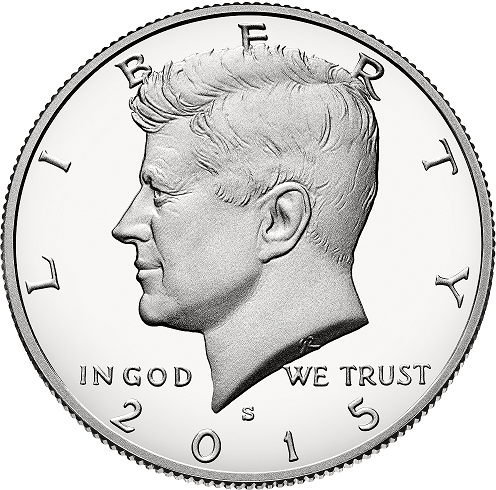
Now, before we get started with this one, we have to add one detail: which coins we’re allowed to use. It’s safe to assume that pennies, nickels, dimes, and quarters are available, but the question doesn’t say anything about half-dollar coins.

So we’re going to figure out the correct answer without half-dollar coins available, and then with half-dollar coins available.

Let’s begin.


[Image courtesy of How Stuff Works.]

The easiest way to get started is to figure out the smallest number of coins we need to make 99 cents, since that’s the highest number we need to be able to form. Once we have that info, we can work backwards and make sure all the other numbers are covered.

For 99 cents, you need 3 quarters, 2 dimes, and 4 pennies. That’s 25 + 25 + 25 + 10 + 10 + 1 + 1 + 1 + 1 = 99.

Right away, we know we’re close with these 9 coins.

You don’t need more than 3 quarters, for instance, because your possible totals are all below $1.

Now, let’s make sure we can form the numbers 1 through 24 with our chosen coins. (If we can, we’re done, because once we’ve covered 1 through 24, we can simply add one quarter or two quarters to cover 25 through 99.)

Our four pennies cover us for 1 through 4. But wait, there’s 5. And we can’t make 5 cents change with 4 pennies or 2 dimes. In fact, we can’t make 5, 6, 7, 8, or 9 cents change without a nickel.

So let’s add a nickel to our current coin count. That makes 3 quarters, 2 dimes, 1 nickel, and 4 pennies. (Why just 1 nickel? Well, we don’t need two, because that’s covered by a single dime.)

Our four pennies cover 1 through 4. Our nickel and four pennies cover 5 through 9. Our dime, nickel, and four pennies cover 1 through 19. And our two dimes, one nickel, and four pennies cover 1 through 29. (But, again, we only need them to cover 1 through 24, because at that point, our quarters become useful.)

That’s all 99 possibilities — 1 through 99 — covered by just ten coins.

[Image courtesy of Wikipedia.]

But what about that half-dollar?

Well, we can apply the same thinking to a coin count with a half-dollar. For 99 cents, you need 1 half-dollar, 1 quarter, 2 dimes, and 4 pennies. That’s 50 + 25 + 10 + 10 + 1 + 1 + 1 + 1 = 99.

Now, we make sure we can form the numbers 1 through 49 with our chosen coins. (Once we can, we can simply add the half-dollar to cover 50 through 99.)

Once again, we quickly discover we need that single nickel to fill in the gaps.

Our four pennies cover 1 through 4. Our nickel and four pennies cover 5 through 9. Our dime, nickel, and four pennies cover 1 through 19. Our two dimes, one nickel, and four pennies cover 1 through 29. And our one quarter, two dimes, one nickel, and four pennies cover 1 through 54. (But, again, we only need them to cover 1 through 49, because at that point, our half-dollar becomes useful.)

That’s all 99 possibilities — 1 through 99 — covered by just nine coins.


Thanks for visiting PuzzleNation Blog today! Be sure to sign up for our newsletter to stay up-to-date on everything PuzzleNation!

You can also share your pictures with us on Instagram, friend us on Facebook, check us out on TwitterPinterest, and Tumblr, and explore the always-expanding library of PuzzleNation apps and games on our website!
Brain Teaser: A Curious Way to Tell Time

We love tackling brain teasers, riddles, math puzzles, and mind ticklers here at PuzzleNation Blog.

Our friends at Penny Dell Puzzles also enjoy putting their puzzly skills to work by posting various brain teasers..

And one of our mutual readers was hoping we could explain how to solve a puzzle that recently made the rounds on Penny’s social media accounts.

We’d be happy to!

Today, let’s take a look at a brain teaser all about time.

So, where do we begin?

Let’s start by breaking that sentence down to make it easier to parse: “The number of hours left today is half of the number of hours already passed.”

Well, a simpler way of saying that is “the number of hours already passed is twice the number of hours left.”

So if you have the number of hours left — let’s call that X — then the number of hours already passed is twice X, or 2X. Between X and 2X, that’s your entire day covered.

Sorting that out gives us the simple formula of X + 2X = 24, since there are 24 hours in a day.

That easily becomes 3X = 24, and simple division tells us that X = 8.

So X, the number of hours left today, is 8. Which means that twice X, or 16, is the number of hours already passed.

And if there are 8 hours left in the day (or 16 hours already passed), that means it’s 4 PM.


Most of the time, brain teasers are all about efficiently organizing the information we have.

That allows us to figure out how best to use that information to move forward and solve the puzzle. This is just as true with a relatively straightforward brain teaser like this as it is with a complicated logic puzzle with all sorts of pieces to put together.

It’s all about figuring out what we know, what we don’t, and how what we DO know can lead us to what we don’t.

That’s just part of the fun.


Thanks for visiting PuzzleNation Blog today! Be sure to sign up for our newsletter to stay up-to-date on everything PuzzleNation!

You can also share your pictures with us on Instagram, friend us on Facebook, check us out on TwitterPinterest, and Tumblr, and explore the always-expanding library of PuzzleNation apps and games on our website!
Answers to Our 6th Anniversary Instagram Brain Teasers!

Last week, we celebrated six years of PuzzleNation Blog by announcing a week-long puzzly social media blitz.

Facebook and Twitter saw twice-daily alerts for the puzzle of the day for both Daily POP Crosswords and Penny Dell Crosswords App, cuing solvers to contact us with the answers to particular across and down clues.

Instagram solvers were encouraged to tackle a series of brain teasers, and today, we’ve got all the answers for you! Let’s jump right in.


We started off on Tuesday with this relatively straightforward brain teaser: How can you add eight 4s together so that the total adds up to 500?

We got the most responses to this one, and it’s no surprise, as we have some very crafty followers on Instagram. The trick here is number placement. By grouping 4s, you create larger numbers that make it easier to add to your total.

Solution: 444 + 44 + 4 + 4 + 4 = 500


Wednesday’s puzzle involved placing the numbers 1 through 8 into the grid above. Consecutive numbers cannot appear in an adjacent or diagonal box.

This puzzle was actually created and submitted by a PuzzleNationer named Sanjana, so kudos to you, Sanjana, as you made one heck of a brain teaser!

Here’s the solution. (Using the same numbers in reverse or flipped layout creates four different variations on the same solution.)


Thursday’s brain teaser put your Scrabble and Upwords skills to the test, as we played a round of Quad-Doku! The goal is to play each tile, one at a time, onto the board, forming a new common word (or words) each time. Do this with all 8 tiles in any order. By the end, all four corners will have changed.

This is a nice chain-solving puzzle, and here’s the solution we came up with:

F makes FOUR/FIND, S makes FINS/SEEM, A makes SEAM, B makes FIBS, C makes SCAM, W makes SWAM, L makes FOUL/LOOM, and P makes LOOP/SWAP.


On Friday, we posted a riddle to test your puzzly skills. Once I am 24, twice I am 20, three times I am unclean. What am I?

Solution: The answer is X. It’s the 24th letter of the alphabet, two X’s makes 20 in Roman numerals, and three X’s marks something as inappropriate for some viewers.


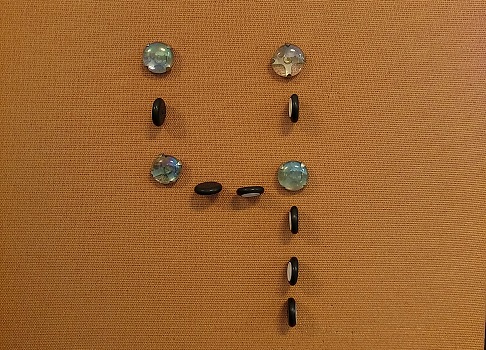
Monday brought us our final brain teaser, a matchstick puzzle (or, in this case, a toothpick puzzle). Can you move four toothpicks in order to change the zigzag path into 2 squares? The two squares do not have to be equal in size.

In the image above, we’ve circled the four toothpicks to move.

And here is the completed puzzle, with two squares of unequal size.


How did you do, intrepid solvers? Well, based on the responses we received, pretty darn well! We’ll be reaching out to contest winners later this week!

But in the meantime, we’d like to thank everyone who participated in our PN Blog 6th Anniversary event. You help make this the best puzzle community on the planet, and we are forever grateful.


Thanks for visiting PuzzleNation Blog today! Be sure to sign up for our newsletter to stay up-to-date on everything PuzzleNation!

You can also share your pictures with us on Instagram, friend us on Facebook, check us out on TwitterPinterest, and Tumblr, and explore the always-expanding library of PuzzleNation apps and games on our website!
PuzzleNation Blog Looks Back on 2017!

2017 is quickly coming to a close, and as I look back on an eventful year in the world of puzzles and games, I’m incredibly proud of the contributions both PuzzleNation Blog and PuzzleNation made to the puzzle community as a whole.

Over the last year, we explored board games and card games, strategy games and trivia games, dice games and tile games, do-it-yourself puzzlers and pen-and-paper classics. We met game designers, constructors, artists, and creative types of all kinds.

We unraveled math puzzles and tackled the Crossword from Hell. We accepted the challenge of diabolical brain teasers, optical illusions, Internet memes, and more, even pondering our place in the world of puzzles as electronic solvers like Dr. Fill and AlphaGo rise in capability.

We delved into puzzle history with posts about the legacy of female codebreakers in World War II, game dice from centuries ago, theories about Shakespeare’s secret codes, and the long history of cryptography and the NSA. We brought to light valuable examples of puzzles in art, popular culture, famous quotations, and even the natural world as we pondered whether bees are verifiable problem-solvers like crows and octopuses.

We spread the word about numerous worthwhile Kickstarters and Indiegogo campaigns, watching as the puzzle/game renaissance continued to amaze and surprise us with innovative new ways to play and solve. We shared worthy causes like Puzzles for Progress, as well as amazing projects like new escape rooms, dazzling corn mazes, and the ongoing Kubrick’s Game interactive experience.

We cheered the 75th anniversary of the New York Times Crossword, and chronicled the many celebrations that marked the occasion, from guest crossword constructors like Bill Clinton and Lisa Loeb to a puzzle-centric cruise across the Atlantic!

We also mourned as friends and fellow puzzlers passed on. We said goodbye to David Lindsey and Raymond Smullyan, two underappreciated giants of the field. The pun-fueled show @midnight this year, which inspired our monthly hashtag game, also closed up shop, sadly.

We celebrated International TableTop Day, made puzzly bouquets in honor of International Puzzle Day, marveled at the records broken at the Rubik’s Cube World Championship, attended the American Crossword Puzzle Tournament and New York Toy Fair, and dove deep into an ever-expanding litany of puzzle events like the Indie 500, BosWords, Lollapuzzoola 10, and Crosswords LA.

We found puzzly ways to celebrate everything from Pi Day, the Super Bowl, and Star Wars Day to Halloween, Thanksgiving, and Christmas, and we were happy to share so many remarkable puzzly landmark moments with you. We even discovered Puzzle Mountain!

It’s been both a pleasure and a privilege to explore the world of puzzles and games with you, my fellow puzzle lovers and PuzzleNationers. We marked five years of PuzzleNation Blog this year, I recently penned my 800th blog post, and I’m more excited to write for you now than I was when I started.

And honestly, that’s just the blog. PuzzleNation’s good fortune, hard work, and accomplishments in 2017 went well beyond that.

Every month, we delivered quality content for the Penny Dell Crosswords App. From monthly deluxe sets and bonus boxes to Dell Collection sets and holiday bundles, dozens upon dozens of topnotch puzzles wended their way to our loyal and enthusiastic solvers.

And just last month, we launched our newest puzzly endeavor — Daily POP Crosswords — bringing you fresh, up-to-date cluing and relatable themes in world-class puzzles created by some of the industry’s best constructors! (Many of whom you’ve gotten to know in our recent interview series, Meet the Daily POP Crosswords Constructors!)

But whether we’re talking about the Penny Dell Crosswords App or Daily POP Crosswords, I’m proud to say that every single puzzle represents our high standards of quality puzzle content crafted for solvers and PuzzleNationers.

And your response has been fantastic! Daily POP Crosswords is thriving, the blog has over 2200 followers, and with our audience on Facebook, Twitter, Instagram, and other platforms continuing to grow, the enthusiasm of the PuzzleNation readership is both humbling and very encouraging.

2017 was our most ambitious, most exciting, and most creatively fulfilling year to date, and the coming year promises to be even brighter.

Thank you for your support, your interest, and your feedback, PuzzleNationers. The new year looms large, and we look forward to seeing you in 2018!


Thanks for visiting PuzzleNation Blog today! Be sure to sign up for our newsletter to stay up-to-date on everything PuzzleNation!

You can also share your pictures with us on Instagram, friend us on Facebook, check us out on TwitterPinterest, and Tumblr, and explore the always-expanding library of PuzzleNation apps and games on our website!