What Can YOU Solve In Under a Second?

Oh yes, it’s Rubik’s Cube time once again.

Every time I think I’ve seen everything someone can do with a Rubik’s Cube, a month or two later, another amazing video appears on the Internet, proving me wrong.

We’ve covered Rubik’s Cubes a lot on this blog. We’ve seen them solved underwater, while being juggled, during a skydive, and yes, we’ve seen them solved in increasing faster times.

As of last year, the record for a robot solving a Rubik’s Cube was .637 seconds. That robot, Sub1, has been the Guinness World Record holder ever since.

Until now, it seems.

That’s a right, a pair of engineers — Ben Katz and Jared Di Carlo — have nearly halved that world record with what they call their “Rubik’s Contraption.” This cube-solving bot posts a solving speed of .38 seconds.

Their machine is so fast that they had to program it to only allow one motor to move at a time. You see, in previous runs, more than one motor would try to move, and the cube would be RIPPED APART.

This lightning-fast robot is still waiting review by the team from Guinness, so, for now, Sub1’s record stands.

But for how long?


Thanks for visiting PuzzleNation Blog today! Be sure to sign up for our newsletter to stay up-to-date on everything PuzzleNation!

You can also share your pictures with us on Instagram, friend us on Facebook, check us out on Twitter, Pinterest, and Tumblr, and explore the always-expanding library of PuzzleNation apps and games on our website!

Crossword Clue Common Questions!

If you solve enough crossword puzzles, you’re bound to encounter some repeated clues. After all, there are words that lend themselves easily to crossword construction, and if a word appears often, then certain clues for that word are practically guaranteed to recur.

For instance, let’s talk dogs. “Popular dog’s name” as a clue for FIDO? Is FIDO a popular dog name anymore? Was it ever?

What about that other crossword-friendly pup’s name, ASTA? I’ve seen “Asta’s bite” as a clue for NIP, but can we verify that? Did Asta ever bite someone on Nick and Nora’s watch?

[Image courtesy of I Love Asta.com.]

And speaking of animals, what about the clue “Playful mammal” for SEAL? Isn’t that a bit presumptuous? I mean, sure, a given seal might appear playful to some, but all seals as a general rule? Seems a bit much.

Did the house from Home Again have an ELL? Or the one from This Old House? Because if not, “Home Again add-on” and “This Old House addition” are technically incorrect.

What about that famed “Bakery employee” you see from time to time in grids? Bakery personnel, I implore you. Please answer… is there really such a thing as an ICER?

[Image courtesy of Getty Images.]

Why are ARKS clued as “Clumsy vessels”? How clumsy could a boat be? Did it keep tipping over? IS THAT WHAT HAPPENED TO THE UNICORNS?!

Is the NILE really a “Cleopatra backdrop”? Can someone verify that the Nile was a setpiece or location for the film?

And for you fans of poetic contractions in crosswords, here’s a question: Did Byron ever really use “E’ER” in one of his pieces? Did Yeats? Did other odists?


What do you think, fellow puzzlers and PuzzleNationers? Are there any common crossword clues that raise questions for you? Let us know in the comments section below! We’d love to hear from you!

Thanks for visiting PuzzleNation Blog today! Be sure to sign up for our newsletter to stay up-to-date on everything PuzzleNation!

You can also share your pictures with us on Instagram, friend us on Facebook, check us out on Twitter, Pinterest, and Tumblr, and explore the always-expanding library of PuzzleNation apps and games on our website!

The Puzzly Legacy of Edgar Allan Poe

[Image courtesy of the Poetry Foundation.]

Edgar Allan Poe is one of the most influential writers in all of American literature. Not only did he come to epitomize all things ghastly and unnerving in Gothic horror with chillers like “The Tell-Tale Heart” and “The Cask of Amontillado,” but he also trailblazed the detective fiction genre with his character C. Auguste Dupin.

He also made an impact on the world of puzzles.

[Image courtesy of the National Cryptologic Museum Foundation.]

Those familiar with Poe’s works of fiction probably think I’m referring to his story “The Gold-Bug,” one of, if not the first, stories to not only mention cryptography, but to include a substitution cipher (a cipher where each letter in the alphabet is represented by a different letter, number, or symbol).

In “The Gold-Bug,” an unnamed narrator meets the unusual William Legrand, a man obsessed with restoring his family’s lost fortune. Legrand shows off a large scarab-like insect, the titular gold bug. A month later, the narrator and Legrand are reunited when the obsessed Legrand (along with his servant Jupiter) goes off on a expedition to discover the location of the buried treasure of the legendary Captain Kidd.

As it turns out, a piece of paper Jupiter used to collect the gold bug had traces of invisible ink on it, revealing a cipher containing instructions for how to find Kidd’s gold.

[Image courtesy of Bookriot.]

But this was far from Poe’s only dalliance with codebreaking. In fact, he helped popularize the art and science of cryptography with a series of articles in a Philadelphia publication called Alexander’s Weekly Messenger.

In December of 1839, he laid out a challenge to his readers, boasting that he could crack any substitution cipher that readers submitted:

It would be by no means a labor lost to show how great a degree of rigid method enters into enigma-guessing. This may sound oddly; but it is not more strange than the well know fact that rules really exist, by means of which it is easy to decipher any species of hieroglyphical writing — that is to say writing where, in place of alphabetical letters, any kind of marks are made use of at random. For example, in place of A put % or any other arbitrary character –in place of B, a *, etc., etc.

Let an entire alphabet be made in this manner, and then let this alphabet be used in any piece of writing. This writing can be read by means of a proper method. Let this be put to the test. Let any one address us a letter in this way, and we pledge ourselves to read it forthwith–however unusual or arbitrary may be the characters employed.

For the next six months, Poe tackled every cipher sent to Alexander’s. According to Poe, he received around a hundred ciphers, though historians have stated that only 36 distinct ciphers appeared in Alexander’s Weekly Messenger, 15 of which had solutions or partial solutions printed.

Nonetheless, it’s believed that Poe solved each of those 36 ciphers.

[Image courtesy of Awesome Stories.]

He followed up this impressive feat with an essay about cryptography in July of 1841 for Graham’s Magazine, “A Few Words on Secret Writing,” in which he discussed ancient methods of encryption and decryption, name-dropping codebreaking icons like Trithemius, Vigenere, and others.

He also published two cryptograms for the readers to solve, both submitted by a man named W.B. Tyler, “a gentleman whose abilities we highly respect.” Poe claimed he didn’t have time to solve either cryptogram, leaving them to the readers to crack. (Naturally, some scholars theorize that W.B. Tyler was none other than Poe himself.)

It would be over a century before the first verifiable solution to a W.B. Tyler cryptogram appeared. Professor Terence Whalen published his solution to the first Tyler cryptogram in 1992, and even offered a $2500 prize to whomever could solve the remaining Tyler cryptogram.

[Image courtesy of Cryptiana.web.]

That prize was claimed 8 years later by a Canadian software expert named Gil Broza, who cracked what turned out to be a polyalphabetic cipher, one in which several substitution alphabets are used.

Naturally, Poe’s interest in secret messages and codebreaking has led some to suspect that secret messages are lurking in his poetry and works of fiction. (Similar conspiracy theories abound regarding the works of Shakespeare.)

To be fair, there is something to this theory.

In a manner similar to Lewis Carroll hiding Alice Liddell’s name in an acrostic poem at the end of Through the Looking-Glass, Poe dedicated a poem to friend and poet Sarah Anna Lewis by hiding her name, one letter per line, in the poem itself.

[Image courtesy of The Baltimore Post Examiner.]

Of course, Poe’s method was more intricate than Carroll’s. The S in Sarah was the first letter on the first line, the A was the second letter on the second line, the R was the third letter on the third line, and so on. (Hiding coded messages in plain sight in this manner is known as steganography.)

And to this day, the hunt is on for secret messages in Poe’s works, particularly his more esoteric and oddly worded pieces. For instance, his prose poem “Eureka” — a musing on the nature of the universe itself, which actually proposed a Big Bang-like theory for the birth of the universe well before scientists offered the same theory — is believed to contain some sort of secret message or code.

Poe stated on more than one occasion that “human ingenuity cannot concoct a cipher which human ingenuity cannot resolve.” So if there is a code lurking in his works, someone will surely find it.

And in the meantime, we can still enjoy the chills, the grand ideas, and the mysteries he left behind. That’s quite a puzzly legacy.


Thanks for visiting PuzzleNation Blog today! Be sure to sign up for our newsletter to stay up-to-date on everything PuzzleNation!

You can also share your pictures with us on Instagram, friend us on Facebook, check us out on Twitter, Pinterest, and Tumblr, and explore the always-expanding library of PuzzleNation apps and games on our website!

The World of Puzzly Furniture!

It’s fair to say that the flat-pack furniture model made famous by IKEA, that marvelous house of Swedish innovation, has turned practically every one of their customers into impromptu puzzle solvers.

But did you know that there’s a whole world of puzzle furniture out there for you to explore and assemble?

Some of it is inspired by puzzles, while other pieces are puzzles themselves! In today’s post, I thought I’d take my fellow puzzlers and PuzzleNationers on a brief tour of the world of puzzly furniture.

Most puzzle-inspired furniture is designed around the idea of personalization and variation. You often have several pieces to work with, allowing you to construct different pieces of furniture based on your needs or aesthetics.

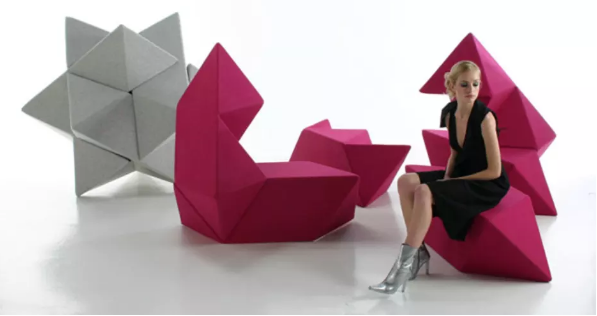
For instance, the piece pictured above is called “To Gather,” and it can be assembled into a sofa or converted into separate seats. Offered by Studio Lawrence, To Gather is pretty eye-catching, though it might be a little blocky for some tastes.

For something a bit more traditional, there’s the Slot Sofa by Matthew Pauk. This piece combines a sofa, coffee table, and ottoman, but can be combined so that the coffee table rests between the two corner seats and the ottoman cushions tuck away underneath the sofa.

It’s a super-clever space saver and probably one of my favorite puzzly pieces that I’ve ever seen.

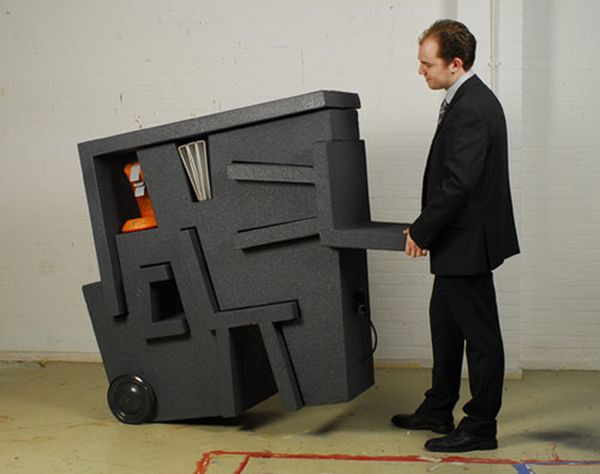
Being able to tuck away multiple pieces of furniture in one is also the goal for this mobile office piece, which contains two chairs, a desk, and more within its foam-core modular form.

Although it’s not the most aesthetically pleasing design, it’s lightweight, easy to move around, and doesn’t take up a lot of space when recombined. I could see some start-ups making use of this sort of thing, both to catch the eye and to save on space and materials.

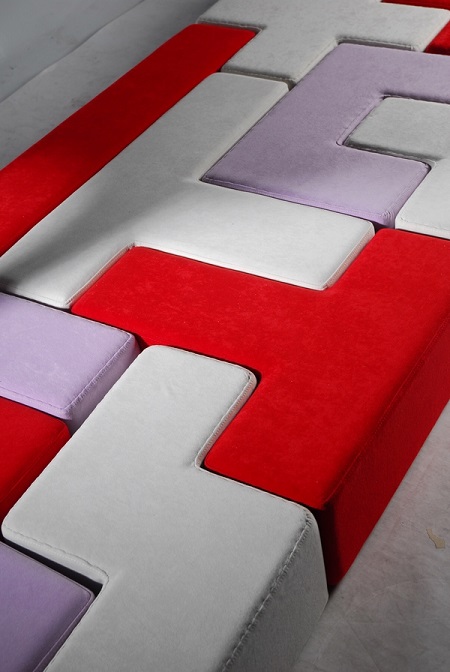
A lot of puzzly furniture is based around Tetris-style pieces (or Tetrominoes) that can be moved around and placed in various configurations. The TAT-tris piece is one of the most adaptable, forming a solid cushion mat at the start, and then allowing for infinite variation when it comes to assembling tables, chairs, and more.

Intended for teens and children to use as a puzzly exercise, TAT-tris looks both comfy and like it would be a huge amount of fun to play with.

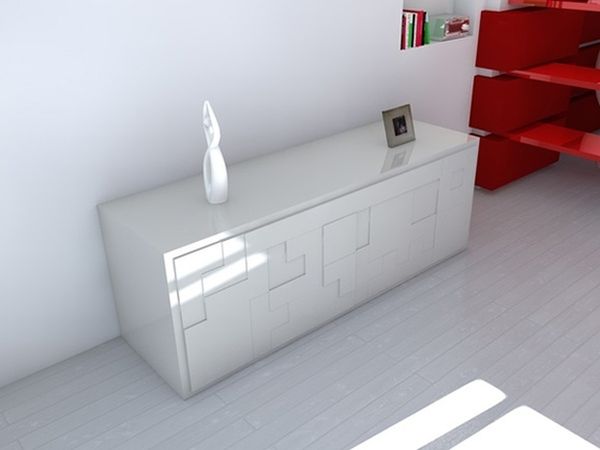
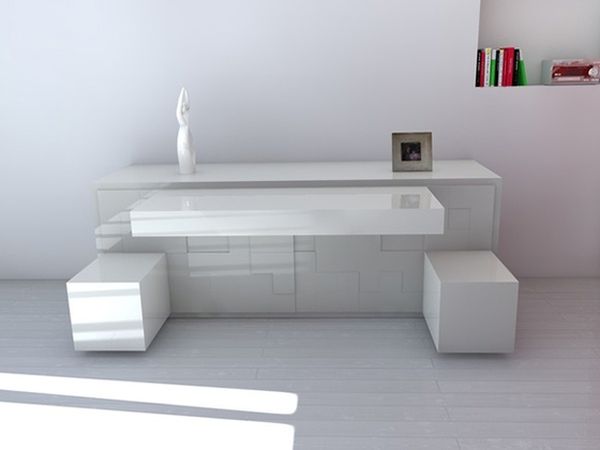
Tetris also inspired this sideboard designed by Pedro Machado. “T@tris” is a beautifully lacquered piece that consists of 26 tetronomoes slotted together.

One configuration allows for two benches and a slide-out table, while other pieces form drawers, allowing for all sorts of storage in a fairly compact area.

Very modern and a little bit glam, this piece makes excellent use of space and isn’t as visually distracting as many other pieces of puzzly furniture.

Speaking of visually distracting, this furniture set by Schamburg + Alvisse arrives assembled in a star shape, but can be disassembled into all sorts of forms. Chairs, sofa, bed, or table are all possible with this Star sculpture. It’s certainly unique, but not as space-efficient as some of the other pieces we’ve looked at today.

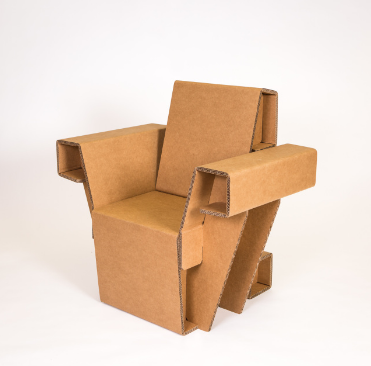
In terms of space efficiency, it’s hard to beat furniture that arrives as flat cardboard. But that’s the entire business model behind Chairigami, makers of desks, tables, chairs, and sofas, all from heavy-duty cardboard.

I doubt these pieces would challenge any puzzle solver for long, but simply relying on origami to design functional furniture is a really cool and clever puzzly concept.

The armchair especially is very striking.

But when you’re talking puzzle furniture, the uncrowned kings of the field are undoubtedly the team at Praktrik: Puzzle furniture is the only kind of furniture they sell!

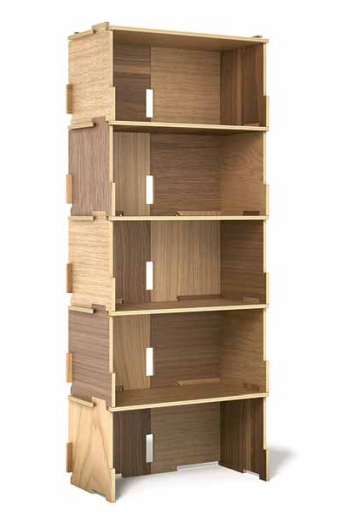
Purveyors of beautiful chairs, shelves, tables, and more, Praktrik offers a truly unique puzzling experience, offering you the disassembled piece and challenging you to complete it.

In fact, they’re proud to celebrate and spread the word when customers end up creating unexpected masterpieces from Praktrik sets!

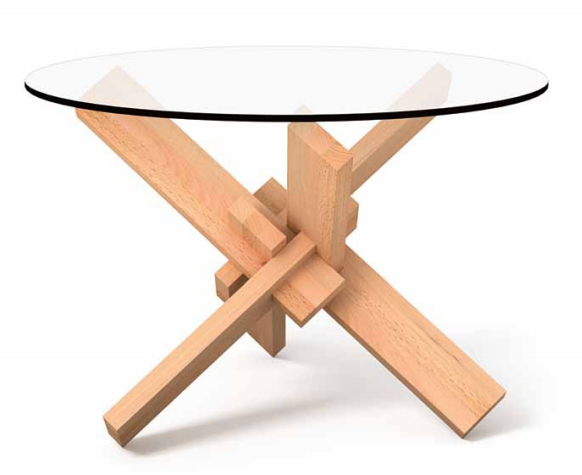
The chairs and shelves don’t seem too daunting, but the tables have a wide arrange of difficulties, and their increasingly elaborate arrangements of wooden supports and pieces evoke memories of classic brain teasers and puzzle boxes.

You can peruse their website to explore the full range of Praktrik puzzle furniture; it’s both extensive and very impressive! In fact, it was crossing paths with them that inspired this entire blog post.

So if you’re looking to add a little puzzly pizazz to your living room, maybe a piece of puzzle furniture is the way to go. What do you think, fellow puzzlers? Do any of these pieces pique your interest? Let us know in the comments section below!


Thanks for visiting PuzzleNation Blog today! Be sure to sign up for our newsletter to stay up-to-date on everything PuzzleNation!

You can also share your pictures with us on Instagram, friend us on Facebook, check us out on Twitter, Pinterest, and Tumblr, and explore the always-expanding library of PuzzleNation apps and games on our website!

A Puzzly Touch of Spring!

[Image courtesy of Atlas Obscura.]

It snowed over the weekend here on the East Coast, and after a disappointing prediction of six more weeks of winter from some of the more famous groundhogs around the world, you may find yourself longing for spring and all the marvelous greenery it promises.

In that spirit, I thought I would dedicate this February day to some mind-bogglingly lovely mazes that combine nature’s beauty with the ingenuity of humans.

[Image courtesy of Mental Floss.]

To start, feast your eyes upon the lavender labyrinth at Cherry Point Farm and Market in Shelby, Michigan, one of the oldest operating farms in Michigan.

The owner began designing the labyrinth in 2001, and it has since grown large enough to be seen on Google Earth! Finding your way to the center of the labyrinth should take about an hour, and attendance is free!

Be sure to visit in mid-July, when the French lavender is in full bloom, and enjoy the gorgeous scenery not far from Lake Michigan.

[Image courtesy of Atlas Obscura.]

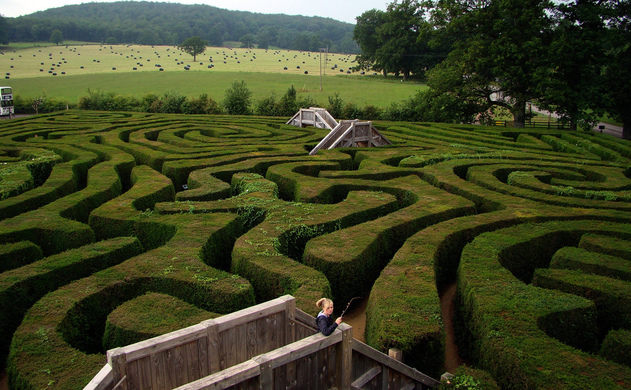
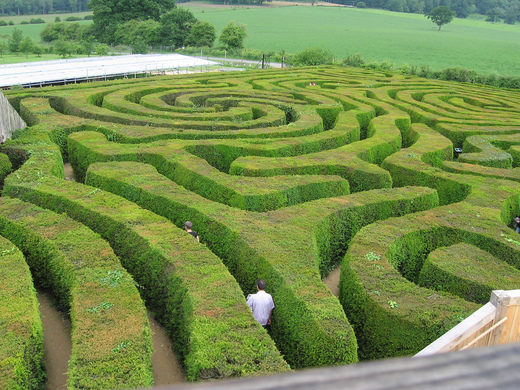
Of course, if you’re looking for a bit more of a challenge when it comes to your homegrown mazes, the Longleat Hedge Maze in Wiltshire, England will pique your interest.

It’s the longest hedge maze in the world — but not the largest — and consists of more than a mile and a half of meandering paths, including dead ends.

[Image courtesy of Atlas Obscura.]

With six raised bridges and a tower from which to survey the entire maze, it’s one of the most striking labyrinths I’ve ever seen.

It’s actually one of several mazes on the property — others include the Lunar Labyrinth and the Sun Maze — but it’s by far the largest on the property. Although it only dates back to 1975 (while some mazes in England date back centuries), it’s truly a sight to behold.

[Image courtesy of Atlas Obscura.]

To close out our look at labyrinths around the world, we venture into the southern hemisphere to explore the Enchanted Maze Garden in Arthurs Seat, Australia.

Although it is the year-round home of “a traditional hedge maze with a Japanese Garden at its center, an ancient turf labyrinth, and a circular roomed maze for children,” it’s the constantly evolving Maize Maze that puts Arthurs Seat in the record books every year.

Each year, a new maze is designed, and with GPS assistance, over 100,000 stalks of corn are planted to create the Maize Maze. Sprawling across two and a half acres, the Maize Maze is open from mid-February through late April.

Hopefully these glimpses into the amazing depth and breadth of hedge and corn mazes around the world has you looking forward to springtime puzzling outdoors! Or, at the very least, not feeling so dreary about winter.


Thanks for visiting PuzzleNation Blog today! Be sure to sign up for our newsletter to stay up-to-date on everything PuzzleNation!

You can also share your pictures with us on Instagram, friend us on Facebook, check us out on Twitter, Pinterest, and Tumblr, and explore the always-expanding library of PuzzleNation apps and games on our website!
Last-Minute Puzzly Valentine’s Day Ideas!

Valentine’s Day looms large, and sometimes it’s hard to find that perfect way to express your love for that certain someone… particularly if that certain someone is the puzzly type.

But have no fear! We’re here with some terrific last-minute puzzly ideas for Valentine’s Day!

[Image courtesy of YouTube.]

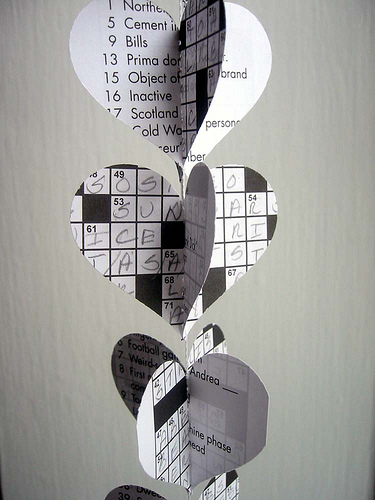
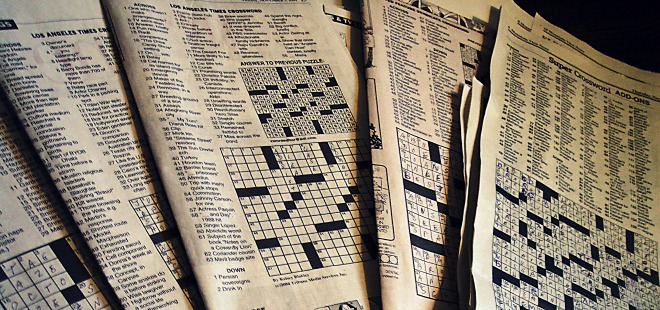
Have you considered a puzzle bouquet? You could grab some newspaper crosswords and origami them into flower shapes for a fun puzzle-fueled spin on a holiday classic.

Or maybe they like coded puzzles? You could write the object of your affection a coded love letter!

All throughout history, people have employed different tricks and techniques to keep their private messages away from prying eyes, and you could do the same! Whether it’s a simple letter-shifting cipher or something more complex, just make sure your message is worth reading. =)

[Image courtesy of Shutterstock.]

Or maybe you’d like to show off how much you know about him or her. Then you could whip up a little scavenger hunt! You could leave clues around leading to a gift, or a romantic dinner, or some other grand finale. Maybe a rose with each clue.

(You could make each clue or destination about your relationship or about your partner, allowing you to show off how well you know them… where you first met, favorite meals, favorite movie… )

If you don’t want to leave things around where anyone could nab them, keep a few small tokens on you, giving one for each destination reached or clue solved. Heck, you could enlist a friend to text clues to your special someone once they’ve reached a particular destination!

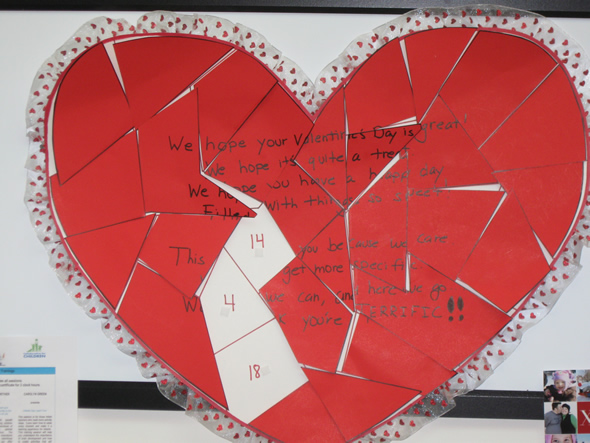
For a family-friendly version of the same idea, have the kids help you cut out and hide jigsaw pieces around the house that, when put together, spell out a Valentine’s message, a picture of the family, or a picture of some gift or event to come!

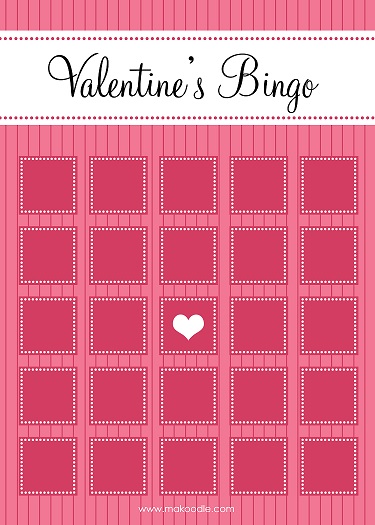
You could even walk around and play Valentine’s Day Bingo.

Go for a walk or take your loved one out to dinner, and see if one of you can get bingo by observing different things. A couple holding hands as they walk, a Valentine’s Day proposal, outrageously priced flowers…

Even on short notice, the possibilities are endless when you put your mind to it. Happy Valentine’s Day, fellow puzzlers!


Thanks for visiting PuzzleNation Blog today! Be sure to sign up for our newsletter to stay up-to-date on everything PuzzleNation!

You can also share your pictures with us on Instagram, friend us on Facebook, check us out on Twitter, Pinterest, and Tumblr, and explore the always-expanding library of PuzzleNation apps and games on our website!