It’s Follow-Up Friday: Rube Slowberg Edition!

By this time, you know the drill. Follow-Up Friday is a chance for us to revisit the subjects of previous posts and bring the PuzzleNation audience up to speed on all things puzzly.

And in today’s post, I’m returning to the subject of Rube Goldberg machines.

A Rube Goldberg machine, you may recall, is a device designed to accomplish a simple task in as many unnecessary, ludicrous steps as possible. The name comes, appropriately enough, from Rube Goldberg, a cartoonist and inventor most famous for his cartoons featuring singularly silly and elaborate machines like the one pictured above.

We’ve posted videos of Rube Goldberg machines in the past, because they’re a perfect example of a mechanical puzzle in action. Only when things happen in a precise order does the machine complete its task.

There are numerous competitions pitting clever puzzlers and inventors against each other to build the most spectacular and labyrinthine Rube Goldberg device, but Bob Partington has taken the concept to an unexpected extreme.

You see, he’s designed the world’s slowest Rube Goldberg device. The goal is simple: put the golf ball into the hole. But it takes WEEKS to perform!

Check it out:

When Goldberg started doing his drawings, even he couldn’t have envisioned someone taking his hilariously elaborate ideas this far.

Kudos to Bob Partington for taking the waiting game to the next level. Watching this in real time would be like Zen and the Art of Rube Goldberg Machine Maintenance.


Thanks for visiting PuzzleNation Blog today! Be sure to sign up for our newsletter to stay up-to-date on everything PuzzleNation!

You can also share your pictures with us on Instagram, friend us on Facebook, check us out on TwitterPinterest, and Tumblr, and explore the always-expanding library of PuzzleNation apps and games on our website!

Puzzles in Pop Culture: Square One TV

Puzzles in Pop Culture is all about chronicling those moments in TV, film, literature, art, and elsewhere in which puzzles play a key role. In previous installments, we’ve tackled everything from The West Wing, The Simpsons, and M*A*S*H to MacGyver, Gilmore Girls, and various incarnations of Sherlock Holmes.

And in today’s edition, we’re jumping into the Wayback Machine and looking back at the math-fueled equivalent of Sesame Street: Square One TV!

[The intro to Square One TV, looking more than a little dated these days.]

This PBS show ran from 1987 to 1994 (although reruns took over in 1992), airing five days a week and featuring all sorts of math-themed programming. Armed with a small recurring group of actors, the writers and producers of Square One TV offered many clever (if slightly cheesy) ideas for presenting different mathematical concepts to its intended audience.

Whether they were explaining pie charts and percentages with a game show parody or employing math-related magic tricks with the aid of magician Harry Blackstone, Jr., the sketches were simple enough for younger viewers, but funny enough for older viewers.

In addition to musical parodies performed by the cast, several famous musicians contributed to the show as well. “Weird Al” Yankovic, Bobby McFerrin, The Fat Boys, and Kid ‘n’ Play were among the guests helped explain fractions, tessellations, and other topics.

[One of the many math-themed songs featured on the show.]

Two of the most famous recurring segments on Square One TV were Mathman and Mathcourt. (Sensing a theme here?)

Mathman was a Pac-Man ripoff who would eat his way around an arcade grid until he reached a number or a question mark (depending on this particular segment’s subject).

For instance, if he came to a question mark and it revealed “3 > 2”, he could eat the ratio, because it’s mathematically correct, and then move onward. But if he ate the ratio “3 < 2”, he would be pursued by Mr. Glitch, the tornado antagonist of the game. (The announcer would always introduce Mr. Glitch with an unflattering adjective like contemptible, inconsiderate, devious, reckless, insidious, inflated, ill-tempered, shallow, or surreptitious.)

Mathcourt, on the other hand, gave us a word problem in the form of a court case, leaving the less-than-impressed district attorney and judge to establish whether the accused (usually someone much savvier at math than them) was correct or incorrect. As a sucker for The People’s Court-style shenanigans, this recurring segment was a personal favorite of mine.

But from a puzzle-solving standpoint, MathNet was easily the puzzliest part of the program. Detectives George Frankly and Kate Tuesday would use math to solve baffling crimes. Whether it was a missing house, a parrot theft, or a Broadway performer’s kidnapping, George and Kate could rely on math to help them save the day.

These segments were told in five parts (one per day for a full week), using the Dragnet formula to tackle all sorts of mathematical concepts, from the Fibonacci sequence to calculating angles of reflection and refraction.

These were essentially word problems, logic problems, and other puzzles involving logic or deduction, but with a criminal twist. Think more Law & Order: LCD than Law & Order: SVU.

Granted, given all the robberies and kidnappings the MathNet team faced, these segments weren’t aiming as young or as silly as much of Square One TV‘s usual fare, but they are easily the most fondly remembered aspect of the show for fans and casual viewers alike.

Given the topic of Tuesday’s post — the value of recreational math — it seemed only fitting to use today’s post to discuss one of the best examples of math-made-fun in television history.

Square One TV may not have been nearly as successful or as long-lasting as its Muppet-friendly counterpart, but its legacy lives on in the hearts and memories of many puzzlers these days.


Thanks for visiting PuzzleNation Blog today! Be sure to sign up for our newsletter to stay up-to-date on everything PuzzleNation!

You can also share your pictures with us on Instagram, friend us on Facebook, check us out on TwitterPinterest, and Tumblr, and explore the always-expanding library of PuzzleNation apps and games on our website!

The Value of Recreational Math

There was a wonderful opinion piece in The New York Times a few weeks ago about the importance of recreational math.

Now, as author Manil Suri said, I’m sure that to some people, the idea of recreational math sounds like an oxymoron. But it’s everywhere! From poker players calculating their odds based on the cards dealt to the number crunching in role-playing games in order to complete certain tasks (or develop a character’s skills), math is built into many recreational activities.

It’s certainly a part of many kinds of puzzles, including brain teasers. Heck, previous brain teasers featured here in the blog like Mystery Number, the Birthday Puzzle, and the jugs of water trap from Die Hard with a Vengeance would all easily fall under the umbrella of recreational math.

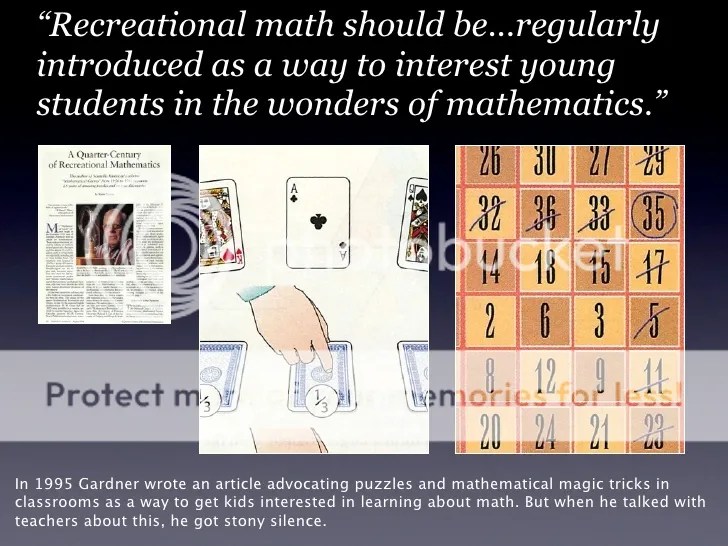
The article goes on to mention the wonderful work of Martin Gardner, whose column “Mathematical Games” in Scientific American was a mainstay of recreational math and puzzly whimsy for over twenty-five years.

From Suri’s article:

In his final article for Scientific American, in 1998, Mr. Gardner lamented the “glacial” progress resulting from his efforts to have recreational math introduced into school curriculums “as a way to interest young students in the wonders of mathematics.”

Indeed, a paper this year in the Journal of Humanistic Mathematics points out that recreational math can be used to awaken mathematics-related “joy,” “satisfaction,” “excitement” and “curiosity” in students, which the educational policies of several countries (including China, India, Finland, Sweden, England, Singapore and Japan) call for in writing.

In contrast, the Common Core in the United States does not explicitly mention this emotional side of the subject, regarding mathematics only as a tool.

This is an excellent counterpoint to the regular argument that the primary value of puzzle-solving and other activities (like recreational math) is to stave off brain health issues later in life.

In a previous post, we discussed the inconsistent reports about the effects of puzzle-solving on the brain, leaving it unclear if regular doses of puzzles and recreational math are beneficial for other aspects of brain health over time, like memory retention, neuroplasticity, and concentration.

That may well be the case, but Suri’s point stands. The idea of instilling a sense of fun and wonder into the field of math, especially for younger minds? That’s one worth pursuing.

Show them that math can be about more than fulfilling homework or graphing parabola. Show them that mathematical concepts can help you crack a diabolical seesaw brain teaser, save a village with a grain of rice, or find an alternate solution to a PSAT question and prove the testers wrong.

It has been championed in the past by television shows like Square One TV and MythBusters, but sadly, examples like that are few and far between.

And if we can instill recreational math as a key facet of math itself, then we’d be one step closer to ensuring that STEM courses will have plenty of participants in the future.


Thanks for visiting PuzzleNation Blog today! Be sure to sign up for our newsletter to stay up-to-date on everything PuzzleNation!

You can also share your pictures with us on Instagram, friend us on Facebook, check us out on TwitterPinterest, and Tumblr, and explore the always-expanding library of PuzzleNation apps and games on our website!

Collection 10 now available for the Penny Dell Crosswords App!

Hello puzzlers and PuzzleNationers! Happy Monday!

That’s right, it’s a bonus blog post today because we’ve got some exciting news!

Our latest puzzle set for the Penny Dell Crosswords App just launched in the App Store, and it’s one of our best yet!

Say hello to Collection 10! Just in time for autumn!

Collection 10 offers 150 puzzles for your solving pleasure!

Get the Value bundle, including all 150 puzzles at a special low price, or choose from 5 30-puzzle packs — Penny Press Easy, Penny Press Medium, Penny Press Hard, Dell Easy, and Dell Medium!

Five flavors of crosswords in one package! Plus you don’t have to rake any of those colorful leaves! How can you go wrong?


Thanks for visiting PuzzleNation Blog today! Be sure to sign up for our newsletter to stay up-to-date on everything PuzzleNation!

You can also share your pictures with us on Instagram, friend us on Facebook, check us out on TwitterPinterest, and Tumblr, and explore the always-expanding library of PuzzleNation apps and games on our website!

It’s Follow-Up Friday: Halloween Answers edition!

Welcome to Follow-Up Friday! Last week, we had two terrific Halloween-themed games for you, and it’s time to reveal the answers!

First up, it’s our Johnny Depp Cosplay Challenge! I posted this picture and challenged you to identify elements from as many Johnny Depp roles or films as possible:

  • The Lone Ranger / Tonto: bird on head, sheriff’s star
  • Edward Scissorhands: scissorhand
  • Dark Shadows / Barnabas Collins: long vampire nails/claws on other hand
  • Fear and Loathing in Las Vegas / Raoul Duke: sunglasses, cigarette holder, camera
  • Pirates of the Caribbean / Captain Jack Sparrow: bandanna, coat, beads in beard
  • Alice in Wonderland / Mad Hatter: socks, scarf hanging from his pocket, pocket watch on chain
  • The Tourist / Frank Tupelo: bow tie, tuxedo vest

Did I miss anything?


Secondly, it’s time to reveal the puns behind our annual PuzzleNation Punderful Costume Game!

We challenged you to figure out these clever costumes, so let’s see how you did!

#1

She’s the Life of the Party!

#2

They’re the Spice Girls!

#3

He’s the guy that walks into the bar!

#4 (the gentleman next to Woody from Toy Story)

He’s Maroon 5!

#5 (under the red arrow)

She’s a copycat!

#6

He’s a formal apology!

#7

The one on the left is Oh Deer! and the one on the right is Holy Cow!

#8

She’s the Lorde of the Rings!

#9

She’s Ariana Grande! (R E on a grande)

#10

She’s someone you can count on!


Special thanks to the folks at The Chive and The Thinking Closet for their assistance in compiling this year’s punny costumes!

How many did you get? Have you seen any great punny costumes we missed? Let us know!

Thanks for visiting PuzzleNation Blog today! Be sure to sign up for our newsletter to stay up-to-date on everything PuzzleNation!

You can also share your pictures with us on Instagram, friend us on Facebook, check us out on TwitterPinterest, and Tumblr, and explore the always-expanding library of PuzzleNation apps and games on our website!

Demystifying Role-Playing Games

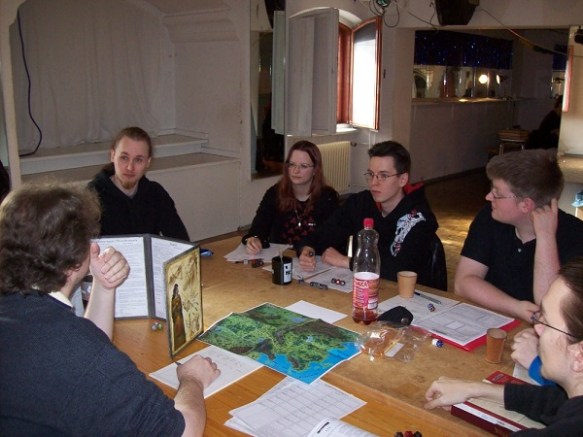
When you hear the words “role-playing game,” what comes to mind? A bunch of nerds in a basement, hunched around a table debating weird and esoteric rules? Practitioners of the black arts, thumbing their noses at God and all that is natural? Or nothing at all?
rpg-2009-berlin-2

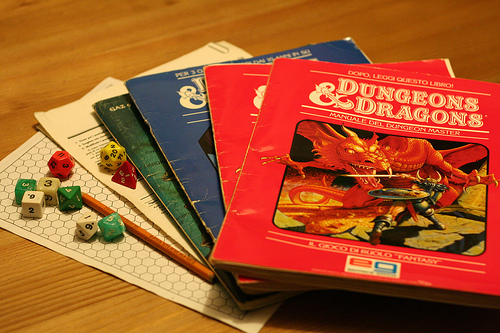
Some TV shows, like Community and Freaks & Geeks, have displayed role-playing games in a positive light, but for the most part, role-playing games in general, and Dungeons & Dragons in particular, have gotten a bad rap over the last few decades, maligned as (at best) a game for lonely friendless types and (at worst) a tool to corrupt children.

(This might sound ridiculous to many of you, but folks like Pat Robertson continue to talk about role-playing games as if they’re synonymous with demon worship.)

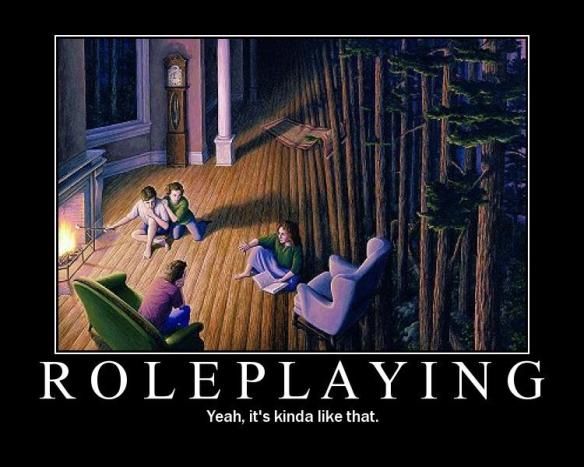
But in reality, role-playing games are simply a way for a group to tell one collaborative story.
roleplaying-kinda-like-that

There are two major elements to this storytelling. The first is managed by a single person who oversees that particular game or gaming session. In Dungeons & Dragons, this person is called the Dungeon Master, or DM; in other games, this person is the Game Master, the Storyteller, or bears some other title tied to the game or setting. For the sake of simplicity, from this point on, I’ll refer to this person as the DM.

So, the DM manages the setting and sets up the adventure. In this role, the DM will describe what the player characters (or PCs) see and explain the results of their actions. The DM also plays any characters the players interact with. (These are known as NPCs, or non-player characters.) Essentially, the DM creates the sandbox in which the other players play.
1951073350_7e357dbdec_3

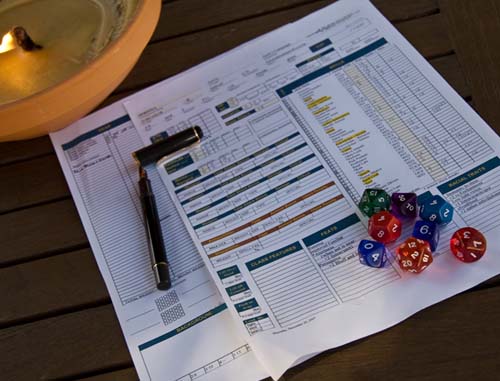
Which brings us to the second element in role-playing storytelling: the players. Each player assumes a role, a character, and plays that character for the length of the session, or the game, if there are multiple sessions. (Some games last months or years, so these characters evolve and grow; players often become quite attached to their characters.)

The PCs navigate the world created by the DM, but their actions and decisions shape the narrative. No matter how prepared a DM is or how carefully he or she has plotted out a given scene or adventure, the PCs determine much of what happens. They might follow the breadcrumbs exactly as the DM laid them out, or they might head off in an unexpected direction, forcing the DM to think on the fly in order to continue the adventure.
dd2

That’s what makes role-playing games so amazing: you never quite know what you’re going to get. The PCs usually don’t know what the DM has in store, and no DM can predict with perfect clarity what the PCs will do. You’re all crafting a story together and none of you knows what exactly will happen or how it all ends.

For instance, I run a role-playing game for several friends that is set in the universe of Buffy the Vampire Slayer, and my PCs routinely come up with solutions to problems and puzzles that I didn’t expect, but that nonetheless would work. They constantly keep me on my toes as a DM, and it’s one of my favorite aspects of the game.

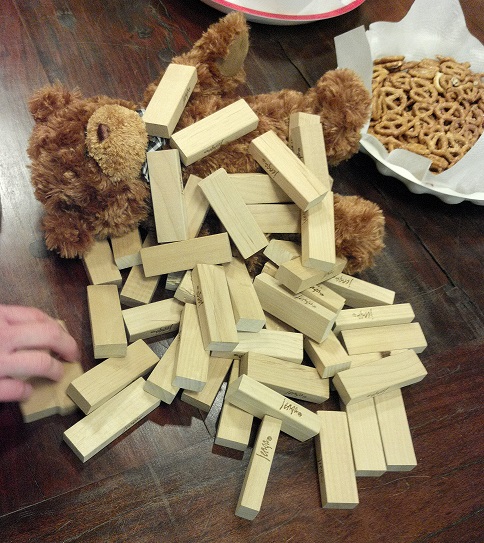
Oftentimes, major events and key moments are determined by dice rolls, adding an element of chance to the story. (In some games, players have replaced dice rolls with a Jenga-style block tower, and they must remove pieces from it to achieve certain goals. That adds a marvelous sense of real-world tension to the narrative tension already present!)
tabletop6

And while I’ve talked quite a bit about the game aspect, some of you might be wondering where the puzzly aspect comes in.

Some of the best, most satisfying puzzle-solving experiences of my life have come from role-playing games.

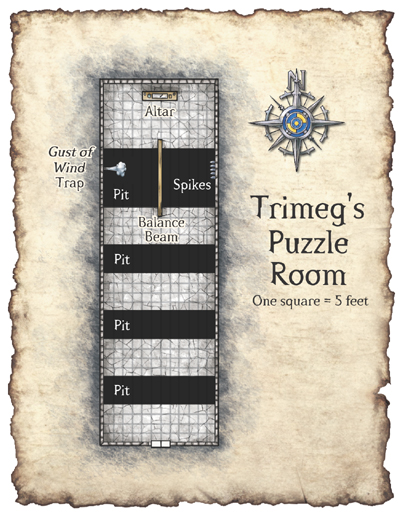
These puzzles can be as simple as figuring out how to open a locked door or as complicated as unraveling a villain’s dastardly plot for world domination. It can be a poem to be parsed and understood or a trap to be escaped.

There are riddles of goblins and sphinxes, or the three questions of trolls, or even the brain teasers and logic problems concocted by devious fey hoping to snare me with clever wordplay. I’ve encountered all sorts of puzzles in role-playing games, and some of them were fiendish indeed.
trimegspuzzleroom

One time, during a LARP session (Live-Action Role-Playing, meaning you actually act out the adventure and storytelling), I thought I’d unraveled the meaning of a certain bit of scripture (regarding a key that would allow me to escape the room) and acquired a sword as my prize, only to realize much much later that the key I’d spent the entire session searching for was the sword itself, which unlocked the door and released me.

And designing puzzles for my players to unravel is often as much fun as solving the puzzles myself. Especially when they’re tailored to specific storytelling universes or particular player characters.

(Trust me, it doesn’t matter if you’re dealing with a Jedi or a paladin; riddles stop pretty much everybody in their tracks.)

b7052aee1c93bff98f4c513e4470fbb6

Whether it’s Dungeons & Dragons or Pathfinder, Legend of the Five Rings or Star Wars, GURPS or Ninja Burger, there’s a role-playing game out there for everyone, if you’re just willing to look.


This post was meant as a brief overview of role-playing games as a whole. If you’d like me to get more in depth on the subject, or if you have specific questions about role-playing games, please let me know! I’d be happy to revisit this topic in the future.

Thanks for visiting PuzzleNation Blog today! Be sure to sign up for our newsletter to stay up-to-date on everything PuzzleNation!

You can also share your pictures with us on Instagram, friend us on Facebook, check us out on TwitterPinterest, and Tumblr, and explore the always-expanding library of PuzzleNation apps and games on our website!