A Video Game Puzzle Hunt Reaps Real-World Rewards!

We’ve written about some pretty amazing and elaborate puzzle hunts here in the past. There was the Gravity Falls cipher hunt that led to an actual statue of the show’s villain Bill Cipher in the woods of Reedsport, Oregon. (And a mayoral position for the first person to find him and shake his hand!) There was the puzzle-turned-global-scavenger hunt from Trials Evolution that won’t be completed until 2113 at the base of the Eiffel Tower.

And now, a massive crowdsourcing effort has cracked another masterpiece, a puzzle hidden in an expansion pack for the video game Destiny 2. Destiny 2 is an online first-person-shooter loaded with sci-fi trappings and in-depth storytelling where players explore a shared environment while engaging in their own personal plot and adventures.

The most recent expansion to the game, Warmind, was released last week, and players noticed an elaborate symbol on a wall in the bunker of Rasputin, a sentient robot. The symbol appeared to be a lock surrounded by keys and curious symbols.

This Kotaku post went live on Friday, three days after the Warmind release, revealing the incredible online effort already in motion to unravel the secrets of the Rasputin puzzle. The subreddit r/raidsecrets was ground zero for the puzzle-solving efforts, and players compiled their theories and discoveries there.

Players quickly determined that each of the keys had a symbol that linked back to other imagery from the game, and by following those breadcrumbs, they had a chance to crack the cipher.

The first symbol was found in several places, each time with a set of digits and a bar in a particular position. Solvers theorized that these symbols represented the word “reverse.”

The second symbol appeared beside a Braille grid, leading hunters to crates with Braille lettering on them: OEAARRTFWTH. This anagrams to The Art of War, Sun Tzu’s famous tome. In this case, The Art of War was used as the source material for an Ottendorf Cipher. (That particular cipher was made famous by Nicolas Cage’s National Treasure movies.)

This type of cipher uses numbers in groups of three, and these numbers correspond to positions of letters in a book. Most often the numbers refer to Line, Word, and Letter. Decoding the number-combinations in the image above led to the answer “Destroy all second A and B. Then destroy all third C and R.”

These two clues were assumed to be instructions for what to do with the encoded ciphertext others had discovered in the game:

This encrypted message was the heart of the puzzle. But there was more to uncover first.

As it turns out, the last three keys in the image represented different words to apply to the ciphertext in order to properly decode it.

The fourth symbol was found near a Morse Code sequence that spelled out “NTEHNMLNEEGIT,” an anagram for “Enlightenment.”

The fifth symbol pointed toward a monitor with some peculiar code on it. It turns out the code was actually Jianpu, an ancient form of Chinese notation for writing music. When translated into actual music, a player identified the piece as an excerpt from Tchaikovsky’s Swan Lake.

One intrepid codebreaker then tried to decrypt the ciphertext given the clues everyone had assembled thus far.

He reversed the ciphertext, according to the instruction of the first key. He then removed every other A and every other B from the text, then every third C and every third R, according to the instructions of the second key.

Then, employing a Vigenere cipher, he used the two key words he had — “enlightenment” and “swan lake” — to begin decrypting the text. He managed to decrypt the entire text, but more incredibly, he also reverse engineered the missing third key word — “mechanized” — while doing so.

And what was the final message, after all this?

thank you for taking the time to piece together this message, friend. the time of our final conflict is drawing closer and you and ana have an important role to play in the events to come. so watch over her, guardian. i would have no life without ana or the exoprogram. i regret that we have become strangers, but we each have a path that we must walk. and, ironically, there never seems to be enough time. tell her, rasputin’s first attempt was in the right location, but the wrong moment. look here: 43.549573, -73.544868 – e

As you might suspect, those numbers at the end are GPS coordinates, which correspond to Sleeping Beauty Mountain in upstate New York. (The company that developed Warmind, Vicarious Visions, is based in upstate New York.)

A small treasure trove of prizes awaited the brave soul who trekked out to Sleeping Beauty Mountain on Saturday morning. The centerpiece was a giant spear, a replica of a weapon from the game known as the Valkyrie.

From the Kotaku article following up on the puzzle’s resolution:

There was also a box of gold coins (along with instructions asking the finder to only take one), a set of notes, and a journal for recording visitors. The note, from Warmind design lead Rob Gallerani, encouraged the finder(s) to share photos of this discovery and told them that there are only three spears like that in existence — one at Vicarious Visions, one at Bungie, and this.

The spear, shown above (alongside the visiting team from Vicarious Visions) now resides at a comic shop called The Freakopolis Geekery.

As for the gold coins and the geocache Vicarious Visions had set up for others who make the trip, unfortunately, park rangers removed it because the designers didn’t get a permit. The coins have been returned to Vicarious Visions, who are currently reaching out to all the folks at r/raidsecrets who contributed to the solution of the puzzle, hoping to get them the coins they so richly deserve.

And, as if all that wasn’t amazing enough, it turns out… this might not be the end of the adventure.

Because a sharp-eyed observer noticed some text embossed on the upper portion of the replica Valkyrie spear:

At the moment, no one knows what the letters mean. But if I had to wager, I’d say the master puzzle solvers at r/raidsecrets should keep digging. Who knows what they’ll find next?


Thanks for visiting PuzzleNation Blog today! Be sure to sign up for our newsletter to stay up-to-date on everything PuzzleNation!

You can also share your pictures with us on Instagram, friend us on Facebook, check us out on TwitterPinterest, and Tumblr, and explore the always-expanding library of PuzzleNation apps and games on our website!

The Indie 500 Crossword Tournament returns soon!

Three years ago, a new crossword tournament joined the ranks of the American Crossword Puzzle Tournament and Lollapuzzoola, immediately carving out its own niche in the puzzle world. The Indie 500 offered topnotch puzzles and a pie-fueled solving experience both live in Washington, D.C., and for solvers at home.

And it’s back! The fourth edition of The Indie 500 is happening on Saturday, June 2, and this year, the theme is “Dressed to Fill.”

This year’s tournament follows the same format as previous years: five preliminary puzzles of varying difficulty, plus a final puzzle for the top three scorers in both divisions.

[There’s also a fair amount of slapstick.]

Registration is open for the tournament, and if you can make it to D.C., it’s only $30 to compete! But don’t worry if you can’t, because solving from home is only $10!

Not only that, but there’s a fashion-themed meta suite that lets you name your own price, as well as access to the previous tournament bundles for $5 apiece. Those are super-affordable prices for some outstanding puzzles!

Andy Kravis, Erik Agard, and Neville Fogarty all make their fourth appearance as veteran constructors — understandable, since they’re also event organizers — and they’re joined once again by Angela Olson Halsted and Peter Broda, as well as tournament newcomers Anna Gundlach, Laura Braunstein, Lily Silverstein, and Sophia Maymudes!

And, of course, there will be pie.

You can click here for the Indie 500 home page, and click here for a rundown of last year’s puzzles!

Will you be competing, or participating from home? Let us know in the comments below!


Thanks for visiting PuzzleNation Blog today! Be sure to sign up for our newsletter to stay up-to-date on everything PuzzleNation!

You can also share your pictures with us on Instagram, friend us on Facebook, check us out on TwitterPinterest, and Tumblr, and explore the always-expanding library of PuzzleNation apps and games on our website!

PuzzleNation Product Review: ThinkFun’s Kaleidoscope Puzzle

[Note: I received a free copy of this product in exchange for a fair, unbiased review. Due diligence, full disclosure, and all that.]

Clear, or transparent, cards are a rarity in puzzles and games, but they offer a terrific gameplay mechanic: the ability to stack cards without obscuring information.

The clear cards in the storytelling game Gloom allow players to add and subtract points from various characters as the grim and whimsical stories unfold. The quick-play pattern-matching game On the Dot — which was part of last month’s Tabletop Tournament — challenges players to properly arrange four clear cards — each with randomly-placed colored dots — in order to match a given pattern before their opponents do.

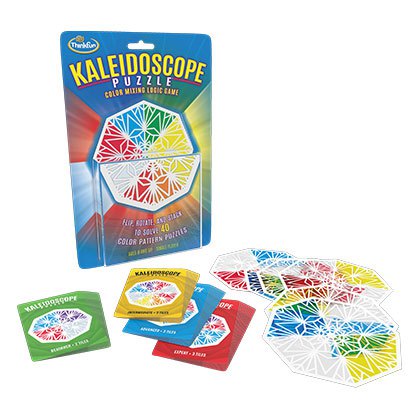
Now, the creative minds at ThinkFun have put a wonderful, vibrant twist on the clear-card genre of puzzles and games with their latest release: Kaleidoscope Puzzle.

[Two of the six kaleidoscope tiles.]

In Kaleidoscope Puzzle, you have six octagonal tiles, each with its own pattern of tinted and clear quadrants. It’s up to the solver to arrange either two or three of the six tiles in order to recreate the patterns on the challenge cards.

First off, I want to say that this might be the most aesthetically pleasing puzzle I’ve ever solved. Just turning the kaleidoscope cards in my hands in front of a light is enjoyable, letting the snowflake-patterning on each card blur and come into focus anew as the cards line up, each time matching and mixing the various colored quadrants to create eye-catching effects. It’s brilliant in its simplicity, and unlike any color-based puzzle I’ve seen on the market today.

It almost feels like putting together a stained-glass window, particularly as the challenge cards progress and the patterns grow more elaborate.

[One possible combination of those two tiles.]

The Beginner challenge cards help to familiarize you with the gameplay. You quickly figure out placement and color combinations. As you transition into the Intermediate challenge cards, the patterns grow more elaborate, and honestly, more beautiful. It’s amazing the combinations you can conjure with just two of the six possible kaleidoscope tiles!

Halfway through the Intermediate challenge cards, they ratchet up both the possibilities and the difficulty, as you now have to create the patterns with three kaleidoscope tiles. Now you’re trying to cover all four quadrants with color patterns, and it becomes about maximizing what each tile offers.

But it’s in the Advanced challenge cards that the game really separates itself from On the Dot-style solving, because Kaleidoscope puzzle has the color-mixing element as well. Not only are you manipulating the kaleidoscope tiles to place the basic colors where you need them, but you also need to create green, orange, and purple patterns as well.

Toward the end of the Advanced challenge cards, you start to deal with eighths instead of quadrants, divvying up the field into increasingly more complicated designs, reminiscent of pie charts.

Sometimes, you might discover alternate ways to form the patterns, which is very satisfying indeed. It also speaks to how adaptable the six kaleidoscope tiles are, since you can arrange them in seemingly endless combinations.

By the time you reach the Expert challenge cards, you’ll be turning, flipping, and rearranging these tiles like crazy to form the intricate patterns on the cards. It’s an unexpectedly relaxing form of puzzling, a meditative mix of challenge and aesthetics.

[The same pattern coming to life under a desk lamp.]

I cannot say enough good things about this puzzle. Mixing the resource management of how to get the most out of each tile you choose with the striking visuals of the kaleidoscope tiles makes for a unique solving experience.

Puzzles that are as satisfying to look at after the solve as they are to solve in the first place… that’s a true rarity. What a treat.

[Kaleidoscope Puzzle is available from ThinkFun and participating retailers, starting at $9.99!]


Thanks for visiting PuzzleNation Blog today! Be sure to sign up for our newsletter to stay up-to-date on everything PuzzleNation!

You can also share your pictures with us on Instagram, friend us on Facebook, check us out on TwitterPinterest, and Tumblr, and explore the always-expanding library of PuzzleNation apps and games on our website!

New Clues for an Unsolved Treasure Hunt!

[Image courtesy of Westword.]

Who doesn’t love a treasure hunt? The chance to pit your wits, your skills, and your luck against the elements, a dodgy old map, and the curious clues left behind by an eccentric mind… who could resist?

We’ve detailed a few famous unsolved treasure hunts in the blog in the past, and by far the most popular one that remains is the brainchild of Forrest Fenn.

Somewhere in the Rocky Mountains, there is said to be a treasure chest containing millions of dollars worth of treasure.

[Image courtesy of Wikipedia.]

How does one find this treasure? By deciphering the nine clues in Fenn’s poem, “The Thrill of the Chase.”

As I have gone alone in there
And with my treasures bold,
I can keep my secret where,
And hint of riches new and old.

Begin it where warm waters halt
And take it in the canyon down,
Not far, but too far to walk.
Put in below the home of Brown.

From there it’s no place for the meek,
The end is drawing ever nigh;
There’ll be no paddle up your creek,
Just heavy loads and water high.

If you’ve been wise and found the blaze,
Look quickly down, your quest to cease
But tarry scant with marvel gaze,
Just take the chest and go in peace.

So why is it that I must go
And leave my trove for all to seek?
The answers I already know
I’ve done it tired, and now I’m weak

So hear me all and listen good,
Your effort will be worth the cold.
If you are brave and in the wood
I give you title to the gold.

Hidden since 2010, the poem has baffled and beguiled thousands of aspiring treasure hunters, and several accidental deaths have been attributed to the treasure hunt.

In order to prevent such accidents in the future, Fenn has released a few additional clues to keep hunters safe:

“The treasure chest is not under water, nor is it near the Rio Grande River. It is not necessary to move large rocks or climb up or down a steep precipice,” he writes. “Please remember that I was about 80 when I made two trips from my vehicle to where I hid the treasure.”

Whether these hints will help aspiring hunters, it’s hard to say. For now, that treasure is still out there somewhere…


Thanks for visiting PuzzleNation Blog today! Be sure to sign up for our newsletter to stay up-to-date on everything PuzzleNation!

You can also share your pictures with us on Instagram, friend us on Facebook, check us out on TwitterPinterest, and Tumblr, and explore the always-expanding library of PuzzleNation apps and games on our website!
May the Fourth Be With You!

Hello fellow puzzlers and PuzzleNationers! It’s Star Wars Day, and what better way to celebrate than with a puzzly Star Wars brain teaser!

A fellow Star Wars fan and puzzler sent in this delightful little logic puzzle, and we decided to share it with you! Can you crack this SW gift mystery?


Three friends had three kids who were all named after Star Wars characters. For Star Wars Day one year, all three kids (Han, Leia, and Luke) got different Star Wars LEGO sets as gifts (the Millennium Falcon, an AT-AT, and an Imperial Star Destroyer).

Each set had a different number of pieces (1345, 1432, or 1569) and each kid took a different amount of time to complete the model (2, 3, or 4 hours). Using the clues below, can you figure out which kid got which model, how many pieces it had, and how long it took them to build it?

1. The model with the most pieces took the most time to complete, but the model with the least pieces did not take the least amount of time to complete.

2. The models weren’t to scale, so the Millennium Falcon actually had more pieces than the Imperial Star Destroyer, a fact that Luke was upset to learn since he likes bigger models.

3. Han spent the three hours between opening his gifts and lunch building his model.

Good luck, fellow puzzlers! Although the puzzle is a bit easier if you’re familiar with the Star Wars Universe, any solver should be able to crack this puzzle with the clues provided!

Let us know if you solved it in the comments below! And May the Fourth Be With You!


Thanks for visiting PuzzleNation Blog today! Be sure to sign up for our newsletter to stay up-to-date on everything PuzzleNation!

You can also share your pictures with us on Instagram, friend us on Facebook, check us out on TwitterPinterest, and Tumblr, and explore the always-expanding library of PuzzleNation apps and games on our website!

PuzzleNation Product Review: Get the MacGuffin

[Note: I received a free copy of this product in exchange for a fair, unbiased review. Due diligence, full disclosure, and all that.]

There are all sorts of different card games out there. Some require you to empty your hand of cards before your opponents can. Some are about accumulating the right cards to accomplish certain tasks, reach certain totals, or match certain patterns and images.

Today’s card game is a little different, because it’s not about emptying your hand, accomplishing goals, or matching images… it’s all about outlasting your opponents.

In today’s product review, we explore the latest offering from the crew at Looney Labs: Get the MacGuffin.

At first glance, this might simply seem like a scaled-down version of Fluxx. You have action cards (which affect how you and other players play the game) and object cards (which are placed down in front of you, like the Keepers and Creepers in Fluxx).

As you might expect from the name of the game, getting the MacGuffin is a worthwhile accomplishment, but it’s not the true endgame here. It’s just one very attractive way to reach the endgame.

Between the action cards and object cards, you’re simply trying to keep cards in your hand or in play in front of you while your opponents whittle down their own meager stashes of cards. If you run of cards, you’re out of the game.

And this happens faster than you’d think. With only 23 cards in the deck — 7 object cards and 16 action cards — you could run out of cards in only a few turns. You see, each player starts with the same number of cards. But there’s a big difference between the minimum number of players (two, which means you each get 5 cards, leaving 13 cards out of play) and the maximum number of players (eleven, which means you each get 2 cards, leaving 1 card out of play).

The cards vary wildly in value. Some are very silly; play The Shrugmaster, for instance, and you simply shrug, using up a turn. Otherwise, you don’t affect the game or the other players in any way.

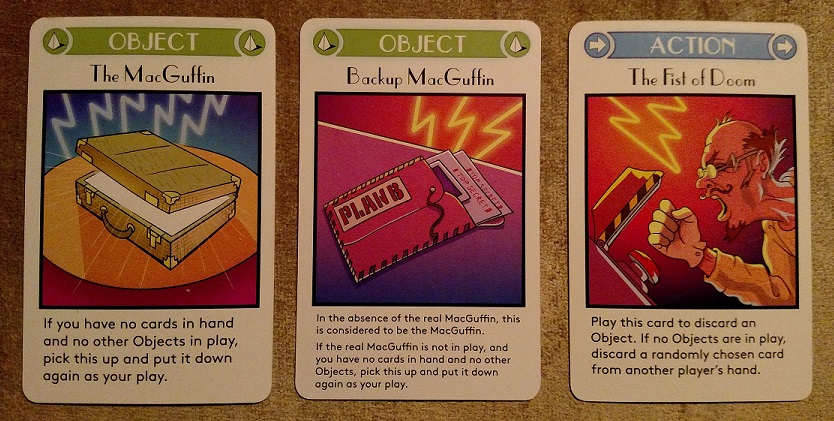
Compare this to a valuable card, like The MacGuffin, which can be picked up and played again over and over. As long as you have that card in play in front of you, you will always have another turn. In a game where every turn can cost you cards, The MacGuffin is a powerful card to wield.

Players familiar with Fluxx will find some of the actions and object card powers familiar, as they allow you to randomly remove cards from other players’ hands, swap cards (or hands) with other players, and even block other cards from being used.

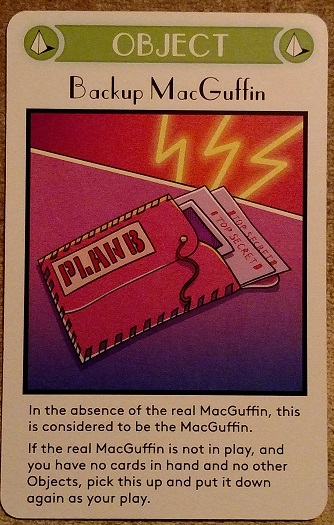
The balance of cards and actions is impeccable. While some cards are very influential, there is always another card in the deck that can remove it, shift it, or neutralize it. (For every MacGuffin, there is not only a Backup MacGuffin, but also a Fist of Doom.)

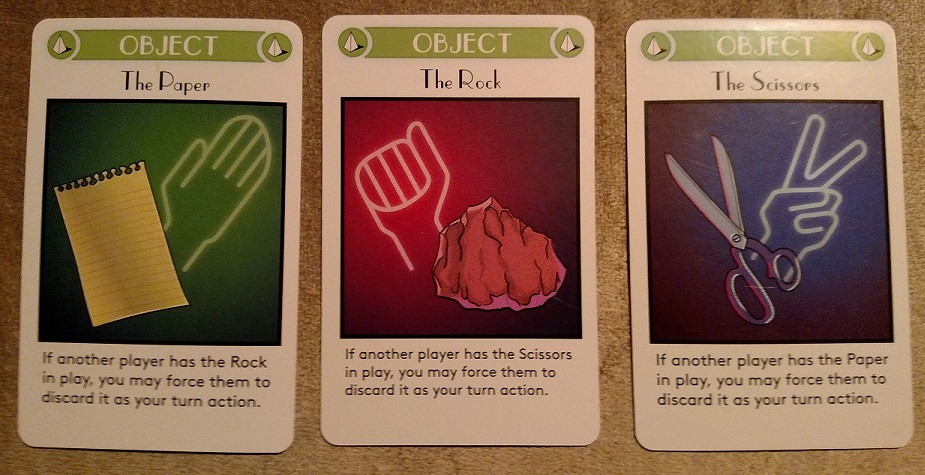
This adds tons of replay value to a card game that at first blush might seem limited. But the level of card interaction — like the Rock, Paper, and Scissors cards pictured above — make each game an unexpected treat.

Plus it’s a hugely different game based on the number of players. With a big group, you need to be more aggressive, because you could run out of cards in a few minutes. With a smaller group — or just a pairing — you have to strategize more, protecting your valuable cards while trying to prevent your opponents from taking advantage early. Or, heaven forbid, getting the MacGuffin.

Not only that, but the art on each card is terrific. The random characters on the object cards in particular — everyone from The Merchant and The Spy to The Thief and The Assassin — hint at a larger narrative, a bigger storytelling world that the game seems to only scratch the surface of. They feel like the misfits from a particularly wacky Guy Ritchie heist movie, adding a fun element of whimsy to the often-dastardly proceedings.

Get the MacGuffin is a quick-play game that you’ll want to play over and over again.

[Get the MacGuffin is available from Looney Labs and other participating retailers, starting at just $10!]


Thanks for visiting PuzzleNation Blog today! Be sure to sign up for our newsletter to stay up-to-date on everything PuzzleNation!

You can also share your pictures with us on Instagram, friend us on Facebook, check us out on TwitterPinterest, and Tumblr, and explore the always-expanding library of PuzzleNation apps and games on our website!