PuzzleNation Product Review: Word Domination

Gathering letters to spell words and gain points… it’s a game mechanic so familiar and traditional that it’s easy to take for granted these days. Whether you’re talking about the wooden tiles of Scrabble or the electronic tiles of Words With Friends, the mind-bending spin of Unspeakable Words or the three-dimensional challenge of Upwords, it’s a classic concept.

Word Domination builds on that concept by adding a new strategical element. As you spell words, you claim letters from a shared letter pool. It’s essentially a more aggressive form Boggle.

Each player assumes the identity of a James Bond-style villain, and each letter tile doubles as a prize or piece of loot that can be captured by a player.

The player then uses a letter tile drawn at random with some of the letters laid out in the play area to spell a word, temporarily capturing those letters. (Unlike Boggle, the letters in the word don’t need to be touching.)

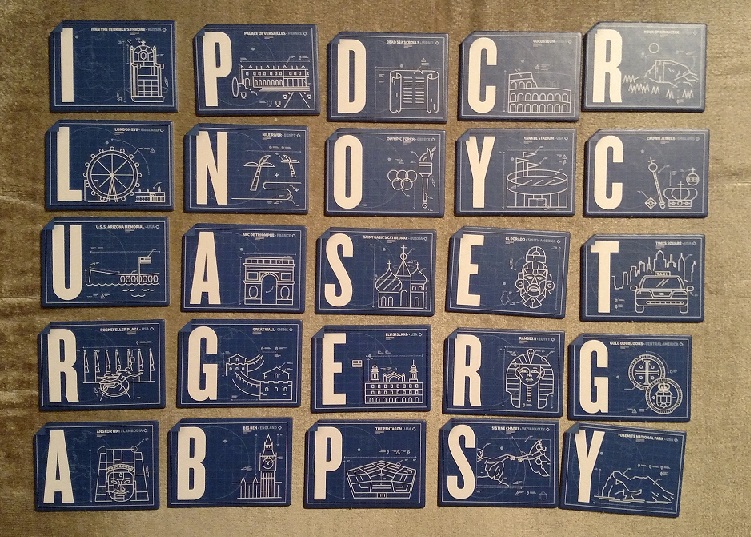
For example, in the first round, Player 1 spells the word ODYSSEY, placing zeppelin tokens on each of the 7 letters in the world, including the O that the player added on their turn. Player 1 then draws a new random tile for the next round, and play moves to Player 2.

Player 2 spells the word FORGERY and places her zeppelin tokens. And since she used three letters that Player 1 had captured, she captures those letters and removes his zeppelin tokens from the board.

Let’s jump ahead slightly. Player 3 spells the word TESSERACT, stealing some captured letters from both Player 1 and Player 2, and that concludes the first round. When round 2 starts up, Player 1 spells the word DYNASTY and places his zeppelins.

And since the letters D and Y were already captured by Player 1 in the first round, capturing them a second time means Player 1 has stolen those letters from the game board, and claims them for himself.

Those letters are given to Player 1 to use for the rest of the game, and replaced with STOLEN tiles, which are worth points at the end of the game.

After six rounds of play, the player who has claimed the most territory (and earned the most points) wins the game.

Now, naturally there are wrinkles to add to the gameplay, like helping other players spell words in order to split the profits with them, arming yourself with certain rare letters and weaponizing them, and even utilizing special abilities only your character has access to.

Between these twists and the baseline gameplay, you have a rich and variable game experience that really allows a strategic player to shine when matched up against players that might have stronger vocabularies or better luck drawing letter tiles.

And the game aesthetic really adds to the playing experience. The idea of stealing letter treasures, claiming territory with little zeppelin tokens, and running amok as a film villain (complete with bizarre letter-based weapontry and a punny name) is the perfect mix of silly and clever, spicing up a solid game with enjoyable little quirks.

Word Domination balances luck, strategy, and vocabulary skills to create a game that feels familiar but keeps you on your toes. What a treat.

Word Domination is created by Jeff Beck and is available through Uproarious Games and select online retailers for $32.99.


Thanks for visiting PuzzleNation Blog today! Be sure to sign up for our newsletter to stay up-to-date on everything PuzzleNation!

You can also share your pictures with us on Instagram, friend us on Facebook, check us out on TwitterPinterest, and Tumblr, and explore the always-expanding library of PuzzleNation apps and games on our website!

PuzzleNation Product Review: Less

lessgame

There are many games out there that pair nicely with food or drink. Many party games even revolve around this mechanic, like Jason Anarchy’s alcohol-fueled roleplaying game Drinking Quest.

But I think Less is the first game where the playing tiles intentionally double as coasters for your drinks. It feels like a game that could be played in a tavern at a moment’s notice, which lends its minimalist style an old-world gaming charm.

less1

But I’m getting ahead of myself here. Less is a strategy game that combines the tactical planning of chess with the dynamic maneuverability of checkers.

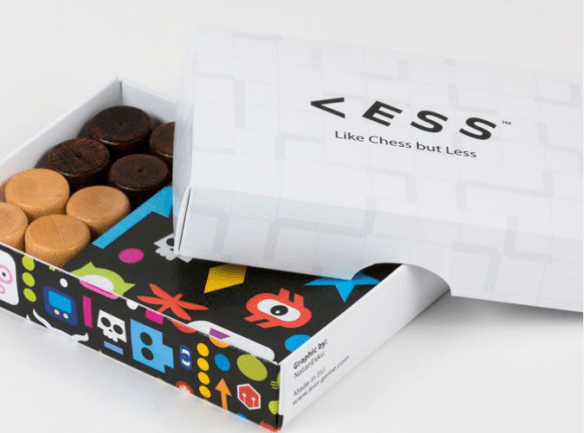
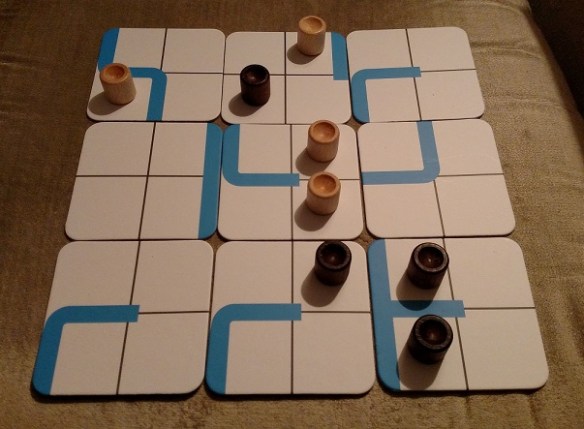
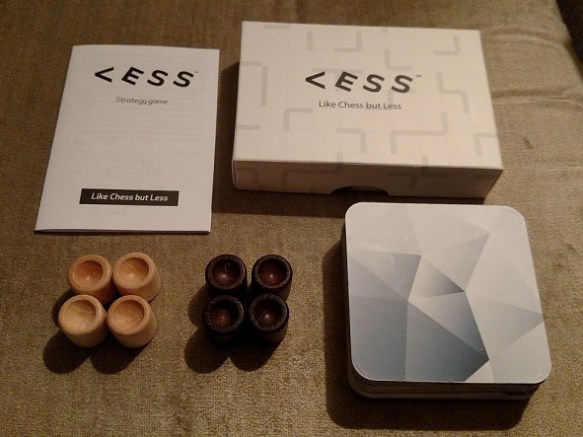
The game consists of 12 tiles and 8 game pieces, 4 white and 4 black. The players randomly select 9 of the 12 tiles and arrange a 3×3 game board. (With 12 tiles and four ways to place each tile, you’re virtually guaranteed a different game board every time you play.)

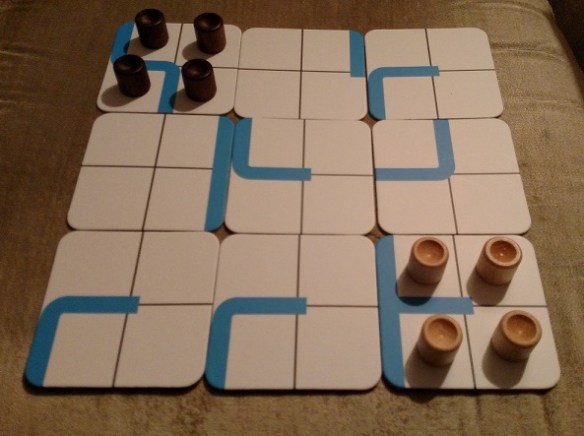
One player sets up their 4 game pieces in one corner, and the other player sets up their game pieces in the opposite corner. The goal of the game is to move all 4 of your pieces into your opponent’s corner before your opponent can occupy your corner.

less2

To do so, you are allowed three moves per turn. You can use all three moves for a single game piece, or spread them out over multiple game pieces. Moving a piece from one square to a neighboring square is one move. Jumping over a game piece to the next open square is also one move. (Here’s where checkers-style planning comes in handy.)

By now, you’ve probably noticed those blue walls on some of the tiles. Those walls require an extra move to traverse, so moving a game piece over a wall requires two moves. (And if neighboring squares each have a wall between them, jumping that double wall requires all three moves that turn.)

This three-move system offers players loads of options going forward, but your best bet is to arrange a sequence of leapfrog jumps to move your pieces as efficiently as possible across the board. (Unlike chess or checkers, there is no capturing or removing your opponent’s pieces from the board.)

less3

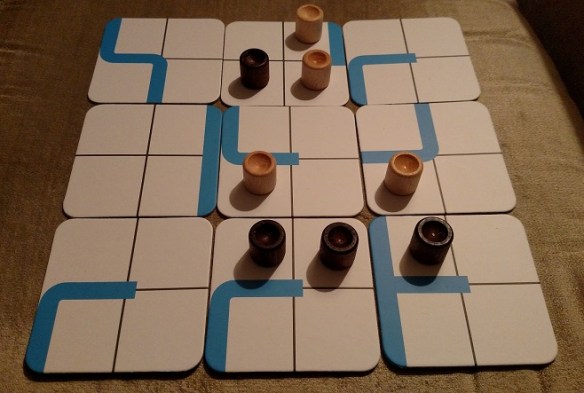
[Here, black has more pieces near the opposing corner, but that blue wall will make it harder to occupy the corner efficiently. Meanwhile, more of white’s pieces are farther away, but there are fewer obstacles to slow those pieces down.]

Mixing a tactical approach with the improvisation that comes with reacting to your opponent’s movements makes Less a very engaging gaming experience, even if a game routinely lasts less than ten minutes. And on the puzzle side of things, figuring out the most efficient way to navigate a path toward your opponent’s corner is great fun, since every game is different, and your opponent has different obstacles to tackle than you do, given the random placement of walls on the board.

Plus, if you’re willing to invest in two copies of the game, you can play with four players, as you and your partner coordinate your efforts across a 4×4 game board in the hopes of occupying your opponents’ corners first.

It’s a game that takes a few minutes to learn and offers near-infinite replayability. It might be called Less, but it feels like a very complete, very satisfying challenge.

less4

Less is published by InventedFor and is available online at less-game.com (with numerous coaster designs for the reverse side of the tiles). Click here for full details.


Thanks for visiting PuzzleNation Blog today! Be sure to sign up for our newsletter to stay up-to-date on everything PuzzleNation!

You can also share your pictures with us on Instagram, friend us on Facebook, check us out on Twitter, Pinterest, and Tumblr, and explore the always-expanding library of PuzzleNation apps and games on our website!

PuzzleNation Reviews: Linkee and Mr. Lister’s Quiz Shootout

[Note: I received free copies of these games in exchange for a fair, unbiased review. Due diligence, full disclosure, and all that.]

The folks at Bananagrams are synonymous with letter-tile games like Pears in Pairs, Zip It, and of course their flagship product, but today they’ve brought us something a little different. Instead of flashing your anagram skills or showing off your well-honed Scrabble techniques, these games will test your trivia knowledge, your ability to play well with others, and how shrewd a strategist you are.

In this post, we’ll be reviewing Linkee and Mr. Lister’s Quiz Shootout!

linkee1

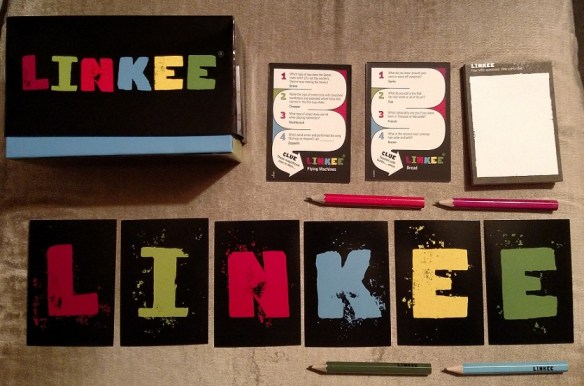
Linkee is a trivia game for three or more players. (Up to 30, apparently!) Each trivia card has a letter on the back, and the goal of the game is to acquire enough letter cards to spell “LINKEE.”

One person acts as the Question Master, while the other players (or teams, if you prefer) each grab a pencil and pad. The Question Master shows the players what letter they’re playing for, then poses each of the four questions on the card. The players write down the answers and try to figure out what theme links the four answers.

linkee-1

The first player or team to shout out “LINKEE!” and identify the link gets the letter card. You can shout out “LINKEE!” at any point, but if you’re wrong, you’re out until the next card is played. So confidence and boldness has to be tempered with strategy.

That’s what makes the game more intriguing than your average trivia game. It’s not just knowing the answers to individual trivia questions; it’s figuring out the link between them, and doing so before your opponents.

If the four answers aren’t enough for any player or team to figure out the link, the Question Master reads a clue at the bottom of the card.

linkee2

Although this can be a fun game for a few players, it really shines when you can get four teams going at once, because the shouting and competitiveness really brings out the fun of the game. (Thankfully, you don’t need to get both the yellow and green Es. That was the difference maker in one game this weekend.)

Although I’d rate the trivia as fairly easy for the average board game fan or puzzler in your household, some of it is not geared toward younger players — I doubt the 8- or 10-year-olds in your house know about the Rat Pack or Malala Yousafzai, for instance — so that’s something to consider.

Otherwise, this is the rare trivia game that’s more about speed and association than about straight-up trivia knowledge.

mrlister

Mr. Lister’s Quiz Shootout follows a similar format to Linkee, but has a completely different flavor.

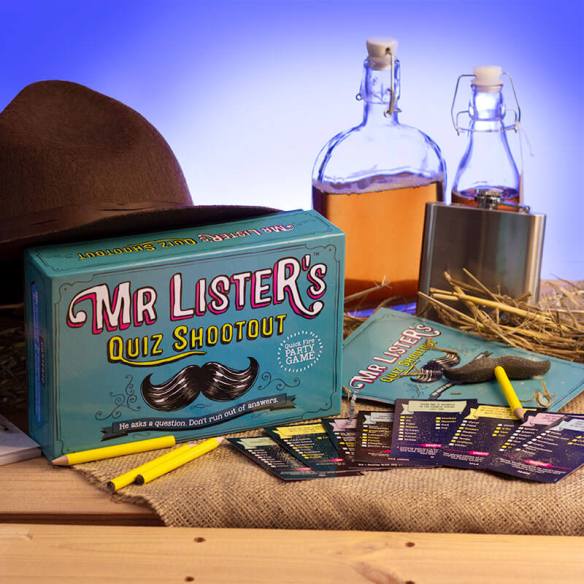
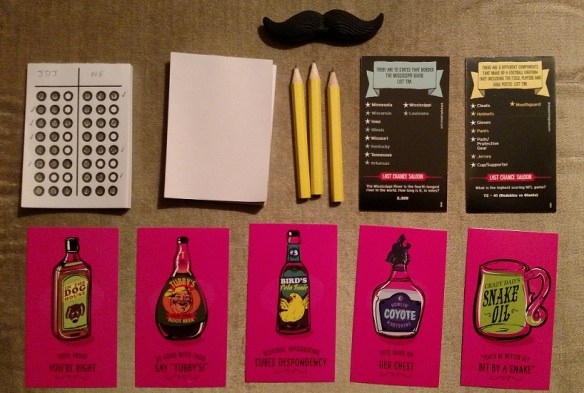
Here, instead of a Question Master, you have Mr. Lister, the mustachioed bartender. Instead of spelling out LINKEE, you’re trying to acquire five different drinks, which are on the backs of the question cards. Again, players get a pad of paper and a pencil.

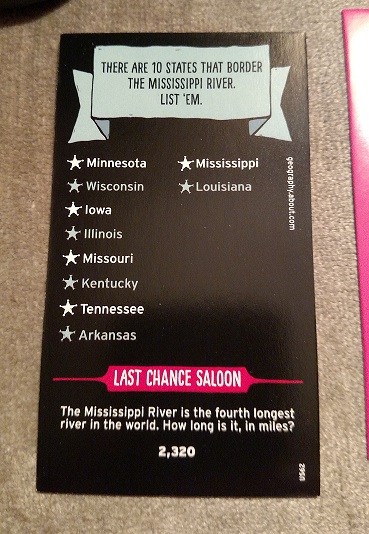
The main difference is that instead of figuring out the link between trivia questions, the teams must instead try to figure out which entries appear on the card, in the manner of Family Feud. For instance, a card could list “Americans’ 10 Favorite Cheeses.” Now the teams have a brief bit of time in which to write down which cheeses they think are in that top ten.

mrlister1

Once the teams have made their lists, it’s time for the shootout! The first team selects one of the answers they’ve jotted down and tells Mr. Lister. If the answer is on the card, Mr. Lister marks it as a hit. If not, Mr. Lister marks it as a miss. Then the other team takes their first shot.

After both teams each take three shots, the team with the most hits wins the card. If there’s a tie, Mr. Lister reads the tie-breaking Last Chance Saloon trivia question at the bottom of the card. Each team writes down their answer, and whichever team is closest to the correct answer wins the card.

mrlister2

This game feels more like a night of bar trivia than a round of your favorite trivia board game, and the old-timey saloon shtick is delightful. (Throwing in a mustache eraser that fits on atop the pencil is just the icing on the cake.) This is reinforced by the awesome box design, which features several bullet holes that go all the way through to the other side. It’s a simple gag, but an effective one, a highlight in game design for me.

Unfortunately, the gameplay was marred slightly by a few themed categories that were unclear or otherwise poorly explained. (The loose definition of “amusement parks” and “ethnic groups” led to some acrimony during one session, especially since these were trivia hounds, who are nitpickers and hair-splitters by nature. In the future, I recommend any Mr. Listers read through the card beforehand in order to avoid similar issues.)

Whether you prefer list building or associative thinking, both of Bananagrams’ latest trivia offerings will make welcome additions to your gaming arsenal.

[Linkee is available at Barnes & Noble, Amazon.com, and on the Bananagrams website. Mr. Lister’s Quiz Shootout is available at Target and on the Bananagrams website.]


Thanks for visiting PuzzleNation Blog today! Be sure to sign up for our newsletter to stay up-to-date on everything PuzzleNation!

You can also share your pictures with us on Instagram, friend us on Facebook, check us out on TwitterPinterest, and Tumblr, and explore the always-expanding library of PuzzleNation apps and games on our website!

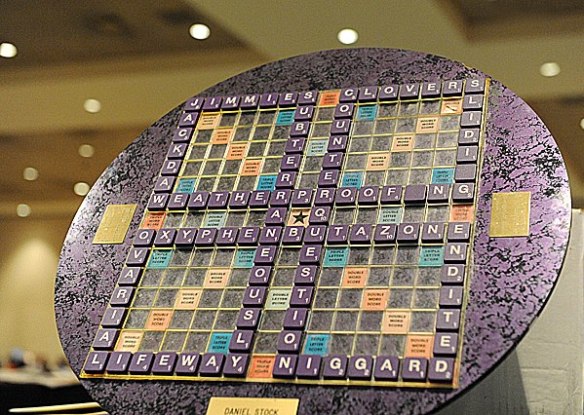
Scrabble-Rousers Change the Game with Shorter Words!

Whether we’re talking Scrabble, Words With Friends, or another word-forming game where points are king, there’s one abiding rule: bigger words are where it’s at.

They reach the bonus squares easier, they offer more slots for new letters in your rack, and there’s always the chance of scoring bonus points for using all your letters.

But as it turns out, bigger words are not the end-all be-all of Scrabble. Between computer analysis of scoring possibilities and the dedicated playtesting of champion-level Scrabblers from across the world, a sea change in gameplay is now underway.

Apparently, studying up on your 5-letter words is far more beneficial than shooting for 6- and 7-letter plays, since most of the bonus squares are four or five letters apart.

And slowly but surely, the formerly dominant North American and European players are losing ground to players from countries like Nigeria, culminating in a win last year for Nigerian Wellington Jighere at the World Scrabble Championship in Australia.

From The Wall Street Journal:

It was the crowning achievement for a nation that boasts more top-200 Scrabble players than any other country, including the U.K., Nigeria’s former colonizer and one of the board game’s legacy powers.

“In other countries they see it as a game,” said Mr. Jighere, now a borderline celebrity and talent scout for one of the world’s few government-backed national programs. “Nigeria is one of the countries where Scrabble is seen as a sport.”

[Image courtesy of The Wall Street Journal and Getty Images.]

And those sportsmen have exploited the West’s reliance on long words by strategically employing smaller words and being more judicious in their use of the letters in their racks.

Whereas Western players would often go for the maximum score every round (using every tile they can), they leave themselves open to bad draws of replacement tiles, which can hamper their efforts in following rounds.

This is considered poor rack management by players like the champion-level Nigerians:

Now, his [Jighere’s] method is changing the game. Champions have studied his defensive style, including his decision to put REPAIR on an S during the final, for 30 points. He could have earned 86, including a 50-point bingo, spelling PEREIRAS. Instead, Mr. Jighere kept an “e” for the next round.

“It’s this sort of strategic thinking that the Nigerians are embracing,” said American Chris Lipe, runner up in the 2014 world championship, who called Mr. Jighere’s performance a Scrabble master class.

It just goes to show you, bigger isn’t always better. (Though vocabulary still wins the day.)


Thanks for visiting PuzzleNation Blog today! Be sure to sign up for our newsletter to stay up-to-date on everything PuzzleNation!

You can also share your pictures with us on Instagram, friend us on Facebook, check us out on TwitterPinterest, and Tumblr, and explore the always-expanding library of PuzzleNation apps and games on our website!

PuzzleNation Product Reviews: Takat and Noueni

In today’s product review, we look at two card games that are all about matching colors, identifying patterns, and scoring points, but in very different ways. Today, we put Takat and Noueni under the PuzzleNation Blog microscope!


Let’s start with Takat.

A card game for 2 to 4 players designed by Tyler Kilgore, Takat is different from most pattern-matching tile games or card games because it’s not about maximizing points…it’s about scoring as few points as possible as you place cards and create different colored shapes on the board.

The game starts with each player secretly drawing a card that reveals that player’s color for this game. Not only are you trying to conceal your color from your opponents, but you’re trying to guess what color they have, based on how they place cards and build shapes on the board.

[Some of the multicolored tiles. There are only two legal plays represented here: the second and third tiles in the top row, and the third tile in both the top and bottom rows.]

The multicolored patterns on the cards allow for all sorts of placement options. When you place a card, you can either neighbor a card on the board or partially overlap it, but you always have to make sure the colors match. If the edge of a card is red and blue, the card you place beside it must also be red and blue.

Since the goal of the game is to score as few points as possible, the strategy quickly becomes a mix of bluffing and deduction. You have to complete shapes in your opponents’ colors without revealing your own. (For instance, if you keep building red, blue, and yellow shapes but not green ones, you’ve told your opponents you’re purposely avoiding green, which will only encourage them to build green shapes and give you more points.)

In this game in progress, the players have mostly avoided completing any shapes; there’s the mostly-round yellow shape on the top right as well as the pointy red shape below it (which is partially formed by two overlapping tiles, unintentionally obscuring the black line at the bottom right of the yellow shape.) Those two are the only shapes completed, which means those shapes are worth more points than shapes that aren’t enclosed by black lines.

But since you can score points on neighboring tiles as well as completed shapes, you have to pay as much attention to who placed a tile as you do to what tile they placed.

For instance, on the bottom left, there’s 2 points for the neighboring red tiles, 3 points for the blue shape above it, and 2 points for the yellow rectangle beside the blue shape, despite none of those shapes being closed by black lines.

The game ends when all cards have been played. Then the players reveal their colors, and the points on the board are tallied up, based on how many shapes were made (and how many were completed), as well as how many cards were used in making each shape. The lowest score wins.

The game play of Takat is pretty easy to pick up, but the scoring is a bit more esoteric and takes some getting used to. It does, however, make for a fun variation on the usual tile-placement scoring game, and as a fan of games like Mafia and other bluffing/concealment games, it does make for a more tense playing experience than your average round of Qwirkle.


Now let’s take a look at Noueni.

Designed by 263 Games, Noueni is also a card game for 2 to 4 players that involves pattern-matching, color-based scoring, and cards that can either overlap or sit next to other cards. But there are some important distinctions between Noueni and Takat.

For example, each player chooses their color at the start of the game, and there’s no attempt to conceal it from your opponents. Also, like many pattern-matching games, highest score wins. In this game, your score is determined by how many of your scoring orbs are on the board by the end of the game.

Each card has two colored scoring orbs and a pattern of black lines emerging from them. Those lines are the connectors, and they determine how the cards placed on the board line up. Any card played must link up with the other cards on the board, whether there’s zero, one, two, or three connectors along that neighboring edge.

As you can see, the green scoring orb on the upper left connects to the red orb by three connections, but the other red orb connects to a yellow orb with only two. So far, there have been no overlapping cards played, so all four players are tied with two scoring orbs showing apiece. (The connections aren’t part of the scoring; they’re just the mechanism for lining up cards.)

A few moves later into the game, the yellow (upper right), red (upper left), and blue (middle) players have all added to the board using those matching connections, but the green player has overlapped half of a blue card, using those connections and obscuring the blue scoring orb.

Overlaps allow you to cover your opponents’ scoring orbs and claim those spots for yourself, but you have to exactly match the connections they left behind. (You can only overlap half of a card already on the board, so even if the green player had a card exactly matching BOTH of the blue card’s connections, that’s an illegal play. The green player could, however, overlap half of one card and half of another, if the connections lined up.)

And that’s where the strategy aspect of Noueni comes into play. It’s a mix of expanding the board and placing as many scoring orbs as possible, but also seizing the opportunity to hide your opponents’ orbs and match those same connection patterns.

The game ends when all cards have been placed, and the player with the most visible scoring orbs wins.

Noueni is more straightforward than Takat, which will make it more accessible to new players, but it also lacks the tension of hiding your color and ferreting out your opponents’ colors. On the flip side, Noueni does maintain that ever-present paranoia that at any point, someone might drop a card on top of yours and steal a key scoring orb at a crucial moment in the game.

Both are terrific games that build on the pattern-matching color tile game format in interesting ways, requiring more from a player than simply outscoring their opponents. You need to outthink them too.

Takat and Noueni are both available from The Game Crafter.


Thanks for visiting PuzzleNation Blog today! Be sure to sign up for our newsletter to stay up-to-date on everything PuzzleNation!

You can also share your pictures with us on Instagram, friend us on Facebook, check us out on TwitterPinterest, and Tumblr, and explore everything PuzzleNation on our website!

PuzzleNation 2015 Holiday Puzzly Gift Guide: By Category

Welcome to the PuzzleNation Blog 2015 Holiday Gift Guide!

We’re overjoyed to have so many tremendously fun and puzzly products to share with you this year. We just might be your one-stop shop for all things puzzly!

This guide is broken down into categories for ease of searching. We have puzzle apps, puzzle books, downloadable puzzles and puzzles by mail, jigsaw puzzles, puzzle games, board games, card games, and party games. We’re sure you’ll find the perfect gift for any puzzler on your list!


Puzzle Apps

Naturally, you’ll forgive us for starting off with a link for a familiar puzzle app!

The Penny Dell Crossword App not only features bundles of terrific puzzle content, but it offers a free daily puzzle to all users! You can check out the full details on the PuzzleNation website!


Puzzle Books

Pencil-and-paper puzzles are alive and well, and we’re happy to share some of our favorites with you.

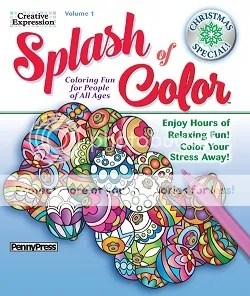


Our friends at Penny Dell Puzzles have put together some outstanding holiday collections with puzzles galore to be solved!

Whether it’s the Colossal Grab-a-Pencil Book of Brain Boosters ($10.50, also available with Logic Puzzles!), the Splash of Color Christmas Special (and its sister title, Flying Colors, both $6.99), the Logic Problems Spectacular collecting more than a hundred brain teasing puzzly challenges ($8.99), or their Super Grab-a-Pencil Pocket series — with a crossword edition (pictured above), a Fill-In editiona Sudoku edition, and a Word Seek edition ($7.95 each) — Penny Dell has you covered.

And be sure to check out their deals on Facebook and Twitter for the entire holiday season. 15% off all sorts of puzzle bundles and books!

And for more specialized puzzle books, some high-level constructors have books of their own for your perusal! With New York Times and Los Angeles Times crosswords to their credit, you’re sure to find some puzzlers within these pages!

–Ian Livengood’s Sit & Solve® Sports Crosswords ($5.95)

–Rich Norris’s A-to-Z Crosswords ($8.95)

–Doug Peterson’s Easy ABC Crosswords ($8.95)

–Jeff Chen’s puzzles for bridge enthusiasts ($12.95)

–Brendan Emmett Quigley’s Sit & Solve® Marching Bands ($5.95) and Diagramless Crosswords ($20.98)

–Patrick Blindauer’s Sit & Solve® Quick-As-A-Wink Crosswords ($5.95) and Wide-Screen Crosswords ($8.95)

–Dale Maron’s Pentdoku Puzzles: Volume 1 ($12.95)

Collins Little Book of Bananagrams

Are you a Bananagrams fan who’s looking for something to give you an edge? The Collins Little Book of Bananagrams might be just what you need! With a list of puzzle words you might not otherwise think of, suggestions for other games to play with Bananagrams tiles, and techniques for speeding up your gameplay, you’re sure to be Top Banana with this handy guide in your pocket. ($9.95)


Downloadable Puzzles and Puzzles by Mail

Many top constructors and organizations market their puzzles directly to solvers, so between by-mail offers and downloadable puzzle bundles, you’ve got plenty of quality choices!

The Uptown Puzzle Club (puzzle bundles by mail) ($35 for 12 issues)

The Crosswords Club (puzzle bundles by mail, available in both regular and large print; $39.95 for 12 issues, $59.95 for large print)

David Steinberg’s Chromatics (color-themed puzzles)

The American Values Crossword (subscription and daily puzzles) ($20 for 1 year)

–Matt Gaffney’s Weekly Crossword Contest ($26 per year)

–Bassey Godwin’s Will Sudoku (PDF puzzle bundle, full review here!) ($10)


Jigsaw Puzzles

Puzzometry

For a next level jigsaw-style challenge, Puzzometry is tough to top. These beautiful pieces can be combined in seemingly endless combinations, and yet, there’s only one solution. Available as Puzzometry ($16), Puzzometry Jr. ($11), and Puzzometry Squares ($16), you’ve got three distinct challenges appropriate for different ages!

[Check out the full review of Puzzometry by clicking here!]

Tavern Puzzles

These hand-forged beauties are ready to challenge your dexterity and cleverness, as you accept the Tavern Puzzles challenge. Whether you’re trying to free your heart from the tangled pieces of Heart’s Desire or remove the ring from the Iron Maiden, you’re sure to put your skills to the test. ($22)


Puzzle Games

These one- and two-player puzzle games are perfect to train your brain and keep you guessing!

Houdini, Gravity Maze, and Laser Maze Jr. (ThinkFun)

ThinkFun meshes learning and gameplay with three logic games ready to challenge kids and adults alike. Whether it’s the ropes and locks challenging nimble fingers in Houdini ($19.99), the marble-dropping path-building of Gravity Maze ($24.99), or the study of optics and mirrors with an actual laser in Laser Maze Jr. ($29.99), young minds and older minds will soon be in fighting trim for puzzling!

[Check out our full product reviews of Houdini by clicking here, Gravity Maze by clicking here, and Laser Maze Jr. by clicking here!]

Word Winder (David L. Hoyt)

Word Winder (also available in app, puzzle book, and GIANT versions!) is a game of finding chains of hidden words in an ever-changeable grid! Put your strategy and spelling skills to the test! ($19.95)


Board Games

Some of the puzzliest games on the market today are being made by top-flight board game companies, and we’ve got some marvelous games that will appeal to puzzlers of all ages!

Stuff and Nonsense (Cheapass Games)

Many games are about grand adventures, but only Stuff and Nonsense is about pretending to go on grand adventures while scamming your fellow would-be adventurers. Can you sneak around London and gather the props you need for your impressive lie, all while avoiding the fiendishly clever Professor Elemental? Great fun and quick to learn. ($25)

[To check out the full review of Stuff and Nonsense, click here!]

Castellan (Steve Jackson Games)

Build a castle and then occupy it in Castellan, a game of strategy and opportunity. With great modeled pieces that really add to the aesthetic, Castellan has style and substance. ($34.95)

[Check out our full product review here!]

Zip It (Bananagrams)

Bananagrams is already pretty travel-sized, but if you’re looking for a game you can play on an airplane tray table, you need to check out Zip It. This 24-cube game works on Bananagrams rules AND allows you to use the carrying case to keep score! For puzzling in your pocket, you can’t go wrong. ($12.99)

Tsuro: The Game of the Path (Calliope Games)

A path-laying game with tons of style and historical spirit, Tsuro casts up to eight players as flying dragons, and tasks you with laying out your path with special tiles. Your goal is to avoid meeting another dragon or flying off the board. It’s a simple mechanic with plenty of replay value, and perfect for quick games with large groups. ($29.99)

Walk-By Scrabble Board, Lexicographer’s Extended Scrabble, and Drawing Room Scrabble (Hammacher Schlemmer)

Hammacher Schlemmer has several Scrabble variants available, including the Lexicographer’s Extended Scrabble for those with mega-syllabic ambitions ($29.95) and Drawing Room Scrabble for those with swankier taste ($149.95) — not to mention the mindboggling World’s Largest Scrabble Game for $12,000! — but few are as clever or as convenient as the Walk-By Scrabble Board! Designed as a family game for people on the go, it’s a perfect way to bring back Board Game Night for busy families! ($29.95)

[Check out our full product review of the Walk-By Scrabble Board here!]

Qwirkle (MindWare)

A wonderful mix of Uno and Mexican Train Dominoes, Qwirkle is all about placing your tiles to maximize points and minimize helping your opponents. With six bright colors and six different shapes to match up, Qwirkle is endless fun that’s so easy to jump right into! ($34.99)

Tak•tak (Twizmo Games)

If you’re looking for a game that combines the strategy of chess and the mechanics of Upwords, Tak•tak is right up your alley. Score points by stacking and attacking your opponent’s pieces in this game that’s more than meets the eye! ($18.95)

[Check out our full product review of Tak•tak by clicking here!]


Card Games

These card games add a bit of friendly competition to some splendid strategizing for puzzlers of all sorts!

Pairs (Hip Pocket Games)

A simple card game with a lot of strategy behind it, Pairs is about NOT scoring points and avoiding pairing your cards at all costs. With new deck styles arriving all the time — like the Goddesses of Cuisine deck and the Lord of the Fries deck — complete with numerous variant games available, Pairs is a perfect group card game you can pick up quickly. ($10)

Give Me the Brain (Cheapass Games)

In this revamped version of a lesser-known classic, you and your fellow players are zombies running a fast food joint, competing to complete your tasks first. Unfortunately, there’s only one brain for all of you to share. A mix of strategy and luck, Give Me the Brain is the most fun you can having working in fast food, undead or not! ($25)

[Review coming soon!]

The Stars Are Right (Steve Jackson Games)

Build an army of followers and change the stars themselves in The Stars Are Right, a thoroughly enjoyable card game where the goal is summoning an elder god and destroying the world. As you do. ($27.95)

[Check out our full product review here!]

Batman Fluxx, Retro Loonacy, and Just Desserts (Looney Labs)

The folks at Looney Labs are all about games where the rules can change in an instant. They’ve broadened their library of Fluxx card decks with a marvelous Batman-fueled version ($20), as well as putting a new twist on their fast-play matching game with Retro Loonacy ($15)! Plus, you can always put your culinary skills to the test in the deliciously busy Just Desserts! ($18)

[Check out our full product reviews of Batman Fluxx here, Retro Loonacy here, and Just Desserts here, plus reviews for Adventure Time Fluxx and Fluxx Dice here!]

Timeline (Asmodee Games)

Timeline pits your knowledge of history against a growing timeline of important events, inventions, and historical moments. You don’t have to know exact dates; you just need to know if something happened before OR after something else. Was the toothbrush invented before or after the syringe? Which came first, language or agriculture? Timeline is a fast, fun way of learning (or relearning) history! ($14.99)

Adorable Pandaring (Asmadi Games)

We can all agree that pandas are adorable, but in Adorable Pandaring, you only earn points if your pandas are adorable, so you need to change the rules to favor the pandas in your hand. This game might have some mighty cute art, but don’t be fooled — it is all about timing and strategy. ($12)

[Check out the full review of Adorable Pandaring by clicking here!]

Compose Yourself (ThinkFun)

For a card game that’s marvelously musically different, try your hand at Compose Yourself. It’s designed to teach people of all ages the magic of music, and you can use the cards included to compose your own pieces, performed by an actual orchestra! I sincerely doubt you’ve ever seen — or heard — anything like it. ($14.99)

[Check out the full review of Compose Yourself by clicking here!]


Party Games

Some puzzles are best enjoyed in groups, so here are a few fun options for party puzzling!

Schmovie (Galactic Sneeze)

Are you the funniest, punniest one in your group of friends? Find out by playing Schmovie, the party game that pushes you to scribble down the best name for an imaginary movie created on the spot! Now redesigned in a sleeker box and playable by all ages, this is the movie game for everyone. ($19.95)

[Check out our full product review of the original version of Schmovie here!]

ROFL! (Cryptozoic)

Challenge your friends to decode famous movie lines, catchphrases, and song lyrics in Cryptozoic’s game ROFL!, created by Dork Tower‘s John Kovalic! Put your texting and abbreviation skills to the test in this laugh-out-loud party treat! ($35)

[Check out our full product review here!]


Thank you to all of the constructors, designers, and companies taking part in our holiday gift guide!

Thanks for visiting PuzzleNation Blog today! Be sure to sign up for our newsletter to stay up-to-date on everything PuzzleNation!

You can also share your pictures with us on Instagram, friend us on Facebook, check us out on TwitterPinterest, and Tumblr, and explore the always-expanding library of PuzzleNation apps and games on our website!