Justice For Snow! (The 2025 Toy Hall of Fame Inductees Revealed)

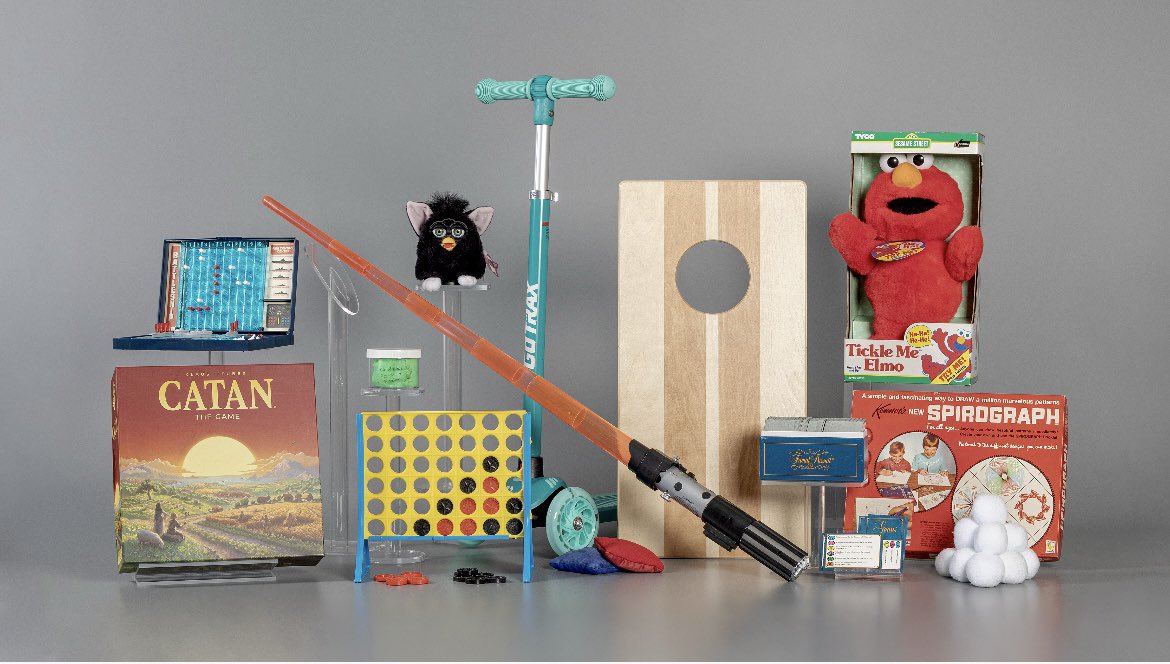
Back in September, I wrote about the 12 nominees for this year’s class of The National Toy Hall of Fame: Furby, spirograph, Star Wars lightsaber, Tickle Me Elmo, scooter, cornhole, Battleship, Catan, Connect Four, Trivial Pursuit, slime, and snow.

I predicted that Catan, Connect Four, and Tickle Me Elmo would win. And I was wrong, as none of those three were selected to join the Toy Hall of Fame.

But I was hoping that the lightsaber, snow, and Trivial Pursuit would make the cut, as they were my personal nominees for this year’s class.

And I did get one of them right!

Battleship, slime, and Trivial Pursuit were the 2025 class for the National Toy Hall of Fame, where they will join all the other inductees on display at The Strong National Museum of Play.

That being said, please allow me to get up on my soapbox for a moment.

How is snow not already in the National Toy Hall of Fame?

It’s not like natural items haven’t made the cut in the past. The stick is already in. And you’re telling me that snow — a free toy that falls from the sky AND CREATES ENTIRE DAYS FREE OF SCHOOL IN WHICH TO PLAY — is not a Hall of Famer?

Blasphemy. Battleship can’t create days off.

And so, fellow puzzlers and players and appreciators of all things play, I ask you on this day to join me in my new movement.

#JusticeForSnow

Oh yes, I’ve already started the hashtag in my reply to the announcement of this year’s inductees. And it’s just the beginning. I intend to correct this injustice with all of the influence I can bring to bear. (Please note, that amount of influence is minuscule, as The Strong National Museum of Play has refused to return my calls on several occasions.)

But I shall not be deterred!

Will you join me on this glorious endeavor? Or has the whimsy and wonder of playing with snow been whittled away by years of shoveling driveways clear or stepping in slushy puddles on the way to work?

I tell you, friends, my whimsy has not abated in the slightest. I can remember staring out the window with my dad, watching wet snow cling to the trees, as if they were painted just so, picture perfect for Christmas card art, right in front of us. And despite the fact that we knew it would royally suck to shovel that snow later, we still smiled as we watched it accumulate.

So, National Toy Hall of Fame, better make some room on next year’s ballot. It’s gonna be snow’s time to shine.


The National Toy Hall of Fame Finalists Are Here! Still Time to Vote!

This year’s contenders for the National Toy Hall of Fame Class of 2025 have been whittled down to 12 finalists, and the competition is fierce.

You’ve got classic toys from across the decades (Furby, spirograph, Star Wars lightsaber, Tickle Me Elmo), representatives from more physical activities (scooter, cornhole), board games (Battleship, Catan, Connect Four, and Trivial Pursuit), and even materials kids play with (slime, snow).

The idea of “play” is represented in so many different ways across these 12 finalists, and it really encompasses just how vast and varied play is, how much imagination and expression and creativity are reflected in all sorts of different childhood experiences.

Personally, I’m rooting for the lightsaber, Trivial Pursuit, and snow to make the cut. I’ve been a Star Wars fan since I was 2. Trivial Pursuit was the first trivia game I can remember playing (even if it was an edition intended for players way older than I was at the time). And snow is so fundamental to winter play — sledding, snowmen, snowball fights, DAYS OFF FROM SCHOOL TO PLAY — that it’s surprising it hasn’t already been inducted.

(Though I suspect Catan, Connect Four, and Tickle Me Elmo will make the cut instead of some of my faves.)

And voting is still open for another day.

Yes, while the final determinations are made by the National Toy Hall of Fame’s National Selection Advisory Committee — ooh, so formal! — the three toys that receive the most public votes will be submitted for consideration alongside the top three submissions from the Selection Committee.

Which of these twelve contenders would you like to see join such playtime luminaries as Lite-Brite, My Little Pony, the stick, the Atari 2600, and the Rubik’s Cube? Let me know in the comments section below! I’d love to hear from you.

And while you’re at it, tell me what toys you think should be in the National Toy Hall of Fame!

The 2025 Conference on BIPOC Game Studies

The 2025 Conference on BIPOC Game Studies convened this past weekend, bringing together students, game designers, college professors, and influential names in the games industry. It was organized in part by the Strong National Museum of Play in Rochester, New York.

The goal? To share research, showcase games, and discuss the future of game studies through the lens of BIPOC experiences (Black, Indigenous, and People of Color).

Here is a bullet point list of themes the conference was designed to explore:

  • Representation and Identity in Video Games
  • Digital & Analog Games as Cultural Artifact
  • Games By & About Black and Indigenous Communities
  • Decolonizing Game Development & Design
  • Integration of Indigenous & Black Knowledge Systems
  • Afrofuturism in Gaming
  • Cultural Preservation & Digital Heritage
  • Social Impact & Activism Through Games
  • Diversity, Equity & Inclusion in Playful Technologies

Both board games and video games were topics of discussion across the three-day event, with panels and presentations covering properties as varied as Yu-Gi-Oh!, collegiate Esports, The Last of Us, murder mystery games, Dragon Age, virtual reality, the cultural value of arcades, and more.

Lindsay Grace, co-chair of the Conference and Knight chair in Interactive Media at the University of Miami, eloquently explained to WXXI News why this conference was not just necessary, but invaluable:

“I think one of the most important things to recognize about games is that they are kind of a cultural artifact. And being a cultural artifact, it’s important to ask questions about what these things mean in society, or what these things mean to the people who make them.”

“… One of the things I think is really interesting in game studies is we have the opportunity to think critically about the kinds of problems we’re solving and then also the kinds of solutions we’re offering. So a lot of what people talk about in, say, decolonizing games is about reinvestigating those two questions, what’s the real problem here? What’s the source of that problem? Similarly, how are we solving the problem?”

For years, I have discussed in this blog how the world of puzzles and games not only reflects our culture and choices, but why that’s important. But I can only examine those things through one particular lens, that of a white cishet male. There are blindspots I’m unaware of and experiences I simply don’t have, despite my best efforts.

That’s why it’s so important to have other voices included in the discussion, and events like this are crucial to the health of the games industry and our understanding of why we play games at all.

While I wasn’t in attendance, I have read through the various studies and papers associated with the conference, trying to better educate myself on these topics.

And the topics presented are fascinating.

How the experiences of Black users suffer in virtual reality due to whiteness as a default in so many games.

How the roles of Black and Latinx characters in games like Overwatch and Marvel Rivals contribute to not just representation, but reinforce perceptions of particular ethnic groups only in violent situations, not those of support or providing nonviolent solutions.

How video games are being used to preserve Latinx culture and the artistic legacy of the Hmong.

I learned about topics like Quare Theory and Misogynoir (how racist and anti-Black depictions affect the public perception of Black women), explained through the medium of video games.

But the article I found myself returning to several times over the last few days was “Decolonizing Play: Exploring Frameworks for Game Design Free of Colonial Values.”

It was startling to realize just how many video games are foundationally built on the values of Colonialism, and how easy it would be to NOT reinforce those harmful cyclical patterns.

From the paper by Elaine Gomez: When the topic of colonization arises, many game developers often hesitate to get involved in meaningful and constructive design conversations around how to mitigate values that are heavily ingrained in game theory and player expectations.

Some of the conversations broached by these panels and papers are uncomfortable, but difficult conversations are worth having. Challenging the biases and preconceived notions that games are often built upon is worthwhile. (I’m hoping to reach out to some of the Conference’s participants for more details in the coming weeks to follow up on these enlightening discussions.)

In the meantime, I encourage everyone to read the proceedings from the event and take some time to really ponder the topics presented.

The world of puzzles and games is big enough for everyone, and only gets better when everyone feels included. The 2025 Conference on BIPOC Game Studies is proof of that.

Happy gaming, everyone.

The First Viral Handheld Puzzle Game?

It’s fair to say that PuzzleNation knows a little something about the world of mobile puzzling. Mobile apps are our bread and butter, after all, and whether you’re talking about our Daily POP Crosswords App or the Penny Dell Crosswords App, we are connoisseurs of puzzles that fit in your pocket.

Of course, puzzle apps are a relatively new addition to the genre. Mobile puzzles, like matchstick puzzles, have existed for centuries.

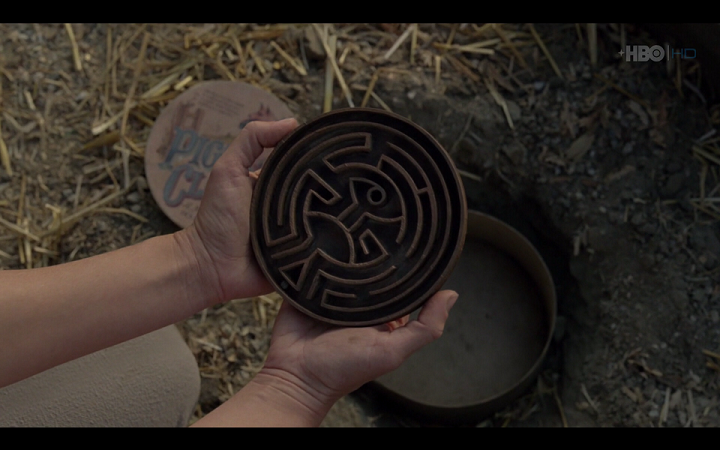
In fact, more than a hundred years ago, a mobile puzzle game went “viral” and became a cultural sensation. (And it has made a recent return to prominence thanks to the HBO drama Westworld.)

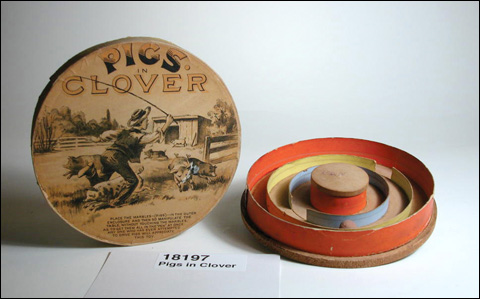
Today, let’s talk about Pigs in Clover.

Pigs in Clover is a ball-in-a-maze puzzle invented in 1899 by toymaker Charles Martin Crandall. Although puzzle historians aren’t sure if Pigs in Clover was the first ball-in-a-maze puzzle created, it was definitely the first to capture the imagination of consumers.

You’ve probably solved a ball-in-a-maze puzzle at some point in your life. From the flat disc and labyrinth-inspired models to spherical and more complicated three-dimensional versions, they’re a fun test of both dexterity and strategic thinking.

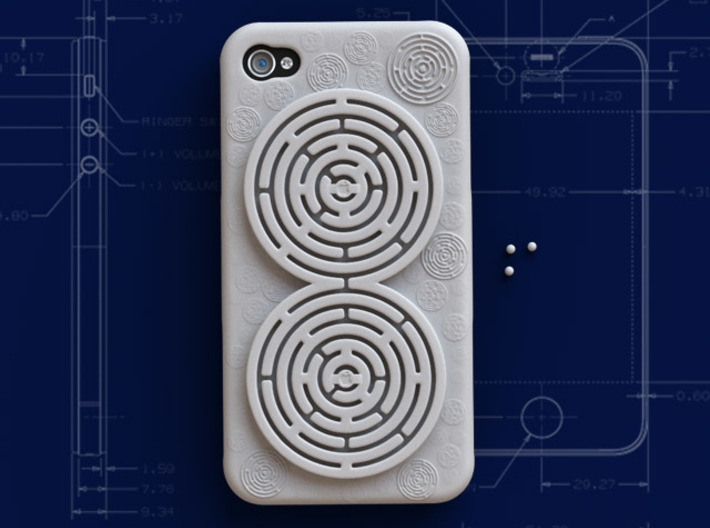
A quick Google image search turns up dozens of variations on the concept, including an iPhone case with two ball-in-a-maze puzzles built into it!

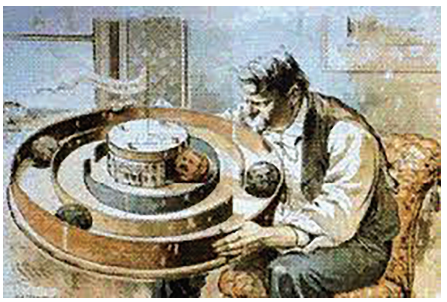
Pigs in Clover was a simpler design, involving only three rings and a center “pen” to herd the “pigs” into. But it’s one that was supposedly so popular upon launch in January of 1889, it impacted the actual operation of the U.S. government.

But how popular was “popular” in 1889?

Well, according to the Waverly Free Press, “The toy works are turning out eight thousand of ‘Pigs in Clover’ a day, and are twenty days behind with their orders.” According to some sources, over a million games were sold by late April 1889!

And one of those games found its way into the hands of William M. Evarts, senator from New York. Depending on the version of events you read, he purchased a copy of Pigs in Clover from either a street vendor or, curiously, an aggressive street fakir.

He then took it home and played with it for hours. At work the next day — and by work, I mean the Senate of the United States — another senator, George Graham Vest, borrowed it and went to the cloak room to try to solve the puzzle game.

Yes, a sitting U.S. senator went and hid in the coats to play this game. It’s sorta like hiding under all the coats at a Christmas party and playing Angry Birds, except in fancier clothing.

Oddly enough, Vest was soon joined in the cloak room by four other senators — Pugh, Eustis, Walthall, and Kenna — who were also interested in trying their hands at the popular game. Apparently, they were too impatient to share Evarts’ copy of the game, since a page was enlisted to go out and buy five more copies of Pigs in Clover for the distracted senators.

Once each had his own game in hand, they engaged in a pig-driving contest. It must’ve been harder than it looks, since it took Vest 30 minutes to herd all of his pigs into the pen.

Yup, at least half an hour of senate business was derailed by a few little metal balls in a cardboard maze. Amazing.

Naturally, the story got out, and a political cartoon in the New York World on March 17th commented on this peculiar delay in President Benjamin Harrison’s agenda, likening the political landscape to the game. With the White House as the pen and various lawmakers as the pigs, the cartoon asked, “Will Mr. Harrison be able to get all these hungry pigs in the official pen?”

It makes you wonder just how many man-hours were lost to Pigs in Clover! After all, a simple game — solved by many — can prove costly.

Remember the Google Doodle in 2010 that allowed you to play Pac-Man? It’s estimated it cost $120 million dollars, and nearly five million hours, in terms of productivity.

Sounds like President Harrison should count himself lucky it was just a half-dozen senators… as far as we know.

[Sources for this article: The Strong Museum of Play, Eli Whitney Museum and Workshop, Le Roy Historical Society, Antique Toy Collectors of America, Wikipedia, and A History of Video Games in 64 Objects.]


Thanks for visiting PuzzleNation Blog today! Be sure to sign up for our newsletter to stay up-to-date on everything PuzzleNation!

You can also share your pictures with us on Instagram, friend us on Facebook, check us out on TwitterPinterest, and Tumblr, and explore the always-expanding library of PuzzleNation apps and games on our website!

It’s Follow-Up Friday: Hall of Fame edition!

Welcome to Follow-Up Friday!

Follow-Up Friday is a chance for us to revisit the subjects of previous posts and bring the PuzzleNation audience up to speed on all things puzzly.

And today, I’d like to return to the subject of Dungeons & Dragons!

I’ve written about Dungeons & Dragons and other roleplaying games in the past, because I think they are a wonderful, underappreciated part of the world of puzzles and games. Some of the best and most satisfying riddles and puzzles I’ve ever solved were an integral part of a game of D&D.

So I’m excited to announce that Dungeons & Dragons has been inducted into the National Toy Hall of Fame!

Housed at The Strong National Museum of Play, the National Toy Hall of Fame recognizes those products and improvised toys that have played a crucial role in the development of children and teens.

Whether they assist in hand-eye coordination, storytelling, deduction, athletics, or creativity, they are all classic examples of toys tied to fond memories of childhood. Previous inductees include the Rubik’s Cube (2014), Hot Wheels (2011), the Radio Flyer Wagon (1999), Jacks (2000), and Play-Doh (1998).

And I for one think Dungeons & Dragons is a very worthy addition to this club.

From the induction notice:

Dungeons & Dragons and its imitators actually changed the nature of play.

In Dungeons & Dragons players assume the roles of characters who inhabit a world moderated and narrated by a Dungeon Master, a player who explains the action to others and solicits their reactions to the unfolding story. The Dungeon Master’s storytelling skills and the players’ abilities to imagine add enjoyment to the game. Some aspects of the play are familiar, such as dice. But the special dice for Dungeons & Dragons hold up to 20 sides. Rolling them determines each character’s individual strengths, plots their complex interactions, and decides the outcome of their encounters.

More than any other game, Dungeons & Dragons paved the way for older children and adults to experience imaginative play. It was groundbreaking. And it opened the door for other kinds of table games that borrow many of its unique mechanics.

For over forty years, Dungeons & Dragons has been synonymous with roleplaying, collaborative storytelling, and good old-fashioned sword-swinging derring-do. And I think it’s fantastic that it’s getting some long-overdue recognition for the positive role it has played in so many people’s lives.

Congratulations to you, Dave Arneson and Gary Gygax. Thank you for hours and hours of brilliant, engaging fun.


Thanks for visiting PuzzleNation Blog today! Be sure to sign up for our newsletter to stay up-to-date on everything PuzzleNation!

You can also share your pictures with us on Instagram, friend us on Facebook, check us out on TwitterPinterest, and Tumblr, and explore the always-expanding library of PuzzleNation apps and games on our website!